What Are Pro Rata Rights?
Turn this article into takeaways for your work.


Each assistant summarizes the article only for you and suggests best practices for your work.
Pro rata rights are a contractual right that lets an existing investor buy a share of the company's future financing rounds, in proportion to what they already own, so their ownership percentage doesn't shrink as new shares are issued. Y Combinator defines the right as the right, not the obligation, for an investor to invest money into a startup's future priced round to maintain their percentage ownership. You'll also hear them called preemptive rights or a participation right. In the standard US venture documents the wording is a "right of first offer."
For founders, the term matters because it shapes who can fill a future round. An investor with pro rata rights has first call on part of the allocation, before a new lead sees a dollar of it. For a new lead investor, it matters for the opposite reason: some of the round may already be spoken for.
This is reference material, not legal advice. Terms vary by jurisdiction and by deal, and anyone signing these documents should have counsel review them.
How Pro Rata Rights Work
Every time a company sells new shares, existing holders own a smaller slice. That's equity dilution, and it's normal. Pro rata rights give an investor the option to offset it by buying part of the new round at the same price and terms as everyone else.
The investor's entitlement is tied to their ownership. A startup-law blog by Yokum Taku of Startup Company Lawyer describes the standard formula (in a 2007 post) as the ratio of the investor's preferred shares, counted on an as-converted basis, to the company's fully diluted capitalization. In plain terms: if you own 10% of the company, you can buy 10% of the new shares being sold.
Two details are easy to miss:
- It's an option, not an obligation. The investor decides at the time of the round whether to write the check.
- It buys, it doesn't give. Exercising the right costs real money at the new round's price. It protects the percentage, not the value of the earlier investment.
A Worked Example
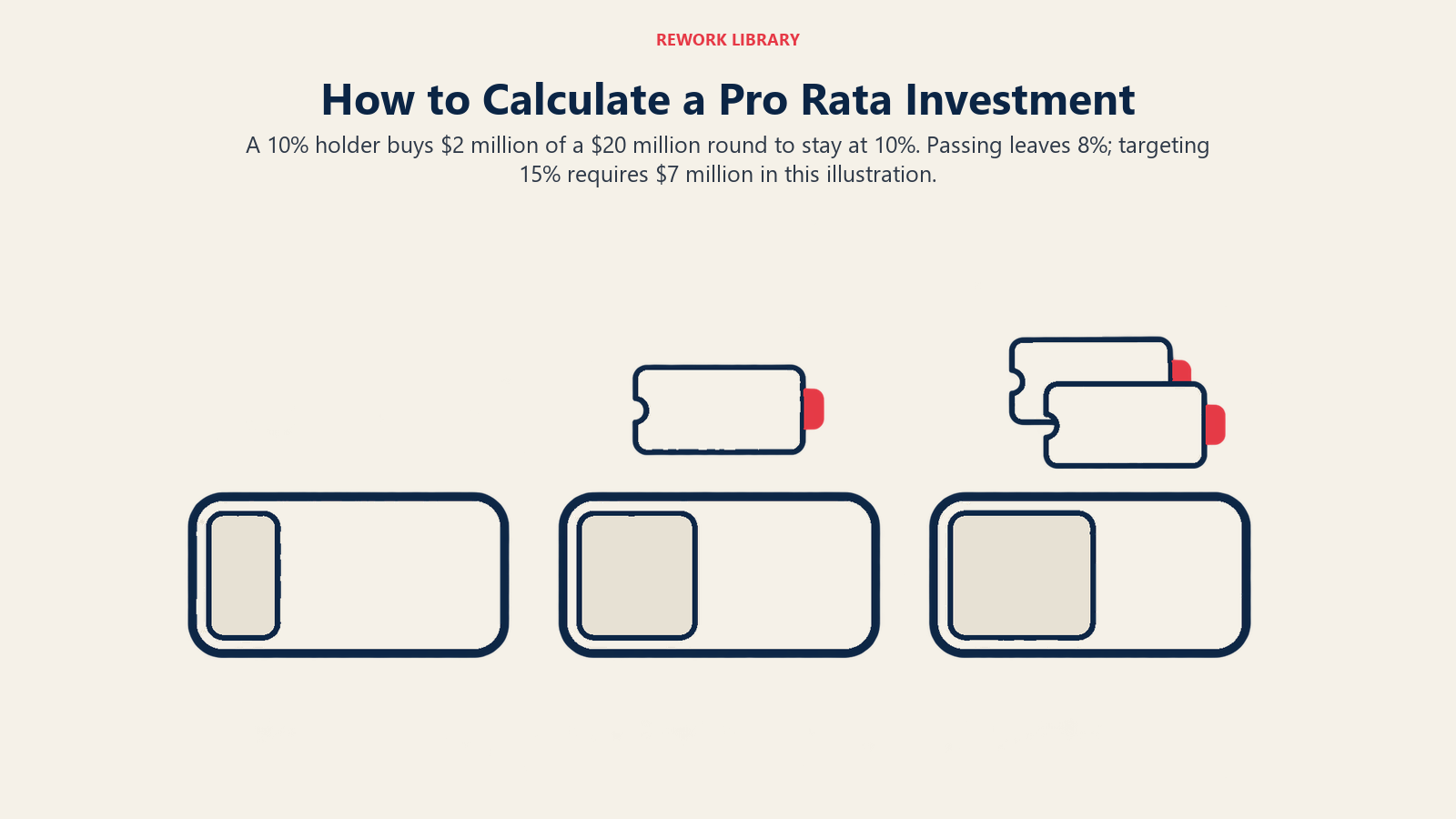
The figures below are illustrative, not drawn from any real company or study. Assume an investor owns 10% of a startup after a Series A. The company then raises a $20M Series B at an $80M pre-money valuation, which makes the post-money valuation $100M. New investors therefore receive 20% of the company ($20M of $100M).
| Scenario | Investor's stake after Series B | How |
|---|---|---|
| Investor passes | 8% | 10% x (1 - 20%) = 8%, diluted by the new shares |
| Investor takes full pro rata | 10% | Buys 10% of the $20M round: $2M, worth 2% of a $100M company |
| Super pro rata, targeting 15% | 15% | Needs 7 more points of a $100M company: $7M, or 35% of the round |
The check for the full pro rata is $2M because 2% of $100M is $2M, and 8% + 2% gets back to 10%. The same arithmetic shows the cost of passing: the investor holds 8%, and a founder who held 50% before the round holds 40%, whether or not the investor participates. What the investor's choice changes is who owns the other shares. If they pass, the $2M goes to someone else.
Key Facts: Pro Rata Rights
- A right, not an obligation, to buy a share of a future round to keep your ownership percentage.
- Usually sized as the investor's as-converted ownership divided by fully diluted shares, applied to the new securities.
- In US venture deals it normally sits in the Investors' Rights Agreement, often limited to "major investors."
- With a SAFE, Y Combinator keeps pro rata rights out of the SAFE and offers an optional side letter instead.
- Illustration: a 10% holder in a $20M round at an $80M pre-money buys $2M to stay at 10%. Passing leaves them at 8%.
- Super pro rata rights go beyond maintenance, letting an investor increase their stake.
Where Pro Rata Rights Are Written
In a priced round. In US venture deals the right is commonly written into the Investors' Rights Agreement (IRA), one of the standard documents signed with the financing, though the exact home varies by deal. The National Venture Capital Association publishes model legal documents, including the Investors' Rights Agreement (listed there as updated October 2025), which US deals commonly use as a starting point. The NVCA page lists the document; the detailed wording is in the model itself, and real deals depart from it, so the signed agreement controls.
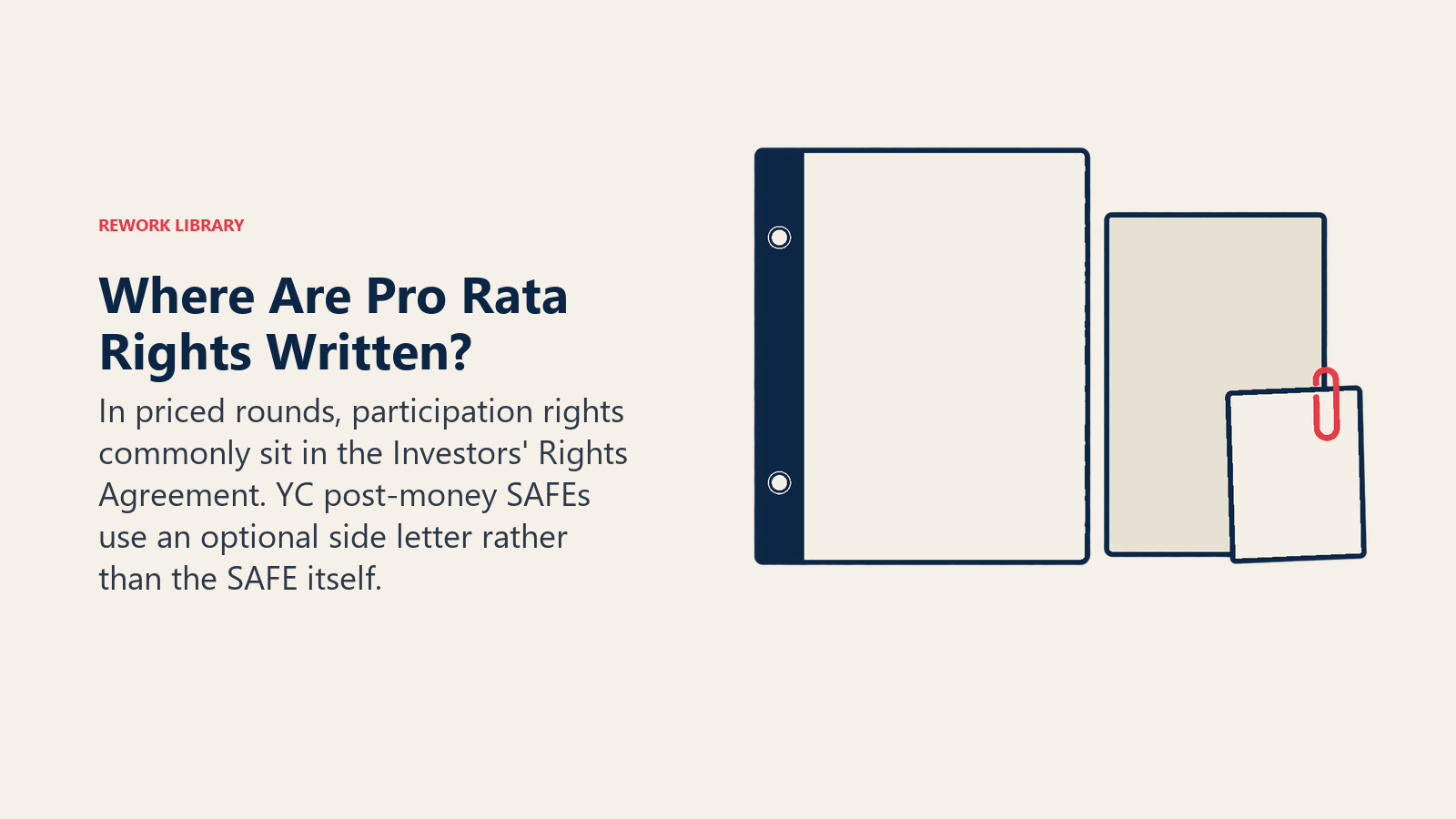
With a SAFE. Y Combinator's post-money SAFE doesn't include a pro rata right. The YC documents page says pro rata rights live in an optional, standardized side letter rather than in the SAFE itself. A founder who signs the side letter gives that SAFE investor the right to buy into the priced round the SAFE converts into. Founders using a convertible note or a custom instrument need to read whether the right is there at all.
Who Gets the Right: Major Investor Thresholds
Companies rarely give pro rata rights to everyone, because dozens of small holders would each be able to claim part of every round. The usual fix is a "major investor" definition. The Startup Company Lawyer post says the right is typically limited to major investors holding a minimum share threshold, set low enough that the smallest venture fund or significant angel in a syndicate qualifies, and high enough to exclude numerous small shareholders.
CRV, a venture firm, writes on its site that the NVCA standard ties pro rata to investors holding one to two percent of fully diluted equity. That's one investor's description, so treat 1% to 2% as a rough pattern rather than a rule. The actual cutoff is a negotiated number, often expressed as a share count or an investment amount. An angel investor who writes a small early check can easily fall under it.
Super Pro Rata Rights
Standard pro rata maintains a percentage. Super pro rata lets an investor buy more than their share, so their ownership goes up. In the example above, the 15% target costs $7M of a $20M round, 3.5 times the $2M a standard right would allow.
CRV's guidance on this is blunt: it says to approach super pro rata carefully, because the provisions can severely constrain a company's ability to bring in new investors. That's attributed opinion from one firm, but the mechanics support it: every dollar reserved for a super pro rata holder is a dollar a new lead can't take.
Why Founders and New Leads Care: Round Crowding
A round has a fixed size. If existing investors with pro rata rights take their full allocation, less is left for new investors, and the incoming lead may be asked to take a smaller piece than they wanted.
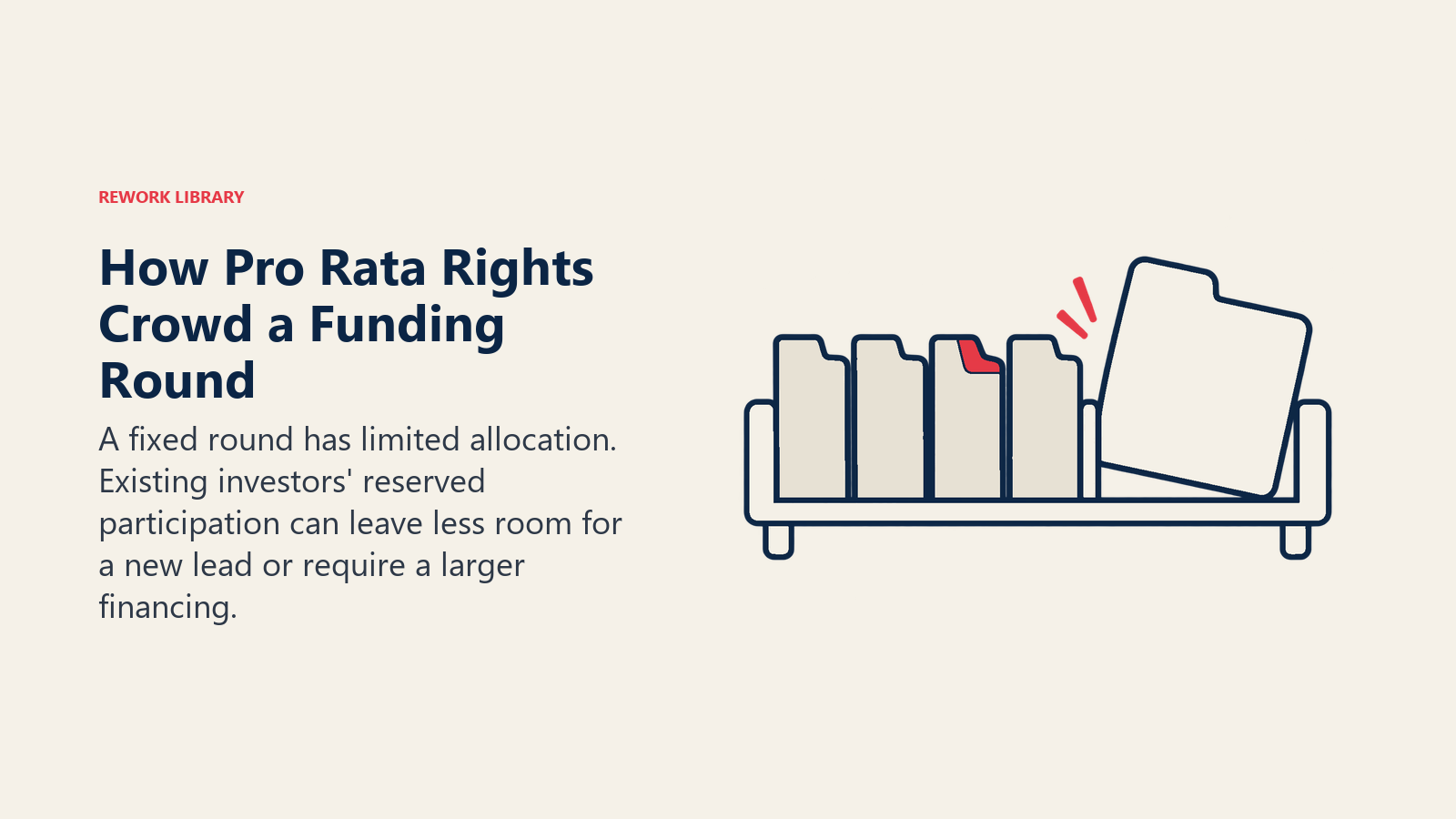
- For founders: Existing investors' pro rata can be a vote of confidence. It can also squeeze out a new investor who would add expertise or a better price.
- For a new lead: Ask early how much of the round is already committed to existing holders. A lead wanting a target stake may need a larger round or may decline.
- For the process: Notice periods slow things down. The Startup Company Lawyer post notes that if some investors don't fully participate, other rights holders may get an over-allotment option on the unsubscribed shares, which can delay closing.
CRV's recommendations for founders include granting rights to major investors only, giving complete pro rata to the lead, and adding time or round limits so the right doesn't run forever. These are one firm's views, and your counsel may see it differently.
What Happens When Investors Don't Exercise
If an investor skips their allocation, three things typically follow, depending on the documents:
- The shares are freed up. The company can sell them to new investors or other rights holders, sometimes through the over-allotment option described above.
- The investor is diluted normally. In the example, they end up at 8% instead of 10%.
- The right may or may not survive. Some agreements keep the right for future rounds. Others, particularly where counsel has negotiated round limits, end it. Check the wording, and note that a pattern of passing in follow-on rounds can leave an investor with less influence later.
Relation to Dilution and Anti-Dilution
Pro rata rights and anti-dilution protection are often confused, but they work differently.
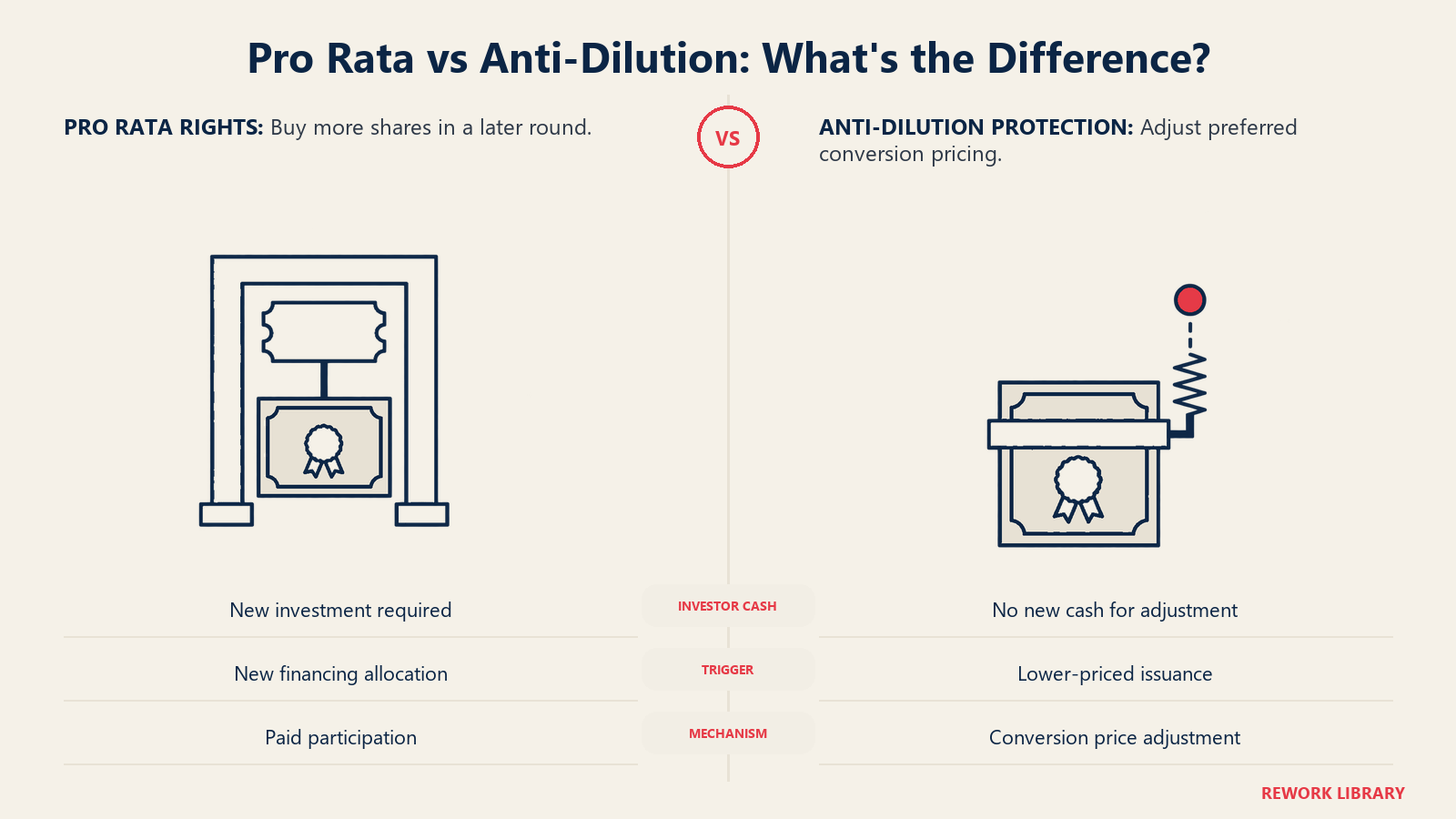
- Pro rata rights let the investor pay to avoid dilution. They cost money.
- Anti-dilution protection adjusts the investor's conversion price if the company later sells shares at a lower price. It's most relevant in a down round. It costs the investor nothing, and the founders absorb the effect.
An investor can have either one, both or neither. Founders modeling a future round should check how both affect the cap table, including the employee option pool, because a larger allocation to existing investors can mean a larger share of dilution lands on common holders.
Common Mistakes
- Granting it too broadly. Giving every small investor the right can make every future round slow to close.
- Ignoring super pro rata. A one-line addition to a side letter or term sheet can reserve a large part of later rounds.
- Forgetting the SAFE side letter. Signing the optional YC side letter creates the right even though the SAFE itself doesn't.
- Not modeling the check. Investors should reserve capital for follow-ons, and founders should know which holders are likely to use theirs.
Frequently Asked Questions about Pro Rata Rights
What does pro rata mean in venture capital?
It means in proportion to ownership. A pro rata right lets an investor buy the same share of a future round as the share of the company they already own, so a 10% holder can buy 10% of the new shares and keep their stake from falling.
Are pro rata rights automatic?
No. They have to be written into a contract, usually the Investors' Rights Agreement in a priced round or, with a YC SAFE, an optional side letter. Y Combinator's SAFE does not include the right on its own.
What is a major investor?
It's a defined term that limits which investors get pro rata rights, usually by a minimum shareholding or investment amount. One venture firm describes the NVCA standard as one to two percent of fully diluted equity, but the exact threshold is negotiated in each deal.
What is super pro rata?
It's a right to buy more than your proportional share, so your ownership increases instead of just holding. It can crowd out new investors, so founders usually treat it with caution.
Do pro rata rights prevent dilution?
Only for the investor who pays. Exercising the right keeps that investor's percentage steady, but the founders are still diluted by the new shares. Anti-dilution protection is a different mechanism that adjusts price after a down round.
What if an investor doesn't use their pro rata right?
The unsold shares can go to new investors or other rights holders, and the investor's stake is diluted as normal. Whether they keep the right for later rounds depends on the documents.
Related Reading