What Is Dilution? How Funding Rounds Change Ownership
Turn this article into takeaways for your work.


Each assistant summarizes the article only for you and suggests best practices for your work.
Dilution is the reduction in an existing shareholder's ownership percentage that happens when a company issues new shares. Your shares don't disappear and you haven't sold anything. The company simply has more shares outstanding, so the same number of shares is a smaller slice of a bigger total.
Founders often hear "dilution" as a loss. It isn't automatically one. Owning 20% of a company worth ten times more beats owning 60% of the smaller one. The real question each time shares are issued is whether the new money, hires or deals make the remaining slice worth more than the old one was.
This article covers the formula, the main sources of dilution, a worked example from founding to Series A, how ownership differs from value, and the protections investors use to limit their own dilution. It's reference material, not legal or tax advice. Terms vary by jurisdiction and by deal, so have counsel review any financing documents.
The Dilution Formula
Ownership is simple division:
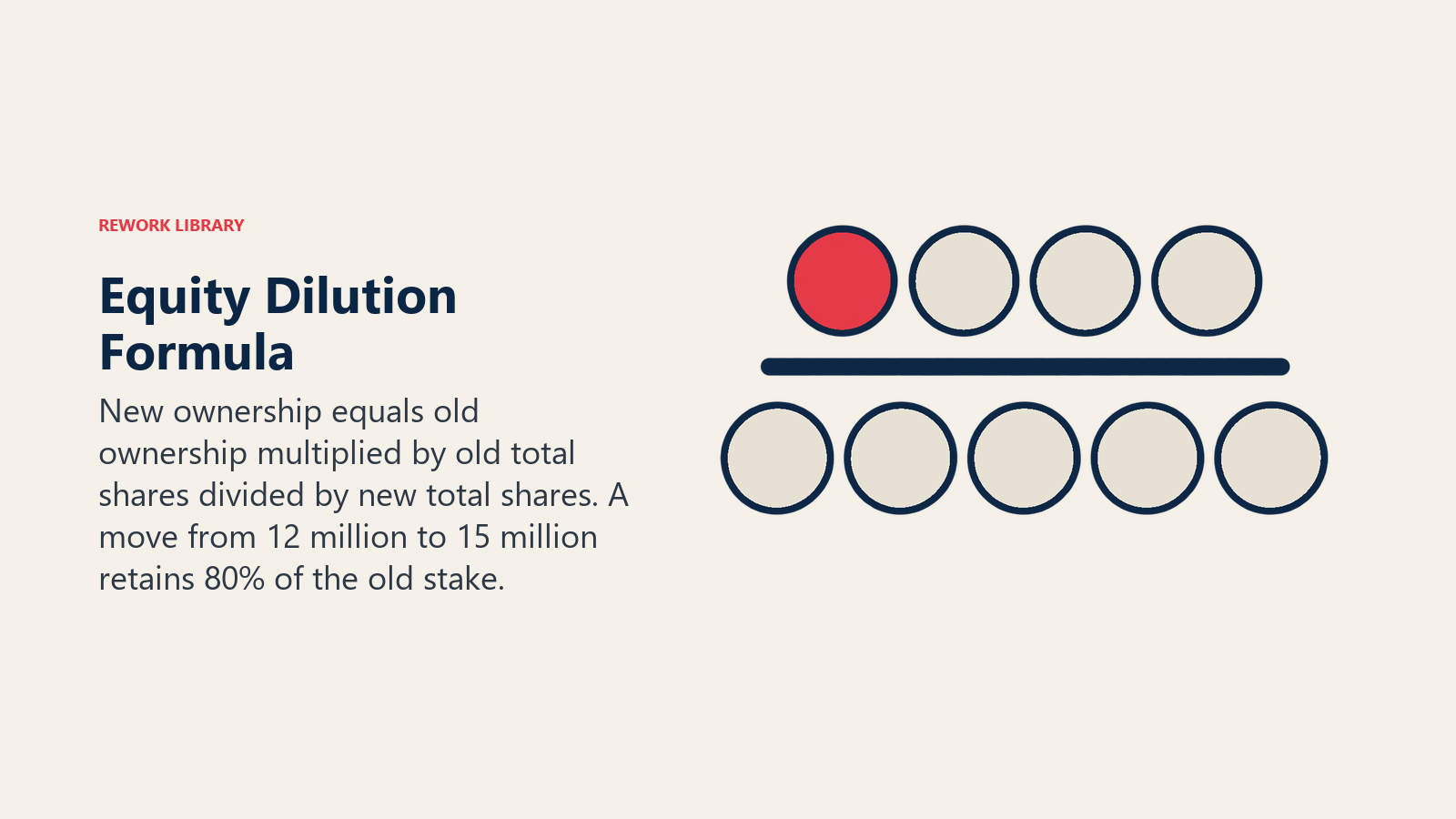
Ownership % = your shares ÷ total fully diluted shares
"Fully diluted" counts every share that exists or could exist: issued stock, the reserved option pool, and securities that convert into stock. The cap table is where that count lives.
When new shares are issued, your share count stays the same and the total grows. So:
New ownership % = old ownership % × (old total shares ÷ new total shares)
The fraction in brackets is the dilution factor. If a round takes the total from 12,000,000 shares to 15,000,000, the factor is 12 ÷ 15 = 0.80, and every existing holder keeps 80% of the percentage they had. Dilution is the other 20%.
A quick shortcut: if new investors buy a given percentage of the company after the round (their post-money stake), existing holders are diluted by that same percentage, plus whatever else was issued alongside it, such as a bigger option pool. See pre-money vs post-money valuation for how that stake is set.
Where Dilution Comes From
Any issuance of new shares, or of rights to shares, dilutes existing holders. The usual sources:
- Priced equity rounds. New investors buy newly issued preferred shares at a set price. This is the largest and most visible source.
- The option pool. Shares reserved for current and future employees count in the fully diluted total. Cooley GO defines an option pool as shares reserved for issuance to service providers under options and other equity incentives, and notes that pools typically expand during venture financings. Investors often ask for the top-up to be sized before they invest, so the dilution lands on existing holders. See employee option pool.
- SAFE and convertible note conversion. These instruments don't issue shares on day one, but they turn into shares at the next priced round. Y Combinator's SAFE documents page explains that on a post-money valuation cap SAFE, the ownership sold equals the investment divided by the valuation cap. So $1M on an $8M post-money cap is 12.5%. A convertible note works similarly but adds interest and a maturity date.
- Warrants. A warrant is a right to buy shares later at a set price, often given to lenders or bridge investors. If exercised, it adds shares.
- Other grants. Advisor equity, acquisition consideration paid in stock, and co-founder vesting all add to the count.
The common thread: dilution is the price of every source of capital or talent that's paid for in equity.
A Worked Example: Founding to Series A
The numbers below are illustrative round figures, not data from any real company. Two founders start with 10,000,000 shares between them. Three events follow.
Event 1: Option pool. The company reserves 1,000,000 shares for employees. Total shares: 11,000,000.
Event 2: Seed SAFE. An investor puts in $1M on a post-money SAFE with an $8M cap. At conversion they own 12.5% of the capitalization (including the pool, before the Series A money). The number of SAFE shares x solves x ÷ (11,000,000 + x) = 0.125, so x = 1,571,429 shares. Total: 12,571,429.
Event 3: Series A. New investors put in $5M at a $20M pre-money valuation, a $25M post-money, so they buy 20% of the post-round company. They also require the pool to be 10% of post-round shares, with the top-up counted in the pre-money. Founders (10,000,000) plus the SAFE (1,571,429) are 11,571,429 shares, which must equal 70% of the new total (100% minus 20% investors, minus 10% pool). New total = 11,571,429 ÷ 0.70 = 16,530,612 shares. That means 3,306,122 shares to Series A and a pool of 1,653,061 (a top-up of 653,061).
| Stage | Total shares | Founders | Seed SAFE | Option pool | Series A |
|---|---|---|---|---|---|
| Founding | 10,000,000 | 100.00% | n/a | n/a | n/a |
| After option pool | 11,000,000 | 90.91% | n/a | 9.09% | n/a |
| Seed SAFE (as converted) | 12,571,429 | 79.55% | 12.50% | 7.95% | n/a |
| After Series A | 16,530,612 | 60.49% | 9.51% | 10.00% | 20.00% |
Check the Series A row: 10,000,000 ÷ 16,530,612 = 60.49% for founders, and 1,571,429 ÷ 16,530,612 = 9.51% for the SAFE holder. The dilution factor for founders across the Series A is 12,571,429 ÷ 16,530,612 = 0.7605, and 79.55% × 0.7605 gives the same 60.49%.
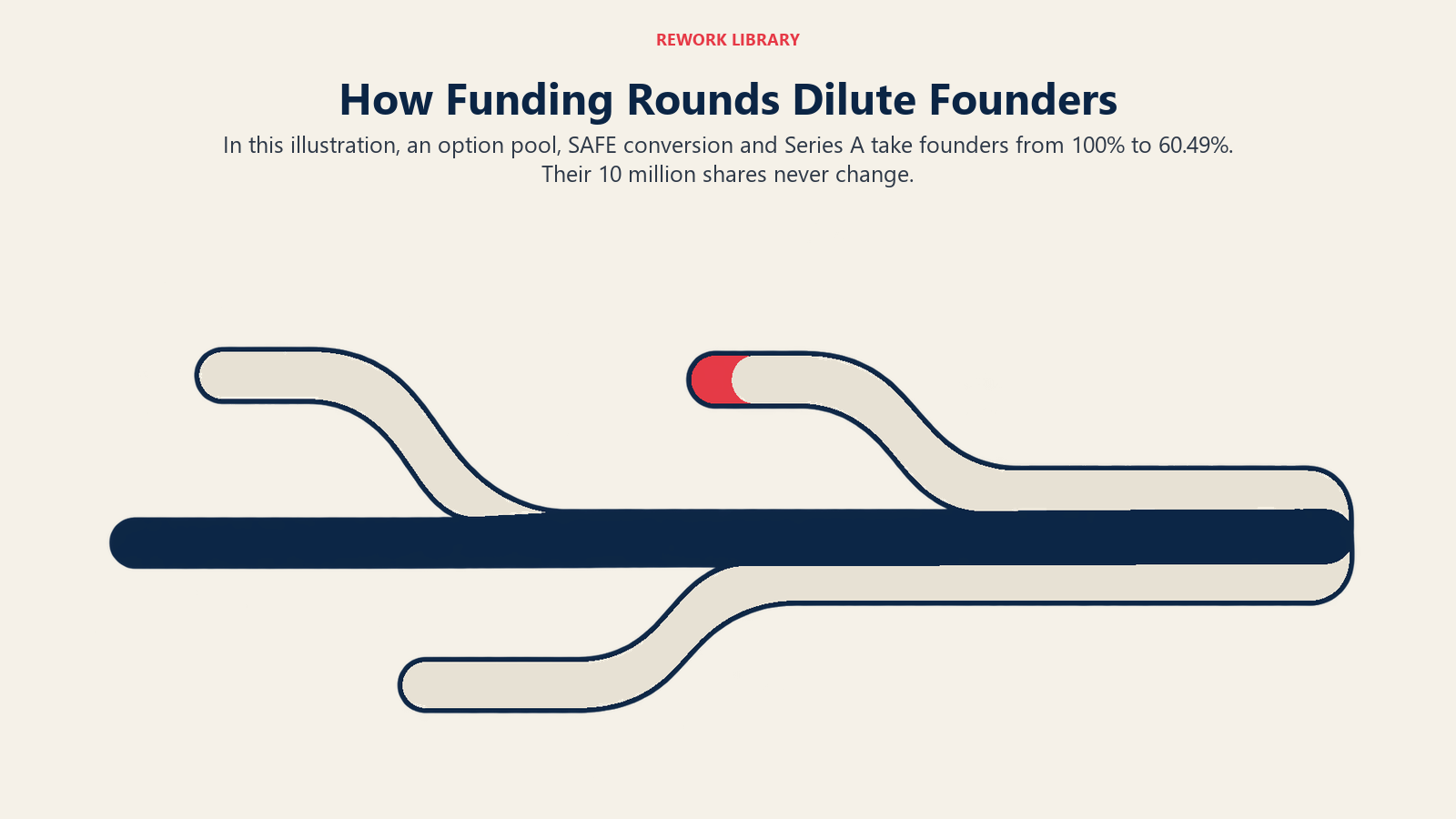
Notice the founders never sold a share. Their count stayed at 10,000,000 the whole way. Their percentage fell from 100% to 60.49% because three other groups were added to the total. The pool top-up also moved the founders' number even though the Series A investors only bought 20%.
Key Facts: Dilution
- Dilution is the fall in your ownership percentage when new shares are issued. Your share count doesn't change.
- New ownership % = old ownership % × (old total shares ÷ new total shares).
- Sources: priced rounds, option pool top-ups, SAFE and note conversion, warrants, and stock grants.
- On a post-money valuation cap SAFE, the ownership sold equals the investment divided by the cap (Y Combinator).
- In the illustrative example above, founders fall from 100% to 60.49% through a pool, a SAFE and a Series A without selling a share.
- Anti-dilution clauses protect investors, and the cost lands on the other holders.
Ownership vs Value
Percentage and value are different measures. Value is your percentage multiplied by what the company is worth.
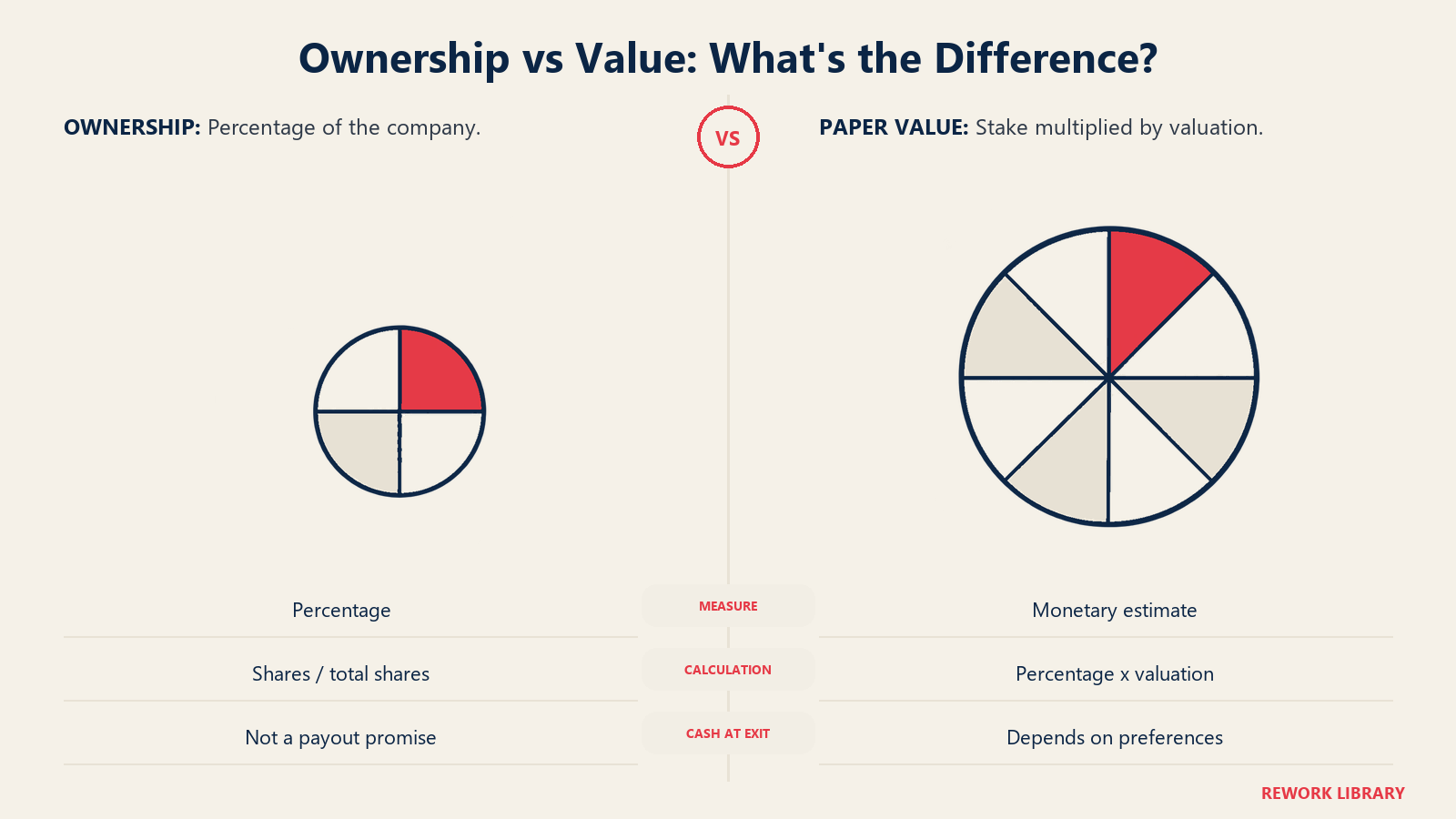
Using the illustrative figures above, Series A investors pay $5M for 20%, which implies a $25M post-money valuation. The founders' 60.49% is then worth about $15.1M on paper (60.49% × $25M). Before the round, a founder holding 100% of a company that investors valued at, say, $1M would have held $1M. The percentage fell by roughly 40 points while the paper value rose by more than fifteen times.
That's the case for taking dilution when the money is put to work: the company grows faster than the slice shrinks. The opposite case exists too. A down round can cut both the percentage and the value, and that's when dilution hurts. Paper value also isn't cash. The shares only pay out at an exit, and then only after any preferences are paid. For the role of valuation in this math, see that entry.
Two practical points on founder equity: decide before the first raise how much total dilution you're willing to accept, and model how many rounds that supports. A founder who gives up a quarter of the company in each of four rounds ends up with about 32% (0.75 to the fourth power is 0.316), before any pool increases.
Anti-Dilution Protection
Investors don't like being diluted either, especially by a cheaper round. Preferred stock often carries anti-dilution protection in the company's certificate of incorporation. The National Venture Capital Association publishes model legal documents, including a model certificate of incorporation, that are a common starting point in US venture deals. Signed terms differ from the model, so the actual charter is what counts.
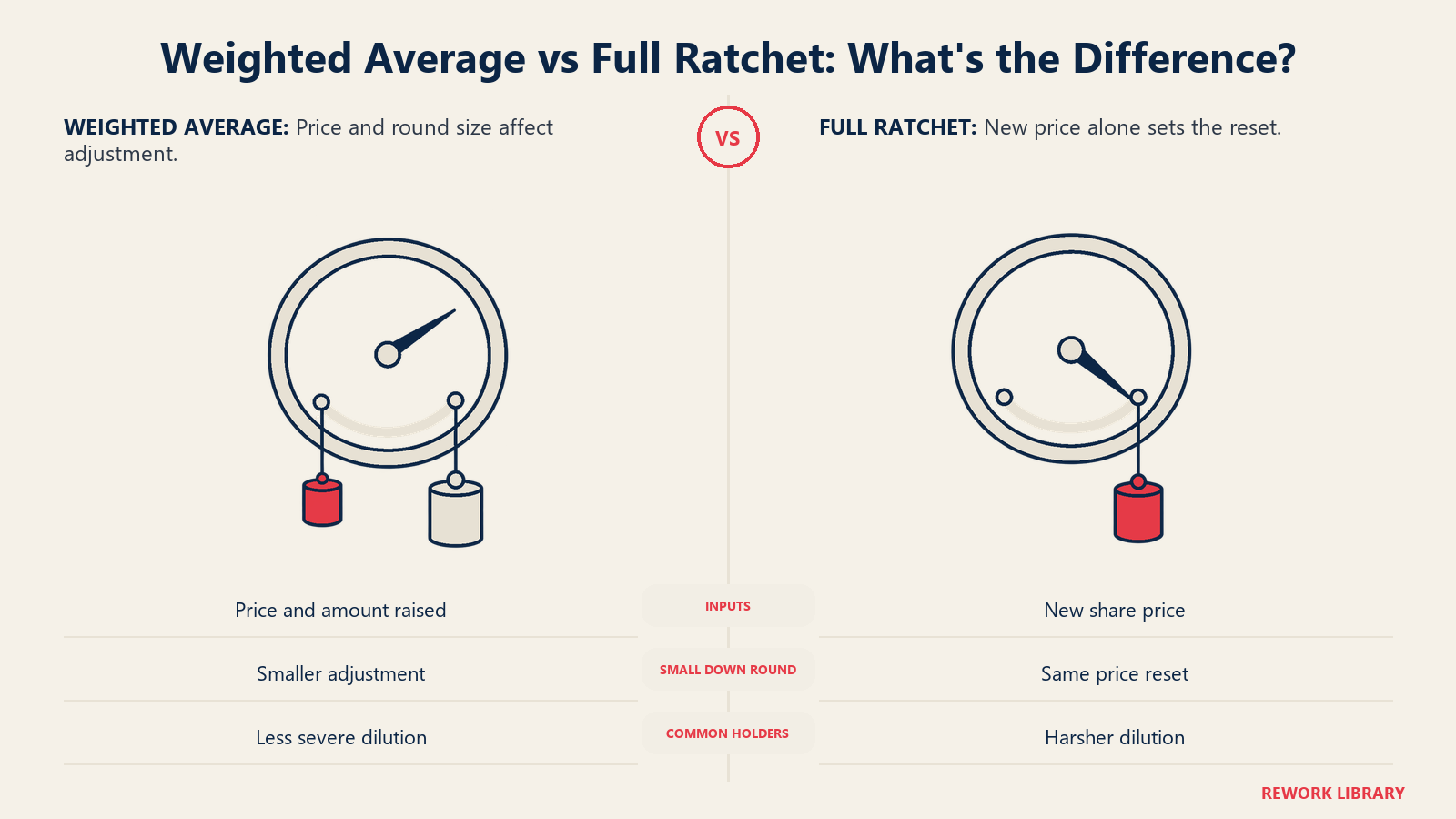
There are two main forms, covered in more detail in down round:
- Broad-based weighted average. The adjustment to the preferred stock's conversion price depends on both the new, lower price and how much is raised. Cooley GO's glossary entry notes that a down round selling $1 million of shares gives a much smaller conversion adjustment than one at the same price selling $10 million.
- Full ratchet. Cooley GO's entry contrasts it with the weighted-average approach: the adjustment is based on the new share price alone, whatever the amount sold. It's the harsher form for common holders.
Anti-dilution protection only applies to price-based dilution from a lower-priced issuance. It doesn't stop dilution from a normal up round, an option pool top-up or the conversion of a SAFE. And it isn't free: the extra conversion shares go to the protected investor and dilute everyone else, founders included.
Pro Rata: The Investor's Defence
The investor-side counter to dilution is the right to buy into later rounds. A pro rata right lets an investor buy enough of a new round to hold their percentage steady.
Illustration using the example above: the seed investor holds 9.51% after the Series A. If a Series B raises $10M, exercising pro rata means investing about 9.51% of the round, or roughly $0.95M. They'd keep 9.51% of the company rather than falling. The exact calculation depends on how the agreement defines the base, so treat this as a simplified model.
Pro rata costs the investor more cash each round. It also takes allocation away from other investors, which is why a new lead sometimes pushes back.
How to Model Dilution
Founders who model before negotiating avoid most surprises. A working approach:
- Start from the fully diluted cap table. Include issued shares, the option pool and every SAFE or note that hasn't converted yet.
- Pick the round assumptions. Amount raised, pre-money valuation, and any required pool top-up.
- Model conversions. Run each SAFE or note at its cap or discount, and use whichever gives the investor more shares if both apply.
- Compute the new share count and percentages. Use the formulas above.
- Repeat for the next two rounds, with a range of valuations, including a flat and a lower one.
- Check payout at exit, not only percentages. Preferences sit ahead of common stock, so ownership alone doesn't tell you what you'd receive. See liquidation preference.
A spreadsheet works for one or two rounds. Once there are several SAFEs, note terms and option grants, a dedicated cap table tool is less error-prone.
Frequently Asked Questions about Dilution
What is dilution in simple terms?
Dilution is the drop in your ownership percentage when a company issues new shares. You still hold the same number of shares, but they're a smaller share of a larger total. It can come from investors, an option pool, or conversion of SAFEs and notes.
Is dilution always bad?
No. If the new capital helps the company grow enough, a smaller percentage can be worth more than a bigger one in the old company. It becomes a problem when the round is priced low, the pool is oversized, or the money doesn't produce growth.
How do I calculate dilution from a round?
Divide your shares by the total fully diluted shares after the round. Or multiply your old percentage by old total shares over new total shares. For example, a total going from 12,000,000 to 15,000,000 keeps 80% of each holder's prior percentage.
What dilutes founders besides investors?
Option pool creation and top-ups, conversion of SAFEs and convertible notes, warrants, and stock granted to advisors or used in acquisitions. Pool top-ups that count in the pre-money hit existing holders rather than the new investors.
What is the difference between weighted average and full ratchet anti-dilution?
Both adjust an investor's conversion price after a lower-priced round. Weighted average scales the adjustment to how much is raised, while full ratchet resets to the new price regardless of amount. Full ratchet is harsher on founders.
Can an investor avoid dilution?
Partly. A pro rata right lets an investor buy into later rounds to hold their percentage, and anti-dilution clauses adjust conversion prices after a lower-priced round. Neither is automatic, and both depend on the signed documents.
Related Reading