What Is Blitzscaling?
Turn this article into takeaways for your work.


Each assistant summarizes the article only for you and suggests best practices for your work.
Blitzscaling is a way of growing a company that deliberately puts speed ahead of efficiency while the outcome is still uncertain. The term comes from Reid Hoffman (co-founder of LinkedIn) and Chris Yeh, who wrote a book on it in 2018. Their own site defines it as a set of practices for igniting and managing dizzying growth, one that "prioritizes speed over efficiency in an environment of uncertainty."
That's a narrow claim, and it's easy to stretch. Blitzscaling isn't "grow fast" and it isn't "spend a lot." It's a bet that in some markets the prize goes to whoever gets big first, so it's rational to tolerate waste, mess and risk to get there.
Where the idea came from
The idea reached a wide audience through a Harvard Business Review piece. HBR's April 2016 article "Blitzscaling" is written by Tim Sullivan, built around Hoffman's experience (PayPal, LinkedIn, an early investment in Facebook, and a partnership at the venture firm Greylock). It's paywalled, so the article itself isn't quoted here beyond what HBR shows publicly.
Hoffman and Yeh then expanded the idea into the 2018 book. The Computer History Museum summarizes the core argument as Silicon Valley learning that growing fast matters more than being first, particularly in markets where only the first and biggest player wins.
What blitzscaling actually looks like
In practice, blitzscaling means a company does things a careful operator would normally avoid:
- Spending capital to grow before the business model is fully proven.
- Hiring ahead of need and accepting that some hires won't fit.
- Making decisions with partial information and fixing mistakes afterward.
- Tolerating customer complaints and rough product edges in the short term.
Hoffman is open about the cost. In a GIC ThinkSpace interview, he lists the side effects as "customer complaints, 'embarrassing' products, and management crash-and-burns." The same piece says he recommends spotting risks early, distinguishing failures you can fix later from ones that need immediate action, and setting clear company values so employees can handle uncertainty.
That's the trade in one line: you buy speed with chaos, and you try to keep the chaos from becoming a disaster.
The five stages by headcount
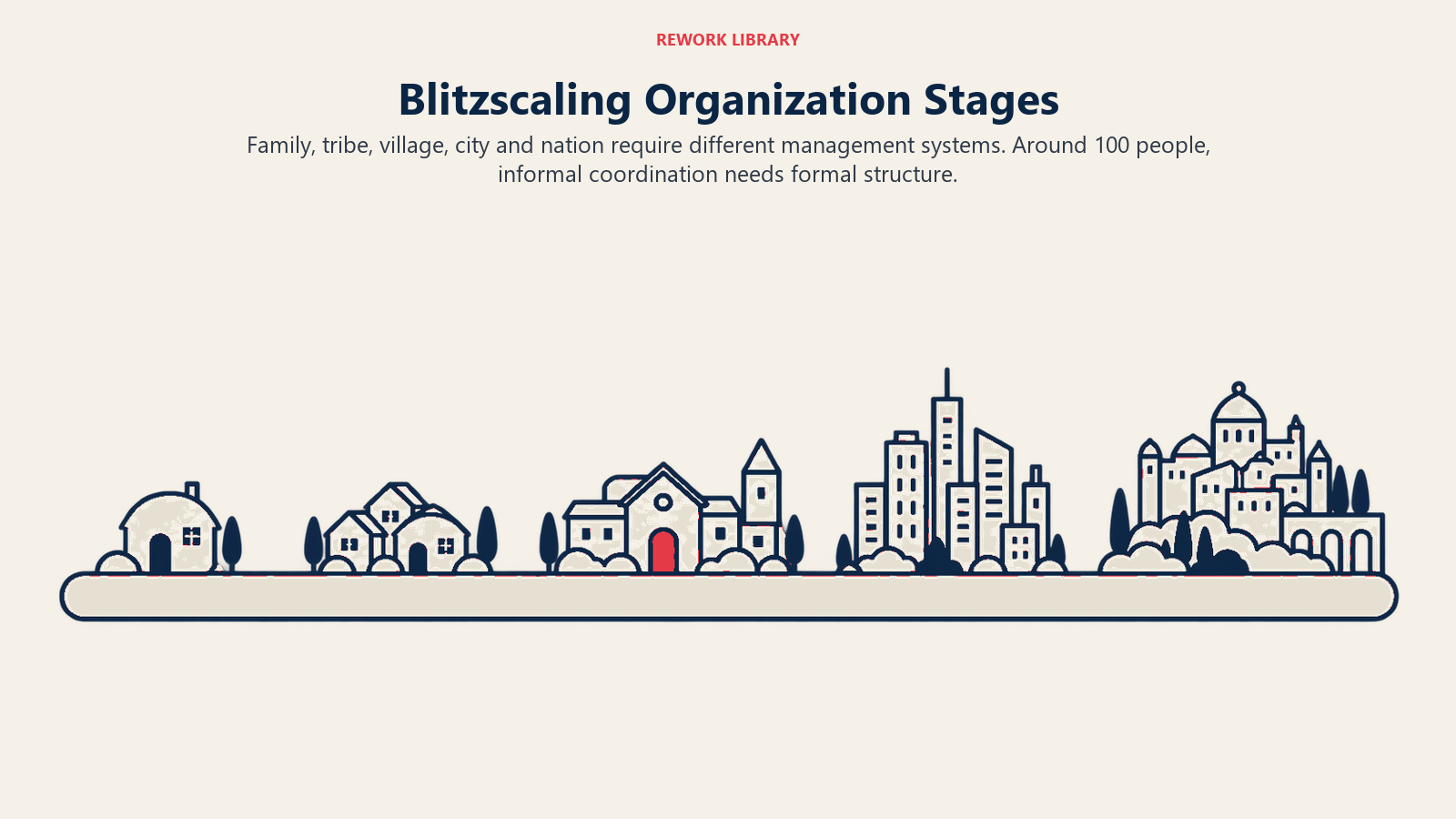
Hoffman and Yeh describe a company's life in five stages named after human groupings. Chris Yeh walks through them in a ServiceRocket podcast interview, where the ranges are:
| Stage | Employees | What changes |
|---|---|---|
| Family | 1 to 9 | Founders do the work directly |
| Tribe | 10 to 99 | Informal structure, founders manage the people doing the work |
| Village | 100 to 999 | Formal structure and processes arrive |
| City | 1,000 to 9,999 | Leaders set goals and strategy across large teams |
| Nation | 10,000 or more | The company starts new business units |
Yeh calls the move from tribe to village the hardest transition. His reasoning: families and tribes are informal, while at around 100 people you become a village with real formal structure. The "what changes" column above is our short paraphrase of the framework, not a quote.
The practical lesson is that what worked at 15 people will break at 150. A founder who still wants to approve every decision becomes the bottleneck.
When blitzscaling makes sense
The authors don't recommend it for every company. In the GIC interview, Hoffman says to ask whether there's a huge market, whether there's good product-market fit, and whether the company has characteristics of a mature business.
Those questions point to four conditions that tend to make speed pay off. This is our own summary of the logic, not a list quoted from the book:
- Market size. The market has to be big enough that exponential customer growth is possible, and big enough to attract the investment that funds it.
- Distribution. There's a channel that scales without cost rising in step, such as word of mouth or an existing network.
- High gross margins. Each sale leaves enough money to help finance growth. Thin-margin businesses burn cash faster than they can grow into it.
- Network effects. Each new user makes the product more valuable to others. See our guide to network effects for how these work.
If none of these hold, speed alone just burns runway. A company with weak margins, no network effect and a small market gains very little by being first, because there's no durable advantage to lock in. That's why first-mover advantage is often weaker than founders assume.
Key Facts: Blitzscaling
- Definition: prioritizing speed over efficiency in an environment of uncertainty, per blitzscaling.com.
- Origin: Reid Hoffman's April 2016 HBR feature (written by Tim Sullivan) and the 2018 book with Chris Yeh.
- Five stages by headcount: family (1 to 9), tribe (10 to 99), village (100 to 999), city (1,000 to 9,999), nation (10,000+), per Chris Yeh.
- Conditions that make speed pay off: a large market, scalable distribution, high gross margins and network effects.
- Hoffman names the costs himself: customer complaints, embarrassing products, and management crash-and-burns (GIC).
The critique
Blitzscaling has serious critics. The best known is Tim O'Reilly, founder of O'Reilly Media. In early 2019 he reviewed the book in Quartz, and Founding Fuel's summary of his piece reports his main arguments:
- Scaling attracts investor money, which prompts even more scaling before the company has proven a viable business model.
- That dynamic favors a "winning at all costs" kind of entrepreneur, one who is hard-charging and willing to crash through barriers.
- He pointed to the ride-hailing race between Uber and Lyft as an example.
- Winners at scale carry real responsibility for their effects on society, not only to shareholders.
The list above follows a secondary account of O'Reilly's original piece.
Hoffman's side acknowledges the ethics point. The Computer History Museum piece covers the "techlash" and says responsible blitzscaling needs the right culture, accountability and openness, especially in finance and healthcare. The disagreement isn't about whether speed carries risk. It's about whether the strategy as a whole pushes founders toward ignoring it.
For a founder or executive, the sharper question is financial. If the plan depends on unit economics that you hope will improve at scale, you're making a bet, not executing a plan. Blitzscaling raises the stakes on that bet.
Blitzscaling vs classic scaling vs frugal growth
The table below is our own framing to help you compare approaches. It isn't a taxonomy from the book.
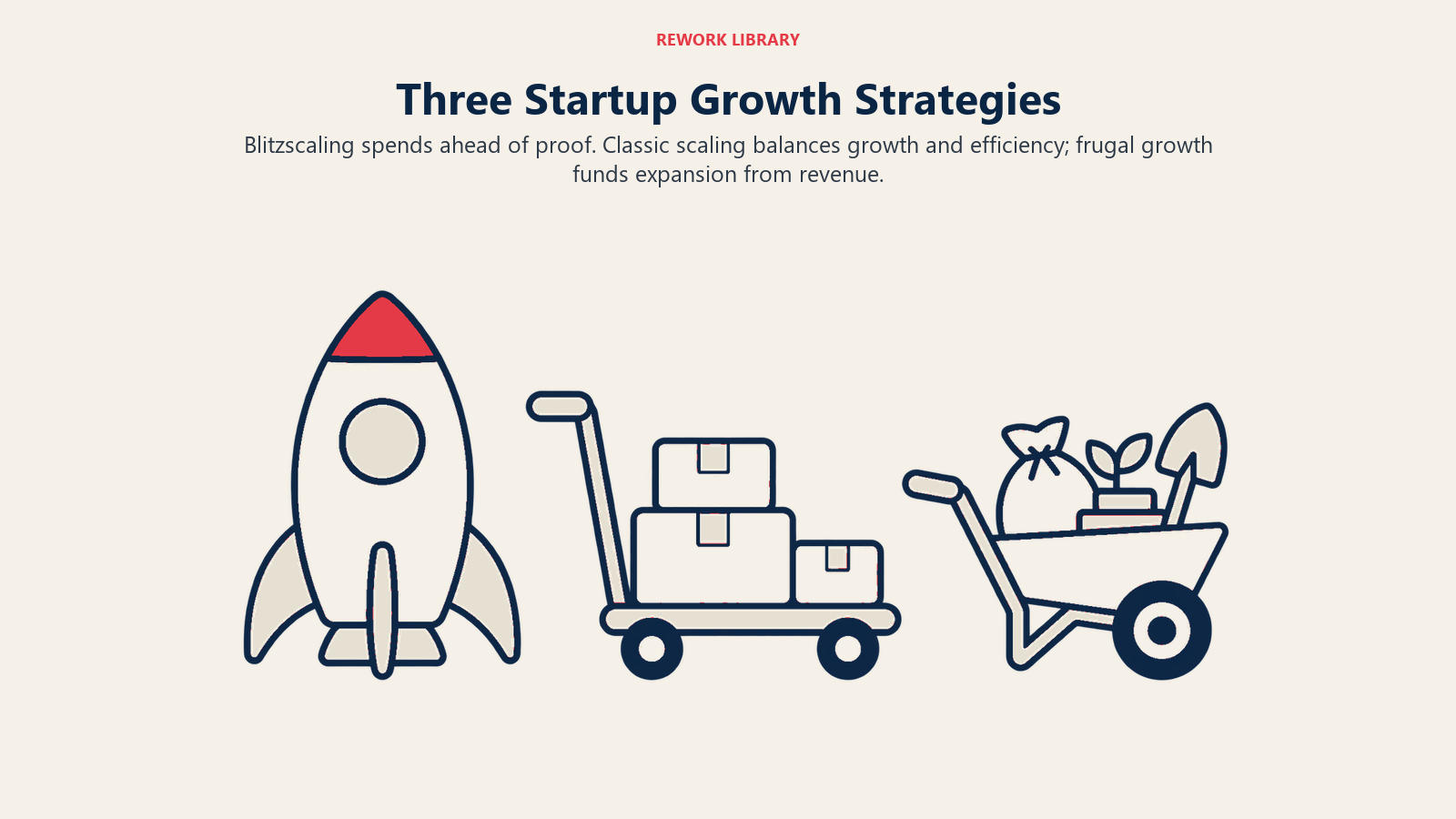
| Blitzscaling | Classic scaling | Frugal, default-alive growth | |
|---|---|---|---|
| Core priority | Speed over efficiency | Balance of growth and efficiency | Efficiency and survival |
| Spending vs proven model | Spends ahead of proof | Spends once the model shows signs of working | Spends from revenue |
| Funding need | High, repeated outside rounds | Moderate | Low, often none beyond early capital |
| Tolerance for mess | High, by design | Moderate | Low |
| Best fit | Winner-take-most markets with network effects | Markets with several viable competitors | Niche or slower markets, owner-operators |
| Main risk | Burning out of runway or failing to reach the next round | Being outrun by a faster rival | Being outrun in a market that rewards scale |
"Default-alive" here just means the company would reach profitability on its current revenue and costs without raising more money.
The strategies aren't a permanent choice. A company can run lean through the early stage, find clear signals that it's in a winner-take-most market, and then shift into blitzscaling. The reverse also happens: companies slow down after the land grab ends.
A quick illustrative check
This is our own arithmetic, not data from a study. Say a founder runs a software company with $2 million in annual revenue and a 20% gross margin because of heavy delivery costs. Doubling revenue to $4 million brings in roughly $800,000 of gross profit, which won't fund the sales and hiring needed to double again. Now take a similar company with an 80% gross margin and a network effect: doubling revenue produces about $3.2 million of gross profit, and each new user makes the product better for the rest. The second company has the shape that blitzscaling assumes. The first is better off growing at the pace its cash allows.
Common mistakes
- Blitzscaling without a market that rewards it. Speed only pays when being big creates an advantage, like a network effect or a distribution edge.
- Skipping product-market fit. The authors treat its absence as a limiting factor. Pouring money into a product people don't want just accelerates the loss. See stages of a startup.
- Ignoring cash. Fast growth often means a high burn rate. If the next round slips, a weak market can end in a down round or worse.
- Not changing the organization at each stage. The jump to a formal village structure is where many founders stall.
- Treating "move fast" as permission to ignore consequences. Even the proponents say it doesn't excuse unintended harm.
For more on the thinking of the person behind the idea, see our profile of Reid Hoffman's leadership approach.
Related reading