What Is a Liquidation Preference?
Turn this article into takeaways for your work.


Each assistant summarizes the article only for you and suggests best practices for your work.
A liquidation preference is a right attached to preferred stock that lets investors be paid out of the proceeds of a "liquidation event" before common shareholders (usually founders and employees) receive anything. A liquidation event normally means a sale of the company, a merger, or a wind-down. The preference is written as a multiple of the money invested: a 1x preference means the investor gets one times their investment back first.
It matters because a company's valuation on the term sheet and the amount founders actually walk away with at an exit are two different numbers. The liquidation preference sits between them. In a big exit it barely shows up. In a modest exit, or after a down round, it can decide who gets paid and who gets nothing.
This article explains how the preference works, the three main structures, how seniority changes the order of payment, and a worked example with the arithmetic shown. It's reference material, not legal advice. Terms vary by jurisdiction and by deal, and founders should have counsel review any term sheet before signing.
How a Liquidation Preference Works
When investors buy preferred stock in a priced round, the stock carries extra rights compared with the common stock held by founders. The liquidation preference is one of the most important. As WilmerHale's startup practice describes it, it's the amount of sale or liquidation proceeds that preferred shareholders receive before common shareholders are entitled to receive anything.
Three inputs define the preference:
- The multiple. Usually 1x. A 2x preference pays back twice the invested amount before common gets anything.
- Participation. Whether the investor gets the preference and then also shares in what's left, or has to pick one.
- Seniority. When there are several rounds of investors, who is paid first if there isn't enough to cover everyone.
The legal wording lives in the company's certificate of incorporation (the charter). The National Venture Capital Association publishes model legal documents, including a model certificate of incorporation, that are widely used as a starting point in US venture deals and that offer alternative wordings for these provisions. Real deals differ from the model, so the signed documents are what count.
A point that surprises many first-time founders: the preference only matters when the company is sold or wound down. It does nothing while the company is operating. It also isn't a debt. If the sale price is too low to cover the preference, the investor isn't owed the difference later.
The Three Structures
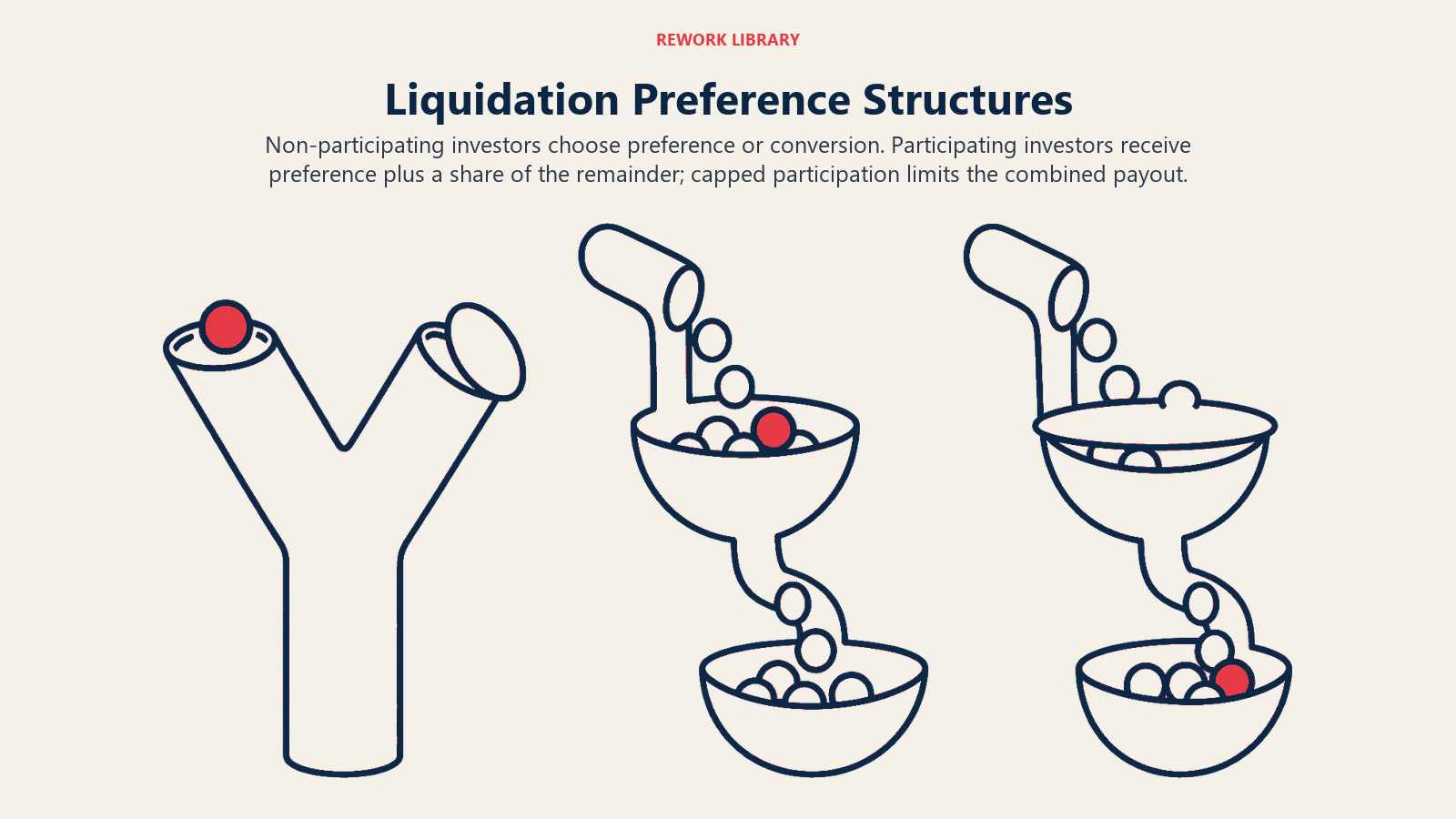
Non-participating preferred
The investor chooses one of two outcomes: take the preference amount, or convert to common stock and share in the proceeds by ownership percentage. They take whichever is larger. This is the most founder-friendly structure and the one most often described as standard.
Participating preferred
The investor takes the preference first and then also shares in the remaining proceeds as if they had converted. People call this "double dipping." It moves more of the sale price toward the investor in every exit size.
Capped participating preferred
A middle path. The investor participates after the preference, but total proceeds from the preference plus participation are capped at a set multiple of the original investment (3x is a common illustration). Once the as-converted value of their shares would exceed the cap, the investor converts to common and takes the larger amount.
| Structure | Investor gets | Who it favors |
|---|---|---|
| Non-participating | Preference OR as-converted share, whichever is greater | Founders |
| Participating | Preference AND as-converted share of the rest | Investors |
| Capped participating | Preference plus participation up to a cap, or convert if that's worth more | Between the two |
A Worked Exit Waterfall
The numbers below are illustrative arithmetic, not data from any study or real company. Assume an investor puts $5M into a Series A for 20% of the company, so the post-money valuation is $25M. Everyone else (founders, employees, option holders) holds the other 80% as common stock. There is no debt and no other preferred stock. We'll look at three exit values and three structures, all with a 1x multiple.
Non-participating 1x
| Exit value | Investor option A: take $5M preference | Investor option B: convert to 20% | Investor receives | Common receives |
|---|---|---|---|---|
| $4M | $4M (only $4M available) | $0.8M | $4M | $0 |
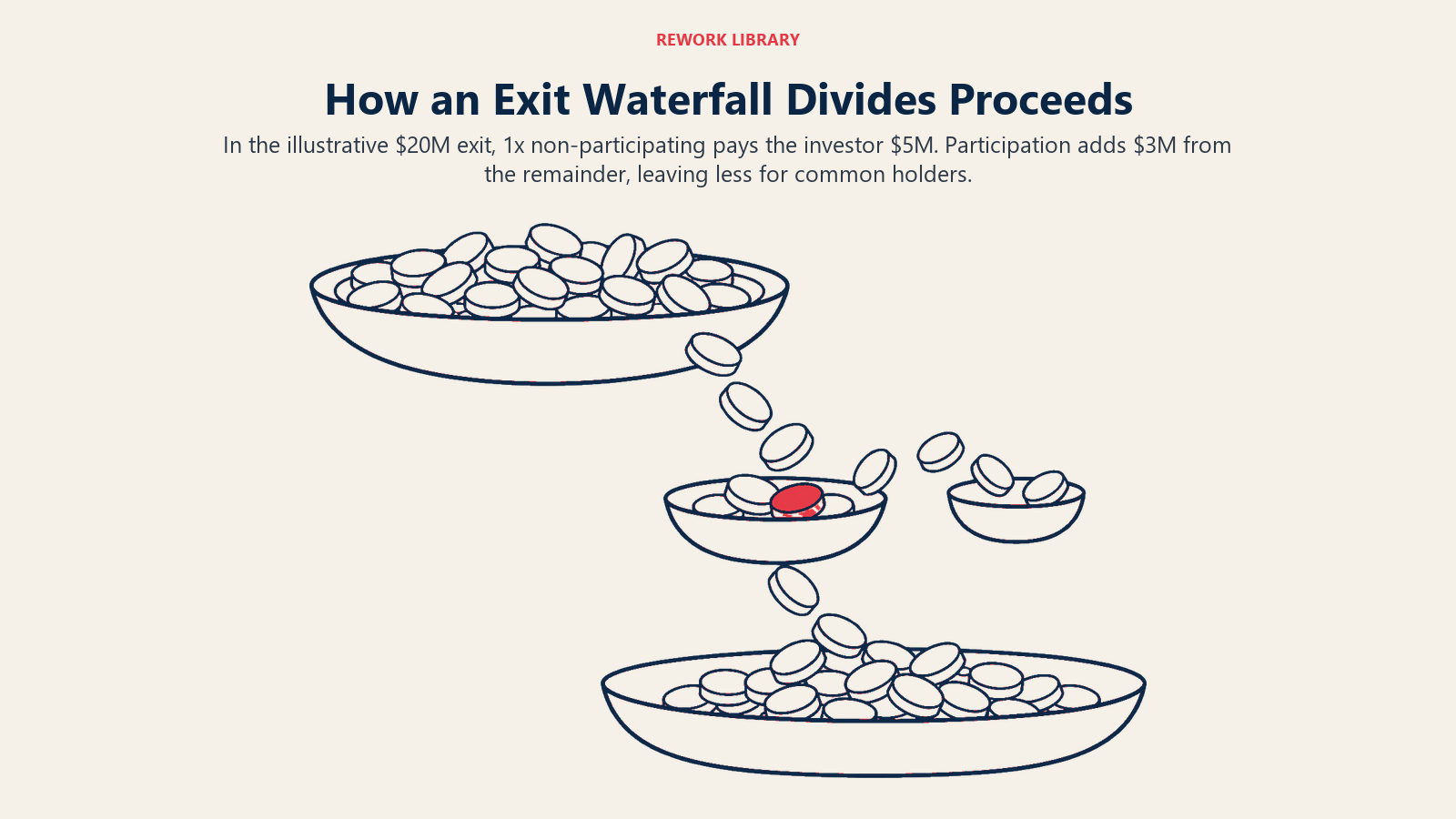
| $20M | $5M | $4M | $5M | $15M |
| $60M | $5M | $12M | $12M (converts) | $48M |
At $4M, the exit is smaller than the preference, so the investor takes the entire $4M and common gets nothing. At $20M, the preference ($5M) beats conversion ($4M), so the investor keeps the preference and common receives $15M. At $60M, converting is worth more, so the preference falls away and everyone is paid by ownership percentage.
Participating 1x (uncapped)
| Exit value | Preference | Share of the remainder | Investor receives | Common receives |
|---|---|---|---|---|
| $4M | $4M | $0 | $4M | $0 |
| $20M | $5M | 20% x $15M = $3M | $8M | $12M |
| $60M | $5M | 20% x $55M = $11M | $16M | $44M |
At $20M the investor takes 40% of the proceeds while owning 20% of the company. At $60M the investor takes about 27% ($16M of $60M). The extra comes straight out of the common holders' pockets: $15M versus $12M at the $20M exit, and $48M versus $44M at $60M.
Capped participating 1x, with a 3x cap ($15M total)
| Exit value | Participating math | Cap check | Investor receives | Common receives |
|---|---|---|---|---|
| $20M | $5M + $3M = $8M | Under the $15M cap | $8M | $12M |
| $60M | $5M + $11M = $16M | Over the cap, so limited to $15M (converting gives only $12M) | $15M | $45M |
The investor only gives up the cap and converts to common when 20% of the exit value is worth more than $15M. That happens above a $75M exit (20% x $75M = $15M).
What a 2x multiple does
With a non-participating 2x preference, the investor's preference is $10M. At the $20M exit, they'd take the $10M instead of converting (20% of $20M is only $4M), and common would receive $10M instead of the $15M it gets under 1x.
Key Facts: Liquidation Preference
- A liquidation preference pays preferred investors before common shareholders in a sale, merger, or wind-down.
- Written as a multiple of invested capital (1x, 2x). It isn't a debt and does nothing while the company operates.
- Non-participating: investor takes the preference or converts, never both. Participating: both. Capped: both, up to a limit.
- Seniority decides the payment order across rounds: standard (newest first) or pari passu (everyone shares pro rata).
- In the worked example above (illustrative), a $5M investment for 20% takes $5M of a $20M exit non-participating, but $8M if participating.
- The preference bites hardest in modest exits and after down rounds. Above a certain exit value, non-participating investors convert and the preference stops mattering.
Seniority: Who Gets Paid First
When a company has raised several rounds, each round's preferred stock has its own preference. The charter sets the payment order.
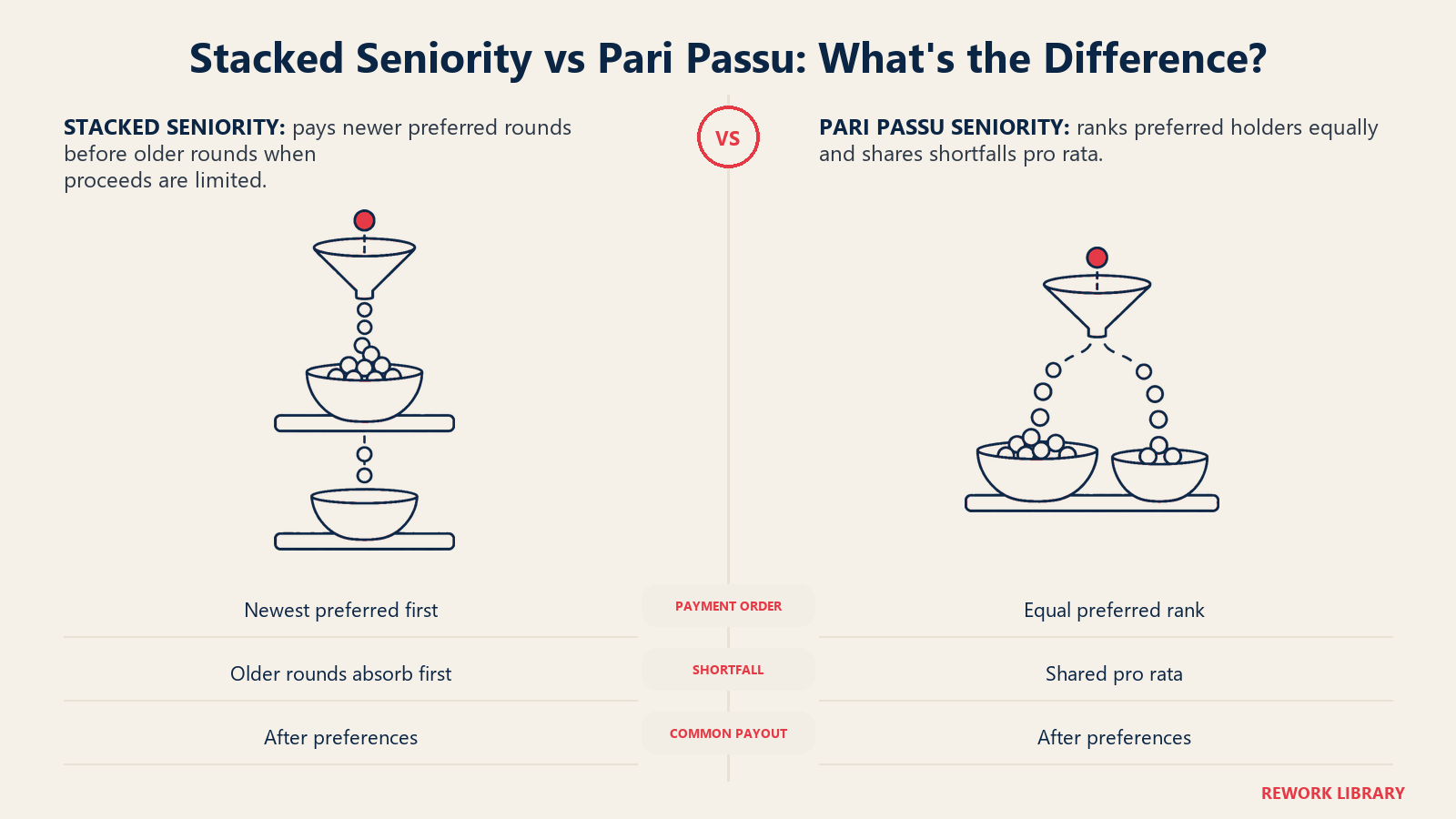
Standard (stacked) seniority. The newest round is paid first, then the one before it, and so on, then common. WilmerHale's summary describes the stacked structure as paying the last investor in first, and it often shows up in later rounds when investors want protection at higher valuations.
Pari passu. All preferred holders rank equally. If proceeds don't cover every preference, they split what's available in proportion to the amounts they're owed.
Here's an illustration using made-up figures. A seed investor put in $2M and a Series A investor put in $5M, both with 1x non-participating preferences. The company sells for $6M.
| Seniority | Series A receives | Seed receives | Common receives |
|---|---|---|---|
| Standard (Series A first) | $5M | $1M | $0 |
| Pari passu | $6M x 5/7 = about $4.29M | $6M x 2/7 = about $1.71M | $0 |
Total preferences are $7M, more than the $6M available, so common receives nothing either way. The difference is only which investor absorbs the shortfall.
Why It Matters in Down Rounds and Modest Exits
Venture investors usually underwrite for outsized outcomes, but most sales are not outsized. When a company sells for less than it raised, or for roughly the same as its last valuation, the preferences are what founders feel.
In a down round, new investors often ask for senior preferences, higher multiples, or participation to compensate for the risk, since the company is worth less than at its last priced round. That can leave founders and employees with a small share of an exit whose headline price looks decent. A $30M sale sounds like a win until $25M or more of preferences sit ahead of the common stock.
This is also why founders should model exits, not just ownership. A cap table showing 60% founder ownership says nothing about payout at an exit below the total preferences. Tools for cap table management often include waterfall modeling for this purpose.
The same logic applies when a bridge round or convertible note later converts into preferred stock: the converted holders may come with their own preference, adding another layer to the stack.
What the Market Looks Like
The direction of terms is toward simpler structures. Cooley's venture financing report for the first quarter of 2019 found the share of deals using full participating liquidation preferences had fallen to 8% of transactions. That's an older data point, and later editions may differ, so check the most recent report from a law firm or a data provider such as Carta before treating any figure as current. Whatever the average, your own deal is negotiated. A lead investor typically sets the terms for the round, and other investors usually follow.
Common Mistakes and Founder Watch-Outs
- Negotiating only valuation. A higher valuation with participation and a 2x preference can leave founders worse off than a lower valuation with a clean 1x non-participating preference. Model both at several exit values.
- Ignoring the cumulative stack. Each round adds preferences. Add them up before the next raise and see what the exit has to be for common to receive anything.
- Forgetting employees. Option holders are common. A modest exit that pays founders a little may pay employees nothing, which hurts retention long before an exit.
- Confusing the multiple with the participation right. "1x" tells you the size of the preference. It doesn't tell you whether the investor also participates. Ask for both terms.
- Treating the term sheet as final. Short term sheets compress these provisions to a line or two. The charter has the full mechanics, including conversion triggers and how dividends are handled.
- Skipping local advice. Preferred stock structures, investor protections, and enforceability vary by country. A founder raising from regional or foreign funds should have counsel who knows the relevant jurisdiction.
How It Compares to Related Terms
- Valuation. Valuation sets the price per share and ownership percentage. Liquidation preference sets who is paid first from exit proceeds. They are separate levers, and investors often trade one for the other.
- Anti-dilution protection. Protects the investor's ownership percentage if a later round prices lower. A liquidation preference protects the investor's payout at exit. They are often negotiated together after a down round.
- Debt. Debt must be repaid whatever the company's value, and can force a bankruptcy. A preference only applies when there are proceeds to distribute.
- Runway and burn rate. These decide how likely a company is to face a low-priced sale or wind-down, which is when the preference becomes the main event.
Frequently Asked Questions about Liquidation Preference
What does 1x liquidation preference mean?
It means preferred investors are entitled to receive one times the amount they invested before common shareholders are paid out of exit proceeds. A $5M investment carries a $5M preference. Whether they can also share in the remainder depends on whether the stock is participating.
What is the difference between participating and non-participating preferred?
With non-participating preferred, the investor takes either the preference or the as-converted common share, whichever is larger. With participating preferred, the investor takes the preference and then also shares in what remains. In the worked example above, a $5M investment for 20% yields $5M non-participating but $8M participating on a $20M exit.
Does a liquidation preference apply if the company shuts down?
Yes, in the sense that preferred holders rank ahead of common holders for any assets left after creditors are paid. But a preference is not a debt, so if there is little or nothing left, the investor isn't owed the shortfall later.
What is the difference between standard and pari passu seniority?
With standard seniority, the newest round is paid first and older rounds are paid from what's left. With pari passu, all preferred holders rank equally and share pro rata if proceeds fall short of total preferences.
When does the liquidation preference stop mattering?
For non-participating preferred, once the as-converted share of proceeds exceeds the preference, the investor converts to common and the preference is irrelevant. In the example above with 20% ownership and a $5M preference, that happens above a $25M exit.
Can founders negotiate the liquidation preference?
Yes. The multiple, participation, cap, and seniority are all negotiable, and the leverage depends on the round's competitiveness and the company's position. Founders should model payouts at several exit values and have counsel review the terms.
Related Reading

On this page
- How a Liquidation Preference Works
- The Three Structures
- Non-participating preferred
- Participating preferred
- Capped participating preferred
- A Worked Exit Waterfall
- Non-participating 1x
- Participating 1x (uncapped)
- Capped participating 1x, with a 3x cap ($15M total)
- What a 2x multiple does
- Seniority: Who Gets Paid First
- Why It Matters in Down Rounds and Modest Exits
- What the Market Looks Like
- Common Mistakes and Founder Watch-Outs
- How It Compares to Related Terms
- Related Reading