What Is a Bridge Round?
Turn this article into takeaways for your work.


Each assistant summarizes the article only for you and suggests best practices for your work.
A bridge round is a short-term financing that gives a company enough cash to reach its next milestone or its next priced equity round. It's usually smaller than a full round, raised quickly, and structured as a convertible instrument such as a convertible note or a SAFE rather than as priced shares.
The name says what it does. A company has money from its last round, needs more before it can hit the numbers a new investor wants to see, and uses a bridge to cover the gap. The one question that matters is bridge to where? A bridge with a clear destination can be a smart, cheap move. A bridge with no destination is just a delay.
How a Bridge Round Works
A normal priced round sets a valuation, issues new shares, and often takes weeks or months to close. A bridge skips most of that. Because the instrument is convertible, the company and investors don't have to agree on a valuation today. They agree on terms that decide how the money converts into equity later, usually at the next priced round.
The typical sequence looks like this:
- The company sees that its runway will run out before the next round can realistically close.
- It approaches existing investors first, because they already know the business and can move fast.
- Terms are set: amount, instrument, discount, valuation cap, interest, maturity date.
- Money arrives within days or a few weeks, with far less legal work than a priced round.
- At the next priced round, the bridge converts into shares, often at a better price than the new investors pay.
Bridges can also come from the other direction. A company can raise a small, fast extension of its last round ("Seed extension", "Series A-1") from the same or new investors at the same price as the original round. That's still a bridge in function, even though it's priced.
Common Instruments
Most bridges use one of four structures. Each has different mechanics and different founder watch-outs.
| Instrument | What it is | Key terms | Main watch-out |
|---|---|---|---|
| Convertible note | A loan that converts into equity at the next round | Interest rate, maturity date, discount, cap | It's debt, so it has a maturity date and can be called if the company can't convert or repay |
| SAFE | A contract giving the investor future shares, with no interest or maturity | Valuation cap, discount, MFN | Several SAFEs with different caps stack up and can dilute founders more than expected |
| Priced extension | More shares of the same series at the same price | Price per share, amount | Needs a valuation everyone accepts, so it's slower and harder to agree |
| Venture debt or revolving line | A loan from a lender, sometimes with warrants | Interest, covenants, warrant coverage | Repayment obligations arrive while cash is still tight |
For SAFEs, Y Combinator publishes standard documents and plain-language definitions. It describes a post-money SAFE as one with a valuation cap that is the company's valuation after the investment is made. It defines the valuation cap as the highest valuation at which a SAFE converts into shares, and a discount as a lower price than the next priced round's investors pay (for example, a 20% discount means the SAFE holder pays 20% less than new investors). It also describes an MFN SAFE as one with no cap or discount that automatically takes the terms of any SAFE issued later. If you need the note-specific mechanics, see convertible notes.
Discount, Cap and Warrant Terms
Three levers decide how generous a bridge is to the people providing it.
Discount. The bridge investor converts at a percentage below the price new investors pay. A 20% discount means they get shares at 80% of the round price. Bridge discounts are the investor's reward for taking more risk and putting money in earlier than the new lead.
Valuation cap. The cap sets a ceiling on the valuation used to convert the bridge. If the next round is priced above the cap, the bridge converts as though the company were worth only the cap. Investors typically get whichever is better for them, the discount price or the cap price.
Warrants. Some bridges, especially insider-led ones from later-stage investors, add warrants: the right to buy more shares at a set price later. Warrants are extra upside on top of the discount and cap. They're common enough in debt-style bridges that founders should ask for them to be modelled in the cap table before signing.
Interest on a convertible note is usually paid in shares at conversion, not in cash, so it adds to the dilution too.
A Worked Example (Illustrative)
This is simplified arithmetic, not data from a real company.
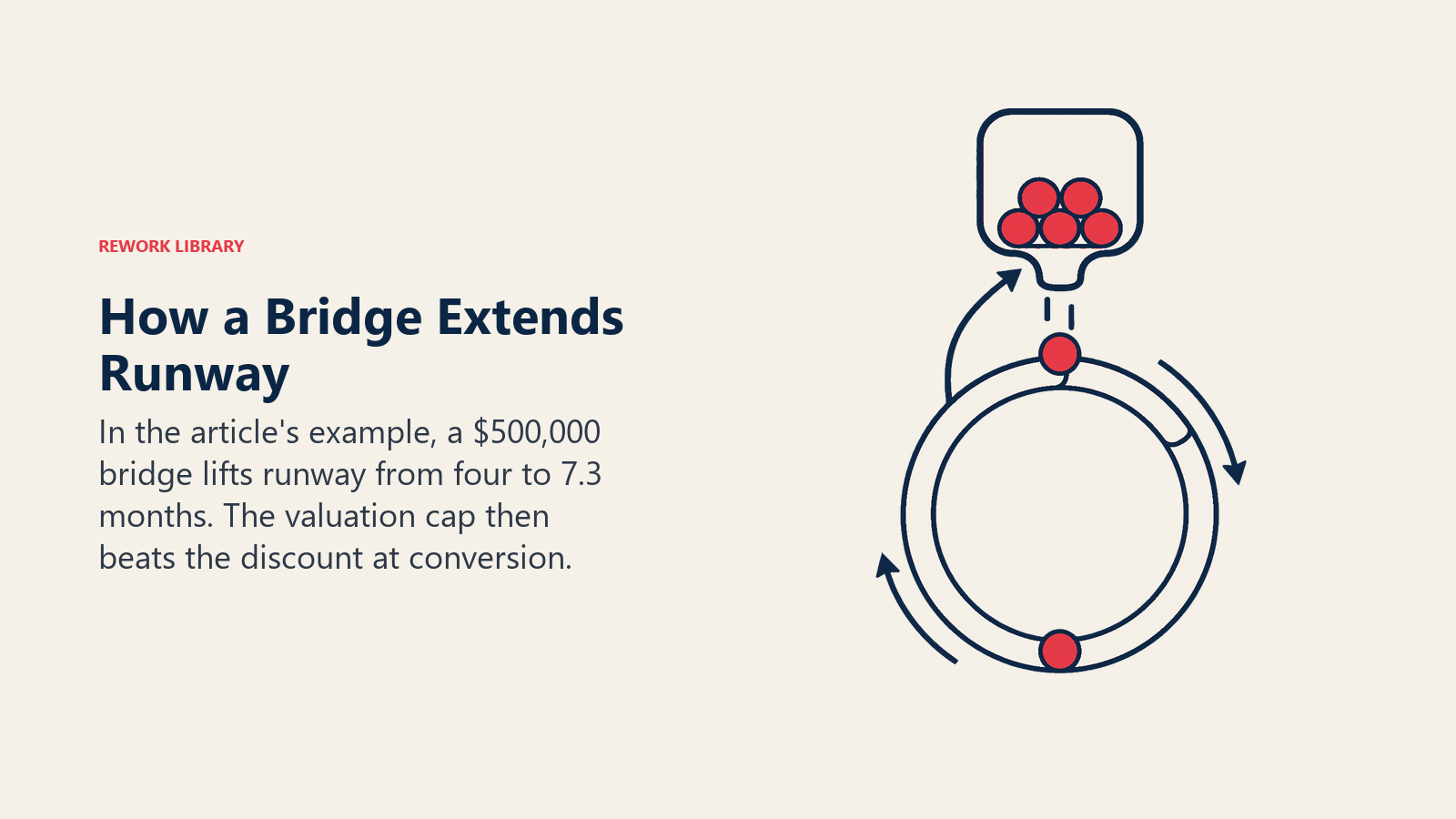
A startup has $600,000 in the bank and burns $150,000 a month. That's four months of runway. Its last priced round was a seed round, and it needs about six more months to reach the revenue milestone a Series A investor will ask for. The founders raise a $500,000 bridge from existing investors on a convertible note with a 20% discount and a $6 million valuation cap.
- New cash lifts runway: $1,100,000 divided by $150,000 a month is about 7.3 months. That clears the six-month milestone with a little room.
- Six months later, the startup closes a Series A at a $10 million pre-money valuation. For simplicity, treat the cap as a pre-money cap and ignore accrued interest.
- Discount price: 80% of the round price, so the investors would effectively convert at an $8 million valuation.
- Cap price: $6 million divided by $10 million is 60% of the round price, which is better for the investors than the discount.
- The note converts at the cap. The $500,000 buys the same shares that $833,000 would buy at the Series A price.
The founders got a milestone-reaching runway extension. The cost is that about $333,000 of extra value went to the bridge investors compared with a straight $500,000 investment at the new price. If the bridge also carried warrants or interest, the cost would be higher. That's the trade: speed and low friction now, more dilution later. For the broader link between price and ownership, see valuation.
Key Facts: Bridge Rounds
- A bridge round is financing raised between priced rounds to extend runway or reach a milestone.
- Common instruments are convertible notes, SAFEs, priced extensions and venture debt.
- Discount, valuation cap and warrants decide how much the bridge costs the founders in dilution.
- Insider-led bridges are fast but can leave new investors asking why outsiders did not join.
- A bridge only works if the company can name the specific milestone it will reach with the money.
- Terms vary by jurisdiction. Have counsel review the documents before signing.
Insider-Led vs New-Investor Bridges
Who funds the bridge changes how it's read and how it's negotiated.
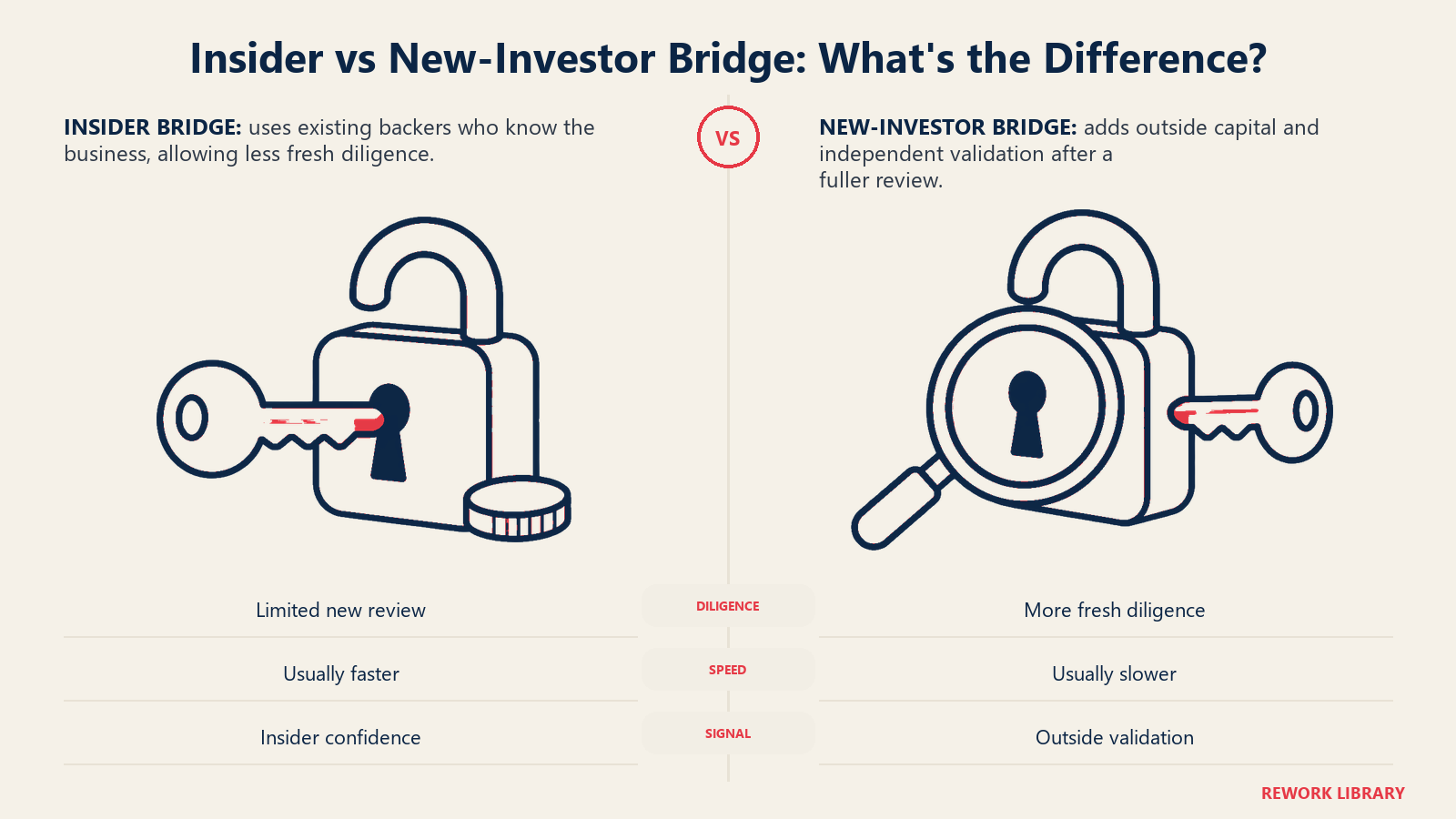
Insider-led bridges come from existing investors, often the lead from the last round. They close quickly, need little diligence, and usually carry simple terms. The downside is signalling. Future investors will ask whether insiders put in only what they had to, and whether any insider declined to participate. A bridge where everyone pitches in pro rata tells a better story than one funded by a single investor while others stay out.
New-investor bridges bring fresh money and a fresh opinion. They take longer and demand more diligence, and new investors often ask for firmer terms (lower caps, bigger discounts) because they're stepping in during a hard moment. But a new investor choosing to bridge is real outside validation, which an insider-only bridge can't give.
Mixed bridges combine both, and they're often the strongest signal. An outside investor setting terms, with insiders following, avoids the "insiders propping up the company" reading.
Either way, the terms should be offered to all participating investors on the same footing. Different caps for different people create a fairness problem and make conversion math messy.
Bridge to Where?
The most useful discipline for any bridge is writing down its destination. A bridge has to end somewhere, and there are four common endpoints.
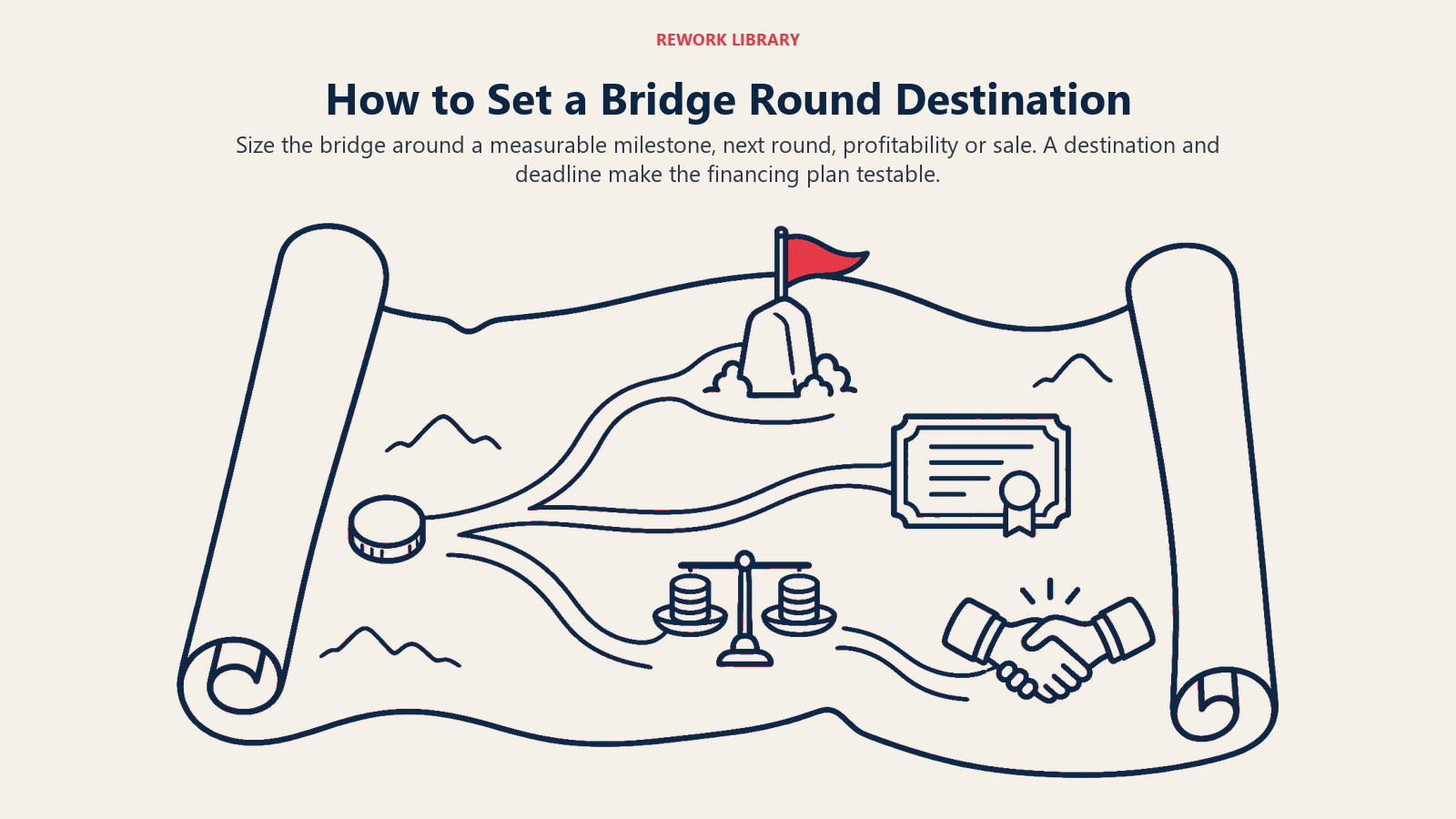
| Destination | What the bridge must achieve | What can go wrong |
|---|---|---|
| A milestone | Hit a specific, measurable target (for example, a revenue level or a product launch) that unlocks a better valuation | The milestone moves, or the market stops caring about it |
| The next priced round | Cover the time a round takes to close | The round takes longer than planned, and a second bridge follows |
| Profitability | Reach break-even so no outside capital is needed | Costs are cut too late or growth stalls before break-even |
| A sale | Keep the company alive through an acquisition process | Buyers wait for the company to run out of cash |
A bridge to a milestone is the healthiest version. A bridge to "whenever the market recovers" is the riskiest, because there's no way to tell if it worked. If the plan is profitability, the unit economics and cash flow have to support it, not just hope.
Signalling Risk
Bridges carry a signal, whether founders intend one or not. New investors will read the bridge as one of three things:
- Healthy extension. The company is on track and wants a few more months to hit a bigger number.
- Distress. The company missed its plan, and the bridge is keeping it alive.
- Insider confidence. Existing investors know the company best and are doubling down.
The same bridge can be read all three ways depending on how it's framed. A founder who explains the milestone, the numbers so far, and why insiders are investing controls the story. A founder who goes quiet hands it to the investors.
Repeated bridges are the real red flag. One bridge is normal. A second bridge to cover the first suggests the plan isn't working, and the next investor will likely price in that risk, sometimes through a down round or a heavily negotiated structure.
How It Relates to Runway and Burn
A bridge is a runway tool. The math is simple: runway equals cash divided by monthly burn rate. A bridge adds to the cash side. But it only helps if burn stays under control. Founders who treat a bridge as permission to keep spending end up needing another one in six months.
A useful rule is to size the bridge to the milestone, not to the fear. Work backwards: how many months does it take to hit the target, how long does a fundraise take after that, and what's the buffer? Raise that amount and no more. Raising more than needed at bad terms is expensive. Raising less than needed means a second bridge.
Some founders also cut burn alongside the bridge, so the same dollars last longer. That's usually a good sign to investors, because it shows the company is managing for outcomes, not just for survival.
Common Mistakes and Founder Watch-Outs
- No destination. Raising a bridge without a written milestone and date.
- Too many instruments. Stacking SAFEs and notes with different caps, then discovering the dilution at the next round. Model the cap table before signing, and consider cap table software to see the effect.
- Ignoring maturity dates. Convertible notes can come due. If conversion hasn't happened by then, the holder may ask for repayment or an extension.
- Unequal terms. Giving different investors different caps or discounts without telling everyone.
- Hiding the bridge. New investors will find out. Disclose it, explain it, and show the plan.
- Treating it as a fix for a broken model. If the underlying economics don't work, a bridge only postpones the problem.
- Skipping legal review. Bridge documents look simple but have real consequences for control and dilution. Terms and rules differ by jurisdiction, so have counsel review them.
For the wider fundraising picture, including how bridges fit into a full capital plan, see the strategic fundraising guide.
How Bridges Compare to Adjacent Terms
| Term | How it differs from a bridge |
|---|---|
| Priced round | Sets a valuation and issues new shares. A bridge defers the valuation. |
| Extension | A top-up of the same series at the same price. Often called a bridge, but it is priced. |
| Down round | A priced round at a lower valuation than before. A bridge can lead into one, or avoid it. |
| Convertible note | An instrument. A bridge is a purpose, and a note is one way to do it. |
| Venture debt | Borrowed money repaid in cash. A bridge usually converts into equity. |
Related Reading