What Is a Lead Investor?
Turn this article into takeaways for your work.


Each assistant summarizes the article only for you and suggests best practices for your work.
A lead investor is the investor in a funding round who sets the price and terms, usually writes the largest check, and organizes the other investors around that deal. In a priced equity round, the lead issues the term sheet, runs the deepest due diligence, directs the legal documents, and very often takes a seat on the company's board.
Think of the lead as the anchor of the round. Other investors (called co-investors or followers) mostly accept the terms the lead negotiated. That's why founders spend so much effort finding the lead first: until one investor says "I'll set the terms and put in the first big check," most rounds don't close.
This article explains what leads do, how they differ from other investor roles, what a lead typically gets in return, and what founders should check before accepting one. It's reference material, not legal advice. Terms vary by country and by deal, so have a lawyer review any term sheet before you sign.
What a Lead Investor Does
The lead carries the work that the rest of the investor group relies on. In practice that comes down to five jobs.
- Sets the price and terms. The lead negotiates the valuation, the amount raised, and the main investor protections with the founders. Everyone else in the round usually invests on those same terms.
- Issues the term sheet. The term sheet is a short, mostly non-binding summary of the proposed deal. It's the lead's formal offer. Our guide to valuation covers how the price in that document gets derived.
- Runs diligence. The lead checks the cap table, intellectual property ownership, contracts, financials and corporate records. Co-investors often lean on this work instead of repeating it.
- Drives the legal documents. The lead's counsel typically drafts or controls the financing documents. The NVCA, the US venture capital trade body, publishes free model legal documents for venture financings, including a stock purchase agreement, an investors' rights agreement, a voting agreement and a right of first refusal and co-sale agreement. Many US deals start from these templates.
- Pulls in the rest of the round. A credible lead signals conviction to other investors, which makes filling the remaining allocation easier. CRV, a venture firm, describes this "first domino" effect in its own explainer on lead investors.
After closing, many leads also help with hiring, introductions and the next round, though that's a bonus and not something the term sheet guarantees.
A Worked Example
Here's an illustrative round, using our own arithmetic with made-up numbers. It isn't a benchmark.
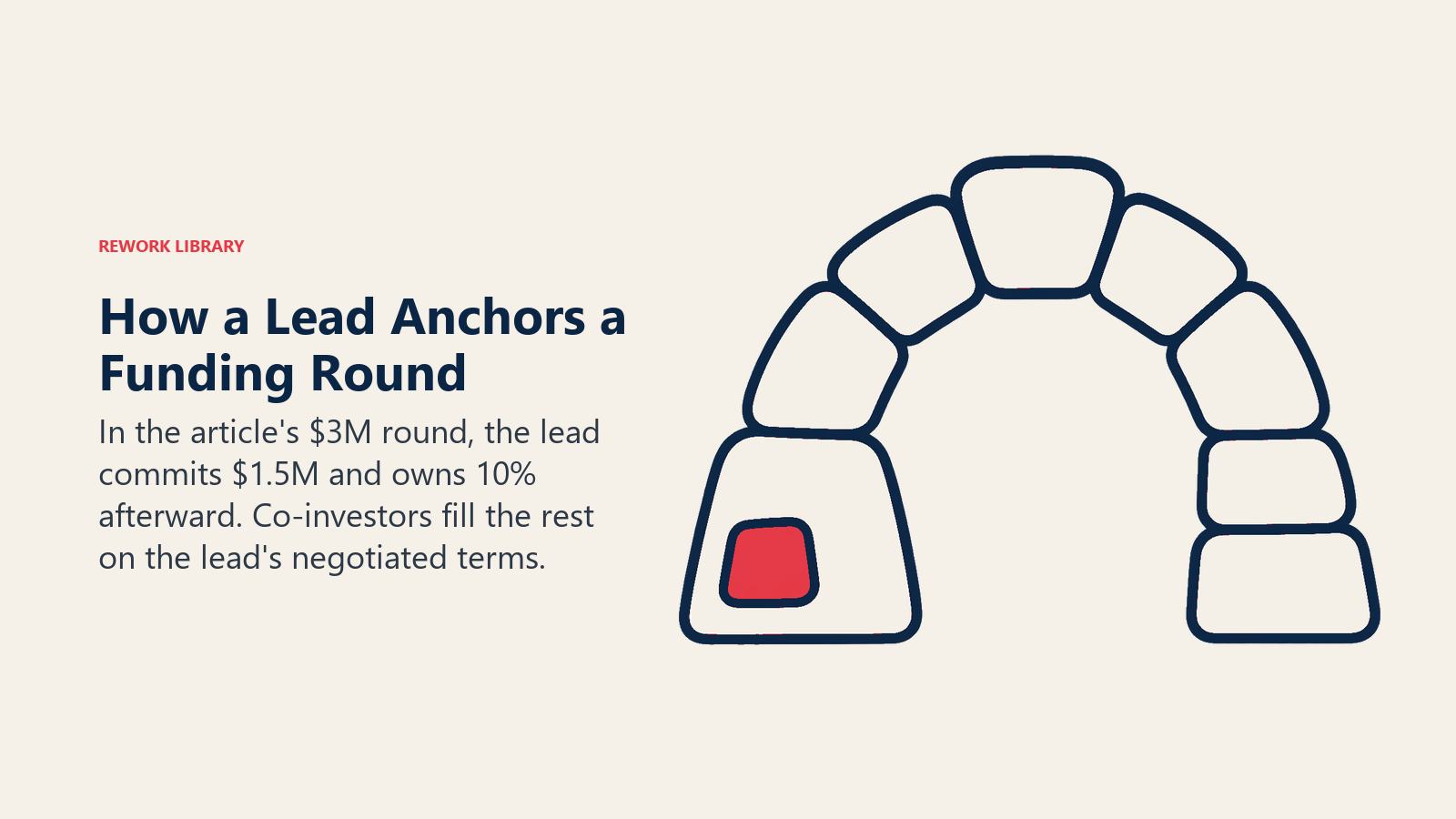
A startup raises $3 million at a $12 million pre-money valuation, so the post-money valuation is $15 million ($12M + $3M).
| Investor | Role | Check | Ownership after round |
|---|---|---|---|
| Fund A | Lead | $1.5M | 10% ($1.5M / $15M) |
| Angel group | Co-investor | $0.9M | 6% |
| Two individual angels | Co-investors | $0.6M | 4% |
| Total new investors | $3.0M | 20% |
Existing shareholders (founders, earlier investors, any option pool) hold the remaining 80%. Fund A set the $12 million number, wrote half the round, and would probably ask for a board seat. The other three checks exist because Fund A's term sheet gave them something to say yes to. If Fund A walks away, the $1.5 million hole usually isn't filled by "just a few more angels." It often means starting the process over.
Lead Investor vs Other Investor Roles
The roles overlap, so people mix them up. Here's how they differ.
| Role | What they do | Typical check size in the round | Board seat? |
|---|---|---|---|
| Lead investor | Sets terms, issues term sheet, runs diligence, anchors the round | Largest | Often yes, or an observer seat |
| Co-lead | Shares the lead job with another firm, splitting price negotiation and diligence | Large | Sometimes |
| Co-investor | Invests on the lead's terms, relies on the lead's diligence | Smaller | Rarely |
| Follow-on investor | An existing investor who adds money in a later round to keep their ownership share | Varies | Only if they already have one |
| Syndicate member | Joins through a lead who organizes a group, common with angels | Small | No |
Two clarifications matter here. First, "follow-on" describes a relationship to an earlier round, while "co-investor" describes a role within one round. The same fund can be a follow-on investor and a co-investor in the same deal. Second, a syndicate is a group of investors, often angels, who pool behind one organizer. In that case the organizer functions as the lead.
An angel investor can lead a small round, but leads are more often institutional funds at seed and later stages.
Rounds Without a Lead
Some rounds close without a single dominant investor. They're often called party rounds, because many small investors participate and nobody sets the price firmly.
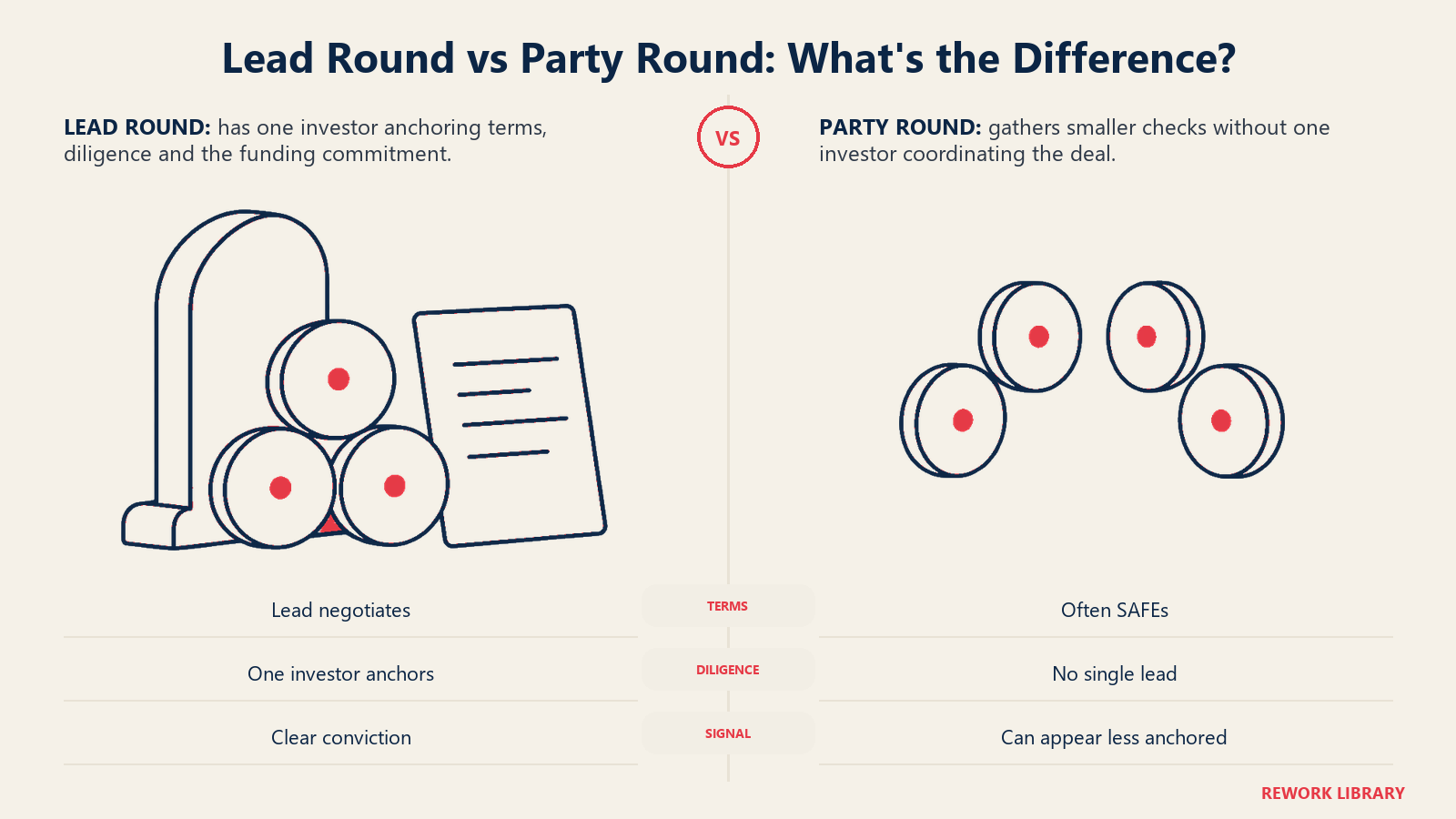
Founders sometimes choose this path on purpose, usually through SAFEs. A SAFE, the Simple Agreement for Future Equity that Y Combinator published, sets a valuation cap now and converts automatically when a priced round happens later. Because there's no priced round yet, no one needs to be the lead. That makes SAFE rounds fast and lightweight.
The trade-off is that a party round gives you no anchor. No single investor has a large stake in your success, and nobody did the heavy diligence. CRV's guidance says a party round can signal that no serious investor wanted to lead, which can hurt credibility with later-stage investors. That's one firm's view, not a law of fundraising, but it matches how many investors read a round with no clear lead.
For related instruments, see convertible notes and bridge rounds, which are also used when a priced lead round isn't available yet.
What Leads Usually Get in Return
Taking the lead means more work and more risk, so leads typically ask for more than followers do. Common asks include:
- A board seat or observer seat. One director seat is the usual request. The seat gives the lead a formal voice in major decisions and a duty of care to the company.
- Information rights. Regular financial reporting, beyond what small co-investors receive.
- Pro rata rights. The right to invest in future rounds to avoid dilution. Co-investors often get these too, but the lead's are usually broader.
- Protective provisions. Veto rights over specific actions, such as selling the company or issuing senior shares.
- A larger allocation. The lead often has first call on how much of the round they take.
Standard investor terms such as liquidation preference are also usually negotiated by the lead and then extended to everyone in the round. That's one reason the lead's terms matter even to investors who never meet you.
Board Seat and Governance Implications
A board seat for the lead changes how a company is run. Before the round, a founder-run board may be one or two people who agree on almost everything. After the round, the board has a director with a fiduciary duty to the company as a whole, and an investor's perspective on pace and exit timing.
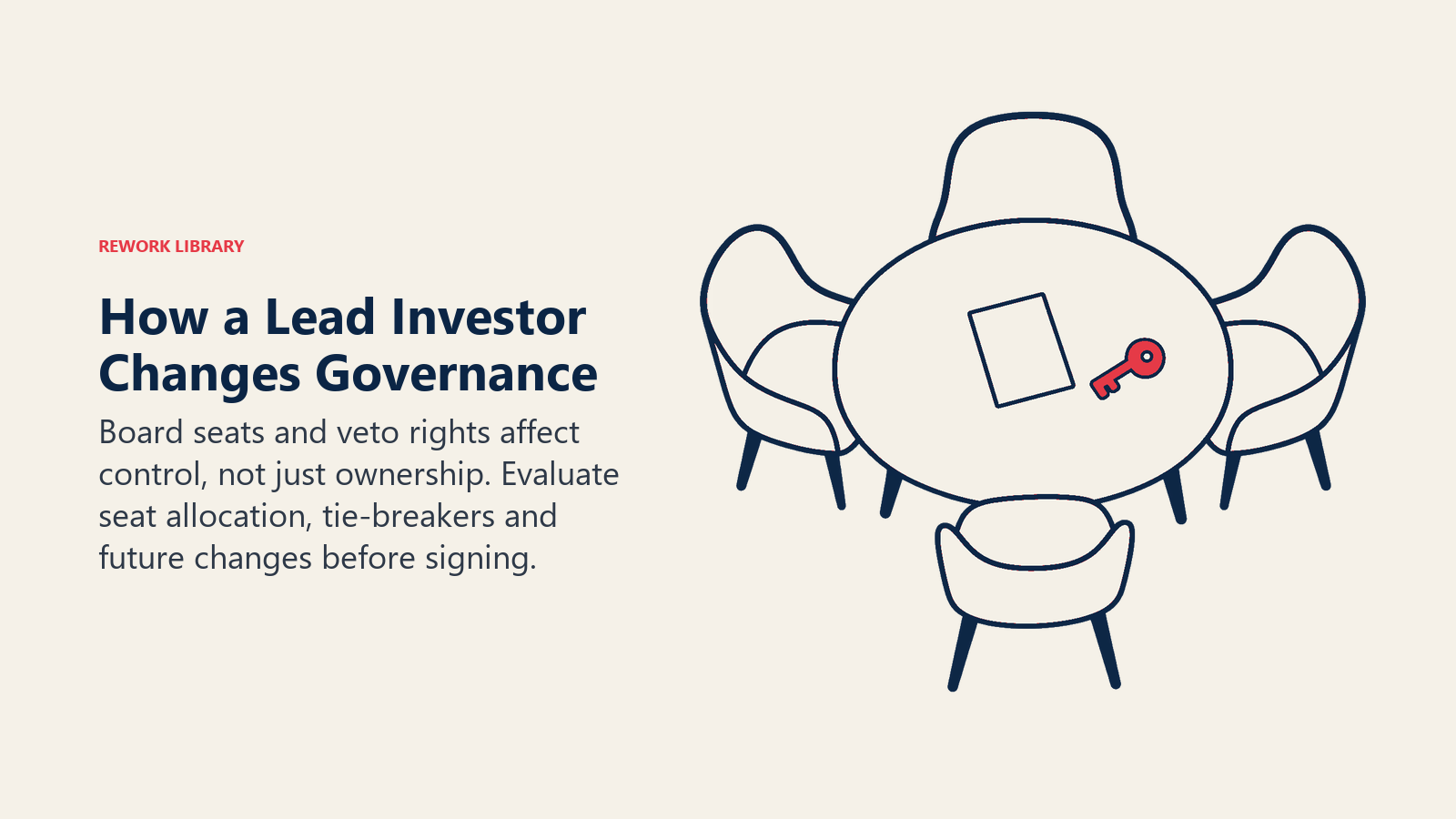
Founders should check three things in the term sheet:
- Board composition. How many seats exist, who picks each, and who holds the tie-breaker. A five-person board with two founders, one lead, and two independents works very differently from a three-person board where the founders are outvoted.
- Protective provisions. A long veto list can let an investor block decisions even when they don't control the board.
- What happens in later rounds. A seat granted now gets harder to reshape when new investors want their own.
The practical rule: treat the board seat as part of the price. A slightly lower valuation with clean governance can be a better deal than a higher number with heavy control rights.
How to Find and Evaluate a Lead
Finding a lead takes a process, not luck.
- Build a target list. Look for firms that invest at your stage, in your sector, with a typical check size large enough to anchor a round of your size. A fund that normally writes $250,000 checks can't comfortably lead a $3 million round.
- Seek warm introductions. Founders in an investor's existing portfolio, or earlier investors you already have, are the usual route in.
- Run the process tightly. Meet many investors in a short window so interest builds on a similar timeline. A slow, drawn-out process reads as weak demand.
- Check them as carefully as they check you. Ask other founders in their portfolio how they behave during bad quarters, not only good ones.
When you compare offers, look past valuation to these factors:
| What to compare | Why it matters |
|---|---|
| Valuation and amount | Sets your dilution; see valuation |
| Board and veto terms | Determines who controls major decisions |
| Reserve capacity | Whether the fund can follow on in your next round |
| Speed and certainty | How fast the lead can close and how likely it is to hold the terms |
| Reputation with founders | A signal of how they act when things get hard |
Match the amount raised to your plan too. Your runway and burn rate tell you how much the round has to cover before the next one. For a wider look at the fundraising process, read the strategic fundraising guide.
Key Facts
- A lead investor sets the valuation and terms, usually writes the largest check, and organizes the rest of the round.
- The lead issues the term sheet, which is generally non-binding on most points, and directs the legal documents.
- Co-investors typically invest on the lead's terms and rely on the lead's diligence.
- Leads commonly ask for a board seat or observer seat, plus information and pro rata rights.
- SAFE and convertible-note rounds can close without a lead because no price is set yet.
- A round with no clear lead is sometimes read by later investors as a sign that no serious investor wanted to lead.
Common Mistakes and Founder Watch-Outs
- Chasing followers first. Small investors usually wait for a lead's terms. Lining up checks without a lead often leads to commitments that evaporate.
- Optimizing only for valuation. Governance and veto rights can matter more than a few points of price.
- Treating "interested" as "leading." Many investors say they're "in" without committing to set terms. Ask directly: "Will you lead, and what check size?"
- Ignoring cap table effects. Each round changes who owns what. A cap table tool helps; see best cap table software.
- Skipping legal review. Term sheets look short but contain terms that last for years. Have counsel read them.
- Letting one investor dominate every round. Relying on one fund to lead every time can make you dependent on their view of your company.
Outside the US
The roles described here come from US venture practice, and many investors in other markets follow similar patterns, with a lead negotiating terms and others joining. But legal structures, standard documents and investor protections differ across countries such as Singapore, Vietnam and Indonesia. Check local law and local norms with a lawyer in your jurisdiction instead of assuming US terms apply.
Frequently Asked Questions about Lead Investors
What is a lead investor in simple terms?
A lead investor is the investor who sets the price and terms of a funding round and usually writes the biggest check. Other investors typically join on those same terms. The lead also runs the main due diligence and often takes a board seat.
Does every funding round need a lead investor?
No. Rounds built on SAFEs or convertible notes can close with many small investors and no lead, because no price is being set yet. But a priced equity round almost always needs someone to set the valuation and drive the legal documents, and that someone is the lead.
What is the difference between a lead investor and a co-investor?
The lead negotiates terms, issues the term sheet and does the deepest diligence. A co-investor invests alongside the lead, usually with a smaller check, and accepts the terms the lead negotiated. Co-investors rarely get a board seat.
How much of the round does a lead usually take?
There's no fixed rule. Leads often take the largest share, and sometimes about half, but that depends on the round size, the fund's usual check and how many other investors participate. Treat any percentage as a rough guide, not a standard.
Does a lead investor always get a board seat?
Not always, but it's common. Some leads take a director seat, some take an observer seat with no vote, and some at very early stages take neither. Board composition is negotiable and should be read closely in the term sheet.
How do I find a lead investor?
Start with investors who fund your stage and sector and whose check size fits the round. Seek warm introductions, meet many investors in a short window, and speak to founders in their portfolio before choosing. Compare governance terms, not only valuation.
Related Reading