What Is the Idea Stage of a Startup?
Turn this article into takeaways for your work.


Each assistant summarizes the article only for you and suggests best practices for your work.
The idea stage is the very first phase of a startup's life. A founder or small founding team has a problem worth solving and a rough hypothesis about how to solve it, but little or no product, no repeatable sales, and often no company paperwork. The job at this stage is not to build. It's to find out whether the problem is real, who has it, and whether anyone would pay for a fix.
Most of the work is learning, not shipping. The stage ends when the team has enough evidence to justify building a first version and, usually, asking for outside money. That next step is covered in pre-seed startups and seed-stage startups. For the full sequence, start with the hub article on the stages of a startup.
What the idea stage is, and what it isn't
At this stage a startup is mostly a set of unproven beliefs. Steve Blank, whose customer development method shaped much of modern startup practice, defines a startup as an organization formed to search for a repeatable and scalable business model. The idea stage is the earliest part of that search.
Blank describes the starting position as a vision of a product plus a series of hypotheses about every piece of the business model: who the customers are, how the product is distributed, how it's priced, and how it gets financed. The founder's job, in his words, is to quickly validate whether the model is correct by seeing whether customers behave the way the model predicts. Most of the time, he notes, they don't.
So the idea stage is not:
- A finished plan. A long document full of guesses is still guesses.
- A product launch. If you're already selling to repeat customers, you've moved past this stage.
- A fundraising round. Some founders raise on an idea alone, but that's an outcome of strong evidence and reputation, not the point of the stage.
- A company registration milestone. Legal setup matters, but it doesn't prove anything about demand.
Why the idea stage matters
Early mistakes are the cheapest to fix, and also the easiest to miss. Paul Graham of Y Combinator argues that the most common mistake startups make is solving problems no one has. He gives his own example: in 1995 he spent six months on a company to put art galleries online, only to find galleries didn't want to be online, because it wasn't how the art business worked.
The lesson isn't that ideas are fragile. It's that a plausible-sounding idea can fool its owner. Graham says founders end up building things nobody wants when they begin by trying to think of startup ideas, rather than noticing real problems. The idea stage exists to catch that error before months of salary, savings, and goodwill are spent.
The core questions to answer
A useful way to run the idea stage is to treat it as a short list of questions with evidence behind each one.
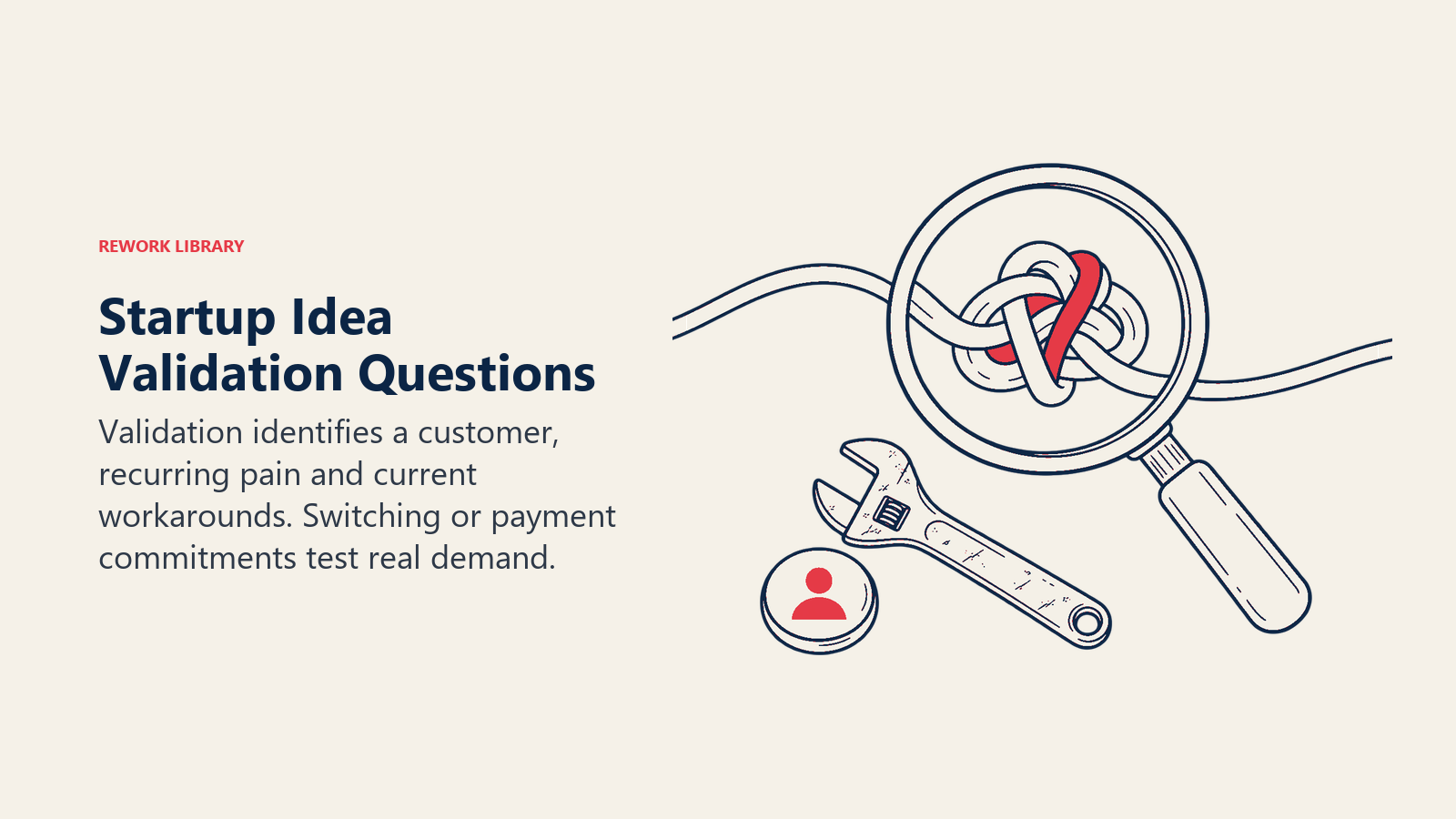
| Question | What a good answer looks like | Weak answer |
|---|---|---|
| Who has the problem? | A named, reachable group of people you can talk to this week | "Everyone" or "small businesses" |
| How bad is the problem? | People already spend time, money, or workarounds on it | People nod politely but do nothing about it today |
| How is it solved now? | You can list current tools, spreadsheets, or habits | "Nothing exists" with no competitors or workarounds |
| Would they switch or pay? | Specific people describe what they'd give up or pay | Compliments with no commitment |
| Can this team build it? | The founders have the skills or access to build a first version | The plan depends on hiring skills nobody has yet |
| Is the market large enough? | A path from a first niche to a bigger group | A market size copied from a report with no link to your customer |
If you can't answer the first three with real conversations, you're still at the idea stage no matter how many slides you've made.
Where good ideas come from
Founders often ask how to find an idea at all. Graham's advice is that the verb you want to use is not "think up" but "notice". He calls ideas that grow out of the founders' own experiences "organic" startup ideas, and says the most successful startups almost all begin that way.
He also lists three traits of the best ideas: they're something the founders themselves want, that they can build themselves, and that few others realize are worth doing. And he warns about two filters that hide good ideas: the "unsexy" filter and the "schlep" filter, the tendency to skip ideas that involve tedious, messy, real-world work. Payments before Stripe is the example he uses.
Practical sources of ideas include:
- Your own work. Friction you hit every week as an employee or customer.
- Frequent complaints. The same gripe from many people in one role or industry.
- Changes in a field. New technology, regulation, or behavior that makes an old process obsolete.
- Expensive workarounds. Teams paying people to move data between tools by hand, for example.
A framework like Jobs to Be Done helps here, because it asks what progress a customer is trying to make rather than what features they want.
What founders actually do at this stage
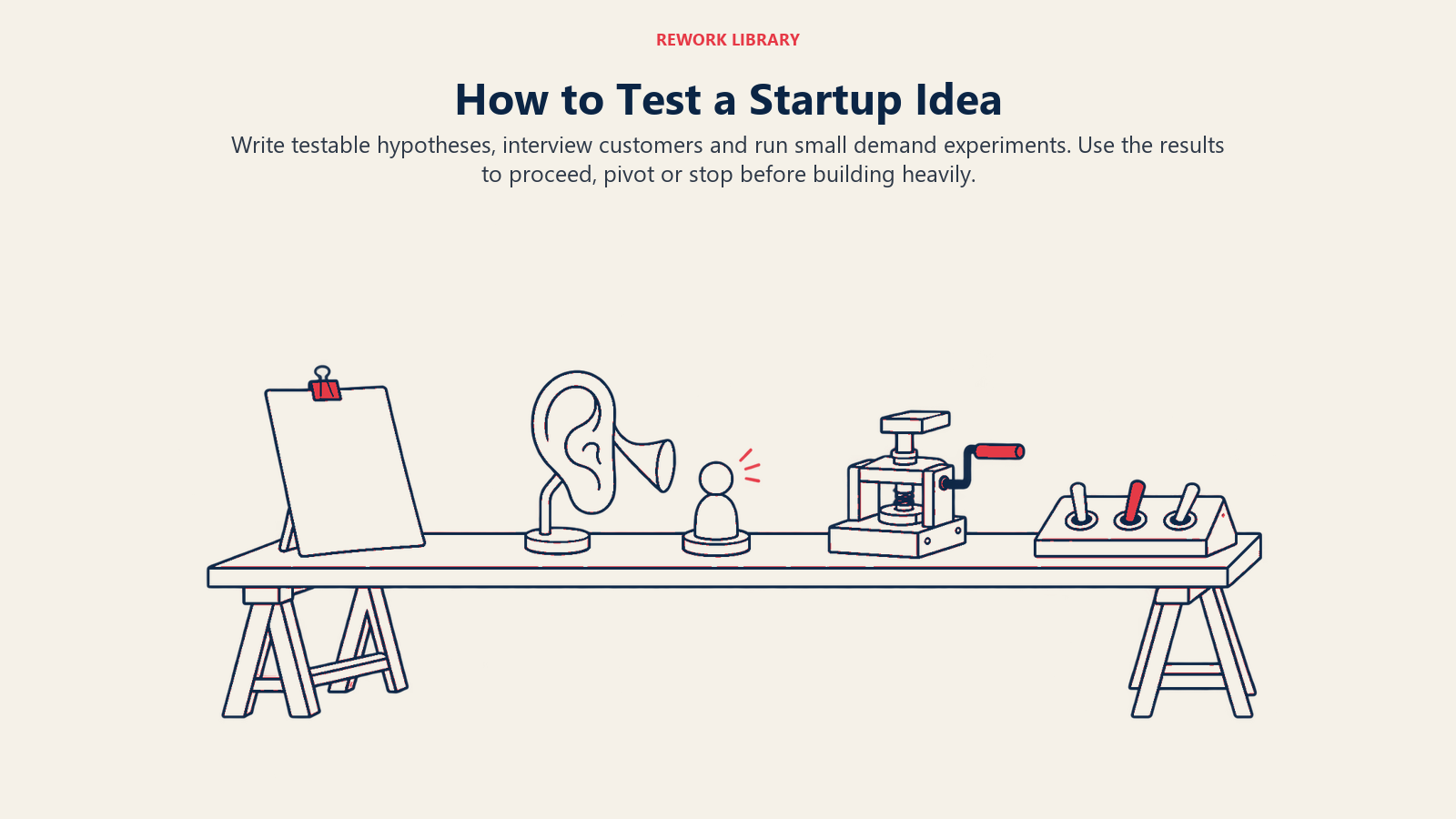
The work falls into five loops, which usually overlap.
1. Write the hypotheses down
Turn the vision into statements that can be wrong. "Operations managers at 50 to 200 person logistics firms lose hours each week reconciling delivery data, and would pay to stop" is testable. "Logistics needs better software" is not. The Business Model Canvas is a common one-page way to list customer segments, value proposition, channels, revenue, and costs as assumptions to check. A close cousin, the Value Proposition Canvas, zooms in on the customer's pains and gains.
2. Talk to potential customers
Blank's customer development approach rests on the idea that the answers are outside the office, with customers. The Lean Startup method makes a related point: figure out the problem to be solved first, then learn through small experiments before building a full product. Good interviews ask about the past ("Tell me about the last time this happened") rather than the future ("Would you use this?"), because people are poor at predicting their own behavior.
3. Study the alternatives
Competitors, substitutes, and the "do nothing" option all count. The US Small Business Administration describes market research as a way to confirm and improve a business idea and reduce risk while it's still just a gleam in your eye, and pairs it with competitive analysis to find what makes your business different. If you can't find any alternative, treat that as a question mark, not a green light. It may mean the problem isn't painful enough for anyone to have tried to fix it.
4. Test demand cheaply
Before writing code, founders run low-cost tests: a landing page with a clear promise and a signup form, a manual service delivered by hand, or a prototype that's a clickable mockup. The Lean Startup site describes the build-measure-learn loop, starting with a minimum viable product to begin learning as quickly as possible. At the idea stage, even that can be smaller than a product: a concierge version where you do the work yourself.
5. Decide on the next step
After enough conversations and tests, the team makes one of three calls: proceed to build, change the idea (a pivot), or stop. Stopping early is a legitimate result. It's the cheapest possible failure.
What counts as evidence
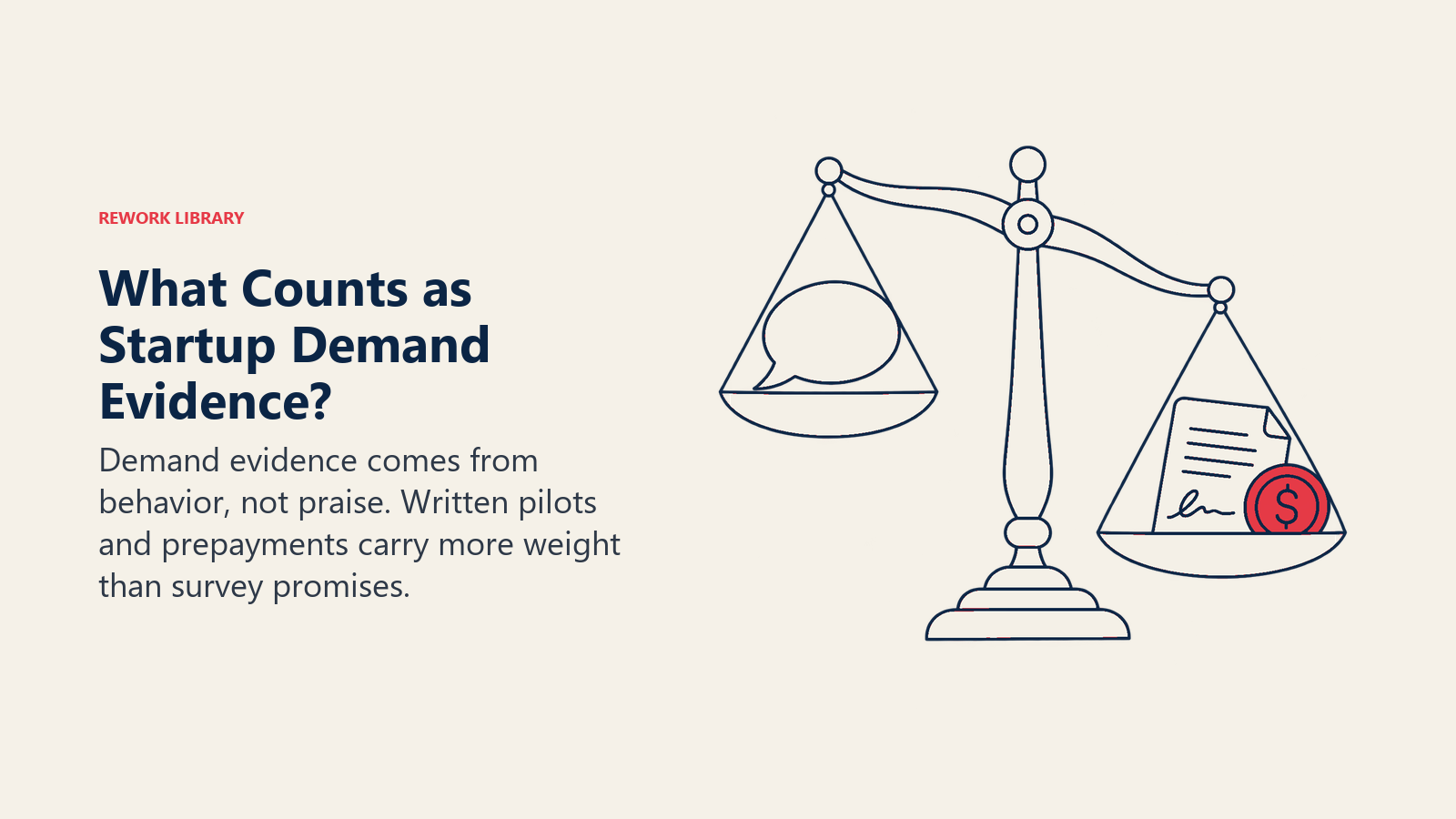
Not all signals are equal. A rough ladder, from weakest to strongest:
| Signal | Strength | Why |
|---|---|---|
| Friends say it sounds great | Very weak | Politeness costs them nothing |
| Survey answers saying "I'd use this" | Weak | Stated intent often differs from behavior |
| Interviews describing a painful, recurring problem | Moderate | Real past behavior, but no commitment |
| Waitlist signups from a targeted audience | Moderate | Small cost to the user, still a signal |
| Signed letters of intent or pilot agreements | Strong | A written commitment |
| Prepayments or paid pilots | Strongest | Money moves before the product exists |
This ladder is our own framing for ranking evidence, not a figure from any study. The point is that behavior and money beat opinions.
Funding at the idea stage
Most idea-stage startups run on founder savings, a day job, or a small amount of help from family and friends. Formal venture investing is rare this early, because there's little to evaluate beyond the team and the problem.
Some founders do take small checks from angel investors, especially if they have a track record, a prototype, or a strong network. Be careful about what you give up for very little money. If you do raise, track burn rate and runway from the start, so you know how long your savings last and what evidence you can gather in that time.
Funding norms vary by country and by industry, and grants, bank loans, or a local accelerator might be options depending on where you operate. Check local rules before you rely on any one source.
Team and structure
At this stage, the team is usually one to three people. Two things matter most:
- Complementary skills. Someone who can build or at least prototype, and someone who can talk to customers and sell.
- Agreement on the basics. Who does what, who owns how much, and what happens if someone leaves. Even a simple written founder agreement avoids painful arguments later.
You don't need an office, a brand, or a long list of hires. Time and focus are the real inputs.
Common mistakes at the idea stage
- Falling in love with the solution. The product is a hypothesis, not an identity. Graham describes being attached to his own model of the world and carrying on after the evidence said otherwise.
- Talking only to friends. They're kind, which makes them bad sources of signal.
- Skipping the problem and jumping to features. Feature lists feel like progress, but they come before you know what matters.
- Building before testing. A working product is the most expensive way to learn that nobody wants it.
- Defining the market too broadly. "Everyone with a phone" isn't a customer. Pick a narrow group and prove it there first.
- Treating a missing competitor as a good sign. Absence of alternatives often means absence of demand.
- Staying here forever. Research can become a way to avoid the risk of building. Set a time box and a decision date.
Signs you're ready to leave the idea stage
There's no official gate, but these signals suggest it's time to build a first version:
- You've spoken with a meaningful number of people in one specific segment, and the same problem keeps coming up.
- Several of them already use workarounds, tools, or budget to deal with it.
- At least a few have made a concrete commitment: a pilot, a deposit, a signed letter, or a firm date to try it.
- You can describe the customer, the problem, and the first version of your solution in two sentences.
- You know what the first version must prove, and how you'll measure it.
After that comes the work of building something small, getting it in front of real users, and moving toward product-market fit. Teams exploring the following stages can also look at the early-stage growth model and the comparison of early-stage vs growth-stage companies. For a model that describes how companies change as they grow, see Greiner's growth model.
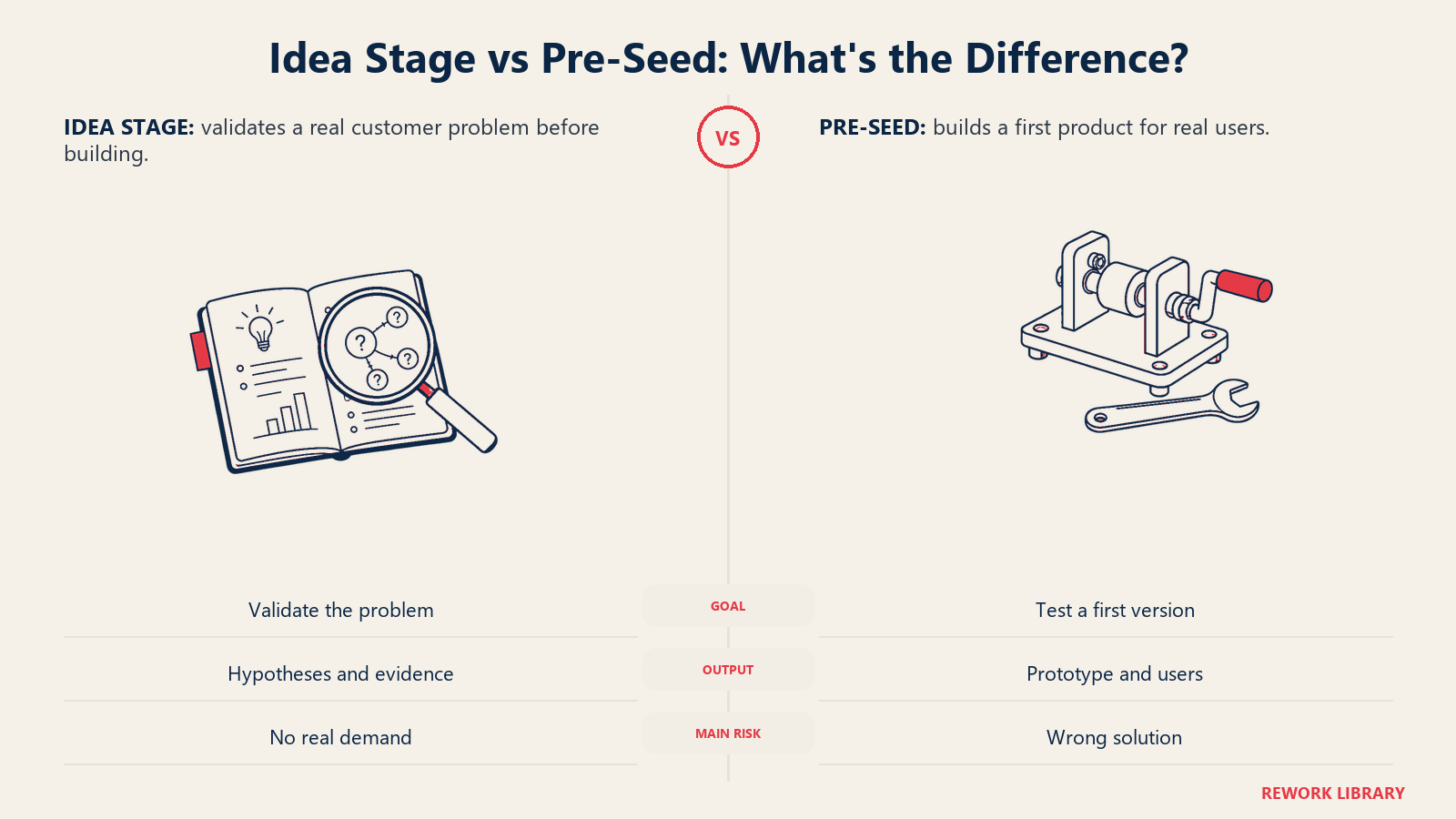
Idea stage compared with the next stage
| Idea stage | Pre-seed | |
|---|---|---|
| Main goal | Learn whether the problem is real | Build and test a first version |
| Typical output | Validated hypotheses, interview notes, a decision | Prototype or MVP, first users |
| Team | 1 to 3 founders | Founders, maybe a few early helpers |
| Revenue | None, or tiny | Little to none |
| Money source | Savings, side income, friends and family | Savings, small checks, grants, accelerators |
| Biggest risk | Solving a problem no one has | Building the wrong solution |
Labels vary between investors and regions, and some people merge these two stages or skip the term altogether. Treat the table as a typical pattern, not a rule.
Key Facts: The Idea Stage of a Startup
- Steve Blank defines a startup as an organization formed to search for a repeatable and scalable business model, and the idea stage is the first part of that search.
- Paul Graham says the most common mistake startups make is solving problems no one has.
- Graham also says the best ideas are ones the founders want, can build themselves, and few others realize are worth doing (source).
- The Lean Startup method begins by defining the problem, then building a minimum viable product to start learning.
- The SBA says market research helps confirm and improve a business idea and lets you reduce risk before the business exists.
- There is no formal legal definition of the idea stage. Labels and funding norms vary by country.
Related reading

On this page
- What the idea stage is, and what it isn't
- Why the idea stage matters
- The core questions to answer
- Where good ideas come from
- What founders actually do at this stage
- 1. Write the hypotheses down
- 2. Talk to potential customers
- 3. Study the alternatives
- 4. Test demand cheaply
- 5. Decide on the next step
- What counts as evidence
- Funding at the idea stage
- Team and structure
- Common mistakes at the idea stage
- Signs you're ready to leave the idea stage
- Idea stage compared with the next stage
- Related reading