Pre-Money vs Post-Money Valuation Explained
Turn this article into takeaways for your work.


Each assistant summarizes the article only for you and suggests best practices for your work.
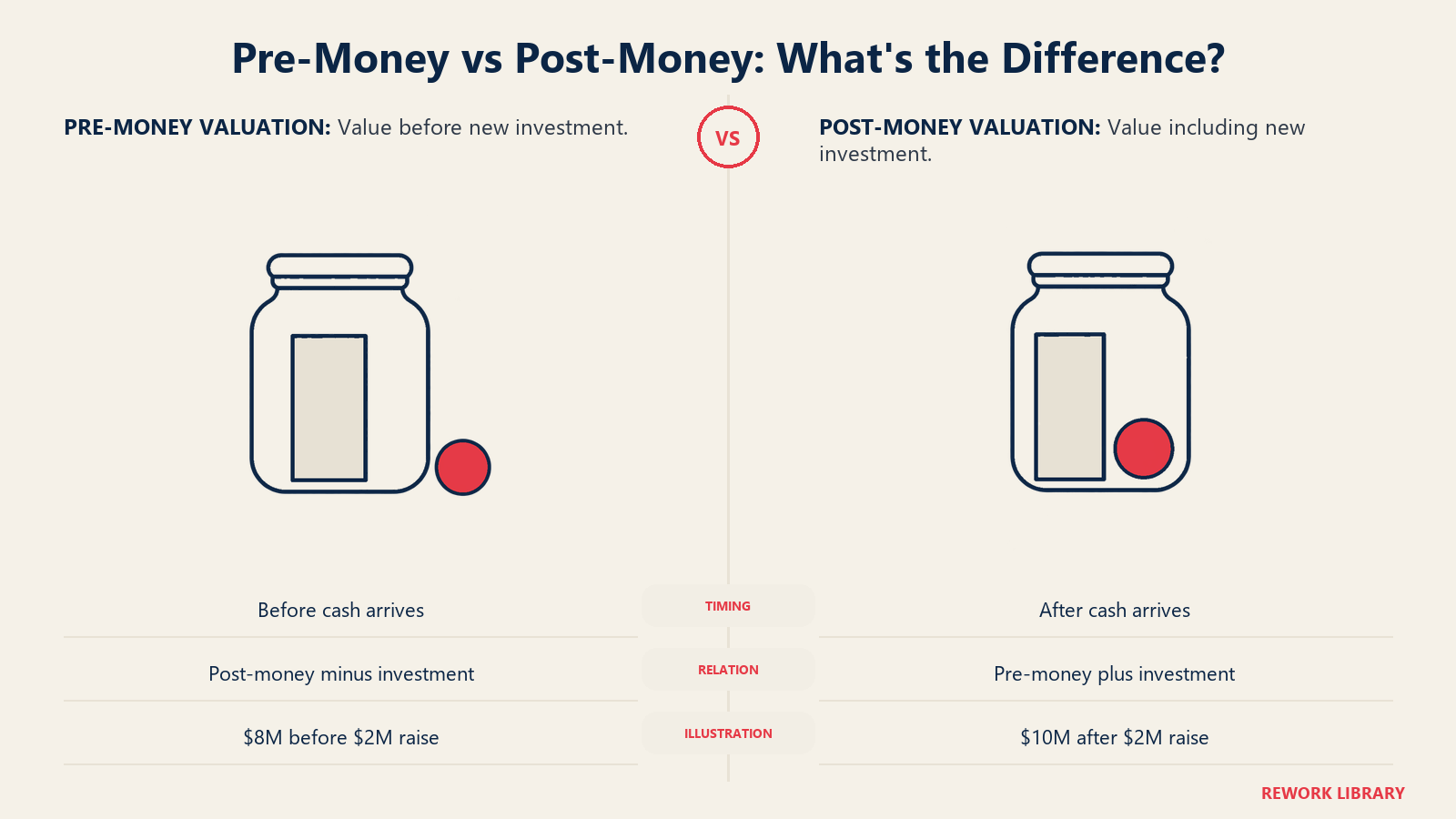
Pre-money valuation is what a company is worth immediately before it receives an investment. Post-money valuation is what it's worth immediately after. Y Combinator puts it in nearly those words: a pre-money valuation is the valuation immediately before the company receives the investment, and a post-money valuation is the valuation immediately after the investment is made.
The two numbers differ by exactly the amount of new money. That sounds trivial, but it's where a lot of founder confusion starts. "We raised at a $10M valuation" can mean two very different things depending on which number is being quoted, because the investor's ownership percentage is calculated from the post-money figure.
This article covers the definitions, the three formulas you need, a worked example with the arithmetic shown, how an option pool changes the picture, and how SAFEs treat the two terms. It's reference material, not legal or financial advice. Terms vary by jurisdiction and by deal, so have counsel review anything before you sign. For the broader idea of how companies get valued in the first place, see valuation.
The Core Definitions
Pre-money valuation is the agreed value of the company before the new investment lands in its bank account. It's what the company is "worth" at the moment the investor decides to write the check.
Post-money valuation is pre-money plus the new cash. The cash is now an asset of the company, so the company is worth that much more on paper.
Post-money = pre-money + new investment.
Valuation in an early-stage round is a negotiated number, agreed between the company and the lead investor who typically sets the terms for a round.
The Three Formulas
- Post-money valuation = pre-money valuation + new investment
- Investor ownership % = new investment / post-money valuation
- Price per share = pre-money valuation / pre-money fully diluted shares
A quick note on "fully diluted." It counts every share that exists or could exist: issued common and preferred shares, options already granted, and options reserved in the pool. Using the fully diluted count matters, because a price per share built on issued shares alone would overstate what the investor's money buys.
A Worked Example
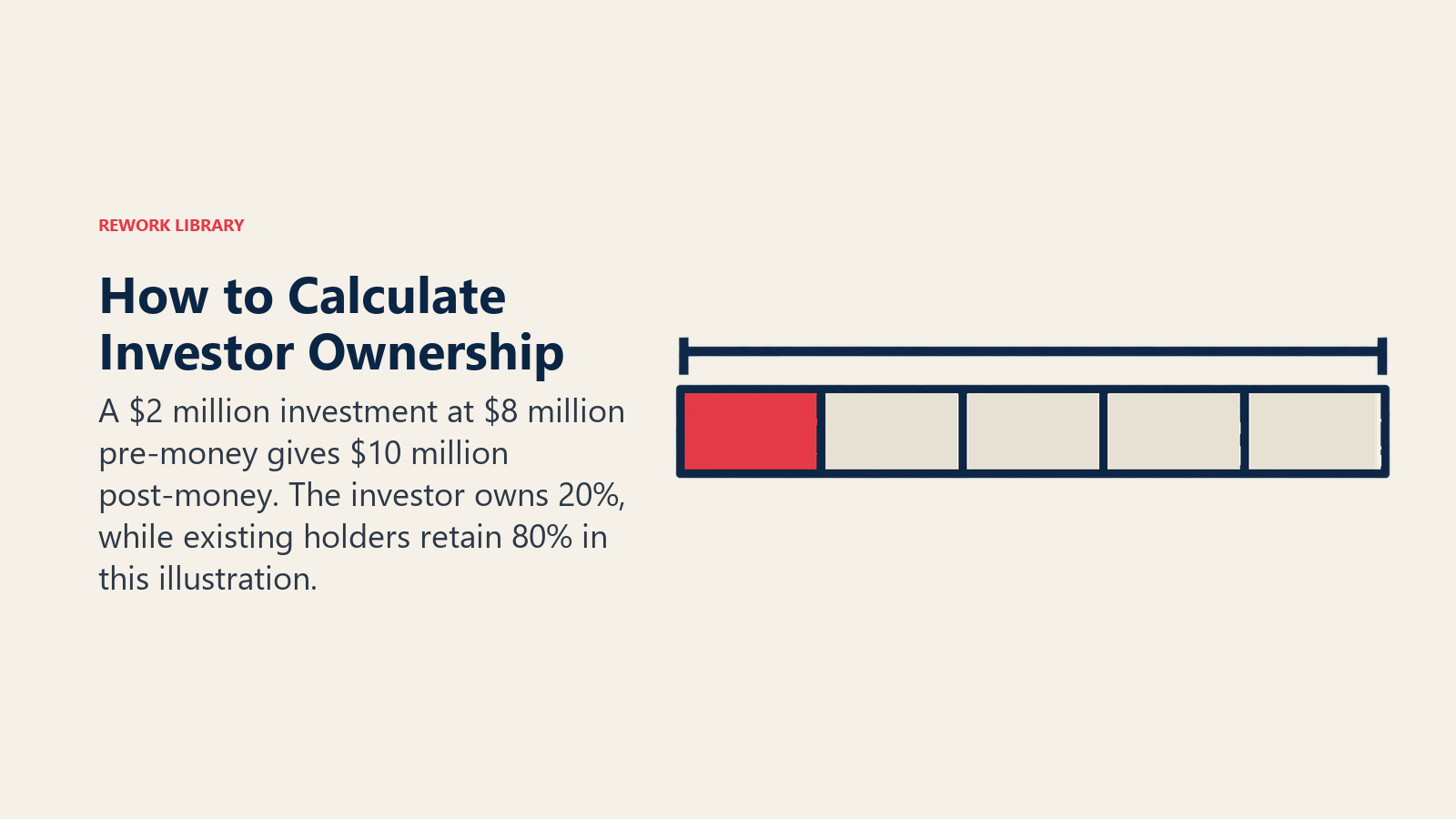
The numbers below are illustrative, not data from a real company. Assume a company has 8,000,000 fully diluted shares and agrees to raise $2M at an $8M pre-money valuation.
| Step | Calculation | Result |
|---|---|---|
| Post-money valuation | $8M + $2M | $10M |
| Investor ownership | $2M / $10M | 20% |
| Price per share | $8M / 8,000,000 shares | $1.00 |
| New shares issued | $2M / $1.00 | 2,000,000 |
| Total shares after | 8,000,000 + 2,000,000 | 10,000,000 |
| Existing holders' ownership | 8,000,000 / 10,000,000 | 80% |
Check: 2,000,000 new shares out of 10,000,000 is 20%, matching the formula. The existing holders were worth 100% of an $8M company before the round. After it, they own 80% of a $10M company, which is still $8M of value. Nobody lost value. They gave up percentage in exchange for cash.
Now flip the framing. Suppose an investor says "we'll invest $2M at a $10M valuation." If that's pre-money, the post-money is $12M and the investor owns $2M / $12M, about 16.7%. If it's post-money, the investor owns 20% and the pre-money is $8M. Same headline, a 3.3 point difference in ownership. Always ask which one is meant.
Why the Distinction Matters in Negotiation
Founders tend to compare offers by the headline valuation. That's only useful if every offer quotes the same basis.
- A $10M pre-money offer for $2M gives the investor about 16.7%.
- A $10M post-money offer for $2M gives the investor 20%.
The second headline looks identical but costs the founders 3.3 more points of the company. The same logic applies to bigger rounds, where the gap widens: at $20M raised, a $50M pre-money means the investor owns about 28.6% ($20M / $70M), while a $50M post-money means 40%.
So when you compare term sheets, convert every offer to the same basis. Work out post-money, investor percentage, and the price per share, and compare those. It's also worth modelling the next few rounds on your cap table so you can see how much each equity dilution step takes from the founders.
The Option Pool Effect
The employee option pool is the part of pre-money valuation that surprises people most. Investors typically want enough unissued options set aside to cover hiring for the next stretch, and they usually want that pool to exist before they invest.

Cooley GO, a law firm's startup resource, explains that the pool typically represents a percentage of the post-closing fully diluted capitalization, and that most investors require the full amount of it to be treated as part of the pre-closing capitalization when calculating their price per share. The result, in its words, is that it only dilutes existing holders and not the new shares. Cooley adds that you may be better off at a lower valuation with a smaller pool than at a higher valuation and a larger pool.
Here's an illustration using made-up figures, extending the example above. The headline is still an $8M pre-money and $2M investment ($10M post-money, investor 20%), but the investor requires a pool equal to 10% of the post-closing company, created inside the pre-money.
| Item | Calculation | Result |
|---|---|---|
| Existing shares | Given | 8,000,000 |
| Existing holders' share of post-money | 100% - 20% investor - 10% pool | 70% |
| Total shares after the round | 8,000,000 / 0.70 | about 11,428,571 |
| New investor shares (20%) | 11,428,571 x 20% | about 2,285,714 |
| New pool shares (10%) | 11,428,571 x 10% | about 1,142,857 |
| Price per share | $2M / 2,285,714 | $0.875 |
| Existing holders' effective pre-money | 8,000,000 x $0.875 | $7M |
The headline says $8M pre-money, but the pool shuffle means the people who already own the company are effectively valued at $7M. The $1M gap is the value of the new pool. Check the other side: 8,000,000 plus the 1,142,857 pool shares is 9,142,857 fully diluted pre-money shares, times $0.875, which gives the $8M headline. Both views are right. They just answer different questions.
The takeaway is to negotiate the pool size alongside the valuation. If you can show a concrete hiring plan, you can often justify a smaller pool. Our guide to the employee option pool goes through sizing in more detail.
SAFEs: Pre-Money vs Post-Money
A SAFE (Simple Agreement for Future Equity) is an instrument that converts into shares at a later priced round. SAFEs carry a valuation cap, and the cap can be defined on a pre-money or post-money basis.
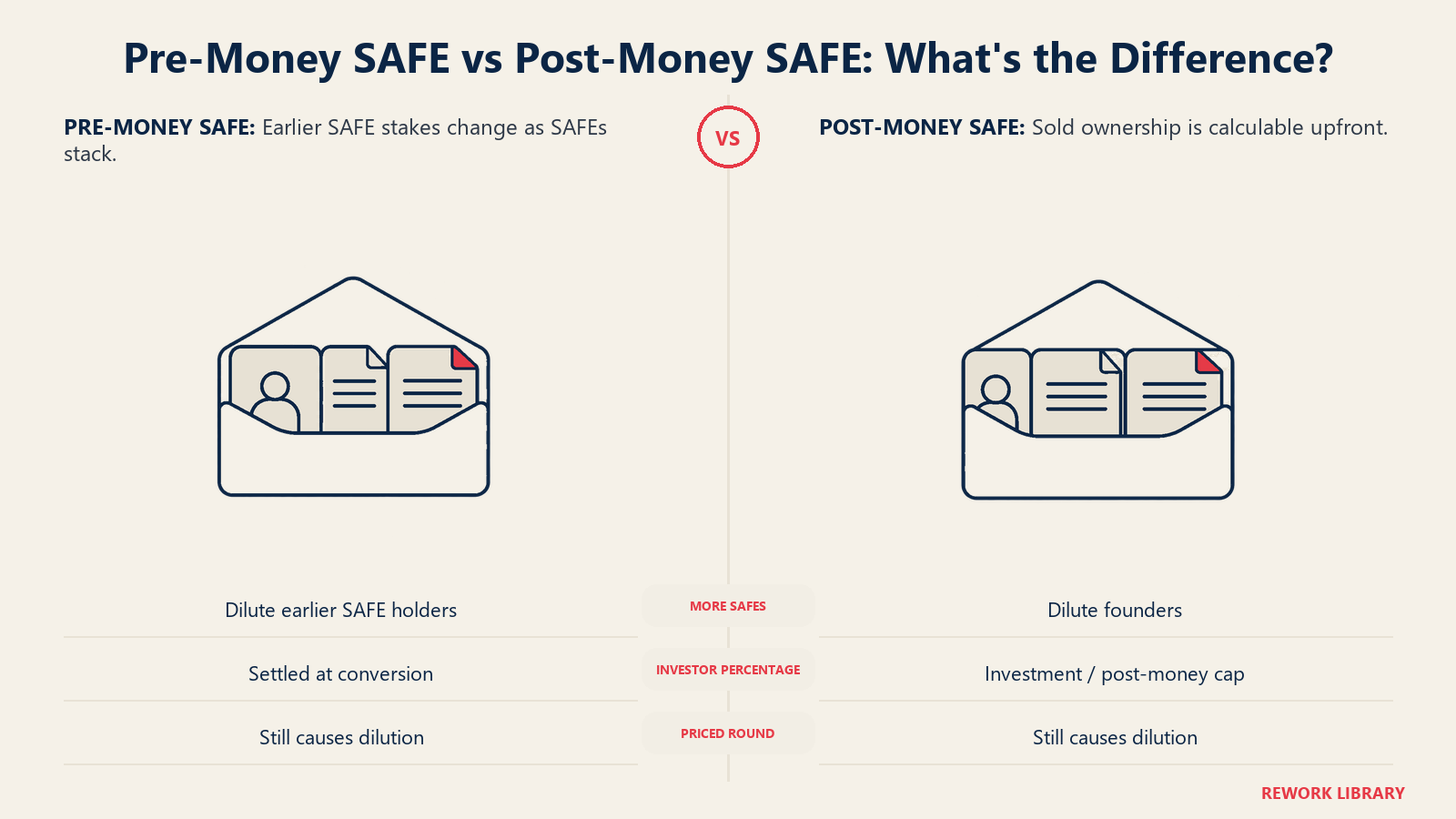
The practical difference is who absorbs the dilution from other SAFEs. With a pre-money SAFE, each new SAFE added before the priced round dilutes the earlier SAFE holders and the founders together, and the final percentage isn't clear until conversion. With a post-money SAFE, the cap includes all the SAFEs, so each investor knows their percentage up front.
YC's SAFE materials state this plainly: with a post-money SAFE, the amount of ownership sold is immediately transparent and calculable for both the founder and the investor. YC's post-money SAFE user guide is linked from that same page and walks through the conversion mechanics.
Here's a simple illustration, with made-up numbers. A founder signs one $1M SAFE with a $10M post-money cap. The investor's ownership at conversion is $1M / $10M = 10% of the company capitalization, as defined in the SAFE. If the founder then signs another $1M SAFE at the same cap, that investor also gets 10%, and the founders absorb both. Under a pre-money version of the same deal, the first SAFE's final percentage would shrink as the second one stacked on.
For the older instrument, a convertible note, the same pre-money or post-money question appears in how the valuation cap is defined, so read the cap definition each time.
Key Facts: Pre-Money vs Post-Money Valuation
- Post-money valuation = pre-money valuation + new investment.
- Investor ownership % = new investment / post-money valuation.
- Price per share = pre-money valuation / pre-money fully diluted shares.
- In the illustrative example above, $2M at an $8M pre-money gives the investor 20% of a $10M post-money company at $1.00 per share.
- If the same $2M is offered at a "$10M" valuation, it's 16.7% if that's pre-money and 20% if it's post-money.
- An option pool created inside the pre-money lowers the existing holders' effective pre-money, in the illustration from $8M to $7M.
- Post-money SAFEs fix each investor's ownership percentage at signing.
Common Confusions
- Mixing up the two when comparing offers. Always ask "pre or post?" and convert everything to one basis.
- Thinking post-money is the company's "real" value. Both are negotiated numbers. Post-money simply includes the new cash.
- Forgetting the option pool. A headline pre-money can be much lower once the pool is included, as in the $8M to $7M illustration.
- Assuming a higher valuation always wins. A higher valuation with a big pool, extra preferences or participation can leave founders worse off.
- Treating the valuation as permanent. A later round priced lower than a previous post-money is a down round, and it can trigger extra protections for earlier investors.
- Ignoring the stage. At the very earliest stages, many teams skip a priced valuation entirely and use a SAFE or note instead. See the seed stage startup overview for how that fits in.
Related Reading