What Is a Convertible Note?
Turn this article into takeaways for your work.


Each assistant summarizes the article only for you and suggests best practices for your work.
A convertible note is a loan that a startup expects to repay in shares instead of cash. An investor lends money now, the note accrues interest, and when the company later raises a priced equity round, the loan (plus interest) converts into stock, usually at a better price than the new investors pay. The US Securities and Exchange Commission describes it as "a loan made by an investor to a company that can be converted into a different security".
Founders use notes because early companies are hard to price. Instead of arguing over a valuation when there's almost no revenue to anchor it, both sides agree to postpone the question until a larger investor sets one. That's the whole trade: speed now, a pricing decision later.
How a Convertible Note Works
The lifecycle has four steps.
- The investor wires the principal. The company books it as debt, not equity. No shares are issued yet.
- Interest accrues. Most notes charge simple interest, and it's normally paid in shares at conversion rather than in cash.
- A trigger happens. Usually that's a priced equity round (a "qualified financing"), though a sale of the company can also trigger conversion or repayment, depending on the note.
- The note converts or comes due. In a qualified financing, principal plus accrued interest converts into shares. If nothing happens before the maturity date, the investor can generally demand repayment or negotiate a conversion or extension.
The same SEC page adds that the note typically converts automatically into preferred stock when the next round closes or other agreed conditions are met. Because the investor took risk before the round was priced, the note gives them a reward through a cap, a discount, or both.
Key Terms in a Convertible Note
| Term | What it means | Who it favors |
|---|---|---|
| Principal | The amount lent | Neutral |
| Interest rate | Annual rate that accrues on the principal, normally converted to shares | Investor |
| Maturity date | The date the debt comes due | Investor |
| Valuation cap | The highest valuation at which the note converts, whatever the new round is priced at | Investor |
| Discount | A percentage off the price new investors pay | Investor |
| Qualified financing threshold | Minimum new cash a round must raise to trigger automatic conversion | Company (a higher bar delays conversion) |
| Maturity treatment | What happens if no round occurs: repayment, conversion, or extension | Depends on drafting |
Cooley GO, a law firm's startup resource, lays out typical ranges. It says interest used to run at 6 to 10 percent and has become more common at around 4 percent. It describes a typical discount of 15 to 25 percent off the price paid by later equity investors. And it says the qualified financing threshold is usually "something like one to two times the principal amount of notes outstanding." Treat those as reference points, not market rules. Terms move with the economy, the investor and the founder's leverage.
Two terms matter most in practice.
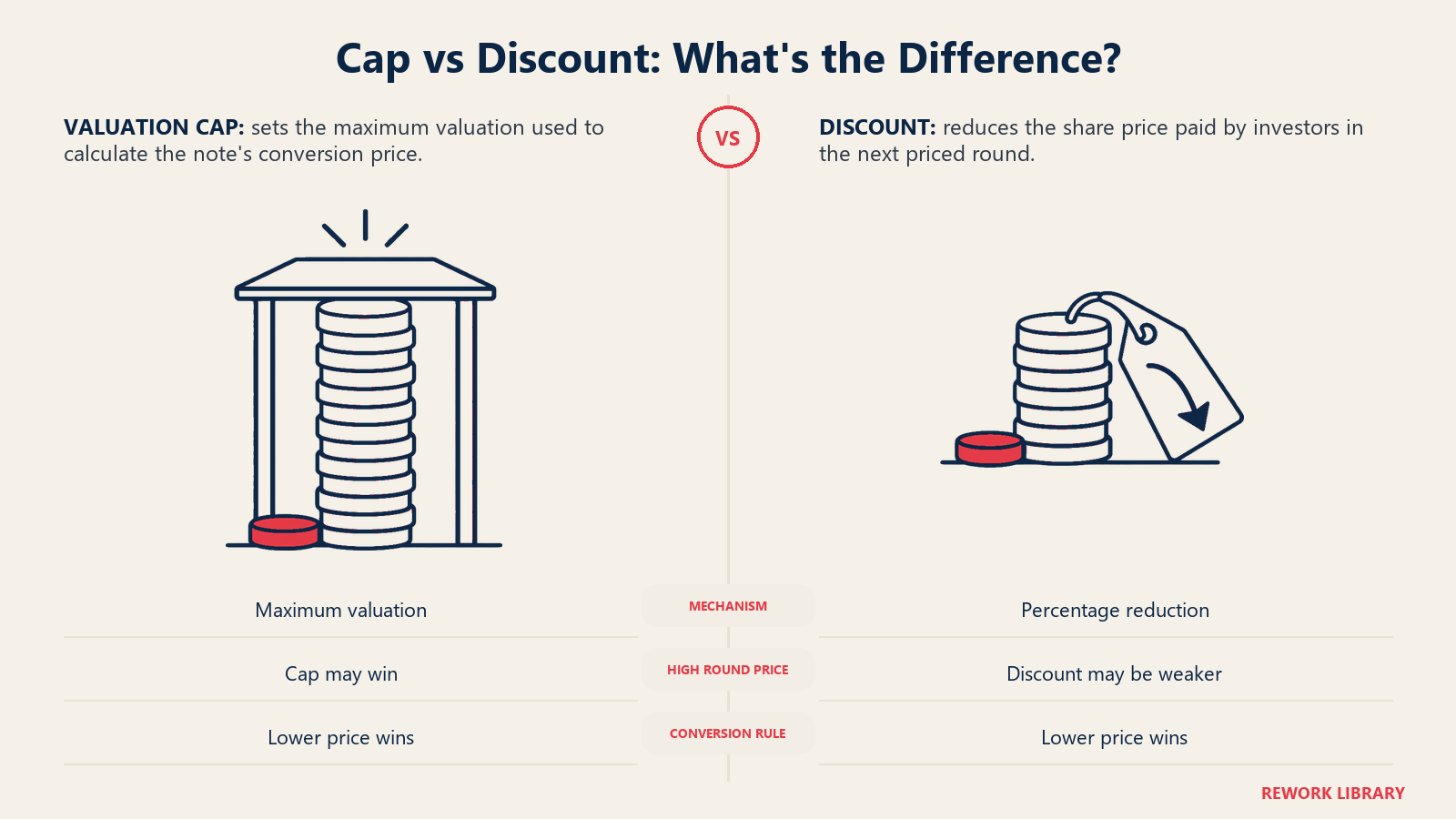
The valuation cap protects the investor from a runaway round. If the company is priced at $20 million, a note with an $8 million cap still converts as if the company were worth $8 million, so the investor gets more shares per dollar.
The discount protects them from the opposite problem. If the next round is priced low, a cap that's above that price does nothing, but a 20 percent discount still gives a lower price than the new investors pay.
Notes can have a cap only, a discount only, both, or neither. With both, the investor typically gets whichever produces the lower conversion price.
A Worked Example: Cap vs Discount
The numbers below are our own illustrative arithmetic, not data from a study. Real terms vary.
Setup:
- A company raises a $500,000 convertible note.
- Terms: 6 percent simple interest, an $8,000,000 valuation cap, a 20 percent discount.
- The company raises a priced Series A 18 months later.
- The company has 12,000,000 fully diluted shares before the round (a simplification that ignores the new option pool and the shares the notes themselves add).
Step 1: Accrued interest. $500,000 x 6% x 1.5 years = $45,000. The amount that converts is $545,000.
Scenario A: the round is priced high ($12M pre-money).
- Series A price per share: $12,000,000 / 12,000,000 = $1.00
- Discount price: $1.00 x (1 - 0.20) = $0.80
- Cap price: $8,000,000 / 12,000,000 = $0.6667
- The cap price is lower, so the cap wins.
- Shares issued: $545,000 / $0.6667 = 817,500 shares
- At the Series A price, those shares are worth $817,500, about 1.5 times what the noteholder put in with interest.
Scenario B: the round is priced low ($9M pre-money).
- Series A price per share: $9,000,000 / 12,000,000 = $0.75
- Discount price: $0.75 x 0.80 = $0.60
- Cap price: $0.6667 (unchanged)
- The discount price is lower, so the discount wins.
- Shares issued: $545,000 / $0.60 = 908,333 shares
| Round priced at $12M | Round priced at $9M | |
|---|---|---|
| Series A price per share | $1.00 | $0.75 |
| Discount price (20% off) | $0.80 | $0.60 |
| Cap price ($8M cap) | $0.6667 | $0.6667 |
| Price the note uses | $0.6667 (cap) | $0.60 (discount) |
| Shares from $545,000 | 817,500 | 908,333 |
The lesson for founders: the higher your next round is priced, the more dilution the cap creates, because the note converts at a deep discount to that price. The cap is a bet on your success, and a good outcome makes it expensive. Several notes at different caps stack up quickly, and the founder often doesn't see the combined dilution until the term sheet arrives.
Convertible Note vs SAFE
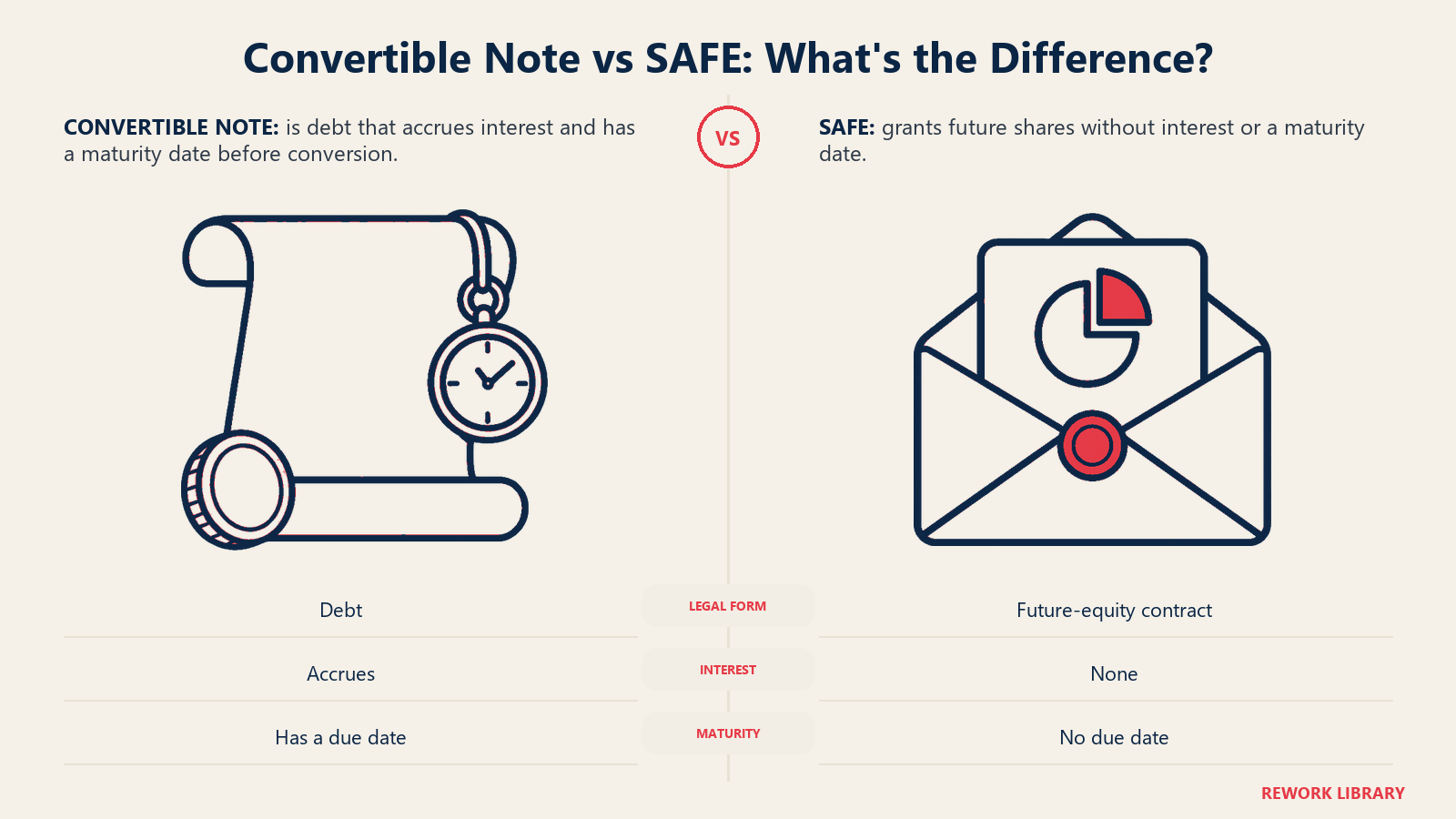
Y Combinator introduced the SAFE (Simple Agreement for Future Equity) as an alternative. Its own site says the SAFE was "created at Y Combinator by Carolynn Levy in 2013", and it draws the contrast plainly: a convertible note is debt, with interest that accrues and a maturity date set for repayment or forced conversion, while a SAFE is not debt and has no interest or maturity date.
| Convertible note | SAFE | |
|---|---|---|
| Legal form | Debt | Contract for future shares |
| Interest | Accrues | None |
| Maturity date | Yes | None |
| Repayment risk | Yes, at maturity | No repayment obligation |
| Paperwork | Heavier, more negotiation | Standardized, shorter |
| Common in | Bridge rounds, some angel and seed deals | Pre-seed and seed, especially YC-style deals |
A note's maturity date is the key difference. It creates a pressure point that a SAFE doesn't have. That pressure is what a savvy investor sometimes wants, and what a savvy founder wants to avoid. Notes still show up when investors want a creditor's claim, when a lender such as a bank or venture debt provider is involved, or when local legal practice favors debt instruments.
Risks at Maturity
Maturity is where notes get uncomfortable. Founders sometimes treat a note as "free money that turns into equity" and forget it's still a debt with a due date.
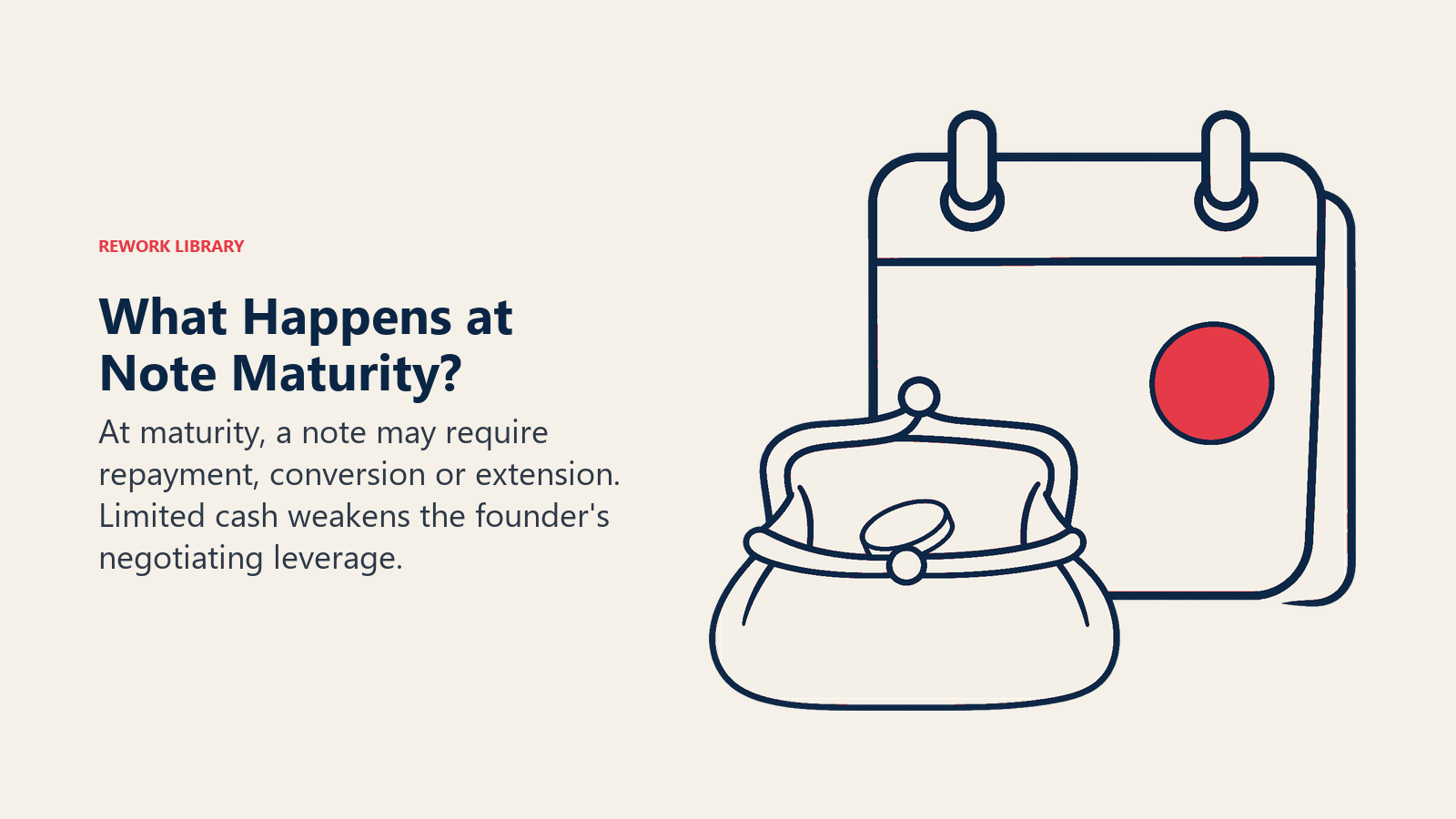
1. No round arrives in time. If the company hasn't closed a qualified financing, the investor may be able to demand repayment of principal plus interest. A company with six months of runway can't usually write that check. Cooley GO explains that at maturity the investors can typically elect repayment or conversion into equity at a price agreed in advance, and that parties may instead extend the date.
2. Extensions cost leverage. Investors who agree to extend may ask for a lower cap, a higher rate or more rights. A company negotiating an extension is negotiating from weakness.
3. Several notes mature at different times. A company that has issued notes across multiple months can face a cluster of due dates, each with different investors who may want different outcomes.
4. Conversion math surprises. Interest adds shares, caps convert at old prices, and a larger option pool at the new round shifts dilution toward existing holders. Model it before signing, ideally in a cap table tool.
5. A weak next round. If the next round is a down round, the discount still gives noteholders a better price than the new investors, and the founders absorb the dilution.
Some founders cover a gap with a bridge round built on notes. That works when everyone expects a priced round soon, and it works less well when the plan has slipped.
Common Mistakes
- Stacking notes without modeling them. Add every note to the cap table scenario at a few round sizes before raising the next one.
- Setting the cap too low. A cap that looks generous to the founder on day one can cost far more shares if the company does well.
- Ignoring the qualified financing threshold. If the threshold is too high, a modest round won't trigger conversion and the debt stays on the books.
- Forgetting the maturity date. Put every maturity date on the finance calendar, next to a cash forecast.
- Skipping legal review. Terms vary by jurisdiction, and securities rules differ from country to country. In the US, notes are securities offered under federal and state securities rules. Outside the US, local law decides how debt and equity instruments are treated, so have counsel review the terms. This article is general education, not legal advice.
Key Facts
- A convertible note is debt that converts into equity, typically at the next priced round.
- Its pricing levers are the valuation cap and the discount. Interest usually converts into extra shares.
- Cooley GO reports typical discounts of 15 to 25 percent and qualified financing thresholds of one to two times principal.
- A note has a maturity date, and a SAFE does not.
- Y Combinator created the SAFE in 2013 as a simpler alternative.
- Higher future valuations make a cap more costly to the founder.
Who Typically Uses Convertible Notes
Notes show up most often in three situations. The first is early seed funding from an angel investor, where a quick close matters more than a precise price. The second is a short bridge between rounds, where existing investors lend money to reach a milestone. The third is deals where a creditor position matters to the investor. Founders raising larger rounds, as covered in the strategic fundraising guide, more often move to priced equity, where a lead investor sets the price and the preferences, including liquidation preference.
Frequently Asked Questions about Convertible Notes
Is a convertible note debt or equity?
It starts as debt and is meant to become equity. Until it converts, the company owes the principal and accrued interest, and the investor holds no shares. At a qualified financing, the balance converts into shares, normally preferred stock.
What is the difference between a valuation cap and a discount?
A cap sets the maximum valuation used to calculate the investor's conversion price. A discount takes a percentage off the price new investors pay. With both, the investor usually gets whichever produces the lower price, as the worked example above shows.
What happens if a convertible note reaches its maturity date before a funding round?
It depends on the note's terms. The investor can usually elect repayment or conversion, or the parties can agree to extend the date, often in exchange for new terms. A company without cash to repay has less negotiating power at that point.
Does interest on a convertible note get paid in cash?
Usually not. Most notes accrue simple interest that is added to the principal and converts into shares with it. Check the note, since some require cash payment.
Should a startup use a convertible note or a SAFE?
Both defer the pricing decision. A SAFE has no interest or maturity date, so it carries less repayment risk for the company. A note can suit deals where the investor wants a debt claim. Compare both against the company's runway and have counsel review the terms.
How much do convertible notes dilute founders?
It depends on the cap, discount, interest and the size of the next round. In the worked example above, $545,000 of converting debt became 817,500 or 908,333 shares depending on the round price. Model your own numbers on a cap table before signing.
Related Reading