What is Runway? The Countdown Clock Every Startup CEO Must Watch
Turn this article into takeaways for your work.


Each assistant summarizes the article only for you and suggests best practices for your work.
"How much runway do you have?"
It's the first question every investor asks. Yet I'm amazed how many founders guess. Last month, a CEO told me "about 8 months." Reality? 4.5 months.
That's the difference between raising money and raising panic.
Runway: Your Business Life Expectancy
Runway = Cash in Bank ÷ Monthly Burn Rate
Dead simple math that determines if your company lives or dies:
- 18 months runway = Comfortable
- 12 months runway = Time to fundraise
- 6 months runway = Red alert
- 3 months runway = Death zone
But here's what kills startups: They calculate runway wrong and realize too late.
The Real Runway Formula
Basic runway is a lie. Here's what you actually need:
True Runway = (Cash + Confirmed Receivables - Payables) ÷ (Average Burn Rate × Growth Factor)
Let's break this down:
- Cash: What's actually in the bank
- Confirmed Receivables: Money definitely coming (signed contracts)
- Payables: What you owe right now
- Average Burn: Last 3 months average (not just last month)
- Growth Factor: Your burn is probably increasing
Example:
- Cash: $500,000
- Receivables: $50,000
- Payables: $50,000
- Net available: $500,000
- Monthly burn: $100,000 (and growing 10% monthly)
- True runway: 4.5 months (not 5)
That half month? It's the difference between closing funding and closing doors.
Runway Stages: From Comfort to Crisis
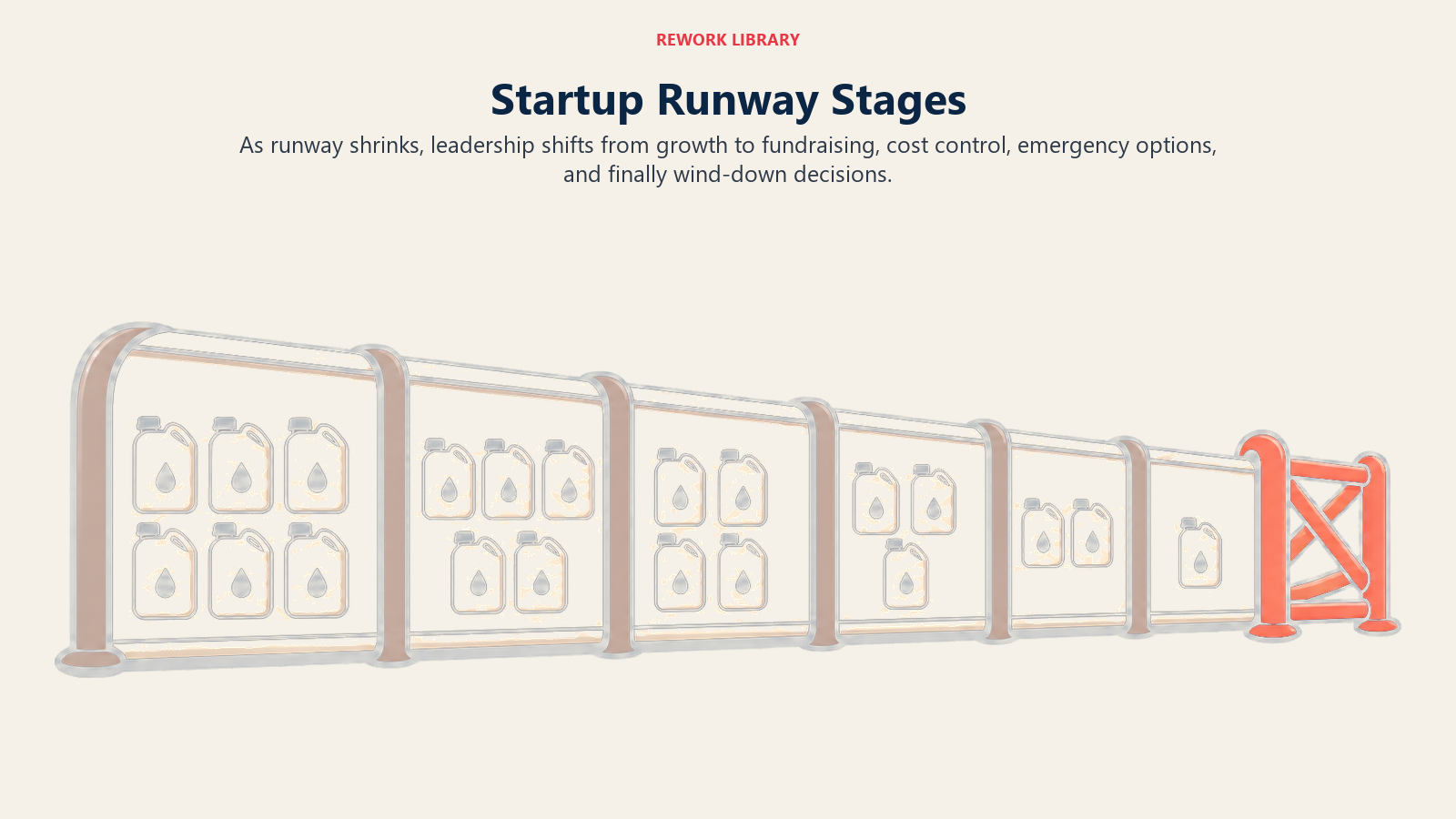
As cash time declines, leadership priorities shift from growth and planning to urgent fundraising, cost control, emergency options, and shutdown risk.
18+ Months: The Comfort Zone
- Focus on growth, not fundraising
- Test and iterate freely
- Hire strategically
- Action: Build sustainable unit economics
12-18 Months: The Planning Zone
- Start fundraising conversations
- Optimize burn rate
- Show clear metrics improvement
- Action: Create fundraising deck
9-12 Months: The Fundraising Zone
- Active fundraising (takes 3-6 months)
- Can still negotiate from strength
- Multiple options available
- Action: Meet 50+ investors
6-9 Months: The Urgency Zone
- Fundraising becomes desperate
- Terms get worse
- Team starts worrying
- Action: Cut non-essential spending
3-6 Months: The Danger Zone
- Desperation visible to investors
- Key employees leave
- Can't afford mistakes
- Action: Consider acquisition/pivot
0-3 Months: The Death Zone
- Payroll at risk
- Firesale valuations only
- Legal issues emerging
- Action: Wind down or miracle
The Hidden Runway Killers
Killer 1: The Hockey Stick Hire
"We need to hire 5 salespeople next month!"
- Salary: $75K × 5 = $375K/year
- Real cost with benefits: $500K/year
- Ramp time: 3-6 months
- Runway impact: Minus 3 months instantly
Killer 2: The Big Contract Mirage
"That enterprise deal will close next month!"
- Probability: 30%
- Payment terms: Net 90
- Implementation: 6 months
- Reality: No cash for 7-10 months
Killer 3: The Efficiency Fallacy
"We'll reduce burn by 40% if needed"
- Severance costs: 2-3 months
- Productivity hit: 30%
- Morale damage: Permanent
- Actual savings: 20% at best
Killer 4: The Fundraising Timeline
"We'll raise in 3 months"
- Reality: 6-9 months average
- Due diligence: 2 months
- Legal: 1 month
- Money hits: 1 month later
Extending Runway: The Survival Playbook
Revenue Acceleration (Fastest Impact)
Week 1 Tactics:
- Call every pending deal
- Offer annual prepayment discounts (20%)
- Convert free trials aggressively
- Launch flash sale for quick cash
Month 1 Results: 20-40% revenue boost possible
Cost Reduction (Biggest Impact)
Immediate Cuts:
- Travel & entertainment (100%)
- Software subscriptions (50%)
- Contractors (70%)
- Marketing experiments (80%)
Painful Cuts:
- Salary freezes/cuts (10-20%)
- Office space (sublease)
- Perks and benefits
- Headcount (last resort)
Rule: Cut deep once rather than death by thousand cuts
Creative Extensions
Revenue-Based Financing: Trade future revenue for cash now Customer Prepayments: 20% discount for annual prepay Venture Debt: If you qualify (extends 3-6 months) Grants/Tax Credits: R&D credits, government programs Strategic Partnerships: Let partners fund development
Runway Benchmarks by Stage (2026)
Pre-Seed
- Typical: 12-18 months
- Burn: $10-30K/month
- Focus: Find product-market fit
Seed
- Typical: 18-24 months
- Burn: $50-150K/month
- Focus: Prove repeatable sales
Series A
- Typical: 18-24 months
- Burn: $200-500K/month
- Focus: Scale efficiently
Series B+
- Typical: 24-36 months
- Burn: $1M+/month
- Focus: Market dominance
The Default Alive Calculator
Paul Graham's critical question: Are you default alive or default dead?
Default Alive: Revenue growth > Expense growth Default Dead: Expense growth > Revenue growth
The math:
- Current MRR: $50,000
- Growth rate: 10% monthly
- Current burn: $200,000
- Burn growth: 5% monthly
- Verdict: Default dead in 8 months
To become default alive:
- Need 20% monthly growth, OR
- Reduce burn to $100,000, OR
- Some combination
Runway Psychology: The Founder's Dilemma
The Optimism Trap
"Things always work out" - Until they don't
The Ostrich Strategy
"I don't want to know" - Ignorance isn't bliss
The Hero Complex
"I'll figure it out" - Markets don't care about heroes
The Momentum Fallacy
"We're growing so fast" - Growth without runway = funeral
The cure: Weekly runway updates. Public dashboard. No surprises.
Your Runway Management System
Weekly Dashboard
- Cash position
- Burn rate (7-day average)
- Runway in months
- Days until fundraising must start
- Default alive/dead status
Monthly Review
- Actual vs projected burn
- Revenue growth trajectory
- Scenario planning (best/base/worst)
- Go/no-go fundraising decision
Quarterly Planning
- Detailed financial model
- Fundraising timeline
- Milestone alignment
- Team communication
Fundraising Timeline Reality
Month 1-2: Preparation
- Update deck and financials
- Warm introductions
- Initial conversations
Month 3-4: Active Pitching
- 50-100 investor meetings
- Follow-ups and deep dives
- Term sheet negotiations
Month 5-6: Closing
- Due diligence
- Legal documentation
- Money transfer
Buffer: Always add 3 months
Your 30-Day Runway Action Plan
Week 1: Face Reality
- Calculate true runway (use the real formula)
- List all upcoming expenses
- Model three scenarios
- Share with co-founders
Week 2: Extend Timeline
- Identify quick revenue wins
- Cut non-essential expenses
- Negotiate payment terms
- Update financial model
Week 3: Make Decisions
- Go/no-go on fundraising
- Set burn rate targets
- Communicate to team
- Create accountability
Week 4: Execute
- Launch revenue initiatives
- Implement cost cuts
- Start fundraising prep
- Track daily progress
The Hard Truth About Runway
Runway isn't just a metric, it's your company's lifeline. Every decision should be filtered through one question: "Does this extend or shorten our runway?"
The startups that survive aren't always the best products. They're the ones that manage runway religiously.
Your competition might have better tech, bigger teams, or more press. But if you have more runway, you win by default. They die, you don't.
That's the game. Play accordingly.
Remember: It's better to cut 20% of your team and survive than keep everyone and die together. Hard choices preserve runway. Delayed choices destroy companies.
Ready to master survival? Learn Burn Rate optimization to track exactly how fast capital is leaving your company.
Part of the [Business Terms Collection]. Last updated: 2026-07-21
On this page
- Runway: Your Business Life Expectancy
- The Real Runway Formula
- Runway Stages: From Comfort to Crisis
- 18+ Months: The Comfort Zone
- 12-18 Months: The Planning Zone
- 9-12 Months: The Fundraising Zone
- 6-9 Months: The Urgency Zone
- 3-6 Months: The Danger Zone
- 0-3 Months: The Death Zone
- The Hidden Runway Killers
- Killer 1: The Hockey Stick Hire
- Killer 2: The Big Contract Mirage
- Killer 3: The Efficiency Fallacy
- Killer 4: The Fundraising Timeline
- Extending Runway: The Survival Playbook
- Revenue Acceleration (Fastest Impact)
- Cost Reduction (Biggest Impact)
- Creative Extensions
- Runway Benchmarks by Stage (2026)
- The Default Alive Calculator
- Runway Psychology: The Founder's Dilemma
- The Optimism Trap
- The Ostrich Strategy
- The Hero Complex
- The Momentum Fallacy
- Your Runway Management System
- Weekly Dashboard
- Monthly Review
- Quarterly Planning
- Fundraising Timeline Reality
- Your 30-Day Runway Action Plan
- The Hard Truth About Runway