What Is a Down Round?
Turn this article into takeaways for your work.


Each assistant summarizes the article only for you and suggests best practices for your work.
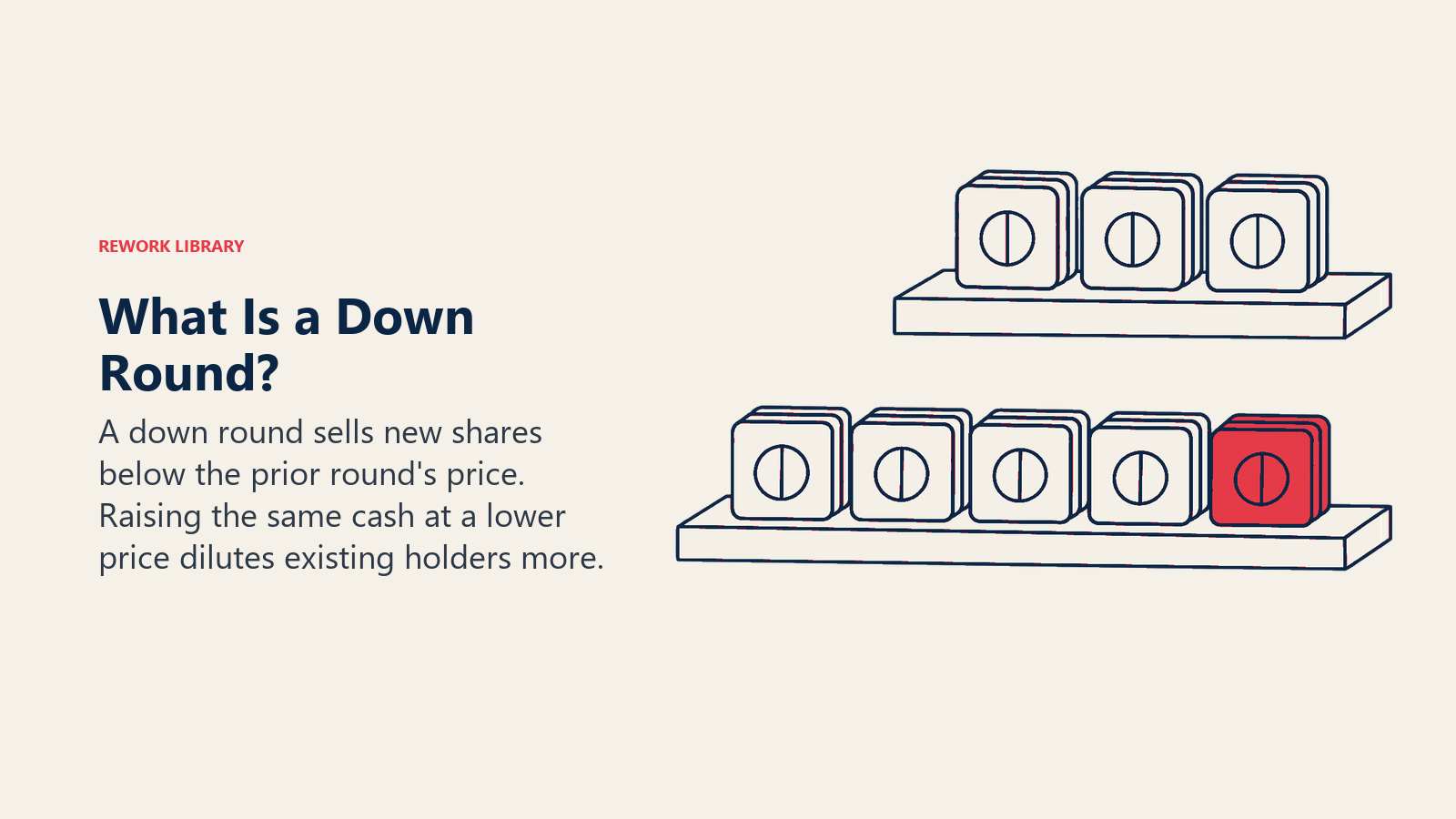
A down round is a priced funding round where the new investors pay less per share than the previous investors did. In plain terms, the company is worth less on paper than it was at its last raise. The cleanest test compares the new round's pre-money valuation with the post-money valuation of the round before it. If the first number is lower, it's a down round.
Down rounds aren't a sign of fraud or collapse. They happen to healthy companies when markets reprice, when growth slows against the plan, or when the last round was priced too aggressively. But they carry real costs: more dilution, strained cap tables, awkward conversations with employees, and sometimes a change in who controls the company.
How a Down Round Works
Every priced equity round sets a price per share. Take the pre-money valuation, divide by the fully diluted share count, and you get the price. A down round simply produces a lower price than the previous round did.
Here's the part founders often miss: the comparison that matters is pre-money against the prior post-money. Say a company raised at a $40M post-money valuation. A new round at a $30M pre-money is a down round, even though the company will be worth $35M after the new cash lands. The price per share is lower than before, and that's the trigger for most of the contractual consequences below.
A few terms worth separating:
- Valuation is the number both sides agree the company is worth at that moment. See valuation for how those numbers get set.
- Price per share is what actually drives conversion ratios and anti-dilution adjustments.
- Flat round means the new price equals the old price. It's not technically down, but it feels like one to everyone involved.
Why Down Rounds Happen
There's rarely a single cause. The common ones:
- Market repricing. Investor appetite for a whole sector cools, and comparable companies raise at lower multiples. The company didn't get worse, but the benchmark moved.
- Missed plan. Revenue growth came in below what the last valuation assumed. A round priced on a 3x growth story doesn't survive a 1.5x reality.
- Overpriced last round. A high valuation feels great at the time. Then the company has to grow into it, and if it can't, the next round resets the number.
- Short runway. A company with three months of cash has little negotiating power. Investors know it, and price accordingly. A high burn rate makes this worse.
- Weak unit economics. If unit economics don't hold up under diligence, the valuation has to absorb the risk.
What a Down Round Does to Ownership
Dilution happens in any round, because new shares are issued. In a down round, the same dollar amount buys more shares, because each share is cheaper. So a given raise dilutes existing holders more than it would have at a higher price.
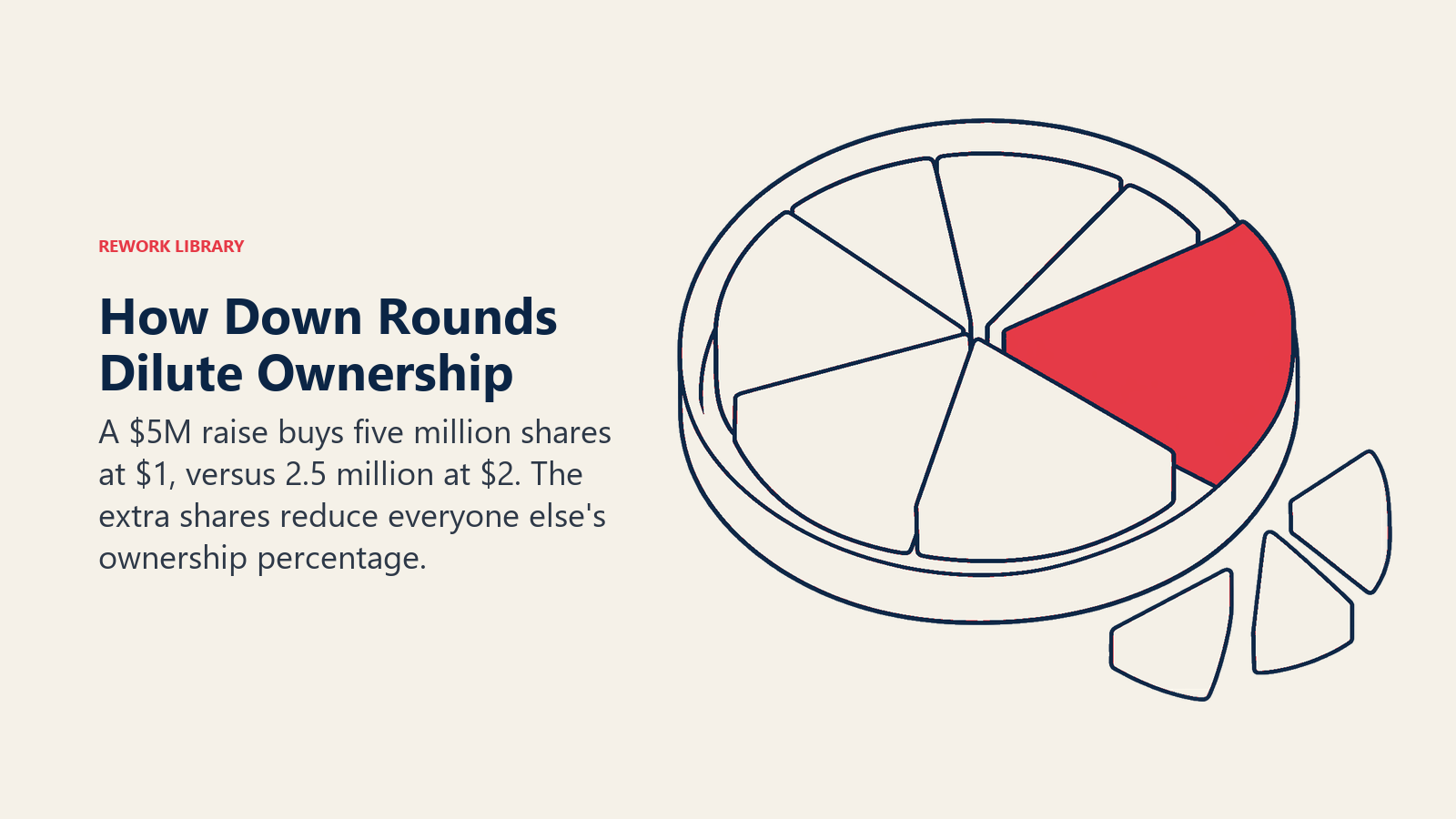
Illustrative arithmetic, not data from any real company: a company with 20,000,000 fully diluted shares raised at a $2.00 share price ($40M post-money at that time). Now it raises $5M at $1.00 per share. The new investors get 5,000,000 shares. Had the same $5M come in at $2.00, they'd have received only 2,500,000 shares. The extra 2,500,000 shares come out of everyone else's ownership.
Dilution is only the first layer, though. The bigger swing usually comes from anti-dilution protection.
Anti-Dilution Protection in a Down Round
Many preferred stock investors negotiate protection in the certificate of incorporation. If the company later sells shares at a lower price, the earlier investors' preferred shares convert into extra common shares, which cushions their loss. That protection is triggered by exactly this event, a down round. The mechanism lives in the preferred stock's conversion price, so the adjustment is automatic once the terms are met.
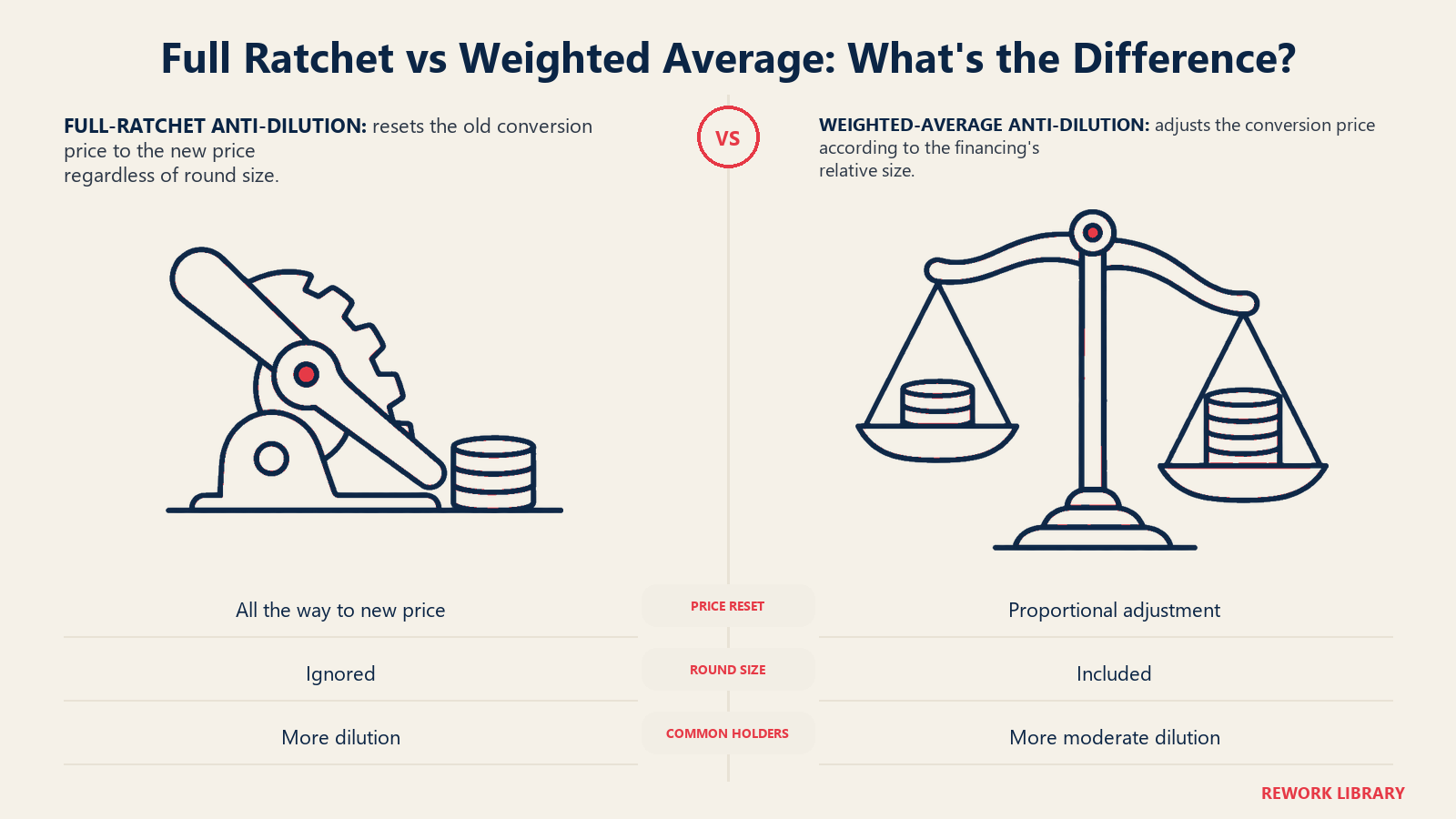
There are two main versions, and they hit very differently.
Full ratchet. The earlier investors' conversion price drops all the way to the new, lower price. It ignores how much money was raised. Even a tiny down round at a lower price resets the earlier investors as if they'd bought at that price.
Broad-based weighted average. The adjustment depends on both the price drop and the size of the new financing relative to the whole company. Cooley GO's glossary makes the point plainly: a down round selling $1 million of shares produces a much smaller conversion adjustment than one at the same price selling $10 million. It's the more moderate form and the one that appears in many venture-backed companies' charters.
A worked example
Everything below is illustrative arithmetic with round numbers, built on the company above. It uses the commonly cited broad-based formula: new conversion price = old price × (A + B) ÷ (A + C), where A is shares outstanding before the round (broad-based counting), B is the shares the new money would have bought at the old price, and C is the shares actually issued at the new price. Real documents define A and the carve-outs differently, so treat this as a teaching model.
Setup:
- Series A investor holds 5,000,000 preferred shares, bought at $2.00 ($10M invested).
- Everyone else (founders, employees, other holders) holds 15,000,000 shares.
- New round: $5M at $1.00 per share, so C = 5,000,000. At the old price, $5M would have bought B = 2,500,000 shares.
| No protection | Broad-based weighted average | Full ratchet | |
|---|---|---|---|
| New conversion price | $2.00 | $1.80 | $1.00 |
| Series A as-converted shares | 5,000,000 | about 5,555,556 | 10,000,000 |
| Total shares after round | 25,000,000 | about 25,555,556 | 30,000,000 |
| Series A ownership | 20.0% | about 21.7% | 33.3% |
| Everyone else's ownership | 60.0% | about 58.7% | 50.0% |
| New investors' ownership | 20.0% | about 19.6% | 16.7% |
The weighted average calculation: $2.00 × (20,000,000 + 2,500,000) ÷ (20,000,000 + 5,000,000) = $2.00 × 0.9 = $1.80. Series A's 5,000,000 shares then convert at a ratio of $2.00 ÷ $1.80, about 1.111, giving roughly 5,555,556 common shares.
Same company, same new money, very different outcomes. Under full ratchet the other holders lose ten full percentage points of ownership compared with no protection. Under weighted average they lose about one and a third. The new investors also notice: their percentage shrinks when earlier holders are protected, which is why they often push to renegotiate or waive those rights as a condition of leading the round.
Effects Beyond the Cap Table
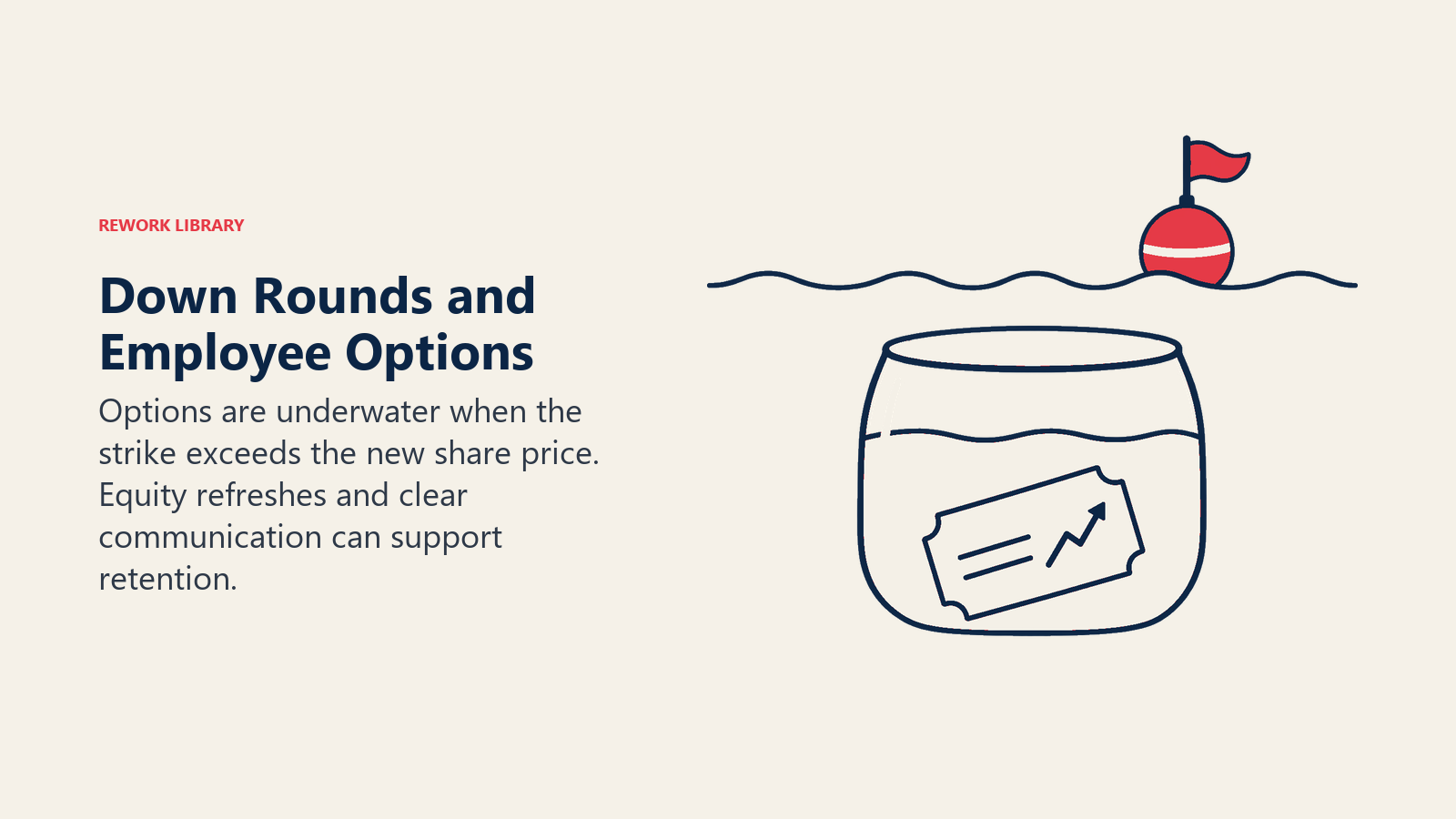
Underwater employee options. Options are granted with a strike price tied to a company valuation. If the new share price falls below that strike, the options are worth nothing on paper. Employees who joined at the peak hold paper that can't pay off unless the company grows well past the old price. Many companies respond with a repricing, a new grant, or a refresh program, each with accounting and tax questions that counsel should review.
Morale and signalling. A lower valuation is public inside the company, and often outside it. Top performers get recruiter calls. Existing investors may hesitate to follow on. Customers sometimes read it as a stability risk. How leadership explains the round matters as much as the terms.
Control and governance. Investors with leverage may ask for more board seats, tighter vetoes, or a bigger liquidation preference. A new lead investor sets these terms, and the earlier investors usually have to consent to the structure.
Future fundraising. The next round will be benchmarked against this one. A down round resets the reference price for everything that follows.
Pay-to-Play and Recapitalizations
Two structures show up when a down round is also a rescue.
Pay-to-play. Existing preferred holders must invest their pro rata share in the new round to keep their special rights, such as anti-dilution protection. Investors who don't participate see their preferred converted to common or lose some protections. It rewards the investors who keep backing the company and pushes others to either commit or step back.
Recapitalization (recap). The cap table is restructured, often by converting older preferred shares into common, resetting preferences, or cancelling accumulated terms, so the company can attract new capital. Recaps are heavy: they usually involve extensive negotiation between founders, existing investors and the new money. They tend to be the answer when the old cap table can't support a fundable deal.
Alternatives to Taking a Down Round
A down round isn't always the only path. The realistic options:
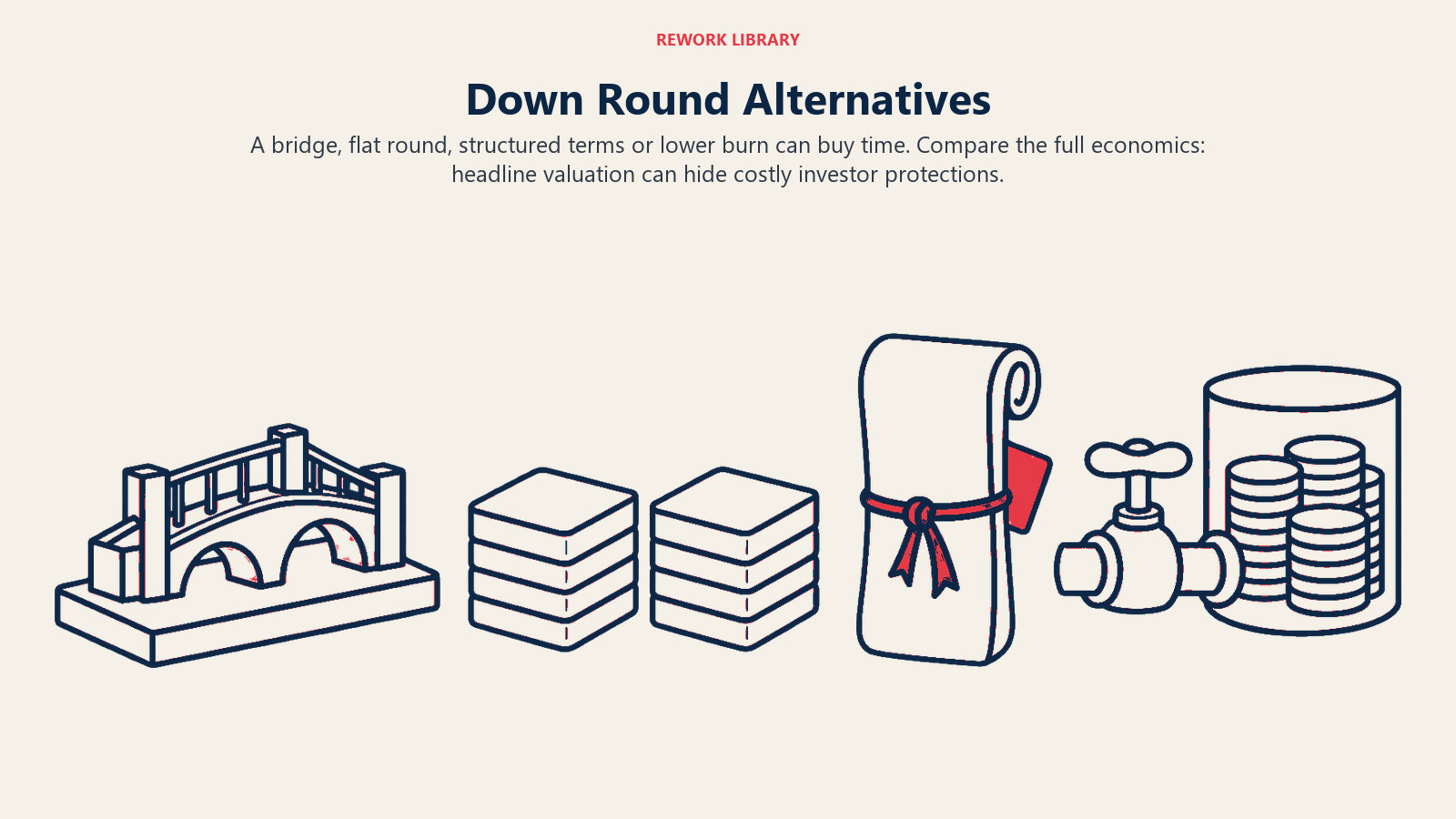
| Alternative | What it means | Main trade-off |
|---|---|---|
| Flat round | Raise at the same price as last time | Avoids triggering price-based protections, but gives no valuation credit for time passed |
| Structured terms | Keep the headline valuation but add a bigger liquidation preference, participation or other protections | Looks better on paper, but quietly shifts value to the new investor |
| Bridge | Raise a smaller amount now, often through a convertible instrument, to buy time | Delays the pricing decision. See bridge round and convertible note |
| Cost cuts | Reduce burn and extend runway so the next round happens from strength | Can slow growth, and cuts people |
| Insider-led round | Existing investors price and fund the next round | Faster, but terms depend on how much insiders want to protect their own stake |
Structured terms deserve extra caution. A headline valuation that looks flat or up can hide terms that make the real economics worse for common holders. Read the whole term sheet, not just the valuation line.
Common Founder Mistakes
- Waiting too long. Raising with a few months of cash left hands pricing power to the investor. Starting early gives you the option to say no.
- Not modelling the cap table. Run the numbers on every anti-dilution scenario before agreeing to terms. A cap table tool makes this faster and less error-prone.
- Ignoring employees. Silence about underwater options breeds rumours. A clear plan for refreshing equity helps retention.
- Fighting the price instead of the terms. A slightly lower valuation with clean terms can beat a higher one loaded with preferences and ratchets.
- Skipping legal review. Anti-dilution drafting is technical and varies by deal. Have counsel review the terms. Nothing here is legal advice, and rules and market practice differ by jurisdiction.
Key Facts
- A down round is a priced round at a lower price per share than the previous round, usually tested as new pre-money below prior post-money.
- Anti-dilution protection in the US is typically written into a company's certificate of incorporation, and it is triggered by a down round.
- Full ratchet resets the earlier investors' conversion price to the new price whatever the round size. Broad-based weighted average scales the adjustment to how much is raised (Cooley GO).
- In the illustration above, the same $5M raise left other holders at 60.0%, 58.7% or 50.0% depending on whether protection was absent, weighted average or full ratchet.
- Options struck above the new share price are underwater, and companies often respond with refresh grants or repricing.
- Terms and market practice vary by country, so confirm local rules with counsel.
Frequently Asked Questions about Down Rounds
Is a down round always bad?
It's painful, but not always fatal. A down round that gives a company enough cash and a realistic valuation can be healthier than a stretched price it can't live up to. The damage comes from the terms and the signal, not just the number.
What is the difference between a down round and a flat round?
A down round prices shares below the previous round. A flat round prices them at the same level. Both avoid growth in valuation, but only a down round normally triggers price-based anti-dilution adjustments.
What is the difference between full ratchet and broad-based weighted average anti-dilution?
Full ratchet resets earlier investors' conversion price to the new, lower price regardless of how much money was raised. Broad-based weighted average adjusts it by a smaller amount that depends on the size of the new round relative to all existing shares. The worked example above shows the gap in ownership.
What happens to employee stock options in a down round?
Options with a strike price above the new share price become underwater. Companies may issue new grants at the lower strike, reprice existing options, or offer other equity refreshes. Each route has tax and accounting implications, so counsel should review them.
What is a pay-to-play provision?
It requires existing preferred investors to put new money into the round in proportion to their holdings. Investors who don't may lose special rights or have their preferred shares converted to common. It's used to keep existing backers committed.
Can founders avoid a down round?
Sometimes. Options include a flat round, a bridge, structured terms, an insider-led round or cutting burn to extend runway. Each has trade-offs, and starting the process early gives the most room to choose.
Related Reading