What Is a Cap Table?

Turn this article into takeaways for your work.


Each assistant summarizes the article only for you and suggests best practices for your work.
A cap table, short for capitalization table, is the record of who owns what in a company. Cooley GO's guide puts it simply: it shows the ownership of the company's stock, options and other securities, and it's key to understanding the owners' economic and voting interests.
Every priced round, every SAFE, every option grant and every departing employee changes it. Founders who can read their own cap table can see what a new round will cost them before they sign. Founders who can't tend to find out at the worst moment, usually mid-diligence.
This article covers what a cap table contains, how it changes from founding to Series A, a worked example with the arithmetic shown, and the errors that cause the most grief. It's reference material, not legal or tax advice. Terms vary by jurisdiction and by deal, and counsel should review anything you sign.
What a Cap Table Contains
At its simplest, a cap table is a list of securities and the people or entities that hold them. It can be a summary that groups holders into buckets such as "founders" and "investors," or a detailed ledger with one row per holder and per security type.
Most cap tables share the same building blocks:
| Item | What it is | Who usually holds it |
|---|---|---|
| Common stock | Basic ownership shares | Founders, early employees who exercised options |
| Preferred stock | Shares with extra rights, such as a liquidation preference | Investors in priced rounds |
| Options | Rights to buy common stock at a fixed price | Employees, advisors |
| Option pool (unissued) | Shares reserved for future grants | Nobody yet, see employee option pool |
| SAFEs and convertible notes | Money in now, shares later | Angels, seed investors |
| Warrants | Rights to buy stock, often issued with debt | Lenders, strategic partners |
For each holder the table typically shows the number of shares, the percentage of shares outstanding, and the percentage on a fully diluted basis.
Outstanding versus fully diluted
Shares outstanding counts stock that has actually been issued. Fully diluted counts that plus everything that could become stock: options granted, the unissued pool, and convertible instruments once they convert. Investors price rounds on the fully diluted number, so that's the percentage that matters in negotiation.
How It Changes Round by Round
A cap table is a living document. Four events move it most:
- Founding. Founders receive common stock. Splits between co-founders are covered in founder equity.
- Early money. Angels often invest through SAFEs or a convertible note. Nothing is issued yet, but the cap table should track these as pending conversions. On Y Combinator's documents page, the post-money SAFE is described this way: the ownership sold equals the investment divided by the valuation cap, and the SAFEs convert into preferred stock when the company sells preferred shares in an equity financing.
- A priced round. New preferred shares are issued, an option pool is often enlarged, and every existing holder is diluted. Whether the investor's percentage is measured before or after the new money is explained in pre-money vs post-money valuation.
- Ongoing activity. Options are granted, exercised, or forfeited. People leave. Some investors use pro rata rights to buy more.
A Worked Example: Founding to Series A
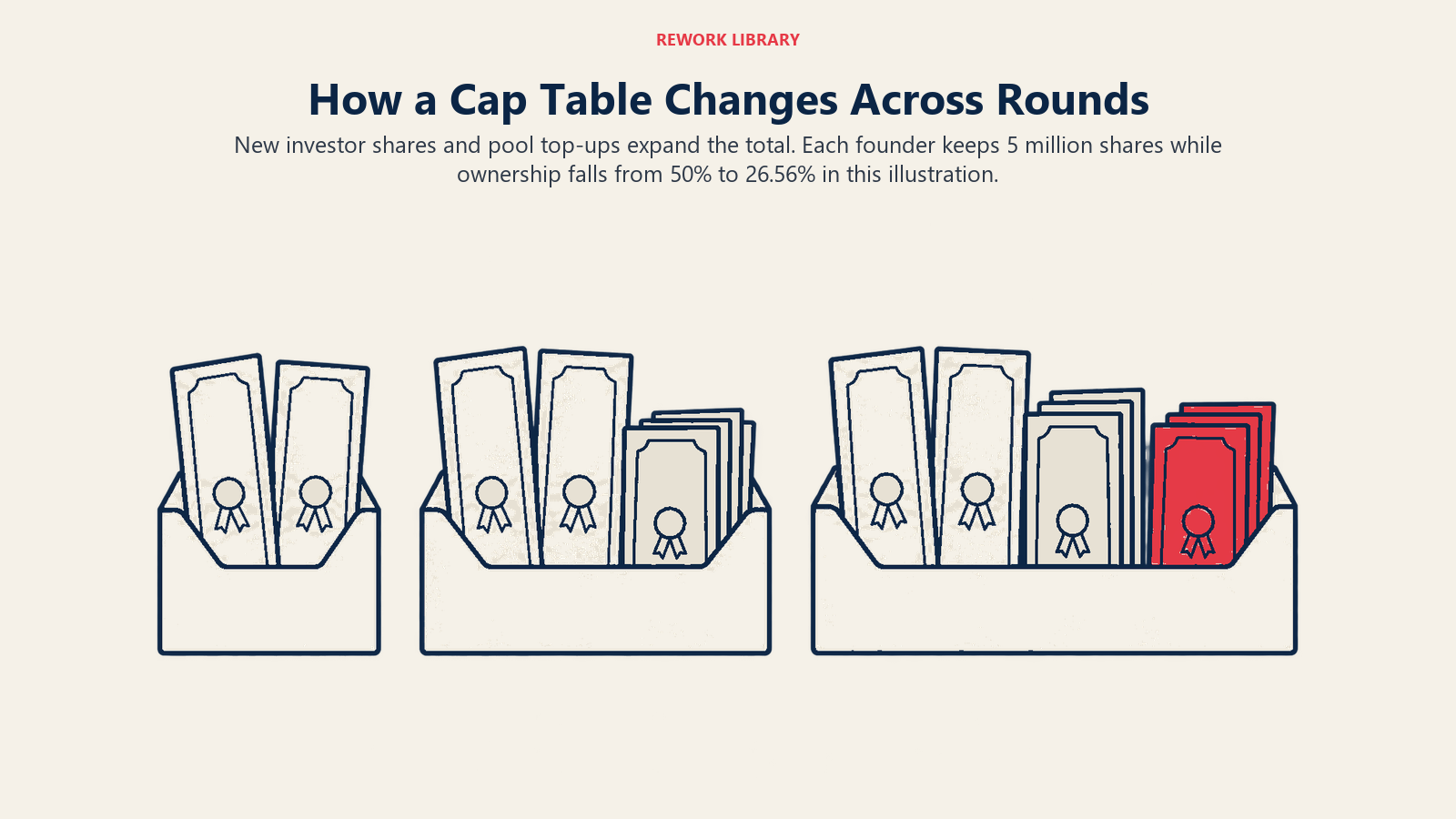
The figures below are illustrative arithmetic, not data from a real company. Two founders start with 5,000,000 common shares each.
Stage 1: Founding
| Holder | Shares | Fully diluted % |
|---|---|---|
| Founder A | 5,000,000 | 50.00% |
| Founder B | 5,000,000 | 50.00% |
| Total | 10,000,000 | 100.00% |
Stage 2: Seed round
An investor puts in $2M at an $8M pre-money valuation, so the post-money valuation is $10M and the investor owns 20%. As part of the deal the company creates a 1,250,000-share option pool, counted in the pre-money number.
- Pre-money fully diluted shares: 10,000,000 + 1,250,000 = 11,250,000
- Price per share: $8,000,000 / 11,250,000 = about $0.7111
- New seed shares: $2,000,000 / $0.7111 = 2,812,500
- Post-money fully diluted shares: 11,250,000 + 2,812,500 = 14,062,500
| Holder | Shares | Fully diluted % |
|---|---|---|
| Founder A | 5,000,000 | 35.56% |
| Founder B | 5,000,000 | 35.56% |
| Option pool | 1,250,000 | 8.89% |
| Seed investor (preferred) | 2,812,500 | 20.00% |
| Total | 14,062,500 | 100.00% |
Stage 3: Series A
A new investor puts in $8M at a $32M pre-money valuation ($40M post-money), for 20%. The pool is topped up by 1,000,000 shares before the round, again in the pre-money number.
- Pre-money fully diluted shares: 14,062,500 + 1,000,000 = 15,062,500
- Price per share: $32,000,000 / 15,062,500 = about $2.1245
- New Series A shares: $8,000,000 / $2.1245 = 3,765,625 (that's 25% of the pre-money count, since $8M is a quarter of $32M)
- Post-money fully diluted shares: 15,062,500 + 3,765,625 = 18,828,125
| Holder | Shares | Fully diluted % |
|---|---|---|
| Founder A | 5,000,000 | 26.56% |
| Founder B | 5,000,000 | 26.56% |
| Option pool | 2,250,000 | 11.95% |
| Seed investor | 2,812,500 | 14.94% |
| Series A investor | 3,765,625 | 20.00% |
| Total | 18,828,125 | 100.00% |
Each founder went from 50% to 35.56% to 26.56% without selling a share. Their share count never changed. The denominator grew. Together the founders still hold 53.11%, but they also own less of a much bigger company, which is the trade a priced round represents.
Notice, too, that the pool is created before the money arrives, so it dilutes existing holders and not the new investor. That's a negotiating point, not a law of nature.
Key Facts: Cap Table
- A cap table lists a company's securities (stock, options, warrants, SAFEs, notes) and who holds each one.
- Fully diluted ownership includes granted options, the unissued pool, and convertible instruments, and it's the basis rounds are priced on.
- Every financing, option grant, exercise and departure changes it. Founders' percentages fall at each round even though their share counts stay the same.
- In the illustrative example above, each founder goes from 50% to 35.56% after a $2M seed and to 26.56% after an $8M Series A.
- Cooley GO warns that a poorly managed cap table can lead to bad decisions, diligence issues, and costly "clean-up" exercises.
- This is not legal or tax advice. Terms vary by jurisdiction.
How SAFEs and Notes Complicate It
A SAFE or note isn't stock when it's signed, but it will be. If you only track issued shares, your cap table understates dilution until the conversion round arrives, and then the number moves all at once.
Cooley GO's article on the valuation cap illustrates why the details matter. In its example, notes with a low cap convert at a steep discount to the new investors' price, yet receive the same type of preferred shares, with the same per-share liquidation preference, as the cash investors. That can leave early holders with a larger stake and a larger preference than the dollars they put in would suggest. Many cap tables hide this until a model of the next round is run.
The practical habit: model the next round with every SAFE and note converting, then look at the fully diluted result.
Common Errors
- Tracking only issued shares. The unissued pool and unconverted SAFEs belong in the fully diluted view.
- Forgetting vesting and forfeitures. An employee who leaves before vesting returns unvested options to the pool. If nobody updates the table, it drifts from reality.
- Informal promises. A verbal "you'll get 1%" isn't on the table, but it can become a claim later. Written grants, approved by the board, are what count.
- Spreadsheet version sprawl. Three copies of "cap-table-final-v2" guarantee a mismatch in diligence. Keep one source of truth, with a changelog.
- Ignoring the pool's effect on price. A larger pool in the pre-money number lowers the effective valuation founders receive. Compare offers on a fully diluted, pool-included basis.
- No exit modeling. Percentages don't show payouts. With preferred stock in the mix, a down round or a modest sale can pay common holders far less than their percentage implies.
Cap Table vs Related Terms
- Valuation. Valuation sets the price per share. The cap table shows what that price does to everyone's ownership.
- Dilution. The fall in an existing holder's percentage when new shares are issued. The cap table is where you see it happen.
- Option pool. A reserve of shares for hires. It sits on the table as a line item, and its size changes everyone else's percentage.
- Liquidation preference. The cap table shows ownership. The preference decides who's paid first at an exit.
Frequently Asked Questions about Cap Tables
What is a cap table in simple terms?
It's a table of everyone who owns a piece of the company, what they hold (shares, options, SAFEs, notes), and what percentage that represents. It's the single record of ownership that investors, lawyers and acquirers rely on.
What's the difference between outstanding and fully diluted ownership?
Outstanding counts only shares already issued. Fully diluted adds granted options, the unissued option pool and convertible instruments as if they had converted. Rounds are priced on the fully diluted figure.
When should a startup start keeping a cap table?
From incorporation, when the founders receive their shares. Early errors, such as unrecorded grants or unclear SAFE terms, are cheaper to fix when there are two holders than when there are fifty.
Do SAFEs and convertible notes appear on a cap table?
Yes, ideally as pending conversions, with their caps and discounts recorded. They aren't shares yet, but they'll convert at the next priced round and dilute everyone, so model them in.
Does a higher percentage always mean a bigger payout?
No. Preferred stock can carry a liquidation preference that's paid before common holders, so the payout at an exit depends on the preference terms as well as the percentage. See the article on liquidation preference for the mechanics.
Do I need cap table software?
Not at the start. A carefully maintained spreadsheet can work for a two-founder company. Many teams move to a dedicated platform once there are investors, option grants and several instruments, since platforms can issue grants and model rounds and exits. Have counsel review the records either way.
Related Reading