Early-Stage vs Growth-Stage Companies: What Changes
Turn this article into takeaways for your work.


Each assistant summarizes the article only for you and suggests best practices for your work.
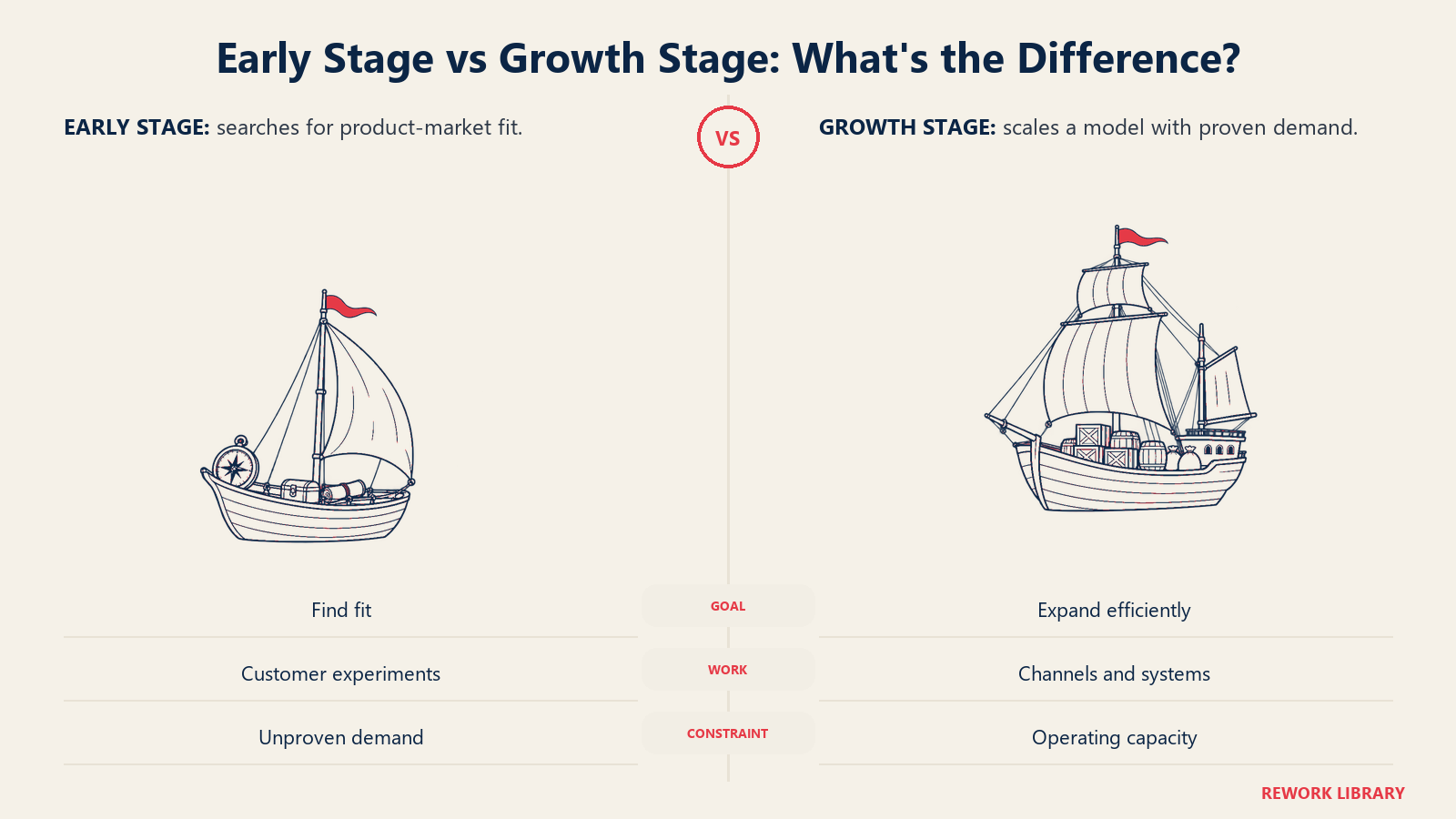
An early-stage company is still searching for a business model that works. A growth-stage company has found one and is now trying to repeat it at larger volume. That single shift, from search to execution, explains almost everything else that changes: what you measure, how you hire, where the money comes from, and what the founder does all day.
There's no official line between the two. Investors, accelerators and researchers draw it in different places, and the labels overlap with funding rounds (pre-seed, seed, Series A and beyond). So treat this article as a map of the typical differences, not a rulebook. For the full ladder of stages, start with stages of a startup.
The core difference: searching vs executing
Steve Blank defines a startup as an organization formed to search for a repeatable and scalable business model. That phrase works as a dividing line.
Before the model is found, the company is running experiments. Who is the customer? What will they pay? How do we reach them cheaply? Most of these questions are open, and most early guesses are wrong.
After the model is found, those questions have working answers. The job becomes doing the proven thing faster and more consistently, hiring people to do it, and adding the systems that stop it from breaking as volume rises.
Startup Genome puts the same idea in stage terms. It describes six stages (Discovery, Validation, Efficiency, Scale, Sustain and Conservation) and says early-stage startups search for product/market fit under extreme uncertainty, while late-stage ones search for a repeatable, scalable model and then scale into companies that execute under high certainty. The names differ from the funding-round labels, but the logic is the same.
Side-by-side comparison
| Dimension | Early stage | Growth stage |
|---|---|---|
| Main question | Does anyone want this, and will they pay? | Can we repeat this and grow it efficiently? |
| Primary goal | Find product-market fit | Scale a proven model |
| Core activity | Experiments, customer conversations | Building channels, teams and systems |
| Key metrics | Retention, early usage, weekly growth rate | Unit economics, CAC payback, revenue growth, net revenue retention |
| Funding | Founders, friends and family, angels, pre-seed, seed | Series A and later, venture debt, sometimes profit |
| Team | Small, generalist, founder-led | Larger, specialist, with managers |
| Processes | Informal, changed weekly | Documented, owned, measured |
| Biggest risk | Building something nobody needs; running out of cash | Scaling too early, losing speed and culture, breaking operations |
| Founder's role | Does the work: builds, sells, supports | Builds the team that does the work |
Real companies don't tick every box in one column. A company can have strong retention and still lack a repeatable sales motion, which makes it early on one dimension and growing on another. Use the table to spot which questions you haven't answered yet.
Goals: from finding fit to scaling a model
The early-stage goal is product-market fit: evidence that a specific group of customers has a real problem, uses your product to solve it, and keeps coming back. Everything else is secondary until that's true.
The growth-stage goal is different in kind. Fit is assumed, and the target becomes predictable, efficient growth. That means a sales or marketing engine you can feed money and people and get a reasonably forecastable result. The early-stage growth model covers how to approach the first phase, and the scaling growth framework covers the second.
One way to see the gap: an early-stage founder asks "should we build this feature?" A growth-stage leader asks "which of three channels should get the next hire?" The first is about learning. The second is about allocation.
Metrics: what you track changes
Early on, the most useful numbers are simple and close to the customer: how many people use the product, how many come back, how fast usage or revenue is compounding. Y Combinator's Paul Graham argues the most essential thing about a startup is growth, and he suggests measuring it weekly, with 5-7% a week a good rate during YC, 10% exceptional, and 1% a sign you haven't figured out what you're doing. He adds that revenue is the best thing to measure, and active users the next best when you aren't charging yet. That's a rule of thumb from one accelerator's batch period, not a benchmark for every company, but it shows the early-stage mindset: small bases, fast feedback, short measurement windows.
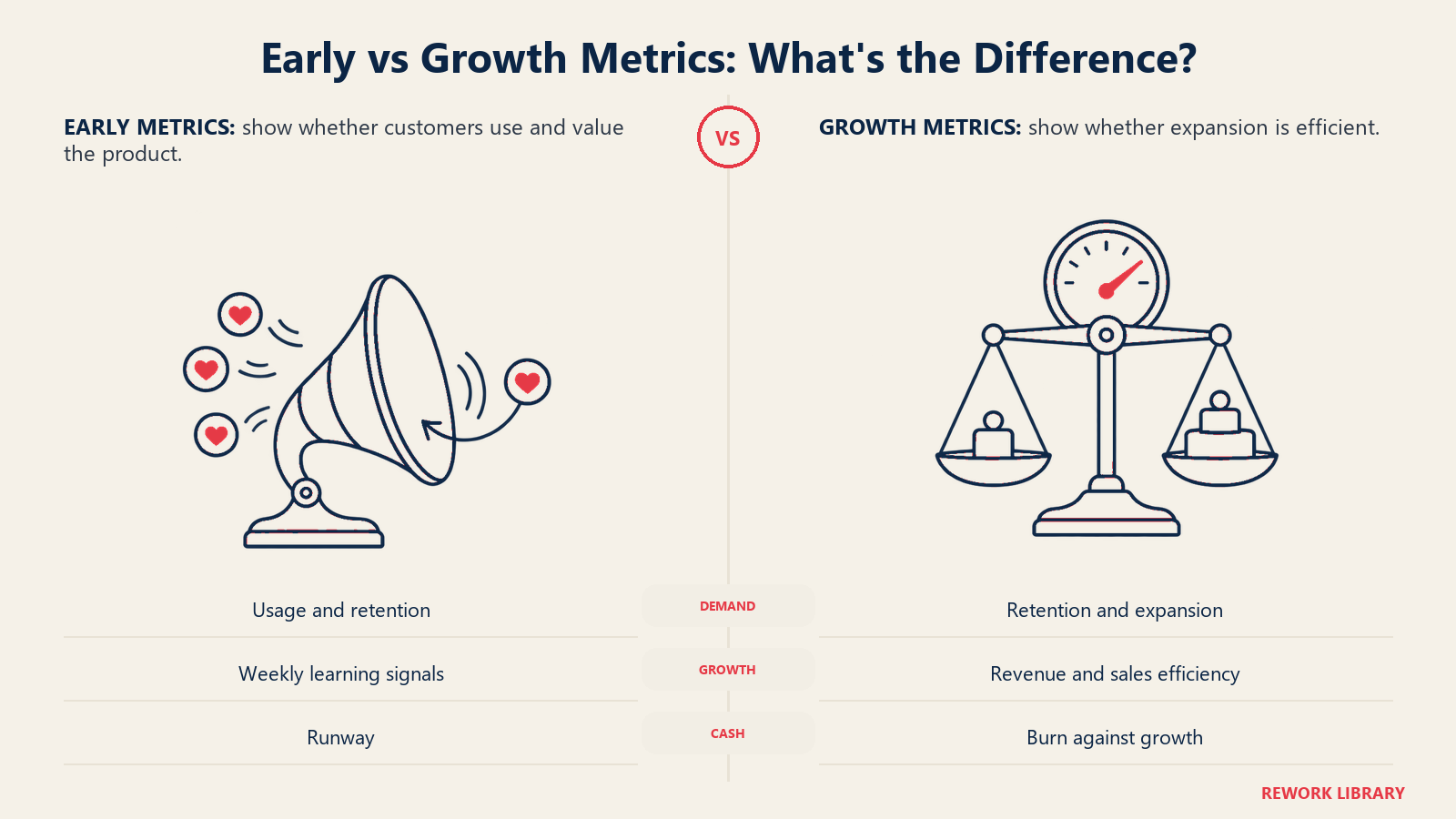
As the company grows, weekly percentage growth gets harder to sustain because the base is bigger. Attention moves to metrics that show whether growth is efficient and repeatable:
- Unit economics: what it costs to win a customer compared with what that customer pays over time.
- Retention and expansion: do existing customers stay and spend more?
- Sales efficiency: how long new reps take to produce, and how predictable the pipeline is.
- Burn rate against growth: how much cash each unit of growth consumes.
The trap is borrowing the wrong dashboard. A ten-person company with twenty customers doesn't need a board-style KPI pack. And a company with hundreds of customers and fifty employees can't run on gut feel and a spreadsheet of signups.
Funding: who writes the check and why
Early-stage money is mostly a bet on people and a plausible idea. It comes from founders' savings, friends and family, angel investors, and small pre-seed or seed rounds. Amounts are modest, and the investor is paying for the chance to learn whether the idea works.
Growth-stage money is a bet on a model with evidence behind it. Investors look at traction, retention and unit economics, and they fund the expansion of something already working. Rounds are larger, diligence is heavier, and the expectations that come with the money (targets, board seats, reporting) are heavier too.
Funding labels are rough guides to where a company sits, and they don't map cleanly to stage in every market. Practices and typical round sizes vary a lot by country and sector, so check what's normal where you raise. Some companies reach a growth stage largely on customer revenue and never raise a large round at all.
Team and structure: generalists become specialists
At the earliest stage, a team is a few people who do whatever's needed. Titles are loose. The founder might write code in the morning and close a sale in the afternoon. Decisions are made in conversation, and everyone knows what everyone else is doing.
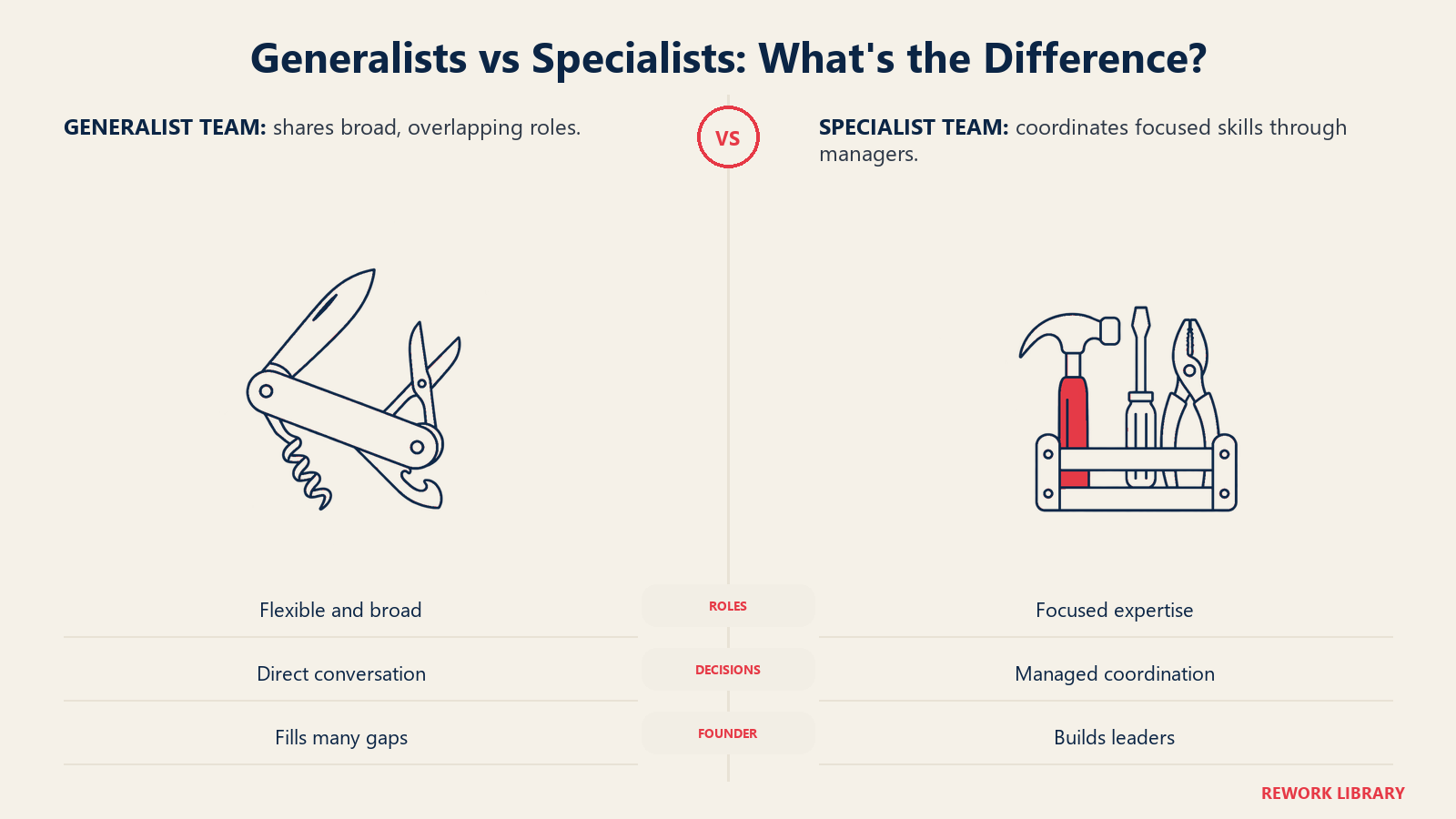
That stops working as headcount rises. The company needs people who are deeply good at one thing (sales, support, finance, recruiting) and managers who coordinate them. Reporting lines appear. Meetings that used to be unnecessary become the only way information moves.
Larry Greiner's classic Harvard Business Review article, Evolution and Revolution as Organizations Grow, is the standard reference for this idea. Its opening example is a company whose key executives cling to an organizational structure long after it has served its purpose. The Greiner growth model walks through the phases in detail. The practical lesson for founders is that the structure that got you here is rarely the structure that gets you there.
Processes: from improvised to repeatable
Early processes are informal on purpose. If you don't yet know how a sale should go, writing down a sales playbook locks in guesses. It's fine for onboarding to be "the founder jumps on a call."
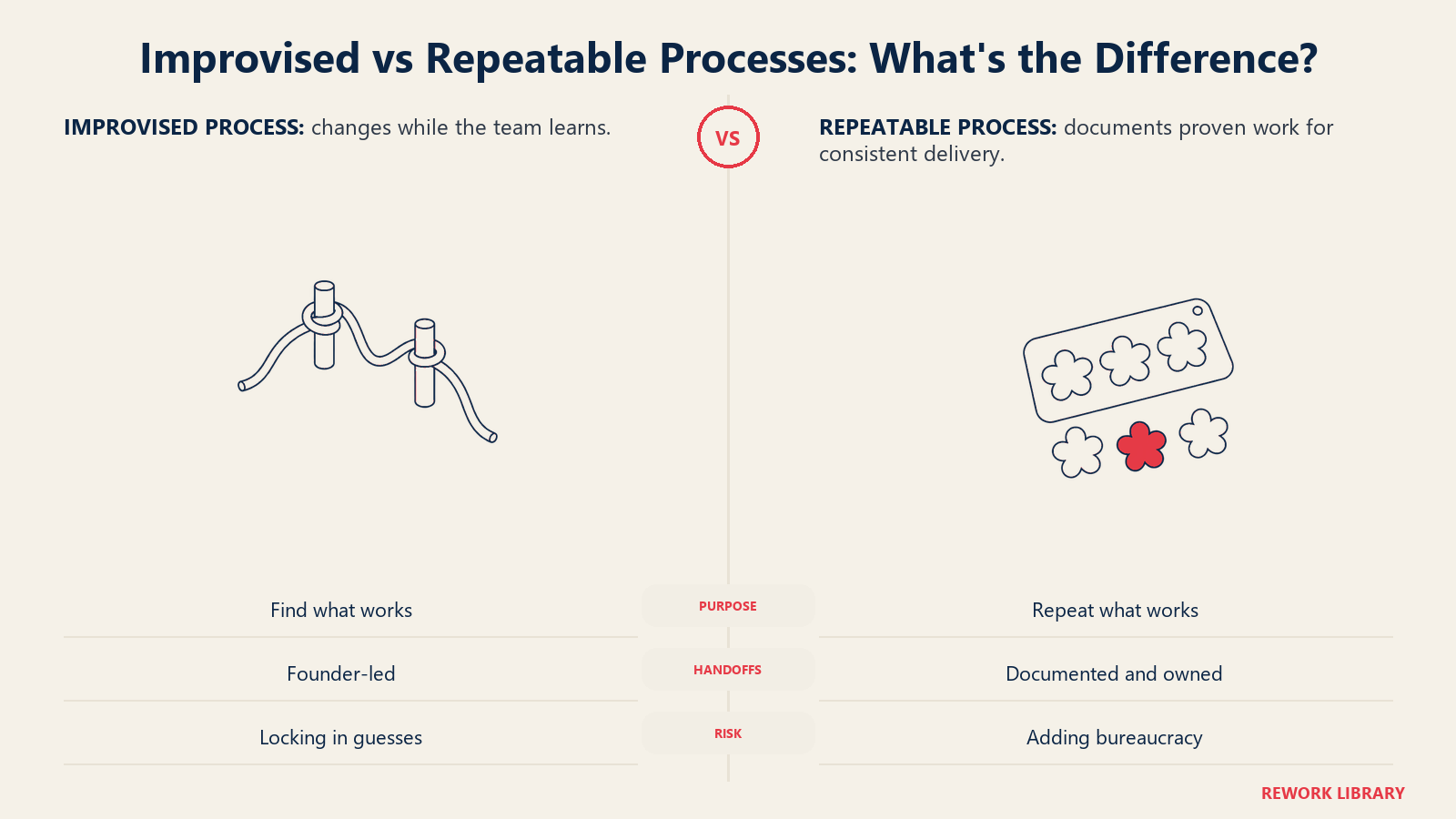
Once something works repeatedly, informality becomes a cost. New hires can't learn from watching the founder, because there are too many of them and the founder is busy. The company needs documented ways of doing the things that matter most: how leads are qualified, how customers are onboarded, how support issues escalate, how hiring decisions are made.
The goal isn't bureaucracy. It's scalability: the ability to take on more volume without cost and chaos rising at the same rate. The test for any new process is whether it removes a recurring failure or just adds a step.
Risks: what can kill the company
The dominant early-stage risks are market risk (nobody wants it enough) and survival risk (the cash runs out before the answer arrives). Neither is solved by hiring more people.
Growth-stage risks are different. The market question is mostly answered, and the danger is in execution: hiring ahead of demand, letting culture and communication degrade, spending on channels that don't pay back, or breaking the product's quality while chasing volume.
Startup Genome's research on this is worth knowing, with a caveat about its age. In its 2011 analysis of more than 3,200 high-growth technology startups, it reported that premature scaling was the primary cause of failure and affected 70% of the startups in its dataset. It also reported that startups scaling properly grew about 20 times faster than those that scaled prematurely. That's one dataset from over a decade ago, and its definitions are the researchers' own, so read it as a warning pattern, not a precise forecast. The pattern is still useful: adding team, spend and complexity before the model is proven is a common way to burn through money.
The opposite mistake exists too. A company that has clearly found fit but keeps operating like a scrappy experiment can stall. Competitors with the same insight and more infrastructure will outrun it.
The founder's role: from doer to builder of the team
In the early stage, the founder is the product team, the first salesperson, and the support desk. Their personal speed and judgment are the company's advantages.
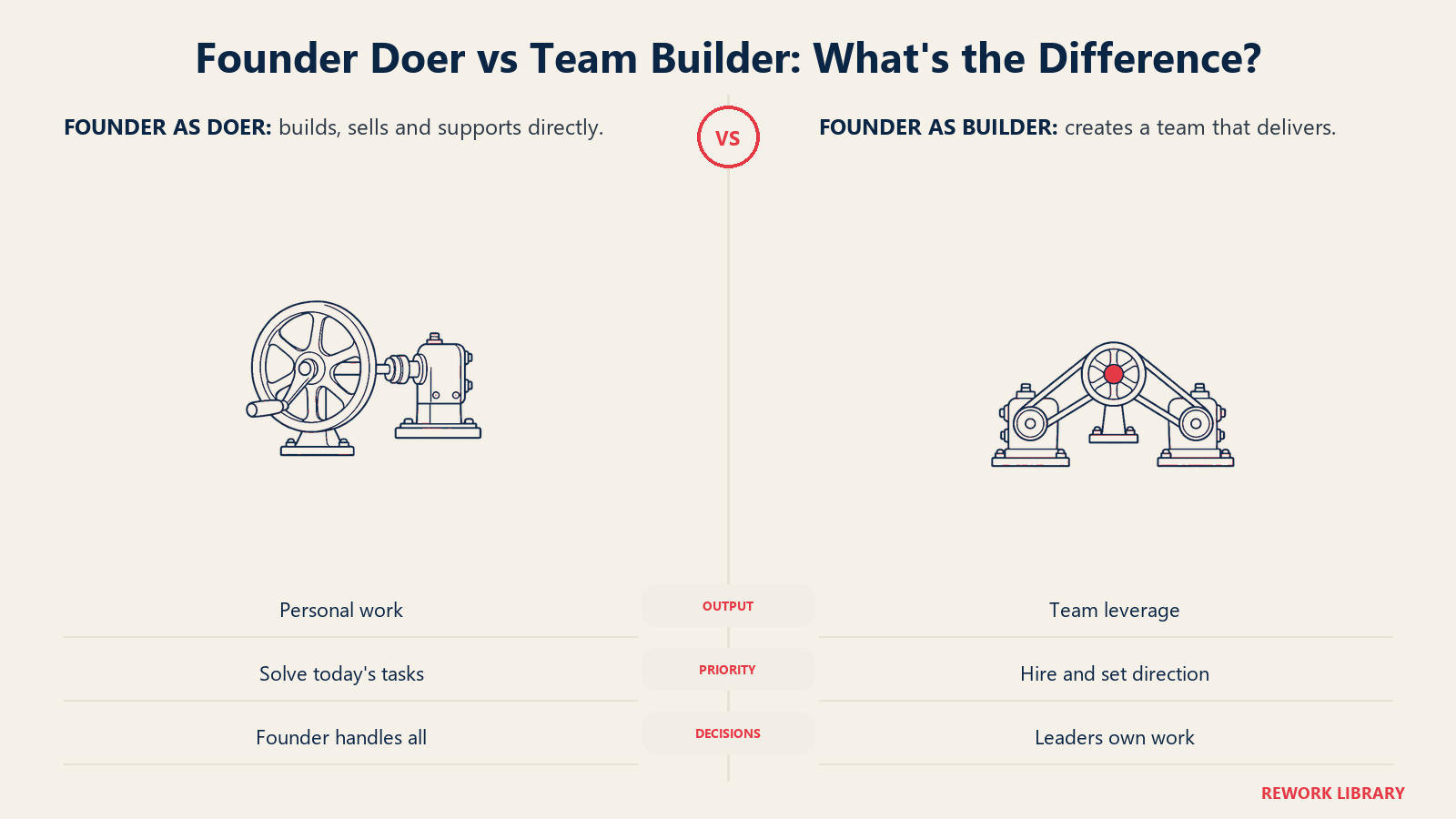
In the growth stage, the founder's output is leverage. They hire leaders, set priorities, decide what the company will stop doing, and maintain the culture as it gets harder to see. Work they used to enjoy gets delegated, and that's uncomfortable. Many founders find this transition harder than the early grind, because the skills are different and the feedback is slower.
Some founders move into a different role at this point, such as a product or technical leadership position, while a more experienced operator runs the company. Neither choice is wrong. What goes badly is pretending the job hasn't changed.
How to tell which stage you're in
No single metric settles it, but these questions help.
- Can you describe your best customer precisely? If not, you're probably still searching.
- Do customers stay without heroic effort? Strong retention is the clearest early sign of fit.
- Can a new hire win customers using a written playbook? If only the founder can sell it, the model isn't repeatable yet.
- Does adding money to a channel produce a predictable return? If you can't say what $1 of spend buys, scaling spend is a gamble.
- Are you constrained by demand or by capacity? Early companies lack demand. Growth companies are limited by their ability to serve and hire.
If most answers are "no," invest in learning before you invest in scale. If most are "yes," the constraint has probably moved to systems and people. The growth stage assessment gives a more structured way to check.
Stage isn't a one-way street, either. A company can be growth-stage in its core product and early-stage in a new one, which is the idea behind the three horizons of growth. For software companies specifically, the SaaS growth stages article maps the same journey to SaaS metrics.
Common mistakes when moving between stages
- Scaling before the model works. Hiring a sales team for a product that only some customers keep using.
- Importing big-company process too soon. Approval chains and reporting cycles that slow a ten-person team.
- Keeping early-stage habits too long. Founder-approved everything, no written priorities, no managers.
- Using the wrong metrics. Celebrating signups when retention is poor, or chasing efficiency before fit.
- Ignoring cash as complexity rises. Larger teams make burn grow faster than most plans assume.
- Not changing the founder's job. The company grows, the founder keeps doing the old role, and everything bottlenecks on them.
Key Facts: Early-Stage vs Growth-Stage
- Steve Blank defines a startup as an organization formed to search for a repeatable and scalable business model; growth begins once that model is found.
- Startup Genome describes six stages (Discovery, Validation, Efficiency, Scale, Sustain, Conservation) and says early stages search for product/market fit under extreme uncertainty (Startup Genome).
- Startup Genome's 2011 study of 3,200+ high-growth tech startups reported that premature scaling affected 70% of them, and that properly scaling startups grew about 20 times faster.
- Paul Graham suggests 5-7% weekly growth is good during YC and 1% suggests a startup hasn't figured out what it's doing (Y Combinator essay).
- Eurostat defines a high-growth enterprise as one with average annualised employee growth above 10% a year over three years and at least 10 employees at the start (Eurostat). Other measures, such as turnover or a 20% threshold, are also used.
- Eurostat reported that around 10.0% of EU enterprises with at least 10 employees were high-growth in 2024 (Eurostat).
- Stage boundaries and typical funding amounts vary by country and sector.
Related reading

On this page
- The core difference: searching vs executing
- Side-by-side comparison
- Goals: from finding fit to scaling a model
- Metrics: what you track changes
- Funding: who writes the check and why
- Team and structure: generalists become specialists
- Processes: from improvised to repeatable
- Risks: what can kill the company
- The founder's role: from doer to builder of the team
- How to tell which stage you're in
- Common mistakes when moving between stages
- Related reading