Statement of Work (SOW): What to Include (With Template)
Turn this article into takeaways for your work.


Each assistant summarizes the article only for you and suggests best practices for your work.
A statement of work (SOW) is the document that converts a handshake agreement into a binding project commitment. Without one, both client and vendor walk into an engagement carrying different assumptions about what gets delivered, when, and at what cost.
Getting the SOW right at the start saves weeks of rework, dispute, and costly scope debates later. This guide covers every section a solid SOW needs, the three types to choose from, how it compares to similar documents, and a template you can adapt today.
What is a statement of work (SOW)?
A statement of work (SOW) is a formal project document that defines the scope of work, deliverables, timeline, acceptance criteria, and terms between a client and a vendor or project team. It's the contract-level companion to a project charter: the charter authorizes the project internally; the SOW governs the external or cross-functional agreement that makes the work happen.
The SOW answers five questions that must be settled before work begins:
- What is being done? (scope and deliverables)
- How will it be done? (methodology and standards)
- When will it be done? (timeline and milestones)
- Where will it be done? (location and environment)
- How much will it cost? (payment terms and rates)
Contracts often attach an SOW as an exhibit, making it a legally referenced document. That's why precision matters here far more than it does in internal planning tools.
Key Facts
- Organizations with a formal SOW process report a 28% reduction in scope disputes and change orders compared to those relying on verbal agreements alone (Project Management Institute, 2023).
- 73% of failed IT projects cited unclear requirements and scope as a primary cause (Standish Group CHAOS Report, 2022).
- The average SOW runs 3 to 10 pages for professional services engagements; complex construction or government contracts often reach 50+ pages (PMI Practice Standard for Project Estimating, 2021).
What to include in a statement of work
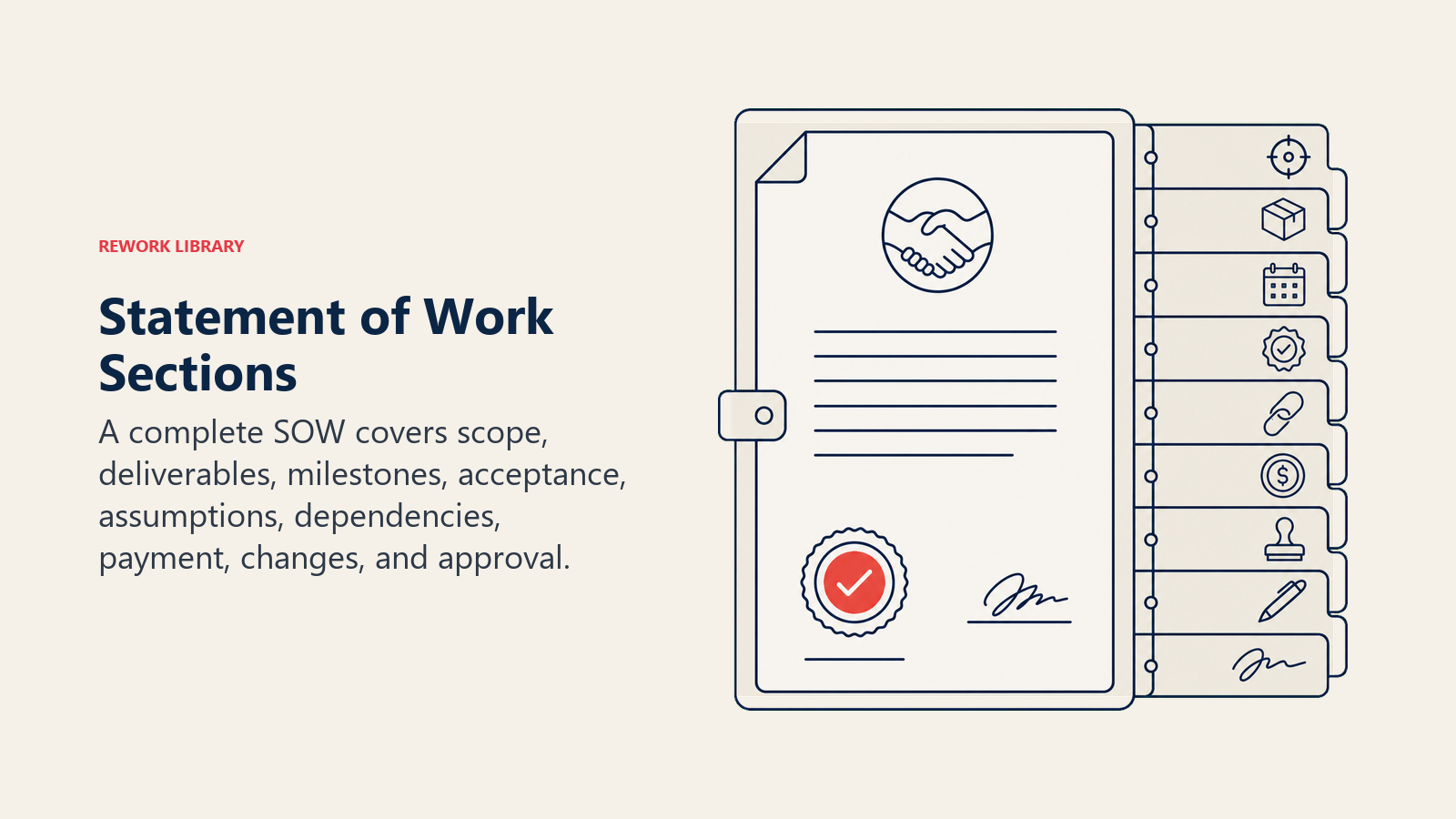
Every SOW should cover the following sections. Some industries add specialized clauses (security, compliance, insurance), but these ten form the universal baseline.
| Section | What it covers |
|---|---|
| Project overview | One-paragraph summary of the project: business problem being solved, client, vendor, and overall objective |
| Scope of work | Detailed description of all tasks, activities, and services to be performed; includes explicit out-of-scope items |
| Deliverables | Specific outputs the vendor will provide: reports, software builds, designs, training materials, etc. |
| Timeline and milestones | Start date, end date, key milestone dates, and any phase gates requiring sign-off |
| Acceptance criteria | The measurable standards each deliverable must meet before the client approves it |
| Assumptions and constraints | What the SOW assumes to be true; limits on resources, technology, access, or regulatory requirements |
| Dependencies | What the vendor needs from the client (data, approvals, access) and by when |
| Payment terms | Fee structure, invoicing schedule, late-payment penalties, and reimbursement policies for expenses |
| Change management | Process for requesting, evaluating, and approving scope changes; how changes affect cost and timeline |
| Signatures and approval | Authorized signatures from both parties, date of execution |
The scope and deliverables sections carry the most legal weight. Vague language here is the single biggest driver of disputes. "Provide a website" is not a deliverable. "Deliver a responsive, five-page marketing website with a contact form, CMS integration, and accessibility compliant with WCAG 2.1 AA by July 31" is.
The assumptions section is often skipped, but it's just as important. If your SOW assumes the client will provide brand assets by week two and they don't, you need a written record that the delay originated with the client, not you.
Types of statement of work
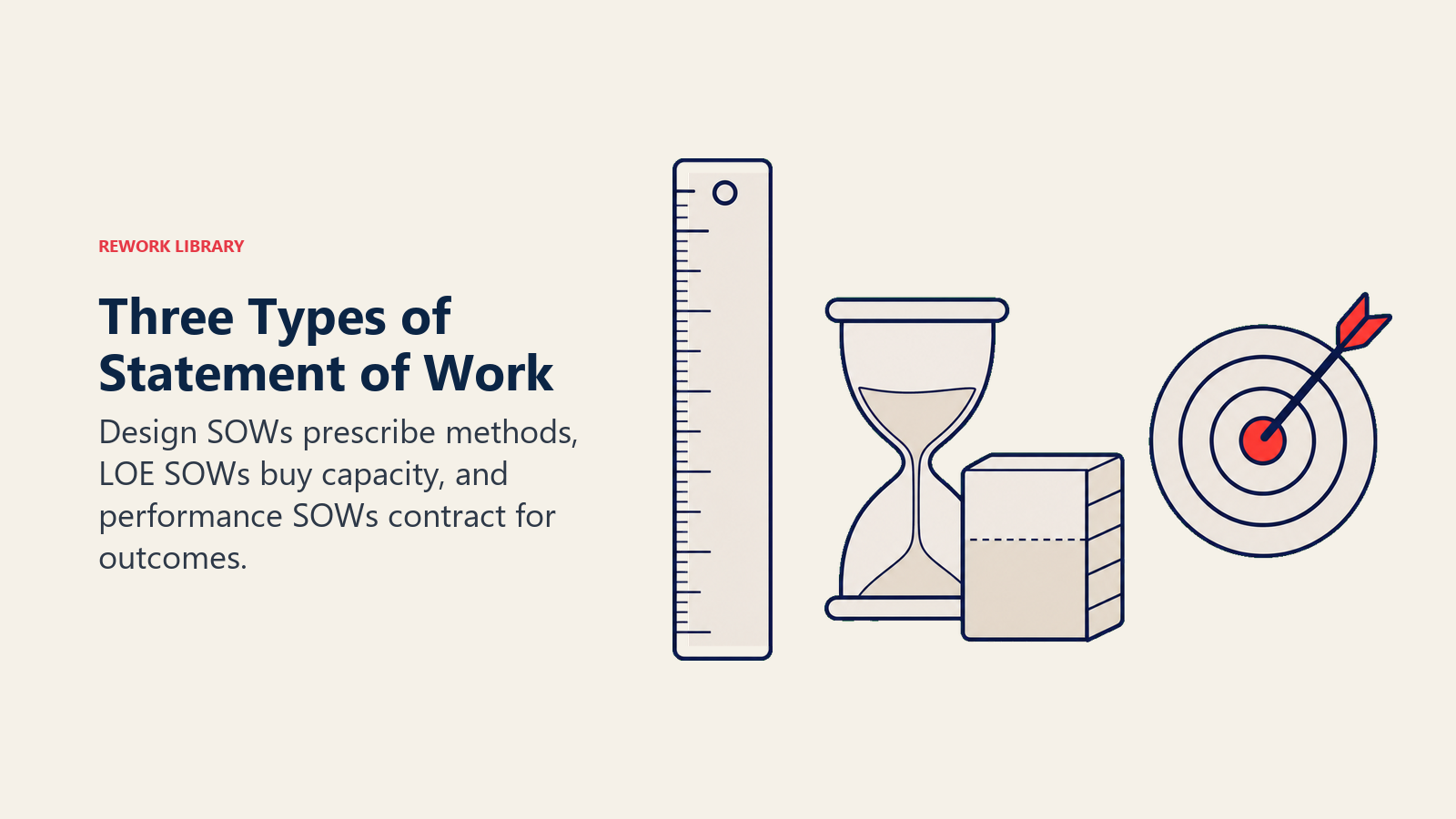
Three SOW types exist, and choosing the right one depends on how well the project scope can be defined upfront.
| Type | How it works | Best for |
|---|---|---|
| Design/detail SOW | Specifies exact tasks, materials, and methods the vendor must follow; highly prescriptive | Projects where the client knows exactly what they want: manufacturing, government contracts, construction |
| Level-of-effort (LOE) SOW | Defines the amount of work (hours, FTEs, duration) rather than specific outputs; vendor provides services within that budget | Staff augmentation, managed services, consulting retainers where deliverables vary week to week |
| Performance-based SOW | Defines the outcomes or results required but leaves the method to the vendor; ties payment to results | Outcome-driven engagements: marketing campaigns (leads generated), software development (features shipped), process improvement (cycle time reduction) |
A design/detail SOW gives the client maximum control but requires the most upfront specification work. If requirements are incomplete, the vendor will stick precisely to the letter of the document and the client ends up unhappy with a technically compliant result.
A performance-based SOW gives the vendor flexibility to innovate but demands clear, measurable outcomes. If acceptance criteria are weak, disputes about whether the standard was met become frequent.
Most real-world SOWs blend types. A software project might use performance-based criteria for feature acceptance while specifying exact team composition (level-of-effort) for staffing.
SOW vs project charter vs scope statement
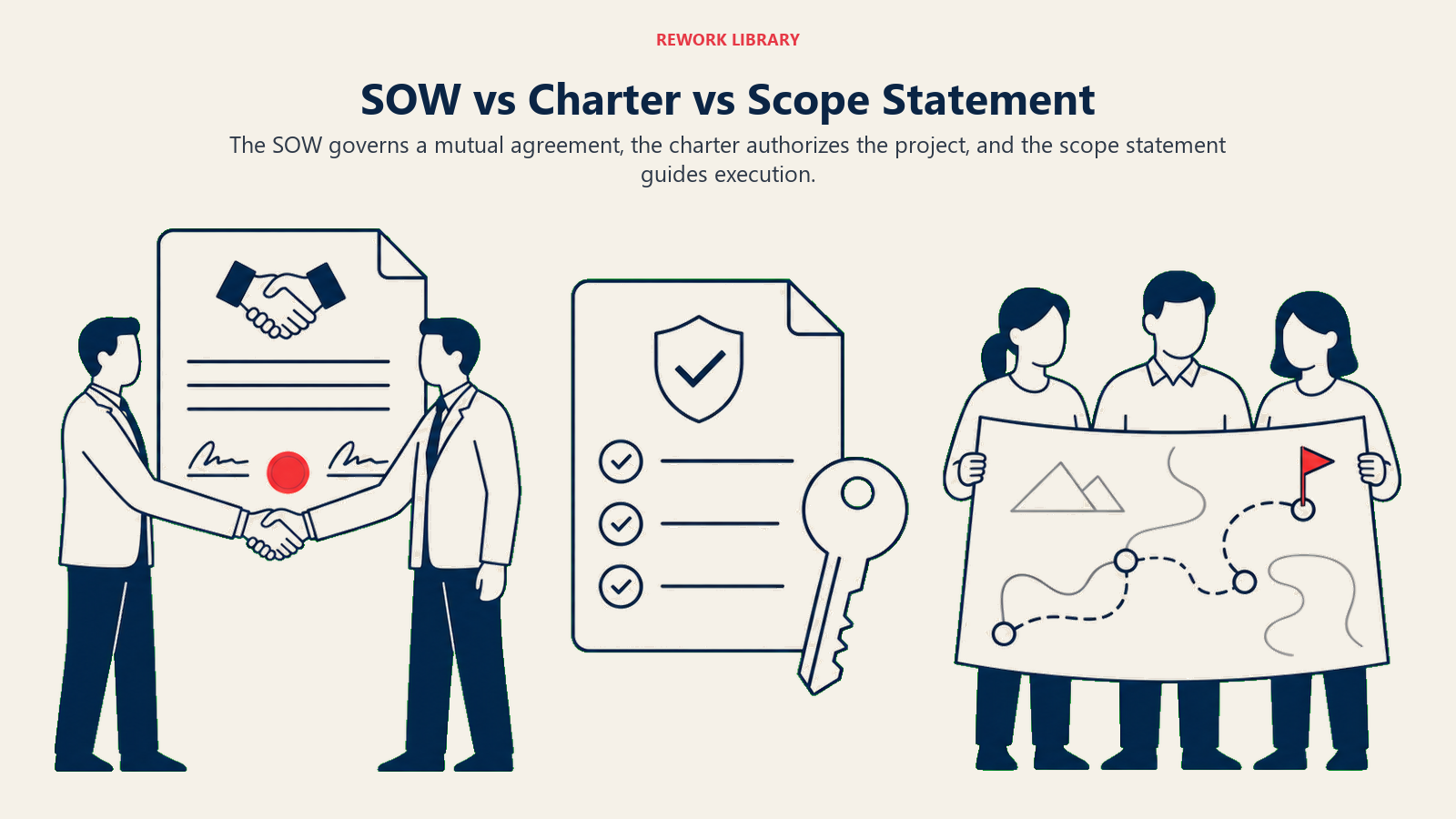
These three documents often confuse teams because they overlap. Here's how to tell them apart:
| Document | Purpose | Audience | When written | Legal weight |
|---|---|---|---|---|
| Statement of work (SOW) | Governs the agreement between client and vendor on scope, deliverables, payment, and terms | Client + external vendor or cross-functional team | Before contract execution | High: often a contract exhibit |
| Project charter | Formally authorizes the project and grants the PM authority to use resources | Internal stakeholders, project sponsor | Project initiation | Medium: internal document |
| Project scope statement | Defines what is and is not in scope for the project team during execution | Project team, PM, stakeholders | Planning phase | Low: internal reference |
A project might have all three. The SOW with the client defines what the vendor must deliver. The project charter internally authorizes the vendor's PM to mobilize resources. The scope statement breaks the work down for the internal team's planning.
The SOW also differs from a Master Service Agreement (MSA). An MSA sets the overarching legal terms for all work between two parties (liability, IP, dispute resolution). SOWs are then issued under the MSA for specific engagements. Think of the MSA as the framework and each SOW as a task order under it.
How to write a statement of work
Align scope, define deliverables and acceptance, set milestones and payment, then lock changes with signatures.
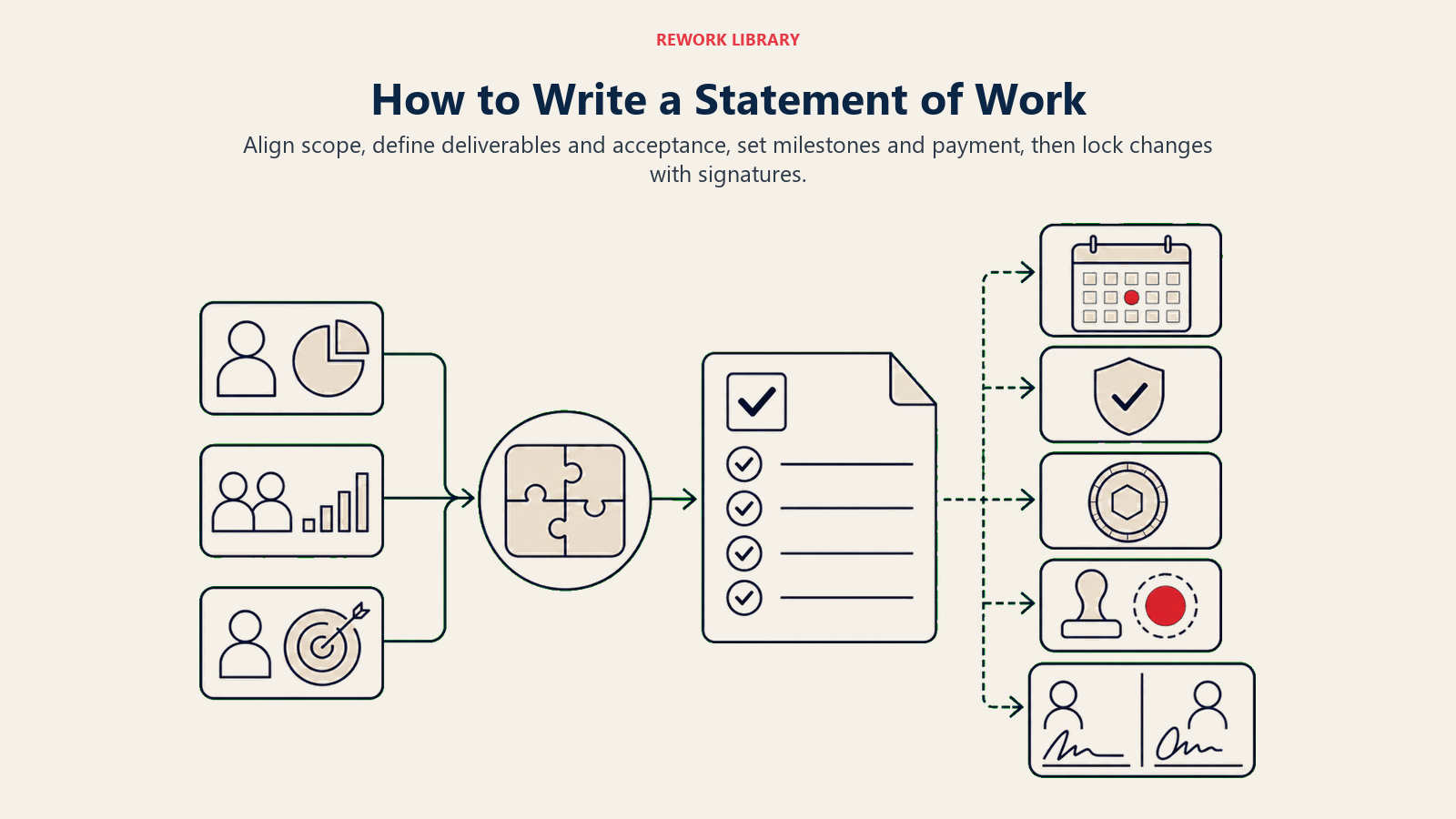
Step 1: Align on scope before writing
Talk to every stakeholder before you open a document. Run a scope workshop with the client, delivery leads, legal, and finance. Use a requirements traceability matrix to capture and link requirements to deliverables. The writing is easy once you know what you're agreeing to.
Step 2: Write the project overview
One paragraph, plain language. State who the client is, who the vendor is, what business problem the project solves, and the expected business outcome. Skip the marketing language. "Improve the client's lead response time from 48 hours to under 4 hours" is more useful than "transform the client's sales operations."
Step 3: Define scope and out-of-scope items
List every task and service that falls inside the engagement. Then explicitly list what is out of scope. This second list is just as important. If you don't say it's out of scope, some stakeholders will assume it's included.
A work breakdown structure (WBS) is a practical tool here. Build the WBS first, then use it to populate your SOW scope section. The WBS forces you to decompose the work to a level where nothing ambiguous survives.
Step 4: Define deliverables and acceptance criteria
For each deliverable, answer: What is it? What format? Who reviews it? What quality standard must it meet? What is the approval deadline?
Connect acceptance criteria to your project baseline so you have a reference point for measuring progress throughout the project.
Step 5: Build the timeline
Map milestones to calendar dates. Include client-side dependencies (data delivery, approvals, sign-offs) with their due dates. Note which milestones are gates: work on the next phase cannot begin until the client approves the previous one.
A communication plan pairs naturally with this step. Define how progress will be reported, at what frequency, and to whom.
Step 6: Agree on payment terms
Specify the total contract value, payment schedule (milestone-based or calendar-based), invoicing instructions, and what triggers each payment. Include late-payment provisions and what happens to the work if payment is delayed.
Step 7: Add change management and signatures
Define the change request process: who can submit a change, who evaluates it, how long review takes, and how changes affect price and schedule. Both parties sign. Keep signed copies accessible to both the PM and legal.
Reference your RACI matrix when assigning approval authority in the change process. It prevents confusion about who is accountable for decisions.
Statement of work template
Below is a minimal SOW structure you can copy and adapt. Replace bracketed fields with your actual project details.
STATEMENT OF WORK
Project name: [Project Name] Client: [Client Organization] Vendor/Service Provider: [Your Organization] Effective date: [Date] Contract reference: [MSA number or contract ID, if applicable]
1. Project overview
[Client name] is engaging [Vendor name] to [describe what the project does and the business outcome it addresses]. This SOW governs all work performed between [Start Date] and [End Date].
2. Scope of work
In scope:
- [Task or service 1]
- [Task or service 2]
- [Task or service 3]
Out of scope:
- [Excluded item 1]
- [Excluded item 2]
3. Deliverables
| Deliverable | Description | Format | Due date | Acceptance owner |
|---|---|---|---|---|
| [Deliverable 1] | [Description] | [Format] | [Date] | [Name/role] |
| [Deliverable 2] | [Description] | [Format] | [Date] | [Name/role] |
4. Timeline and milestones
| Milestone | Due date | Gate? |
|---|---|---|
| Project kickoff | [Date] | No |
| Phase 1 complete | [Date] | Yes |
| Final delivery | [Date] | Yes |
5. Acceptance criteria
Each deliverable is accepted when: [describe the measurable standard, e.g., "all automated tests pass with zero critical defects, client QA team signs off within 5 business days of delivery"].
6. Assumptions and constraints
- Client will provide [specific data or access] by [Date].
- Work is performed in [location or environment].
- All deliverables are in [language].
7. Payment terms
Total contract value: [Amount] Payment schedule: [e.g., 30% on execution, 40% on milestone 2 approval, 30% on final acceptance] Invoicing: [Instructions for invoice submission]
8. Change management
Changes to scope, timeline, or cost require a written Change Request submitted to [name/role]. Vendor will respond within [X] business days with impact assessment. No change takes effect without written approval from both parties.
9. Authorized signatures
| Party | Name | Title | Signature | Date |
|---|---|---|---|---|
| Client | ||||
| Vendor |
Common mistakes when writing a statement of work
Vague deliverables. "A report" is not a deliverable. "A 20-page written analysis in PDF format covering X, Y, and Z, delivered by [date]" is. Every deliverable needs a format, a success standard, and a due date.
Missing out-of-scope list. Clients frequently assume that related work is included unless explicitly excluded. If you don't write it out, you'll find yourself doing it for free.
Unrealistic timelines without client dependencies. Timelines that depend on client actions (data delivery, approvals, access provisioning) need to show those dependencies explicitly. If the client is two weeks late with a data export, your delivery date shifts. The SOW should say that.
Acceptance criteria that can't be measured. "High quality" is not an acceptance criterion. "Zero SEV-1 bugs, load time under 2 seconds on a 4G connection, WCAG 2.1 AA compliance verified by automated scan" is.
Single-party signature. An SOW signed by only one party isn't a mutual agreement. Both parties must sign before work begins.
Ignoring the change management section. Teams that skip this section spend the second half of the project arguing about whether scope changed and who has to pay for it. Write the process before the first change request arrives.
A well-written statement of work pays for itself the first time a scope dispute comes up. With clear deliverables, measurable acceptance criteria, and an explicit change process, both parties spend less time arguing and more time building. Use the template above as a starting point, get both parties to review every section carefully, and treat the signature line as the moment the real project begins.

Senior Operations & Growth Strategist
On this page
- What is a statement of work (SOW)?
- What to include in a statement of work
- Types of statement of work
- SOW vs project charter vs scope statement
- How to write a statement of work
- Step 1: Align on scope before writing
- Step 2: Write the project overview
- Step 3: Define scope and out-of-scope items
- Step 4: Define deliverables and acceptance criteria
- Step 5: Build the timeline
- Step 6: Agree on payment terms
- Step 7: Add change management and signatures
- Statement of work template
- Common mistakes when writing a statement of work