SAFe: The Scaled Agile Framework Explained
Turn this article into takeaways for your work.


Each assistant summarizes the article only for you and suggests best practices for your work.
The Scaled Agile Framework (SAFe) is the most widely adopted approach for bringing agile to large enterprises. If your organization has hundreds of engineers, dozens of teams, and complex product lines that can't easily fit into a single Scrum setup, SAFe gives you a structured way to coordinate them all without abandoning the core agile principles you already rely on.
It's not a perfect solution, and it has real critics. But understanding what SAFe actually is, and what it's trying to solve, helps you make a smarter call about whether it belongs in your organization.
What is SAFe (the Scaled Agile Framework)?
SAFe (Scaled Agile Framework) is a set of organizational and workflow patterns for implementing agile practices at enterprise scale. Scaled Agile, Inc. developed and maintains it. The framework combines ideas from Lean, Agile, and systems thinking to help teams that number in the hundreds or thousands deliver software and products faster, with better quality and alignment to business goals.
Small teams running Scrum or Kanban don't need SAFe. But when you have 50, 100, or 500 teams that all need to ship toward the same product vision, coordination becomes the bottleneck. SAFe addresses that bottleneck by defining clear layers of planning, common cadences, and specific roles that bridge strategy and execution.
Key facts
- SAFe is used by 35% of organizations doing agile at scale, making it the most popular scaling framework (State of Agile Report, 2023).
- Organizations implementing SAFe report a 30-75% faster time-to-market in Scaled Agile case studies (Scaled Agile, Inc., 2022).
- The framework has gone through five major versions since its introduction in 2011, with SAFe 6.0 released in 2023.
The four SAFe configurations
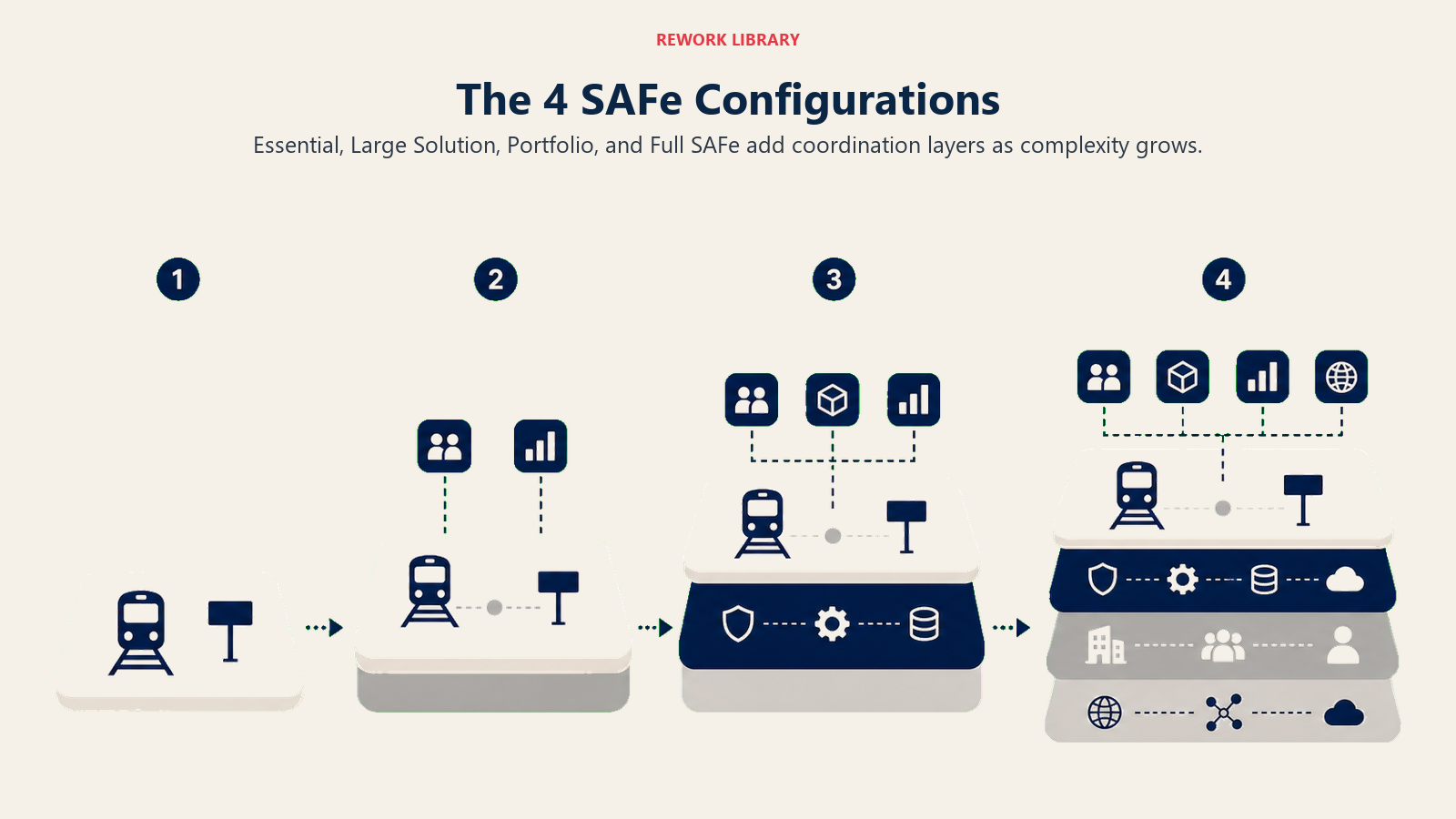
SAFe isn't one-size-fits-all. It comes in four configurations, each designed for a different organizational size and complexity.
| Configuration | What it adds | Best for |
|---|---|---|
| Essential SAFe | The minimum viable SAFe: one Agile Release Train (ART), PI planning, core roles, and a team-level backlog structure | Organizations new to SAFe, or those with 50-125 people on a single product |
| Large Solution SAFe | Adds the Solution Train layer for coordinating multiple ARTs building a single large solution | Aerospace, defense, and complex product companies with 125-500 practitioners |
| Portfolio SAFe | Adds portfolio-level strategy, Lean budgeting, and investment themes that connect execution to business strategy | Enterprises managing multiple value streams and product lines |
| Full SAFe | Combines all three layers: portfolio, large solution, and essential | The largest enterprises running many ARTs across multiple value streams |
Most organizations start with Essential SAFe. The other configurations add overhead, so you only adopt them if you genuinely need the coordination layer they provide.
Core concepts: ARTs, PI planning, and the levels
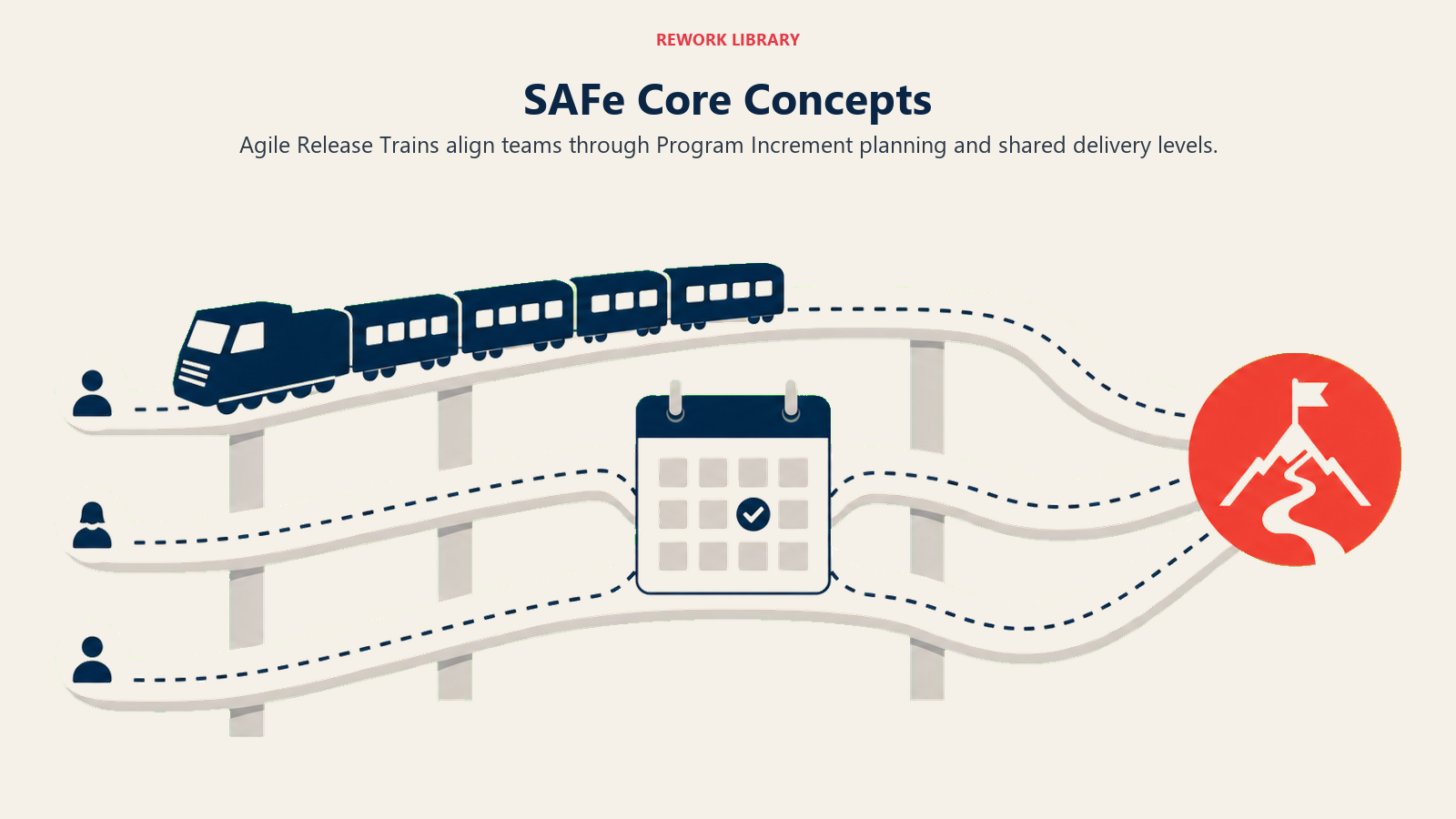
Agile Release Trains align teams through Program Increment planning and shared delivery levels.
The Agile Release Train (ART)
The Agile Release Train is the backbone of SAFe. An ART is a long-lived team of agile teams (typically 50-125 people) that plans, commits, and delivers together on a shared mission. Think of it as a virtual organization that stays together across multiple product cycles.
All teams on an ART follow the same iteration cadence, usually two-week sprints. They participate in the same planning events and operate on the same Program Increment (PI) timeline. This shared cadence is what lets dozens of teams stay synchronized without constant top-down direction.
Program Increment (PI) planning
PI planning is the heartbeat of SAFe. Every 8-12 weeks, all teams in an ART gather for a two-day face-to-face event (or virtual equivalent) to plan the next increment of work. Teams inspect the current state of the product, review the roadmap, and commit to specific objectives for the coming PI.
The result is a set of PI objectives for each team, a consolidated ART board showing dependencies, and a risk register. PI planning is often called the "secret sauce" of SAFe because it creates real alignment across teams without requiring constant management intervention. It's also expensive in time, which is one reason critics question whether SAFe's overhead is worth it.
The levels
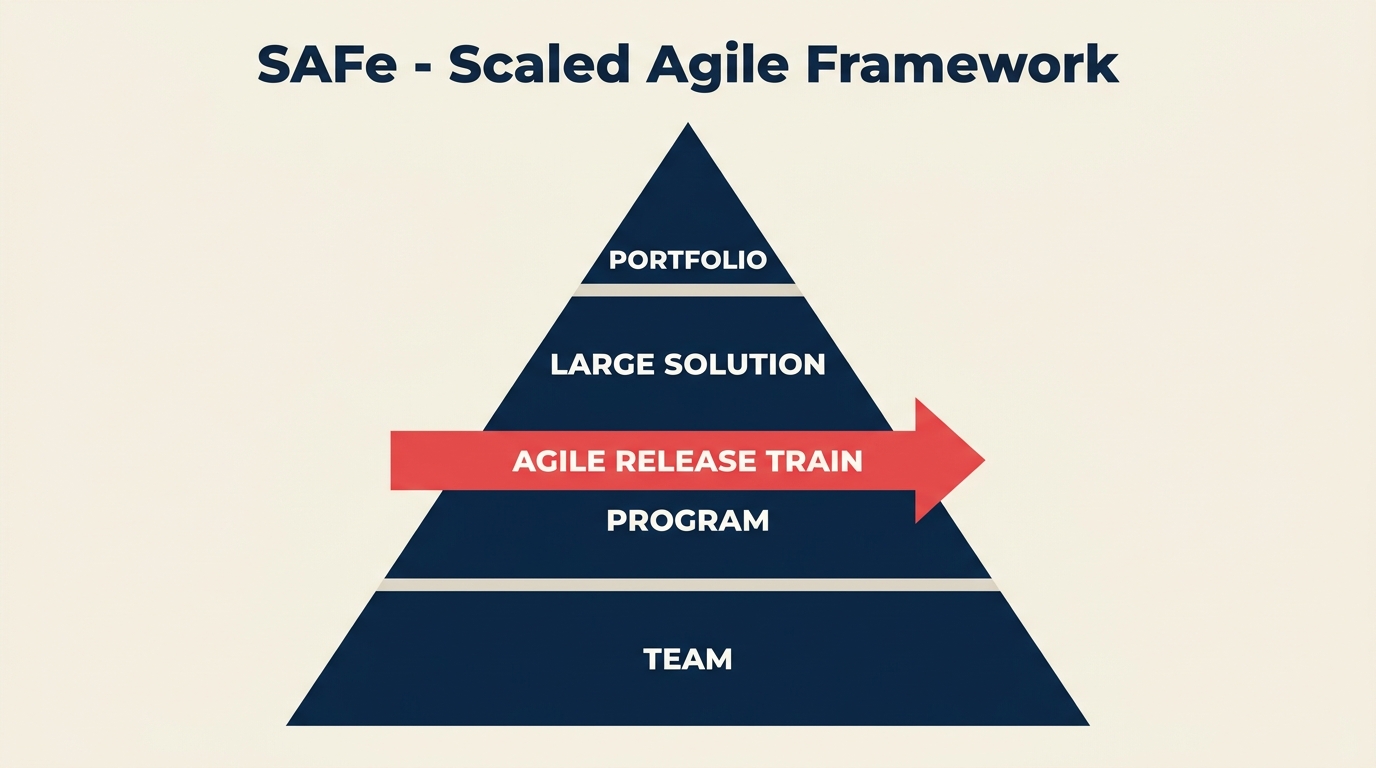
SAFe organizes work across three (or four) levels:
Team level. Individual agile teams run sprints, maintain team backlogs, and participate in standard agile ceremonies like retrospectives and sprint reviews. The product backlog at this level feeds into the program-level backlog.
Program level. This is where ARTs operate. Teams coordinate through PI planning, the Program Board (for visualizing cross-team dependencies), and a shared program backlog called the Program Increment Backlog (or PI Backlog). A Release Train Engineer (RTE) facilitates this layer.
Large Solution level (if needed). When multiple ARTs build a single large system together, this layer coordinates them. A Solution Train Engineer and Solution Architects maintain solution-level backlogs and run Solution PI planning.
Portfolio level. Here, strategy connects to execution. Business leaders define investment themes and value streams, set budgets using Lean Portfolio Management (LPM), and monitor flow using portfolio Kanban. Epics at this level break down into features at the program level, then into stories at the team level.
SAFe roles
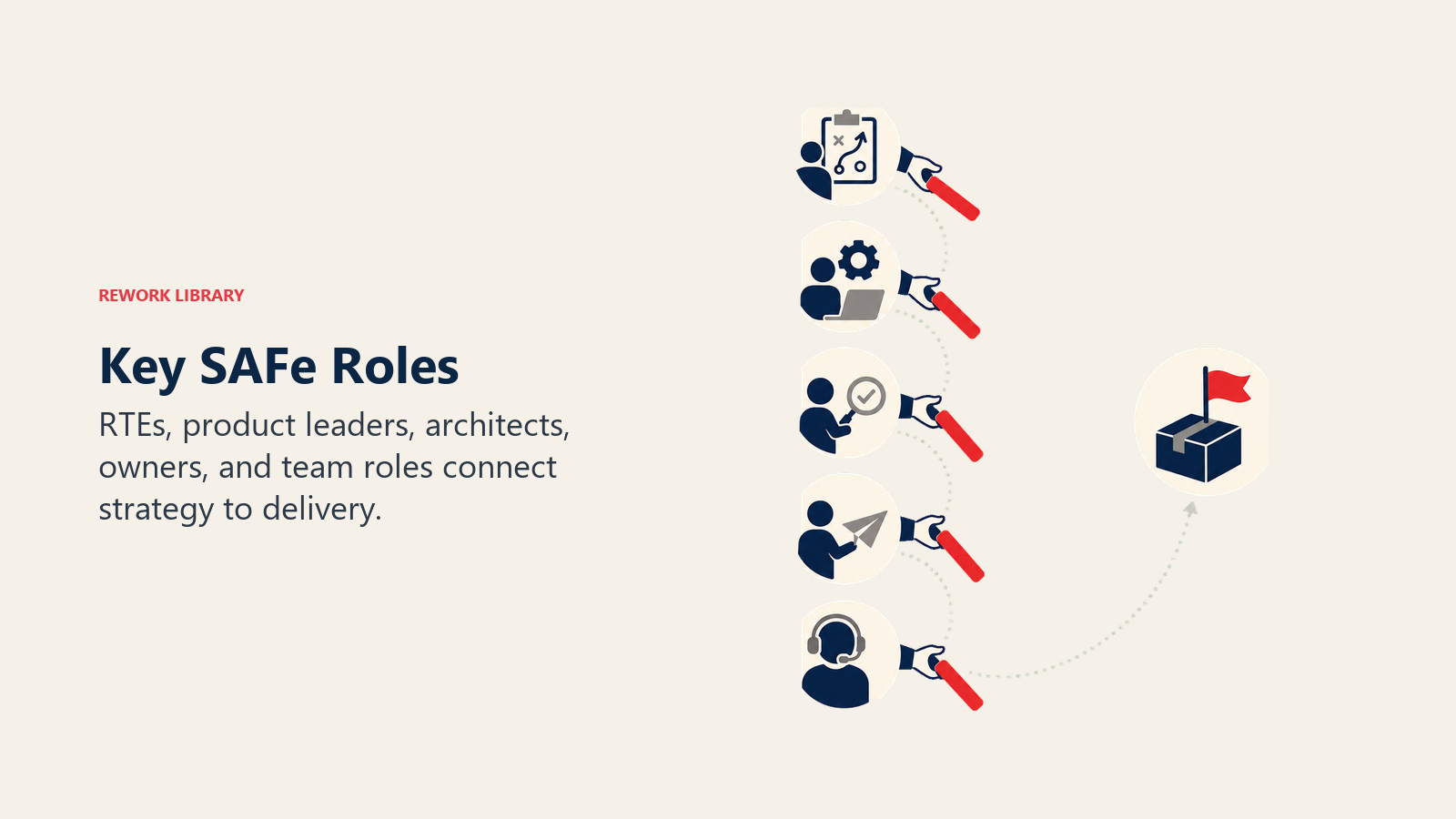
SAFe defines a rich set of roles across each level. Here are the ones you'll encounter most often.
| Role | Level | Responsibility |
|---|---|---|
| Release Train Engineer (RTE) | Program | Servant leader for the ART; facilitates PI planning, removes impediments, coaches teams on SAFe practices |
| Product Management | Program | Owns the program backlog (features); aligns with business stakeholders and sets priorities for each PI |
| System Architect | Program | Defines technical architecture at the ART level; works with teams to ensure design decisions support the overall system |
| Business Owners | Program | Senior stakeholders who own PI objectives and evaluate business outcomes; they participate actively in PI planning |
| Scrum Master | Team | Facilitates team ceremonies, coaches the team on Agile/SAFe practices, removes team-level blockers |
| Product Owner | Team | Manages the team backlog, writes and accepts stories, represents customer and product management interests to the team |
| Enterprise Architect | Portfolio | Guides technical direction across the portfolio; identifies cross-cutting concerns and enables reuse |
| Lean Portfolio Management (LPM) | Portfolio | A function (not one person) that connects strategy to execution, manages the portfolio Kanban, and allocates budgets to value streams |
The RTE is often described as a "super Scrum Master" for the train. It's a full-time role, and the quality of the RTE often determines how well the ART actually functions.
Benefits of SAFe
Alignment at scale. PI planning creates a shared plan that everyone, from engineers to executives, can reference. Teams know how their work connects to the larger product vision. That kind of alignment is rare and valuable in large organizations.
Predictable delivery. Because all teams work on the same PI cadence, leadership can forecast deliveries with reasonable accuracy. You know roughly what's coming out of each PI before the PI even starts.
Faster feedback loops. SAFe pushes teams to deliver working software every two weeks, with system demos at the end of each PI. That's a much tighter feedback loop than the traditional waterfall release cycle that many enterprises still run.
Built-in business agility. Portfolio SAFe's Lean Portfolio Management gives executives a way to shift investment between value streams without waiting for the next annual budget cycle. It's not true continuous funding, but it's significantly more responsive than typical corporate planning.
Community and tooling. SAFe has a large certified practitioner community and strong tooling support from platforms like Jira Align, Rally, and Planview. That ecosystem can accelerate adoption.
Criticisms and limitations
SAFe has genuine critics, and their objections deserve serious consideration before you commit.
It's heavyweight. SAFe introduces a lot of roles, artifacts, and ceremonies on top of what teams already do. For organizations that want "agile" to mean "simple and adaptive," SAFe can feel like the opposite.
Top-down by design. One persistent critique is that SAFe replicates traditional management hierarchy under an agile label. Business Owners approve PI objectives. Budgets flow down from the portfolio level. Teams plan against a roadmap that business stakeholders largely control. That's a far cry from the self-organizing teams at the heart of the agile manifesto.
"SAFe is not agile." A vocal group of agile coaches and thought leaders argue that SAFe's rigidity contradicts agile values. Dave Thomas (one of the original Manifesto signatories) and others have criticized it for institutionalizing processes over people. Ron Jeffries has called it "Dark Scrum with extra steps." These are strong words, but the underlying concern is real: organizations can adopt SAFe's ceremonies while losing the mindset that makes agile work.
Velocity in agile can mislead. When SAFe teams measure velocity at the PI level without caring about whether those numbers translate to user value, they optimize for output over outcomes. SAFe doesn't prevent this, and the pressure to commit to PI objectives can make it worse.
Certification culture. SAFe's certification ecosystem (SAFe Agilist, RTE, POPM, etc.) creates a business model that some critics find misaligned with the spirit of agile. Certifications can become checkboxes rather than genuine competence signals.
None of this means SAFe is wrong for your organization. But going in with eyes open helps you avoid implementing the bureaucracy without capturing the benefits.
How to implement SAFe
Scaled Agile, Inc. publishes an Implementation Roadmap. Here's a plain-English version of it.
Step 1: Train the leadership team
SAFe doesn't work if senior leaders aren't bought in and trained. Start with a two-day Leading SAFe course for executives, directors, and senior managers. If leaders still run waterfall portfolio planning while teams try to run SAFe, the framework will fail at the seams. Leadership alignment is non-negotiable.
Step 2: Identify value streams and ARTs
Map your organization to the work it delivers to customers, not your org chart. A value stream is the sequence of steps that produces a product or service customers value. Each value stream becomes the boundary of an ART. Define your first ART before defining the second: it's easier to learn, adjust, and then expand than to launch five ARTs simultaneously.
Step 3: Create the implementation plan
This means deciding your PI length (8 or 12 weeks), planning the first PI planning event, training the teams who'll form the ART, and standing up the roles (RTE, Product Management, System Architect). You don't need every role perfect from day one, but you need the core ones filled by people who understand the framework.
Step 4: Train teams and launch the ART
Run a two-day ART Launch event that combines SAFe for Teams training with the first PI planning. This gets every team member oriented and produces the first real PI plan. Expect this to be messy. First PI planning events rarely go smoothly. That's expected and fine.
Step 5: Coach the execution
During the first few PIs, coach continuously. RTEs and Scrum Masters need to help teams internalize the cadence. Common failure points: teams skipping iteration reviews, PI objectives that are too vague to evaluate, and dependency tracking on the Program Board that no one updates.
Step 6: Expand and improve
After 2-3 PIs, assess what's working and what isn't. Run a thorough inspect-and-adapt (I&A) workshop at the end of each PI to generate actionable improvements. Only expand to a second ART or to portfolio SAFe once the first ART is stable. Scaling broken processes just makes the problems bigger.
SAFe vs other scaling approaches
SAFe offers more structure; LeSS, Nexus, Scrum@Scale, and Spotify-style models trade prescription for autonomy. Disciplined Agile takes a different route: a toolkit for tailoring whichever approach a team already uses.
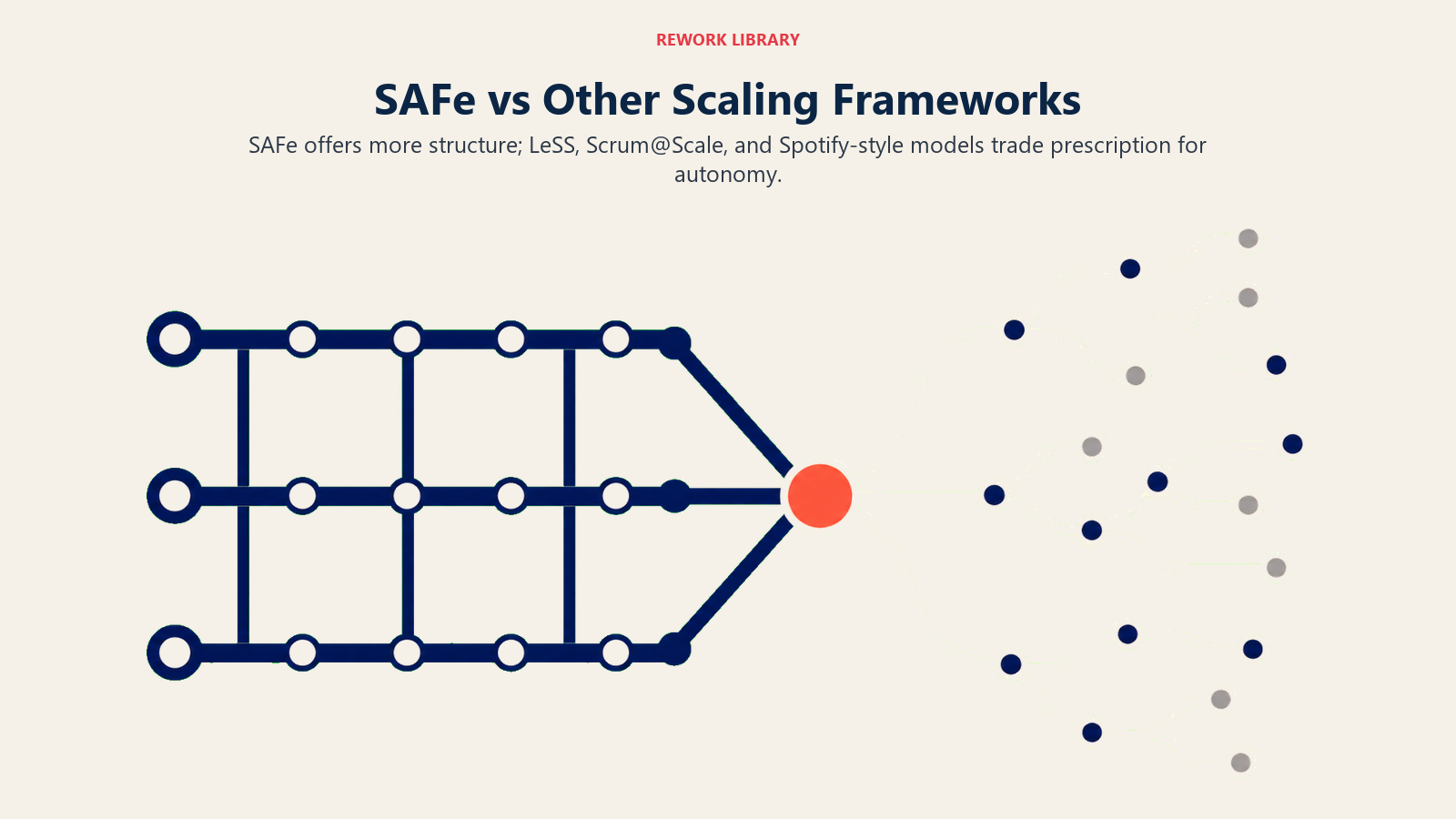
| Framework | Approach | Best fit | Key trade-off |
|---|---|---|---|
| SAFe | Prescriptive, multi-level, role-heavy | Large enterprises (200+ engineers) needing structure and predictability | High overhead; can feel bureaucratic |
| LeSS (Large-Scale Scrum) | Minimal structure; extend Scrum to multiple teams with one Product Owner and one Product Backlog | 2-8 teams willing to do the organizational work of true Scrum | Requires deep Scrum mastery; hard in siloed orgs |
| Scrum@Scale | Fractal: replicate Scrum structures at each level | Organizations that already do Scrum well and want to scale gradually | Less prescriptive; requires more self-organization |
| Spotify Model | Tribes, squads, chapters, guilds; culture-driven | Tech companies wanting autonomy and alignment with minimal process | Not a true framework; the original Spotify has moved on |
If you're evaluating scrumban for individual teams or thinking through agile vs scrum comparisons before choosing a scaling approach, read those first. The team-level practice you choose affects how well any scaling framework can work on top of it.
Frequently Asked Questions about SAFe
Is SAFe still agile?
That depends on how you implement it. SAFe incorporates agile principles and uses agile ceremonies, but its structured hierarchy and top-down planning cycles push against some core agile values. Done well, SAFe can produce genuinely adaptive organizations. Done poorly, it creates the illusion of agility while keeping all the old command-and-control dynamics in place.
How long is a Program Increment (PI)?
A PI is typically 8 to 12 weeks. Most organizations use 10-week PIs made up of five two-week iterations. The last iteration is usually an Innovation and Planning (IP) iteration used for cleanup, hardening, and planning the next PI.
Do you need SAFe certification to implement it?
No. Certification helps teams learn the framework faster, and an RTE certificate gives the RTE credibility with the teams they're coaching. But organizations have successfully implemented SAFe with minimal formal certification by investing in internal coaching and hands-on practice. The certification ecosystem is useful but not required for success.
How many teams form an Agile Release Train?
An ART typically has 5 to 12 teams, with each team having 5-9 members. That puts the ART size at 50-125 people. Going larger than 125 means you probably need to split into two ARTs or move to the Large Solution configuration.
What's the difference between an Epic and a Feature in SAFe?
An Epic is a large business or technical initiative defined at the portfolio or large solution level. Features are smaller deliverables defined at the program level that implement part of an Epic. Teams then break Features into user stories in their team backlogs. The Epic-Feature-Story hierarchy is how work flows from strategy down to daily execution.
What SAFe gets right and where to go next
SAFe isn't for everyone. But for large organizations genuinely struggling with coordination, misaligned roadmaps, and slow delivery, it provides a concrete starting point. The framework's biggest value isn't the ceremonies themselves. It's the shared language and cadence it creates across teams that previously had no common rhythm.
Start small, train honestly, and run real inspect-and-adapt sessions. The organizations that get the most out of SAFe treat it as a starting configuration, not a permanent destination.
If you're still deciding between delivery approaches, extreme programming offers a more engineering-focused alternative worth examining alongside SAFe.
Related reading

Senior Operations & Growth Strategist
On this page
- What is SAFe (the Scaled Agile Framework)?
- The four SAFe configurations
- Core concepts: ARTs, PI planning, and the levels
- The Agile Release Train (ART)
- Program Increment (PI) planning
- The levels
- SAFe roles
- Benefits of SAFe
- Criticisms and limitations
- How to implement SAFe
- Step 1: Train the leadership team
- Step 2: Identify value streams and ARTs
- Step 3: Create the implementation plan
- Step 4: Train teams and launch the ART
- Step 5: Coach the execution
- Step 6: Expand and improve
- SAFe vs other scaling approaches
- What SAFe gets right and where to go next
- Related reading