Extreme Programming (XP): Values and Practices
Turn this article into takeaways for your work.


Each assistant summarizes the article only for you and suggests best practices for your work.
Extreme Programming (XP) is the agile methodology that says good engineering habits should be taken to their logical limit. Where other frameworks tell you how to manage work, XP tells you exactly how to write, test, and integrate it.
Kent Beck introduced XP in the late 1990s while working on the Chrysler Comprehensive Compensation project. He noticed that the practices software teams occasionally used when things got serious, like writing tests first or reviewing code with a partner, worked best when applied constantly. XP formalizes that insight into a set of values and practices any team can adopt.
What is Extreme Programming?
Extreme Programming is an agile methodology built around frequent releases, continuous feedback, and strict engineering discipline. It packages proven software craftsmanship habits into a coherent framework so teams can ship production-ready software in short weekly or biweekly iterations.
Unlike Scrum, which focuses primarily on process and ceremony, XP prescribes specific technical practices. It tells you to write tests before code, to integrate your work several times a day, and to keep design simple enough to change at any time.
Key facts
- Teams practicing continuous integration see up to 65% faster code integration cycles (DORA State of DevOps Report, 2023).
- Test-driven development (TDD) reduces defect rates by 40 to 80% in controlled studies (Microsoft Research / IBM Research, 2008).
- As of 2024, XP practices are embedded in the working habits of roughly 14% of professional software teams, often combined with Scrum (State of Agile Report, 2024).
XP shares its philosophical roots with the Agile Manifesto, which codified the movement Beck helped start. But XP predates the Manifesto by two years and goes further in specifying engineering behavior.
The 5 values of XP
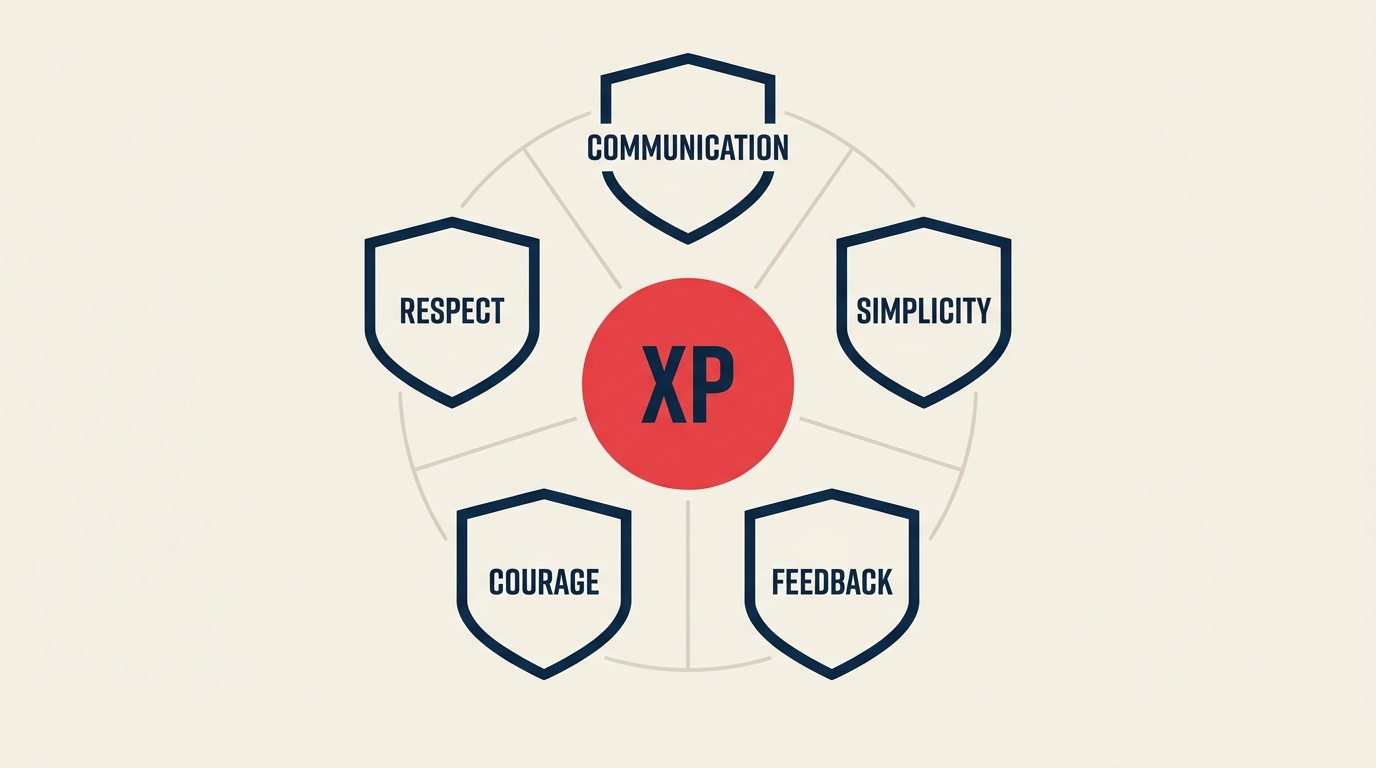
XP is explicit about the mindset behind its practices. These five values shape every decision on an XP team.
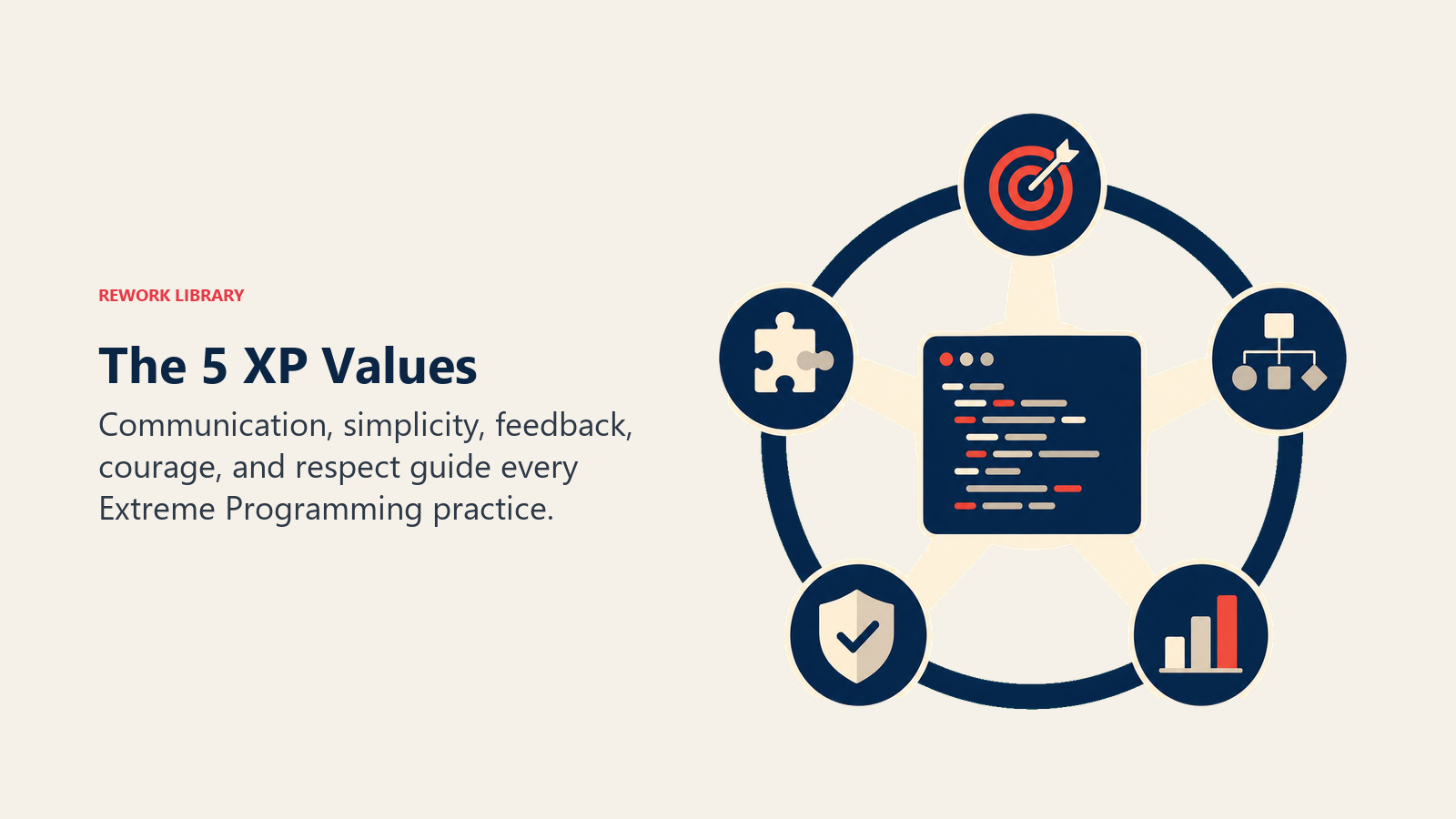
Communication. Problems fester when people stop talking. XP requires constant face-to-face conversation between developers, testers, and the customer representative embedded on the team.
Simplicity. Build only what you need today. An XP team resists speculative design and favors the simplest solution that solves the current problem. This makes code easier to change tomorrow.
Feedback. Short cycles exist to generate feedback fast. Feedback comes from unit tests running in seconds, from integration builds that run hourly, and from customers reviewing real features every week.
Courage. Good engineering decisions are sometimes uncomfortable. XP asks teams to delete dead code, refactor mercilessly, and tell the customer when a deadline is unrealistic. That takes courage.
Respect. Every team member's contribution matters. Respect means no one ships code that deliberately breaks someone else's work, and no one dismisses a concern without hearing it out.
The 12 core XP practices
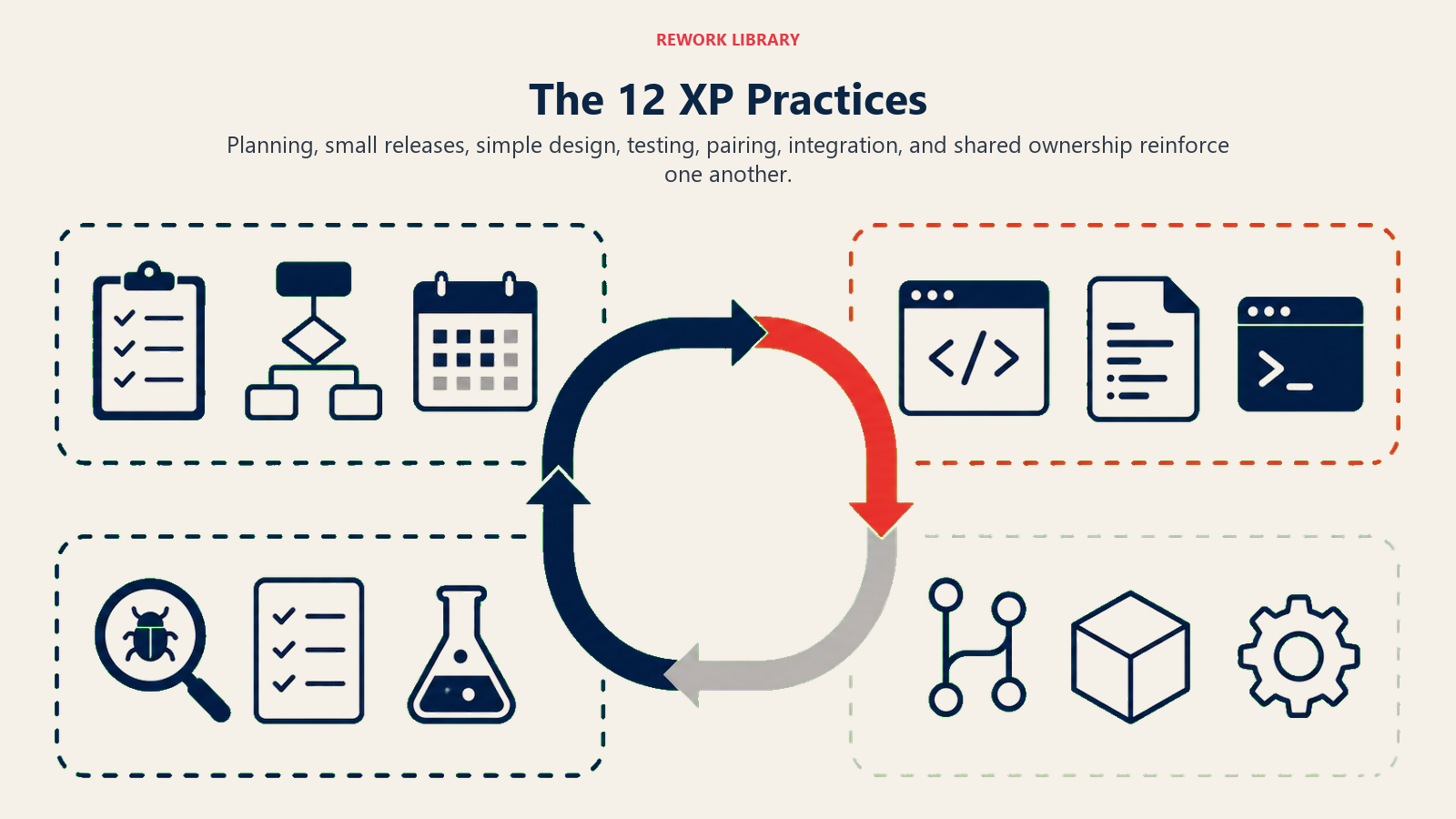
XP organizes its practices into four groups. The groupings below reflect how Kent Beck described them in his original formulation.
Fine-scale feedback
| Practice | What it means |
|---|---|
| Pair programming | Two developers share one workstation. One writes code; the other reviews in real time. Roles swap often. |
| Test-driven development (TDD) | Write a failing test first. Then write just enough code to make it pass. Then refactor. |
| Planning game | Customer and developers collaborate each iteration to decide what gets built and estimate the effort. Covered in more detail under sprint planning. |
| Whole team (on-site customer) | A real customer or business representative joins the team full-time to answer questions and accept or reject features immediately. |
Continuous process
| Practice | What it means |
|---|---|
| Continuous integration (CI) | Developers integrate their work into the shared codebase multiple times per day. Automated tests run on every commit. |
| Refactoring | Continuously improve the internal structure of code without changing its behavior. Never let technical debt accumulate. |
| Small releases | Ship working software to users or staging in very short cycles, ideally weekly. Don't batch work for a big-bang launch. |
Shared understanding
| Practice | What it means |
|---|---|
| Collective ownership | Any developer may change any part of the codebase at any time. No one "owns" a module; the team owns everything. |
| Coding standards | The whole team agrees on a consistent style so any developer can read and modify any code without friction. |
| System metaphor | The team uses a shared, simple story to describe how the system works. This aligns everyone on architecture without heavy documentation. |
| Simple design | The system always reflects the simplest design that passes all tests and expresses the team's intent. Complexity is removed the moment it is spotted. |
Programmer welfare
| Practice | What it means |
|---|---|
| Sustainable pace (40-hour week) | No one works overtime consistently. Tired developers make mistakes and accumulate debt. XP treats sustainable pace as a non-negotiable. |
Benefits of XP
Defects surface immediately. TDD and CI catch regressions the moment they appear, not three sprints later when the source is hard to trace.
Change is cheap. Simple design plus continuous refactoring means the codebase never hardens into a form that's expensive to modify. When requirements shift, which they will, XP teams adapt without rewriting.
Customer trust grows. Because the customer representative sees working software every week, there are no unpleasant surprises at launch. Stakeholders can redirect the team based on real, demonstrated progress.
Team knowledge spreads. Pair programming and collective ownership mean no individual becomes a single point of failure. When someone leaves, the codebase knowledge stays with the team.
Quality without a separate QA phase. Testing is built into every hour of development. Quality isn't a gate at the end; it's a continuous property of the work.
Limitations and when not to use XP
XP is not the right fit everywhere. Here's where it struggles.
Distributed teams. Pair programming is most effective in person. Remote pairing tools help, but the practice loses some of its spontaneous feedback when developers are in different time zones.
Large or stable teams. XP was designed for small teams, typically five to twelve developers. On larger programs, the coordination overhead of collective ownership and continuous integration can become significant without additional tooling.
Regulatory or safety-critical contexts. Industries like aerospace, medical devices, or financial compliance often require detailed upfront documentation and sign-off that conflicts with XP's minimal-documentation preference. XP practices can still coexist with compliance workflows, but you'll need to adapt them carefully.
Teams new to automated testing. TDD requires a cultural shift. Teams that have never written tests first may find XP's pace overwhelming. A gradual introduction, starting with CI and coding standards, tends to work better than adopting all twelve practices at once.
When requirements are fixed and unchanging. XP's value comes from adaptability. If the contract defines every requirement up front and changes are penalized, XP's flexibility is wasted and a plan-driven approach may serve the project better.
How to adopt XP on a team
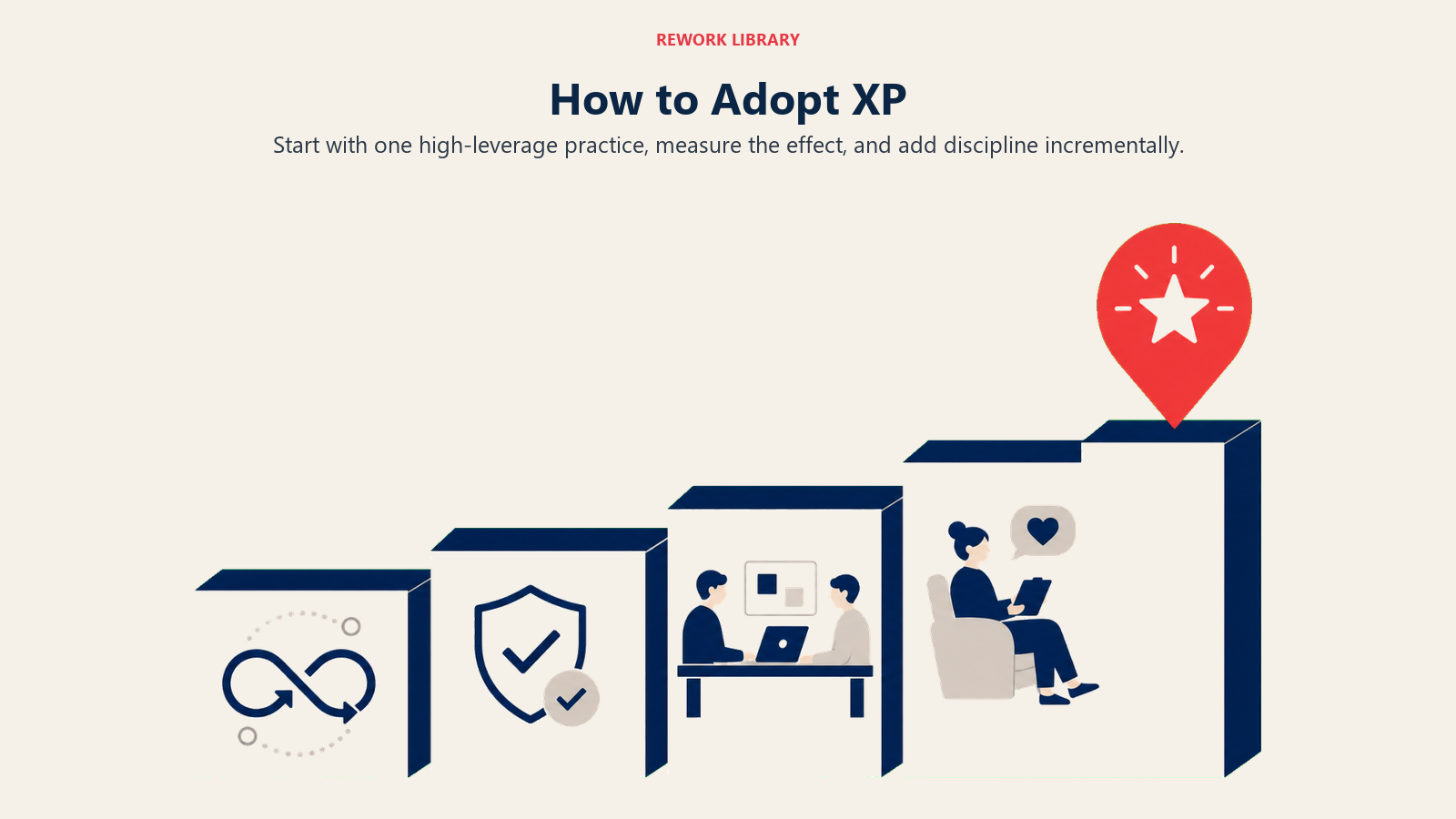
XP is best introduced in stages. Dumping twelve new practices on a team overnight rarely sticks.
Step 1: Agree on coding standards
Before anything else, the team aligns on one shared coding style and enforces it through linting or formatting tools. This is low friction and creates the shared understanding that the rest of XP builds on.
Step 2: Introduce continuous integration
Set up a CI pipeline that runs automated tests on every commit. Even if the test suite is small at first, the habit of integrating frequently and fixing failures immediately changes how the team thinks about their work.
Step 3: Start pair programming for complex work
Don't mandate pairing for every task from day one. Start with the most complex or risky work. Teams often find they want to pair more once they see how quickly problems get caught.
Step 4: Adopt test-driven development incrementally
Pick one new feature and build it with TDD from the start. Compare the defect rate and refactoring confidence against features built the old way. The evidence usually convinces skeptics faster than any argument.
Step 5: Bring a customer representative into the planning cycle
The planning game only works if someone with real product authority participates. If a dedicated on-site customer isn't practical, establish a regular cadence (weekly or biweekly) where a business stakeholder reviews stories, answers questions, and accepts completed user stories. Pair this with clear acceptance criteria and a shared definition of done.
XP vs Scrum
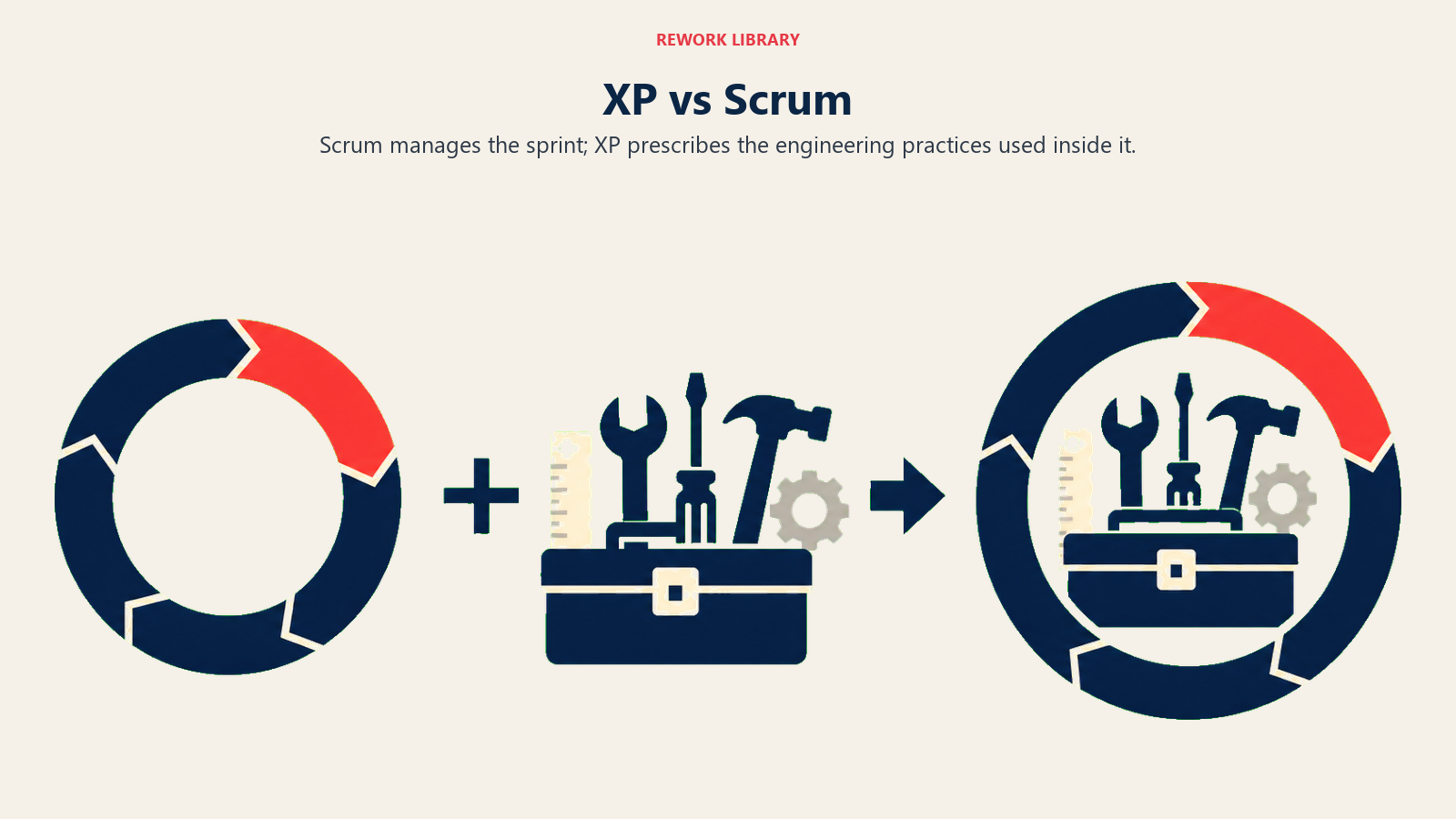
XP and Scrum are both agile, but they operate at different levels. Many teams run both simultaneously.
| Dimension | XP | Scrum |
|---|---|---|
| Focus | Engineering practices and code quality | Team process and sprint management |
| Iteration length | 1 week (typically) | 1 to 4 weeks (sprint) |
| Prescribes technical practices | Yes (TDD, CI, pair programming, etc.) | No |
| Roles | Developer, customer, coach | Product Owner, Scrum Master, Development Team |
| Customer involvement | On-site representative full-time | Product Owner attends sprint ceremonies |
| Change mid-iteration | Allowed if small | Generally discouraged within a sprint |
| Common combination | XP engineering practices inside Scrum sprints | Same |
Teams running Scrum often adopt XP practices like TDD and CI inside their sprints. Scrum provides the management wrapper; XP provides the engineering discipline. The combination is sometimes called "Scrum/XP" and is one of the most common agile configurations in practice.
Teams that need even more flexibility in blending agile approaches sometimes use Scrumban, which pulls Kanban-style flow management into a Scrum cadence. For organizations scaling beyond a single team, the Scaled Agile Framework (SAFe) can accommodate XP practices at the team level while adding coordination layers above.
Frequently Asked Questions about Extreme Programming
Is Extreme Programming still used today?
Yes. XP practices are very much alive, often embedded inside Scrum teams that don't necessarily call them "XP." Continuous integration, TDD, and pair programming are now standard practices in modern software development, partly because XP proved their value in the early 2000s.
Can you combine XP and Scrum?
Absolutely, and many teams do. Scrum handles the sprint structure, ceremonies, and backlog management. XP handles how code is actually written and tested inside those sprints. The two frameworks are complementary rather than competing.
What is the planning game in XP?
The planning game is XP's approach to iteration planning. Customers write stories describing what they need; developers estimate the effort. Together they decide what fits into the next iteration. It's similar to a sprint planning session in Scrum but with the customer playing a more active, real-time role in deciding scope.
Does XP require full-time pair programming?
Not necessarily. XP recommends pair programming for most production code, but many teams apply it selectively, especially for complex, high-risk, or unfamiliar work. The goal is more eyes on more problems, not rigid adherence to a rule.
What's the difference between TDD and unit testing?
Unit testing means writing tests to verify code that already exists. TDD flips that order: you write the test first (which fails), then write the minimum code to make it pass, then clean up the design. The sequence matters because it forces you to think about what the code should do before writing it.
Closing thoughts
XP remains one of the most technically rigorous agile methodologies available. Its practices have aged well precisely because they address the root causes of software quality problems: late integration, missing tests, over-complex design, and poor communication. Teams that take XP seriously tend to produce code that's easier to change, easier to test, and easier to hand off.
Start with one or two practices, measure the impact, and build from there. The full set of twelve practices is a destination, not a starting point.
Related reading

Senior Operations & Growth Strategist
On this page
- What is Extreme Programming?
- The 5 values of XP
- The 12 core XP practices
- Fine-scale feedback
- Continuous process
- Shared understanding
- Programmer welfare
- Benefits of XP
- Limitations and when not to use XP
- How to adopt XP on a team
- Step 1: Agree on coding standards
- Step 2: Introduce continuous integration
- Step 3: Start pair programming for complex work
- Step 4: Adopt test-driven development incrementally
- Step 5: Bring a customer representative into the planning cycle
- XP vs Scrum
- Closing thoughts
- Related reading