Project Charter: What It Is and How to Write One (Template)
Turn this article into takeaways for your work.


Each assistant summarizes the article only for you and suggests best practices for your work.
A project charter is the single document that formally kicks a project into existence. Skipping it is one of the most reliable ways to guarantee that a project runs over budget, over time, or over everyone's patience.
Most teams dive straight into tasks before anyone has agreed on what the project is actually trying to accomplish. The charter exists to close that gap. It forces the conversation about purpose, success criteria, and who holds authority before the first task is assigned.
What is a project charter?
A project charter is a formal document that authorizes a project to begin, defines its high-level objectives, and grants the project manager the authority to use organizational resources. It's the founding contract between the project sponsor, the project manager, and the organization.
The term comes from the Project Management Body of Knowledge (PMBOK), where PMI defines the charter as the output of the Initiating Process Group. In practical terms, the charter answers four questions up front: Why are we doing this? What will we produce? Who is responsible? And what does success look like?
A charter is not a detailed schedule, a task list, or a technical specification. It's a short, high-level document, typically two to six pages, that gives a project its official starting point. Everything that comes after, the project plan, the work breakdown structure, the Gantt chart, builds on the foundation the charter establishes.
Key Facts
- Per PMBOK 7th edition, the project charter is the document that formally authorizes a project to begin and gives the project manager authority to apply resources (PMI, 2021).
- Projects with a documented charter are 2.5x more likely to meet original goals and business intent (PMI Pulse of the Profession, 2023).
- The average project charter is 2 to 6 pages in most enterprises, with regulated industries trending longer (PMI community survey, 2024).
Why a project charter matters
Projects fail for predictable reasons. Scope creep, misaligned stakeholders, unclear ownership, and fuzzy success criteria show up in post-mortems again and again. A well-written charter attacks all four directly.
Executive sponsor alignment is the first payoff. A signed charter means the sponsor has read and agreed to the purpose, budget envelope, and success criteria. When scope disputes arise later, the charter is the reference point everyone returns to. Without it, those conversations become debates about memory and intention.
Stakeholder buy-in happens naturally when the charter process surfaces disagreements early. Different departments often have different assumptions about what a project will deliver. Writing the charter forces those assumptions into the open where they can be resolved before work starts rather than after it's underway.
Authority clarity matters more than most teams admit. The charter explicitly grants the project manager the right to assign resources, make decisions, and escalate blockers. This sounds obvious, but in matrix organizations where resources report to functional managers, a signed charter is the difference between a project manager who can get things done and one who spends all their time negotiating for access.
And the data backs this up. PMI's research shows chartered projects are 2.5x more likely to meet their original goals. That's not a marginal improvement. It's the difference between a project that delivers and one that quietly becomes a cautionary tale.
The 10 sections of a project charter
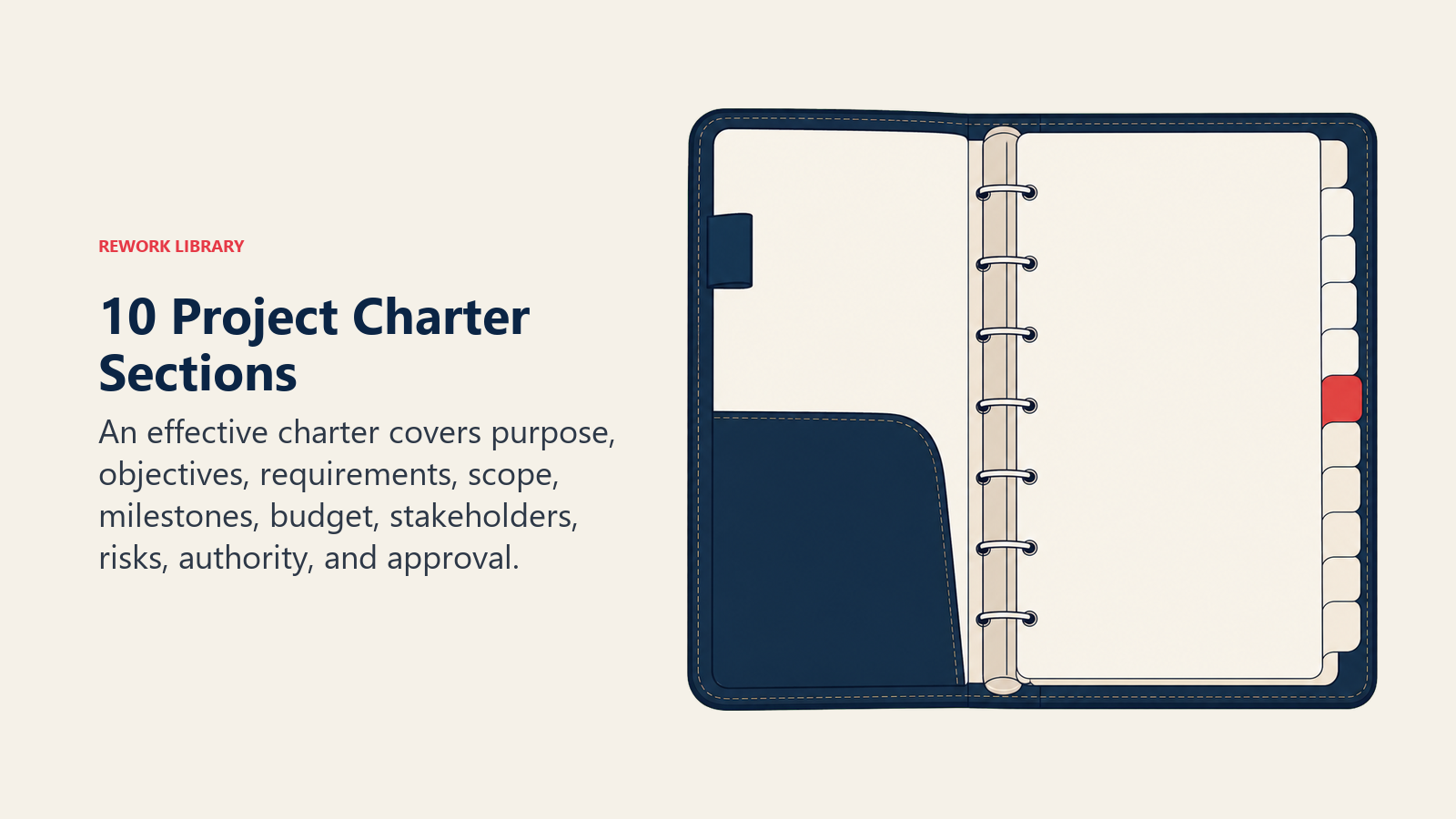
Every effective charter covers these ten areas. You don't need a template with rigid section headings, but you do need every concept present, somewhere, in the document.
Project name: A clear, descriptive name that the team and stakeholders will use consistently. Avoid internal code names that mean nothing outside the immediate team.
Purpose and justification: Why is this project being done? What business problem does it solve or what opportunity does it capture? This section should reference measurable context: revenue lost, compliance risk, customer complaints, or market timing.
Objectives and success criteria: What will the project achieve, and how will you know it succeeded? Objectives should follow the SMART format (Specific, Measurable, Achievable, Relevant, Time-bound). Vague objectives like "improve the customer experience" don't work here. "Reduce average onboarding time from 14 days to 7 days by Q4" does.
High-level requirements: The key conditions the final deliverable must meet. Not a full requirements document, but enough specificity that stakeholders agree on what "done" means. Think of this as the short list of non-negotiables.
Scope and deliverables: What is explicitly in scope, and what is explicitly out of scope. Both sides of the boundary matter. If something is ambiguous, call it out. Stating what's out of scope prevents scope creep as clearly as stating what's in.
Milestones: The major checkpoints in the project timeline, with target dates. These are not a full schedule. They're the five to ten moments where the project will demonstrate meaningful progress: end of discovery, first prototype, pilot launch, full deployment, project close.
Budget: The approved funding envelope and any major cost categories. Some organizations include just the total; others break it down by phase or resource type. The key is that a sponsor has signed off on a specific number, not a range.
Stakeholders: Who has a stake in the outcome, who will be affected, and who needs to be consulted or kept informed. This maps directly to the RACI matrix that comes later in planning. The charter version is higher-level: names, roles, and their relationship to the project.
Risks and assumptions: Known risks that could affect the project, with a brief note on likelihood or impact. And assumptions, the things you're treating as true without full confirmation. Both deserve attention because an unchallenged assumption is just a risk you haven't acknowledged yet.
Approval signatures: The formal sign-off from the project sponsor and any other required approvers. This is what transforms the document from a draft into an authorization. Without signatures, the charter is advisory. With them, it has organizational weight.
Project charter vs project plan vs scope statement
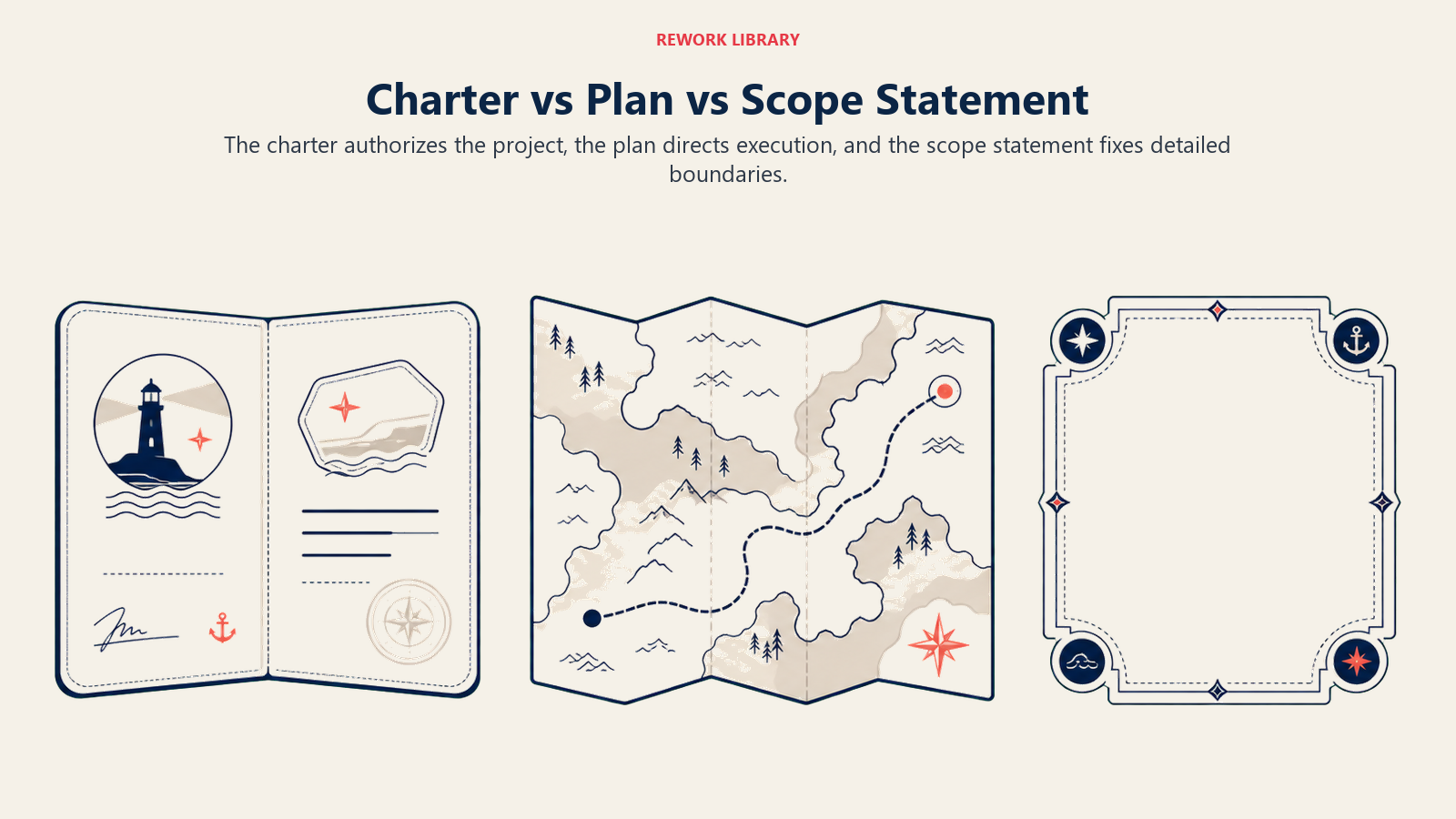
These three documents are related but serve different purposes. Confusing them causes real problems.
| Document | Purpose | When created | Length | Audience |
|---|---|---|---|---|
| Project charter | Authorizes the project to begin; names objectives, sponsor, PM, and budget envelope | Initiating phase | 2-6 pages | Executives, sponsor, PM |
| Project plan | Detailed roadmap: schedule, budget, resources, risk responses, communication plan | Planning phase | 20-50+ pages | PM, team leads, sponsor |
| Scope statement | Defines project boundaries in detail: deliverables, acceptance criteria, exclusions | Planning phase | 3-10 pages | PM, team, client |
The charter comes first and is intentionally brief. It's written before the team fully understands the work, so it can't be detailed. The project plan is built during planning once the team has done enough analysis to make reliable commitments. The scope statement lives inside the project plan as part of the scope baseline, alongside the work breakdown structure.
A common mistake is writing the charter after the planning work is done and then back-dating it. This defeats the purpose. The charter should be written first, with the limited information available at the start, and then used to authorize the planning work.
How to write a project charter: step by step
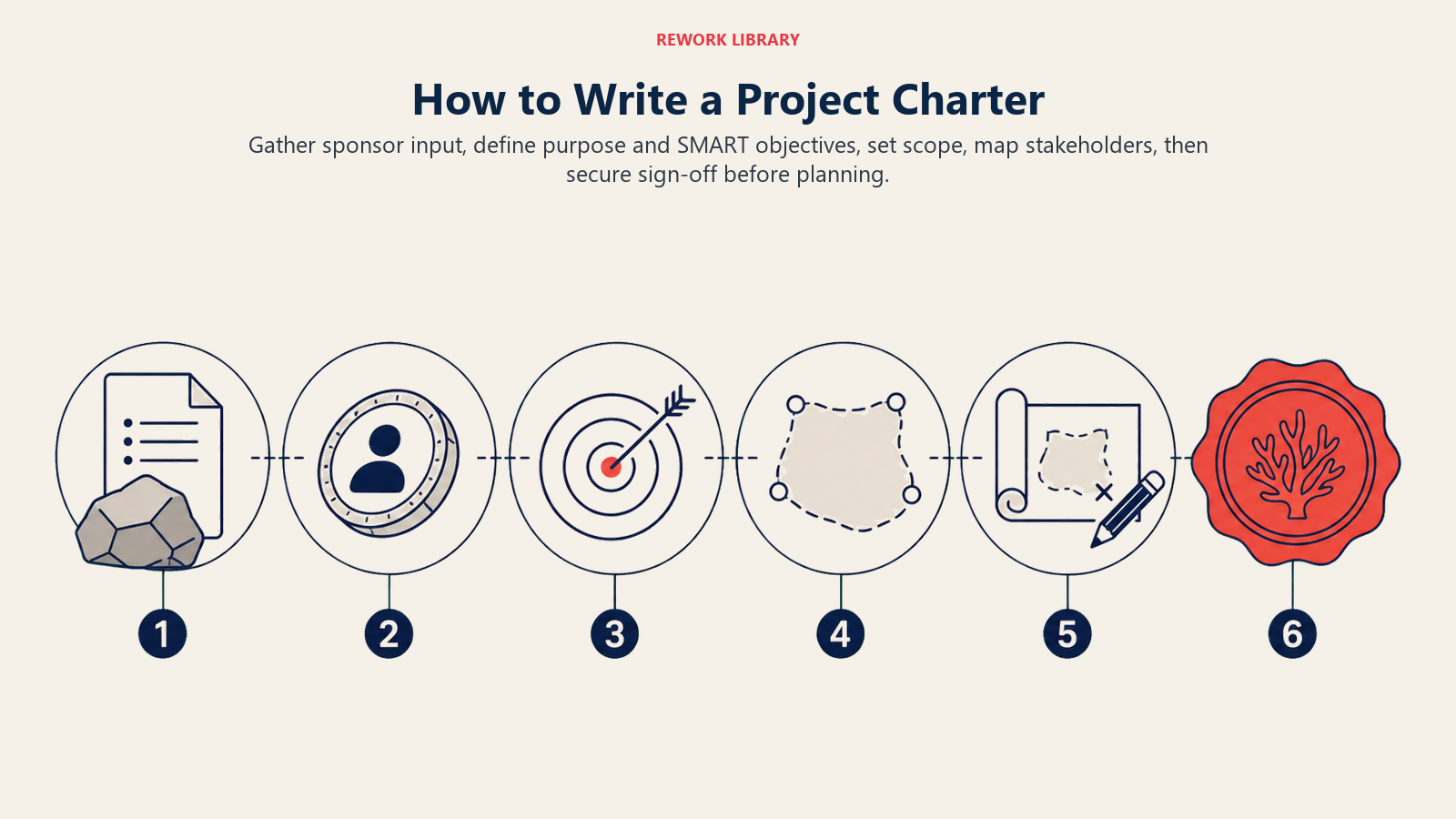
Writing a charter is not a solo activity. It requires inputs from the sponsor, key stakeholders, and the project manager. Here's the sequence that works.
Step 1: Gather inputs before you write anything
Talk to the sponsor and relevant stakeholders before opening a template. You need to understand the business case, any constraints (budget cap, regulatory requirements, hard deadlines), and which organizational resources are available. Pull any existing documents: a business case, a request for proposal, a board decision memo. These become the raw material.
Step 2: Draft the purpose and justification
Write the "why" first. A strong purpose statement connects the project to organizational strategy or a specific business problem. If you can't articulate why the project matters in two or three sentences, that's a signal to go back to the sponsor before proceeding. Unclear purpose at charter stage becomes unclear scope at execution stage.
Step 3: Define objectives using SMART criteria
Each objective should be specific enough that a third party could verify whether it was achieved. Run each one through the SMART test. "Launch the new employee portal" is not an objective. "Launch the new employee portal to all 500 employees by March 31, with 80% of users completing onboarding within the first two weeks" is.
Limit objectives to three to five. More than that usually means the project scope is too broad and should be broken into separate initiatives.
Step 4: List scope and key deliverables
Write down what the project will produce and, critically, what it won't. The out-of-scope list is often more valuable than the in-scope list. For a CRM implementation, you might note explicitly: "Phase 1 does not include integration with the billing system" or "custom reporting is out of scope and will be addressed in Phase 2." This prevents the charter from being used to justify work that was never agreed to.
Step 5: Map stakeholders and confirm sponsor
Identify everyone who has authority over project decisions, will be affected by the outcome, or needs to be informed. Confirm who the project sponsor is, because this person will sign the charter and become the primary escalation path for issues the project manager can't resolve independently. A project without a clear, engaged sponsor almost always struggles.
Step 6: Get sign-off before planning begins
Route the draft charter to all required approvers. Hold a brief review meeting if the document surfaces disagreements. The goal is not a perfect document but a signed one. Once you have sign-off, planning can begin with the confidence that the organization is committed to the project's direction. Everything in the project life cycle that follows builds on this authorization.
Project charter template
Use this as a starting point. Adjust the headings and fields to match your organization's norms.
PROJECT CHARTER

Project Name: [Full descriptive name]
Project Manager: [Name, contact]
Project Sponsor: [Name, title]
Date: [Charter date]
Version: 1.0

---

PURPOSE AND JUSTIFICATION
[Why is this project being undertaken? What business problem does it solve?
Reference any supporting data, financial impact, or strategic priority.]

---

OBJECTIVES AND SUCCESS CRITERIA
Objective 1: [SMART objective: specific, measurable, time-bound]
Objective 2: [SMART objective]
Objective 3: [SMART objective]

Success will be measured by: [Key metrics and targets]

---

HIGH-LEVEL REQUIREMENTS
- [Requirement 1]
- [Requirement 2]
- [Requirement 3]

---

SCOPE
In Scope:
- [Deliverable or work area 1]
- [Deliverable or work area 2]

Out of Scope:
- [Explicitly excluded work 1]
- [Explicitly excluded work 2]

---

MILESTONES
Milestone 1: [Description] | Target: [Date]
Milestone 2: [Description] | Target: [Date]
Milestone 3: [Description] | Target: [Date]

---

BUDGET
Total approved budget: $[Amount]
[Optional: breakdown by phase or major cost category]

---

KEY STAKEHOLDERS
[Name] | [Role] | [Interest/influence]
[Name] | [Role] | [Interest/influence]

---

RISKS AND ASSUMPTIONS
Risks:
- [Risk 1]: [Brief likelihood/impact note]
- [Risk 2]: [Brief likelihood/impact note]

Assumptions:
- [Assumption 1]
- [Assumption 2]

---

APPROVALS

Project Sponsor: _________________ Date: _______
Project Manager: _________________ Date: _______
[Additional approver if required]: _____ Date: _______
Project charter examples by industry
The charter format stays consistent across industries, but the content looks different depending on the type of work. Here's how the same ten sections translate across four common contexts.
| Industry | Project name | Purpose | Key objectives |
|---|---|---|---|
| Software / Technology | CRM Migration | Replace legacy spreadsheet-based lead tracking to reduce manual errors and improve sales velocity | Go live within 6 months; reduce lead drop rate from 15% to under 5%; achieve 90% rep adoption in 30 days post-launch |
| Construction | HQ Office Renovation | Reconfigure open floor plan to support hybrid work model and reduce facilities cost by consolidating from 3 floors to 2 | Complete construction by Q3 without disrupting operations; stay within $1.2M budget; achieve 95% employee satisfaction score on post-move survey |
| Marketing | Brand Refresh | Modernize visual identity and messaging to align with repositioning from SMB-focused to enterprise-focused buyer | Launch new brand assets by April; update all digital touchpoints within 60 days of brand launch; no drop in brand recognition score |
| R&D / Product | Next-Gen Analytics Module | Build a native analytics module to reduce reliance on third-party BI tools and increase product stickiness for enterprise accounts | Ship beta to 10 design partners in Q2; achieve NPS of 40+ from beta group; reduce average reporting setup time from 4 hours to under 30 minutes |
Notice that in each case, the objectives are measurable and time-bound. The purpose ties back to a business outcome. And the project name is descriptive enough that a new stakeholder could understand what it is without a briefing.
For teams using Waterfall methodology, the charter aligns directly with the project's first gate review. For teams using Agile or Scrum, the charter typically covers the full product initiative while individual sprints operate within that authorized scope.
Common mistakes and how to fix them
| Mistake | Fix |
|---|---|
| Writing the charter after planning is done | Draft the charter first, with limited information. It's supposed to authorize planning, not summarize it. |
| Objectives that can't be measured | Apply SMART criteria to every objective before finalizing. If you can't define how you'll measure it, it's not done yet. |
| No explicit out-of-scope list | Add a dedicated "Out of Scope" section. Stating what's excluded is as important as stating what's included. |
| Missing sponsor signature | A charter without an approver's signature is a draft. Route it and follow up until you have sign-off. |
| Confusing the charter with the project plan | Keep the charter brief and high-level. If you're writing task lists or resource assignments, stop, that's planning-phase work. |
| Listing every stakeholder without prioritization | Group stakeholders by level of influence and interest. Not every stakeholder needs the same level of engagement. |
| Scope defined too broadly | If the charter scope spans more than one calendar year or multiple business units, consider splitting into separate projects with separate charters. |
Best practices
- Write the charter with the sponsor, not for the sponsor. Collaboration during drafting surfaces disagreements early and builds shared ownership of the document.
- Use plain language. Charters fail when they're full of jargon that non-technical stakeholders skip over without reading. The sponsor needs to understand and stand behind every word.
- Keep it short enough to read in 15 minutes. If it takes longer, it's too detailed. Save the detail for planning documents.
- Version and date every revision. Charters sometimes get updated as new information emerges. Track changes so everyone knows which version is current.
- Distribute the signed charter to all key stakeholders. It's not enough to have a signed copy in a folder. The people who will execute the work should know what they're authorized to do.
- Reference the charter in planning kickoffs. Start every planning meeting by reviewing the charter objectives. This keeps planning aligned with what was actually approved.
- Review the charter at major milestones. If the project scope or objectives shift significantly, update the charter and get re-approval rather than quietly deviating from the original authorization.
- Link the charter to the PERT chart and Gantt chart that come later. Showing how the detailed schedule traces back to charter milestones reinforces discipline and makes deviations visible.
The project charter won't guarantee a project succeeds. But it sets the conditions that make success possible. Teams that skip it spend the back half of the project relitigating decisions that should have been made at the start. Sign the charter, distribute it, and build everything else on that foundation.
And if you're ready to move from authorization into execution, the next step is turning the charter's high-level milestones into a full project plan with a work breakdown structure and a schedule built from the critical path method.

Senior Operations & Growth Strategist
On this page
- What is a project charter?
- Why a project charter matters
- The 10 sections of a project charter
- Project charter vs project plan vs scope statement
- How to write a project charter: step by step
- Step 1: Gather inputs before you write anything
- Step 2: Draft the purpose and justification
- Step 3: Define objectives using SMART criteria
- Step 4: List scope and key deliverables
- Step 5: Map stakeholders and confirm sponsor
- Step 6: Get sign-off before planning begins
- Project charter template
- Project charter examples by industry
- Common mistakes and how to fix them
- Best practices