Daily Standup: How to Run an Effective Scrum Meeting
Turn this article into takeaways for your work.


Each assistant summarizes the article only for you and suggests best practices for your work.
The daily standup is one of the most copied rituals in modern software teams, and one of the most misunderstood. Done right, it keeps a sprint on track without consuming the morning. Done wrong, it turns into a 40-minute status report nobody asked for.
What is a daily standup?
A daily standup (also called the daily scrum) is a short, time-boxed team sync, capped at 15 minutes, where a development team inspects progress toward the Sprint Goal and plans the next 24 hours. The name comes from the original practice of holding the meeting standing up, the physical discomfort being a gentle nudge to keep things brief.
The daily standup is one of the five formal events in the Scrum framework. It belongs to the Developers, not the Scrum Master or Product Owner. The Scrum Master facilitates only when invited. The Product Owner attends as a listener unless the team pulls them in.
Key Facts
- The 2020 Scrum Guide reduced the daily scrum to a single goal: inspect progress toward the Sprint Goal and adapt the Sprint Backlog as needed. The three questions are a suggested technique, not a rule.
- The State of Agile Report (digital.ai, 2023) found that daily standups are the single most widely adopted Scrum ceremony, used by over 86% of agile teams surveyed.
- Atlassian research on meeting costs notes that ineffective meetings cost U.S. businesses an estimated $37 billion per year. A 15-minute daily sync, when well-run, is one of the highest-return meetings a team can hold.
- One quotable framing from the Scrum community: "The daily scrum is not a report to management. It's a plan made by the people doing the work, for the people doing the work."
The three daily standup questions
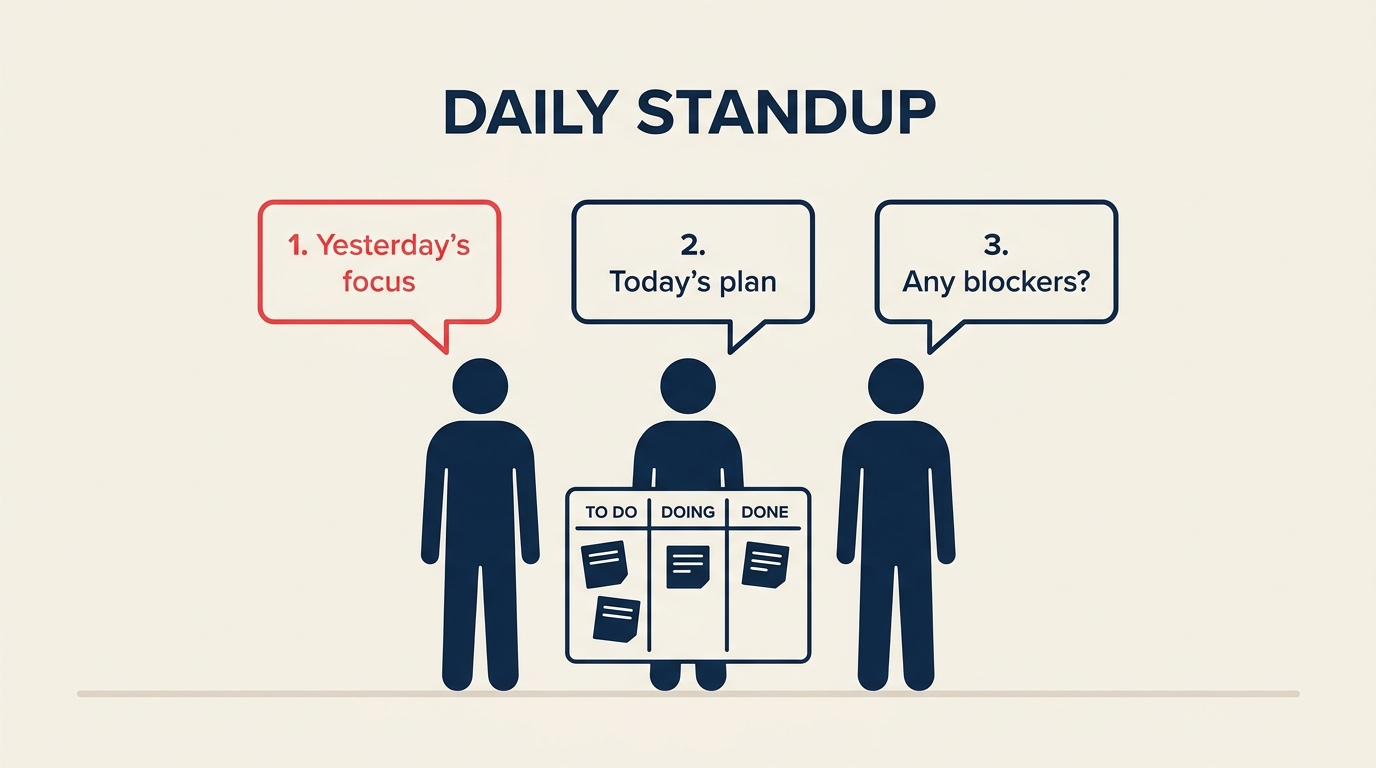
The classic structure asks each team member to answer three questions:
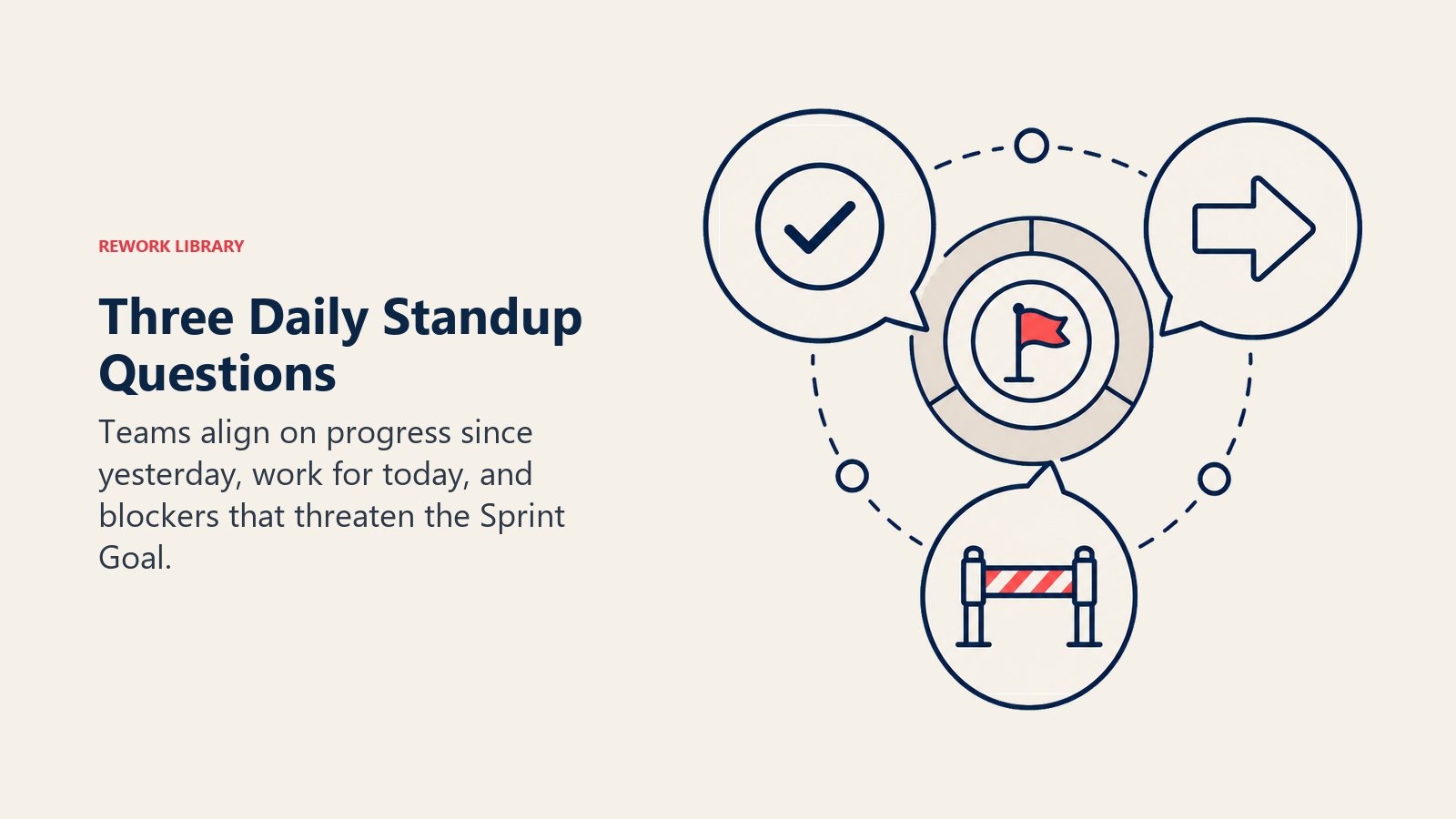
- What did I do yesterday that helped the team reach the Sprint Goal?
- What will I do today to help the team reach the Sprint Goal?
- Are there any blockers (impediments) in my way?
These questions focus the conversation on the sprint, not on general status. The emphasis is forward: what are we doing to reach the goal, and what's in the way?
Modern teams adapt this structure. Some walk the board instead (explained in the formats section below). Others use a looser check-in. The 2020 Scrum Guide deliberately dropped the prescriptive three questions, leaving the format up to the team as long as the meeting stays time-boxed and focused on the Sprint Goal.
Note the phrasing: "helped the team reach the Sprint Goal," not "what I worked on." That framing shifts the mindset from individual task reporting to collective progress. It's a small word change with a big effect.
Benefits of a daily standup
When the format is clean, a daily standup delivers several real benefits:
Surfaces blockers fast. A problem that would take three days to surface in a weekly sync can be raised and routed to resolution inside 24 hours. That's a meaningful difference in a two-week sprint.
Reduces dependency on written updates. Teams with strong standup habits write fewer status emails and attend fewer ad hoc check-in calls. The meeting is the lightweight coordination layer.
Builds shared situational awareness. Everyone on the team knows where the sprint stands. That shared context lets developers help each other without a manager routing requests.
Reinforces sprint focus. A daily question tied to the Sprint Goal keeps the goal visible. It's harder to drift into unplanned work when you answer every morning: "does what I'm doing move the sprint forward?"
Spots scope creep early. If someone mentions work that wasn't in the sprint, the team notices immediately, instead of discovering it at the sprint retrospective.
Common mistakes and anti-patterns
Most bad standups come from one of four patterns:
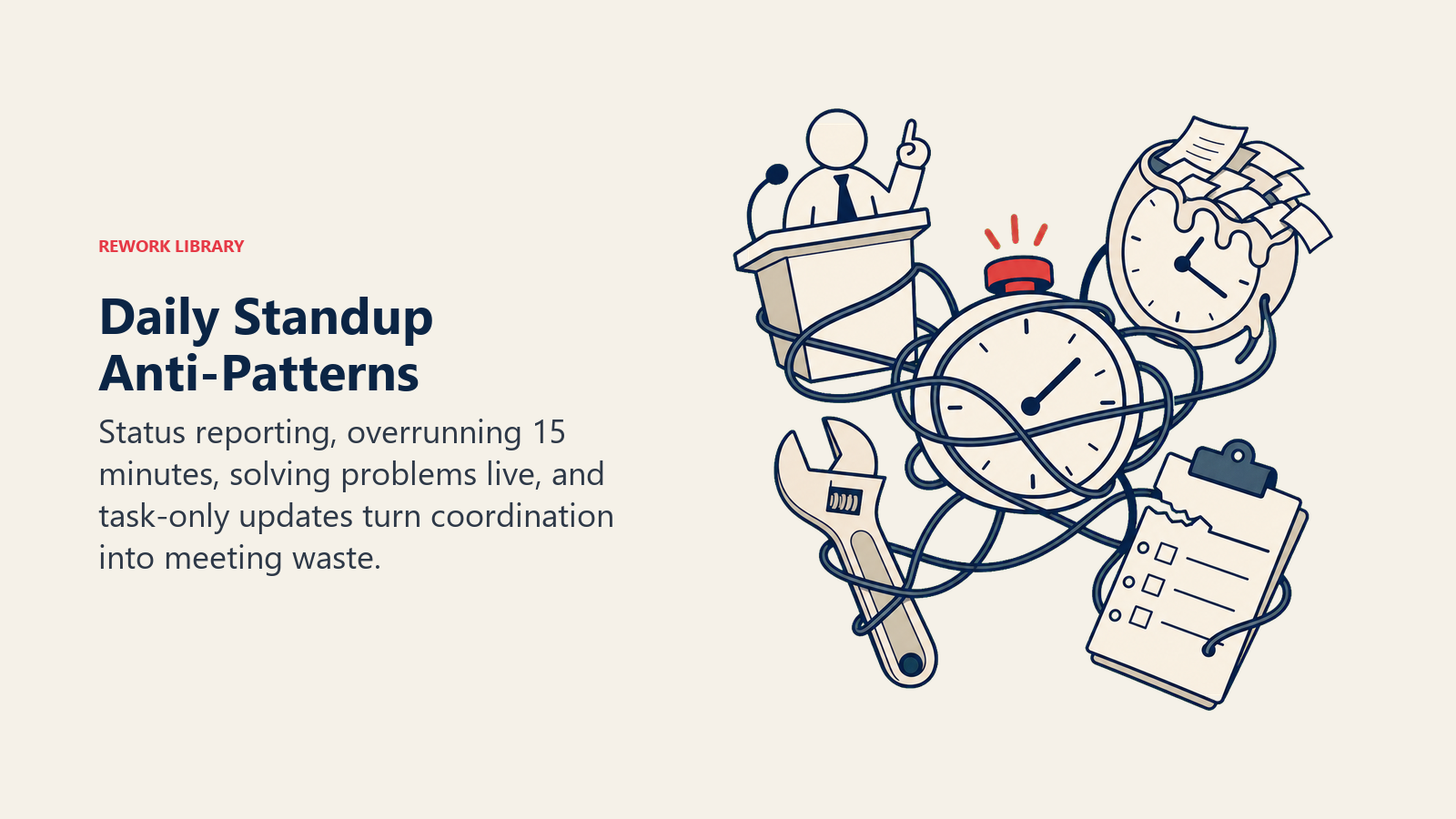
Turning it into a status report to the manager. The daily standup exists for the team, not for leadership. When a manager runs the meeting and developers report up to them in turn, the dynamic shifts. Developers start optimizing their answers for how they'll sound, not for what the team needs to know. The Scrum Master's job is to protect the team from this drift.
Going over 15 minutes. The timebox exists for a reason. When standups regularly run 25 or 30 minutes, attendance drops, attention wanders, and developers start booking over the meeting slot. If a team can't finish in 15 minutes with 5-7 people, the meeting is doing too much.
Problem-solving in the meeting. The standup is for raising blockers, not resolving them. When someone mentions a blocker and the team immediately starts debugging it, one person's issue consumes everyone else's time. The fix: note the blocker, identify who needs to be in the follow-up conversation, and move on. Park the solution for after the standup.
Skipping it. Teams skip the daily standup when they feel it has no value, which usually means it had no value because it was running as a status report. But skipping removes the one guaranteed daily coordination checkpoint. Without it, blockers accumulate silently and dependencies get missed.
Reporting on tasks instead of progress toward the goal. "I worked on the login page" is less useful than "I finished the form validation; the login page is unblocked." The first is activity. The second is progress.
How to run an effective daily standup (step by step)
An effective standup uses a fixed cadence, a strict timebox, visible sprint focus, and immediate ownership of follow-up work.
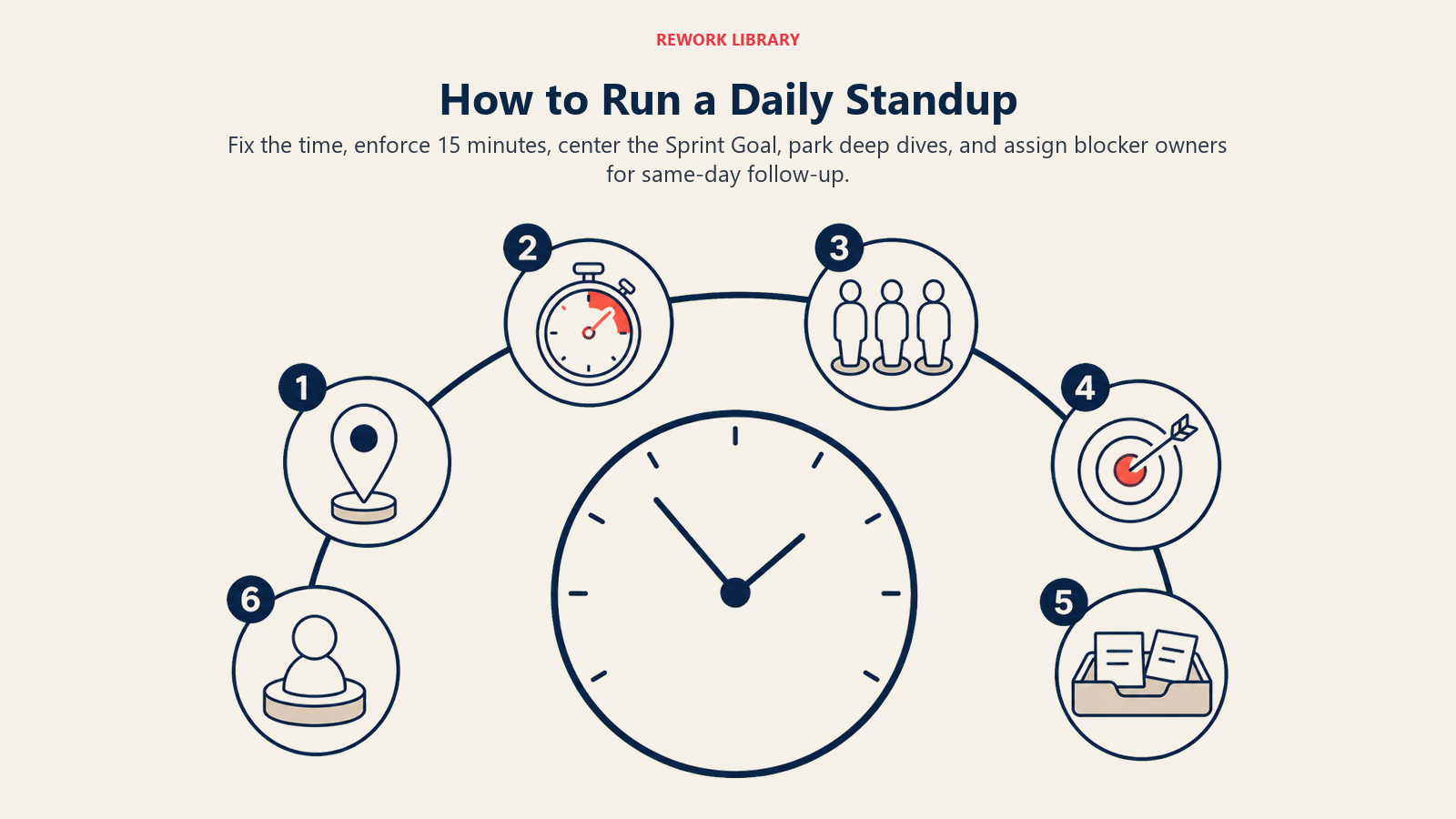
Step 1: Set a fixed time and place
Pick a time that works across the team and lock it in. First thing in the morning works well for most co-located teams. Remote teams sometimes shift 30 minutes later to let people settle. What matters most is consistency: the standup happens at the same time every day, no exceptions. This removes the cognitive overhead of scheduling and signals that the meeting is a non-negotiable part of the sprint cadence.
Step 2: Timebox to 15 minutes
Start a visible timer at the beginning of the meeting. When it hits 15 minutes, the standup ends, even if not everyone has spoken. If 15 minutes consistently isn't enough for your team size, you have a team size problem, not a standup problem. Teams larger than 9 should consider splitting.
Step 3: Keep it standing
If the team is in-person, everyone stands. If the meeting is remote, it still helps to have everyone on camera and upright. The standing posture is a physical signal: this is a brief alignment check, not a workshop.
Step 4: Focus every answer on the Sprint Goal
Before the standup, the Sprint Goal should be visible, on the board, in the meeting background, or read aloud at the start. Each answer should connect to it. If someone is working on something unrelated to the Sprint Goal, that's worth noting: is it truly urgent, or has the team drifted?
Step 5: Park deep dives immediately
When a topic needs more than one sentence, the facilitator interrupts gently: "Let's park that and revisit after the standup." Some teams keep a sticky note or whiteboard column called "parking lot." Anyone who raised a parked item stays for the follow-up. Everyone else is free to leave.
Step 6: Track blockers to resolution
Raising a blocker in the standup is only useful if something happens to it afterward. Assign a clear owner, usually the Scrum Master, to each blocker, and check on it at the next standup. Blockers that sit unresolved for more than two days are a signal that the team's escalation path isn't working.
Daily standup formats and examples
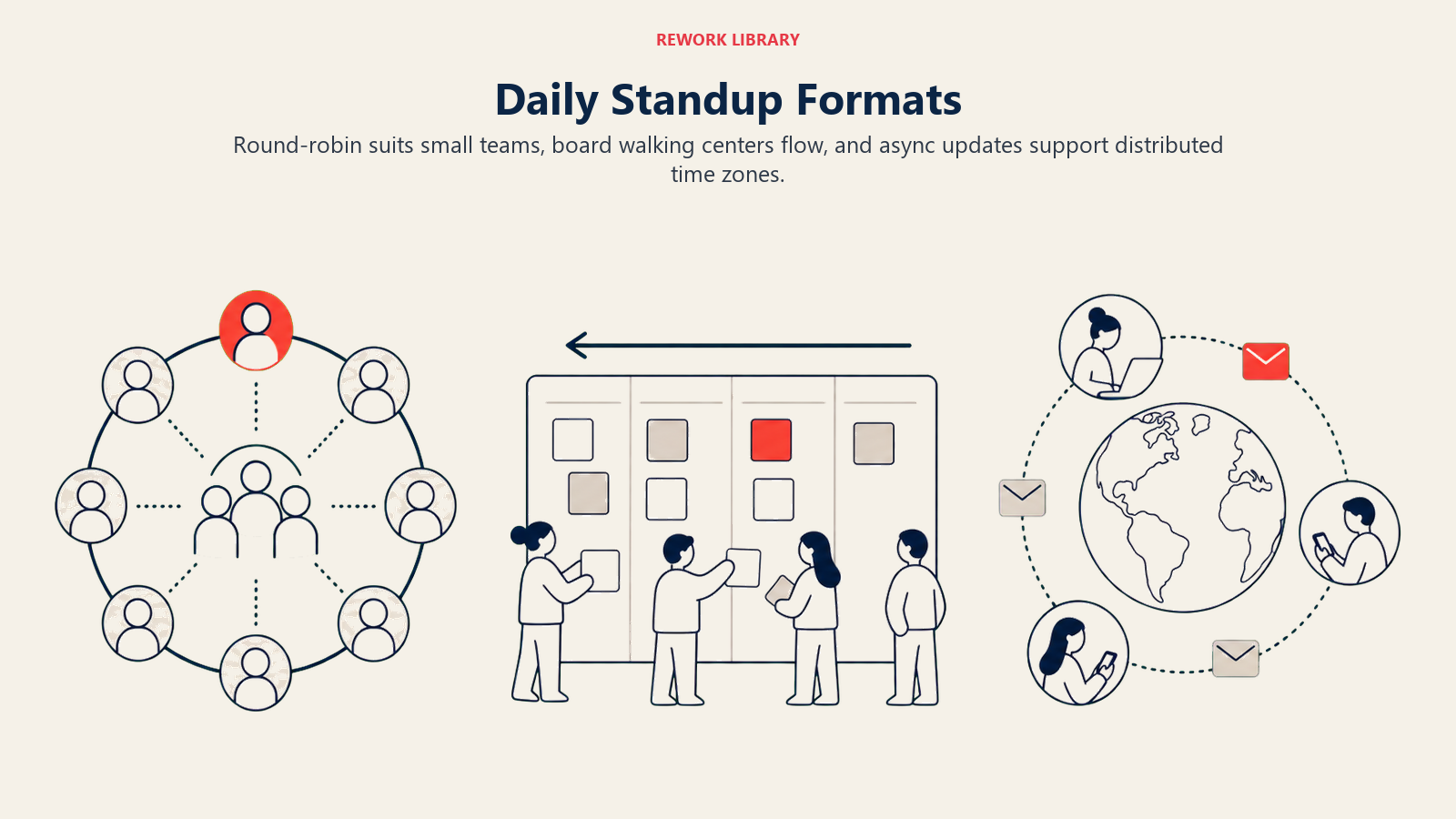
Different teams use different structures. Here's a comparison of the three most common:
| Format | How it works | Best for |
|---|---|---|
| Round-robin | Each team member answers the three questions in turn | Small teams (under 6) with clear task ownership |
| Walk the board | Team moves through sprint board columns right to left (Done > In Progress > To Do), discussing each ticket | Larger teams; keeps focus on sprint flow rather than individuals |
| Async standup | Each member posts answers in a Slack channel or tool like Geekbot before a set time; team reviews async | Remote teams across time zones; pairs with a brief weekly sync |
Example round-robin standup (5-person team, 12 minutes):
- Facilitator reads Sprint Goal aloud (30 seconds)
- Dev 1: "Yesterday I finished the API integration for search. Today I'm wiring it to the front end. No blockers." (60 seconds)
- Dev 2: "I'm still working on the data migration script, took longer than expected. I need 15 minutes with Dev 3 after this to sort a schema question." (60 seconds)
- Facilitator: "Parking lot: Dev 2 and Dev 3 sync after standup." (10 seconds)
- Dev 3, 4, 5: similar cadence
- Wrap: "Two items parked. Everyone else free to go." (30 seconds)
Example walk-the-board standup:
The team moves through the sprint board from right to left. Done column: quick acknowledgment. In Progress: owner gives a one-line status and flags any blockers. To Do: confirm whether anything should be pulled in today. The Sprint Goal stays visible throughout.
For remote and async teams, the Agile Manifesto principle of responding to change over following a plan applies here too. Async standups work well when they're disciplined, everyone posts on time, someone reviews and flags blockers, and there's a weekly video sync to compensate for the loss of real-time interaction.
Best practices
Do:
- Connect every update to the Sprint Goal
- Start and end on time, every time
- Let the team own the meeting, not the manager, not the Scrum Master
- Rotate facilitation if the team wants it; keeps everyone engaged
- Follow up on every parked item the same day
Don't:
- Let blockers sit unassigned
- Combine the daily standup with sprint planning or backlog refinement
- Use the meeting to report metrics, burn rate, or velocity (that's for the sprint review)
- Allow side conversations that exclude the group
- Skip the meeting because "everyone's busy"
A useful mental check before each standup: if the team didn't meet today, what would they not know? If the answer is "nothing, we're all in the same Slack channel," the meeting may need restructuring, not cancellation. The standup provides something Slack can't: a shared, synchronous moment where the whole team commits to the next 24 hours together.
Teams that take the daily standup seriously, that protect the 15-minute timebox, focus on the Sprint Goal, and act on blockers same-day, tend to run tighter sprints overall. The meeting itself isn't magic. But the discipline it instills is.
Related reading

Senior Operations & Growth Strategist
On this page
- What is a daily standup?
- The three daily standup questions
- Benefits of a daily standup
- Common mistakes and anti-patterns
- How to run an effective daily standup (step by step)
- Step 1: Set a fixed time and place
- Step 2: Timebox to 15 minutes
- Step 3: Keep it standing
- Step 4: Focus every answer on the Sprint Goal
- Step 5: Park deep dives immediately
- Step 6: Track blockers to resolution
- Daily standup formats and examples
- Best practices
- Related reading