What is Valuation? Why Your Business Is Worth More (or Less) Than You Think
Turn this article into takeaways for your work.


Each assistant summarizes the article only for you and suggests best practices for your work.
"My competitor just sold for $50 million. We have similar revenue, so we're worth $50 million too!"
Wrong. Dead wrong.
That competitor? 90% recurring revenue, 140% net revenue retention, founder staying on. This company? 40% recurring, high churn, founder checked out.
Same revenue. 10x different valuations.
Valuation: The Art and Science of Worth
Valuation = What someone will actually pay for your business
Not what you think it's worth. Not what you need it to be worth. What a buyer will write a check for.
It's determined by:
- Numbers (The science): Revenue, growth, margins, retention
- Story (The art): Market, team, moat, potential
- Timing (The luck): Market conditions, buyer needs
Get all three right, maximize value. Miss one, leave millions on the table.
The Five Valuation Methods That Matter
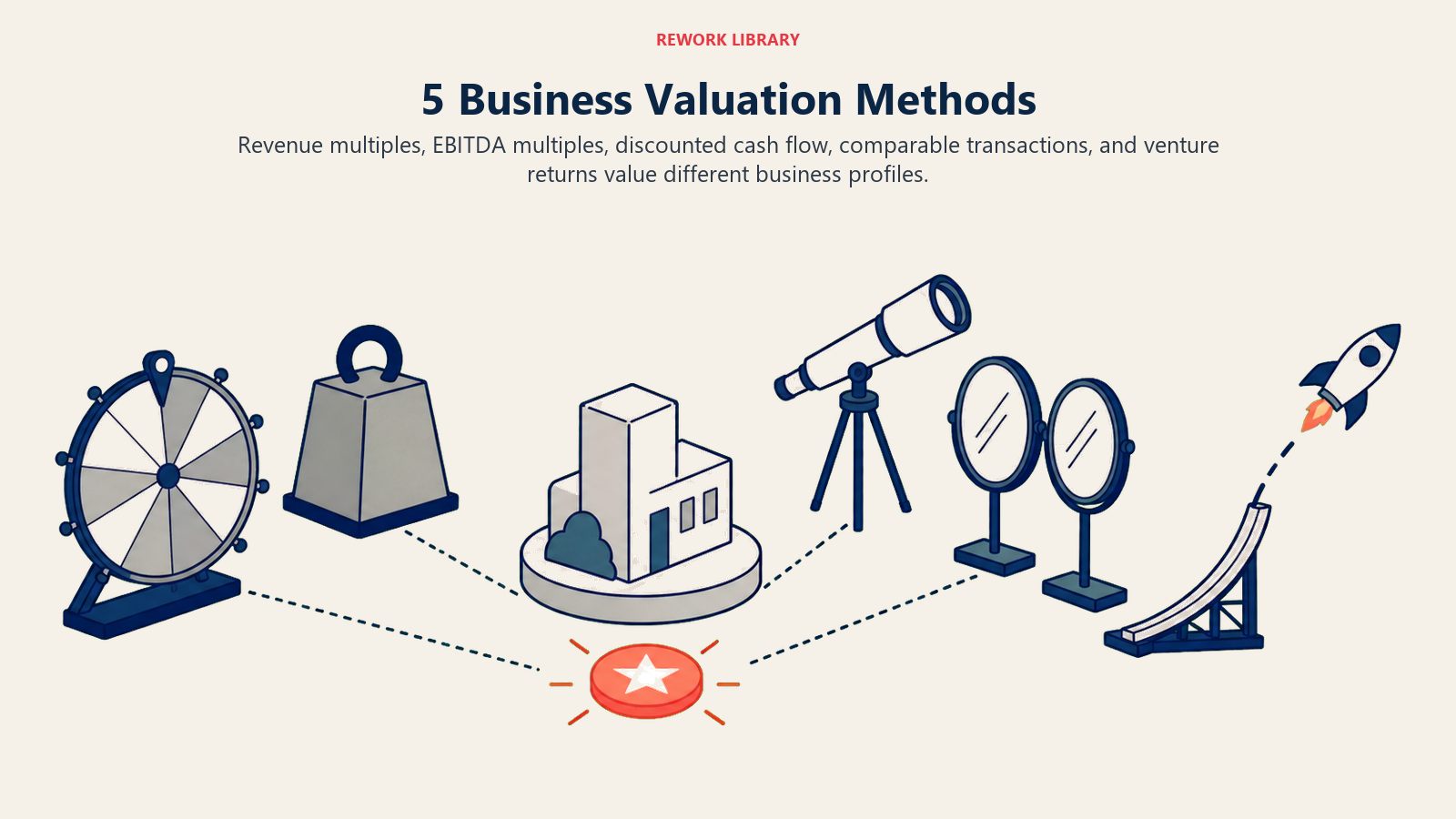
Each valuation method emphasizes a different business profile, so the right choice depends on growth, profitability, predictability, market evidence, and investor expectations.
1. Multiple of Revenue
Best for: High-growth companies, SaaS, marketplaces
Valuation = Annual Revenue × Revenue Multiple
2025 Multiples:
- SaaS (>50% growth): 8-15x ARR
- SaaS (20-50% growth): 4-8x ARR
- E-commerce: 1-3x revenue
- Services: 0.5-2x revenue
Example: $10M ARR SaaS growing 60% = $80-120M valuation
2. Multiple of EBITDA
Best for: Profitable, mature companies
Valuation = EBITDA × EBITDA Multiple
2025 Multiples:
- Software: 15-30x
- Manufacturing: 4-8x
- Retail: 3-6x
- Services: 3-7x
Example: $5M EBITDA software company = $75-150M valuation
3. Discounted Cash Flow (DCF)
Best for: Stable, predictable businesses
Valuation = Sum of (Future Cash Flows ÷ (1 + Discount Rate)^Year)
Key inputs:
- 5-10 year cash projections
- Terminal value
- Discount rate (10-20%)
Reality: Rarely used for startups, common for PE deals
4. Comparable Company Analysis
Best for: When similar companies have sold
Valuation = Your Metrics × Comparable Multiple
Process:
- Find 5-10 similar transactions
- Calculate their multiples
- Apply median to your metrics
- Adjust for differences
Trap: No two companies are truly comparable
5. Venture Capital Method
Best for: High-risk, high-growth startups
Valuation = Exit Value ÷ (1 + Required Return)^Years - Investment
VC math:
- Need 10x return in 5-7 years
- Work backwards from exit
- Assume massive dilution
Example: $1B exit potential ÷ 10x return = $100M post-money valuation
The Valuation Multiple Pyramid
Premium Multiples (10x+ Revenue)
- 100%+ annual growth
- 90%+ gross margins
- 120%+ net revenue retention
- Category leader
- Massive TAM
Standard Multiples (3-10x Revenue)
- 20-100% growth
- 60-90% margins
- 100-120% retention
- Strong position
- Large market
Discount Multiples (<3x Revenue)
- <20% growth
- <60% margins
- <100% retention
- Competitive market
- Limited TAM
Your job: Move up the pyramid.
What Really Drives Valuation
The Rule of 40 (SaaS)
Growth Rate + Profit Margin ≥ 40%
Examples:
- 60% growth + (-20%) margin = 40 ✓
- 30% growth + 15% margin = 45 ✓
- 15% growth + 10% margin = 25 ✗
Companies above 40 get premium valuations.
The Three T's
- Team: Can they execute the vision?
- TAM: Is the market big enough?
- Traction: Proof it's working?
Missing any T cuts valuation 30-50%.
The Moat Factor
No moat: Commodity multiples Some moat: Standard multiples Strong moat: Premium multiples
Moats that matter:
- Network effects
- Switching costs
- Brand power
- Economies of scale
- Proprietary tech
Valuation by Stage (2026 Benchmarks)
Pre-Seed
- Valuation: $1-5M
- Based on: Team + idea
- Typical raise: $100K-500K
Seed
- Valuation: $3-15M
- Based on: Early traction
- Typical raise: $500K-2M
Series A
- Valuation: $15-50M
- Based on: Product-market fit
- Typical raise: $3-10M
Series B
- Valuation: $50-200M
- Based on: Scalable growth
- Typical raise: $10-30M
Series C+
- Valuation: $200M+
- Based on: Market leadership
- Typical raise: $30M+
The Valuation Killers
Killer 1: Customer Concentration
One customer = 40% of revenue? Valuation cut 50%.
Killer 2: Founder Dependency
Everything depends on founder? Buyers run away.
Killer 3: Technical Debt
Held together with duct tape? Discount 30%.
Killer 4: Legal Issues
Pending lawsuits? IP questions? Deal breaker.
Killer 5: Declining Metrics
Revenue down? Churn up? Valuation plummets.
Strategic vs Financial Buyers
Strategic Buyers (Competitors, Partners)
What they value:
- Synergies (1+1=3)
- Market position
- Technology/talent
- Customer base
Typical premium: 20-50% above financial
Financial Buyers (PE, VC)
What they value:
- Cash flow
- Growth potential
- Leverage opportunity
- Exit multiples
Focus: Returns above all
Know your buyer, maximize your price.
The Valuation Negotiation Dance
The Anchor Game
First number sets expectations:
- You say $100M
- They say $50M
- You settle at $75M
vs.
- They say $30M
- You say $50M
- You settle at $40M
Always anchor high with justification.
The Multiple Offers Strategy
One offer = Their terms Three offers = Market price Five offers = Bidding war
Time investment: 6-12 months Value creation: 50-200%
The Earnout Trap
"We'll pay $50M now + $50M earnout"
Reality:
- 50% of earnouts never pay full
- You lose control but carry risk
- Better to take $70M clean
Rule: Discount earnouts by 50-70%.
Building Valuation Over Time
Year 1: Foundation
- Clean up legal/financial
- Build repeatable sales
- Document everything
- Focus on unit economics
Year 2: Growth
- Accelerate revenue
- Improve retention
- Build team depth
- Expand market
Year 3: Scale
- Optimize margins
- Add products/markets
- Build partnerships
- Create moat
Year 4: Premium
- Market leadership
- Best-in-class metrics
- Strategic position
- Multiple buyers
Each phase can double valuation.
Your Valuation Improvement Playbook
Quick Wins (This Quarter)
- Clean financials - Add 10-20%
- Document processes - Add 10%
- Diversify revenue - Add 15-30%
- Improve retention - Add 20-40%
Medium Term (This Year)
- Build recurring revenue - 2-3x multiple
- Expand margins - 1.5x multiple
- Reduce dependency - 1.3x multiple
- Accelerate growth - 2x multiple
Long Term (3 Years)
- Market leadership - 3x multiple
- Platform play - 5x multiple
- Network effects - 10x multiple
- Category creation - Sky's the limit
The Psychology of Valuation
For Founders
Your baby is always worth more to you. The market doesn't care about your feelings.
For Buyers
They see every risk, discount everything, negotiate hard. It's not personal.
The Reality
Valuation is where emotion meets logic. Logic usually wins.
Your Valuation Action Plan
Today:
- Calculate your theoretical valuation (all methods)
- Identify your biggest value killer
- List comparable transactions
- Pick one metric to improve
This Month:
- Get informal valuation feedback
- Fix top 3 value killers
- Build financial model
- Start tracking key metrics
This Quarter:
- Formal valuation exercise
- Build relationships with buyers
- Improve key value drivers
- Create competitive tension
This Year:
- Achieve premium metrics
- Build strategic position
- Create buyer interest
- Maximize valuation
The Ultimate Valuation Truth
Your business is worth exactly what someone will pay for it. Not a penny more.
But here's the secret: You can influence what they'll pay by understanding what they value and systematically building it.
High valuations aren't accidents. They're engineered over years through thousands of decisions that build value.
Start engineering yours today. Because the best time to build valuation is years before you need it.
Remember: Revenue is vanity, profit is sanity, but valuation is reality.
Ready to maximize value? Master Financial Modeling for projections or explore M&A Strategy for exit planning.
Part of the [Business Terms Collection]. Last updated: 2026-07-21
On this page
- Valuation: The Art and Science of Worth
- The Five Valuation Methods That Matter
- 1. Multiple of Revenue
- 2. Multiple of EBITDA
- 3. Discounted Cash Flow (DCF)
- 4. Comparable Company Analysis
- 5. Venture Capital Method
- The Valuation Multiple Pyramid
- Premium Multiples (10x+ Revenue)
- Standard Multiples (3-10x Revenue)
- Discount Multiples (<3x Revenue)
- What Really Drives Valuation
- The Rule of 40 (SaaS)
- The Three T's
- The Moat Factor
- Valuation by Stage (2026 Benchmarks)
- Pre-Seed
- Seed
- Series A
- Series B
- Series C+
- The Valuation Killers
- Killer 1: Customer Concentration
- Killer 2: Founder Dependency
- Killer 3: Technical Debt
- Killer 4: Legal Issues
- Killer 5: Declining Metrics
- Strategic vs Financial Buyers
- Strategic Buyers (Competitors, Partners)
- Financial Buyers (PE, VC)
- The Valuation Negotiation Dance
- The Anchor Game
- The Multiple Offers Strategy
- The Earnout Trap
- Building Valuation Over Time
- Year 1: Foundation
- Year 2: Growth
- Year 3: Scale
- Year 4: Premium
- Your Valuation Improvement Playbook
- Quick Wins (This Quarter)
- Medium Term (This Year)
- Long Term (3 Years)
- The Psychology of Valuation
- For Founders
- For Buyers
- The Reality
- Your Valuation Action Plan
- The Ultimate Valuation Truth