Intent Data: What It Is and How to Use It in B2B
Turn this article into takeaways for your work.


Each assistant summarizes the article only for you and suggests best practices for your work.
Intent data tells you which companies and people are actively researching a problem you solve, right now. And in B2B, timing is most of the game.
Most teams reach out to accounts based on firmographics: industry, headcount, revenue, tech stack. That tells you who could buy. Intent data tells you who is thinking about buying. The difference in conversion rates is significant, and the teams who figure out how to act on intent signals consistently outperform those who don't.
What is intent data?
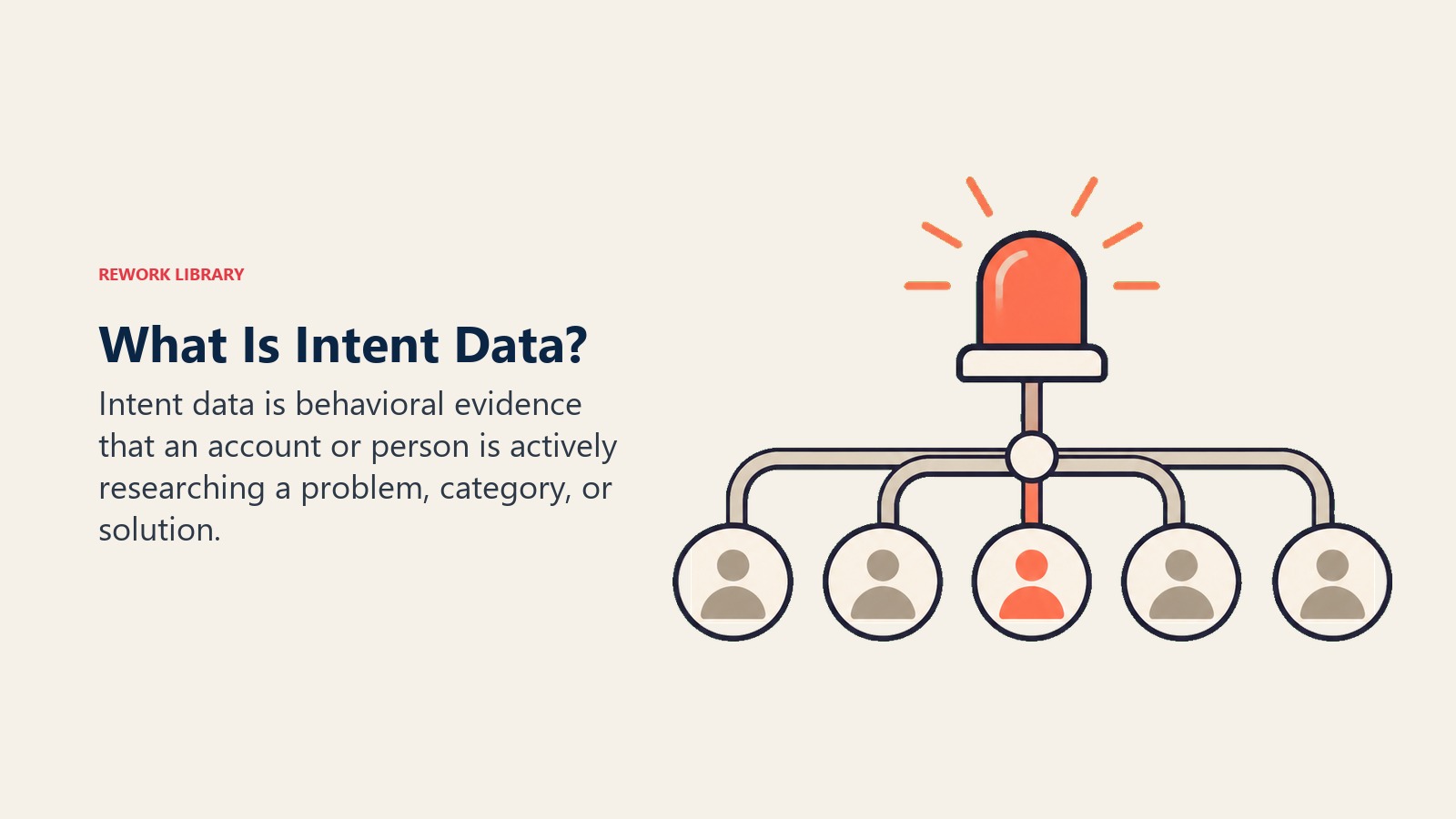
Intent data is a collection of behavioral signals that indicate a person or account is actively researching a product, service, or topic. These signals come from what buyers do online: the articles they read, the software review sites they visit, the keywords they search, and the content they download. When those behaviors cluster around a topic related to your solution, the account is said to be "surging" on that topic.
In B2B, intent data is primarily used to prioritize accounts for sales outreach and marketing campaigns. Rather than treating every account in your ICP the same, you focus energy on the ones showing live buying signals, shortening sales cycles and reducing wasted outreach.
Key Facts
- 67% of the B2B buyer journey happens before a buyer ever contacts a vendor, making behavioral signals the only window into early-stage research (Forrester, 2023).
- B2B buying committees now average 6 to 10 stakeholders, which means intent signals at the account level aggregate behavior across multiple researchers, not just one person (Gartner, 2023).
- Companies using intent data report a 2x improvement in conversion rates for targeted accounts compared to non-intent-based outreach (TechTarget Priority Engine study, 2022).
First-party vs third-party intent data
Not all intent data is the same. The two categories differ on who collected it, and that difference matters a lot for how you use it.
| Dimension | First-party intent | Third-party intent |
|---|---|---|
| Source | Your own website, product, content assets | Aggregated from publisher networks, review sites, search data |
| Accuracy | Very high (you know exactly who visited) | Moderate (probabilistic matching of anonymous signals) |
| Coverage | Limited to accounts already in your orbit | Broad (catches accounts researching you or competitors, even before they visit you) |
| Cost | Low to zero (you own the data) | Subscription fee, often $15k-$80k/year depending on coverage |
| Examples | Page visits, form fills, demo requests, product logins, email clicks | G2 buyer intent, Bombora, TechTarget, 6sense, Demandbase |
| Privacy risk | Lower (consent-based) | Higher (requires GDPR/CCPA due diligence on vendor practices) |
For most B2B teams, the practical answer is: start with first-party, layer in third-party for coverage you can't see yourself.
Types of intent signals
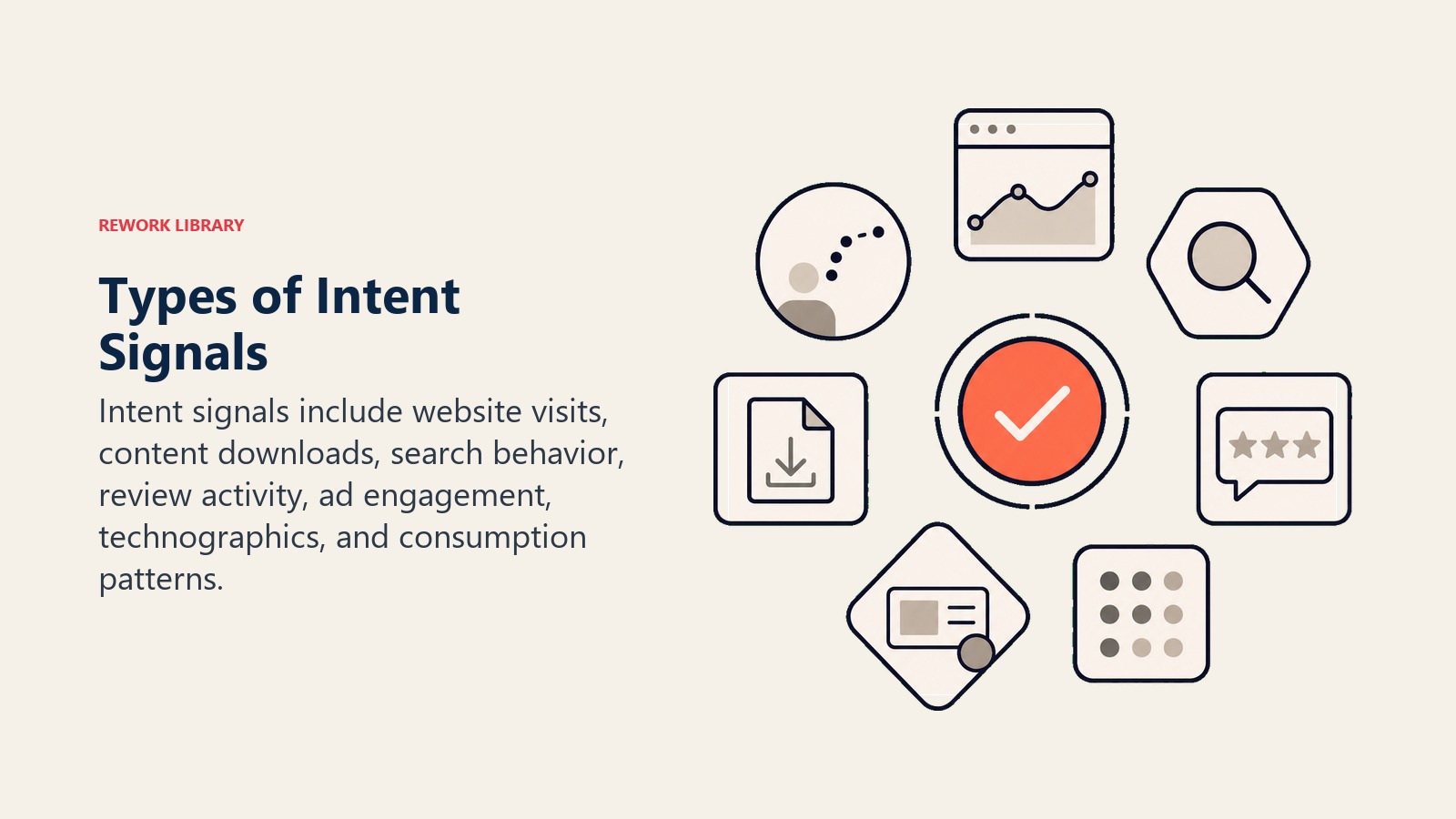
Intent signals fall into several categories. Some are high-confidence buying indicators; others are earlier-stage research behaviors. Knowing which is which helps you route them correctly.
| Signal type | What it looks like | Confidence level |
|---|---|---|
| Website visits | Pricing page, comparison pages, integration docs, demo request page | High |
| Content downloads | Whitepapers, ROI calculators, implementation guides on your site or publisher network | Medium-High |
| Search behavior | Keyword clusters around your category (e.g., "CRM for field sales teams") from B2B data providers | Medium |
| Review site activity | Viewing your profile on G2, Capterra, or TrustRadius; reading competitor reviews | High |
| Ad engagement | Repeated clicks on category-level ads, retargeting engagement, LinkedIn video views | Medium |
| Technographic changes | New software installs or recent cancellations detected via data providers like BuiltWith or HG Insights | Medium-High |
| Content consumption patterns | Multiple articles on the same topic read within a short window by people at the same company | High |
The strongest signals are visit-based and review-site-based, because those require active, deliberate action. Search behavior and content consumption patterns are valuable as early-warning indicators, since they often appear two to four weeks before a buyer reaches out directly.
Benefits of using intent data
The core benefit is prioritization. But there are several downstream effects that make intent data worth the investment.
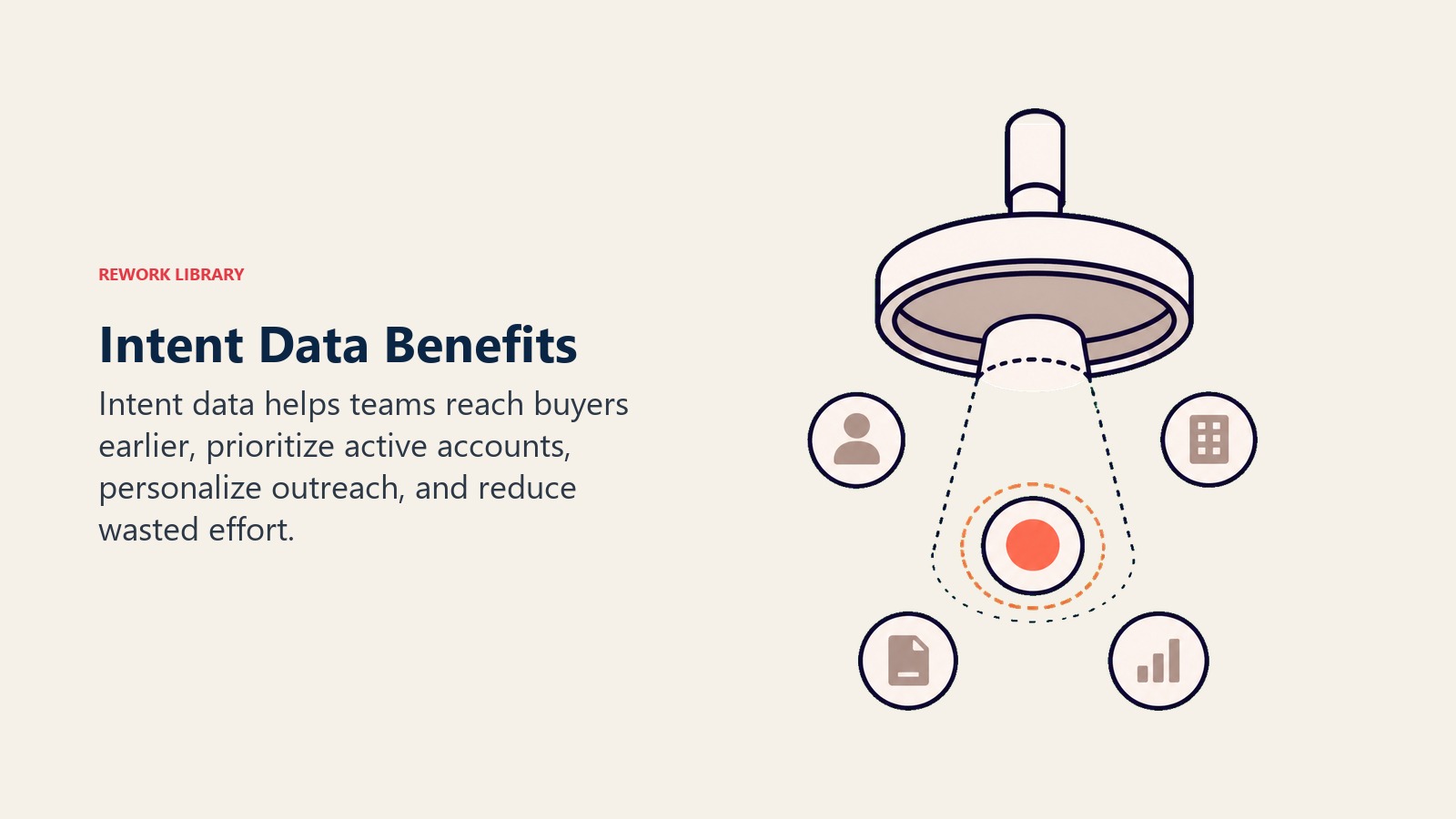
Reach buyers earlier. Most sales teams wait for inbound signals: a form fill, a demo request, a reply to an outbound email. Intent data lets you identify research-stage buyers before they raise their hand, giving you a head start on competitors who are also on their shortlist.
Cut wasted outreach. Sales reps spend a significant portion of their time on accounts that have no active need. Layering intent signals over your ICP means the accounts you reach out to are actually in-market, and response rates reflect that.
Improve ABM relevance. Account-based marketing programs live and die by account selection. Intent data gives marketing and sales teams a shared, evidence-based reason to prioritize specific accounts, rather than debating gut-feel lists. For more on building that shared framework, see account-based marketing.
Enable personalized outreach. Knowing what topics an account is surging on lets you tailor your message. If an account is researching "sales team onboarding software," your outreach can address that problem specifically rather than sending a generic pitch.
Support churn risk detection. For customer success teams, first-party intent signals inside the product can surface accounts researching competitors or reducing product usage, giving you a chance to intervene before renewal conversations go sideways.
Complement product-led signals. For companies with a free trial or product-led growth motion, intent data from outside the product adds context to in-product behavior. An account that is both heavily using a trial feature and surging on competitor-comparison keywords is a high-priority product qualified lead that deserves immediate sales attention.
How to use intent data in B2B
Intent data without a workflow is just noise. The teams that get results are the ones who build a repeatable process around the signals.
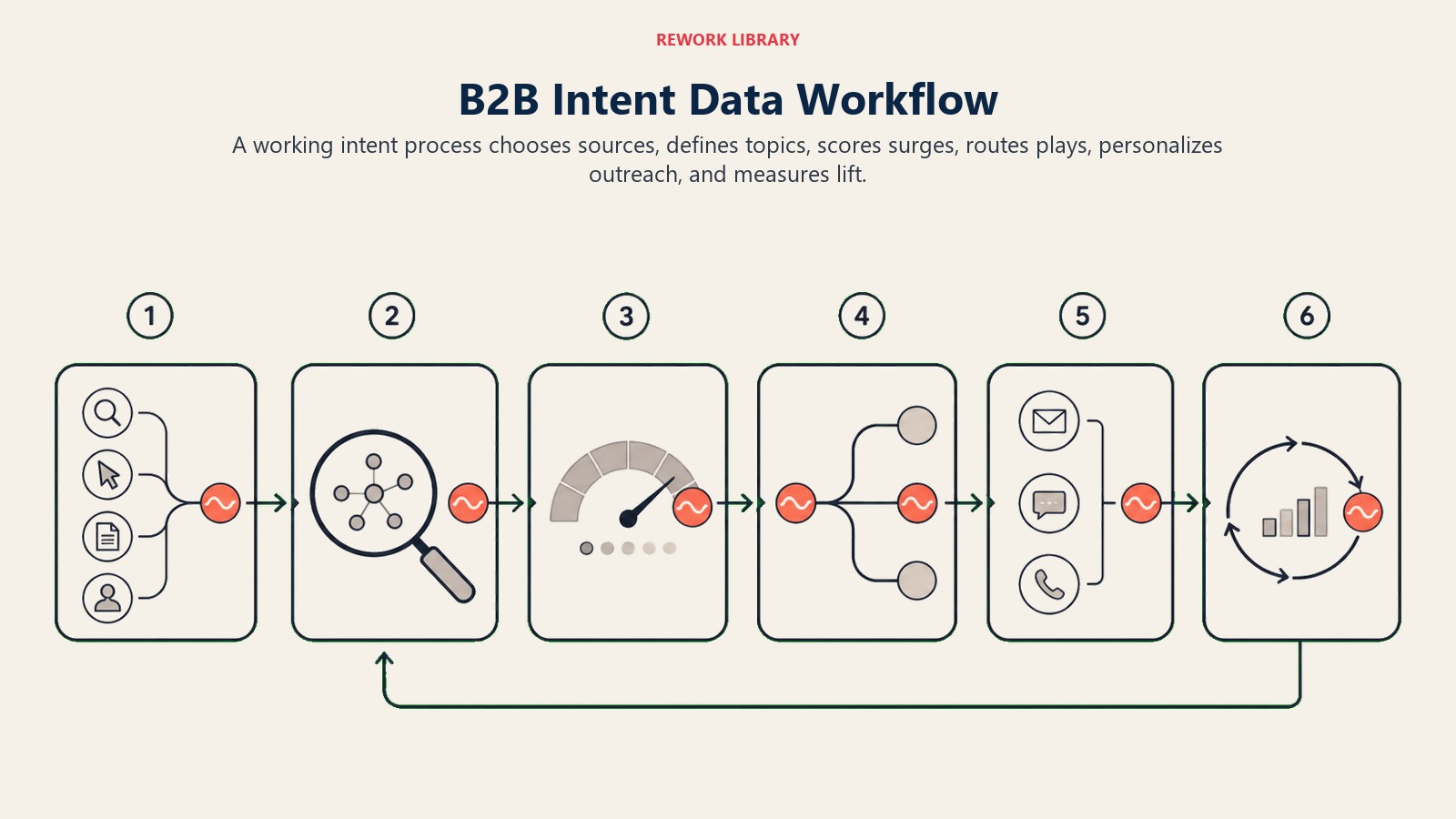
Step 1: Choose your data sources
Start with first-party data you already have: website analytics, marketing automation, CRM activity, and product usage. Map which pages and behaviors correlate with high-intent buyers in your pipeline history. That baseline tells you what to look for in third-party data.
For third-party, evaluate vendors based on the topics they cover, the publisher networks they aggregate from, and how they handle identity resolution. G2 Buyer Intent is strong for software categories. Bombora is broad and widely used for topic-based intent. 6sense and Demandbase combine intent with predictive modeling.
Step 2: Define your topic taxonomy
Intent data is only useful if you're listening for the right things. Work with sales, marketing, and product to build a list of 20 to 50 topics and keyword clusters that represent genuine research by buyers solving the problem you solve.
Include competitor names, category terms, integration partners, and pain-point phrases. Exclude your own brand name from intent scoring (anyone searching your brand is already in your funnel). Revisit the taxonomy every quarter as the competitive landscape shifts.
Step 3: Score accounts and detect surges
A single intent signal means little. What matters is a surge: a noticeable increase in relevant research activity from an account over a short window, typically 2 to 4 weeks. Most intent data platforms provide surge scores out of the box.
Layer intent scores on top of your existing lead scoring systems and ICP fit scores. An account that fits your ICP strongly and is surging on a high-confidence topic is your highest-priority target. An account surging but with poor ICP fit is likely researching for a different reason.
For a framework on how ICP fit interacts with intent, see ideal customer profile.
Step 4: Route to the right play
Not every intent signal warrants a sales call. Build a routing logic that maps signal type and confidence to action.
- High-confidence surge (pricing page + review site activity) from a net-new account: route to outbound SDR immediately.
- Mid-confidence surge (content consumption only) from a net-new account: enroll in a targeted nurture track. See lead nurturing programs for sequencing principles.
- High-confidence surge from an existing open opportunity: alert the AE to accelerate the deal.
- Surge from a current customer: route to customer success for a proactive check-in.
Connecting intent routing to your broader account-based routing strategy ensures signals reach the right rep without manual triage.
Step 5: Personalize outreach using the signal
Generic outreach underperforms even when timing is right. Use the specific topics an account is surging on to shape your message. If they're reading articles about data migration and comparing enterprise platforms, your first touch should address that problem, not a generic product overview.
This is also where lead data enrichment adds value: combining intent signals with firmographic and technographic data gives reps a complete picture before they pick up the phone. And aligning messaging to the specific stage and persona in play improves relevance further, as outlined in buyer persona.
Step 6: Measure lift and refine
Measure two things: signal-to-meeting rate (how often does an intent-triggered outreach result in a booked meeting?) and signal-to-close rate (how often do intent-surfaced accounts end up as customers?). Compare both against your baseline non-intent outreach.
If certain topic clusters consistently outperform others, weight them more heavily in your scoring model. If certain signal types are producing noise, reduce their weight or add a secondary filter. Treat intent data as a model you tune, not a binary filter you set once.
Intent data use cases
| Use case | Intent signal used | Action |
|---|---|---|
| ABM account selection | Third-party topic surges aligned to your ICP | Prioritize for personalized multi-channel campaigns |
| Inbound prioritization | First-party: pricing/demo page visits | Accelerate follow-up speed; see lead-sources-overview |
| Outbound prospecting | Third-party: review site activity, keyword surges | Add to targeted outbound sequences before competitors engage; see outbound lead generation |
| Churn-risk detection | First-party: declining product usage + competitor research signals | Trigger CS outreach; adjust renewal strategy |
| Pipeline acceleration | First-party: late-stage prospects revisiting pricing content | Alert AE to push for next meeting; supports pipeline generation strategy |
| Partner and channel plays | Third-party: surges in partner-adjacent categories | Trigger co-sell or referral motion |
Common mistakes and limitations
Intent data is a powerful tool but it comes with real constraints. Teams that ignore these often end up more frustrated than they would be without intent data at all.
Acting on thin signals. A single article view is not a buying signal. One-off intent spikes without supporting context produce false positives that burn rep credibility and waste sales capacity. Only act when signals cluster across multiple touchpoints or show sustained surge over several weeks.
Ignoring privacy and compliance. Third-party intent data sits in a gray zone for GDPR and CCPA. Vendors vary widely in how they handle consent and data sourcing. Before deploying third-party intent, run it through your legal team and verify vendor data practices. For European accounts especially, first-party signals are far safer to act on. See the FAQ section below for more on this.
No defined play for each signal. Intent data without routing logic just creates a list. If your team doesn't know what to do when an account surges, you'll spend more time debating than acting. Document your playbooks before you turn on the feed.
Overweighting intent and ignoring fit. Some teams get so excited about surging accounts that they chase poor-fit prospects who happen to be researching the category. Intent data works best when it multiplies good ICP fit, not replace it. See lead qualification frameworks for a structured way to combine the two.
Siloed data. Intent signals locked inside one tool (say, your marketing automation platform) that sales reps never see don't drive action. Make sure intent data surfaces in the CRM, the sales engagement tool, or wherever reps actually live.
Intent data doesn't replace good sales and marketing fundamentals, but it compresses the timeline between "account starts researching" and "rep has a relevant conversation." As buying committees grow larger and more of the research journey happens anonymously online, teams that act on behavioral signals will consistently get to the right accounts sooner than those who don't.

Principal CRM Strategist
On this page
- What is intent data?
- First-party vs third-party intent data
- Types of intent signals
- Benefits of using intent data
- How to use intent data in B2B
- Step 1: Choose your data sources
- Step 2: Define your topic taxonomy
- Step 3: Score accounts and detect surges
- Step 4: Route to the right play
- Step 5: Personalize outreach using the signal
- Step 6: Measure lift and refine
- Intent data use cases
- Common mistakes and limitations