Product Qualified Lead (PQL): Definition and Examples
Turn this article into takeaways for your work.


Each assistant summarizes the article only for you and suggests best practices for your work.
A product qualified lead is the clearest buying signal a sales team can receive. Unlike a form fill or a content download, a product qualified lead (PQL) has already used your product and hit a meaningful value moment, which means they're not imagining ROI, they've experienced it firsthand.
For companies running a free trial or freemium model, PQLs are often the highest-converting lead type in the entire funnel, and the fastest to close.
What is a product qualified lead?
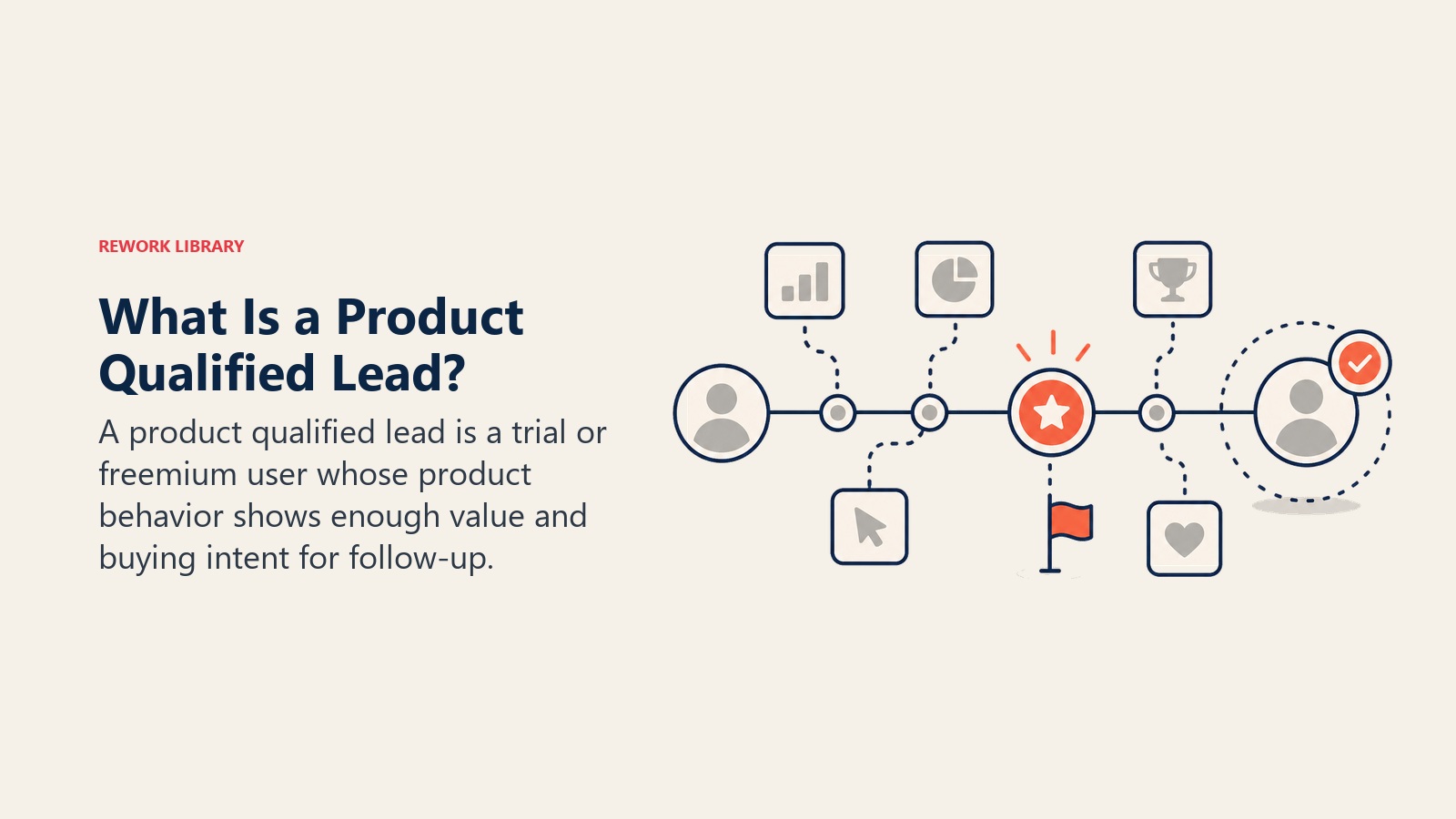
A product qualified lead (PQL) is a trial or freemium user who has reached a predefined activation milestone inside the product, signaling genuine intent to buy. The key distinction from other lead types is the signal source: instead of marketing behavior (clicks, downloads) or a sales conversation, the qualification comes from in-product usage data.
PQLs sit at the center of product-led growth (PLG), a go-to-market strategy where the product itself is the primary acquisition, conversion, and expansion engine. In PLG companies, the free tier isn't just a top-of-funnel hook. It's a proof-of-value delivery mechanism, and PQLs are the users who have taken delivery.
Key Facts
- Companies using product-led growth report that over 40% of their revenue comes from self-serve and freemium channels (OpenView Partners, 2023 PLG Index).
- PQLs convert to paid at roughly 4x the rate of MQLs in PLG-native SaaS companies, based on aggregate benchmarks from Amplitude and Pendo customer data (2022-2023).
- 58% of PLG companies say defining a clear activation event is the single most important step in building a functional PQL model (ProductLed, 2022 State of PLG).
PQL vs MQL vs SQL
These three lead types serve different stages and different teams. Confusing them leads to misrouted leads, wasted outreach, and friction between marketing and sales.
| MQL | SQL | PQL | |
|---|---|---|---|
| Signal source | Marketing activity (content, ads, email) | Sales qualification conversation | In-product usage data |
| Intent strength | Low to medium (expressed interest) | Medium (declared need, budget explored) | High (proven value already experienced) |
| Owner | Marketing team | Sales development or AE | Product + sales or CS (joint) |
| Typical conversion to paid | 1-5% | 15-30% | 15-40%+ (varies by PQL definition tightness) |
| Best suited for | Demand generation, content-driven funnels | Enterprise, outbound, complex deals | Freemium, self-serve, PLG motions |
The difference matters operationally. An MQL who downloads a whitepaper might not be in-market for six months. A PQL who has invited three teammates and hit a feature limit is in-market right now.
What signals define a PQL
Not every active user is a PQL. The goal is to identify users who have crossed from "exploring" into "relying on this." These signals, tracked via product analytics, are the building blocks of any PQL definition.
| Signal | What it indicates | Example |
|---|---|---|
| Activation milestone reached | User experienced the core value moment | Created first project, sent first report, set up first automation |
| Repeated logins within a window | Habitual use forming | Logged in 5+ times in 14 days |
| Collaboration actions | Expansion potential, team-level need | Invited 2+ teammates, shared a document externally |
| Key feature adopted | Depth of engagement with paid-tier functionality | Used an advanced filter, connected an integration, ran a bulk action |
| Usage hitting a plan limit | Direct upgrade trigger | Reached file storage cap, hit seat limit, exceeded API calls |
| Time-to-value under threshold | Fast adoption, high engagement quality | Completed onboarding flow in under 48 hours |
Any single signal can be a weak indicator. PQL models typically combine two or three signals with a scoring threshold to reduce false positives.
Benefits of focusing on PQLs
Sales teams that route PQLs alongside or instead of MQLs see a few consistent advantages.
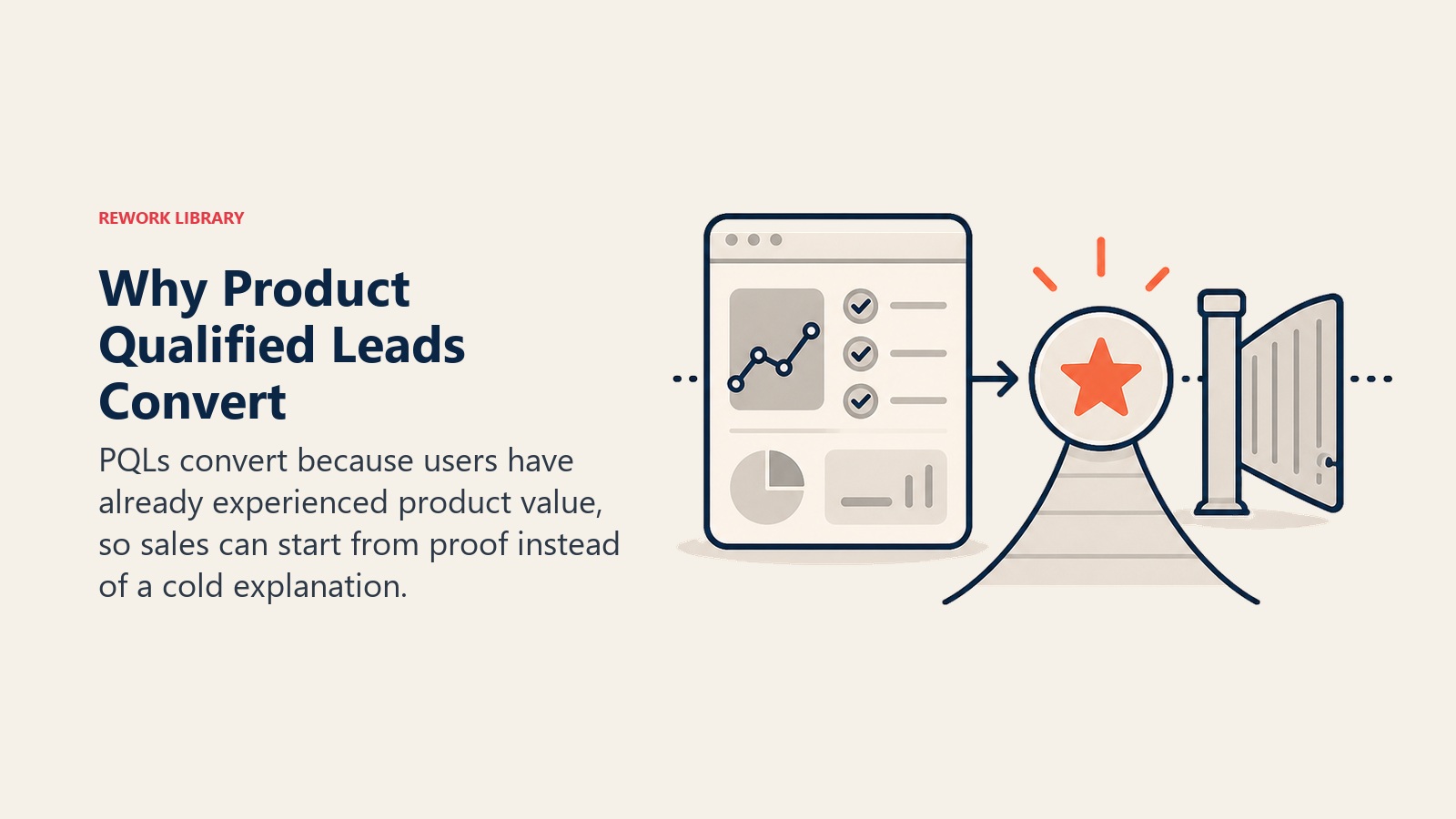
Shorter sales cycles. When a rep reaches out to a PQL, they don't have to build the case for the product from scratch. The user already knows it works. Conversations move faster from "what is this?" to "what plan do I need?"
Higher win rates. PQLs have lower objection volume because the risk concern, "will this actually solve my problem?", has already been answered. The qualification is data-backed rather than self-reported.
Better rep efficiency. Reps spend time on accounts already showing intent, rather than working through a broad MQL pool that may be mostly researchers. This is especially valuable when headcount is flat.
Expansion signals from existing customers. PQL logic isn't only for new-logo acquisition. The same usage signals apply to existing customers approaching plan limits or adopting new modules, which makes PQLs a natural input into customer success-led expansion.
Tighter product-sales feedback loops. When sales reps see which in-product actions precede conversions, that data flows back into product decisions. Features that consistently show up in PQL profiles get prioritized for deeper investment.
How to build a PQL model
Step 1: Define your activation event
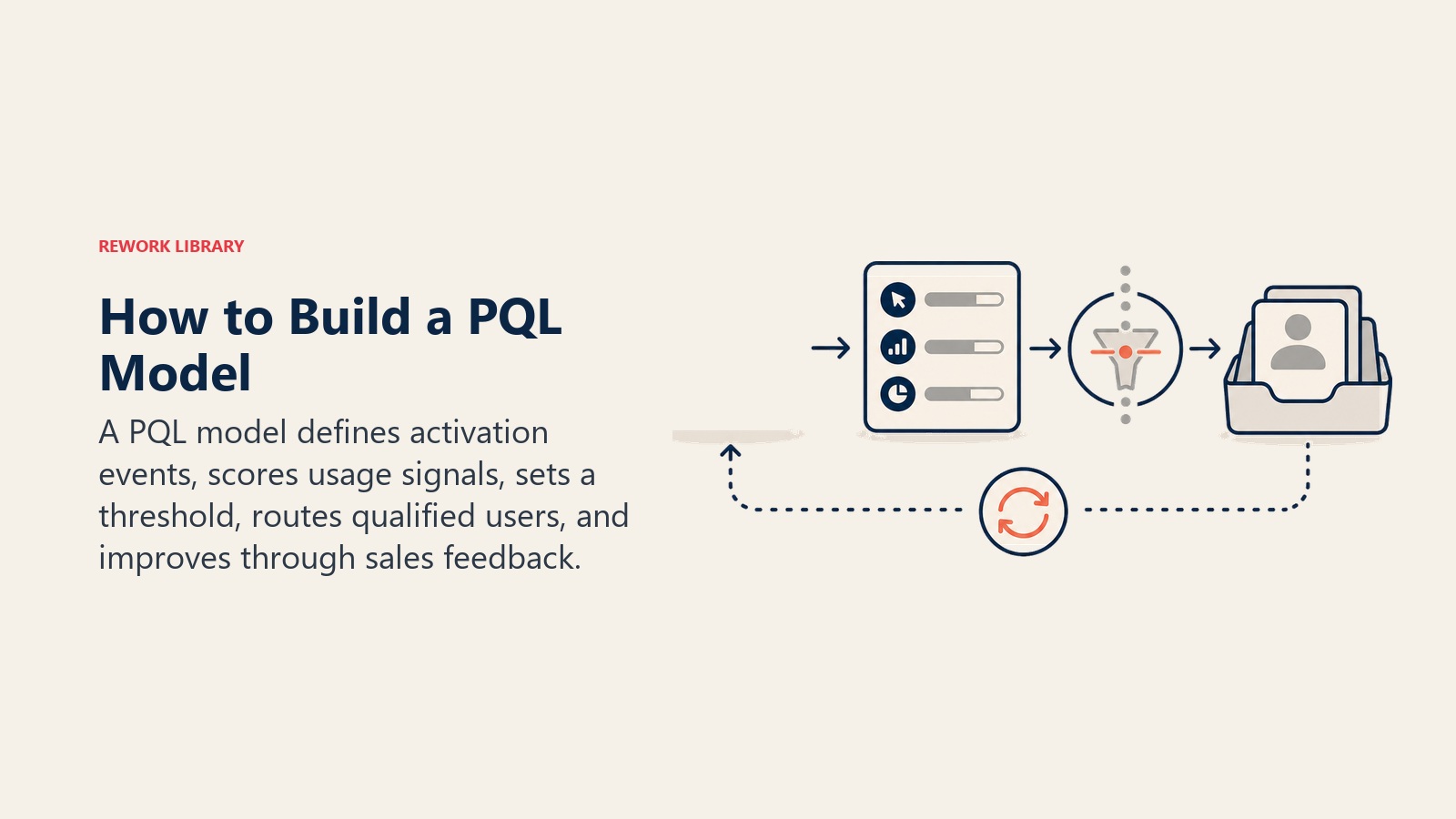
Your activation event is the specific in-product moment when a user first experiences the core value your product delivers. For a project management tool, it might be completing the first project with at least one other collaborator. For an analytics tool, it might be building and sharing the first dashboard. Be precise: vague activation definitions produce vague PQLs.
Ask your best customers what moment made the product feel essential. Their answers almost always converge on one or two actions.
Step 2: Identify qualifying signals
Layer in secondary signals that confirm genuine adoption rather than casual exploration. Review conversion data from past trial-to-paid conversions to identify which usage patterns appeared most frequently in the days before upgrade. Feature adoption depth, collaboration breadth, and frequency of return visits are the three most predictive categories for most SaaS products.
Step 3: Set a PQL score threshold
Assign weights to each signal and establish a minimum score that a user must reach before being flagged as a PQL. Start conservative: a tight definition with higher intent is better than a loose one that floods sales with low-quality leads. You can loosen thresholds once you've validated conversion rates.
A simple starting point: activation event completed (required) + any two secondary signals from your shortlist = PQL.
Step 4: Instrument product analytics
Your PQL model is only as good as your data pipeline. You need event tracking that captures the specific actions in your PQL definition, plus user-level attribution so signals can be tied back to a contact record in your CRM. Tools like Mixpanel, Amplitude, Heap, or Segment are common choices for event collection. The PQL flag typically gets written to your CRM via an integration or webhook when thresholds are crossed.
Step 5: Route PQLs to sales or self-serve
Not every PQL needs a sales rep. Segment PQLs by company size, ICP fit, and deal size potential:
- Self-serve route: Small accounts or individuals who hit a limit get a targeted in-app upgrade prompt or a pricing page visit trigger. No rep required.
- Sales-assisted route: Mid-market or enterprise accounts who qualify as PQLs get a warm outreach from a rep, referencing their specific usage. "I saw your team has been using [feature] heavily, wanted to see if we could help you scale that." This context-aware outreach consistently outperforms cold MQL outreach.
Routing logic should be automated: when a PQL score is reached, a task or alert fires in the CRM, assigning the account to the right rep or queue.
Step 6: Measure and refine
Track PQL-to-paid conversion rate, sales cycle length from PQL creation to close, and average contract value for PQL-sourced deals. Compare these against MQL and SQL benchmarks. If PQL conversion is lower than expected, the most common causes are a loose activation definition, poor CRM routing, or reps not using the usage context in their outreach. Revisit the model quarterly.
Product qualified lead examples
| Company type | Free tier structure | Activation event (PQL trigger) | Secondary signals used |
|---|---|---|---|
| Collaboration tool (e.g., team workspace) | Free for up to 5 users | Invited 3+ teammates and completed first shared project | Logged in 4+ days in a week; used a real-time co-editing feature |
| Analytics SaaS (e.g., BI tool) | Free tier with limited dashboards | Built and shared a dashboard with an external stakeholder | Connected a second data source; returned within 48 hours to add a chart |
| Design tool (e.g., UI/prototyping) | Freemium with export limits | Published or shared a prototype link externally | Hit the free file limit; invited a reviewer outside the organization |
| Sales engagement tool | Trial with capped sequences | Set up and launched a first email sequence | Opened sequence analytics 3+ times; added a second sender account |
| HR/people ops platform | Free for small teams | Completed onboarding and ran first payroll or review cycle | Added a second admin; triggered an automated workflow |
The activation event varies dramatically by product category, but the logic is the same: find the moment the product stops being a test and starts being a tool they depend on.
Best practices and common mistakes
Do: anchor your PQL definition to value delivery, not just activity. A user who logs in every day but never completes the core workflow isn't a PQL. Frequency without activation is just exploration.
Do: keep sales reps briefed on what the PQL signals actually mean. A rep who contacts a PQL without referencing their usage misses the entire advantage of the model. "I noticed you've been using X to do Y" is the opening line. "I'm following up on your trial" is not.
Do: build a feedback loop from sales back to product. When reps lose PQL deals, understanding why (price, missing feature, wrong timing) feeds directly into product roadmap decisions.
Don't: set your activation threshold too low. If 60% of free users become PQLs, your definition is too loose and you've just renamed your entire trial list.
Don't: ignore expansion PQLs from existing customers. Usage hitting a plan ceiling is one of the strongest upgrade signals in the funnel, and it's often undermonitored compared to new-user PQL programs.
Don't: treat PQL as a replacement for lead qualification frameworks entirely. In hybrid GTM motions, MQLs and PQLs often run in parallel, with different routing logic and conversion goals. The frameworks complement each other.
PQL models are still evolving as more B2B SaaS companies adopt product-led growth. But the core principle is durable: a lead who has already experienced value in your product is a fundamentally different kind of buyer than one who has only heard about it. Building the infrastructure to identify and route those leads efficiently is one of the highest-leverage investments a GTM team can make.
To connect PQL signals with the broader funnel, see how lead lifecycle stages map product-qualified users to conversion milestones, and how lead scoring systems can incorporate product usage data alongside firmographic signals. For the conversion metrics that matter most in a PLG motion, lead conversion rate covers the benchmarks and measurement approaches in detail. Cross-collection: opportunity qualification explains how PQL-sourced opportunities get evaluated at the pipeline stage, and lead to opportunity conversion covers the handoff mechanics from marketing and product into the sales pipeline.

Principal CRM Strategist
On this page
- What is a product qualified lead?
- PQL vs MQL vs SQL
- What signals define a PQL
- Benefits of focusing on PQLs
- How to build a PQL model
- Step 1: Define your activation event
- Step 2: Identify qualifying signals
- Step 3: Set a PQL score threshold
- Step 4: Instrument product analytics
- Step 5: Route PQLs to sales or self-serve
- Step 6: Measure and refine
- Product qualified lead examples
- Best practices and common mistakes