Cost Per Lead (CPL): How to Calculate and Reduce It
Turn this article into takeaways for your work.


Each assistant summarizes the article only for you and suggests best practices for your work.
Every marketing dollar your team spends either earns its keep or quietly drains the budget. Cost per lead, or CPL, is the number that tells you which. It is one of the most direct signals of how efficiently your team is turning spend into pipeline. And it is one of the most commonly misread.
CPL sounds straightforward. It is not always. A low CPL can mask a pipeline full of leads that never close. A high CPL can be perfectly acceptable if those leads convert at a strong rate. Getting CPL right means knowing how to calculate it, what to compare it against, and which levers actually move it.
This guide covers all of that.
What is cost per lead?
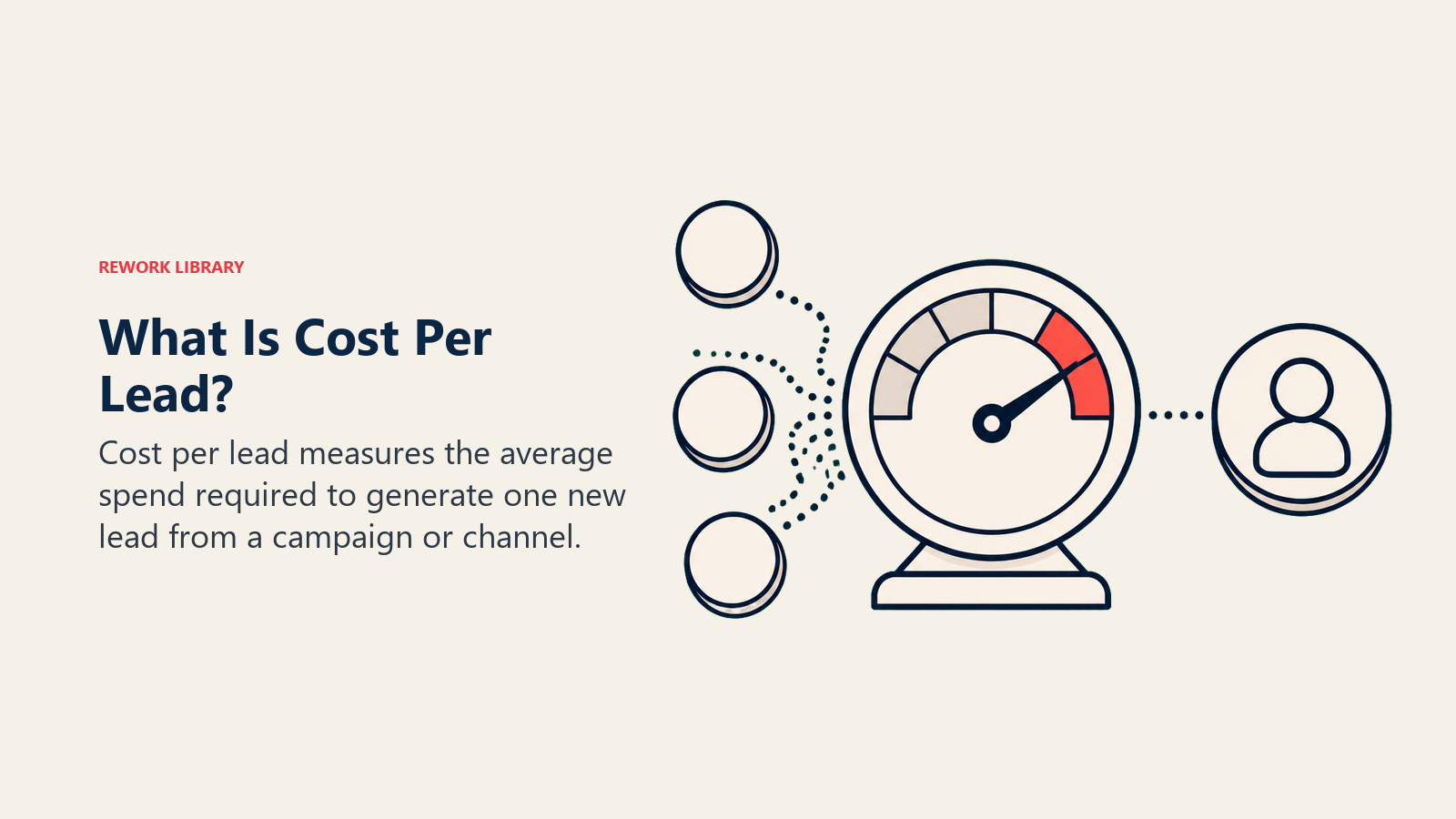
Cost per lead (CPL) is the total marketing spend required to generate one new lead. It tells you, on average, how much you are paying to get a prospect into your funnel. The formula, stated plainly: divide total campaign spend by the number of leads that campaign produced.
CPL matters because it connects marketing activity directly to sales economics. If your team does not know what a lead costs, it cannot make sensible decisions about channel mix, budget allocation, or scaling. It is a foundational metric, not just for marketing teams but for anyone who cares about efficient revenue growth.
But CPL is also incomplete on its own. A lead is not a customer. CPL tells you the cost to fill the top of the funnel; it does not tell you whether those leads are any good. That is why CPL always belongs alongside lead conversion rate and customer acquisition cost.
Key Facts: Cost Per Lead
- Average B2B CPL across all channels sits around $198, though it ranges widely by industry and channel, according to a Ruler Analytics study of 11,000+ B2B companies (2023).
- Organic search and SEO typically deliver the lowest CPL of any channel, often 50-70% below paid search for the same audience, per multiple Demand Gen Report studies.
- Companies that align their lead scoring with CPL data see up to 20% improvement in marketing ROI, according to Forrester Research on marketing measurement maturity.
How to calculate cost per lead
The formula is simple:
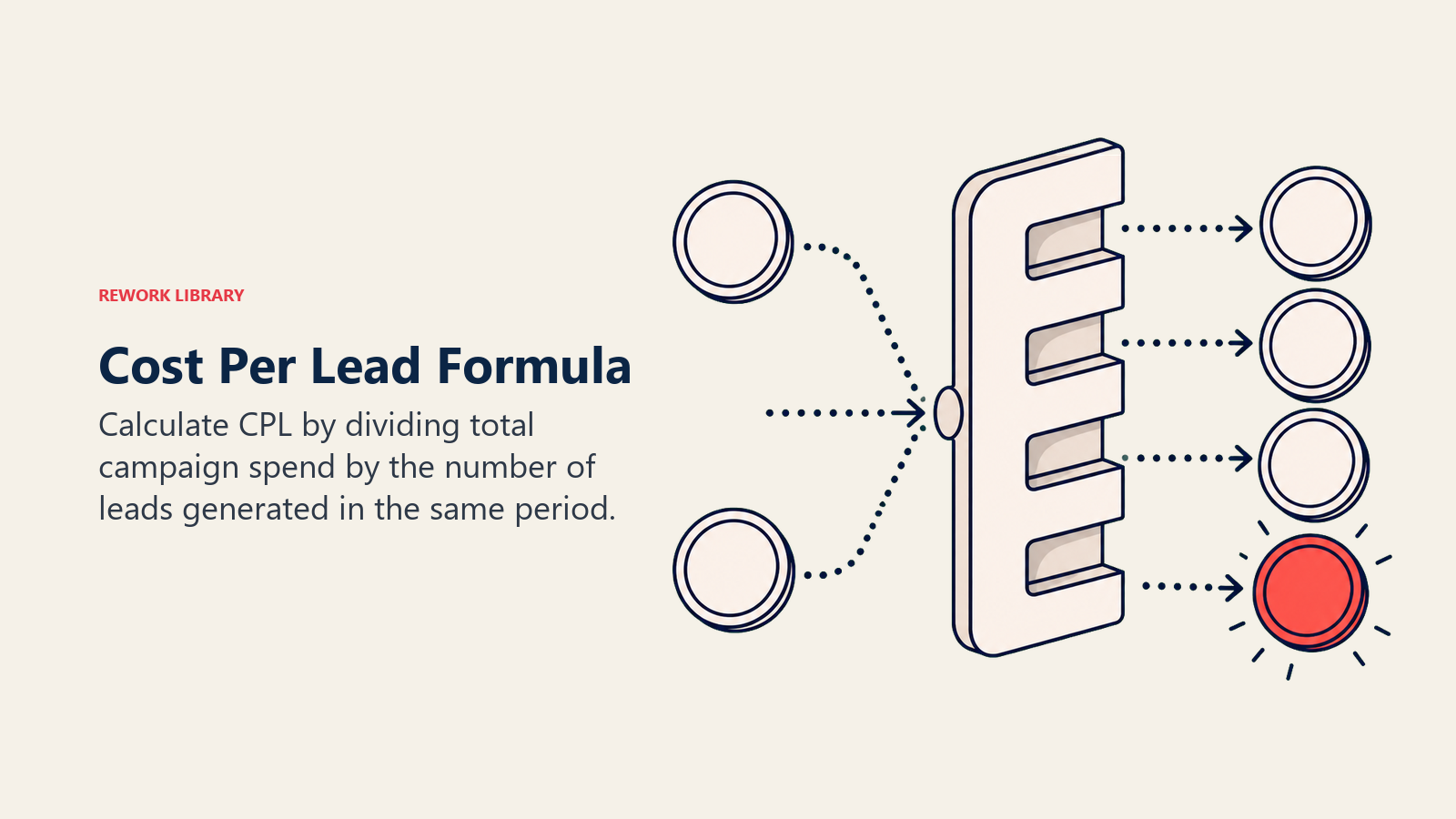
CPL = Total Campaign Spend / Number of Leads Generated
Say your team runs a paid LinkedIn campaign. You spend $12,000 over a month and generate 80 leads. Your CPL is $150.
What counts as "spend" matters a lot here. Most teams undercount. Total spend should include:
- Ad spend or media costs (the obvious one)
- Agency or freelancer fees for copy, creative, or campaign management
- Tool and platform costs allocated to the campaign (your marketing automation seat, landing page software, etc.)
- Internal team time if you want a fully-loaded number (this is optional but more accurate)
Leaving out agency fees or tool costs means you will systematically underestimate CPL. That feels good in the short run and leads to bad channel decisions in the long run.
You can calculate CPL at several levels: per channel, per campaign, per ad set, or per audience segment. The more granular you go, the more useful the number becomes for optimization.
What is a good cost per lead?
There is no single answer. CPL benchmarks vary significantly by channel, industry, company size, and deal value. A $400 CPL might be exceptional for a company selling enterprise software at $100,000 ARR. That same $400 CPL would be catastrophic for a company selling a $500/year subscription.
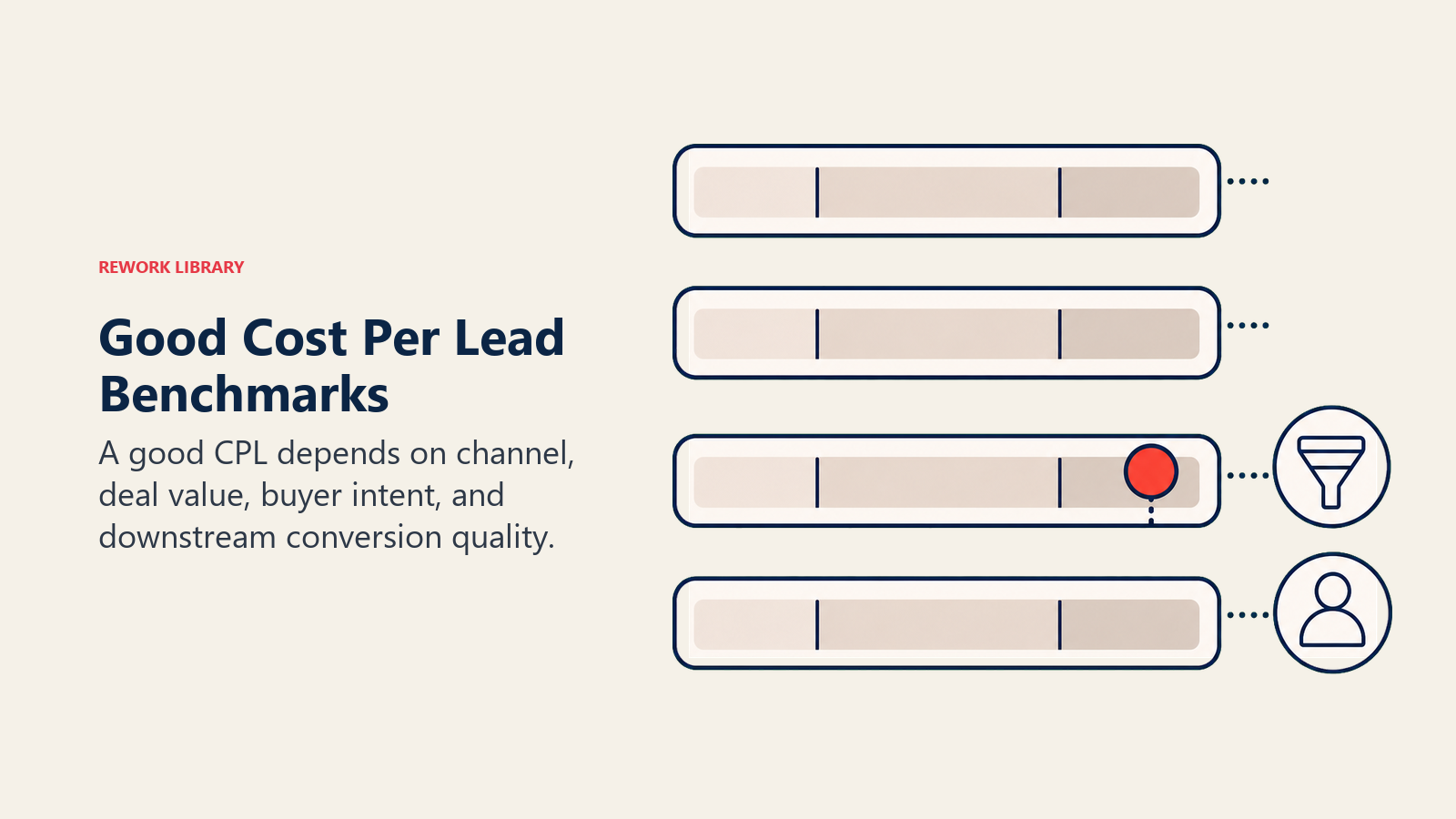
The table below shows approximate CPL ranges by channel for B2B companies, based on published industry benchmarks and agency data from 2023 to 2025:
| Channel | Typical B2B CPL Range | Notes |
|---|---|---|
| Organic search (SEO) | $30 to $150 | Low CPL but slow to build; best long-term channel |
| Content marketing | $40 to $175 | Overlaps with SEO; depends on content investment |
| Email (house list) | $25 to $100 | Very low CPL when list is warm and maintained |
| Webinars and events | $75 to $250 | Higher CPL, but leads tend to be more qualified |
| Paid search (Google Ads) | $100 to $400 | Fast but expensive; quality varies by keyword intent |
| Social media (organic) | $50 to $200 | Highly variable by audience and content |
| LinkedIn Ads | $150 to $600 | Expensive CPL but often strong lead quality for B2B |
| Display advertising | $200 to $700 | High volume, low quality; rarely a primary channel |
| Trade shows and conferences | $500 to $2,000+ | Very high CPL; offset by sales qualification that happens in person |
Industry benchmarks tell a similar story. Technology companies often see average CPLs of $100 to $300. Healthcare and financial services run higher, from $200 to $500 or more, because of longer sales cycles and tighter compliance requirements. Ecommerce and consumer-facing B2B tend to run lower.
The most useful benchmark is your own historical data. Know your CPL by channel, track it over time, and compare it against your lead conversion rate to judge quality.
How to reduce your cost per lead
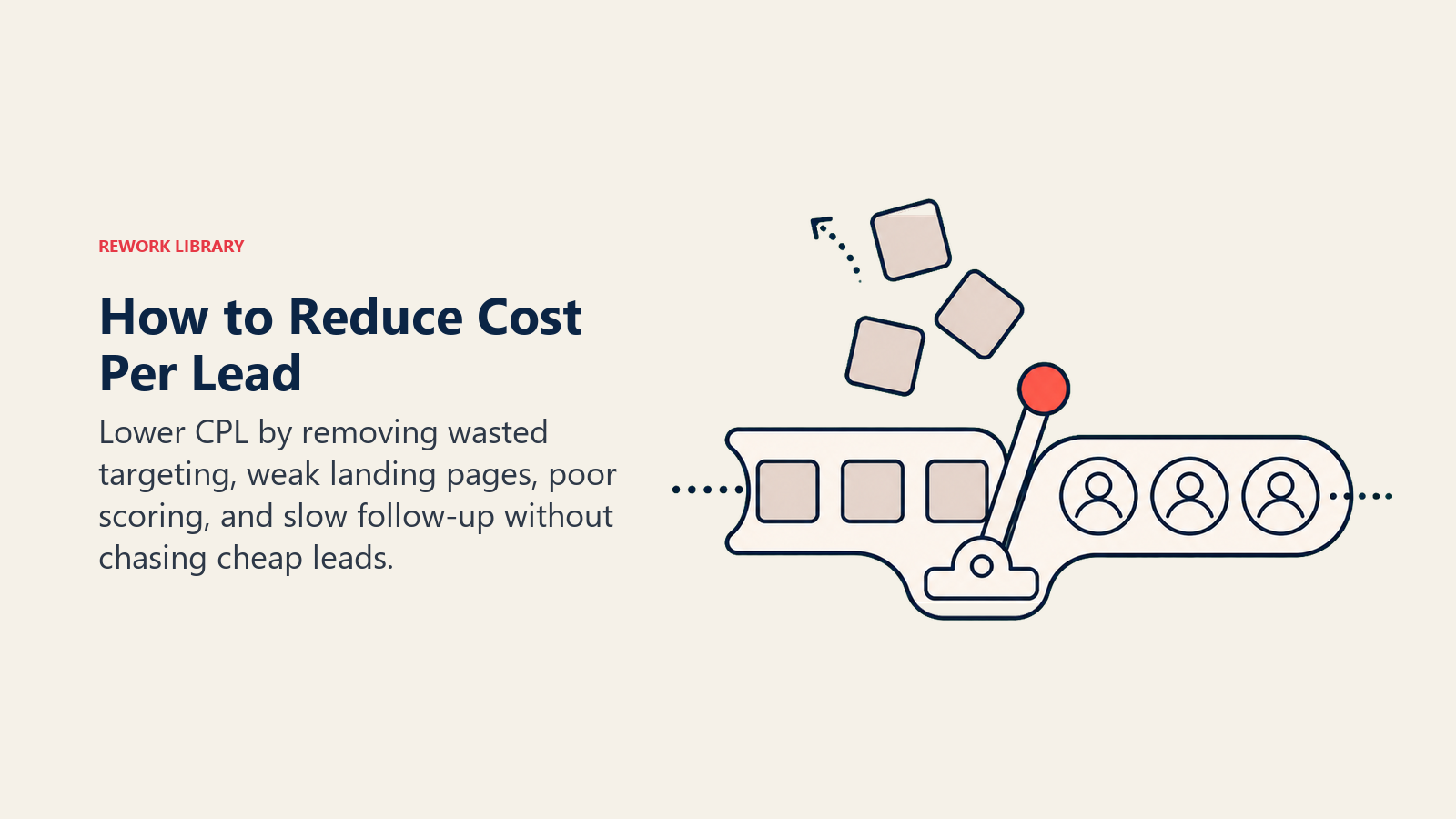
Reducing CPL is not about spending less. It is about generating more leads from the same spend, or the same number of leads at lower spend, without sacrificing quality. Here are five ways to do it.
Step 1: Tighten your audience targeting
Broad targeting generates cheap clicks and expensive leads. Every time your ad reaches someone outside your ideal customer profile, you are paying for an impression that will never convert.
Narrow your targeting parameters: company size, job title, industry, geography, behavioral signals. On paid channels, use negative keyword lists and exclusion audiences aggressively. On LinkedIn, test layered targeting combinations rather than single-dimension targeting. The more precisely you reach the right person, the fewer wasted impressions you pay for.
Step 2: Fix your landing pages
Most paid traffic converts at 2 to 5%. That means 95 out of every 100 people you pay to send to your landing page leave without converting. A one percentage point improvement in conversion rate can cut your CPL by 15 to 30% without touching your ad spend.
Test your headline, your offer, and your form length. Long forms kill conversion. If you are asking for six fields to download a whitepaper, try asking for two. If your landing page headline does not match the ad that drove the click, fix the message match. Speed matters too; a page that loads in under two seconds converts significantly better than one that takes five.
Step 3: Improve lead quality with better scoring
This one is counterintuitive. Improving lead scoring systems does not always lower CPL directly. But it raises the quality of the leads you count, which means you stop optimizing toward volume and start optimizing toward pipeline value.
When you connect CPL data to downstream conversion rates, you often find that your cheapest leads close at the lowest rates. Shifting budget from high-volume/low-quality sources to lower-volume/higher-quality sources might raise CPL on paper while improving cost per closed deal. That is the trade-off worth making.
Step 4: Invest in organic and lower-CPL channels
Inbound lead generation through SEO and content has a higher upfront cost and a slower ramp, but a dramatically lower CPL at scale. A well-ranking blog post generates leads for months without incremental spend. Email marketing to a warm house list is consistently one of the lowest-CPL channels in B2B.
Review your channel mix quarterly. If you are over-indexed on paid ads lead generation and under-indexed on organic, even a modest shift in budget allocation can meaningfully reduce blended CPL over six to twelve months.
Step 5: Reduce time to follow-up
This one surprises people. Lead response time affects CPL indirectly because slow follow-up reduces conversion rates, which means you need more leads to fill the same amount of pipeline. Faster response to inbound leads raises your conversion rate, which lowers your effective CPL even if your nominal spend stays flat.
If your average response time is over an hour for inbound web leads, this is one of the highest-leverage fixes available to you.
CPL vs CAC and other metrics
CPL is often confused with related metrics. Here is how they differ:
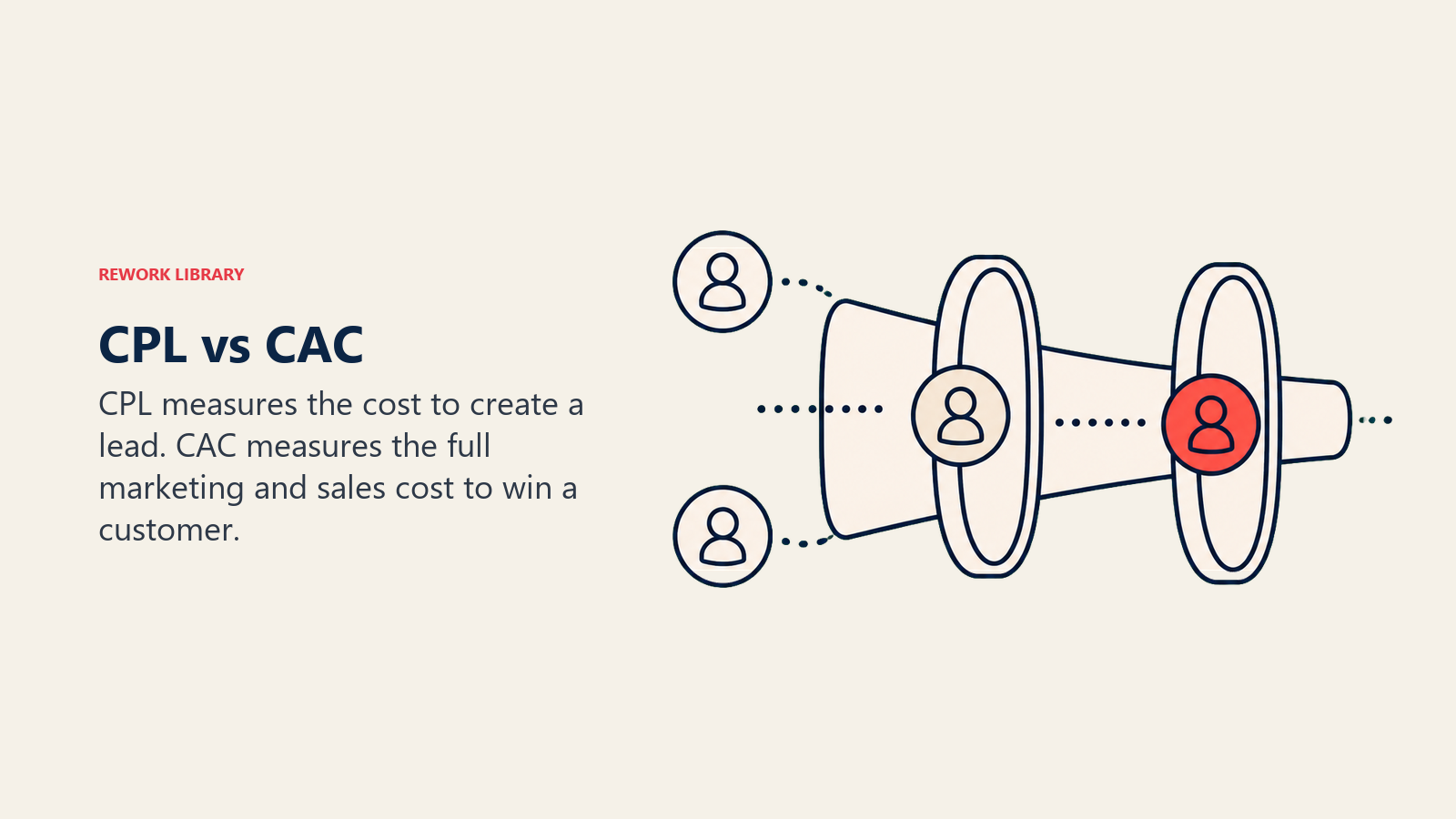
Cost per lead (CPL) measures what you spend to get a prospect into the funnel. It covers the marketing spend up to the point of conversion to a lead.
Customer acquisition cost (CAC) measures what you spend, across marketing and sales, to close one paying customer. CAC includes everything CPL captures plus sales salaries, commissions, and sales tooling costs. If your CPL is $200 and only one in ten leads becomes a customer, your marketing-attributed CAC is $2,000 before you add sales costs. You can read more about this relationship in the customer acquisition cost guide.
Cost per click (CPC) is an ad-specific metric that measures spend per click, not per lead. A low CPC does not guarantee a low CPL; your landing page conversion rate is the bridge between them.
Cost per marketing qualified lead (CPMQL) is a more refined version of CPL that filters for leads meeting your qualification criteria. It is more useful for measuring channel quality, though harder to track in real time.
Use CPL for channel-level efficiency comparisons. Use CAC for the full revenue picture.
Common cost per lead mistakes
Counting the wrong things as leads. If your definition of a lead includes newsletter subscribers, event attendees who did not opt in, or contacts scraped from a list, your CPL looks artificially low and your pipeline data becomes unreliable. Define a lead consistently and stick to it. Optimizing CPL in isolation. A team that only cares about CPL will funnel budget to the cheapest channels, which rarely produce the best buyers. Always look at CPL alongside lead-to-opportunity rate and close rate.
Ignoring blended CPL. Most teams track CPL per channel but miss their blended number across all marketing spend. If you have high organic volume but also spend heavily on events, your blended CPL is the number that matters for budget planning.
Failing to attribute correctly. Multi-touch attribution is hard, but first-touch-only attribution gives you a distorted picture of which channels are actually driving pipeline. At a minimum, track both first touch and last touch CPL by channel.
Not separating new business from existing customers. CPL calculations should cover new-logo lead generation only. Mixing in expansion or upsell activity inflates your lead counts and deflates your apparent CPL.
Frequently Asked Questions about Cost Per Lead
What is a good CPL for B2B SaaS?
It depends entirely on your deal size. A rough rule: your CPL should be no more than 5 to 10% of your average contract value. For a $10,000 ACV product, a CPL of $500 to $1,000 can still be profitable if your close rate is solid. For most B2B SaaS companies, a CPL between $100 and $400 across paid channels is workable.
Should CPL include staff time?
It depends on what you are optimizing. For comparing paid channel efficiency, including only out-of-pocket costs is fine. For calculating true marketing ROI or comparing paid versus organic, including a fully-loaded cost (including team time) gives you a more honest picture.
How often should we review CPL?
At minimum, monthly. For active paid campaigns, weekly tracking lets you catch underperforming ad sets before they drain budget. Quarterly reviews should include a channel-mix analysis to see where shifts in budget allocation make sense.
What is the difference between CPL and CPA (cost per acquisition)?
CPA typically refers to cost per customer acquisition, which is closer to CAC. CPL stops at the lead stage. Some platforms use CPA to mean cost per any conversion action, including a lead form fill, so context matters.
Can CPL be too low?
Yes. A very low CPL often signals lead quality problems. If your sales team consistently finds that cheap leads from a particular source waste their time, the real cost when you account for sales time and conversion rate is higher than the raw CPL suggests. Cheap leads that never close are not cheap. Tracking cost per lead gives your team a shared language for marketing efficiency. But it works best when it sits alongside your other pipeline metrics. Know your CPL by channel, benchmark it against your revenue economics, and keep an eye on the conversion metrics downstream. That is how you use CPL to build a healthier funnel, not just a cheaper one.

Principal CRM Strategist
On this page
- What is cost per lead?
- How to calculate cost per lead
- What is a good cost per lead?
- How to reduce your cost per lead
- Step 1: Tighten your audience targeting
- Step 2: Fix your landing pages
- Step 3: Improve lead quality with better scoring
- Step 4: Invest in organic and lower-CPL channels
- Step 5: Reduce time to follow-up
- CPL vs CAC and other metrics
- Common cost per lead mistakes