Succession Planning: How to Build Leadership Continuity Without Crisis

Turn this article into takeaways for your work.


Each assistant summarizes the article only for you and suggests best practices for your work.
Succession planning is one of the most consistently under-resourced activities in organizational leadership. Boards discuss it briefly in governance checklists. CEOs treat it as a future concern. HR produces succession matrices that sit in folders nobody opens until someone leaves.
And then someone leaves. Or becomes ill. Or is suddenly required to exit. And an organization that assumed it had time realizes it does not.
This guide is for leaders and boards who want to build genuine succession capability rather than succession theater.
Why Succession Planning Fails
Before describing what good succession planning looks like, it is worth being honest about why it so often fails.
It feels like planning for failure. Actively developing a successor can feel like admitting you are replaceable, or like you are being pushed out. Leaders who are uncomfortable with their own mortality, professional or literal, avoid the work.
It requires honesty about people. Effective succession planning requires assessing real individuals against real future roles, naming gaps, and sometimes having uncomfortable conversations about whether someone has what the next role requires. That is harder than generic "leadership development" activities.
The benefit is diffuse and delayed. Succession planning done well shows its value years later, when a transition happens smoothly. The cost is now. This time horizon makes it easy to deprioritize.
Boards do not always push hard enough. Many boards treat succession planning as a CEO responsibility and only engage actively when there is a visible problem. The CEOs who most need board pressure to do the work are often the ones least likely to volunteer that they have not done it.
The Two Kinds of Succession Planning
There are two distinct succession challenges, and confusing them leads to planning that addresses one but not the other.
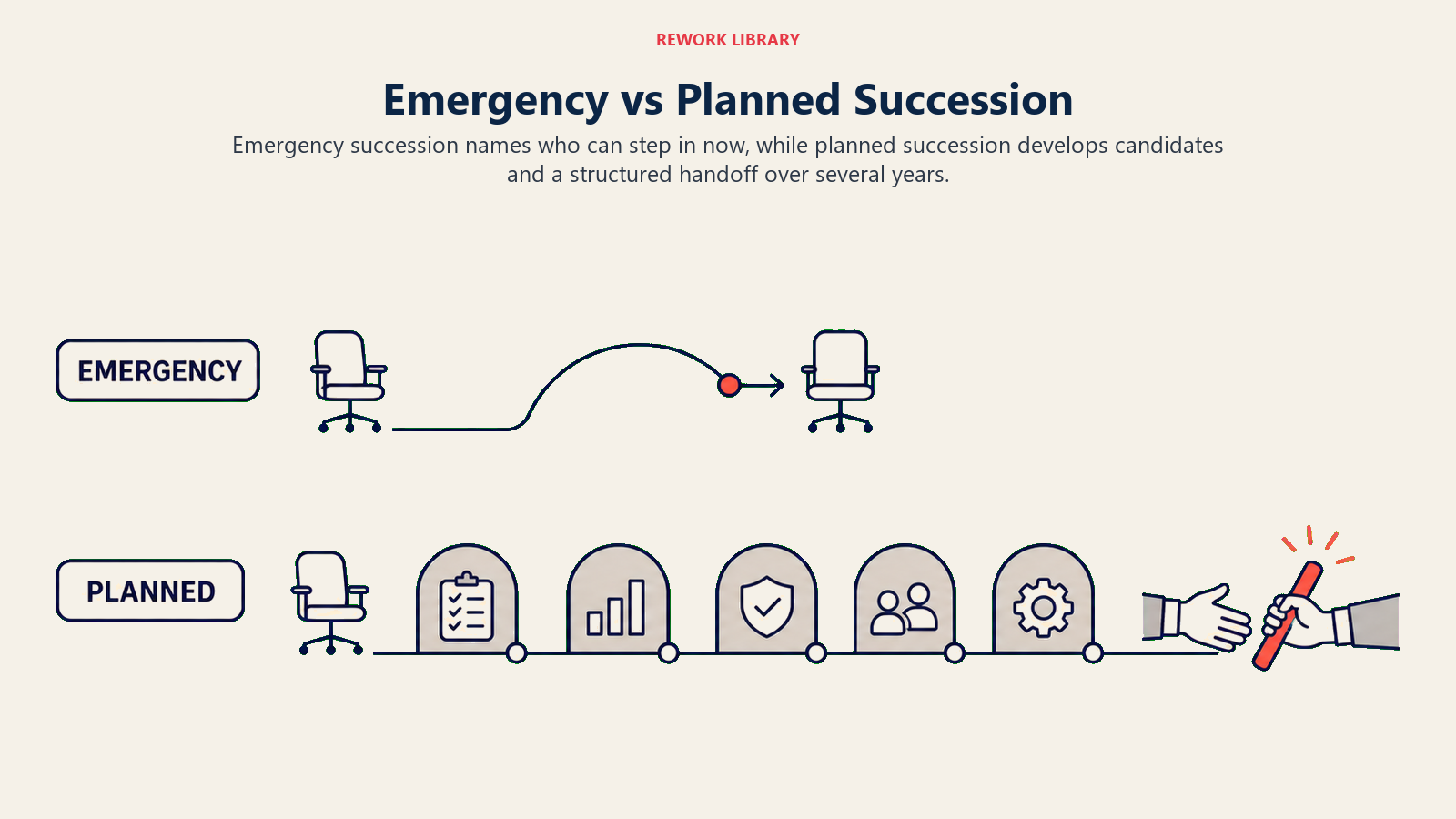
Emergency succession covers the sudden, unexpected loss of a key leader through illness, accident, unexpected departure, or termination. This requires having a designated interim leader who can step in immediately, even if only for a transitional period, and a process for activating an emergency search or internal promotion.
Planned succession covers the anticipated transition of key leaders over a multi-year horizon, through retirement, deliberate role evolution, or strategic restructuring. This requires identifying and developing internal candidates, managing timeline expectations, and executing a structured handoff.
Organizations that only plan for one create real vulnerability to the other. A company with a detailed ten-year succession roadmap but no emergency protocols is exposed. A company with emergency protocols but no pipeline of developed candidates finds itself with a crisis at every planned transition.
Who Needs a Succession Plan
The answer is more positions than most organizations cover. Standard succession planning focuses on the CEO and the C-suite. That is the floor, not the ceiling.
The right question is: if this person were not here tomorrow, what would break, and how fast?
For most organizations, the answer includes:
- CEO and all C-suite direct reports
- Roles with specialized skills or relationships that cannot be filled quickly from the market
- Key customer-facing relationships where the relationship is held personally, not institutionally
- Roles where the incumbent is within five years of likely retirement or departure
- Roles that are pivotal for an upcoming strategic initiative
The depth of planning required varies. For mission-critical roles, having a named internal successor and an active development plan is appropriate. For other roles, having a clear succession process and a candidate pool to draw from is sufficient.
Identifying Succession Candidates
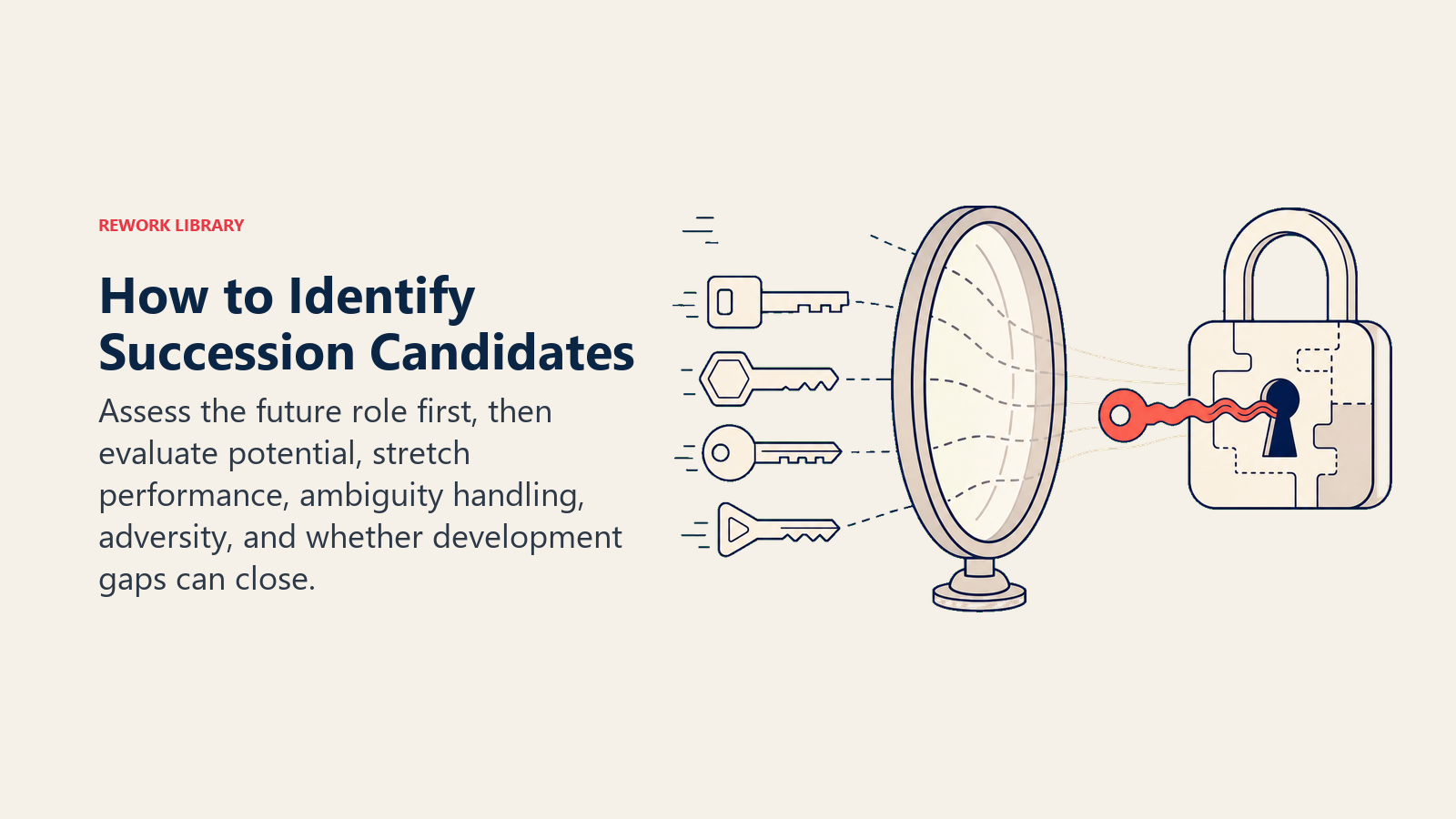
Successor identification starts with two questions: what will this role require in the future? And who in the organization might grow into that?
The "future role" question is harder than it looks. The instinct is to identify successors who could do the current job well. But the current job may not be what the role requires in three to five years. A CFO role that has been primarily about financial reporting may need to shift significantly toward capital allocation strategy or investor relations. A CHRO role that has been primarily operational may need to take on culture architecture at scale. Succession planning that is anchored to the current version of the role sets up mismatches.
The "who might grow into it" question requires disciplined assessment. Organizations that succession-plan well have a clear framework for evaluating potential: What has this person demonstrated in stretch assignments? How do they handle ambiguity and adversity? What is their ceiling, not just their current performance? Where are their development gaps, and are those gaps closable?
One practical distinction: the qualities that make someone successful in their current role are partly predictive of whether they will succeed in a more senior one, but not entirely. Performance in the current role is a necessary but not sufficient condition for succession readiness. Organizations that promote purely on current performance without assessing the skills required for the next role tend to find their succession choices regressing to the mean under increased complexity.
Developing Successor Candidates
Identifying a potential successor is only the start. The more important work is developing them into someone who can actually do the job when the transition comes.
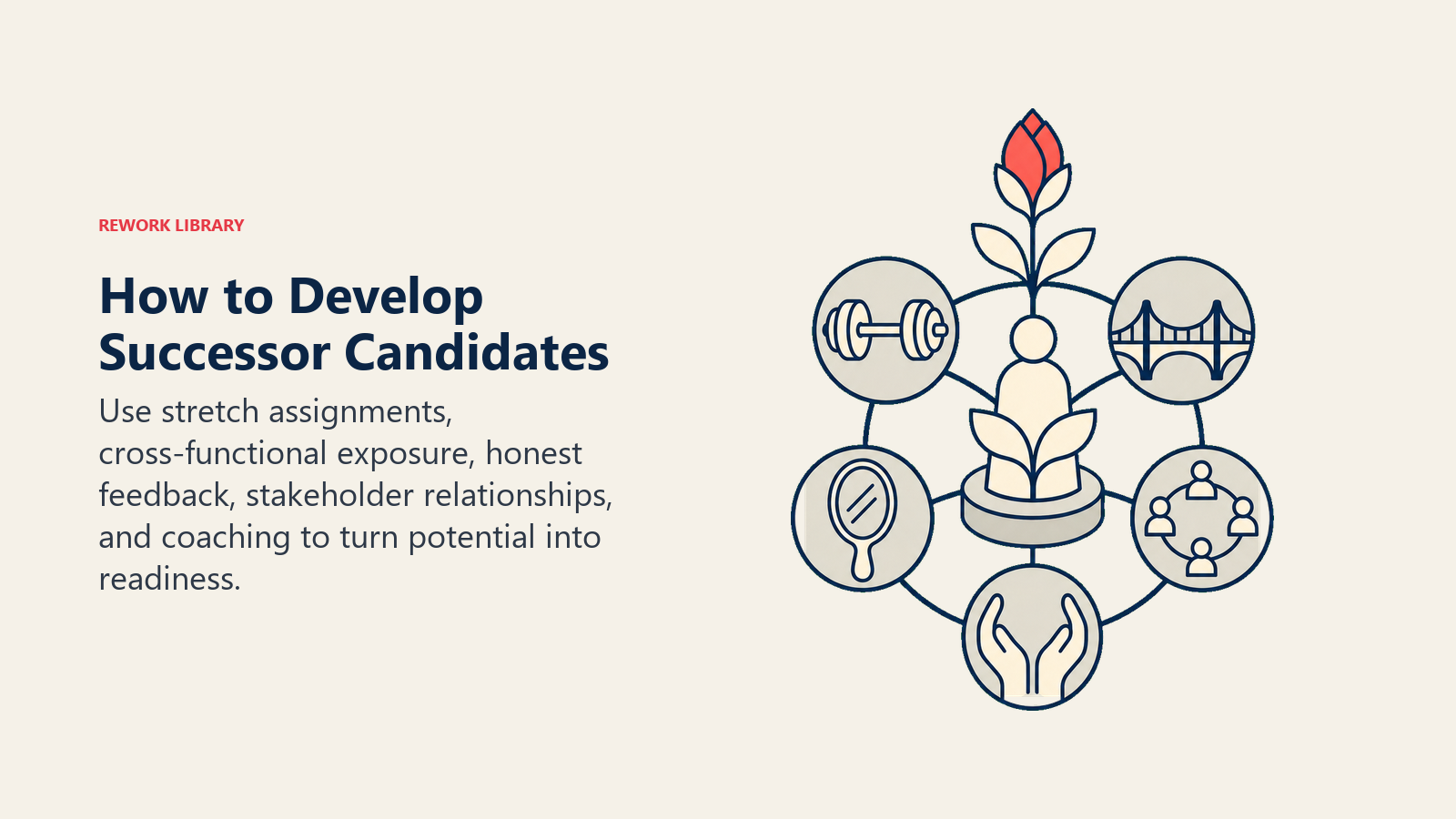
Development activities that matter:
Stretch assignments. Give high-potential candidates responsibility for significant projects outside their core domain, ideally with real stakes. Not make-work leadership development projects, but actual business problems. The development is in the difficulty.
Exposure to the full business. Successors who know only their functional domain are not ready to run a cross-functional organization. Planned exposure through rotation, cross-functional leadership roles, board presentations, and customer engagement builds the breadth needed.
Feedback that is honest about gaps. Development without honest feedback about what is not working produces candidates who are surprised by their own struggles when they take on more responsibility. The most valuable feedback is specific, frank, and focused on the behaviors and capabilities the next role will require.
Relationships with the outgoing leader's key stakeholders. The incoming leader will inherit a stakeholder landscape built over years. Deliberately building those relationships before the transition, with customers, investors, board members, and key external partners, reduces the trust gap that new leaders typically face.
Explicit coaching. Many high-potential leaders have not had real coaching on their leadership presence, their decision-making under pressure, or how they come across in adversarial situations. Investing in coaching at this stage is high-return.
The Succession Conversation
One of the most avoided conversations in succession planning is the one between the current leader and their likely successor.
Many leaders avoid it because it feels awkward, or because they are not certain enough about the timeline or the candidate to make the conversation feel productive, or because they are worried about what it implies for their own tenure.
But the leaders who handle succession well have direct conversations with their successors. Those conversations include:
- What the current leader sees as the role's requirements and the candidate's current gaps
- What specific experiences and development the candidate needs before they are ready
- A rough timeline expectation, with appropriate uncertainty acknowledged
- What the current leader can do to help the candidate get ready
The candidate benefits from clarity about where they stand and what they need to do. The organization benefits from having this explicit rather than implicit. The current leader benefits from having a genuine development relationship rather than an unspoken competition.
Board Involvement in Succession
Boards have a fiduciary obligation on succession planning, but their level of engagement varies enormously.
At a minimum, boards should:
Know who the emergency successor is for the CEO. This should be named, documented, and reviewed annually. Not "we would run a search," but a specific person who could step in immediately.
Have a view on CEO succession readiness. The board's independent assessment of whether there is a credible internal candidate for CEO succession, and what the timeline looks like, should be current and honest.
Engage in honest performance and potential assessment of senior leaders. Boards that only meet executives in formal presentations have insufficient information to assess succession readiness. Direct engagement, in settings beyond the boardroom, is part of the board's succession responsibility.
Set expectations for succession planning depth across the organization. If the CEO is not building succession depth across the C-suite and into the organization, the board has a legitimate oversight role in pushing for it.
Executing a Succession Transition
When the transition actually happens, the quality of the execution matters as much as the preparation.
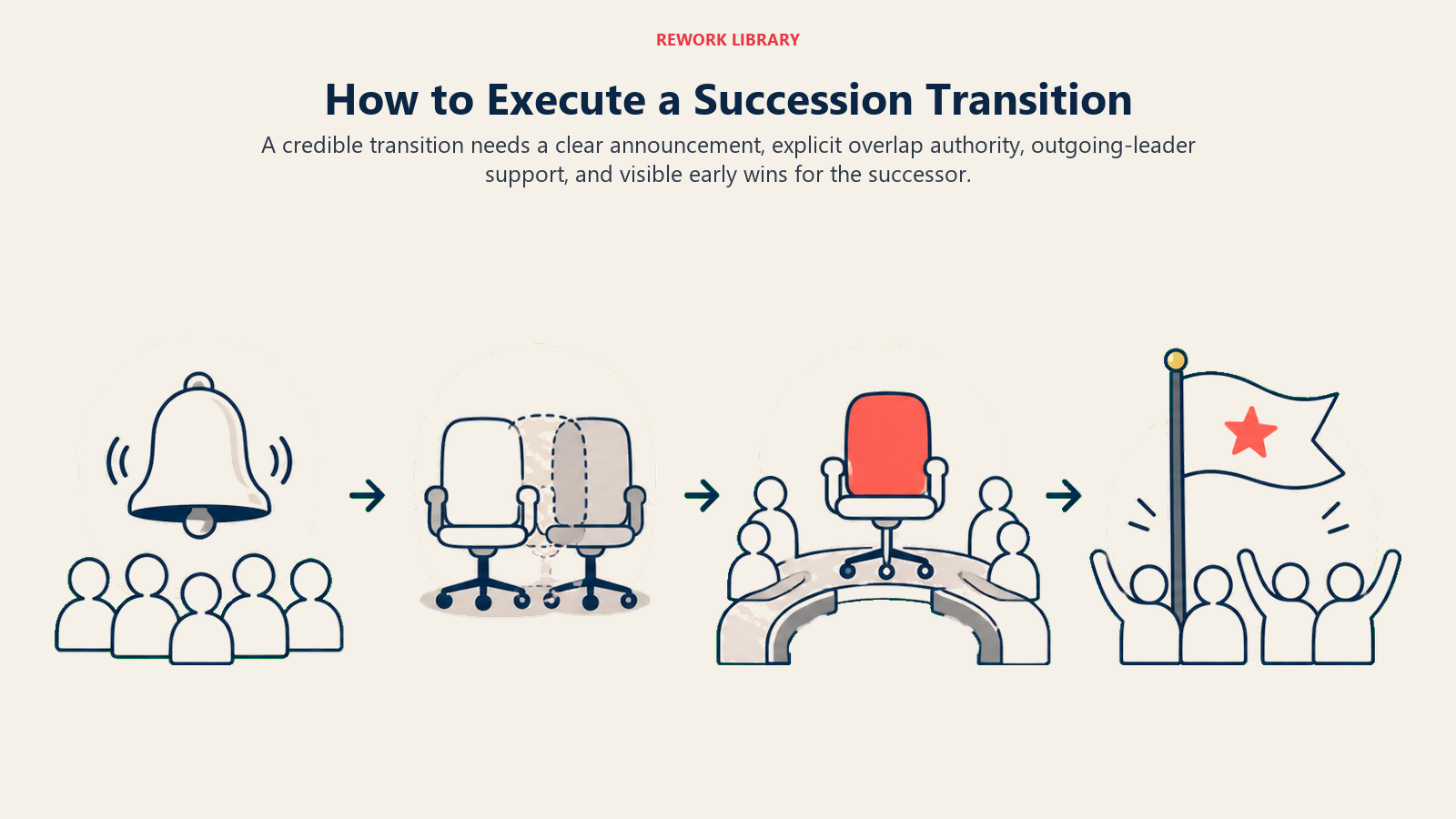
The announcement matters. How a leadership transition is announced, and what narrative it carries, shapes how the organization responds. Transitions that are framed as natural evolution and planned development of a strong internal successor carry a very different energy than those that feel rushed or opaque.
The overlap period. When there is an overlap between the outgoing and incoming leader, the structure of that period is critical. Ambiguity about who has authority during the overlap is damaging. The sequence of decisions that transfer, the timelines, and the public signals of authority need to be managed explicitly.
What the outgoing leader does next. If the outgoing leader stays in an active role within the organization, the new leader's authority depends partly on the outgoing leader's behavior. Active, overt support for the incoming leader's decisions, including decisions the outgoing leader would have made differently, is one of the most valuable things an outgoing leader can do.
Early wins for the new leader. Succession planning should include thought about how the incoming leader will establish early credibility. Not manufactured wins, but deliberate attention to which decisions and initiatives are most visible and most within the new leader's early range of authority.
Key Facts
- Research on CEO succession consistently finds that planned internal successions outperform external hires on most performance metrics within a three-year period, with the exception of turnaround scenarios where external perspective is specifically needed.
- Most organizations identify potential successors but fail to invest in closing the development gaps, making their succession plans aspirational rather than operational.
- Emergency succession events, where an unplanned leadership transition occurs without a prepared successor, are among the strongest predictors of short-term organizational performance decline.
Frequently Asked Questions about Succession Planning
How far in advance should succession planning begin?
For planned successions, three to five years is the minimum planning horizon for CEO and senior C-suite roles. This provides time to identify candidates, design development experiences, and execute a gradual authority transfer. For emergency succession, the planning should happen continuously.
Should succession candidates know they are being considered?
Generally yes, though the framing matters. Leaders who know they are being developed for senior roles are more engaged and more able to work on their development gaps. Secrecy around succession often creates anxiety and political maneuvering that succession planning is supposed to avoid.
What if there is no good internal successor candidate?
The honest answer has two parts: first, investigate whether the development investment has been insufficient, because absent development, most organizations underestimate their internal talent. Second, if after honest assessment there is genuinely no internal candidate, the succession plan for that role should include a structured external search process with a realistic timeline and budget.
How does succession planning relate to leadership development broadly?
Succession planning and leadership development are closely related but distinct. Leadership development is about building capability across the organization. Succession planning is about identifying and preparing specific individuals for specific roles. Good succession planning usually requires a strong leadership development foundation; strong leadership development without succession planning often produces talent that leaves because it sees no path forward.
Related reading: The Leadership Pipeline Model | Founder-to-CEO Transition | Founder CEO Return | Authentic Leadership | Visionary Leadership

Co-Founder, Rework.com