Founder-to-CEO Transition: When the Company Needs a Different Kind of Leader

Turn this article into takeaways for your work.


Each assistant summarizes the article only for you and suggests best practices for your work.
Most companies start with a founder. Most successful companies eventually need a professional CEO. The transition between those two phases is one of the most consequential and frequently mismanaged events in a company's lifecycle.
It is not a failure when a company needs a different leader for its next stage. Companies need different capabilities at different sizes, different market positions, and different strategic moments. The failure is in handling the transition badly.
Why Founder-to-CEO Transitions Are Hard
Founders are not just employees. They are the origin story, the culture, and often the primary relationship for key customers, investors, and early employees. When they move out of the CEO role, a lot moves with them.
The challenges operate at multiple levels.
Identity. Most founders have wrapped their professional identity tightly around the company. Stepping back from CEO is not just a job change; it can feel like a loss of self. This makes the transition emotionally charged in ways that pure professional transitions are not.
Institutional knowledge. Founders carry enormous tacit knowledge that is difficult to document and difficult to transfer. They know which partnerships are held together by personal relationships, which product decisions were compromises with a customer that the company needs to eventually unwind, which early-stage choices carry technical debt the organization has not yet reckoned with.
Loyalty structures. Early employees often joined because of the founder. Their loyalty is frequently to the person as much as the company. A new CEO can walk into an organization where the informal power structure is still routed through someone who is now technically a board member or advisor.
Ambiguity about authority. If the founder stays involved in any capacity, the organization can become confused about who actually has final authority. Two people at the top, with different levels of formal and informal power, creates a dynamic that erodes decision-making clarity.
When the Transition Should Happen
The timing of a founder-to-CEO transition is as important as how it is managed. Moving too early leaves the company without the founder energy it still needs. Moving too late means the company has already been stretched by a leadership model that doesn't fit its current complexity.
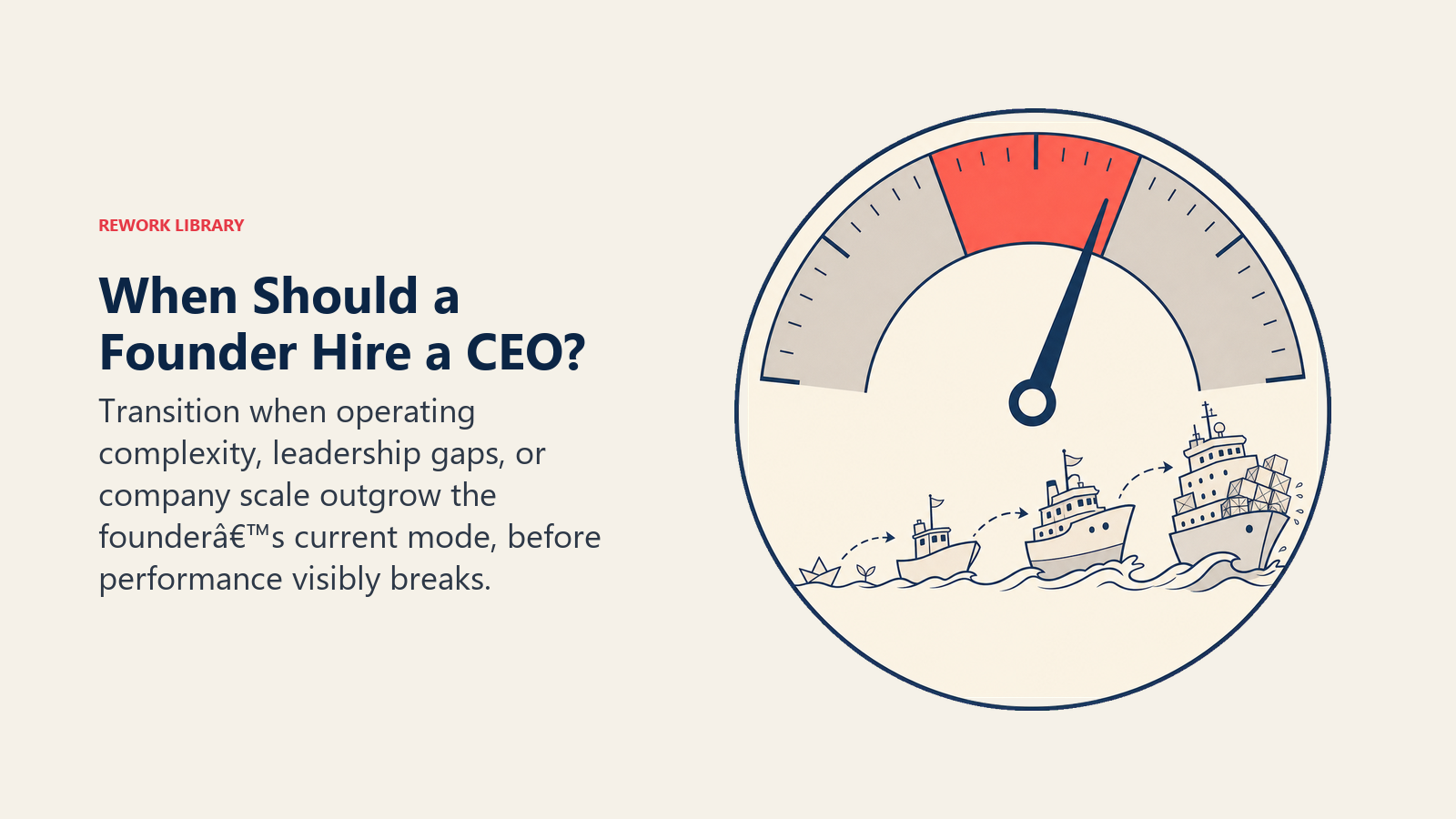
Some signals that a transition may be warranted:
Scale demands the founder doesn't enjoy. Building a 10-person company and running a 300-person company require fundamentally different skills. Some founders genuinely thrive in both contexts. Many do not, and they know it. When the day-to-day of running the company has become primarily about organizational process, financial reporting, and stakeholder management rather than building new things, and when the founder finds those activities draining rather than energizing, the company may be ready for a professional operator.
Specific capability gaps are creating company-level risk. If the company is in a period of critical scaling and the current leadership is missing a specific capability that cannot be compensated for by hiring below the CEO level, that is a structural signal.
The board has lost confidence. Boards that have lost confidence in a founder-CEO but haven't yet said so clearly are common. By the time the board is explicitly discussing a transition, the situation has usually been in quiet crisis for months. Early and honest conversation, even when uncomfortable, produces better outcomes than letting the tension build.
The founder wants to go back to building. Some founders are clearest about what they want. They want to invent things, they want to work on the product, they want the early-stage intensity. A well-structured transition can let them do that.
Who Should Lead the Transition Process
The board owns the transition process. But a transition that the board drives without genuine founder partnership almost always goes badly. The founder needs to feel like an architect of the outcome, not a victim of it.
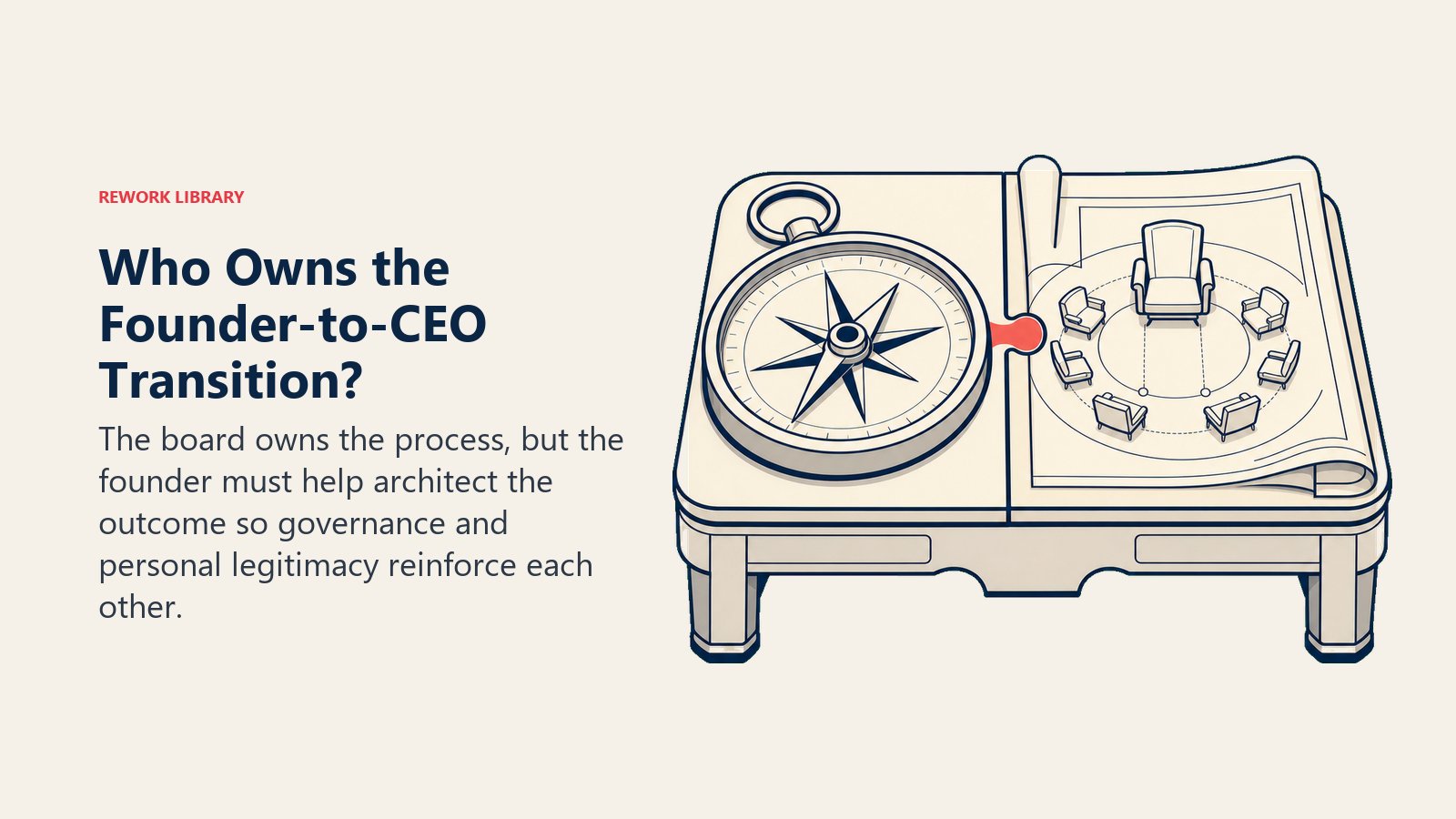
The best transitions involve a direct conversation, well before any urgency, about what the company's leadership needs look like at the next stage and where the founder wants to invest their energy. That conversation is easier when it is not triggered by a crisis or a board confrontation.
The board's role includes:
Defining what the next CEO actually needs to do. Not a generic CEO job description. A specific articulation of what the company needs in the next three to five years and which capabilities matter most.
Managing the search. Whether internal promotion or external hire, the search process sets the tone for what follows. A search that feels rushed or political creates a rocky start for whoever comes in.
Designing the founder's ongoing role. The transition is not just about who becomes CEO. It is about what the founder does next. A vague "executive chairman" or "founder emeritus" title without a clear scope is a recipe for ongoing authority confusion. The board and founder need to agree, in writing, on what decisions the founder remains involved in and which ones transfer fully to the new CEO.
What the Incoming CEO Needs to Know
Taking on a CEO role as the successor to a founder is different from taking on a CEO role in most other contexts.
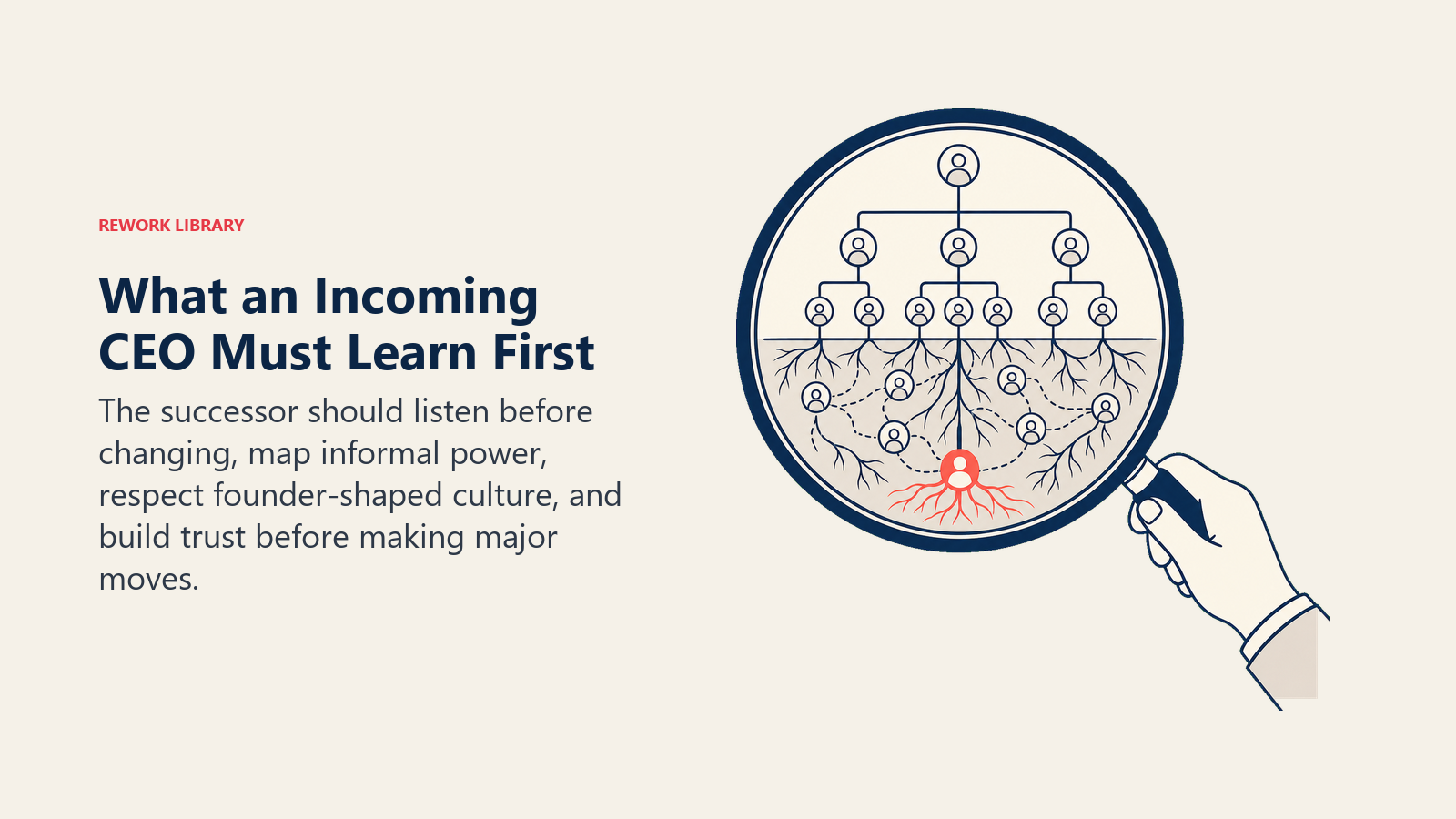
Listen before changing. The organization has a culture, a set of practices, and a set of assumptions that the founder shaped. Many of those are good. Many of the early employees carry institutional knowledge that is not documented anywhere. Spending the first ninety days learning before changing is not weakness; it is how the incoming CEO avoids breaking things that were working.
Understand the founder's relationships. Some of the company's most important relationships are likely held by the founder personally. Those need to be mapped and then gradually transferred. This takes time and intentionality, not just an introduction email.
Get clarity on authority from day one. The ambiguity about who has final authority is the incoming CEO's problem to solve, not the board's or the founder's. The new CEO needs to have an explicit conversation with the founder and the board about decision authority, and then consistently behave in ways that reinforce clarity. When the founder offers advice (as they will), the new CEO must be able to engage with it respectfully while making clear that they hold the decision.
Don't erase the origin story. Founders built something real. Incoming CEOs who signal contempt for the founder era, even implicitly, damage their own credibility with the people who built the company. Honoring what came before is not the same as being constrained by it.
What the Founder Needs to Do
The founder's behavior after the transition matters as much as the transition itself.
Transfer authority completely in the areas that transfer. Half-steps here are poison. If the new CEO has operational authority, the founder should not be accepting operational escalations from the organization. When employees go around the new CEO to the founder, and some will try, the founder needs to route them back.
Respect the new CEO's decisions, including ones you disagree with. The founder will disagree with some of the new CEO's decisions. That is expected. The question is how they handle that disagreement. Expressing disagreement privately to the CEO is appropriate. Expressing it publicly to the organization, or using board relationships to block decisions, is corrosive.
Define your own success metrics. What does the founder want to accomplish in their new role? Product work, key customer relationships, fundraising, public voice? Getting specific about this creates the conditions for the founder to feel valuable rather than sidelined.
Common Failure Modes
The founder who stays too close. The physical and organizational proximity of the founder to the CEO role makes it impossible for the new CEO to establish authority. This is the most common failure mode and the one most damaging to the company.
The board that rushes. A transition executed in haste, often because of some acute pressure, misses the design work that makes it stick.
The new CEO who changes too fast. Incoming CEOs who signal cultural contempt for the founder era or move too quickly to reshape the organization before understanding it often provoke exactly the loyalty backlash they are trying to avoid.
No successor for the founder's relationships. Key customer relationships, investor relationships, and partner relationships that were held by the founder personally need explicit succession plans. When those relationships degrade because the human they were built with has stepped back, it looks like a company in decline.
Key Facts
- The majority of high-growth company transitions from founder to professional CEO require twelve to eighteen months for full authority transfer, not the ninety days often cited.
- The most common point of failure in founder-to-CEO transitions is ambiguity about decision authority rather than capability gaps in either the outgoing or incoming leader.
- Boards that conduct structured conversations about succession before urgency arrives produce better outcomes than those that respond to a crisis.
Frequently Asked Questions about Founder-to-CEO Transition
Is replacing a founder as CEO a sign of failure?
No. It reflects the reality that different phases of a company's growth require different leadership capabilities. A founder who built a company from zero to fifty million in revenue may not be the right person to scale it from fifty to five hundred million, and that is not a judgment on their ability or contribution.
How long does a founder-to-CEO transition typically take?
A meaningful transition, where authority is clearly held by the new CEO and the organization has stabilized around the change, typically takes twelve to eighteen months. The formal handoff of the title is the beginning, not the end.
Can the founder become a great executive after stepping back from CEO?
Yes. Many founders have made significant contributions in product, technology, customer relationships, or public brand in roles other than CEO. The key is defining the role clearly and the founder being genuinely enthusiastic about it.
What should the board look for in an incoming CEO in this context?
Beyond the functional skills the role requires, boards should prioritize candidates who have experience following a strong leader, who have shown the ability to earn credibility rather than demand it, and who demonstrate genuine curiosity about the company's history and culture before proposing changes.
Related reading: Succession Planning | What Is Leadership? | Authentic Leadership | The Leadership Pipeline Model | Visionary Leadership
