Crisis Leadership: Accountability, Performance, and Playbook for Leaders

Turn this article into takeaways for your work.


Each assistant summarizes the article only for you and suggests best practices for your work.
A crisis reveals things about a leadership team that normal operations conceal. Under sustained pressure, the gaps in accountability become visible, the gaps in decision authority become costly, and the gap between a leader's stated values and their actual behavior becomes undeniable.
This article covers three dimensions of crisis leadership that executives need to have thought through before the crisis arrives: accountability, performance standards, and a repeatable response playbook.
What Makes Crisis Leadership Different
In normal operations, leaders have time. They can gather information, consult widely, test hypotheses, and revise decisions. A poor decision made in January can often be corrected by March.
A crisis compresses that timeline. Decisions that would normally take weeks need to be made in hours. Communication that would normally be carefully crafted needs to go out imperfect and early. Teams that would normally operate with significant autonomy need to align fast.
The leaders who do this well are not necessarily the most analytical. They are the most decisive. They make a call on incomplete information, communicate it clearly, watch for early feedback that the call was wrong, and correct quickly. The leaders who struggle in crises are often those who wait for more data, hedge their communication, and create the impression that nobody is in charge.
Accountability in a Crisis
The Instinct to Deflect
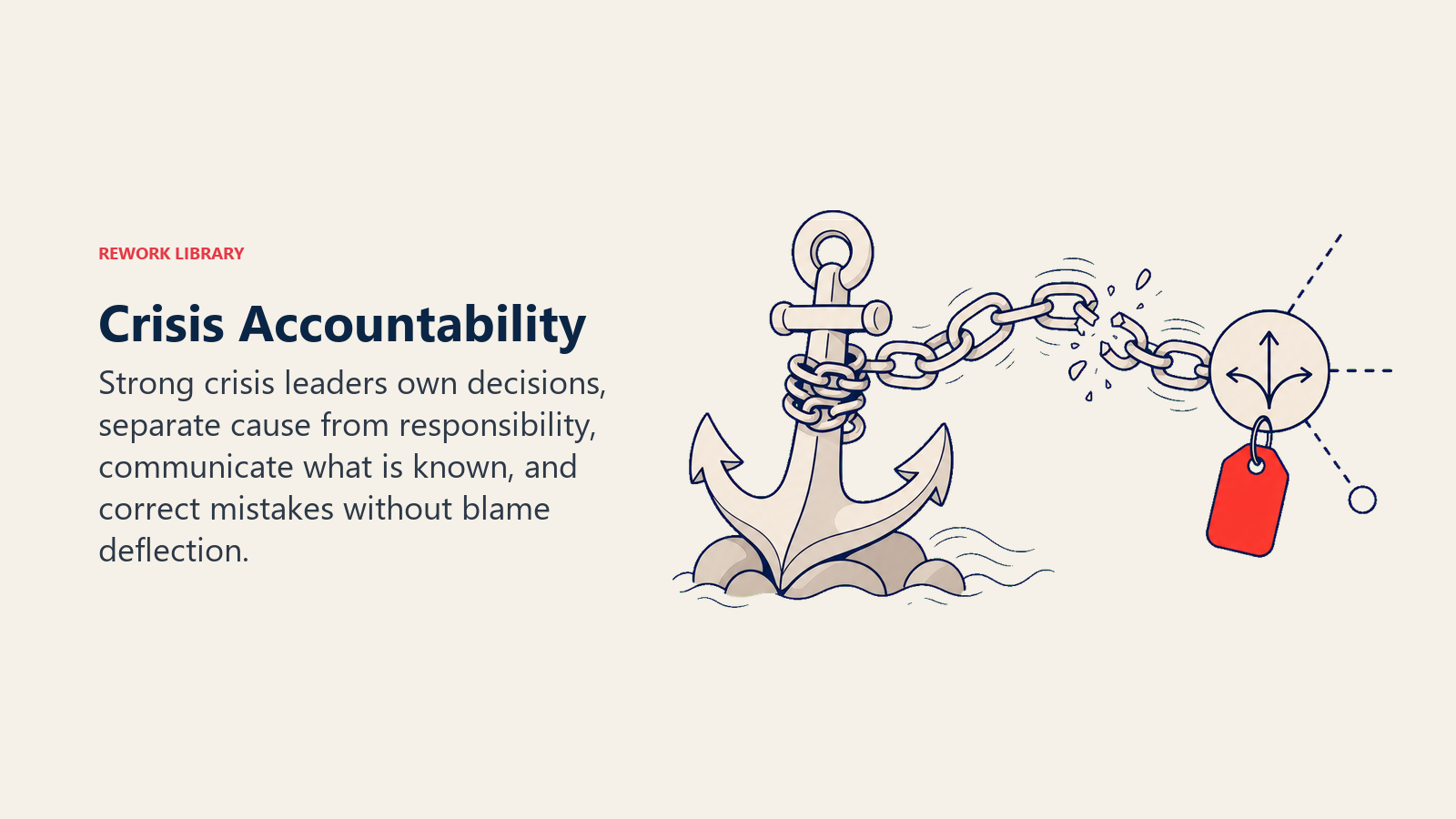
Crisis accountability is hard because crises invite blame deflection. The natural instinct is to point at external causes: the market turned, the supplier failed, the regulator changed the rules, a competitor moved first. All of those things may be true. They are also beside the point.
External causes explain why a crisis happened. They do not relieve leaders of accountability for how the organization responds.
Leaders who handle accountability well do two things most leaders avoid:
First, they acknowledge what the organization contributed to the crisis, even when external factors were the primary driver. An organization with stronger scenario planning might have seen it coming. An organization with deeper cash reserves might have more options now. Naming those gaps honestly, without excessive self-flagellation, builds credibility with boards, investors, and teams.
Second, they are specific about what they are accountable for in the response. Not "we will fix this" (vague), but "I am personally accountable for the three decisions this team will make in the next seventy-two hours, and here is what they are."
Cascading Accountability
A crisis quickly exposes whether accountability is actually distributed in the organization or whether it pools at the top. If every meaningful decision requires the CEO's sign-off, the organization can only move as fast as one person can process information and make calls.
Crisis-ready organizations have done the work, before the crisis, of defining who can make which decisions under what conditions. They have pre-authorized the VP of Operations to re-route supply chains up to a certain dollar threshold without CEO approval. They have pre-authorized the Head of Customer Success to commit to remedies for affected customers without running it through the legal team. They have given regional leaders clear authority over local operational decisions.
This is not about reducing executive oversight. It is about ensuring the executive layer is not the bottleneck for decisions that do not actually require that level of authority.
After-Action Accountability
One of the most valuable things a leadership team can do after a crisis is run a structured post-mortem with genuine accountability. Not "lessons learned" theater where everyone nods and nothing changes. A real analysis of what decisions were made, who made them, what information they had at the time, what the outcomes were, and what the organization will do differently.
The post-mortem must include decisions that turned out to be right as well as those that turned out to be wrong. Leaders learn as much from understanding why a good decision worked as from understanding why a bad one failed.
Performance Standards During a Crisis
The Temptation to Drop the Bar
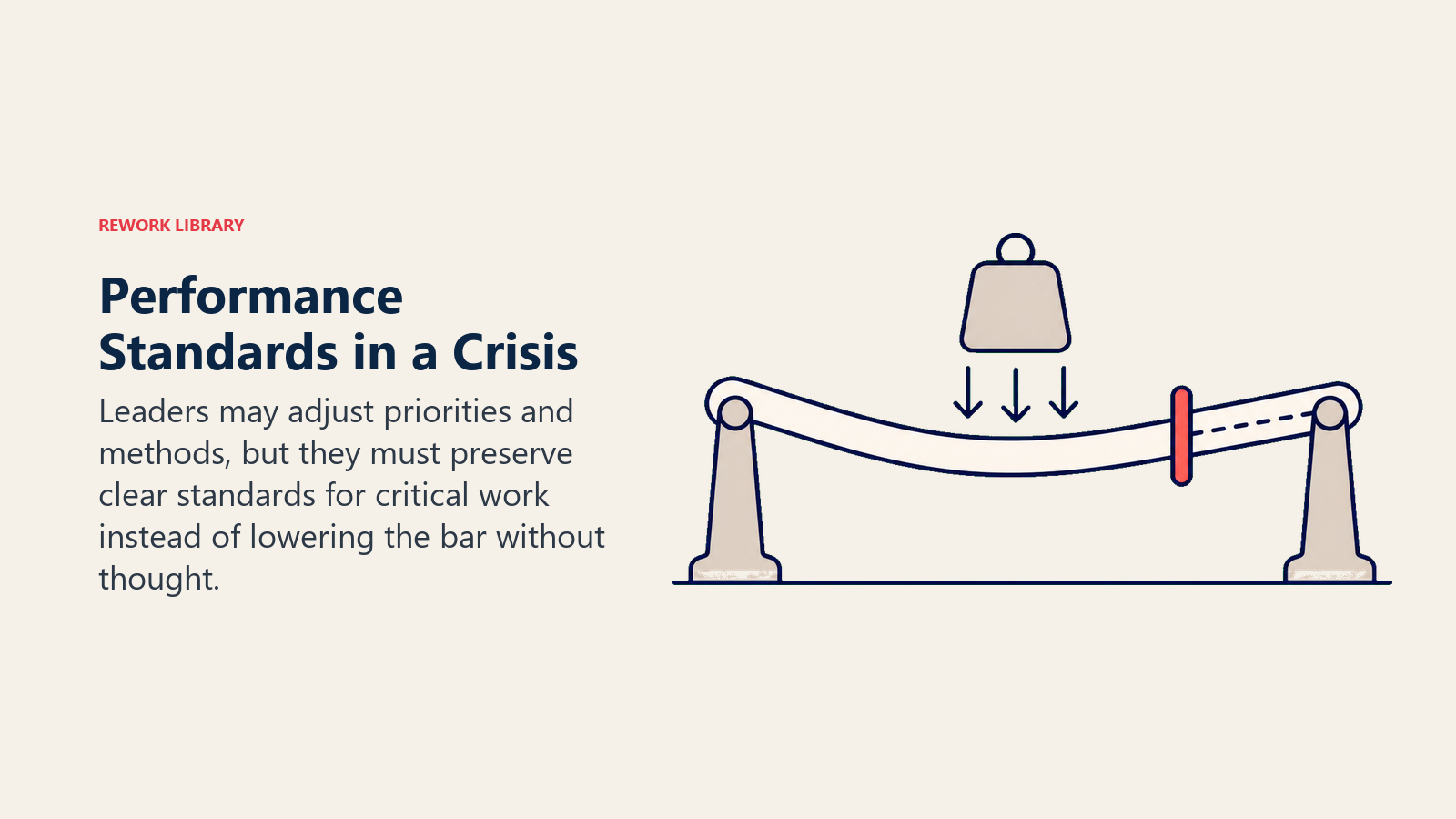
When an organization is under stress, there is a persistent temptation to reduce performance expectations. The reasoning: people are under pressure, morale is fragile, this is not the time to push.
This instinct is partially correct and mostly wrong.
It is correct that some performance expectations become irrelevant or counterproductive during a crisis. Quarterly revenue targets set before a sudden market contraction are a source of dysfunction, not motivation. Revenue quotas that require individual contributors to hit numbers the business itself cannot hit anymore destroy credibility and morale.
But the conclusion that crises require dropping performance standards across the board is wrong. The organizations that come out of crises strongest are typically those that maintained clear standards for what matters most during the crisis, while explicitly relaxing standards that had become beside the point.
What to Measure During a Crisis
During a crisis, the performance metrics that matter shift. The organization needs to know:
Are we making decisions fast enough? Decision velocity is a legitimate performance metric in a crisis. If reviews that normally take a week are taking a week during a crisis, something is wrong.
Are we communicating clearly? This includes both internal communication (does the team know what is happening, what the priorities are, what they should do?) and external communication (do customers, partners, and investors have the information they need?).
Are we conserving what matters most? Usually cash, customer relationships, and key talent. Crises require triage. Not everything can be preserved. What are we protecting first?
Are we learning in real time? The early phase of a crisis involves significant uncertainty. The organization should be running structured daily reviews to update its understanding and adjust its response.
Maintaining Candor
One of the most corrosive forces during a crisis is leadership communication that sugarcoats reality. Teams and boards are usually smarter than executives give them credit for. When communication is consistently rosier than what people are experiencing on the ground, trust erodes fast.
Candor during a crisis does not mean broadcasting every piece of bad news without context. It means being honest about what is known and what is not known, about what is going well and what is not, and about what the organization's realistic options are.
The leaders who build the most trust in crises are those who communicate regularly, acknowledge uncertainty without weaponizing it ("we don't know" paired with "and here is our current best thinking"), and update their story as the situation changes rather than defending an earlier framing that has become obviously wrong.
The Crisis Leadership Playbook
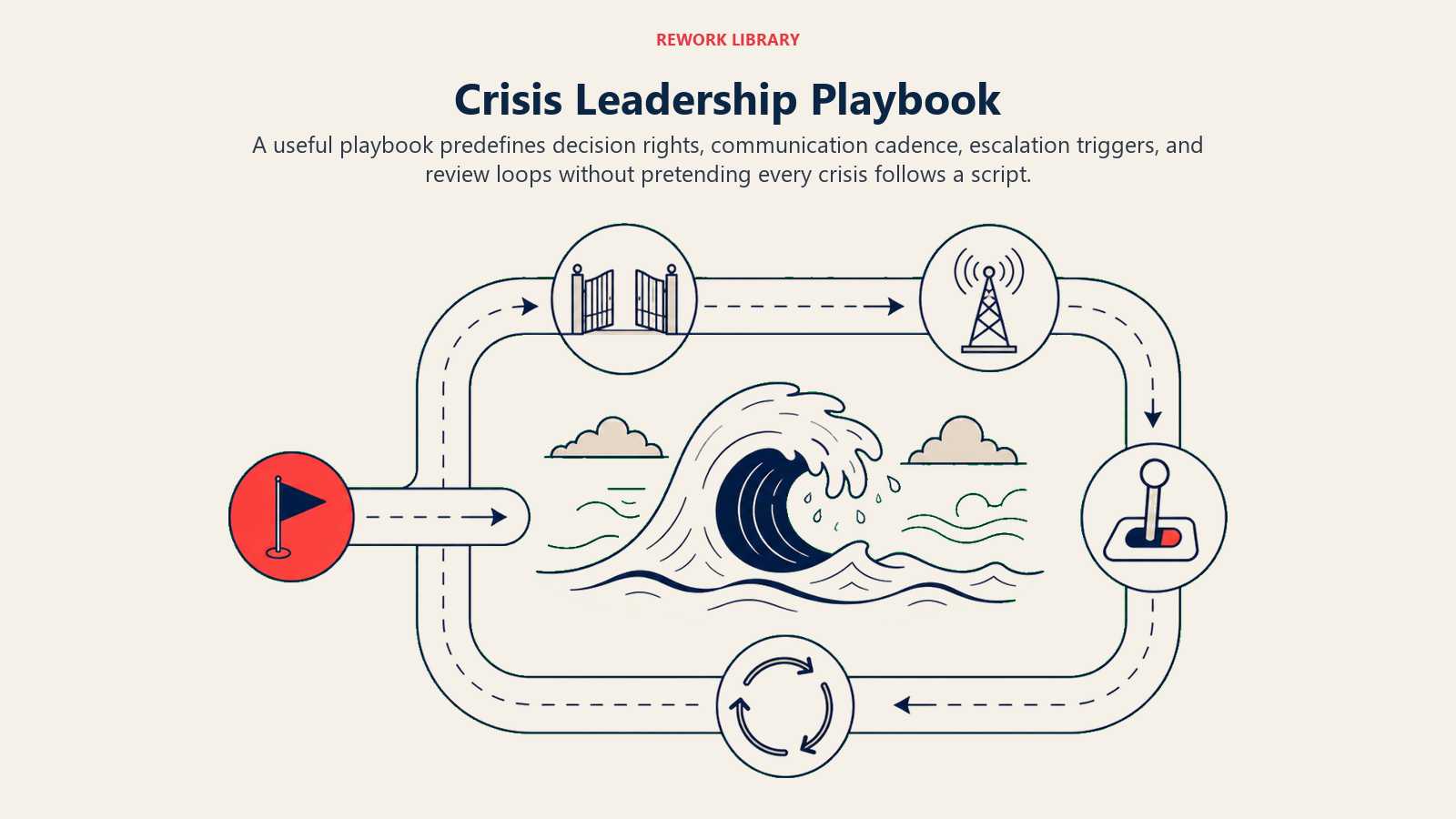
A playbook is not a rigid script. Crises are too unpredictable for that. A playbook is a set of structured decision templates and processes that a leadership team has agreed on in advance, so that in the heat of a crisis they are customizing an approach rather than inventing one.
Phase 1: Stabilize (Hours 0-72)
The first priority in any crisis is stopping the bleeding. Before trying to understand every dimension of the problem, before developing a full recovery strategy, before communicating externally: stabilize.
Stabilization means:
- Convene the core decision-making team. Not the full leadership team, the four to six people who need to make the initial calls.
- Establish a shared understanding of what is actually happening. Not what people fear is happening, not what the media is saying: what is factually confirmed.
- Make the immediate decisions that are clearly required. What must happen in the next twenty-four hours to prevent the situation from getting worse?
- Set up communication cadence. Internal daily updates. External communication as needed. One spokesperson for external.
Phase 2: Assess (Days 3-14)
Once the immediate situation is stable, the leadership team can begin a fuller assessment. This involves:
Damage mapping. What has actually been affected? Customers, revenue, operations, people, reputation? Quantify where possible, but do not let the need for precision delay the assessment.
Option generation. What are the realistic paths forward? Generate multiple options before evaluating any of them. The first option that comes to mind is rarely the best one.
Stakeholder prioritization. Who needs what from you and in what sequence? Employees, customers, investors, regulators, media all have different needs and different timeframes. Get clear on the sequence before communicating.
Resource check. What do you actually have available to respond with? Cash, team capacity, goodwill with key partners, regulatory latitude. Be honest about constraints.
Phase 3: Recover (Weeks 3 and Beyond)
Recovery is the phase most leaders underestimate. The instinct, once the acute crisis has passed, is to declare victory and return to normal operations. But recovery from a significant crisis is its own extended effort. When the damage runs deeper than a single event and the whole organization needs to be rebuilt, this shades into turnaround leadership, a sustained, structured recovery rather than a one-time response.
Recovery planning should include:
Rebuilding trust with affected stakeholders. Trust lost in a crisis is rebuilt through consistent behavior over time, not through a single communication. What is the thirty, sixty, ninety day plan for demonstrating to affected customers or employees that you have genuinely changed?
Structural changes. What did the crisis expose about the organization that needs to be fixed? Not fixed in response planning, but fixed in the underlying organization. Weak scenario planning? Poor communication channels? Unclear decision authority? These need to be addressed before the next crisis.
Team recognition and reset. The people who carried the organization through a crisis are usually exhausted and often underrecognized. This is the moment to make that visible.
Building Crisis Readiness Before the Crisis
The organizations that lead crises well rarely improvise their response. They have done the work in advance:
Scenario planning. What are the three to five scenarios that could significantly threaten the organization? What would we do in each? This does not require predicting the future. It requires identifying the response posture for broad categories of risk (demand collapse, supply disruption, reputational incident, regulatory action, leadership departure).
Decision authority documentation. Who can make what decisions under what conditions? This should be documented and tested, not just assumed.
Communication templates. Not canned press releases, but templates for the structure of crisis communications: what to say first, how to structure uncertainty, how to commit to follow-up without over-promising.
Relationship equity. The leaders and organizations with the most latitude during a crisis are those who built the most trust before it. The board that trusts management has more patience. The customers who have been well-served are more forgiving. The media that has had access in good times is more balanced in bad times. Crisis readiness is partly built in ordinary times.
Key Facts
- Organizations with documented crisis response plans and practiced decision frameworks respond faster and make fewer costly errors than those that improvise.
- Communication frequency during a crisis correlates positively with stakeholder trust, even when the news being communicated is bad.
- The most common executive failure in crises is delayed transparent communication, not the crisis event itself.
- Post-crisis post-mortems that assign accountability for specific decisions, rather than generic "lessons learned" sessions, produce measurably better organizational learning.
Frequently Asked Questions about Crisis Leadership
What is the most important skill in crisis leadership?
Decisiveness under uncertainty. The ability to make a clear call on incomplete information, communicate it without false confidence, and course-correct as new information arrives.
How should a leader communicate during a crisis?
Frequently, honestly, and with appropriate context. Acknowledge what is known and what is not. Avoid sugarcoating. Commit to regular updates and honor that commitment.
When should an organization invoke its crisis response plan?
Any situation that materially threatens business continuity, significant customer relationships, regulatory standing, or reputation warrants structured crisis response. The threshold should be defined in advance, not at the moment of stress.
How do you maintain morale during a crisis without being dishonest?
Focus candor on facts and options, not predictions. Acknowledge difficulty honestly. Recognize effort visibly. Give the team clear priorities so they know where to direct their energy.
What is the difference between crisis management and crisis leadership?
Crisis management is the operational response: logistics, communications, remediation. Crisis leadership is the human dimension: maintaining trust, making hard calls, holding the team together, and modeling the values the organization claims to have.
Related reading: What Is Leadership? | Adaptive Leadership | Ethical Leadership | Psychological Safety | Democratic Leadership

Co-Founder, Rework.com
On this page
- What Makes Crisis Leadership Different
- Accountability in a Crisis
- The Instinct to Deflect
- Cascading Accountability
- After-Action Accountability
- Performance Standards During a Crisis
- The Temptation to Drop the Bar
- What to Measure During a Crisis
- Maintaining Candor
- The Crisis Leadership Playbook
- Phase 1: Stabilize (Hours 0-72)
- Phase 2: Assess (Days 3-14)
- Phase 3: Recover (Weeks 3 and Beyond)
- Building Crisis Readiness Before the Crisis
- Key Facts