AI Governance for Executives: Accountability, Risk, and Oversight
Turn this article into takeaways for your work.


Each assistant summarizes the article only for you and suggests best practices for your work.
AI governance is not a technology problem. It is a leadership problem.
When an AI system makes a bad hiring recommendation, generates a biased credit score, or outputs confidential data, the question that follows is always the same: who was responsible? Without a deliberate governance structure, the honest answer is "nobody clearly." That answer is unacceptable to regulators, to customers, and to boards.
This guide is for C-level leaders and directors who need to build governance that works in practice, not just on paper.
Why Executives Own AI Governance
The instinct is to delegate AI governance to the CTO or a data science team. But governance is fundamentally about authority, accountability, and values. Those sit at the executive level.
AI systems touch hiring, credit, pricing, medical triage, content moderation, and dozens of other decisions that carry legal and reputational weight. When things go wrong at that level, the board and regulators do not ask the engineering team. They ask the CEO.
Executives own AI governance for three concrete reasons:
Resource allocation. Meaningful oversight requires dedicated headcount, audit tools, and process design. None of that happens without executive sponsorship and budget.
Cross-functional authority. AI governance cuts across legal, HR, finance, product, and engineering. Only an executive has the positional authority to enforce consistent standards across those silos.
Stakeholder accountability. Customers, regulators, and investors need a human face behind AI accountability. That face has to be someone with genuine authority to change behavior.
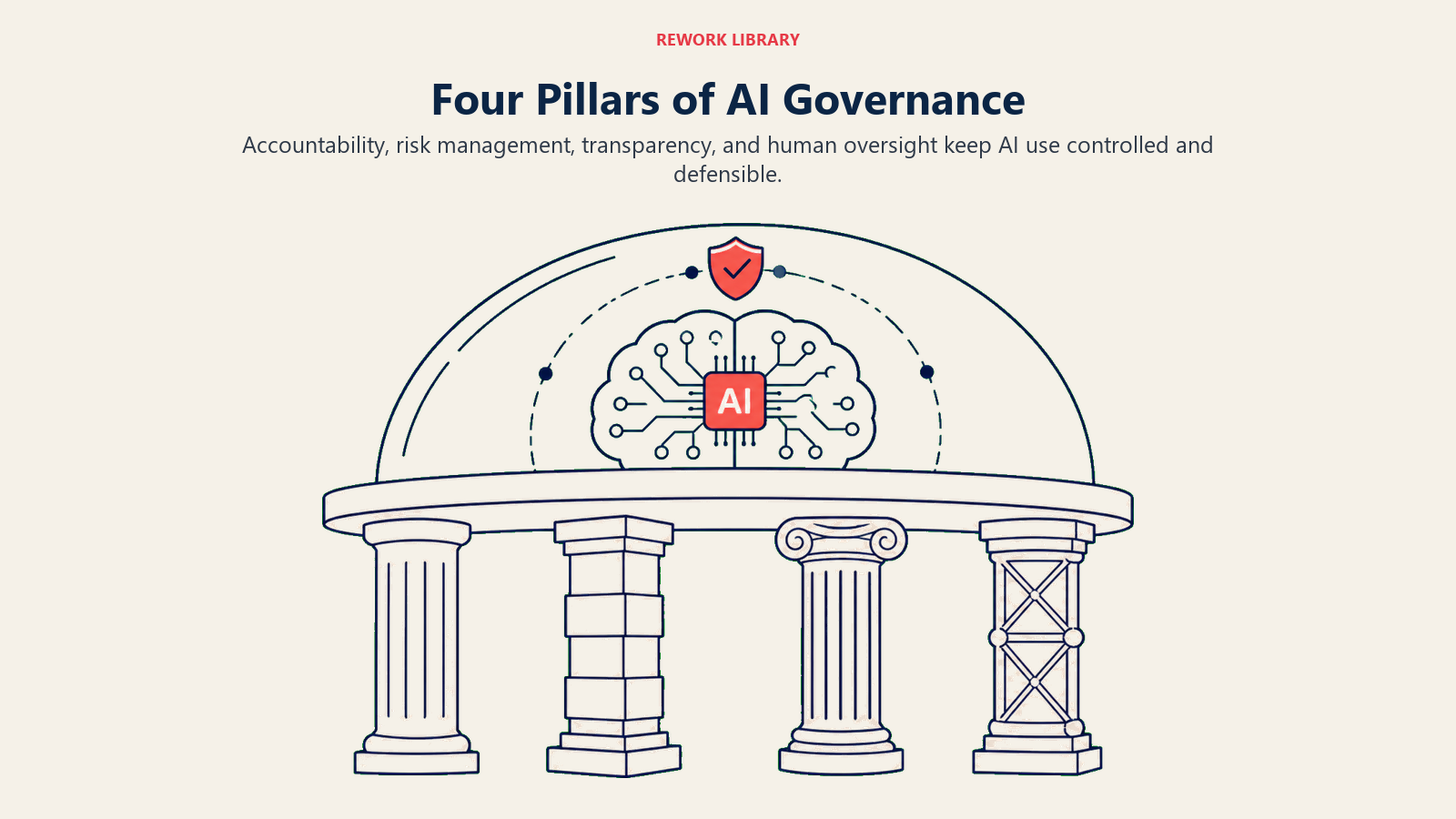
The Four Pillars of an AI Governance Framework
A workable AI governance framework rests on four pillars. Each addresses a distinct failure mode.
1. Accountability and Ownership
Every AI system in production needs a named human owner. This is not a team or a department. It is a specific person who can be held responsible for what the system does.
The owner is accountable for:
- Defining what the system is allowed and not allowed to do
- Reviewing outputs when things go wrong
- Deciding when to pause or shut down the system
- Communicating with affected stakeholders
Without a named owner, accountability diffuses into collective shrug. Organizations that do this well maintain an AI inventory that lists every system in use, its owner, its intended purpose, and its last review date.
2. Risk Classification
Not all AI uses carry the same risk. A system that recommends playlist tracks and a system that flags loan applications for rejection are not the same governance challenge.
A practical classification has three tiers:
High risk: AI that directly affects people's rights, access to services, financial outcomes, or employment. These require the most rigorous pre-deployment review, ongoing monitoring, and human review of individual decisions.
Medium risk: AI that automates internal processes, generates content for human review, or assists decision-making with a human final call. These require periodic audit and clear documentation.
Low risk: AI that handles routine automation with no material impact on individuals. These require basic logging and an owner, but can operate with lighter oversight.
The classification should be done before deployment, not after an incident.
3. Transparency and Explainability
Leadership must be able to answer three questions about any AI system it operates:
- What is it doing?
- Why did it produce this output?
- How would we know if it started producing wrong outputs?
If those questions cannot be answered, the organization is flying blind. Explainability does not always require full model interpretability (that is often technically impossible). But it does require that someone in the organization can describe the system's logic, its training data sources, and its known failure modes in plain language.
Transparency also extends outward. Customers who interact with AI-driven decisions increasingly expect to know when AI is involved and to have a path for human appeal.
4. Monitoring and Correction
AI systems drift. The data they were trained on becomes stale. Edge cases accumulate. Behavior that looked acceptable at launch can degrade over months.
An AI governance framework must include:
Performance monitoring: are outcomes tracking against intended goals? Are error rates within acceptable bounds?
Bias monitoring: are outcomes consistent across demographic groups, or is the system producing disparate results that would not survive legal or reputational scrutiny?
Incident protocols: when something goes wrong, who is notified, in what timeframe, and what is the escalation path? Is there a kill switch?
Scheduled review cycles: every high-risk system should have a calendar review, not just event-driven review. Governance by incident is governance that always arrives too late.
Building the Governance Structure
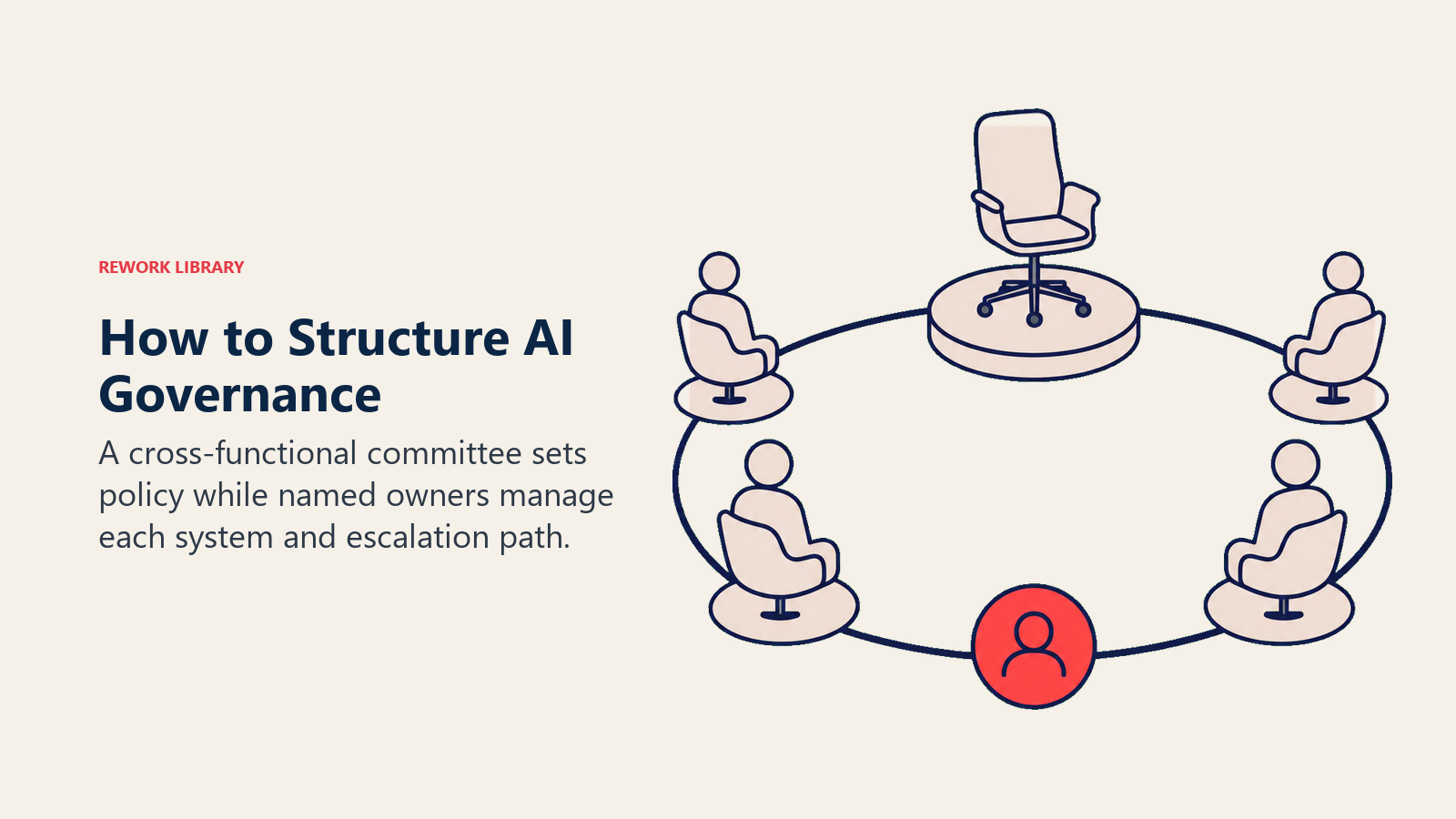
A cross-functional committee sets policy while named owners manage each system and escalation path.
The AI Governance Committee
Most organizations with meaningful AI exposure benefit from a cross-functional governance committee that meets quarterly. The committee typically includes representatives from legal, HR, finance, product, security, and an executive chair.
Its mandate is not to approve every AI project. That would create a bottleneck that kills innovation. Its mandate is to set the rules, handle escalations, and review high-risk deployments.
A lightweight version: a monthly thirty-minute review of the AI inventory, with a standing agenda of flagged incidents, upcoming high-risk launches, and any regulatory developments.
Policies That Actually Get Used
Many organizations write AI governance policies that live in a shared drive and shape nobody's behavior. The difference between policy that works and policy that doesn't is specificity and enforcement.
Effective AI governance policies answer these questions in plain language:
- What can our teams use AI for without additional approval?
- What requires a review before use?
- What is prohibited entirely?
- What happens when someone violates the policy?
Prohibited use cases are often the hardest to define, but they are the most important. Common categories include AI that produces discriminatory outputs, AI that makes final decisions about individuals without human review, and AI trained on data obtained without proper consent.
Training the Organization
Governance fails when only the governance team understands it. Leaders at every level need a working understanding of their AI systems' risks and their own accountability.
This does not mean making every manager a machine learning expert. It means ensuring that people who deploy AI understand what they are accountable for, how to escalate concerns, and what the review process looks like.
The Regulatory Context
AI regulation is moving from voluntary to mandatory in most major markets. The EU AI Act classifies AI systems by risk and imposes specific obligations on high-risk deployments, including documentation, testing, and human oversight requirements.
In the US, sector-specific regulation (financial services, healthcare, employment) already applies to AI-driven decisions in those domains. Broader federal frameworks are developing.
The practical implication for executives: governance structures built now will either ease regulatory compliance or create liability when regulators arrive. The organizations that are ahead on governance treat it as a competitive advantage, not a compliance cost.
Common Failure Modes
Governance theater. Committees exist, policies are written, and nothing actually changes how AI is built or deployed. The signal: policies are reviewed annually but nobody in the organization can name one thing they changed their behavior about.
Speed-safety tradeoff framed as binary. Teams that feel governance will block them find workarounds. The organizations that get this right build lightweight fast-path reviews for lower-risk uses, reserving intensive scrutiny for what actually warrants it.
No human override path. Every AI system that affects individuals needs a credible path for human review. Systems with no override path are both ethically problematic and legally exposed.
Snapshot thinking. Governance applied only at launch misses the drift problem. Systems need ongoing monitoring, not just pre-launch approval.
Key Facts
- The EU AI Act, the world's first comprehensive AI regulation, classifies high-risk AI systems across 8 domains including employment, credit, and public services, requiring mandatory human oversight.
- AI system performance can degrade silently over time as real-world data diverges from training data, a phenomenon called model drift.
- Cross-functional AI governance committees reduce time-to-remediation of AI incidents compared to siloed technical review.
Frequently Asked Questions about AI Governance for Executives
What is AI governance?
AI governance is the set of policies, processes, and accountability structures that determine how an organization develops, deploys, and monitors AI systems. It defines who is responsible, what oversight is required, and what constraints apply to AI use.
How is AI governance different from AI ethics?
AI ethics refers to the principles and values that should guide AI development (fairness, transparency, accountability). AI governance is the operational structure that puts those principles into practice through concrete policies, roles, and enforcement mechanisms.
Who should chair an AI governance committee?
The chair should have cross-functional authority to enforce decisions across engineering, legal, HR, and business teams. In most organizations, this is a C-level leader, typically the CEO, COO, or in larger organizations a dedicated Chief AI or Chief Risk Officer.
How often should AI systems be reviewed?
High-risk systems warrant quarterly review at minimum, plus event-driven review after any significant incident or material change in deployment context. Lower-risk systems may be reviewed annually.
What should an AI incident response protocol include?
An AI incident protocol should define: what constitutes an incident requiring escalation, who is notified and in what timeframe, who has authority to pause or shut down the system, how affected parties are communicated with, and how the organization documents and learns from the incident.
Related reading: What Is Leadership? | Ethical Leadership | Psychological Safety | Adaptive Leadership

Co-Founder, Rework.com
On this page
- Why Executives Own AI Governance
- The Four Pillars of an AI Governance Framework
- 1. Accountability and Ownership
- 2. Risk Classification
- 3. Transparency and Explainability
- 4. Monitoring and Correction
- Building the Governance Structure
- The AI Governance Committee
- Policies That Actually Get Used
- Training the Organization
- The Regulatory Context
- Common Failure Modes
- Key Facts