Platform Strategy Guide: How Leaders Build Businesses That Scale with Network Effects

Turn this article into takeaways for your work.


Each assistant summarizes the article only for you and suggests best practices for your work.
A platform business is one where the core value comes from facilitating interactions between two or more user groups, and where the value of the platform increases as more participants join it. That self-reinforcing dynamic is what distinguishes platform businesses from conventional product or service businesses.
Not every business should be a platform. But for the ones where the model fits, the compounding economics are among the strongest in modern business. Understanding when and how to build a platform, how to govern it as it scales, and how to lead an organization through the distinctive challenges of platform strategy is increasingly a core executive competency.
Platform vs. Product: What the Difference Actually Means
In a conventional product or services business, the company creates value and sells it to customers. More customers means more revenue, but also more cost. Value is produced internally.
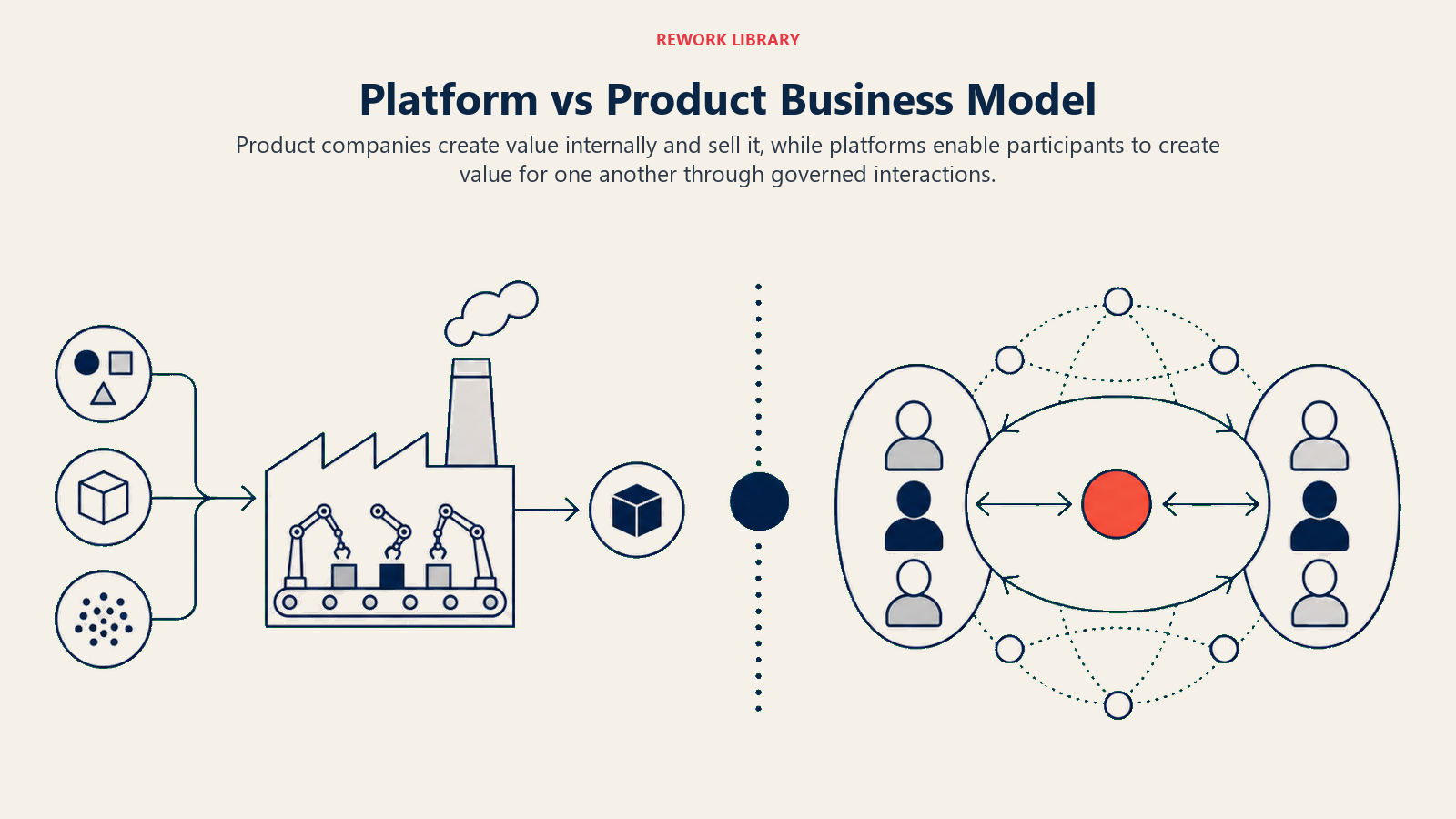
In a platform business, the company creates the infrastructure and rules for interactions, and value is produced by the participants themselves. A marketplace platform does not produce the goods being sold; it creates the conditions for sellers and buyers to find and transact with each other. A software platform does not write the apps that run on it; it creates the environment where developers can build them.
This distinction has profound implications for leadership and strategy:
Value creation is external. You are not managing a production process; you are managing a community. The quality of the platform is partly about the infrastructure you build, but critically also about who participates and how they interact.
The competitive moat is network effects. A platform that has achieved critical mass with its participants is harder to displace than a product that can be copied. But the inverse is also true: before critical mass, a platform with weak engagement is easier to displace because switching costs are low and the network is thin.
The organizational capabilities required are different. Running a platform requires trust and safety teams, developer relations, community governance, and data platforms that most product companies do not have. Building those capabilities ahead of need is part of the platform strategy.
When Platform Strategy Makes Sense
Platform strategy is not universally applicable. Leaders should pursue it when several conditions are present.
There is a natural multi-sided market. The business serves two or more distinct user groups whose interests are complementary: buyers and sellers, developers and users, content creators and content consumers, service providers and clients. The platform creates value primarily by reducing friction between these groups.
Network effects are real. The value of the platform genuinely increases as more participants join. This is not always true. Some businesses that look like platforms do not actually benefit from more participants; more participants just means more costs. The network effect has to be real and meaningful.
Trust and transaction costs are the core problem. Platforms flourish where participants need a trusted intermediary to reduce the friction and risk of interacting with strangers. Remove the platform, and the transactions either do not happen or happen much less efficiently.
The company can sustain the chicken-and-egg bootstrapping phase. Every platform faces the problem of needing participants from multiple sides simultaneously. This phase is expensive and uncertain. Companies that pursue platform strategy need to have a realistic plan for how they get the first side of the market to a useful level of participation, and the capital to survive long enough to achieve it.
The Leadership Challenges of Building a Platform
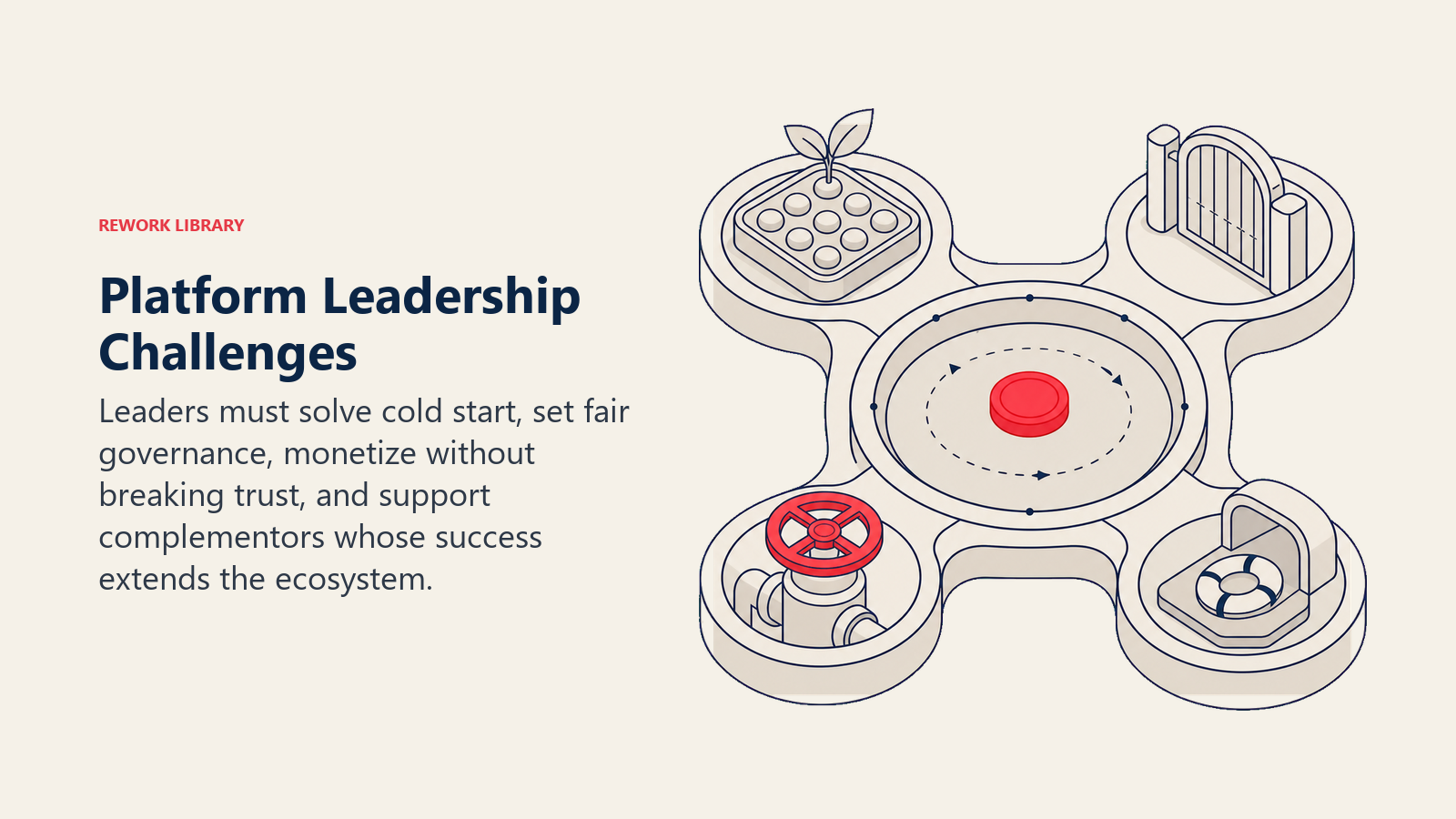
Leaders must solve cold start, set fair governance, monetize without breaking trust, and support complementors whose success extends the ecosystem.
Solving the Cold Start Problem
A new platform with no participants has no value. But you need value to attract participants, and you need participants to have value. This circular dependency is the cold start problem, and it is the first leadership challenge every platform builder faces.
Common approaches:
Seed one side of the market. Before launching the full platform, build inventory or supply on one side directly. An accommodation platform might work with a curated set of hosts before opening the platform broadly. This creates a baseline of value that attracts early participants from the other side.
Start with a narrow vertical. Rather than launching a broad platform immediately, focus on a specific niche where you can achieve critical mass quickly. The density of participants within a narrow market is more valuable than thin coverage of a broad one.
Use existing networks. Early platform growth often comes from tapping into existing communities or networks rather than building new ones from scratch. The initial participant base is recruited from somewhere, not created from nothing.
Subsidize the scarce side. In most multi-sided markets, one side is more valuable or harder to attract than the other. The leadership decision is identifying which side that is and creating appropriate incentives, financial or otherwise, to attract them.
Governance and Rules
Platforms are not self-managing. They require active governance: rules about who can participate, what behaviors are permitted, how disputes are resolved, how quality is maintained.
The governance decisions a platform leader makes shape the platform's character and trajectory more than most product decisions. A marketplace with weak seller quality controls develops a reputation that is hard to shake. A developer platform with unclear IP rules loses developers to competitors who offer clarity.
Platform governance requires addressing:
Participation criteria. Who can join, on what terms, with what verification? The calibration matters enormously. Too loose and quality degrades. Too strict and growth stalls.
Behavioral rules. What are participants permitted and not permitted to do? How are the rules enforced? Who reviews edge cases?
Quality mechanisms. How does the platform maintain and signal quality to participants who cannot evaluate it directly? Rating systems, verification programs, featured provider programs, and removal policies are all governance tools.
Dispute resolution. When participants disagree, how is it resolved? Platforms that handle disputes fairly build trust. Platforms that handle them inconsistently or opaquely lose it.
Monetization Without Undermining the Marketplace
The platform business model requires extracting revenue from facilitating interactions. The leadership challenge is calibrating monetization in a way that does not damage the interactions you are trying to facilitate.
The tension: every fee, every insertion of an ad, every premium placement creates friction or distortion. Charge too much or distort too aggressively and you accelerate the incentive for participants to work around the platform rather than through it. Charge too little and you fail to build a sustainable business.
Platform monetization that tends to work well:
Charge for value-add, not basic access. Charging participants for the basic right to transact on the platform creates resentment. Charging for services that genuinely improve their outcomes, better reach, analytics, insurance, faster payments, tends to produce better economics and less platform resentment.
Match monetization with market structure. In markets where sellers have more market power, charging buyers is common. In markets where buyers have market power, charging sellers is common. The side that benefits most from the platform's matchmaking pays most for it.
Beware the take rate escalation cycle. Platforms that increase their take rate to drive short-term revenue growth often trigger a cycle where participants explore alternatives, reducing engagement, which reduces the platform's value, which requires either further monetization or investment to recover. The discipline of keeping take rates sustainable relative to the value delivered is a long-term competitive decision, not just a quarterly one.
Managing Complementors and Ecosystem Players
Platforms that succeed attract an ecosystem of complementary players: developers, service providers, media creators, third-party apps. Managing those relationships requires a distinct set of leadership skills.
Ecosystem players are simultaneously your greatest asset (they extend the platform's value enormously) and a source of tension (they have interests that do not always align with yours).
The leadership challenges:
Stability and predictability of the rules. Ecosystem players invest based on the rules you set. Changes to those rules, especially changes that disadvantage them in favor of the platform's own competing products, are among the most damaging things a platform can do to an ecosystem relationship. The discipline of maintaining predictable, fair rules for ecosystem players even when you could extract more value by changing them is a strategic choice with long-run implications.
Avoiding the platform-ecosystem conflict. When a platform builds its own products that compete with successful ecosystem applications, it faces fundamental trust questions. Partners who built their businesses on the platform's rules and then see the platform expand into their space have legitimate grievances. Managing this tension, either by creating clear rules about where the platform will and will not compete, or by being transparent about the decision, is a leadership responsibility.
Investing in developer and partner success. Platforms whose partner programs actively help their ecosystem players succeed, with tools, education, promotional support, and revenue-sharing arrangements, build more durable ecosystems than those who simply provide infrastructure and leave partners to fend for themselves.
Platform Strategy at Scale
Platforms that achieve scale face a different set of leadership challenges than those in the growth phase.
Regulatory exposure increases. Platforms with significant market share attract regulatory scrutiny. This is not hypothetical in most major markets; it is a planning assumption. Platform leaders at scale need to take regulatory relations, policy engagement, and compliance infrastructure as seriously as product and growth.
Trust and safety becomes a core function. The behaviors that occur on a large platform at scale, including fraud, abuse, misinformation, and harmful content, become the platform's responsibility in the court of public opinion even when they are not in strict legal terms. Building credible trust and safety capability, staffed and empowered to make hard decisions, is a leadership imperative at scale.
The core network effect can invert. Platforms that become too dominant can start to experience disengagement as users perceive the quality declining, often because monetization has been pushed too far, governance has degraded, or the platform has expanded into activities that feel extractive rather than valuable. Recognizing this inflection before it becomes a serious decline requires ongoing, honest measurement of participant health.
Key Facts
- Platforms that achieve critical mass in their core market segment before expanding tend to outperform those that attempt to cover multiple segments simultaneously.
- Network effects are the most powerful competitive moat in platform businesses, but they are also reversible when participant trust erodes.
- Governance quality, specifically consistent and fair rule enforcement, is among the highest predictors of long-term platform health as measured by participant retention.
Frequently Asked Questions about Platform Strategy Guide
How is platform strategy different from marketplace strategy?
A marketplace is one type of platform, focused on facilitating buying and selling. Platform strategy is the broader concept of building a two-sided or multi-sided business where value is created through participant interactions. Marketplaces are platforms; not all platforms are marketplaces (developer platforms, communication platforms, and operating system platforms are distinct types).
When should a company not pursue platform strategy?
When there is no genuine multi-sided market structure, when network effects are weak or non-existent, when the company lacks the capital to sustain the bootstrapping phase, or when trust and governance requirements exceed the company's operational capacity.
How do you measure the health of a platform?
Key indicators include: participant retention and engagement trends on both sides of the market, take rate relative to value delivered, participant net promoter scores or equivalent satisfaction metrics, time-to-liquidity for transactions (how quickly do buyers and sellers find each other?), and ecosystem participation trends if applicable.
What is the biggest mistake platform leaders make?
Monetizing aggressively before achieving durable network effects. The window between early growth and full critical mass is when participants are most likely to explore alternatives. Monetizing heavily in that window converts participants from invested community members into rational economic actors evaluating better alternatives.
Related reading: What Is Leadership? | Stakeholder Management | Ethical Leadership | Adaptive Leadership | Visionary Leadership

Co-Founder, Rework.com
On this page
- Platform vs. Product: What the Difference Actually Means
- When Platform Strategy Makes Sense
- The Leadership Challenges of Building a Platform
- Solving the Cold Start Problem
- Governance and Rules
- Monetization Without Undermining the Marketplace
- Managing Complementors and Ecosystem Players
- Platform Strategy at Scale
- Key Facts