What Is Leadership Style? A Guide to the Major Styles and How to Choose Yours
Turn this article into takeaways for your work.


Each assistant summarizes the article only for you and suggests best practices for your work.
Leadership style is the characteristic pattern of behaviors a leader uses to influence and direct others. It shows up in how you communicate, how you make decisions, how you give feedback, how you respond under pressure, and what signals you send about what you value.
Every leader has a dominant style. Most leaders have a narrower range than they think they do. The research on leadership effectiveness consistently points in the same direction: the best leaders are not those who have mastered one style, but those who can read a situation accurately and shift their approach to match it.
This article gives you the map. The rest of the library goes deep on each individual style.
Why Leadership Style Matters
Your style is not just a personality preference. It shapes outcomes in measurable ways.
A study of leadership styles and business outcomes found that leaders who used a range of styles, particularly combining authoritative, coaching, and affiliative approaches, produced meaningfully better results across business units than leaders who relied on one or two styles. The climate within a team, how safe it feels to take risks, how clear expectations are, how motivated people feel, is substantially driven by the leader's style choices.
Style also affects retention. Leaders who provide coaching and development (one specific style) retain talent at higher rates than those who focus primarily on task direction and performance demands.
And style affects execution speed. In crisis or time-pressure situations, a more directive style typically produces faster results. In situations requiring genuine creative problem-solving or organizational change, a more participative or coaching approach tends to produce better outcomes. Using the wrong style for the situation costs you time and quality.
The Six Classic Leadership Styles
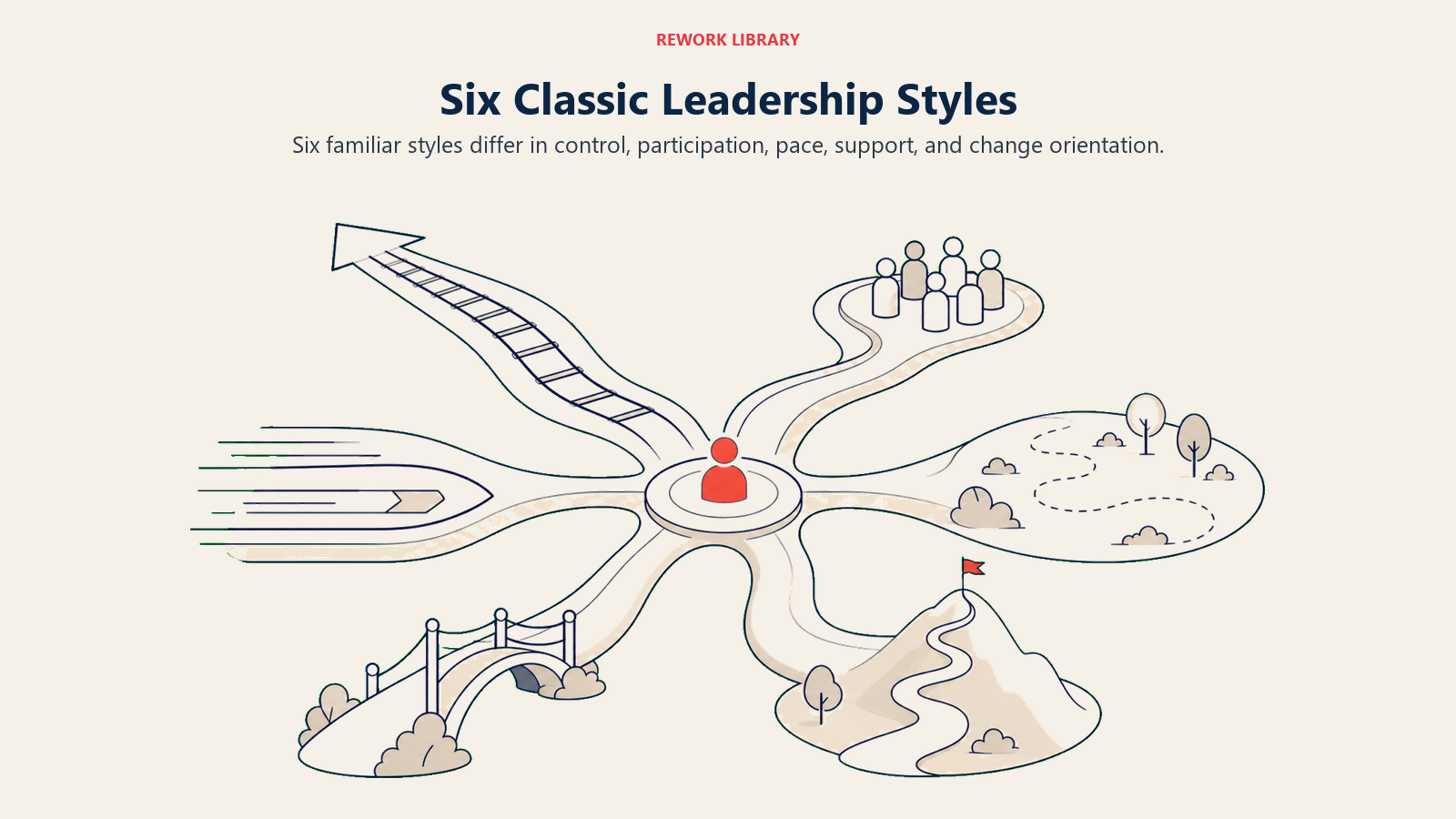
Research frameworks on leadership style have evolved over decades. One of the most durable, grounded in work on emotional intelligence and organizational climate, identifies six styles that appear with regularity across different organizations and contexts.
1. Authoritative (Visionary)
The authoritative leader sets a clear direction and gives people the freedom to figure out how to get there. They lead by conviction and clarity rather than by detailed instruction.
This style is most effective when an organization needs a clear direction, especially when people have been operating without a shared goal or when the situation has become confusing or ambiguous. It is less effective with experts who have more knowledge than the leader, or in genuine collaborative problem-solving situations where the answer is not yet known.
Authoritative leaders anchor their influence on "here is where we are going, and here is why." They say "come with me" rather than "do this."
2. Coaching
The coaching leader focuses on developing individuals: identifying strengths and development gaps, connecting daily work to longer-term career goals, and building capability through feedback and challenge.
This style produces strong results over the medium and long term. It builds loyalty, develops internal talent, and creates high engagement. It requires time investment per individual, which is why it is less effective in pure execution-speed situations.
Coaching leaders ask more than they tell. Their characteristic mode is the question: "What would you do differently next time?" "What skill would help you most here?" "What would the ideal outcome look like?"
For a detailed exploration of this style, see Coaching Leadership Style.
3. Affiliative
The affiliative leader prioritizes people and relationships. Their focus is on building team harmony, emotional bonds, and a sense of belonging. They lead with empathy and tend to communicate warmly and personally.
This style is most valuable for healing team rifts, building trust with a new team, or supporting individuals through stress. On its own, without complementary direction-setting, it can result in groups that feel good but lack the clarity and accountability needed for performance.
Affiliative leaders are identifiable by the fact that they remember details about the people they work with, and they use those details. They ask about the things that matter to their team members outside of work.
4. Democratic (Participative)
The democratic leader builds consensus by involving the team in decisions. They gather input, hear dissenting views, and shape decisions that reflect the collective perspective.
This style creates strong buy-in because people support decisions they were part of shaping. It is most effective when decisions benefit from diverse input, when the team is capable and invested, and when the leader has enough time to let the process run.
It is counterproductive in crises or time-pressured situations, and it can become dysfunctional when the leader uses the appearance of participation to delay making necessary decisions.
For a full treatment, see Democratic Leadership.
5. Pacesetting
The pacesetting leader sets a high performance bar and expects the team to meet it, often modeling exceptional performance themselves. They have little tolerance for underperformance and expect results without much process support.
This style can drive excellent short-term results with a highly competent, self-motivated team. It is damaging when applied to teams that need development, teams that are already under high stress, or individuals who are not yet capable of working at the expected level without support.
The danger of pacesetting, and why it tends to have the most negative effect on organizational climate of any of the six styles, is that it tends to crowd out coaching and development. People who are constantly measured against an implicit standard they cannot quite reach, without support for how to improve, typically leave.
See Pacesetting Leadership for more.
6. Coercive (Commanding)
The coercive or commanding leader demands immediate compliance. They make decisions unilaterally and expect them to be followed without discussion. Authority and obedience are the operative mechanisms.
This is the most misused style in leadership, partly because it tends to be the default under stress. Leaders who feel under pressure often narrow to command mode because it feels decisive and clear.
It is genuinely useful in a small set of situations: genuine emergency where clarity and speed matter more than anything else, managing an underperformer through a structured performance process, or in early crisis response where ambiguity is the primary risk. Its effect on organizational climate is strongly negative when used outside those contexts.
Two Additional Frameworks Worth Knowing
The six styles above describe how a leader operates. Two additional frameworks describe the underlying orientations those styles express.
Task orientation vs. relationship orientation is among the oldest and most durable dimensions of leadership research. Task-oriented leaders focus primarily on getting work done: clarifying roles, setting objectives, measuring results. Relationship-oriented leaders focus on building trust, managing team dynamics, and attending to the human dimensions of work.
Most leadership situations require both. But understanding your own default orientation is useful because leaders who are highly task-oriented without relational attention tend to execute well in the short term and erode the team in the medium term. Leaders who are highly relationship-oriented without task clarity tend to produce high satisfaction and mediocre results.
Transactional vs. transformational is another important distinction. Transactional leadership is about clear exchange: I set expectations, you meet them, you receive reward or consequence. It is effective for routine work with clear metrics. Transformational leadership is about inspiration and change: the leader articulates a vision compelling enough that people are internally motivated to work toward it. It is more effective for significant organizational change, for innovation, and for work where engagement and initiative matter more than compliance.
See Transformational vs Transactional Leadership for a detailed comparison.
Reading the Situation: Choosing Your Style
The single most important practical skill in leadership style is situational reading. The question is not "what is my best leadership style?" The question is "what does this situation require?"
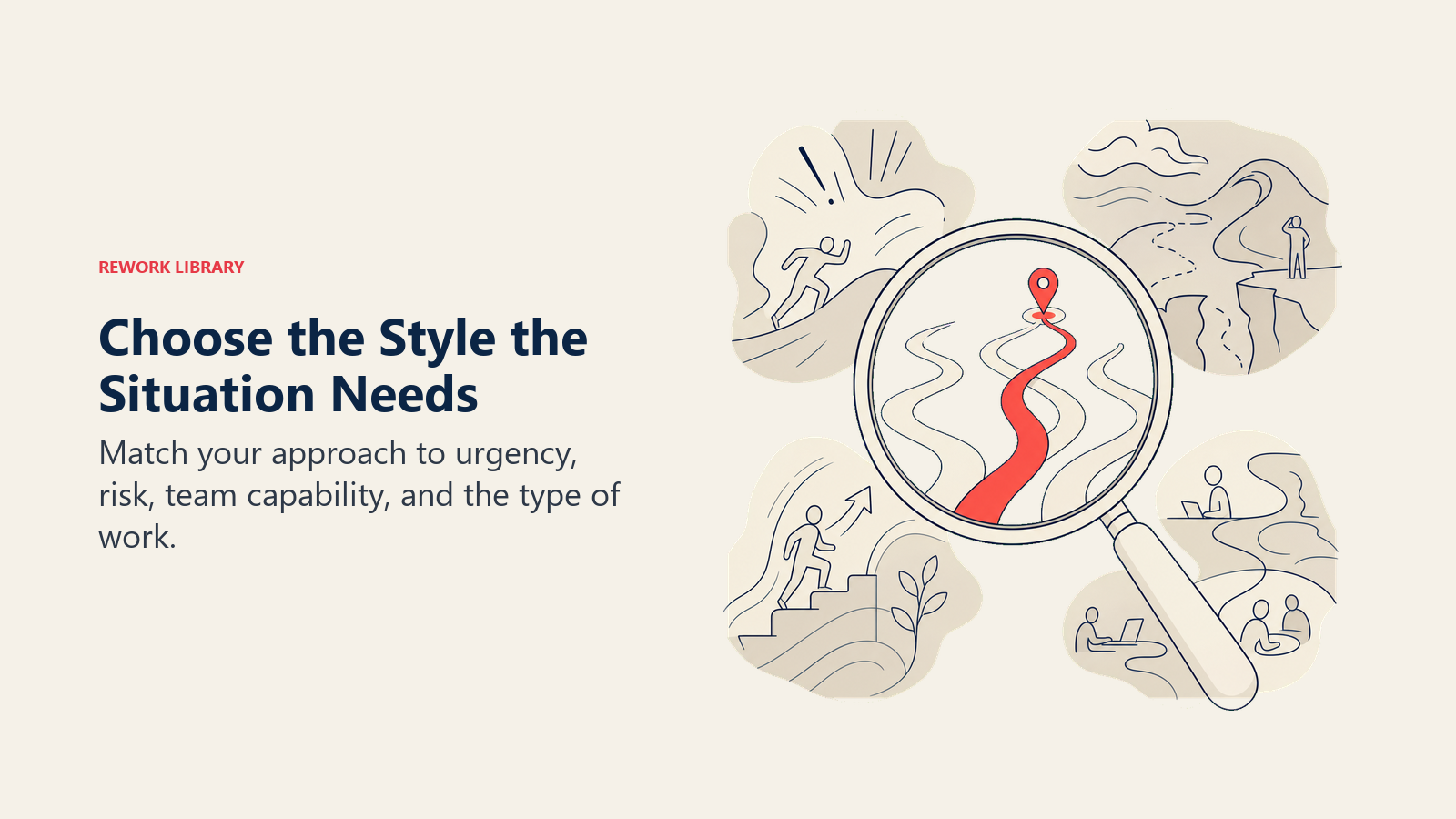
Four factors determine what style a situation calls for:
The team's capability and confidence. A team that is new to the task needs more direction. A team with deep expertise and high confidence needs less direction and more autonomy. Misreading this and applying a directive style to an expert team, or an autonomous style to a team that lacks the capability to execute without guidance, produces poor results.
The urgency of the decision. Fast decisions under real urgency call for more directive approaches. Decisions where the quality of thinking matters more than the speed call for more participative approaches.
The importance of buy-in. Some decisions fail in execution not because they are wrong but because the people responsible for implementing them do not understand or own them. When genuine buy-in is critical to success, participative approaches that build understanding and commitment are worth the time.
The developmental needs of the individuals involved. If you are working with someone who needs to grow a specific capability, a coaching approach invested in that growth is appropriate even when a directive approach might be faster in the short term.
The leader who reads these four factors accurately and shifts their style accordingly is the one who is consistently effective across different situations and different teams.
Developing Range
Most leaders have a dominant style that they are comfortable with and two or three others they can access. Developing genuine range, the ability to use all six styles with competence, requires intentional practice.
Self-awareness is the foundation. Knowing your default style and when it stops serving the situation is the prerequisite for changing it. This usually requires feedback from others, because leaders tend to be the last to see their own patterns clearly.
Practice in low-stakes situations builds the muscle. If coaching conversations feel awkward and you tend to retreat to direction-giving, practice them when the stakes are low. If you tend to be affiliative and avoid direct performance conversations, build that skill when the consequences of a difficult conversation are modest.
The goal is not to abandon your natural style. It is to expand the range so that your natural style is a choice rather than a constraint.
Quick Reference: The Five Deep-Dive Articles
The leadership library covers five specific styles in depth. Here is where each fits in the framework above:
- Classic styles overview (authoritative, democratic, laissez-faire, coercive): Classic Leadership Styles
- Emotional styles (affiliative, coaching, authoritative, commanding, pacesetting, democratic): Emotional Leadership Styles
- Coaching style in depth: Coaching Leadership Style
- Lewin's three-style model (autocratic, democratic, laissez-faire): Lewin's Leadership Styles
- Situational leadership (matching style to follower development level): Situational Leadership Styles
Key Facts
- The six-style model of leadership emerged from research linking leadership behaviors to team climate and business outcomes across multiple industries.
- Leaders who use four or more styles, particularly combining authoritative, coaching, affiliative, and democratic, consistently produce better organizational climate results than those relying on one or two.
- The coercive style, despite its intuitive appeal as a fast decision-maker, has the strongest negative correlation with organizational climate of all six styles when applied outside genuine crisis contexts.
- Leadership style is learnable. Longitudinal studies of leadership development programs show measurable style range expansion with deliberate practice and structured feedback.
Frequently Asked Questions about What Is Leadership Style? A Guide to the Major Styles and How to Choose Yours
Is there a best leadership style?
No single style is universally best. Effectiveness depends on matching the style to the situation: the team's capability, the urgency of the task, the importance of buy-in, and the developmental needs of the individuals involved.
Can you change your leadership style?
Yes. Style is partly a function of personality, but it is substantially a function of habit and skill. With self-awareness and deliberate practice, leaders can expand their range meaningfully.
What is the most common leadership style in business?
Pacesetting and coercive styles are overrepresented relative to their effectiveness, partly because they feel decisive and partly because they are the default under stress. Coaching and affiliative styles are underrepresented despite producing strong medium-term outcomes.
How do I know what my natural leadership style is?
A combination of self-reflection, 360 feedback from peers and direct reports, and working with a coach or mentor on specific situations provides the most reliable picture. Single-instrument assessments (like personality tests) give one dimension; observational feedback gives another.
Related reading: Classic Leadership Styles | Emotional Leadership Styles | Coaching Leadership Style | Lewin's Leadership Styles | Situational Leadership Styles | What Is Leadership?

Co-Founder, Rework.com
On this page
- Why Leadership Style Matters
- The Six Classic Leadership Styles
- 1. Authoritative (Visionary)
- 2. Coaching
- 3. Affiliative
- 4. Democratic (Participative)
- 5. Pacesetting
- 6. Coercive (Commanding)
- Two Additional Frameworks Worth Knowing
- Reading the Situation: Choosing Your Style
- Developing Range
- Quick Reference: The Five Deep-Dive Articles
- Key Facts