Turnaround Leadership: How Executives Lead a Failing Organization Back

Turn this article into takeaways for your work.


Each assistant summarizes the article only for you and suggests best practices for your work.
Most organizational failures do not announce themselves. They accumulate. A quarter of missed targets gets explained away. Then another. The sales pipeline looks weaker but the team believes it will recover. Costs that were supposed to be temporary become structural. By the time the board or CEO names the problem a "turnaround," the organization has often been in decline for eighteen months or more.
Turnaround leadership is different from crisis leadership in an important way. Crisis leadership is about holding the organization together under an acute, time-limited shock. A turnaround is about diagnosing why a business has been structurally failing, stopping the bleeding, and then rebuilding the foundations for a different trajectory. The timeline is longer, the causes are deeper, and the required changes are more fundamental.
This article walks through the four phases of a turnaround and the specific leadership decisions that determine whether a recovery effort succeeds.
Phase 1: Diagnosis
The first job of a turnaround leader is to understand what is actually wrong. This sounds obvious, but most organizations in decline have an official story about why performance has suffered, and that story is usually incomplete.
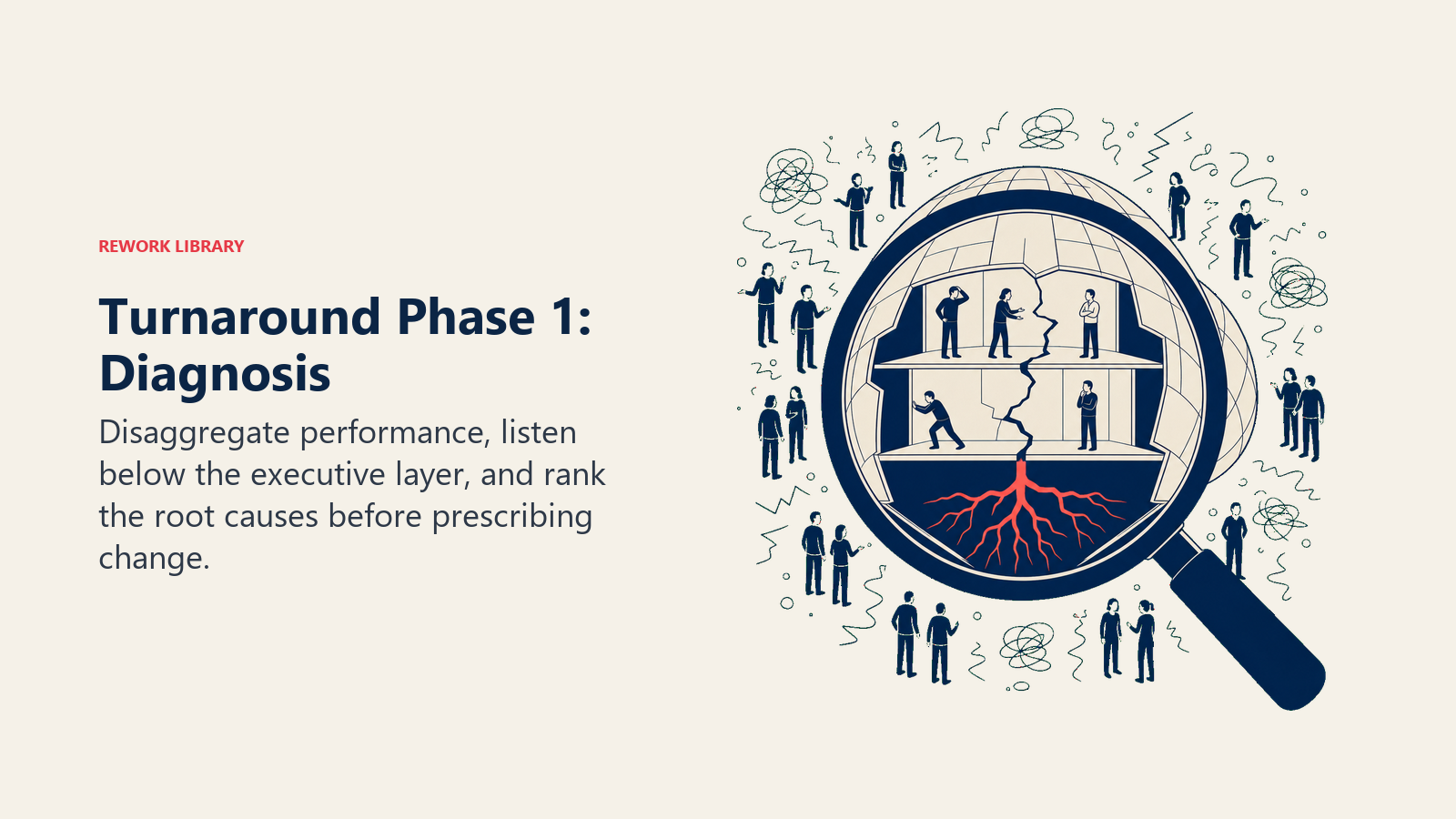
Common official explanations include: macroeconomic conditions, a difficult competitive environment, poor execution by a previous team, bad luck on a few large deals. These explanations are often partly true. But they rarely capture the full picture, and they are usually selected because they protect internal reputations rather than because they are analytically rigorous.
A turnaround leader needs to go deeper.
Separate symptoms from causes. Revenue decline is a symptom. The cause might be pricing problems, product-market fit erosion, sales execution failure, customer retention collapse, or some combination. Each has a different fix. Diagnosing at the symptom level produces interventions that address the surface without solving the underlying problem.
Disaggregate the data. Look at performance by customer segment, product line, geography, and sales cohort. Aggregate numbers hide important patterns. A business losing money overall may have one profitable segment that is cross-subsidizing several unprofitable ones. Understanding where value is being created and where it is being destroyed is foundational to any restructuring decision.
Talk to people who will tell you the truth. Internal interviews rarely surface the real problems quickly because people protect their colleagues and themselves. Front-line employees, recently departed team members, customers who churned, and salespeople who lost deals tend to know things that do not appear in management decks. Build time into the first 60 days for structured listening at levels that are normally below the executive team's visibility.
Be explicit about what you don't know yet. One of the mistakes turnaround leaders make is moving to solutions before the diagnosis is complete. Acting on incomplete diagnosis is efficient in the short term and expensive in the medium term, because it produces changes that address the wrong problems.
The output of the diagnostic phase is a clear, written statement of the two or three root causes of underperformance, ranked by their impact on the business. Everything that follows should connect back to this diagnosis.
Phase 2: Stabilization
Before you can rebuild, you have to stop the deterioration. Stabilization is about buying the time and resources needed to execute a real recovery. It is not the recovery itself.
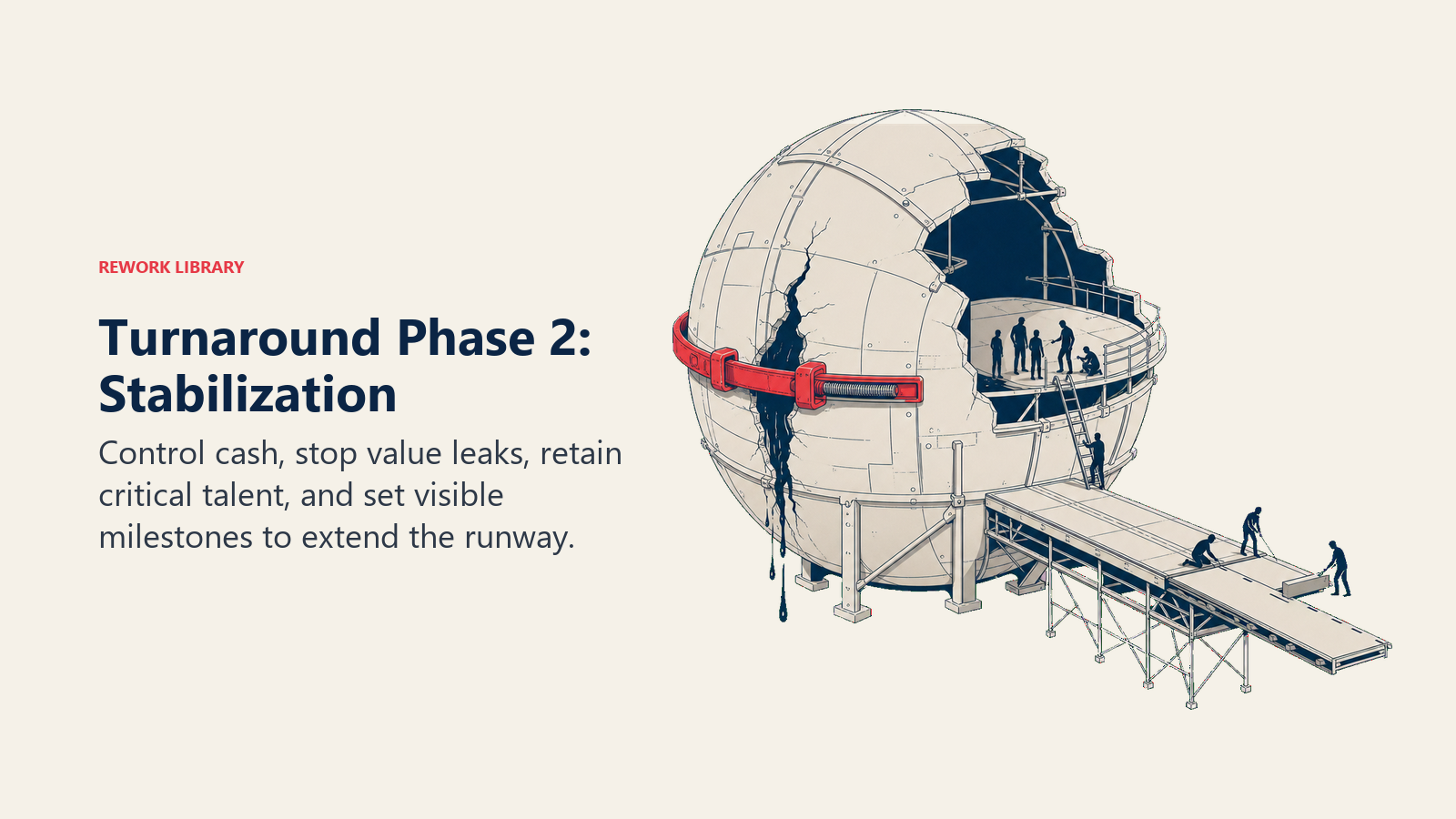
Manage cash aggressively. Most turnaround situations involve cash pressure. The organization has been underperforming and spending to compensate, creating a pattern where losses compound over time. A turnaround leader who does not get control of cash early may run out of runway before the recovery has time to take hold. This means understanding the current cash position, modeling how long it lasts under different scenarios, and making decisions that extend the timeline.
Stop the value leaks. In most troubled organizations, there are specific activities, products, customers, or teams that consume resources without producing proportional return. These are not always obvious from above. They often look like "investments" or "strategic bets" in internal language. Part of stabilization is identifying and stopping these leaks, which requires the courage to cancel things people have been defending.
Communicate honestly about the situation. One of the most damaging patterns in declining organizations is the gap between what leadership says publicly and what the organization actually believes. People are perceptive. They see the trends in their own work. When leadership speaks in optimistic abstractions while the team sees concrete problems, it destroys credibility. Turnaround leaders who speak plainly about the severity of the situation, while projecting genuine confidence in the recovery path, earn more trust than leaders who manage perceptions.
Stabilize key talent. In a visible turnaround, the best people often leave first. They have options, and they are worried about being on a sinking ship. If the turnaround leader loses a critical wave of talent early, the recovery becomes significantly harder. Identifying the people whose departure would be most damaging and acting quickly to retain them is a stabilization priority, not something to defer to the rebuilding phase.
Set short-term milestones. The recovery path in a turnaround is long. Organizations need visible markers of progress to maintain morale and sustain effort. Short-term milestones, defined explicitly and tracked publicly, create momentum. They also create accountability, because the organization can see whether the plan is tracking.
Phase 3: Restructuring
Restructuring is the most visible part of a turnaround and often the most emotionally difficult. It is where the organization stops doing things it has been doing, exits positions it has held, and reconfigures itself around what can actually work.
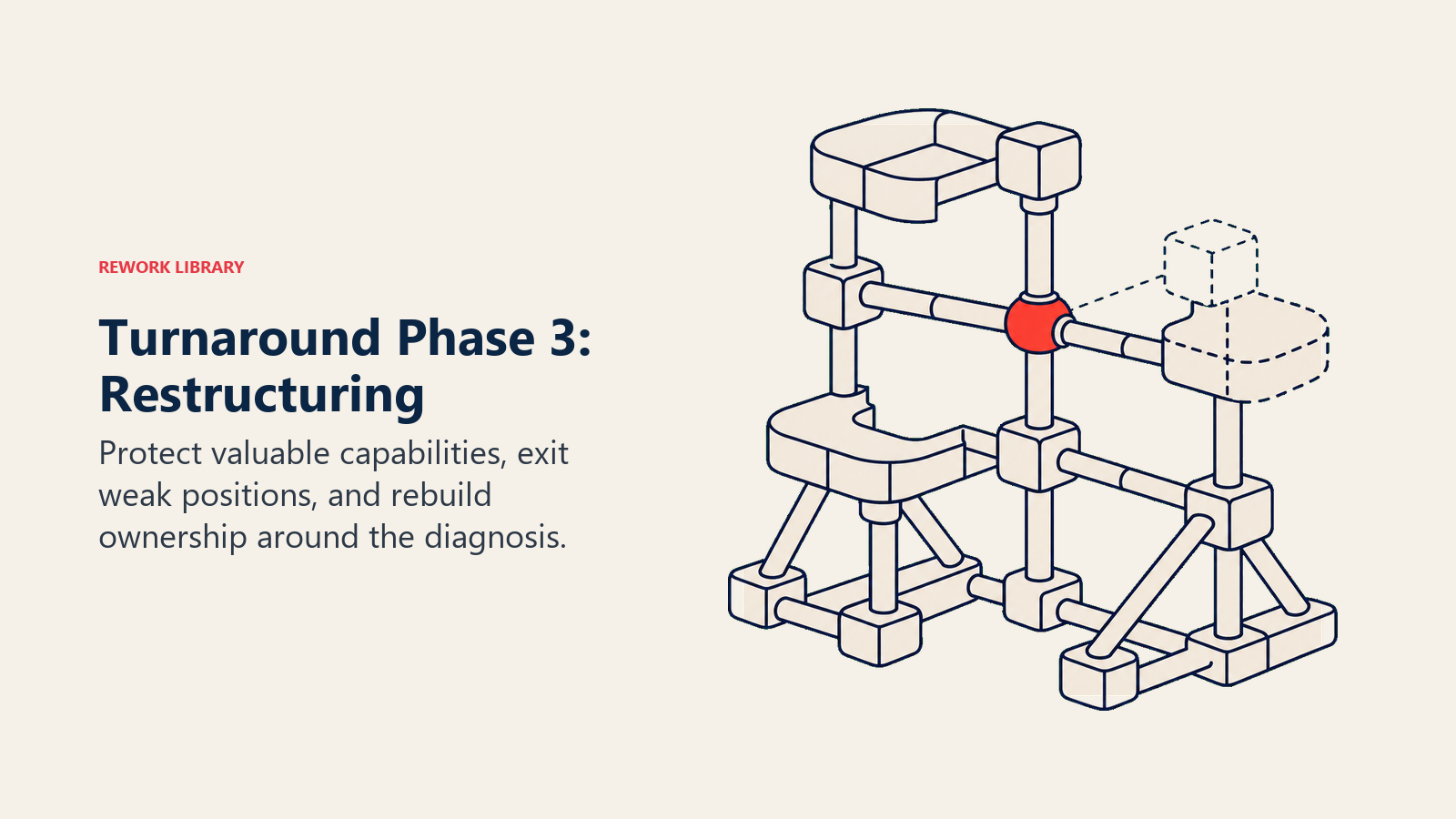
Restructure around the diagnosis, not around convention. The natural tendency in restructuring is to cut by percentage across functions, because it feels fair and avoids hard choices. This approach rarely produces a meaningful change in trajectory. It reduces costs without changing the underlying cost structure, and it forces every function to absorb cuts regardless of whether they are delivering value. Restructuring that actually works is selective: it concentrates resources in the areas where the business can win, and exits cleanly from areas where it cannot.
Make personnel decisions clearly and quickly. One of the biggest mistakes in turnarounds is prolonged personnel uncertainty. When the organization knows changes are coming but does not know who will be affected, productivity collapses. People spend their time managing their own positioning rather than doing the work. The turnaround leader who delays difficult people decisions because they are emotionally hard pays for it in organizational paralysis. It is worth acting faster and with more clarity than feels comfortable.
Redesign reporting and accountability structures. Many organizations in decline have developed accountability structures that obscure performance rather than expose it. Roles are vague, ownership is unclear, and poor results can always be attributed to factors outside any individual's control. Part of restructuring is making accountability specific and visible. Clear ownership, clear metrics, and clear consequences for sustained underperformance are not punitive; they are the conditions under which people can actually do good work.
Protect the elements that have value. Not everything in a struggling organization is broken. Some products, teams, or customer relationships are genuinely strong. A restructuring that damages these in the name of across-the-board change is counterproductive. Part of the turnaround leader's job is distinguishing what to exit from what to protect, and communicating clearly about why.
Restructuring is not the end of the turnaround. It is the clearing of the ground for the rebuilding that follows. Organizations that mistake restructuring for recovery often find that they have reduced costs without restoring growth.
Phase 4: Rebuilding
The rebuilding phase is where the organization constructs a viable path forward. It requires different leadership behaviors than the stabilization and restructuring phases, because it is about building something rather than stopping something.
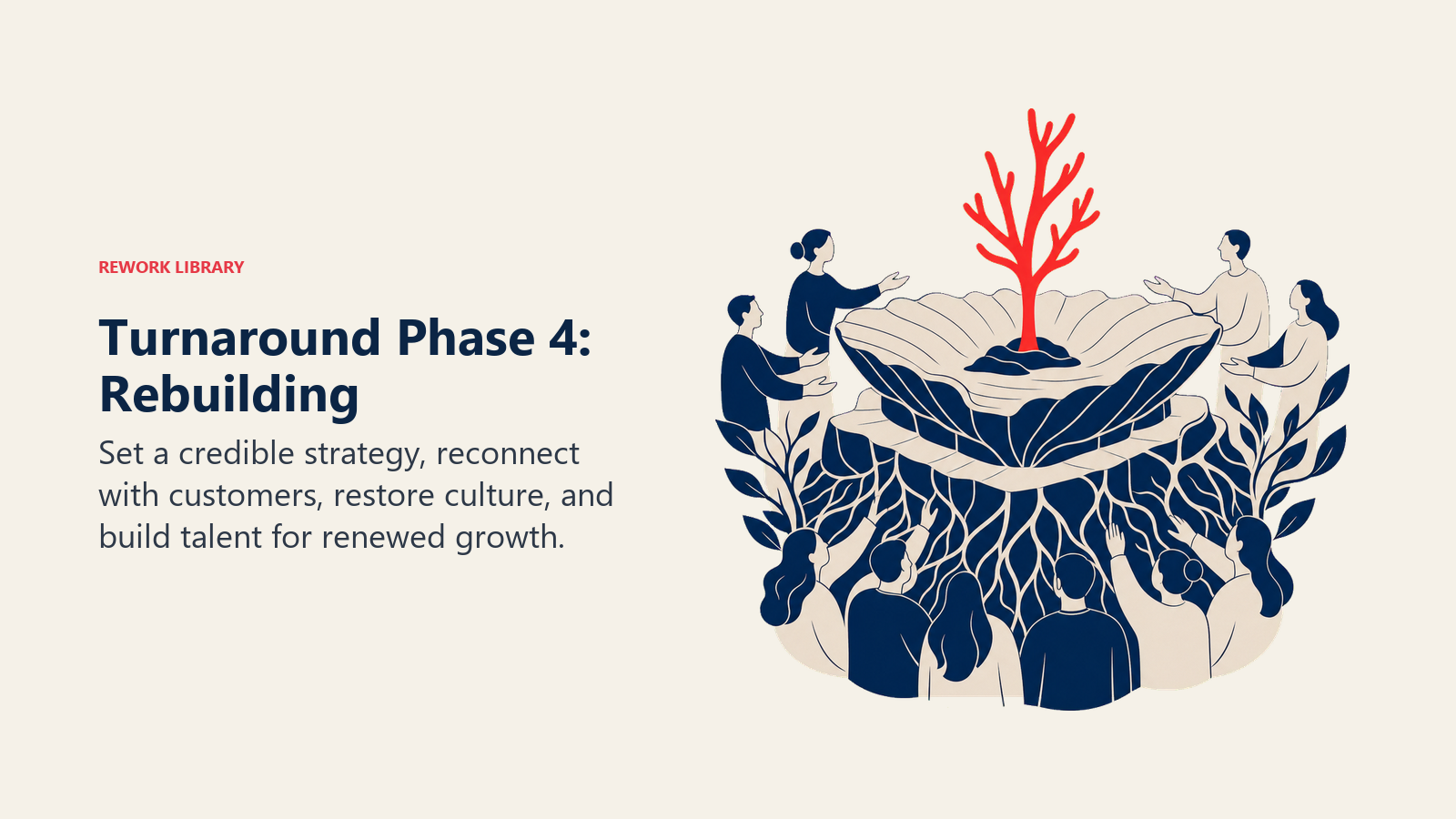
Reestablish a credible strategic direction. After months of cutting and restructuring, the organization needs to understand what it is building toward. A vague "strategy" that says the company will "focus on its core business and invest in growth" is not sufficient. The strategy needs to answer specific questions: which customers, which value proposition, which competitive advantage, what growth model. The more concrete and specific the answer, the more the organization can align behind it.
Invest in rebuilding organizational culture. A turnaround does serious damage to organizational culture. Trust is depleted. People are tired. The instinct to protect oneself and avoid risk has been reinforced by months of uncertainty. Rebuilding a culture that can perform requires deliberate attention to psychological safety, recognition of genuine progress, and visible investment in the team's development.
Reconnect with customers. In struggling organizations, the relationship with customers often suffers because internal problems dominate attention. Rebuilding requires turning attention outward. Understanding what customers actually need now, where the product or service has fallen short, and what would earn renewed trust is foundational to any growth plan.
Build the talent base for the next chapter. The turnaround leader should be thinking about what capabilities the rebuilt organization needs and how to develop or acquire them. Succession planning and talent density become priorities again after being deferred during the crisis period. The organization cannot sustain recovery without people who can execute the new strategy.
Move from protection mode to growth mode. One of the subtler challenges in turnaround rebuilding is helping the organization shift its dominant mental model. After a long period of cutting and surviving, the instinct for self-protection becomes deeply ingrained. Leaders need to signal clearly that the context has changed, and that the organization is now in a position to pursue opportunity rather than defend against threat.
The Leadership Requirements of a Turnaround
Turnarounds are hard for structural reasons, but they are also hard because they require leadership behaviors that most executives have not systematically developed.
Tolerance for sustained uncertainty. A turnaround unfolds over years, not quarters. The leader must be able to maintain clarity and calm through periods where the data is ambiguous, the path is unclear, and the organization is looking for signals about whether things are improving. This is different from the kind of certainty that leaders are often rewarded for projecting.
Willingness to hold two truths simultaneously. The best turnaround leaders are honest about the severity of the problem while being genuinely confident in the recovery path. These are not contradictory. But holding them together requires a kind of psychological steadiness that is difficult to sustain under pressure.
Effective stakeholder management. A turnaround involves navigating a complex set of stakeholders with different interests and different timelines. Boards want progress quickly. Investors have their own financial pressures. Employees need stability. Customers need reassurance. Lenders need compliance with covenants. Managing each constituency effectively, while keeping the organization focused on the actual work of recovery, is a significant leadership challenge. The framework in stakeholder management applies directly here.
Adaptability. The diagnosis you make at the start of a turnaround is the best information you have at that moment, but it will not be complete. New information will emerge. The plan will need to adjust. Turnaround leaders who commit too rigidly to their initial read of the situation lose the ability to update when the evidence changes. Adaptive leadership practices are directly applicable to the turnaround context.
High standards, sustained. The temptation in a long turnaround is to lower the bar because the organization is under stress. This is a mistake. Sustained underperformance against standards, even when people are tired and the situation is difficult, sends a signal that the standards were not serious. Holding high standards while being compassionate about the difficulty of the moment is one of the harder things turnaround leaders have to do.
Turnaround vs. Crisis Response
It's worth being clear about how turnaround leadership relates to crisis leadership, because they are often confused.
A crisis is time-limited. The acute phase passes. The organization returns to something like its previous operating mode, with lessons learned and systems improved. The leadership challenge in a crisis is primarily about decision-making under time pressure, communication under uncertainty, and accountability during a period when normal structures are strained.
A turnaround is structural. The organization has been on the wrong trajectory for long enough that its fundamentals need to change. The leadership challenge is about sustained execution over an extended period, making decisions that are permanently consequential rather than temporarily urgent, and rebuilding institutional capacity rather than mobilizing existing capacity for a short-term challenge.
Both require courage and clarity. But the nature of the problem, and therefore the nature of the solution, is different.
Key Facts
- Most turnarounds that succeed do so within three years. Those that extend beyond three years without a visible trajectory change rarely recover.
- The average tenure of a turnaround CEO is shorter than that of a CEO hired for a growth phase. The skills needed for the two jobs overlap but are not identical.
- Research on corporate turnarounds consistently finds that the diagnostic phase is the most underfunded part of the process. Organizations move to action before they fully understand the cause of failure.
- Cost reduction alone does not produce sustained recovery. The organizations that successfully turn around combine cost discipline with genuine strategic renewal.
- Cultural rebuilding after a turnaround takes longer than financial recovery. Teams that lived through a difficult period carry the experience for years.
Frequently Asked Questions about Turnaround Leadership
How long does an organizational turnaround typically take?
A meaningful turnaround, from the start of the formal recovery effort to sustained positive performance, typically takes two to four years. The stabilization phase can show results within six to twelve months. Restructuring takes another six to eighteen months to complete and begin showing effect. Rebuilding for sustained growth takes the longest, often extending beyond the three-year mark.
Should the turnaround leader be an insider or an outsider?
Both have real trade-offs. Insiders know the organization deeply and can move faster in the early diagnostic phase. But they carry relationships and commitments that can make it harder to make clean breaks from failing programs or people. Outsiders can act with more objectivity but spend significant time in the diagnosis phase simply learning the business. Many boards choose outsiders for turnarounds because the cuts and changes required are easier to make without the weight of internal relationships.
What is the difference between a turnaround and a pivot?
A pivot is a strategic direction change made by an otherwise healthy organization. It is a choice, not a necessity. A turnaround is a response to sustained structural failure. A turnaround may include a strategic pivot as one of its components, but the two are not the same. Organizations in turnaround often do not have the luxury of purely strategic pivoting; they are also managing cash constraints, talent flight, and stakeholder pressure simultaneously.
How do you maintain employee morale during a turnaround?
The evidence suggests that honest communication is more important than optimistic communication. Employees who understand what is happening and why tend to engage with the recovery effort more effectively than those who are managed with careful optimism. Short-term milestones that are visibly achieved, recognition of genuine progress, and transparency about the plan all help. Telling people things are better than they are tends to backfire when the evidence does not match the narrative.
When does a turnaround become a wind-down?
When the root causes of failure are not fixable with the available resources, timeline, and capabilities, the honest conclusion is that the business cannot recover in its current form. Signs that a turnaround may not be viable include: cash running out faster than the recovery plan can take effect, market conditions that have permanently shifted in ways that eliminate the business model, and inability to retain the talent required to execute the plan. Reaching this conclusion clearly and acting on it is itself a form of turnaround leadership, because it preserves value for stakeholders rather than consuming resources in a recovery that cannot succeed.
