What Is a Pre-Seed Startup?
Turn this article into takeaways for your work.


Each assistant summarizes the article only for you and suggests best practices for your work.
A pre-seed startup is a company at the earliest stage where it raises outside money, before it is ready for a formal seed round. It usually has a founding team, a clear problem, and some early evidence (a prototype, a pilot, a waitlist) but little or no repeatable revenue. The money at this point is small and goes toward answering one question: is this worth building at all?
The label is informal. No regulator, law, or industry body defines "pre-seed," and a 2017 Crunchbase News article on the rise of pre-seed funds said as much, noting there wasn't yet a concrete definition. That's still true. Two investors can use the word differently, so founders should ask what a specific person means by it rather than assume.
This article is part of the stages of a startup series. It covers what the stage looks like, how the money works, and how to tell when you're ready to move on.
Where pre-seed fits in the startup journey
Most frameworks describe a startup's life as a sequence: idea, pre-seed, seed, then Series A and later rounds. Pre-seed sits between the first spark and the first "real" institutional round.
| Stage | Main question | Typical state of the company |
|---|---|---|
| Idea stage | Is the problem real? | Concept, research, maybe a founding team |
| Pre-seed | Can we build something people want? | Prototype or early product, first users or pilots |
| Seed stage | Can we repeat it? | Product in market, early revenue or strong usage |
| Series A and later | Can we scale it? | Proven model, growing team |
The boundaries blur. A company with a working product and a few paying customers might call its first round pre-seed, while another with the same traction calls it seed. What matters is the work the money has to do, not the label on the round.
The Crunchbase News piece offers a useful way to think about the origin of the term. As seed rounds grew larger over the prior decade, it argued, a new category appeared to fill the gap, and pre-seed capital is roughly what seed funding used to be. In other words, the word exists because the earliest check got bigger over time. That's a 2017 observation, so treat it as history, not a current market measurement.
What a pre-seed startup typically looks like
There's no checklist, but most companies at this stage share a few traits:
- A small team. Often two or three founders, sometimes one, and maybe a contractor or first hire.
- An unfinished product. A prototype, a landing page, a manual service that will be automated later, or a first version used by a handful of people.
- Evidence of demand, not proof of a model. Customer interviews, signed letters of intent, a pilot, a waitlist, or a few early users. Revenue, if any, is small and irregular.
- Almost no operating history. There's no multi-year financial record to analyze, so investors lean on the team and the problem.
- A short runway. The company is funded for months, not years, and every dollar of burn rate matters.
Because there's so little data, a pre-seed investor is mostly betting on people. That's why founder background, speed of learning, and clarity of thinking carry so much weight in early pitches.
How pre-seed companies get funded
Pre-seed money comes from a handful of sources, often in combination.
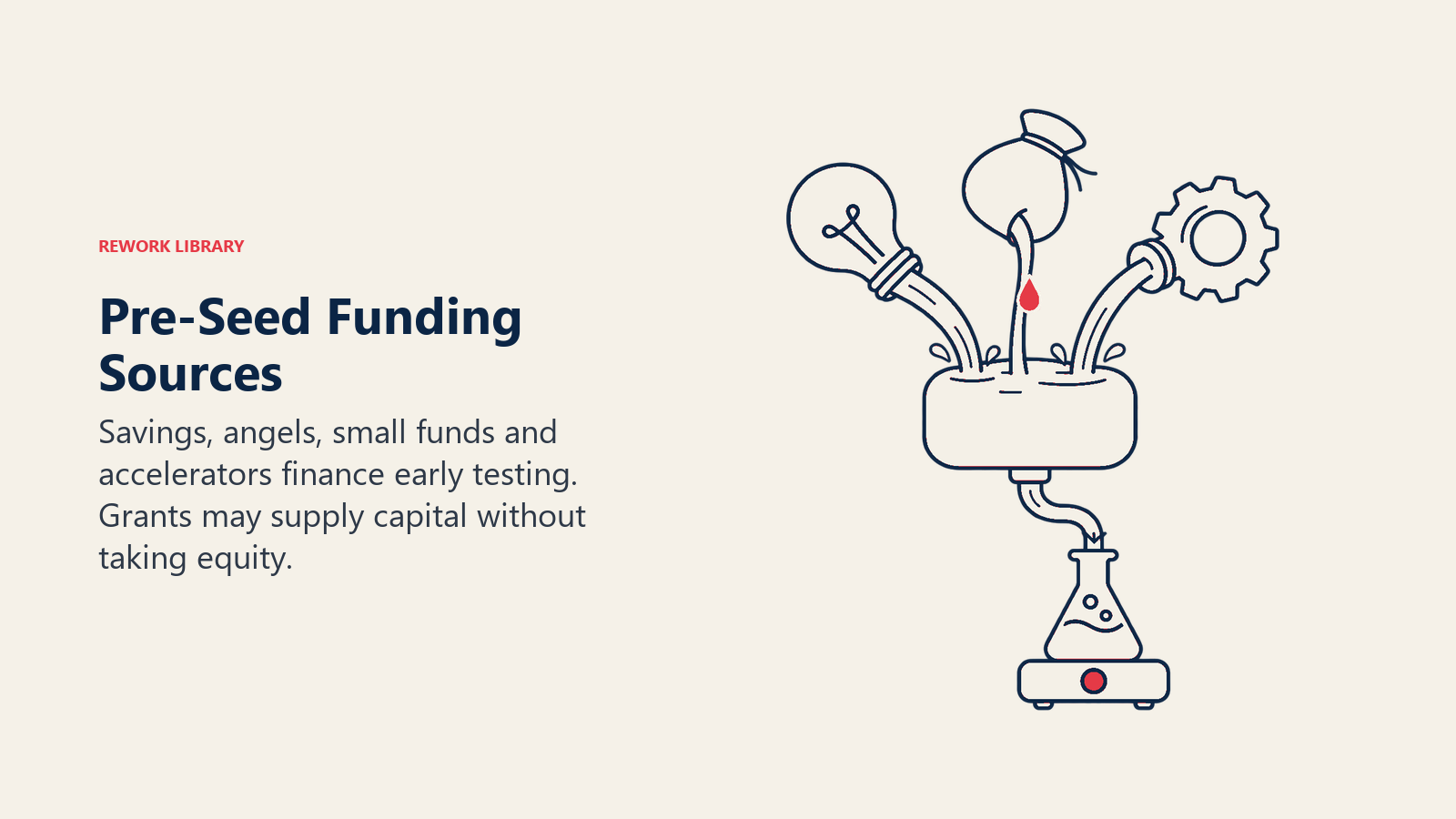
Founders' own savings and bootstrapping. Many companies never take outside money at this stage. Founders fund the first version themselves, which keeps full ownership but limits speed.
Friends and family. People who back the founder personally. It's quick and informal, but it mixes money with relationships, so write down the terms clearly.
Angel investors. Wealthy individuals who invest their own money. An angel investor often writes the first outside check and can move without a committee.
Pre-seed and micro funds. Small venture funds built for the earliest checks. The 2017 Crunchbase News article described one such fund, Afore Capital, as writing average checks of $300,000 to $600,000, and described pre-seed funds as complementary to angels. That figure is one fund's range reported in 2017, so don't read it as a market norm.
Accelerators. Programs that invest a fixed amount and provide mentorship. Y Combinator publishes its standard terms on its deal page: $500,000 total, made up of a $125,000 post-money SAFE for 7 percent equity and a $375,000 uncapped MFN SAFE. That's one program's current published deal, not a benchmark for the whole market.
Equity crowdfunding. Some companies sell small stakes to many people online. In the US, the SEC's Regulation Crowdfunding page says a company can raise a maximum of $5 million through crowdfunding offerings in a 12-month period. It's an option, not a default, and it comes with its own disclosure rules.
Grants and non-dilutive funding. Government programs, competitions, and corporate pilots can supply cash without taking equity. Availability depends heavily on country and sector.
How round size works, and why we don't quote one number
Founders often ask what a "normal" pre-seed round is. Honest answer: it depends on the year, the country, the sector, and who's counting. Different data providers draw the line between pre-seed and seed in different places, and some don't track pre-seed as its own category at all. A number quoted without a year and a method is usually unreliable.
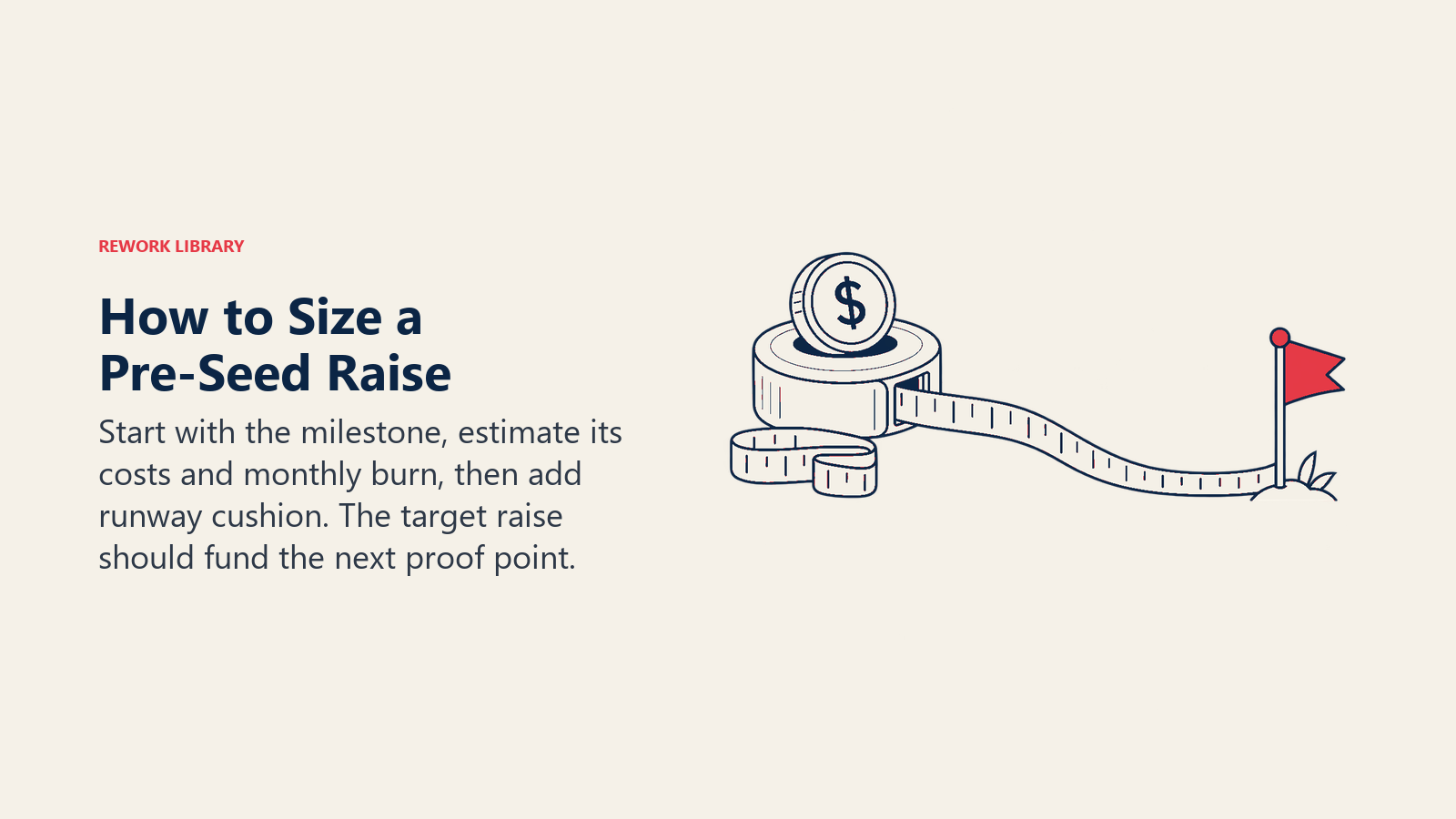
Rather than anchor on a headline figure, work backward from your own plan:
- Pick the milestone. What would make a seed investor say yes? A launched product, a set number of active users, a first batch of paying customers?
- Estimate the cost. Salaries, tools, hosting, legal, and a buffer.
- Divide by monthly burn. That gives the runway you need.
- Add cushion. Fundraising takes longer than expected, and delays eat runway.
The result is your target raise. If investors in your market tend to write smaller checks, you may need to cut scope or stretch runway. If they write larger ones, you may be able to hit the milestone faster. Check recent, dated data for your own market before pitching, and ask founders one step ahead of you what they actually raised.
The instruments: SAFE, convertible note, or priced equity
At pre-seed, the company is hard to value. So many deals postpone the question using an instrument that converts into equity later.
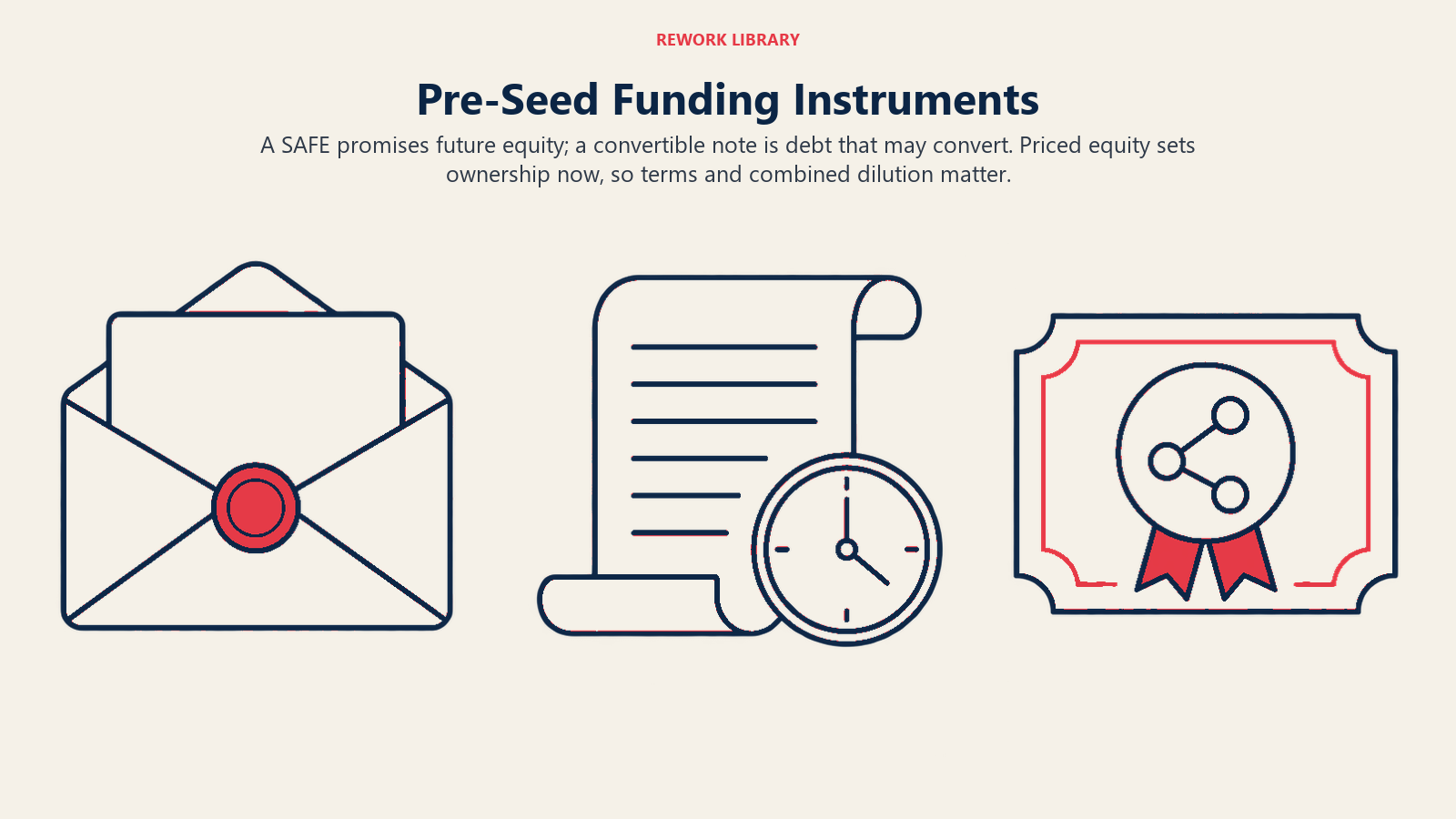
| Instrument | What the investor gets | Priced now? | Key feature |
|---|---|---|---|
| SAFE | A right to shares in a future equity round | No | No interest, no maturity date |
| Convertible note | Debt that converts into shares later | No | Interest and a maturity date |
| Priced equity round | Shares at a set price today | Yes | Requires agreeing a valuation |
The SEC's guide to common startup securities describes a SAFE as an agreement in which the company promises the investor a future ownership interest if a triggering event occurs, such as a future equity financing or a sale of the company. It adds that SAFEs typically don't set a valuation up front, which is what makes them handy before the company can be priced.
Y Combinator, which created the SAFE, explains on its documents page that the valuation cap is the highest valuation at which a SAFE converts, rewarding the investor for coming in early. It also describes a discount, which gives the SAFE investor a lower price per share than the price in the equity round. And it describes an MFN SAFE, which has no cap or discount and instead automatically takes the best terms of any SAFE the company issues later.
A convertible note works similarly in spirit but is legally debt, so it accrues interest and has a maturity date. The SEC page describes a note as a loan that can be converted into a different security.
A priced round is cleaner for ownership math but slower and costlier to document. That's why many pre-seed rounds skip it.
An illustrative example
This is our own arithmetic, not data from any study. Suppose a company raises $300,000 across several post-money SAFEs, each with a $6 million cap. On a post-money SAFE, the ownership an investor receives is their investment divided by the cap, so $300,000 divided by $6,000,000 equals 5 percent of the company, before new money in a later priced round dilutes it. Now suppose the founders sign a second batch of SAFEs at a $10 million cap for another $400,000. That batch converts to 4 percent. Together the two batches take 9 percent. The founders should model that total before signing the second batch, not after.
The lesson isn't that SAFEs are risky. It's that stacked instruments with different caps add up, and the combined dilution is easy to miss when each document is signed separately.
What investors look for at pre-seed
With little data to go on, early investors tend to ask the same few questions.
- Who are the founders? Relevant skill, speed, resilience, and the ability to recruit.
- Is the problem real and painful? Can you name the buyer, explain what they do today, and show why they'd switch?
- What have you learned? Interviews, pilots, and experiments count. A clear account of what you tested and what changed your mind is worth more than a polished deck.
- Can this become big? Venture-backed investors need a path to a large outcome. A solid small business can be a good business and still not fit a venture fund.
- How will you use the money? A specific milestone and a realistic timeline.
- Is the structure clean? Simple terms, few instruments, and a clear cap table.
In a group of investors, one often acts as the lead investor by negotiating terms for everyone. At pre-seed that role is lighter than in later rounds, but it still helps to know who's setting the tone.
What a pre-seed startup should prove before moving on
The goal of pre-seed isn't to spend the money. It's to turn uncertainty into evidence. Before approaching seed investors, many founders aim to show some version of the following:
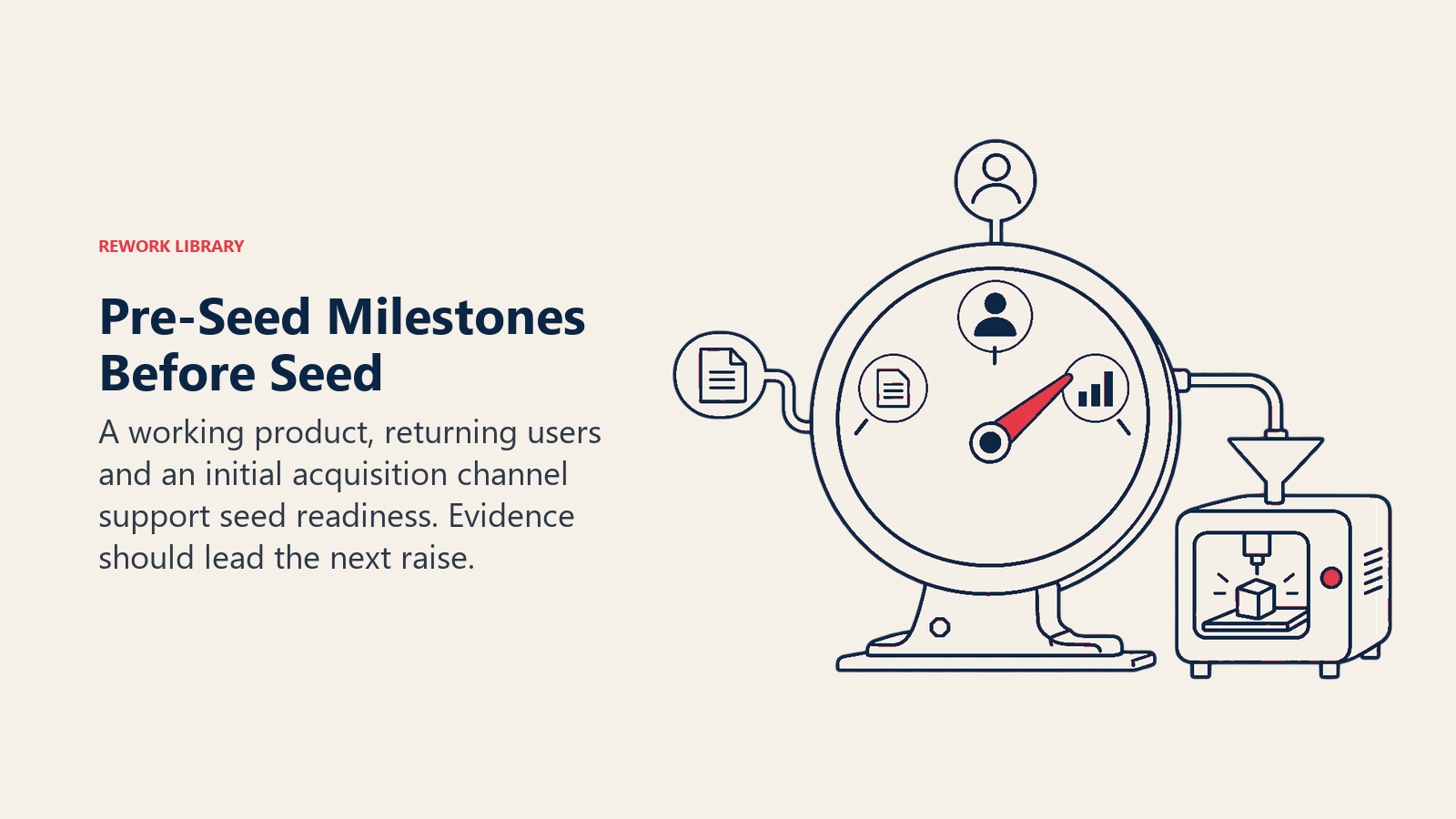
- Real users or customers. Not just sign-ups, but people who use the product or pay for it.
- A repeatable way to reach them. Even a rough channel, such as outbound, a community, or referrals, that brings in the next ten users without heroic effort.
- Early signs of retention. People coming back is a stronger signal than people trying once.
- A working product. It doesn't need to be polished, but it should solve the core problem.
- A credible team plan. Who you'll hire next and why.
These are common goals, not a rulebook. A deep-tech company may reach a different milestone, such as a validated prototype or a regulatory step, before the market sees "traction" in a consumer sense.
Many founders also test pricing at this point. If you're building a product other businesses will buy, early unit economics won't be precise, but they show whether growth could ever be profitable.
Common mistakes at the pre-seed stage
- Raising before knowing the milestone. Money without a target tends to leak into features nobody asked for.
- Chasing a big valuation. A high cap feels good now and can make the next round harder if growth doesn't keep pace.
- Stacking instruments without modeling them. As the example above shows, the total matters more than any single SAFE.
- Taking money from the wrong investor. An unresponsive or controlling early investor can cost more than the check is worth.
- Ignoring legal basics. Securities rules differ by country, and in the US they depend on who the investors are. Have counsel review documents. This article is general education, not legal advice.
- Skipping the runway math. If the round doesn't reach the next proof point, a stopgap round arrives sooner than planned.
- Treating pre-seed as a trophy. Raising isn't the goal. Learning fast enough to justify the next round is.
Pre-seed outside the US
The pre-seed vocabulary comes largely from US venture practice. In other markets, including Southeast Asia, the same stage may be called something else, funded by different sources, or documented with different instruments. Rules on who may invest, how securities are offered, and whether a SAFE or note works as intended differ by jurisdiction. Terms vary by market, so founders outside the US should check with local counsel before copying a US template.
Key Facts
- "Pre-seed" has no formal definition. Crunchbase News noted in 2017 that there wasn't yet a concrete definition (Crunchbase News).
- The same article described pre-seed funds as complementary to angels and reported one fund's average check at $300,000 to $600,000 (2017, single fund).
- Y Combinator's standard deal is $500,000: a $125,000 post-money SAFE for 7 percent plus a $375,000 uncapped MFN SAFE (Y Combinator).
- A SAFE promises future equity on a triggering event and typically sets no valuation up front (SEC).
- A valuation cap is the highest valuation at which a SAFE converts (Y Combinator).
- US Regulation Crowdfunding allows a maximum of $5 million raised in a 12-month period (SEC).
Related reading

On this page
- Where pre-seed fits in the startup journey
- What a pre-seed startup typically looks like
- How pre-seed companies get funded
- How round size works, and why we don't quote one number
- The instruments: SAFE, convertible note, or priced equity
- An illustrative example
- What investors look for at pre-seed
- What a pre-seed startup should prove before moving on
- Common mistakes at the pre-seed stage
- Pre-seed outside the US
- Key Facts
- Related reading