The History of the GPU
Turn this article into takeaways for your work.


Each assistant summarizes the article only for you and suggests best practices for your work.
In the 1960s a computer could print numbers. It could not show a picture you could change. Drawing a single moving line meant the processor spent most of its time redrawing the display.
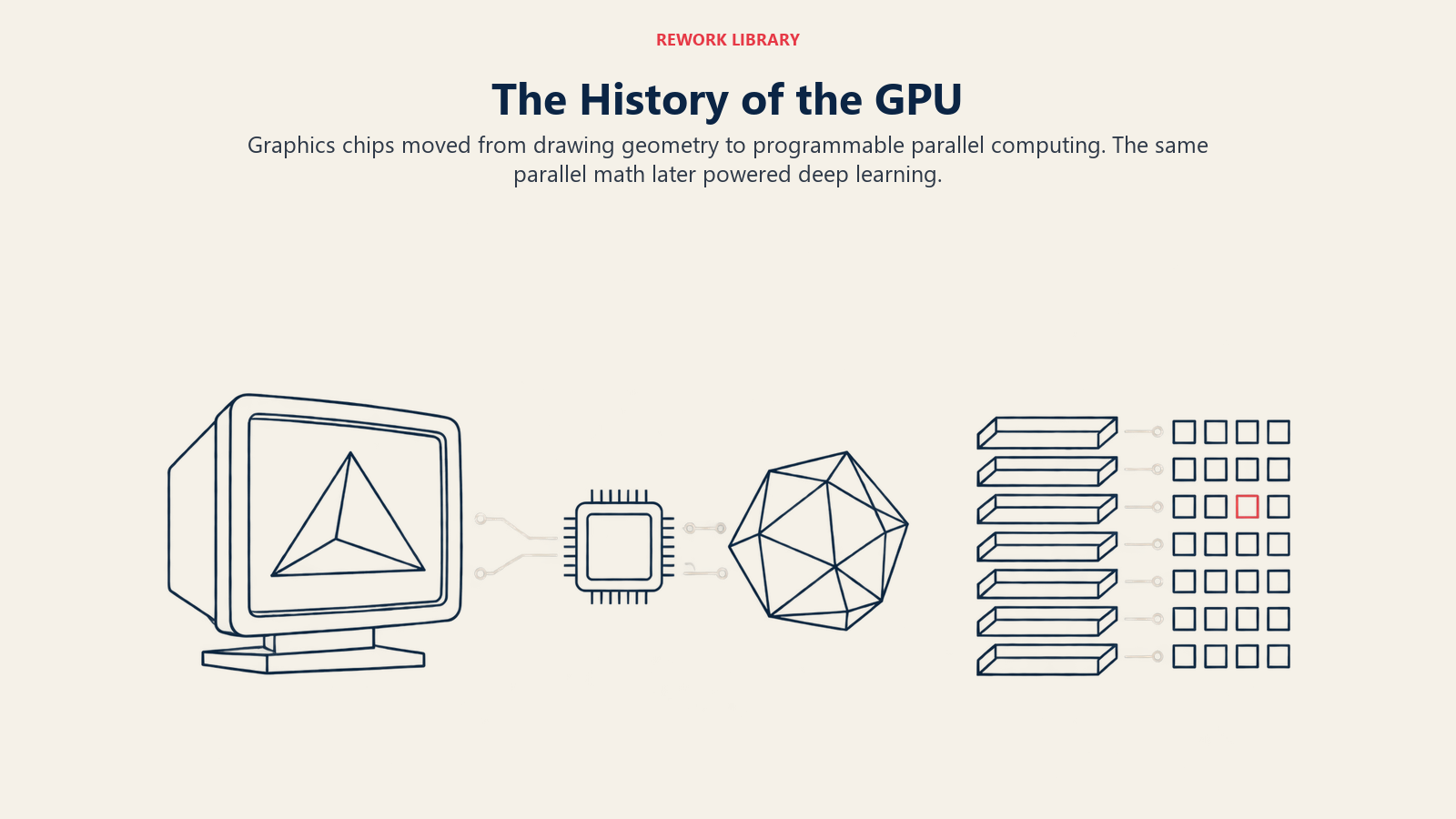
The graphics processing unit has a long prehistory and a precise label. Ivan Sutherland drew on a screen with a light pen in 1963. Jim Clark's Geometry Engine put graphics math on a chip by 1982. NVIDIA marketed the GeForce 256 in 1999 as the world's first GPU. A chip built to paint triangles for flight simulators and games turned out to be the right machine for neural networks, and the people who noticed weren't the people who built it. For the wider story of the field, see The History of Computers, the computer timeline and the generations of computers.
A GPU (graphics processing unit) is a chip that runs very many small calculations at the same time, first to turn 3D models into pixels and later for anything that can be split into many identical pieces. "GPU" is also a brand-era word: NVIDIA applied it to its own product in 1999, and earlier graphics hardware existed under other names.
Timeline at a Glance
| Year | Milestone | Why It Mattered |
|---|---|---|
| January 1963 | Sutherland submits the Sketchpad dissertation at MIT | A person draws on a display with a light pen. |
| 1968 | Evans & Sutherland is founded in Utah | Graphics hardware becomes a company, selling military flight simulators. |
| 1980 to 1982 | Clark publishes the Geometry Engine papers | Graphics geometry moves into custom VLSI chips. |
| January 1993 | NVIDIA is founded | A start-up aims at 3D graphics for PCs. |
| 1996 | 3dfx begins selling Voodoo Graphics chips | 3D acceleration reaches ordinary PC games. |
| August 1999 | NVIDIA launches the GeForce 256, its "first GPU" | The name "GPU" enters the market. |
| 11 October 1999 | The GeForce 256 is released, per NVIDIA | Transform and lighting leave the CPU. |
| February 2001 | GeForce3, called the first programmable GPU | Developers can write their own shading code. |
| November 2006 | GeForce 8800 and CUDA | The GPU can be programmed in C. |
| 2007 | Owens and colleagues publish the GPGPU survey | Researchers catalog general-purpose uses of graphics chips. |
| 2009 | Raina, Madhavan and Ng train deep belief networks on GPUs | Deep learning meets GPU hardware in a paper. |
| 2012 | AlexNet wins ImageNet on two GTX 580 GPUs | The GPU becomes the default machine for deep learning. |
| 2017 | Tesla V100 ships with 640 Tensor Cores | AI math gets dedicated circuits inside the GPU. |
The Display Years (1963-1979)
A light pen and a Utah barracks start computer graphics
The scene is MIT's Lincoln Laboratory in the early 1960s, where a graduate student points a light pen at a display screen to position and change a drawing. Ivan Sutherland's Sketchpad was submitted as his doctoral dissertation in January 1963 and ran on the Lincoln TX-2 computer. The Cambridge Computer Laboratory's electronic edition says Sketchpad exploited the light pen, one of the first graphical user interfaces, and that the program itself had limited distribution because executable versions ran only on a customized machine at Lincoln. Its influence traveled through the dissertation, a movie and a conference paper. The Computer History Museum holds the original Lincoln Laboratory technical report, No. 296, dated 30 January 1963.
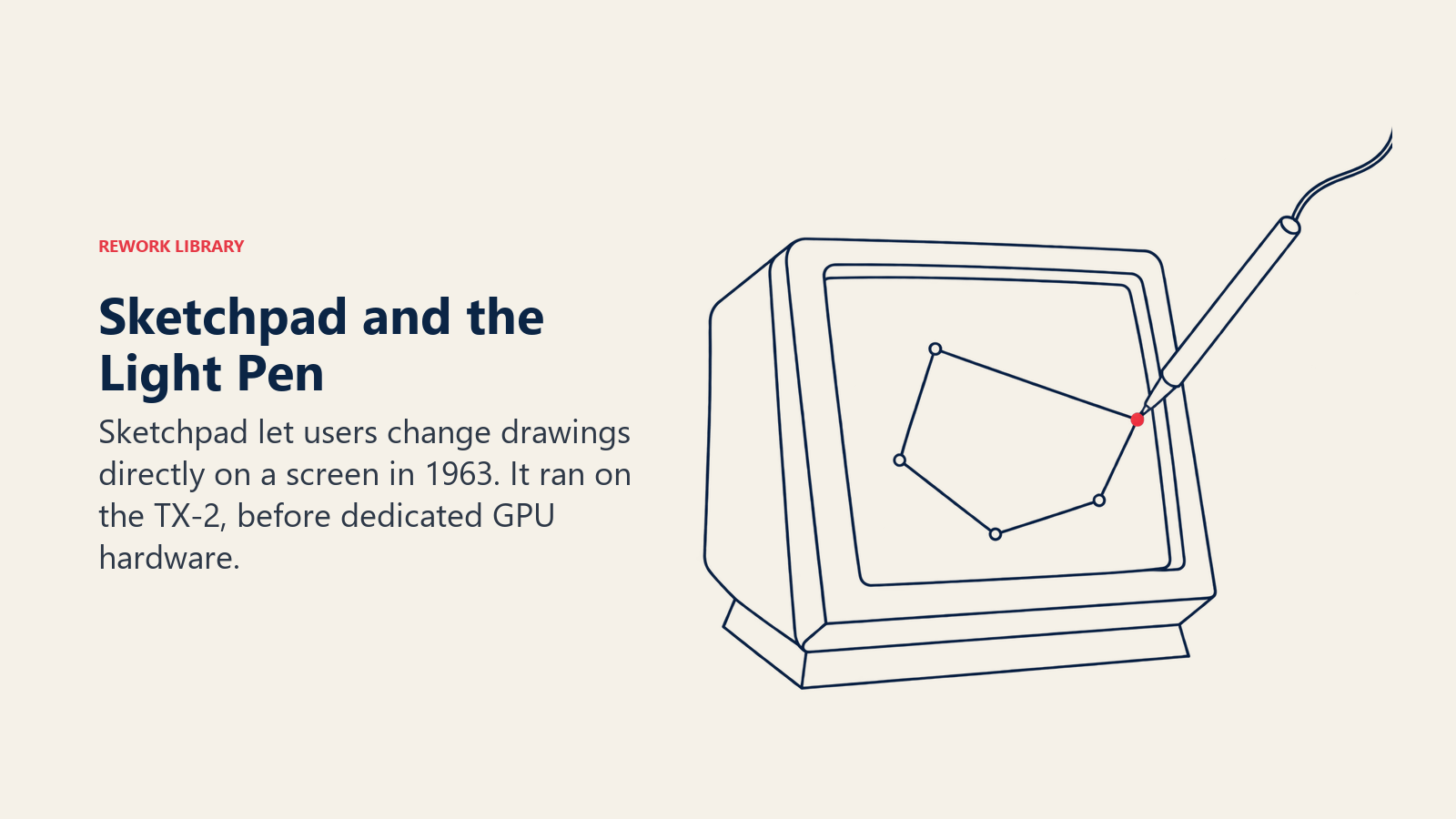
Sketchpad was a precursor, not a GPU. A single general-purpose computer did the drawing, and the display was a peripheral. The idea that graphics needed its own hardware came next. In 1968, per the Computer History Museum, two University of Utah professors founded Evans & Sutherland, first in abandoned barracks on the university grounds. The Museum says building military flight simulators was a major part of the business. IEEE Spectrum adds that Edwin Catmull, John Warnock and Jim Clark got their start as E&S employees or as doctoral students working at its facilities, and went on to found Pixar, Adobe and Silicon Graphics.
The era produced the first paying customers for real-time pictures, and they were military. It also left a gap: graphics hardware was built for a few specialist buyers, not for the general market.
For teams today: the first buyer of a specialized technology is usually the one with a safety or defense reason to pay. Expect the cost to fall only after that buyer has proven the value.
The Geometry Engine (1980-1995)
Stanford puts graphics math on a single chip
The scene is a Stanford lab around 1980, where a team designs a processor that does nothing but graphics geometry. James Clark's paper "A VLSI Geometry Processor for Graphics" appeared in Computer in July 1980, and a longer paper in Computer Graphics in July 1982 describes the result. The Geometry Engine, Clark writes, is a special-purpose VLSI processor, a four-component vector, floating-point engine for matrix transformations, clipping and mapping to output device coordinates. Twelve of them in a pipeline made the full system. The research was supported by DARPA, and Clark credits Marc Hannah's VLSI design skill as indispensable.

That 1982 paper also makes a prediction. Clark expected that the whole system would likely fit on a single chip of about half a million transistors within five years. He was describing, in effect, the path every later graphics chip took. Clark's paper lists both Stanford and Silicon Graphics as his affiliations. This line of work depends on the integrated circuit and the microprocessor, which made custom silicon practical in the first place. The scaling law behind that progress is told in the history of Moore's Law.
NVIDIA's own corporate timeline records that the company was founded in January 1993 by Jen-Hsun Huang, Chris Malachowsky and Curtis Priem.
The era moved graphics math from software into silicon. The next question was whether it could reach home PCs.
For teams today: when a technology works only inside expensive hardware, the next step is the version that fits a mass-market device. Plan for it.
The Voodoo Race (1996-1999)
PC games pull 3D graphics down to the consumer
The scene is a PC game running with a dedicated 3D graphics card. In 1996, the Computer History Museum says, 3dfx began selling Voodoo Graphics chips. It describes 3dfx as founded by three former Silicon Graphics employees, with early success coming in arcade games, and with the company's decline following a failed Sega Dreamcast partnership and ending when it sold all its intellectual property to NVIDIA.
3dfx was not the only maker, and NVIDIA's name for the next step came in 1999. Its corporate timeline records that it launched the RIVA TNT2 in May and, in August, the GeForce 256, which it calls the industry's first graphics processing unit. In an October 2024 anniversary post, NVIDIA says the GeForce 256 was released on 11 October 1999, was introduced as the world's first GPU, and took load off the CPU with hardware transform and lighting. So the dates are two: announced in August 1999, in stores on 11 October.
Treat "first GPU" as NVIDIA's label. The accurate version of the claim is narrow. Geometry hardware existed in 1982, and 3D accelerators existed in 1996. What the GeForce 256 did was put transform and lighting on a PC graphics chip and give the category a name that stuck.
The era made graphics a consumer business with annual product cycles. The side effect was money: a game market buying millions of chips a year funded design work that no laboratory could have paid for.
For teams today: a name for a category can matter as much as the feature. Whoever names the category often defines what the rest of the market is compared to.
The Programmable Years (2001-2006)
Shaders open the chip to anyone who can write code
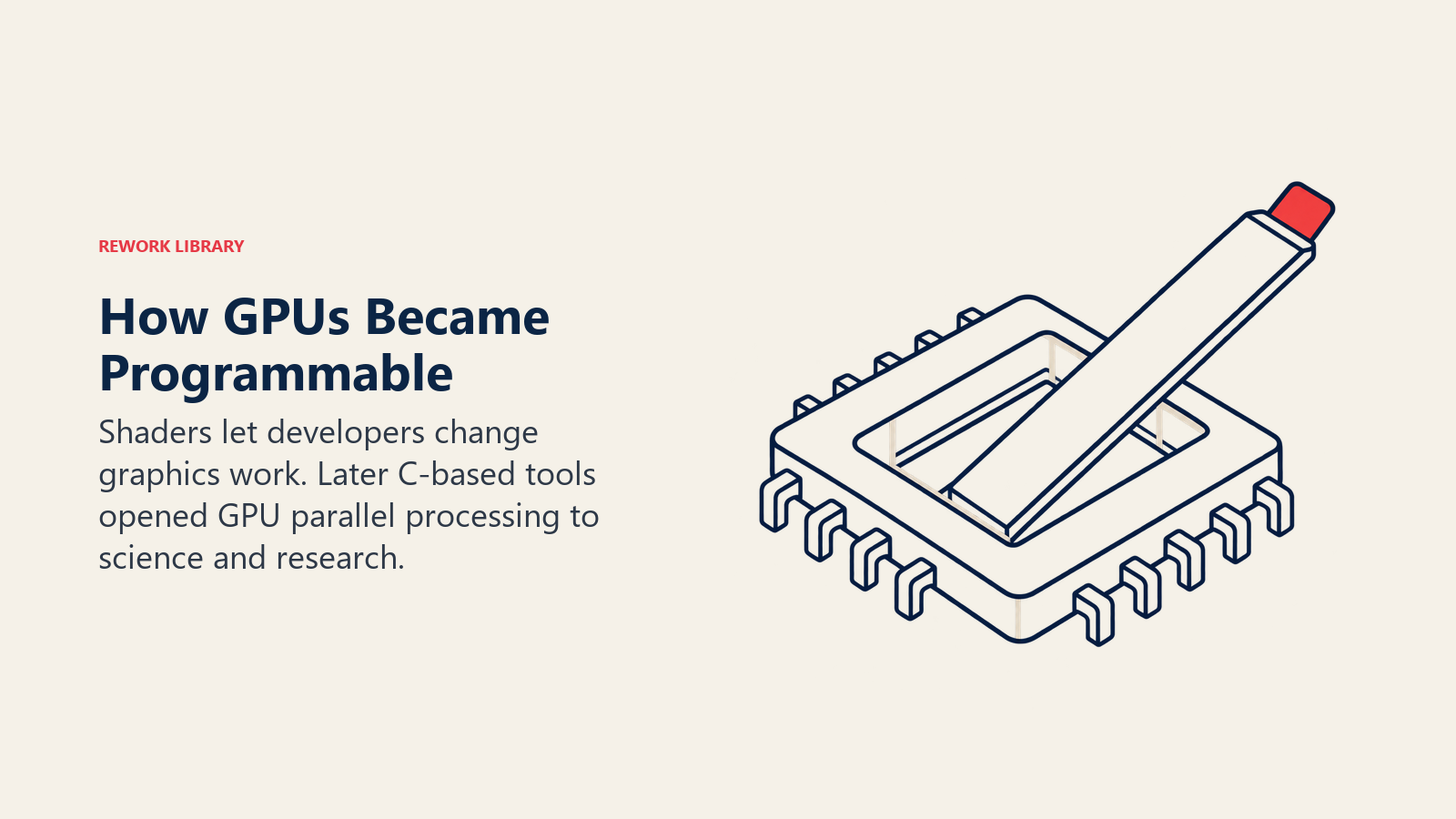
The scene is a game developer's screen showing code that runs on the graphics chip itself. Until 2001, graphics chips did fixed jobs in a fixed order. NVIDIA's timeline says that in February 2001 it introduced GeForce3, "the industry's first programmable GPU", and that is again its own description. What mattered to outsiders was the programmable shader: a small program that developers, not chip designers, wrote.
Researchers noticed. The survey by John Owens and six co-authors, published in Computer Graphics Forum in March 2007, opens with the observation that rapidly rising graphics hardware performance, joined to better programmability, made it a compelling platform for demanding tasks in many fields. This became known as GPGPU, general-purpose computing on graphics processors.
It was hard to do. NVIDIA's later Fermi whitepaper says the GPGPU model required intimate knowledge of graphics APIs, forced problems into vertices, textures and shader programs, lacked basic features like random reads and writes, and for a time lacked double precision. Then, in November 2006, NVIDIA introduced the G80-based GeForce 8800. The same whitepaper says it was the first GPU to support C and the first to replace separate vertex and pixel pipelines with a single unified processor. NVIDIA's corporate timeline marks the same year for CUDA, which it says opened parallel processing capabilities of GPUs to science and research.
The era solved the access problem for scientists. It created a new dependence: the software tools, not just the silicon, now decided who could use the chip.
For teams today: a platform becomes a platform when outsiders can build on it without asking permission. Look at your own product through that lens.
The Deep Learning Turn (2007-2016)
Researchers find a neural-network engine inside a graphics card
The scene is a computer with two graphics cards training a neural network. By 2009 the idea had a paper behind it. Rajat Raina, Anand Madhavan and Andrew Ng argued at ICML that modern graphics processors far surpass multicore CPUs for large-scale unsupervised learning. Their deep belief network code ran up to 55 times faster than a dual-core CPU version, and cut the time to learn a four-layer network with 100 million parameters from several weeks to around a day. The theory behind such networks was decades older, as the history of neural networks explains.
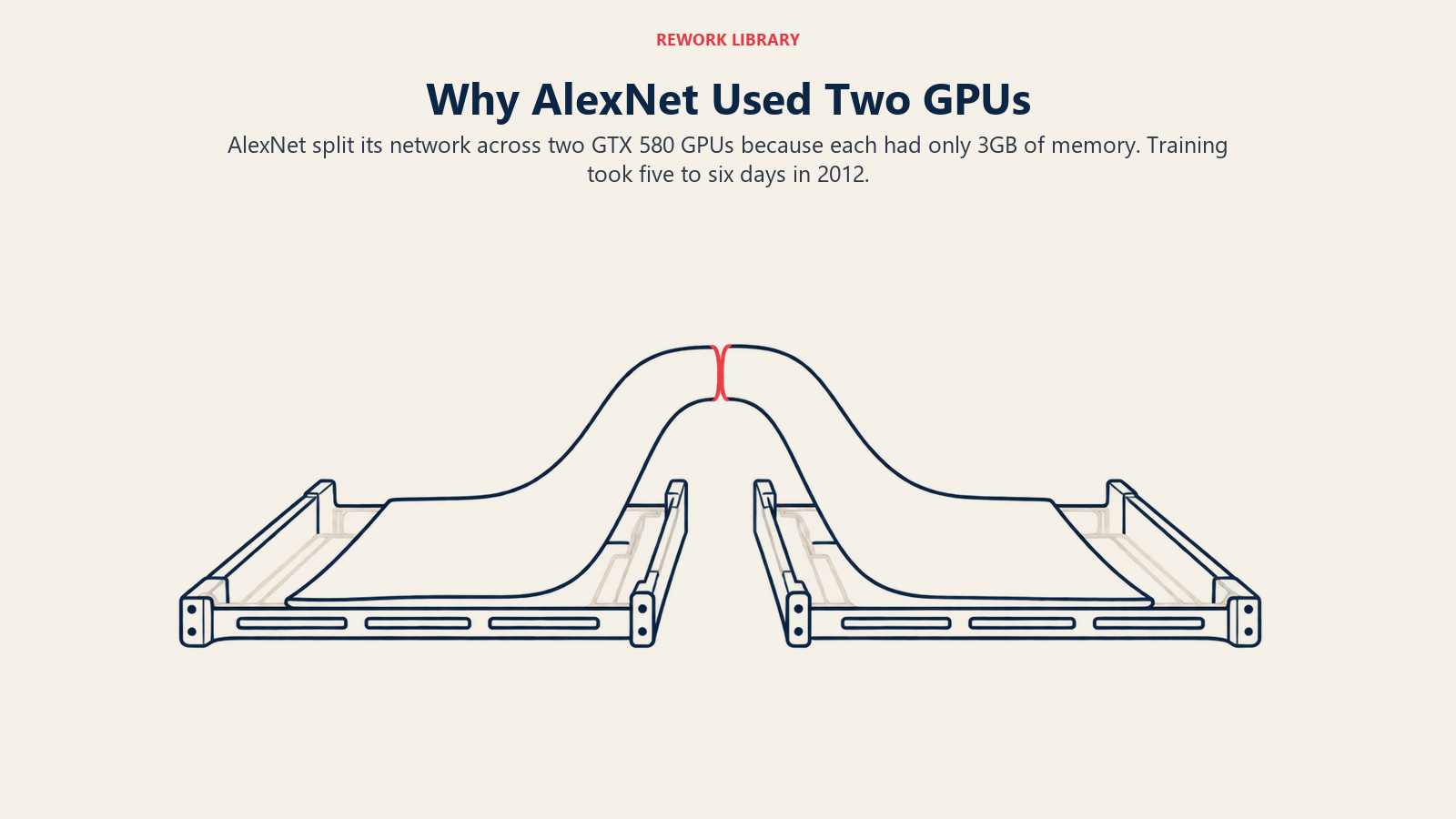
The breakthrough came in 2012. In ImageNet Classification with Deep Convolutional Neural Networks, Alex Krizhevsky, Ilya Sutskever and Geoffrey Hinton report that their network took five to six days to train on two GTX 580 3GB GPUs. The paper says a single GTX 580 has only 3GB of memory, which limited network size, so they spread the net across two cards. Their entry in the ILSVRC-2012 competition won with a top-5 test error rate of 15.3%, against 26.2% for the second-best entry. The authors write that results could improve by waiting for faster GPUs and bigger datasets to become available. NVIDIA's own timeline later credits 2012 as the year it powered AlexNet, which is a company description, not an independent ranking. The full story, including the dataset, is in ImageNet and AlexNet, and the arc after it is in the history of deep learning.
The era solved the training-time problem for neural networks. It also meant that AI progress now depended on a supply of chips designed for a different purpose.
For teams today: breakthroughs often come from combining an old idea with cheap hardware that was built for something else. Watch adjacent markets for that second ingredient.
The Accelerator Age (2017-present)
AI math gets its own circuits inside the GPU
The scene is a server rack full of graphics processors that never draw a frame. NVIDIA's August 2017 Volta whitepaper describes the Tesla V100 as containing 640 Tensor Cores, eight per streaming multiprocessor, each performing 64 floating point multiply-add operations per clock, and delivering up to 125 Tensor TFLOPS for training and inference. In other words, the company built dedicated AI circuits into a product it still called a GPU.
The name itself had stretched. The same chip family serves games and AI training, and the large language models described in the history of large language models were built on this kind of hardware. The wider category is explained in what is an AI chip. Running a trained model, as opposed to training it, has its own demands, covered under inference.
The open problem is dependence. A field that grew on one family of chips and one programming model now has to decide how much of that dependence it wants to keep.
For teams today: if your roadmap rests on a single supplier's hardware or toolchain, write down what it would cost to move. The history of the GPU shows how a tool can end up shaping the field that uses it.
Key People
| Name | Role | Contribution | Year |
|---|---|---|---|
| Ivan Sutherland | Graduate student, later co-founder of Evans & Sutherland | Sketchpad; co-founded E&S | 1963, 1968 |
| David Evans | University of Utah professor | Co-founded Evans & Sutherland | 1968 |
| James H. Clark | Stanford professor, founder of Silicon Graphics | The Geometry Engine papers | 1980-1982 |
| Marc Hannah | VLSI designer | Credited in Clark's paper for VLSI design work | 1982 |
| Jen-Hsun Huang, Chris Malachowsky, Curtis Priem | NVIDIA founders | Founded NVIDIA | 1993 |
| John Owens and co-authors | Graphics researchers | Surveyed general-purpose computing on GPUs | 2007 |
| Rajat Raina, Anand Madhavan, Andrew Ng | Machine-learning researchers | Trained deep belief networks on GPUs | 2009 |
| Alex Krizhevsky, Ilya Sutskever, Geoffrey Hinton | University of Toronto researchers | AlexNet on two GTX 580 GPUs | 2012 |
Key Facts
- Sutherland's Sketchpad was submitted as a dissertation in January 1963 and ran on the TX-2.
- Evans & Sutherland was founded in 1968 and built military flight simulators.
- Clark's Geometry Engine paper, July 1982, describes a pipeline of 12 chips doing matrix transformations and clipping.
- NVIDIA says the GeForce 256 was released on 11 October 1999 as the world's first GPU.
- NVIDIA says G80, in November 2006, was the first GPU to support C.
- AlexNet trained for five to six days on two GTX 580 GPUs and scored 15.3% top-5 error against 26.2% for the runner-up.
The Pattern Behind the History
The same five moves repeat across the GPU's life. We call the sequence the Borrowed Engine. It's our synthesis of the history, not a research finding.
- A narrow, funded job builds the first hardware. Flight simulators and workstations paid for early graphics silicon.
- The job moves to a mass market. PC games turned a rare chip into an annual product.
- Volume funds the next generation. Millions of gamers paid for design cycles that research labs could not.
- Programmability lets outsiders redefine the chip. Shaders, then C, invited scientists.
- The outsider job becomes the main job. Deep learning moved from a side use to the reason data-center GPUs are built.
What It Teaches Teams Today
- Watch the expensive niche. Flight simulators and film studios paid for what games later made cheap.
- Treat the name as a claim. "First GPU" is NVIDIA's wording for a product with real precursors.
- Open the platform to strangers. CUDA's value came from people the chip designers never planned for.
- Pair old ideas with new hardware. Neural networks were decades old when GPUs made them practical.
- Know your dependence. The field that grew on this hardware should know what moving off it would cost.
The GPU's history is a story of a tool outgrowing its job. Before you decide what a technology is for, ask who else might use it and what they would need from you to do so. For the field around it, start with The History of Computers.

Co-Founder, Rework.com