The History of the Personal Computer
Turn this article into takeaways for your work.


Each assistant summarizes the article only for you and suggests best practices for your work.
Through the 1960s, computing meant a shared machine behind a locked door. An operator rationed the time. The problem was access.
The personal computer has no single birthday. Machines meant for one user appeared in the 1960s, a $750 hobby machine was advertised in 1971, the Altair kit made headlines in January 1975, and three finished computers went on sale in 1977. A computer became "personal" when its price, its size and its software finally let one person own it and do real work without an operator. For the wider story, see The History of Computers, the computer timeline and the generations of computers. This article follows the machine that moved onto the desk.
"First personal computer" is a contested label, and the honest answer depends on the definition. A precursor is a machine that pointed the way, such as a desktop computer for one user that still cost as much as a house. The concept is a computer owned by an individual, programmable by that person, at a price a person might pay. The sections below keep the two apart.
Timeline at a Glance
| Year | Milestone | Why It Mattered |
|---|---|---|
| 27 March 1962 | First public demonstration of the LINC (Laboratory Instrument Computer) | A computer built to sit beside one researcher. |
| 1965 | Olivetti presents the Programma 101 in New York | A desktop programmable machine that sold about 44,000 units. |
| 9 December 1968 | Engelbart's demonstration in San Francisco | Showed interactive computing to about 2,000 people. |
| 1971 | Kenbak-1 released at $750 | Believed by the museum to be the first personal computer. |
| 1973 | Micral introduced in France | An assembled machine built around the Intel 8008. |
| 1973 | Xerox Alto built at PARC | Bitmap display, mouse and Ethernet in one personal workstation. |
| January 1975 | Altair 8800 on the cover of Popular Electronics | A $397 kit that flooded its maker with orders. |
| 1977 | Apple II, TRS-80 and Commodore PET | Finished computers for people who couldn't solder. |
| 1979 | VisiCalc arrives for the Apple II | A business reason to buy one. |
| 12 August 1981 | IBM unveils the PC at $1,565 | Put a major corporation's name behind the idea. |
| November 1982 | Compaq announces its Portable | A compatible machine that ran IBM PC software. |
| 1984 | Apple's Macintosh at $2,500 | A graphical, mouse-driven computer for the mass market. |
| 24 August 1995 | Windows 95 ships | The graphical desktop reached the PC mainstream. |
| 10 November 2020 | Apple announces the M1 | The Mac moved to Apple's own system on a chip. |
The Desk-Size Precursors (1962-1970)
Computers shrink toward one user, but not to one budget
The first step was the idea of a console that belonged to one scientist instead of a whole department. The Computer History Museum holds a photo of the first public demonstration of the LINC on 27 March 1962, a Laboratory Instrument Computer pictured with Wes Clark. It was built to serve an experimenter at the bench, not a queue of strangers.
Three years later, in 1965, Olivetti showed the Programma 101 at a fair in New York. The Politecnico di Milano's historical collection says it was designed by Pier Giorgio Perotto with Giovanni De Sandre and Gastone Garziera, that Mario Bellini gave it its form, and that about 44,000 were produced and sold in a few years, around 90 percent of them in the United States. The same page calls it "widely considered the first personal computer produced in the world." It was a desk-sized programmable machine, and a real precursor. Nobody could buy one for the price of a television.
Then came a demonstration about what computing could feel like. On 9 December 1968, Doug Engelbart presented "A Research Center for Augmenting Human Intellect" at the Fall Joint Computer Conference in San Francisco's Civic Auditorium. He worked for about 90 minutes before an audience of roughly 2,000, driving the NLS system located about 30 miles away at SRI. The interface side of that story is in the history of the mouse and the GUI.
All three belong to the precursor stage. They showed that a computer could be interactive and assigned to one person. They didn't yet show that an individual could own one. What made ownership thinkable was the chip story in the history of the integrated circuit and the transistor before it. The world they were escaping is described in the history of the mainframe.
For teams today: a working demo can change what people believe is possible years before the product exists. Show the experience, not just the specification.
The Kit Years (1971-1976)
Hobbyists, not corporations, build the first machines for individuals
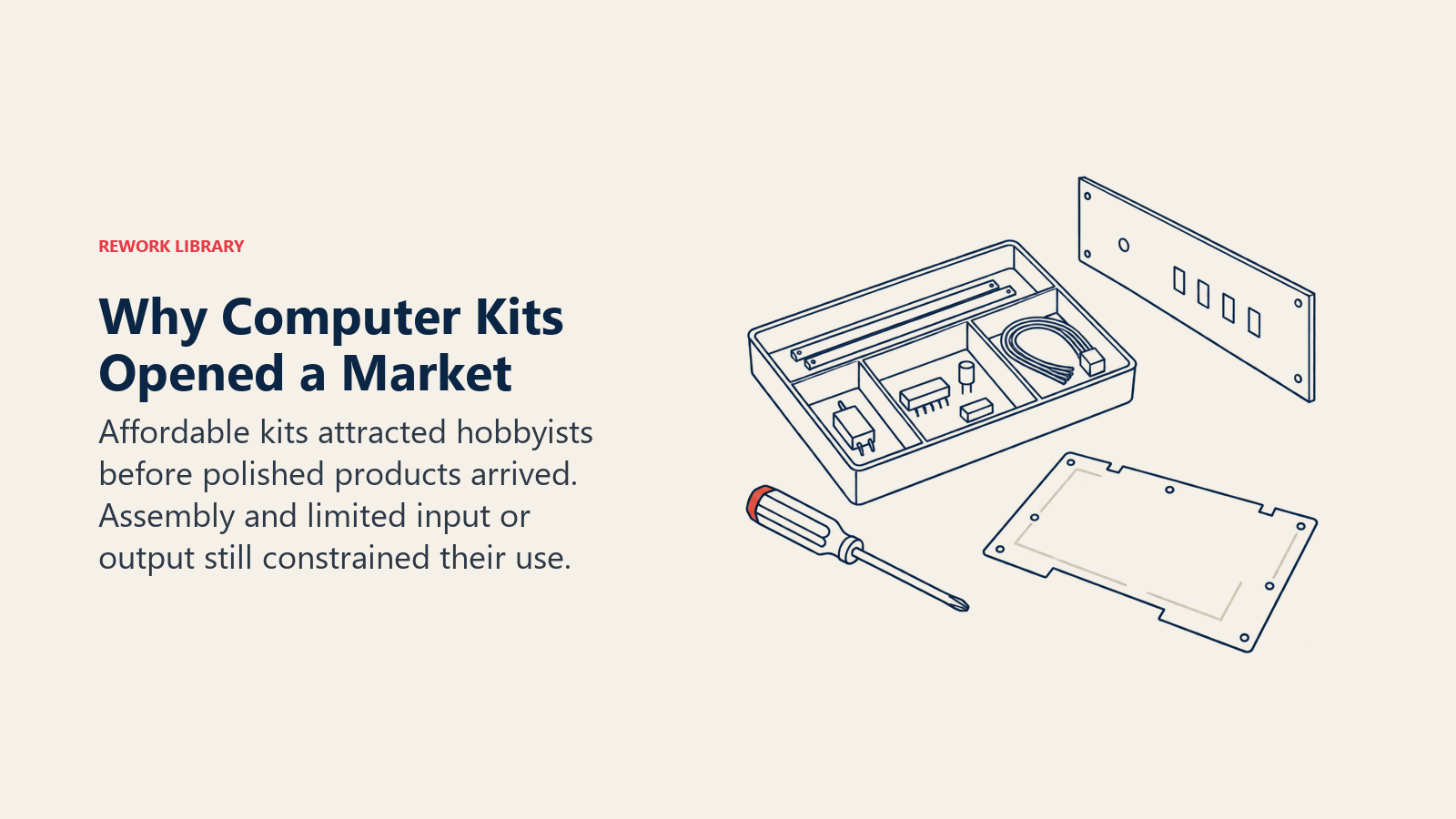
The turning point is a price tag people could afford. The Computer History Museum says the Kenbak-1, designed by John V. Blankenbaker and made by Kenbak Corporation, was released in 1971 for $750. It had 256 bytes of memory, eight data buttons and seven command buttons on the front panel, and eight lights for output. It was aimed at the educational market and advertised in the September issue of Scientific American, the first personal computer advertised on a national basis. The museum's wording is careful: it is "believed to be the world's first personal computer."
In France, R2E introduced the Micral in 1973. The museum credits André Truong Trong Thi and François Gernelle with the design and describes a fully assembled computer using the Intel 8008 microprocessor, made for process control. A few were sold as personal computers, but most went into real-time applications such as tollbooths. The museum doesn't call it the first of anything. The chip inside it came from the story in the history of the microprocessor.
Meanwhile a different vision was being written down. In August 1972, Alan Kay described a "personal, portable information manipulator" in a paper for the ACM national conference. In the paper, as transcribed here, "personal" means "owned by its user (needs to cost no more than a TV)." He said the device should be "no larger than a notebook," weighing under 4 pounds, and argued that "a target price of $500 is not totally outrageous." The machine did not exist. The idea did.
What did exist, at Xerox's Palo Alto Research Center, was the Alto. The IEEE's milestone page records that Xerox decided in 1972 to produce a personal computer for research and dates Butler Lampson's "Why Alto?" memo to 12 December 1972. The team named in the citation includes Ed McCreight, Chuck Thacker, Butler Lampson, Bob Sproull and Dave Boggs, and the machine had a bitmap display of 606 by 808 pixels, a three-button mouse and Ethernet networking. Xerox donated 50 Altos to Stanford, Carnegie Mellon and MIT in 1978. The Alto was a personal computer in the sense of one person per machine. It was a research tool, not a product anyone could buy.
The product that did reach hobbyists was the Altair 8800 from MITS. The museum says Ed Roberts founded MITS in 1970, first making kits for model rockets and then calculators. When calculators became too cheap to be profitable, he designed the Altair, a $397 kit that appeared as the cover article of Popular Electronics, after which orders flooded in. A separate museum record gives it an Intel 8080 processor, an 8-bit word and 256 bytes of memory, and says it is widely credited with sparking the personal computer revolution. The same record says it inspired Bill Gates to write a BASIC assembler and links that to the start of Microsoft.
The kit had a hard limit: you had to build it, and it had little to show for the effort.
For teams today: a rough product with a clear price can start a market that polished products miss. The first users will forgive what the second wave won't.
The Trio and the Spreadsheet (1977-1980)
Finished computers arrive, and a spreadsheet gives buyers a reason
By 1977 the question changed from "can I build one?" to "can I buy one and use it tonight?" The turning point came that year, when the Computer History Museum records three influential machines: the Apple II, the TRS-80 and the Commodore PET. The Apple II was designed by Steve Wozniak and carried a cost of $1,298. The museum's timeline says it shipped as a complete package with a main board, power supply, keyboard, case, manual and game paddles, and that millions were sold between 1977 and 1993. Apple gave away thousands to schools.
Radio Shack's TRS-80 cost $599.95, had a Z80 processor, 4 KB of memory and a built-in BASIC interpreter, and sold 10,000 units in its first month against a first-year projection of 3,000, according to the same timeline. The Commodore PET used a MOS Technologies 6502 processor, the cheap chip from the microprocessor story. Chuck Peddle, who led the 6502 team, also appears in the museum's account of the PET design.
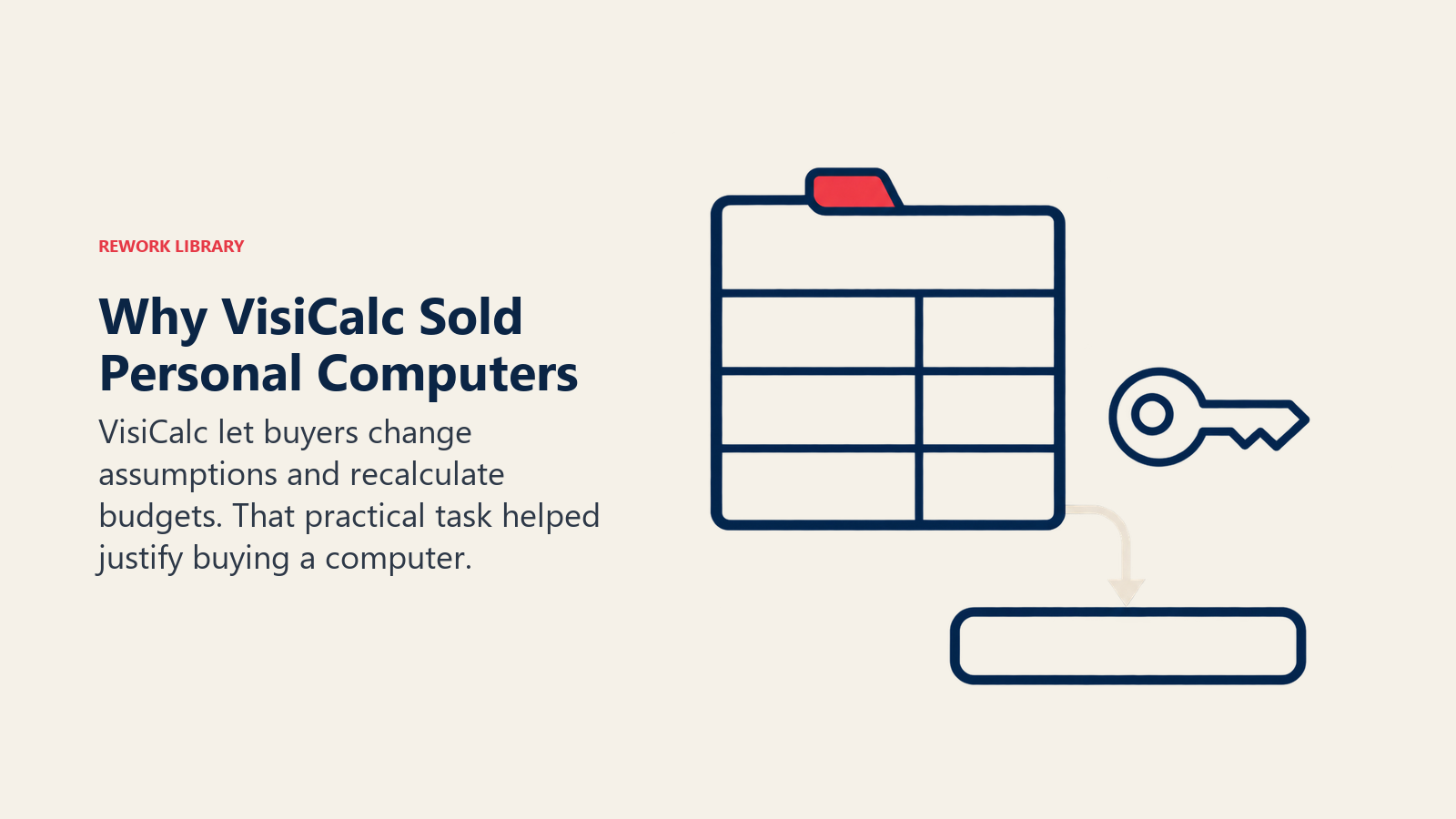
The machine alone didn't make a business case. In the museum's words, the floppy disk drive of 1978 and the spreadsheet program VisiCalc of 1979 turned the Apple II into a blockbuster. A finance manager could now justify the purchase with a task: run the numbers again, with a changed assumption, in seconds.
This era ended with a market full of incompatible machines. Each maker had its own disk format and its own software, and a program written for one didn't run on another.
For teams today: hardware gets attention, but a specific job to be done closes the sale. VisiCalc was the reason to buy. The history of the spreadsheet tells that side of the story.
The IBM Standard (1981-1994)
A corporate name, a published design and the clones that followed
On 12 August 1981 at the Waldorf in New York, IBM unveiled the IBM PC. IBM's own history says Don Estridge was charged with developing it and had it ready for market in one year, after William Lowe, director of the General Systems Division lab in Boca Raton, Florida, proposed the idea to CEO Frank Cary. The target price was $1,500. The unveiled price was $1,565 for a base model with 16 KB of RAM and no disk drive, and a display, two diskette drives and a printer added nearly $3,000. It used Intel's 8088 at up to 5 MHz, and Microsoft supplied the operating system. The Computer History Museum notes that IBM's first personal computer arrived nearly ten years after others were available.
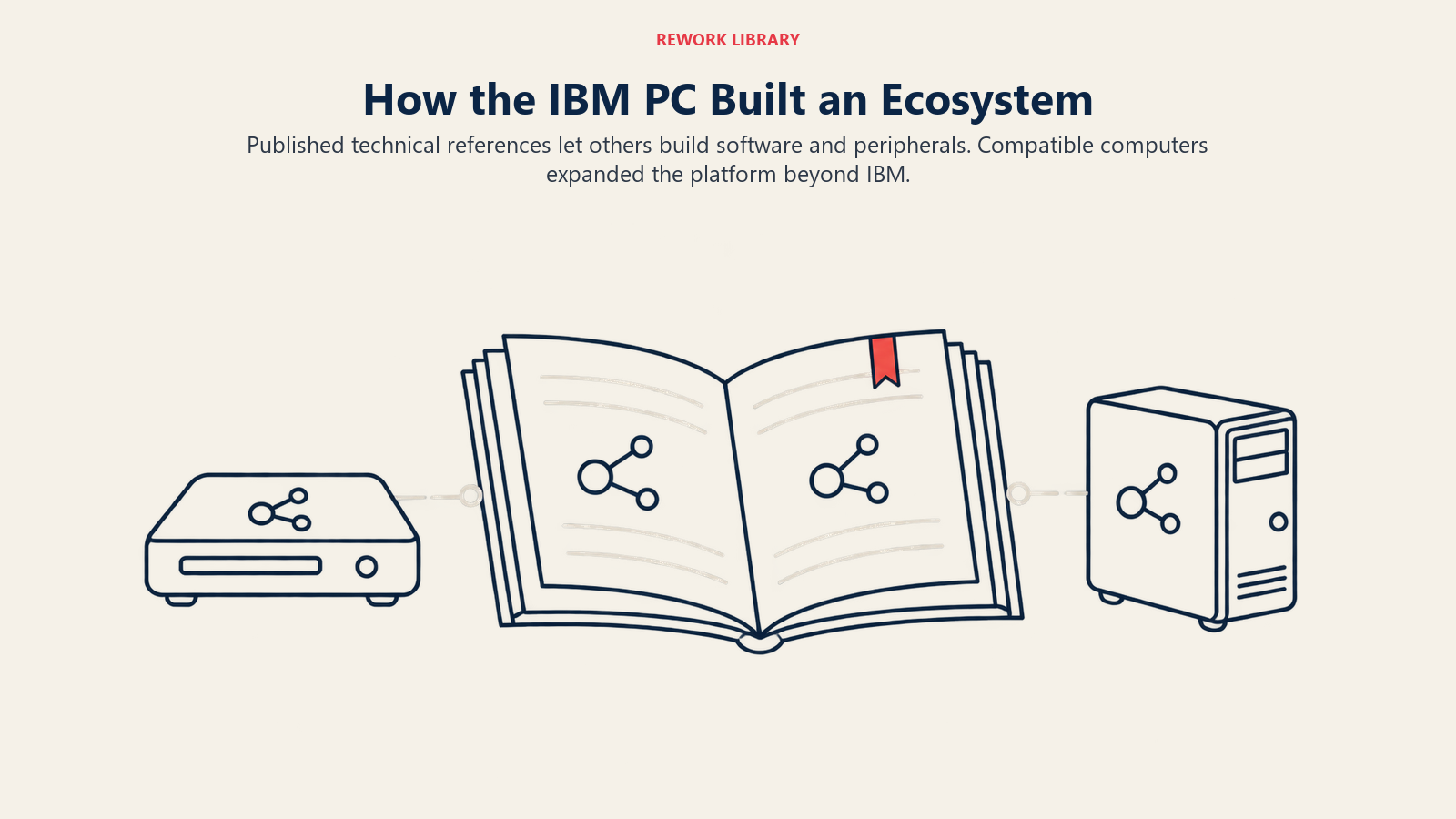
What turned a product into a standard was openness. IBM published technical references, including circuit designs and source code, so others could build software and peripherals, and more than 750 software packages were available within a year. Companies reverse-engineered the boot code to make "IBM compatible" machines. The Centre for Computing History records that the Compaq Portable was announced in November 1982, shipped in March 1983 at $2,995, weighed 28 pounds and was the second IBM-compatible machine. The operating system side is covered in the history of operating systems.
Others kept the field wide. The Osborne 1 of 1981 cost $1,795, weighed 24 pounds and is described by the museum as the first mass-produced portable computer. In 1982 the Commodore 64 sold for $595 with 64 KB of RAM, and the museum's timeline says it sold over 22 million units, while its Revolution exhibit says about 30 million, so the total depends on the page. The same 1982 timeline records that TIME replaced its "Man of the Year" tradition by naming the personal computer its "Machine of the Year."
In 1984 Apple tried a different path. The Macintosh cost $2,500, and the museum calls it the first successful mouse-driven computer with a graphical user interface. Its Super Bowl advertisement aired on 22 January 1984. The compatibility market and the graphical machine would collide by the mid-1990s, and the story of that interface is in the history of the mouse and the GUI.
For teams today: a published standard invites an ecosystem, and an ecosystem can outgrow its founder. IBM's share, per its own history, fell from roughly 80 percent in 1982-1983 to about 20 percent a decade later.
The Everywhere Computer (1995-present)
The desktop becomes the default, then one device among many
Windows 95 shipped on 24 August 1995. The museum's This Day in History entry says sales exceeded all predictions, helped by possibly the largest product launch campaign in history. The museum's launch page adds that over 70,000 people watched the launch via satellite and that within two years Windows 95 ran on more computers than any other operating system. The graphical desktop that the Alto and the Macintosh had shown now sat on the clone market's machines.
Then the business itself changed hands. IBM sold its PC division to Lenovo in 2005 for $1.75 billion, ending the corporate line that began in Boca Raton. The tablet and the phone took over many tasks the desktop once owned. Apple's iPad was announced on 27 January 2010 at $499 for the 16 GB Wi-Fi model, weighing 1.5 pounds. The history of the smartphone continues that thread, and the data-center side is in the history of cloud computing.
The personal computer didn't vanish. It kept shrinking and integrating. On 10 November 2020 Apple announced the M1 for the MacBook Air, the 13-inch MacBook Pro and the Mac mini, which it called the first personal computer chip built on a 5-nanometer process, with 16 billion transistors and an 8-core CPU. Compare that with the Kenbak-1's 256 bytes. The trend behind it is explained in Moore's Law history.
For teams today: the product you sell may be absorbed into a bigger category. Own the thing users still need after the form factor changes.
The Contenders for "First"
| Contender | Year | What the sources say | What it was missing |
|---|---|---|---|
| LINC | 1962 | First public demonstration, 27 March 1962 | A lab instrument, not a product for individuals. |
| Programma 101 | 1965 | "Widely considered the first personal computer produced in the world" | A programmable desktop machine, sold to businesses. |
| Kenbak-1 | 1971 | "Believed to be the world's first personal computer" | 256 bytes of memory and lights for output. |
| Micral | 1973 | Fully assembled, built on the Intel 8008 | Mostly sold for process control. |
| Xerox Alto | 1973 | A personal computer for research, with mouse and Ethernet | Never sold as a product to individuals. |
| Altair 8800 | 1975 | "Widely credited with sparking the personal computer revolution" | A kit with little input or output. |
Key People
| Name | Role | Contribution | Year |
|---|---|---|---|
| Wes Clark | MIT researcher | Pictured with the LINC at its first public demonstration | 1962 |
| Pier Giorgio Perotto | Olivetti designer | Led the design of the Programma 101 | 1965 |
| Doug Engelbart | SRI researcher | Presented the 1968 interactive computing demonstration | 1968 |
| John V. Blankenbaker | Kenbak Corporation | Designed the Kenbak-1 | 1971 |
| André Truong Trong Thi and François Gernelle | R2E | Designed the Micral | 1973 |
| Alan Kay | Researcher | Described a personal, portable information manipulator | 1972 |
| Chuck Thacker and Butler Lampson | Xerox PARC | Part of the Alto team | 1972-1973 |
| Ed Roberts | MITS founder | Designed the Altair 8800 kit | 1975 |
| Steve Wozniak | Apple | Designed the Apple II | 1977 |
| Don Estridge | IBM | Led development of the IBM PC | 1981 |
| William Lowe | IBM | Proposed the consumer PC to CEO Frank Cary | Before 1981 |
Key Facts
- The Kenbak-1 was released at $750 in 1971 and is "believed to be" the first personal computer.
- The Altair 8800 was a $397 kit that appeared on the cover of Popular Electronics.
- The Apple II cost $1,298, and the TRS-80 sold 10,000 units in its first month.
- The IBM PC was unveiled on 12 August 1981 at $1,565 for a base model with 16 KB of RAM.
- The Macintosh launched in 1984 at $2,500.
- Alan Kay's 1972 paper set a target price of $500 for a notebook-size personal machine.
The Pattern Behind the History
The same four moves repeat across the personal computer's history. We call the sequence the Lab to Living Room Cycle. It's our synthesis of the history, not a research finding.
- A precursor proves the experience. The LINC, the Programma 101 and the Alto showed what one-person computing felt like, at a price few could pay.
- Hobbyists prove the market. The Kenbak-1 and the Altair showed people would buy and build.
- A reason to buy closes the sale. VisiCalc gave the Apple II a task that justified the cost.
- A standard decides who profits. IBM published its design, clones followed, and the platform outgrew its maker.
What It Teaches Teams Today
- Separate the precursor from the product. Several machines pointed the way, but only one at a time reached buyers.
- Price is part of the definition. Kay's "no more than a TV" is a design requirement, not a marketing line.
- Sell the job, not the box. The spreadsheet did more for the Apple II than its specifications.
- Openness cuts both ways. IBM's open design built the market and lost IBM its lead.
- Know which "first" you mean. Lab computer, hobby kit, assembled machine and mass-market product are different claims.
The personal computer took about two decades to go from a research bench to a desk. Next time you launch something new, ask what the precursor proved, who the hobbyists are, and what job will make the sale.

Co-Founder, Rework.com