The History of Cloud Computing
Turn this article into takeaways for your work.


Each assistant summarizes the article only for you and suggests best practices for your work.
In the early 1960s, a computer was a room-sized machine that a university or company either owned or did without. People queued with decks of cards for scarce time on it. A few MIT researchers asked a different question. What if many people could share one machine and pay only for what they used?
Cloud computing is older than its name. MIT voiced the idea of selling computing like a public utility in 1961. Time-sharing firms rented computer time over phone lines in the 1960s, and Salesforce rented software over the Web from 1999. Amazon Web Services opened its S3 storage service to anyone on March 14, 2006, with rented servers that summer. The throughline is a good idea arriving years before the network, pricing and tooling that could carry it. For the wider history of the machines, start with The History of Computers.
Timeline at a Glance
| Year | Milestone | Why It Mattered |
|---|---|---|
| 1882 | Edison opens the Pearl Street station in New York on September 4 | The first commercial electric power station in the US, the model people later pointed to for "computing as a utility." |
| 1961 | John McCarthy suggests at MIT's centennial that computing may be organized as a public utility | The idea of renting computing by use, decades before it was practical. |
| 1961 | Fernando Corbató's team demonstrates a prototype time-sharing system in November | Several people could use one computer at the same time. |
| 1964 | Dartmouth launches timesharing and BASIC on May 1 | Students, not just specialists, got interactive access. |
| 1965 | Corbató and Vyssotsky describe Multics at the Fall Joint Computer Conference | A system designed from the start to run as a computer utility. |
| 1966 | Ann Hardy joins Tymshare, which rents time-sharing service to businesses | Computing became a commercial service sold over telephone lines. |
| 1972 | IBM announces VM/370 on August 2 | Virtual machines became a supported product, a building block for later clouds. |
| 1999 | Salesforce incorporates on March 8 | Business software began to be delivered through a browser instead of installed. |
| 2004 | Amazon makes the Simple Queue Service available for beta testing on November 3 | An early Amazon building block offered to outside developers. |
| 2006 | AWS launches publicly on March 14 with S3; EC2 follows a few months later | Storage and servers could be rented by usage. |
| 2008 | Google previews App Engine on April 7; Microsoft unveils Windows Azure on October 27 | The cloud stopped being one company's offer. |
| 2011 | NIST publishes SP 800-145 in September | A shared definition and vocabulary. |
| 2014 | AWS announces Lambda on November 13; the first Kubernetes commit lands on June 6 | Code could run without anyone managing servers, and containers got a standard scheduler. |
| 2016 | Netflix finishes its cloud migration after seven years | A large company ran its streaming service on the public cloud. |
| 2023 | Microsoft makes the Azure OpenAI Service generally available on January 17 | Large AI models became a rentable cloud service. |
The Utility Idea (1882-1965)
Electricity shows the model, and MIT applies it to computing
On September 4, 1882, Thomas Edison opened what the National Park Service calls the first commercial electric power station for incandescent lighting in the United States. Power was now made in one place and sold to many customers. It is the easiest comparison for the utility idea: make the product centrally, sell it to many. This era overlaps the next one, because the idea and the first working experiments arrived together in the early 1960s.
The idea reached computing in 1961. Simson Garfinkel's Technology Review article credits MIT's John McCarthy with saying, at the institute's centennial celebration that year, that computing might someday be "organized as a public utility" like the telephone system. In the passage Garfinkel quotes, each subscriber would pay only for the capacity he used, and the utility could become the basis of a new industry. A cloud service bill is that sentence, 45 years early.
McCarthy was describing a machine that did not exist. The next step was to make one. In spring 1961, Fernando Corbató began a project on the IBM 709 with Marjorie Daggett (then Merwin) and Bob Daley. By November they had what the IEEE Computer Society's Corbató profile calls "a really crude prototype": about 5K words of user address space, a small supervisor managing four typewriters, and one tape drive per typewriter. The same page says the real Compatible Time-Sharing System (CTSS) was not operational on the IBM 7090 until fall 1962. The Computer History Museum credits the MIT Computation Center with developing CTSS, notes that it carried an early text formatter and an early messaging tool that foreshadowed email, and says it operated until 1973.
Then the idea left MIT. On May 1, 1964, Thomas Kurtz and John Kemeny launched a timesharing system at Dartmouth, paired with BASIC, a language they designed so students could learn it quickly. The language story is in The History of Programming Languages. And in 1965, at the Fall Joint Computer Conference, Corbató and V. A. Vyssotsky described Multics, arguing that a multiple access system "operated as a computer utility" would vastly enlarge the scope of computer-based activities. In 1966 Douglas Parkhill gave the idea a book-length treatment: The Challenge of the Computer Utility, published by Addison-Wesley. The operating-system side of this story, including how these systems shaped later design, is in The History of Operating Systems.
A note on precursors and the concept. Edison's station, the telephone network and the time-sharing systems were the models and the first experiments. Nobody in 1961 used the word "cloud" for computing, and the service model we use now, with self-service signup and metered billing, came much later.
The era solved the question of whether computing could be shared. It left open whether anyone could sell it at a price that worked, over networks that could carry it.
For teams today: the best ideas often arrive years before the infrastructure to deliver them. Write them down, and watch for the enabling change.
The Time-Sharing Years (1964-1980s)
Terminals, phone lines and rented computer time
Picture a teletype in an aerospace office, wired by telephone to a computer in another city. According to the Computer History Museum's prehistory of cloud computing, that was ordinary in the 1960s through the 1980s: users connected terminals over phone lines to remote computers run by a time-sharing company, and the operating system switched among their tasks so quickly that each seemed to have a machine of their own. The article's author, historian David C. Brock, argues that much of today's cloud was foreshadowed here, since both keep data and software on remote machines shared among many users. He opens with the quip that the cloud is "just someone else's computer."
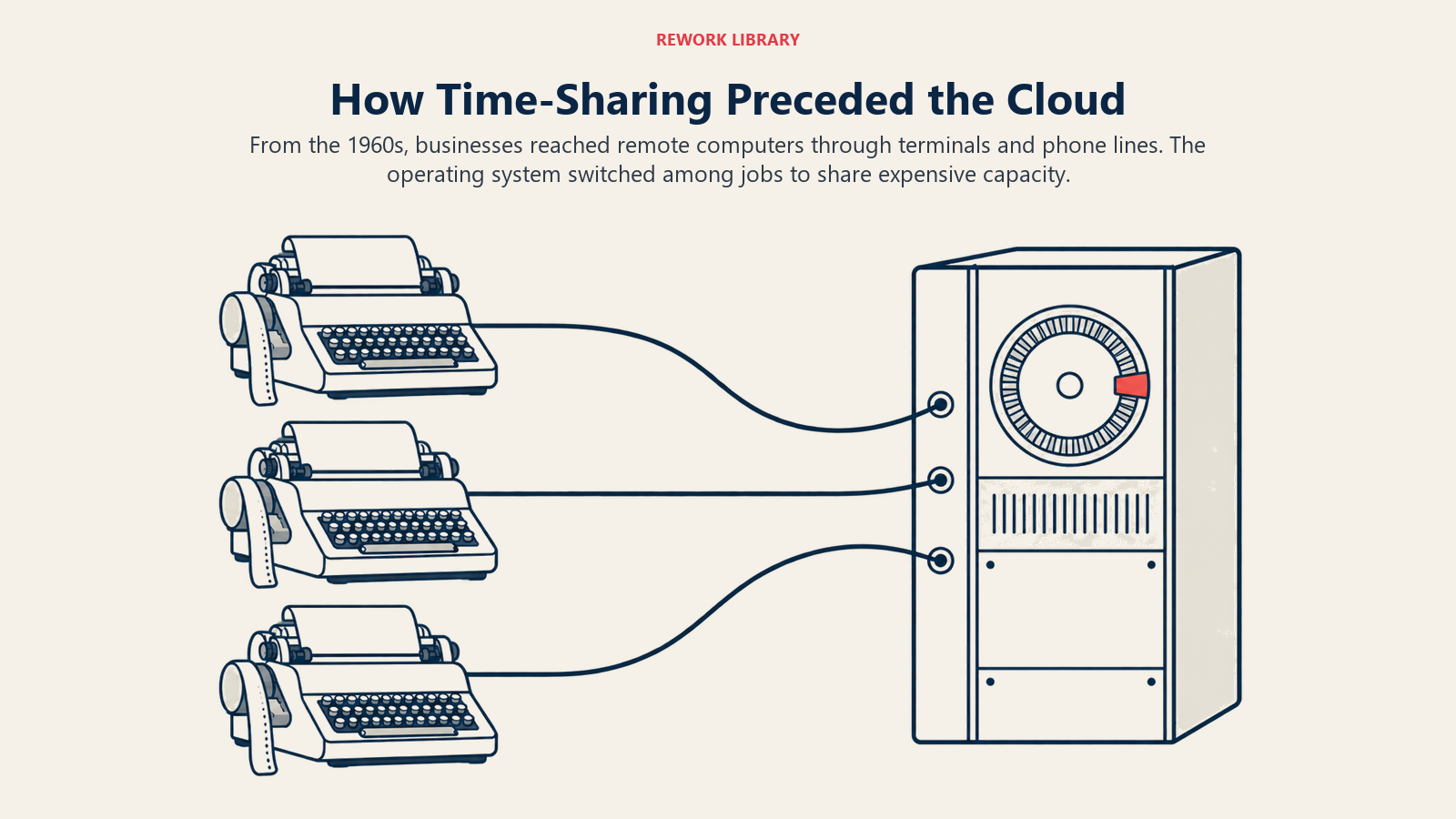
Tymshare is the clearest commercial example. Two former General Electric employees founded it to offer time-sharing to aerospace companies. Ann Hardy, a programmer who had started on IBM's Stretch supercomputer in the 1950s and joined Lawrence Livermore in 1962, joined Tymshare in 1966 and rewrote a Berkeley operating system that wasn't built for commercial use. By 1975 the company handled about 450,000 interactive sessions a month, and its Tymnet network was larger than the ARPANET by the late 1970s. For how the ARPANET itself got going, see the Internet Timeline. McDonnell Douglas acquired Tymshare in 1984, and Tymnet was later sold to British Telecom, which ran it until 2004.
Meanwhile, IBM was working on the technology that would let one machine pretend to be many. Its z/VM history timeline says CP-40 in 1964 introduced CP/CMS as an experimental time-sharing research project for System/360, that CP-67 became a supported product for key time-sharing customers in 1967, and that VM/370 was announced for System/370 on August 2, 1972. Garfinkel later attributes the shift to pay-as-you-go computing in part to virtualization, which lets resources be provisioned on demand and returned to a pool when unused.
The era made McCarthy's picture real for businesses that could afford the lines and the bills. It also showed the weaknesses: Brock notes that some users tried to crash the shared systems, and often succeeded. Shared machines meant shared risk, and security became a product feature.
For teams today: sharing infrastructure lowers cost and raises the stakes on isolation. Ask how your provider separates one customer's work from another's.
The Desktop Interlude (1981-1998)
Computing moves onto the desk and the utility idea waits
On August 12, 1981, Don Estridge unveiled the IBM PC at New York's Waldorf Hotel. It cost $1,565, had 16 KB of RAM and no disk drive, and shipped with two programs: VisiCalc and EasyWriter. A company that had once queued for a mainframe could now buy a computer for a desk. The full run of personal computing milestones is in the Computer Timeline, and the hardware side is covered in Generations of Computers.
For about 15 years the dominant picture was a computer you owned, with software you installed from disks and later from a network. Time-sharing's heyday, in Brock's phrasing, was the 1960s, 1970s and 1980s, and the PC then put a machine on the desk. The period also built what the cloud would need. The Internet and the Web grew in these years; that story is in The History of the Internet. Whatever the reasons, the pieces that would let the utility idea return, a network almost everyone could reach and a browser everyone knew, were being put in place by other people for other reasons.
The era solved the access problem and created a management problem: every desk held its own software, its own files and its own upgrade schedule. That cost is what the next era went after.
For teams today: a technology that looks like it lost may simply be waiting for its conditions. The reverse also holds, so don't write off the model you own because renting is fashionable.
The Rented Server (1999-2010)
Software, storage and servers become things you rent
The first return of the utility idea came as software. Salesforce's own history says the company set out in February 1999 to be "A World-Class Internet Company for Sales Force Automation," and incorporated on March 8. Marc Benioff, Parker Harris, Frank Dominguez and Dave Moellenhoff started building the first version of the product in a rented one-bedroom apartment at 1449 Montgomery Street on San Francisco's Telegraph Hill. On February 7, 2000, salesforce.com launched at a San Francisco event themed "The End of Software," with 1,500 attendees. It was built as an Internet company from its first day.
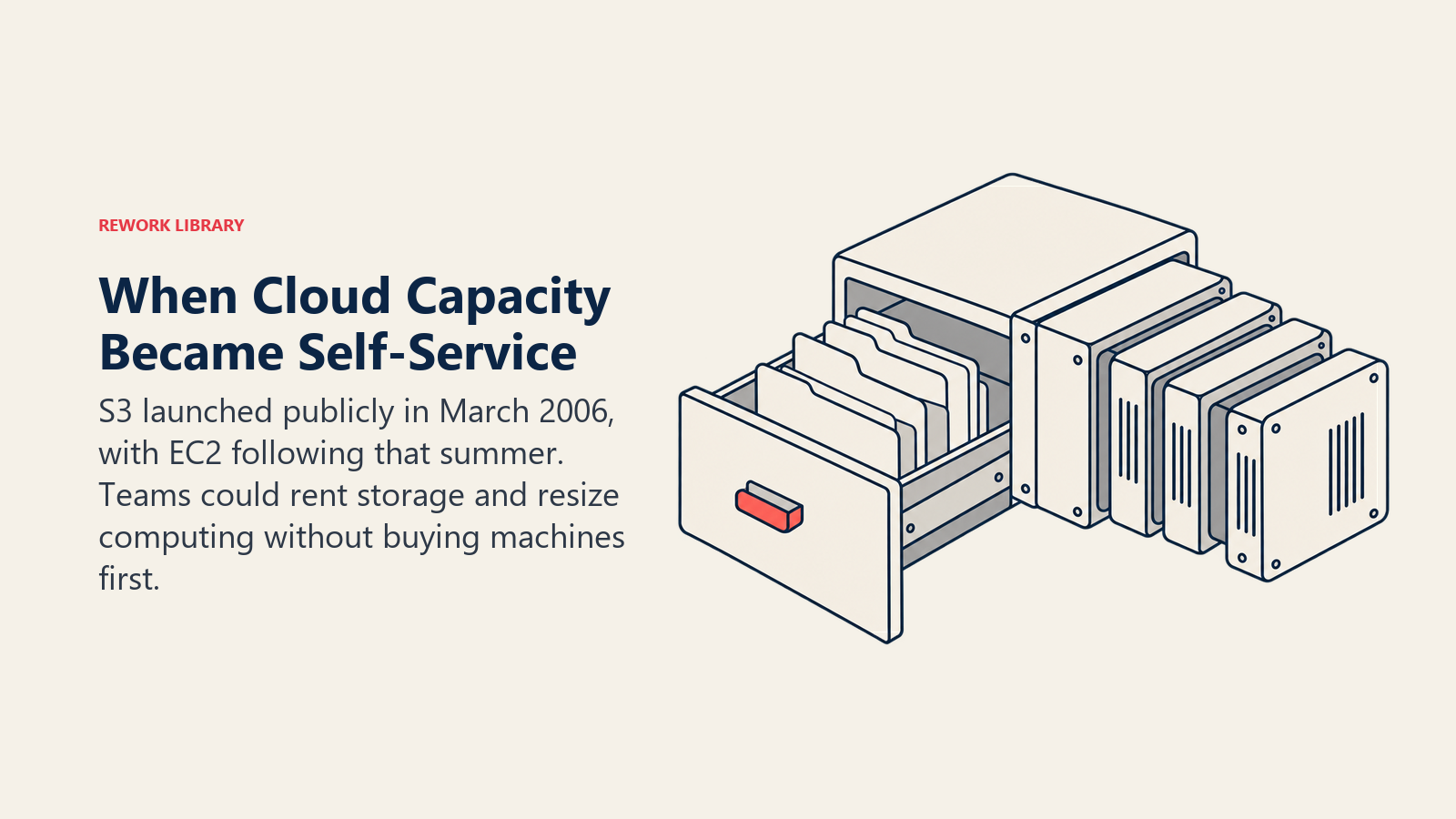
Infrastructure followed. Amazon announced the Simple Queue Service for beta testing on November 3, 2004, describing a hosted queue for buffering messages between distributed application components. AWS then launched publicly on March 14, 2006, with S3 storage as its only service and EC2 servers following a few months later. Amazon's own account says that before this, starting a tech company meant buying machines and forecasting capacity. Its first customers included Don Alvarez, a physicist whose startup FilmmakerLive built tools for remote storyboarding, and Andrew Westphal, a UC Berkeley astrophysicist whose Stardust@home project used S3 to give volunteers access to microscope images. The AWS blog says that internally S3 was described as "Malloc for the Internet." The EC2 beta that followed was pitched as "resizable compute capacity in the cloud," with users paying only for what they used. Utility pricing, at last, on a self-service basis.
The name arrived in the middle of this. On August 9, 2006, Google CEO Eric Schmidt spoke at the Search Engine Strategies conference in San Jose. Live notes record him contrasting the PC client model of about 20 years earlier with a newer one he called "Cloud computing," in which applications can be reached from any device. That is a documented early public use of the phrase, and it came five months after S3 launched.
Competitors moved quickly. Google previewed App Engine on April 7, 2008, a platform for hosting web apps on Google's infrastructure. On October 27, 2008, Ray Ozzie unveiled Windows Azure at Microsoft's Professional Developers Conference in Los Angeles, which Microsoft's release called the cloud-based service foundation under its Azure Services Platform. And in August 2008, Netflix suffered a database corruption that stopped DVD shipments for three days, which began its move away from single points of failure in its own data centers.
The era solved capital and speed: a team no longer had to buy hardware to try an idea. It created new dependence, since the provider now held the data and ran the machines.
For teams today: renting turns a capital purchase into an operating cost, and a monthly bill is easier to approve than a server order. Track what you rent, because it is easier to start paying than to stop.
The Standard Cloud (2011-2019)
Governments define it, containers carry it, a typo shows the risk
Once large buyers showed up, they needed a shared language. The US federal government's Federal Cloud Computing Strategy, dated February 8, 2011 and signed by US Chief Information Officer Vivek Kundra, described a federal IT environment with "low asset utilization" and estimated that $20 billion of the government's $80 billion in IT spending was a potential target for migration to the cloud. In September 2011, NIST's Peter Mell and Timothy Grance published SP 800-145, a definition meant as a baseline for comparing services. It describes "five essential characteristics, three service models, and four deployment models." The characteristics are on-demand self-service, broad network access, resource pooling, rapid elasticity and measured service. The service models are software, platform and infrastructure as a service. NIST stated its purpose plainly: a baseline for comparing services and deployment strategies, not a rule for how to build them.
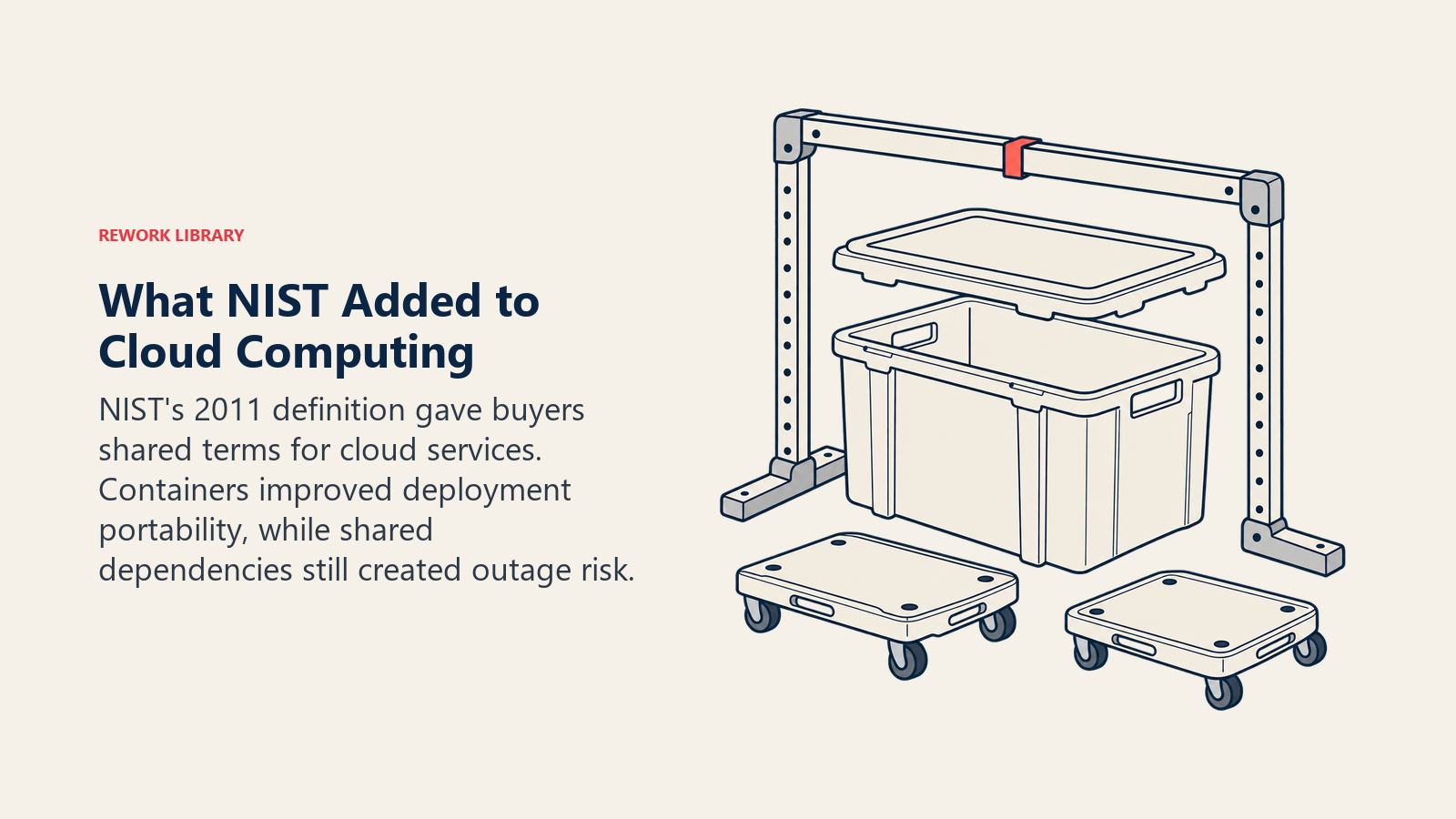
The tooling matured as well. On March 15, 2013, Docker's Solomon Hykes demonstrated Docker publicly at PyCon, arguing that "shipping to the server is hard." On June 6, 2014, Joe Beda checked in the first commit of what became Kubernetes. On November 13, 2014, AWS announced Lambda in preview, a service that runs customer code in response to events and bills by handled requests and execution time. On July 21, 2015, the Linux Foundation announced the Cloud Native Computing Foundation with 22 founding members, and Google contributed Kubernetes as a seed technology. In early January 2016, Netflix said it had finished its cloud migration after seven years and shut down the last data center components used by its streaming service. It cited wanting "highly reliable, horizontally scalable, distributed systems in the cloud," and said cost was a side benefit rather than the main driver.
The risk of concentration became visible too. On February 28, 2017, a team member debugging a slow billing process ran a command to remove a few servers, and one input was entered incorrectly. AWS's post-event summary says a much larger set was removed, S3 in the Northern Virginia region could not service requests from 9:37 AM until 1:54 PM Pacific, and dependent services, including the S3 console, new EC2 launches and Lambda, were affected. AWS changed the tool to remove capacity more slowly and added checks against going below minimum capacity. One mistyped input in one region reached every service that depended on that layer.
The era solved trust and portability: buyers could compare vendors against a common definition, and workloads could move in containers. It created the dependency problem in public view, where one provider's mistake becomes everyone's outage.
For teams today: use the NIST vocabulary when you write requirements, and plan for a provider failing. Ask what happens to your business during a multi-hour outage of the one service everything depends on.
The AI Cloud (2020s-present)
Large models arrive as another rentable service
The newest chapter repeats the old one. Training and running large AI models takes more hardware than most organizations will ever own, so the models are rented. On January 17, 2023, Eric Boyd of Microsoft announced that the Azure OpenAI Service had reached general availability, offering GPT-3.5, Codex and DALL-E 2, with ChatGPT to follow. In 2006 a company could rent storage; now it can rent a model. The physical side of this shift, the buildings and chips behind it, is in what an AI data center is.
Compared with McCarthy's 1961 sketch, the pattern is the same: capacity too big to own, billed by use, reached over a network. What is new is the layer being rented. It's no longer only storage or servers or software; it's judgment of a kind, and that raises fresh questions about where company data goes and who is accountable for an answer. These are open as of today and not yet history.
For teams today: treat AI services like earlier cloud services. Decide what data may leave the building, who owns the output, and what your fallback is when the service changes or goes down.
Key People
| Name | Role | Contribution | Year |
|---|---|---|---|
| Thomas Edison | Inventor | Opened the Pearl Street station, the first US commercial power station for incandescent lighting | 1882 |
| John McCarthy | MIT computer scientist | Suggested computing might be organized as a public utility | 1961 |
| Fernando Corbató | MIT Computation Center | Led the time-sharing prototype and CTSS; co-authored the Multics overview | 1961-1965 |
| Thomas Kurtz and John Kemeny | Dartmouth professors | Launched Dartmouth timesharing and BASIC | 1964 |
| Douglas Parkhill | Author | Wrote The Challenge of the Computer Utility | 1966 |
| Ann Hardy | Programmer and Tymshare executive | Rewrote an operating system for commercial time-sharing | 1966 |
| Marc Benioff and Parker Harris | Salesforce founders | Built and sold CRM through the browser | 1999 |
| Eric Schmidt | Google CEO | Used the phrase "cloud computing" at a San Jose conference | 2006 |
| Peter Mell and Timothy Grance | NIST | Authored the NIST definition of cloud computing | 2011 |
| Joe Beda | Google engineer | Made the first Kubernetes commit | 2014 |
Key Facts
Key Facts: Cloud Computing History
- John McCarthy suggested computing might be organized as a public utility at MIT's centennial in 1961.
- Tymshare handled about 450,000 interactive sessions a month by 1975.
- AWS launched on March 14, 2006 with one service, S3 storage.
- NIST's 2011 definition lists five essential characteristics, three service models and four deployment models.
- The 2011 federal strategy estimated $20 billion of $80 billion in federal IT spending could move to the cloud.
- Netflix took seven years to finish its move to the cloud, from a 2008 database failure to January 2016.
The Pattern Behind the History
Across six eras, the same four moves repeat. We call the sequence the Idea, Wait, Enable, Standardize loop. It is our synthesis of the dates above, not a research finding.
- An idea names the goal early. McCarthy and the Multics authors described computing as a utility years before it was affordable.
- The idea waits for conditions. Cheap desktops, then a public network and a universal browser, changed the economics before the utility came back.
- A launch makes it self-service. Salesforce in 1999 and AWS in 2006 turned an old idea into something a small team could start using in a day.
- Definitions and standards follow. NIST in 2011, containers and the CNCF in the mid-2010s let large buyers compare, move and govern what they rented.
What It Teaches Teams Today
- Separate the idea from the delivery. A model that fails in one decade may be right a decade later. Check what has changed before you reject it.
- Rent with eyes open. Utility billing is a gift when demand is uncertain and a cost trap when it isn't. Review usage on a regular schedule.
- Plan for the shared layer to fail. The 2017 S3 outage showed how one mistake reaches many customers.
- Use common vocabulary. The NIST terms make vendor comparisons and contracts clearer.
- Ask who holds the data. Each wave moved more of the company's work onto someone else's machines. Know where yours is.
The history of cloud computing reads like a long argument that good ideas wait for their moment. If you're deciding what to rent and what to own, the question to ask isn't whether the cloud is the future. It's which of your constraints (cost, speed, control or risk) the next change in the network or the price is about to move.

Co-Founder, Rework.com