Ada Lovelace and the First Computer Program
Turn this article into takeaways for your work.


Each assistant summarizes the article only for you and suggests best practices for your work.
In 1833 a teenager stood in a London drawing room. An inventor more than twice her age showed her part of a calculating machine. Ten years later she published the first long account of how such a machine would be programmed.
The "first computer program" is a table of operations printed in 1843. It was Note G, the last of seven notes that Ada Lovelace added to her translation of an Italian engineer's paper on Charles Babbage's Analytical Engine. The table showed how that machine, never built, would compute Bernoulli numbers. Whether it's truly the first program is contested. Babbage had written small programs for the engine in 1836 and 1837, and historians still argue over how much of Note G is Lovelace's own. For the wider field, see the history of computers. For the man whose engine she described, see Charles Babbage and the Analytical Engine.
Timeline at a Glance
| Year | Milestone | Why It Mattered |
|---|---|---|
| December 10, 1815 | Augusta Ada Byron is born in London | The daughter of a poet is raised on mathematics. |
| June 5, 1833 | Ada, aged 17, meets Babbage at a party | A weeks-later visit to his Difference Engine hooks her. |
| 1834 | Babbage conceives the Analytical Engine | A design for a general-purpose, programmable machine. |
| 1836-1837 | Babbage writes several small programs in his notebook | The reason "first programmer" is disputed. |
| 1840 | Babbage presents the engine in Turin | Luigi Menabrea takes notes at the only public presentation. |
| October 1842 | Menabrea's paper appears in French | The text Lovelace would translate. |
| February-September 1843 | Lovelace writes Notes A to G, published in Taylor's Scientific Memoirs | Note G holds the Bernoulli number program. |
| November 27, 1852 | Lovelace dies at 36 | Her work goes quiet. |
| 1864 | Babbage confirms in his autobiography that he supplied the formulas | Babbage's own account of his share of the work. |
| 1953 | Bowden's Faster than Thought gives Babbage and Lovelace prominence | The rediscovery begins. |
| 1980 | The new military language is named Ada | Her name enters every programmer's vocabulary. |
| 1985 | Dorothy Stein's critical biography appears | The authorship debate becomes public. |
| 2009 | Ada Lovelace Day is founded | She becomes an annual symbol for women in STEM. |
Lady Byron's Plan (1815-1842)
A poet's daughter is raised on mathematics
Imagine a girl in the 1820s whose mother was determined that she would not turn out like her father. Augusta Ada Byron was born on December 10, 1815, the daughter of the poet Lord Byron and the mathematician Annabella Milbanke. Byron left England in April 1816 and never saw her again. According to Scientific American's 1999 account by Eugene Eric Kim and Betty Alexandra Toole, Lady Byron raised her to be a mathematician and a scientist and discouraged her literary leanings, in part to distance her from her father. She was tutored by Mary Somerville, a prominent scientist, and later by the logician Augustus De Morgan.
That education was unusual. The same article notes that British mathematics was floundering in the first half of the 19th century and that mathematical teaching for young people, and especially young women, remained poor. De Morgan taught Ada by post. The Clay Mathematics Institute's online edition of her papers describes the Lovelace-De Morgan correspondence of 1840-1 as an informal correspondence course in which De Morgan gently prompted her to fill gaps in her knowledge, especially in calculus. The letters are preserved at the Bodleian Library in Oxford.
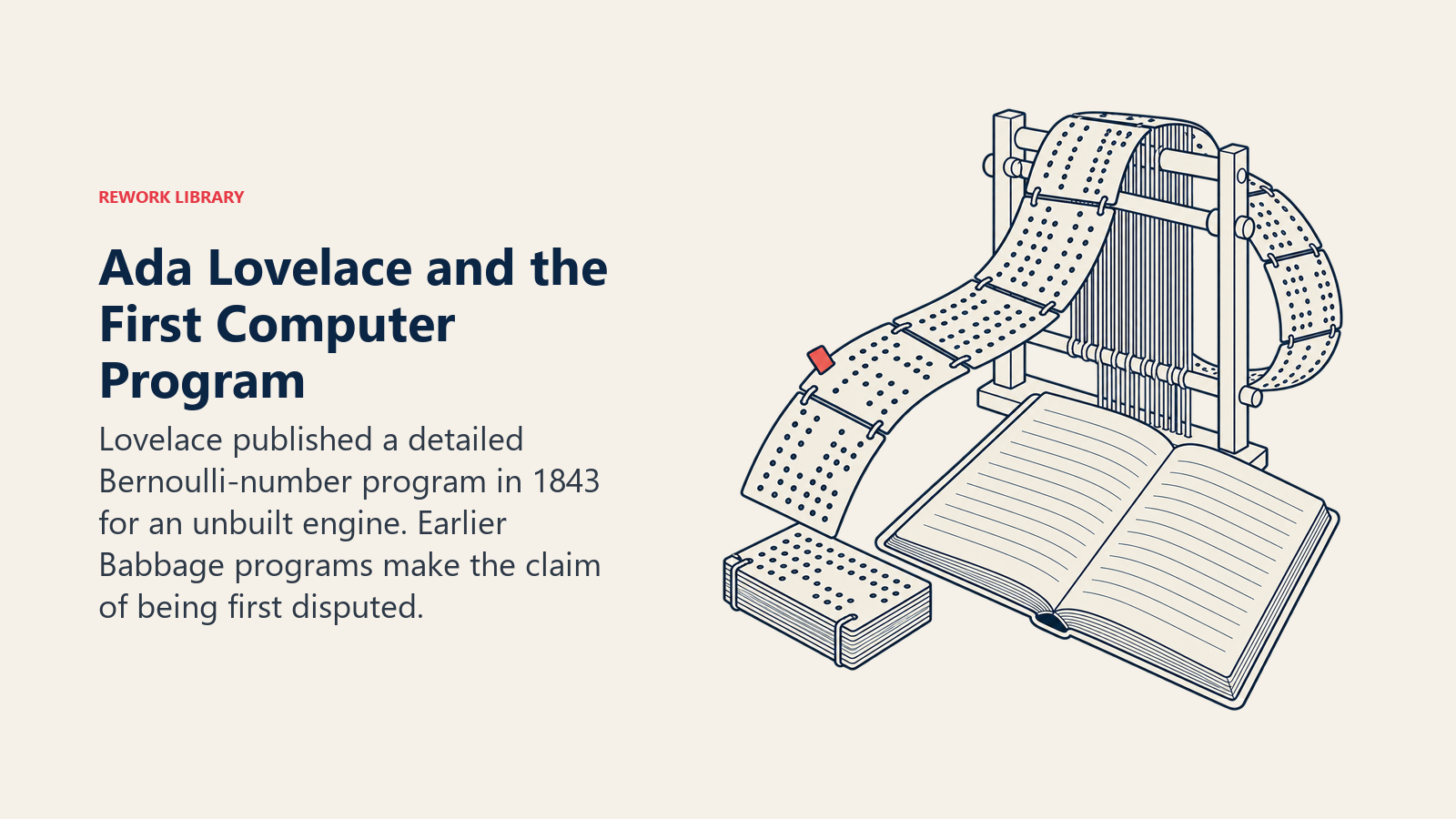
Then came the party. On June 5, 1833, Ada met Charles Babbage, and a few weeks later he showed her the partly built Difference Engine, a machine for generating mathematical tables. She was captivated, according to Scientific American. By then Babbage was already thinking about a bigger machine. The Computer History Museum dates his conception of the Analytical Engine to 1834, as a general-purpose programmable computing machine. As Kim and Toole describe the design, it had a "store" for memory, a "mill" for calculation, a punched-card reader for input, and the ability to repeat instructions or branch on a condition. The punched cards were an idea borrowed from the Jacquard loom.
Babbage's one public presentation of the engine came in 1840 in Turin, where a young engineer, Luigi Federico Menabrea, took notes. Menabrea's paper, "Sketch of the Analytical Engine", appeared in French in the Bibliothèque Universelle de Genève in October 1842. It explained the mathematics of the engine but gave little room to programming itself. It also left an opening. Someone who understood both the machine and the English-speaking audience could translate it and say much more.
The problem this era left was one of audience. The engine existed as drawings and a fragment, and the one published description was in French. For a team today the lesson is plain: a design that lives only in its creator's head, or in the wrong language for the people who must fund it, does not spread.
The Notes of 1843 (1842-1843)
Lovelace translates Menabrea, then outgrows him
The turning point is Menabrea's paper reaching Lovelace in 1842. By then she had married William King, who became the earl of Lovelace. When Babbage heard in early 1843 that she was translating the paper, Scientific American reports, he encouraged her to annotate it. She worked between February and September 1843, writing seven notes lettered A to G that together are more than twice as long as Menabrea's article. The translation and notes were published in Richard Taylor's Scientific Memoirs, volume III, in 1843, signed with her initials A.A.L., which the Fourmilab edition reproduces.
Drafts and letters went back and forth between them for months. She relied on him to explain the machine and to confirm that her descriptions were accurate, but she often surprised him. She resisted changes to her prose. In August 1843, a month before the final proofs went to the printer, Babbage tried to add a preface complaining about the British government's lack of support for the engine. Lovelace was furious, and his preface was published separately and anonymously.
The notes do four things that matter for this history. In Note A she separates the Difference Engine, which tabulates, from the Analytical Engine, which can develop and tabulate any function. In Note A, too, she gives the line most often quoted from her, that the engine "weaves algebraical patterns just as the Jacquard-loom weaves flowers and leaves". Later notes cover the punched-card mechanism, the variables and the idea that a set of cards could be reused. And, in a passage on the engine's symbolic power, she suggested it might compose music if the relations of sounds could be expressed in its notation, an idea the Computer History Museum credits as the first statement that such machines could be used beyond mathematics.
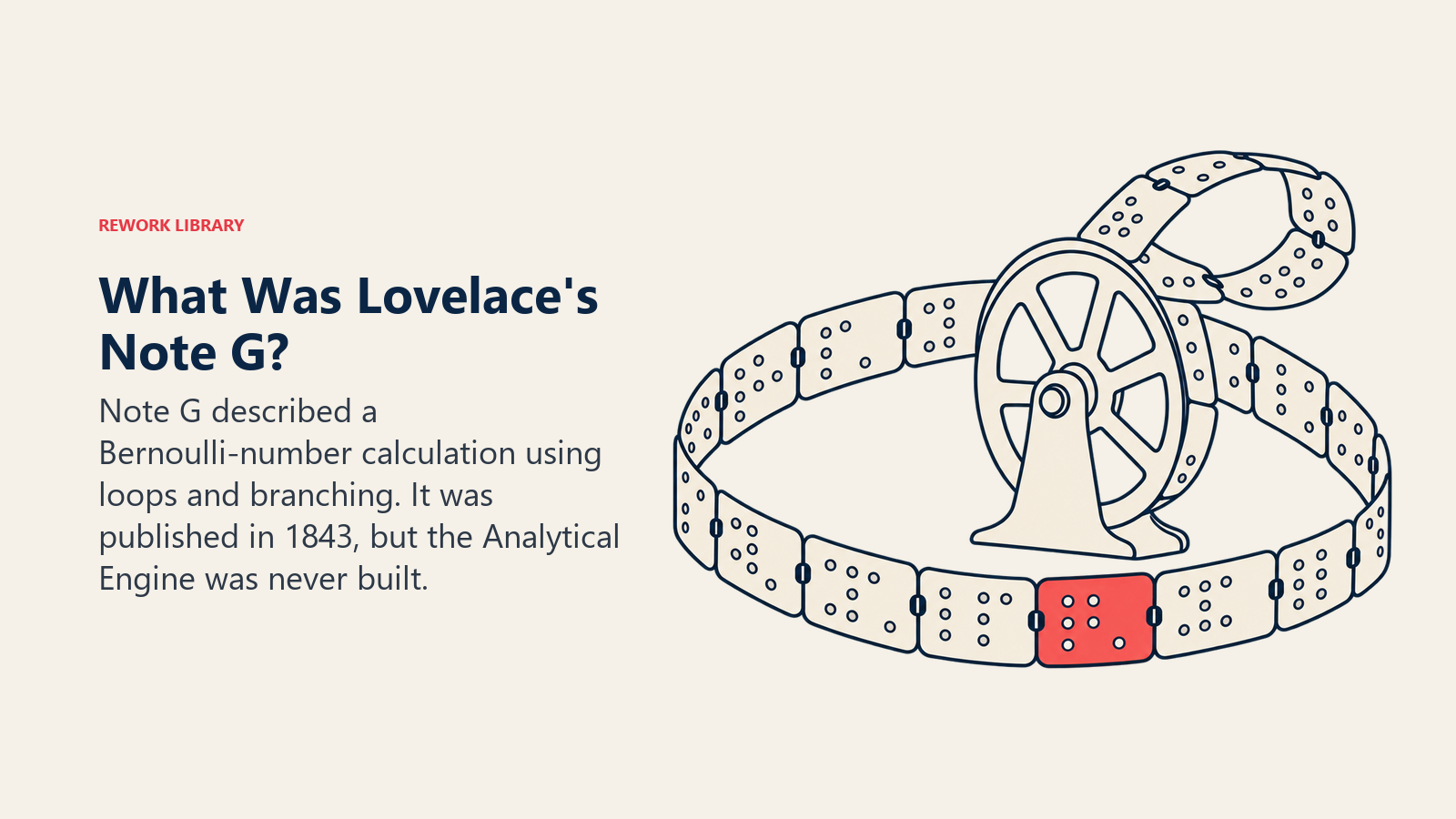
Note G is the last of the seven. In a July 1843 letter, Lovelace wrote to Babbage that she wanted to add a Bernoulli number example and asked him to "Give me the necessary data & formulae". Kim and Toole conclude that including the program was her idea. The program computes Bernoulli numbers, a sequence of figures from Jakob Bernoulli's work on probability, using two loops and the engine's ability to branch. They call it far more ambitious than any program Babbage had written for the engine. Babbage, in his 1864 autobiography, confirmed that he had supplied the formulas. In the same Note G she also wrote that the engine "has no pretensions whatever to originate anything", a sentence Alan Turing would later call Lady Lovelace's objection.
The program had flaws. Kim and Toole point to a bug in Operation 21, where the third factor of the denominator should be 4, not 3. Nobody could run it, because the engine was never built.
What this era solved was visibility: for the first time, the way to instruct a general-purpose machine was written down at length, with a notation, a worked example and a stated limit. It created a new problem. A document without a machine has no users, so its fate depended on whether anyone would later care. For teams today, the notes are an early case of documentation that outlives the product.
The Quiet Century (1843-1952)
An unbuilt machine leaves the notes unread
After 1843 the story goes quiet. Lovelace's health, poor on and off throughout her life, declined further and limited her ability to practice mathematics. She died on November 27, 1852, probably of uterine cancer, and at her request was buried next to her father, as Scientific American records. Her own notebook, which might have shown how she reached her results, is lost. In 1864 Babbage published his autobiography, and he died in 1871. A portion of the engine, part of the mill and the printing devices, was assembled shortly before his death.
The notes had no immediate successors. Kim and Toole call hers the only paper on programming a computer at length to exist for the next century. When computers did arrive, their builders mostly worked it out for themselves. Howard Aiken, who designed the Harvard Mark I in 1944 and liked to think of himself as Babbage's successor, was not familiar with Lovelace's work and did not appreciate the importance of conditional branching. The authors' conclusion is that what we now know about designing and programming computers may not trace directly to Babbage and Lovelace, though they can claim precedence for many of the concepts.
The thread did not break entirely. Turing's 1950 paper "Computing Machinery and Intelligence" quotes a memoir on the Analytical Engine and treats Lovelace's remark about originating nothing as the sixth of his objections. That link, and what he made of it, is covered in the history of the Turing Test. It means her notes were known to at least one founder of the field before the revival.
The lesson of the quiet century for a team is the cost of a missing runtime. Good specifications written ahead of the platform can wait a century for the platform, and the people who later build it may never read them. If you want a design to matter, tie it to something that runs.
Bowden's Prophet (1953-1979)
A sales brochure puts Lovelace back in print
The comeback starts in 1953 with an unlikely source. Bertram Vivian Bowden worked in sales and marketing for Ferranti in Manchester, where the firm was developing a commercial version of the Manchester University Mark I, and he edited a book that began as a sales brochure. Faster than Thought, a symposium on digital computing machines, grew with help from the British computing community. The Computer History Museum catalogs it as a 416-page book from the publisher Pitman. According to the IEEE Computer Society biography, it gave a place of prominence to Charles Babbage and to Ada, Lady Lovelace, when their achievements were little known. Kim and Toole note that Bowden called her a "prophet".
This was a rediscovery rather than a discovery. The notes had been in print since 1843. What changed was an audience. In the 1950s there were real computers and working programmers, and a history book written by someone in the business put her name in front of them.
Bowden's book made her visible; it did not settle who wrote what in Note G. The next change came from a government, not a historian.
For teams today the point is that reputation lags the work. A document may need a champion and an audience that has a use for it before anyone reads it again.
The Ada Years (1980-2008)
A programming language and a biography reopen the case
The turning point is a name. In 1980, the name Ada was selected for the standard language the United States Department of Defense was creating for military embedded systems. A university history of the language says the name honors the person now considered the world's first computer programmer. The design was led by Jean Ichbiah's team, the language was standardized by ANSI in 1983 and by ISO in 1987, and Kim and Toole observe that no other woman in computing has had a language named after her. A sibling article, the history of programming languages, places Ada among the other families.
The name made the claim famous, and it also invited scrutiny. In 1985 Dorothy Stein of the University of London published Ada: A Life and a Legacy, which Kim and Toole call the most outspoken critique. Stein asserted that Lovelace was not a capable enough mathematician to write the Bernoulli program herself. Her evidence, as they summarize it, was twofold. First, Lovelace translated a French typo in Menabrea's paper ("le cos. de n" for "le cas de n") literally, producing an impossible mathematical statement. Second, letters to her tutors showed trouble with functional substitution.
Kim and Toole answered in 1999. They argue the typo error was not unique to Ada, since she also miswrote her own initials on the last note and her 65 pages were reviewed by Babbage and others who missed the same mistakes. On the second point they note that she was learning by post from tutors who helped her for free, so she was more likely to write about what she did not understand than about what she had grasped. They conclude she was certainly the author of the notes and that "the truth lies somewhere in the middle". They add that Babbage himself called her his "interpretress".
They also state the point many popular accounts get wrong: many people incorrectly claim Ada was the first computer programmer, because Babbage wrote the first programs for his engine, though most were never published. That is where the sentence "Ada Lovelace wrote the first program" becomes precise. She wrote the first published program, and one more complex than any of Babbage's earlier ones.
What this era solved was recognition. What it created was a polarized argument, with Lovelace as saint on one side and impostor on the other, and not enough primary evidence in public to settle it. Teams today can see the same pattern in any shared project with unequal credit: if nobody records who did what, the story turns into a fight later.
The Icon and the Archive (2009-present)
Her name becomes a day, and her papers go online
This era overlaps the previous one, because the argument continued while the symbol grew. In 2009, Suw Charman-Anderson founded Ada Lovelace Day, held on the second Tuesday of October each year as a celebration of women's work in science, technology, engineering and maths. It started as a day of blogging and is now an international event. It turned Lovelace from a footnote into a standing reference point.
The evidence moved in parallel. The Clay Mathematics Institute's edition of her mathematical papers draws mainly from Box 170 of the Lovelace Byron family papers at the Bodleian Library, including the De Morgan letters, with the permission of her descendant, the Earl of Lytton. Historian of mathematics Christopher Hollings has studied that correspondence, and the Plus magazine report on an Oxford symposium, published on December 17, 2015, shows how the experts now frame the question.
The disputes narrowed rather than ended. The table below lays out the positions as documented in the sources above, with each side's evidence.
| Question | Position | Who and what evidence |
|---|---|---|
| Who wrote the first programs for the engine? | Babbage, in 1836-1837 | Kim and Toole: small programs in his notebook, mostly unpublished. |
| Who authored Note G? | Lovelace | Kim and Toole: she wrote the notes; Babbage reviewed drafts. Babbage wrote that the selection of examples was "entirely her own". |
| Did Babbage help with the Bernoulli program? | Yes, with the formulas | Babbage's 1864 autobiography, per Kim and Toole. Plus reports that she also caught a mistake in his work. |
| Was Note G a new idea? | Not in its content | Doron Swade, quoted by Plus: it contains no idea without precedent in Babbage's work, and has "algorithmic intention". |
| Where is her original contribution? | Vision and exposition | Plus, and the Computer History Museum: non-numeric uses, and clear explanation. |
| Was she a weak mathematician? | Disputed | Stein (1985) said yes; Kim and Toole replied with the evidence above. |
Stephen Wolfram's 2015 essay Untangling the Tale of Ada Lovelace argues that Lovelace was the driver of the exposition: Babbage suggested illustrations and may have helped, but she chose the content and algebra and caught an error in his Bernoulli work. That is a secondary reading, and it sits on the Lovelace-leaning side of the table. Swade's reading is closer to a cautionary note on how much was new.
What survives all of it is a modest, defensible claim. The Notes are the first long published treatment of programming a general-purpose machine, and Note G is the first published program for one. Whether "first programmer" belongs to Lovelace or to Babbage depends on whether you count published or written, and on what you mean by a program. For the broader question of what counts as a computer at all, see who invented the computer.
For teams today: treat the archive as the way out of a credit dispute. Keep drafts, letters and revision history, because they are what lets later people judge fairly.
Key People
| Name | Role | Contribution | Year |
|---|---|---|---|
| Ada Lovelace | Mathematician and translator | Wrote Notes A to G, including the Bernoulli number program | 1843 |
| Charles Babbage | Inventor | Designed the Analytical Engine; conceived it in 1834 | 1834-1871 |
| Luigi Federico Menabrea | Engineer, later Italy's prime minister | Took notes at the 1840 Turin talk and published them in 1842 | 1840-1842 |
| Lady Byron (Annabella Milbanke) | Mathematician, Ada's mother | Directed her mathematical education | Childhood and youth |
| Augustus De Morgan | Mathematics professor | Taught Ada by correspondence | 1840-1841 |
| Mary Somerville | Scientist | Tutored Ada in mathematics | Youth |
| B. V. Bowden | Ferranti salesman and editor | Edited Faster than Thought | 1953 |
| Dorothy Stein | Biographer | Questioned Lovelace's mathematical ability | 1985 |
| Doron Swade | Curator and historian | Argued Note G held no idea new to Babbage | 2015 |
| Suw Charman-Anderson | Writer | Founded Ada Lovelace Day | 2009 |
Key Facts
- Lovelace's notes were more than twice as long as the Menabrea article she translated, and ran from Note A to Note G.
- Babbage wrote small programs for the engine in 1836 and 1837, several years before Note G.
- Scientific American's authors note a bug in Lovelace's program, in Operation 21, where a denominator factor should be 4, not 3.
- Menabrea's paper appeared in the Bibliothèque Universelle de Genève in October 1842.
- The De Morgan correspondence of 1840-1 is held in Box 170 of the Lovelace Byron papers at the Bodleian Library.
- The Ada language took its name in 1980 and was standardized by ANSI in 1983.
The Pattern Behind the History
Four moves repeat across the six eras. We call the sequence the Spec-Before-Machine Pattern. It is our synthesis of the history above, not a research finding.
- Specify ahead of the hardware. Babbage designed in 1834, wrote programs in 1836 and 1837, and Lovelace published in 1843, with no engine to run any of it.
- Explain to a new audience. Menabrea's French paper was mathematical. Lovelace's English notes made programming concrete, with a notation, a table and a stated limit.
- Contest the credit. When two people share a result, later readers split it differently: Babbage's 1864 account, Stein's 1985 critique, Kim and Toole's 1999 reply, Swade's 2015 reading.
- Let a champion decide what survives. Bowden in 1953, the Ada language in 1980 and Ada Lovelace Day in 2009 each put the work back in front of people who could use it.
What It Teaches Teams Today
- Write the spec before the platform exists, and make it readable. Her notes outlived the engine because they explained the idea, not just the steps.
- Review for correctness, not just clarity. Babbage and others reviewed her 65 pages and still missed a mistranslated typo and a wrong set of initials.
- Log authorship while the work is fresh. Letters and drafts are what let historians reconstruct who did what, and what let the experts reach a defensible middle position.
- State your limits. Her own line, that the engine originates nothing, is still the right caution for any automated system.
- Credit the translator. Turning a specialist's work into something a wider audience can use is a contribution of its own.
For a longer view of how this one idea grew into software as an industry, read the computer timeline and the story of mechanical calculators that came before Babbage. The claim that Ada Lovelace wrote the first program is both defensible and incomplete, and holding both at once is the honest way to tell it. It also leaves a practical rule for any team: put the explanation in writing, in public, with names attached, because someone will want to know later who did what.

Co-Founder, Rework.com