The History of the Smartphone
Turn this article into takeaways for your work.


Each assistant summarizes the article only for you and suggests best practices for your work.
People wanted to reach each other anywhere. They also wanted their calendars, contacts and messages with them. The problem was twofold.
The smartphone has no single birthday. A pocket device that combined a phone with a computer reached the market in the early 1990s with IBM's Simon. The version that changed daily life arrived with Apple's iPhone in 2007 and Google's Android phones in 2008. The phone and the pocket computer grew up separately for decades. The smartphone is what happened when networks, batteries and touch screens finally let them merge. For the wider story, see The History of Computers and the computer timeline. This article follows the phone. It builds on the history of the microprocessor, because every smartphone is a computer first.
One caution on "first." Whether the first smartphone was the IBM Simon, a Nokia, a BlackBerry or the iPhone depends on how you define the word, so this article names the contenders and says what each one did.
Timeline at a Glance
| Year | Milestone | Why It Mattered |
|---|---|---|
| 17 June 1946 | A St. Louis driver makes a call from a car on a Southwestern Bell system | The first mobile telephone service, but only a handful of channels per city. |
| 1947 | Donald H. Ring of Bell Labs conceives cellular service | The cell and frequency reuse idea that every later phone network depends on. |
| 3 April 1973 | Motorola's Martin Cooper makes a handheld call | A prototype shows a phone can be carried in the hand. |
| October 1981 | The FCC announces 800 MHz spectrum for cellular | Regulation finally opens the door for a commercial service. |
| October 1983 | AT&T and Illinois Bell open the first modern cellular system in Chicago | Cellular becomes a product. |
| 1993 | Apple ships the Newton and the Computer History Museum dates the IBM Simon to the same year | The handheld computer and the phone-plus-organizer both reach buyers. |
| 1996 | The Palm Pilot is introduced | A handheld that people actually bought in volume. |
| 19 January 1999 | RIM releases the BlackBerry 850 | Wireless email in a pocket. |
| February 1999 | NTT DoCoMo launches i-mode | Mobile internet service for ordinary phone users. |
| 9 January 2007 | Apple announces the iPhone | A phone, an iPod and an internet device in one touch screen. |
| 5 November 2007 | The Open Handset Alliance announces Android | An open platform backed by 34 companies. |
| July 2008 | The App Store passes 10 million downloads in its first weekend | Third-party software becomes the product. |
| 22 October 2008 | Android Market launches with the T-Mobile G1 | A second ecosystem arrives. |
| 27 July 2016 | Apple says it has sold its billionth iPhone | The scale of one product line. |
| 18 May 2021 | Google says Android has more than 3 billion active devices | A platform larger than any single phone. |
The Car Phone Years (1946-1983)
Mobile calling waits for cells, spectrum and a handheld
Picture a 1946 sedan with a handset under the dashboard and a transmitter serving a whole city. On 17 June 1946, according to the Engineering and Technology History Wiki, a driver in St. Louis placed a call on a system launched by Southwestern Bell, one of AT&T's local companies. The same history says the early design used one central transmitter that provided "a handful of channels for an entire metropolitan area." By 1948, service was offered in nearly 100 cities and highway corridors, with about 5,000 customers. This was a precursor, not a smartphone: it carried voice and nothing else, and it lived in a car.
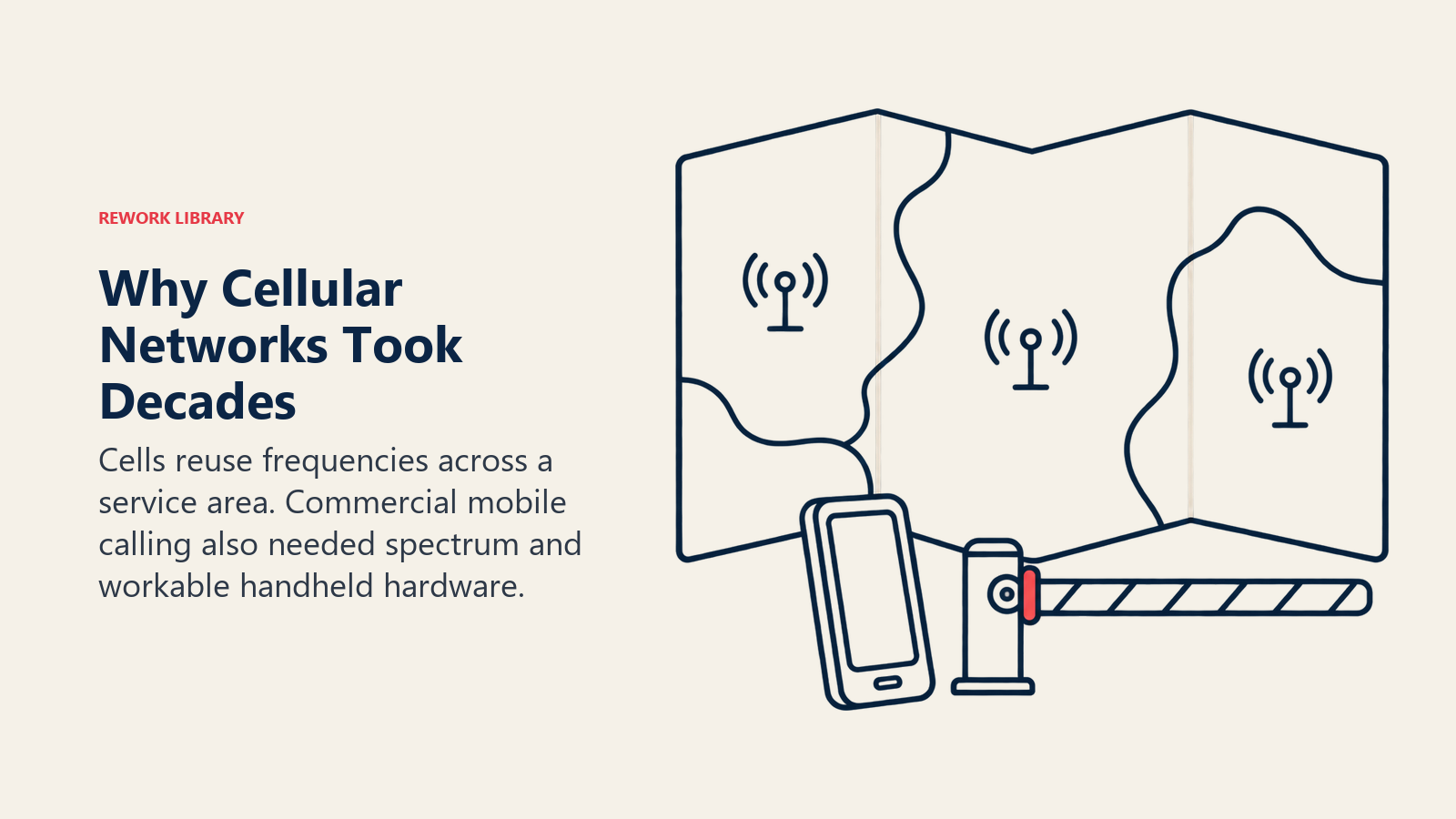
The idea that fixed the capacity problem came a year later. In 1947, Donald H. Ring at Bell Labs conceived cellular service: many low-power transmitters in cells, with frequencies reused and calls switched between cells. The technology and spectrum did not yet exist. AT&T applied to the FCC for more spectrum in 1946 and 1958, and none was granted until 1968. In 1971 AT&T submitted its report on an analog cellular system. Then regulators moved: in October 1981 the FCC announced it would allocate two swaths of 800 MHz frequencies to cellular, with two licenses per market.
Meanwhile the phone left the car. Motorola's team, led by Martin Cooper, demonstrated a working prototype in April 1973. Ericsson's history dates the prototype call to 3 April 1973, and ETHW says Cooper's first call went to Joel Engel at Bell Labs, a rival working on the same problem. The prototype weighed 45 ounces and its battery lasted about 30 minutes. The commercial version, the DynaTAC 8000X, was approved by the FCC in September 1983, according to Ericsson, and listed at $3,995 with roughly 30 minutes of talk time. Thousands of customers joined a waiting list anyway. AT&T and Illinois Bell opened the first modern cellular system in Chicago in October 1983.
So by 1983 the world had a handheld phone and a network built on cells. It did not have a computer in the phone. The era's problem was cost and weight, and its lesson was that the network took longer than the device.
For teams today: the invisible infrastructure usually sets the pace. The 1947 cell idea waited decades for spectrum, and the product followed the rules, not the other way around.
The Pocket Computer Years (1992-1998)
Handheld computers and phones live separate lives
On the other side, the computer shrank on its own track. The turning point is a marketing phrase. John Sculley, Apple's president, called the Newton a "Personal Digital Assistant" in 1992, and the Computer History Museum records Apple shipping the first Newton in 1993. It was a pen-based handheld. The same museum's account says Newton and rival pen-based handhelds such as the EO Personal Communicator were well-financed, heavily hyped devices that failed in the market, costing investors about a billion dollars together. Apple discontinued the line in 1998.
These devices matter to the smartphone for two reasons. They proved people wanted contacts, notes and a calendar in a pocket. And they could not talk to anything. They were computers that needed a cable and a desk. The microprocessors that powered them are covered in the history of the microprocessor, and for how people learned to point at screens, see the history of the mouse and GUI.
Meanwhile the phone remained a phone. Calls were analog, and a cell phone was a business tool or a status object. The two lines of development, the organizer and the phone, were still waiting to meet.
For teams today: being early with the right idea is not the same as winning. The pen computers had the concept and lacked speed, price and a network.
The Simon and the Hybrids (1993-2001)
Phone, organizer and email start to merge
Here the two lines touch for the first time. The device most often called the first smartphone is the IBM Simon. The Computer History Museum describes the IBM/BellSouth Simon Personal Communicator as introduced in 1993 and priced at $899. It combined a mobile phone, a personal organizer, a fax and a pager, and it used a touch screen instead of buttons for dialing and typing. The museum describes it as "Brick-like in both weight and appearance," with less than 30 minutes of talk time, and still calls it the first smartphone. Accounts differ on the Simon's exact dates, since a demonstration, an announcement and retail sales were different moments, and the museum's year is 1993.
The Simon was a precursor of the form and an honest one-off: it did not spawn a market. What did was a series of hybrids that each solved one piece. The Palm Pilot arrived in 1996. The Computer History Museum says its selling points were one-button synchronization with a PC, handwriting recognition, fast response, pocket size and a $299 price, and that U.S. Robotics sold about a million in the first 18 months. Palm called it a "connected organizer" rather than a PDA.
Then email moved to the pocket. On 19 January 1999, Research In Motion released the BlackBerry 850. History.com describes it as a two-way pager with email, not a phone, and quotes RIM calling it "a breakthrough wireless email solution for mobile professionals." RIM's first BlackBerry phone came in 2002. In Japan, a month later, NTT DoCoMo launched i-mode in February 1999, which it calls the world's first mobile Internet-services platform. It showed that ordinary phone users would pay for web-style services on a small screen. Online services of this sort are part of the story in the history of the World Wide Web.
The era ended with a pile of partial answers. One device did email, one did organizing, one did web pages, and none did all of it well. The new problem was that every maker was building its own closed software.
For teams today: a market often forms when one narrow job is done well, such as email for people who live in email. Pick the job first, then widen.
The iPhone Shock (2007-2008)
A touch screen and a store reset the category
On 9 January 2007, at Macworld in San Francisco, Apple announced the iPhone, headlined "Apple Reinvents the Phone with iPhone." Steve Jobs described three products in one: a widescreen iPod with touch controls, a mobile phone and an internet communications device. The device was controlled with multi-touch, using taps, flicks and pinches instead of a stylus. It went on sale at 6:00 p.m. on Friday, 29 June 2007, at $499 for 4GB and $599 for 8GB, with a limit of two per customer. Apple said it sold its millionth iPhone 74 days after launch.
The first iPhone had no App Store. The turning point came in 2008. Apple announced the iPhone 3G on 9 June 2008 and said hundreds of third-party applications had already been built with the new SDK. The same release lists over-the-air push email through Microsoft Exchange ActiveSync, a feature aimed squarely at the BlackBerry's business customers. Then, in July, the store opened. Apple's 14 July release says more than 10 million applications were downloaded in the first weekend, with more than 800 native applications available, over 200 of them free. Jobs called the store "a grand slam."
Android followed on a different model. On 5 November 2007 the Open Handset Alliance announced Android as "the first truly open and comprehensive platform for mobile devices", backed by 34 founding members including Google, T-Mobile, HTC, Qualcomm and Motorola. The first Android phone, the T-Mobile G1, went on sale with Android Market on 22 October 2008. Google's post says the market opened with over 50 apps, a one-time $25 developer registration fee, and a planned 70% revenue share to developers for paid apps.
Notice what changed. The iPhone and Android phones were not the first devices to join phone and computer. They were the first to make the software layer open to outsiders, through a store and an SDK, and to make the screen the keyboard. The operating-system choices underneath are covered in the history of operating systems. The new problem: two ecosystems, each with rules and a cut of the revenue.
For teams today: a platform wins by letting others build on it. The device was the invitation. The store was the business.
The Platform Years (2009-present)
Two ecosystems scale to billions of pockets
The years after 2008 are less about a single launch and more about scale. Apple's newsroom reports that CEO Tim Cook told employees on 27 July 2016 that the company had sold its billionth iPhone. Google's Android blog said in 2018 that there were more than 2 billion active Android devices, and in a post dated 18 May 2021 that Android had grown to more than 3 billion active devices. The two figures count different things, units sold versus devices in active use, so they shouldn't be added or compared one for one.
The category's early leader fell fast. The History.com account says BlackBerry reached about 43 percent of the U.S. smartphone market in early 2010 and that, by 2013, RIM held under six percent. That is one secondary source for the figures, and the direction of the story matches the platform shift above.
The phone also became the host for other technologies. The same pocket device now carries cameras, maps, payments and, on newer chips, neural engines. The graphics hardware behind its screen follows the path in the history of the GPU, and the apps it runs depend on servers described in the history of cloud computing. Chips shrink on the schedule examined in Moore's Law history, and Wi-Fi, covered in the history of Wi-Fi, is the other radio in the device. For the desktop side of the story, see the history of the personal computer.
The era is still open. The computer people use most is the one in their pocket, and the questions now are about attention, privacy and who controls the store.
For teams today: your customers' main computer may be a phone. Test the work on a small screen, with a thumb, on a poor connection, before you call it done.
Key People
| Name | Role | Contribution | Year |
|---|---|---|---|
| Donald H. Ring | Bell Labs engineer | Conceived cellular service with cells and frequency reuse | 1947 |
| Richard Frenkiel, Joel Engel and Bill Jakes | Bell Labs | Pioneered cellular telephony; Engel received Cooper's first handheld call | 1960s-1973 |
| Martin Cooper | Motorola engineer | Led the team behind the first handheld cellular prototype | 1973 |
| John Sculley | Apple president | Called the Newton a Personal Digital Assistant | 1992 |
| Jeff Hawkins | Palm co-founder | Palm Computing, maker of the Palm Pilot | 1996 |
| Steve Jobs | Apple CEO | Announced the iPhone | 2007 |
| Open Handset Alliance members | 34 founding companies | Announced Android | 2007 |
Key Facts
- On 17 June 1946 a St. Louis driver placed the first mobile telephone call on a Southwestern Bell system.
- AT&T and Illinois Bell opened the first modern cellular system in Chicago in October 1983.
- The Computer History Museum dates the IBM Simon to 1993 at $899.
- Apple sold its millionth iPhone 74 days after launch in 2007.
- The App Store passed 10 million downloads in its first weekend in July 2008.
- Google said in May 2021 that Android had more than 3 billion active devices.
The Pattern Behind the History
The same four moves repeat across the smartphone's history. We call the sequence the Network, Device, Platform Cycle. It's our synthesis of the history, not a research finding.
- The network comes first. Cells were conceived in 1947 and waited for spectrum until the 1980s.
- The device finds a narrow job. Car phones, organizers and email pagers each did one thing well.
- The pieces merge when the cost allows. The Simon showed the combination, and later phones made it cheap and light.
- The platform beats the product. The App Store and Android Market turned a phone into a place for other people's software.
What It Teaches Teams Today
- Watch the infrastructure. The idea of a cell phone was older than the hardware by decades.
- Do one job first. BlackBerry won with email before anyone asked for more.
- Early is not enough. The Simon and the Newton had the concept and lost on price, speed and network.
- Build the invitation, then the store. The iPhone became a platform when outside developers could ship software.
- Know which "first" you mean. Handheld phone, phone-plus-computer, mass-market smartphone and app platform are different claims.
The smartphone is what happens when a network, a battery and a screen finally catch up with an idea. Next time a good concept stalls, ask what it is waiting for: the device, or the system around it.

Co-Founder, Rework.com