The History of the Integrated Circuit
Turn this article into takeaways for your work.


Each assistant summarizes the article only for you and suggests best practices for your work.
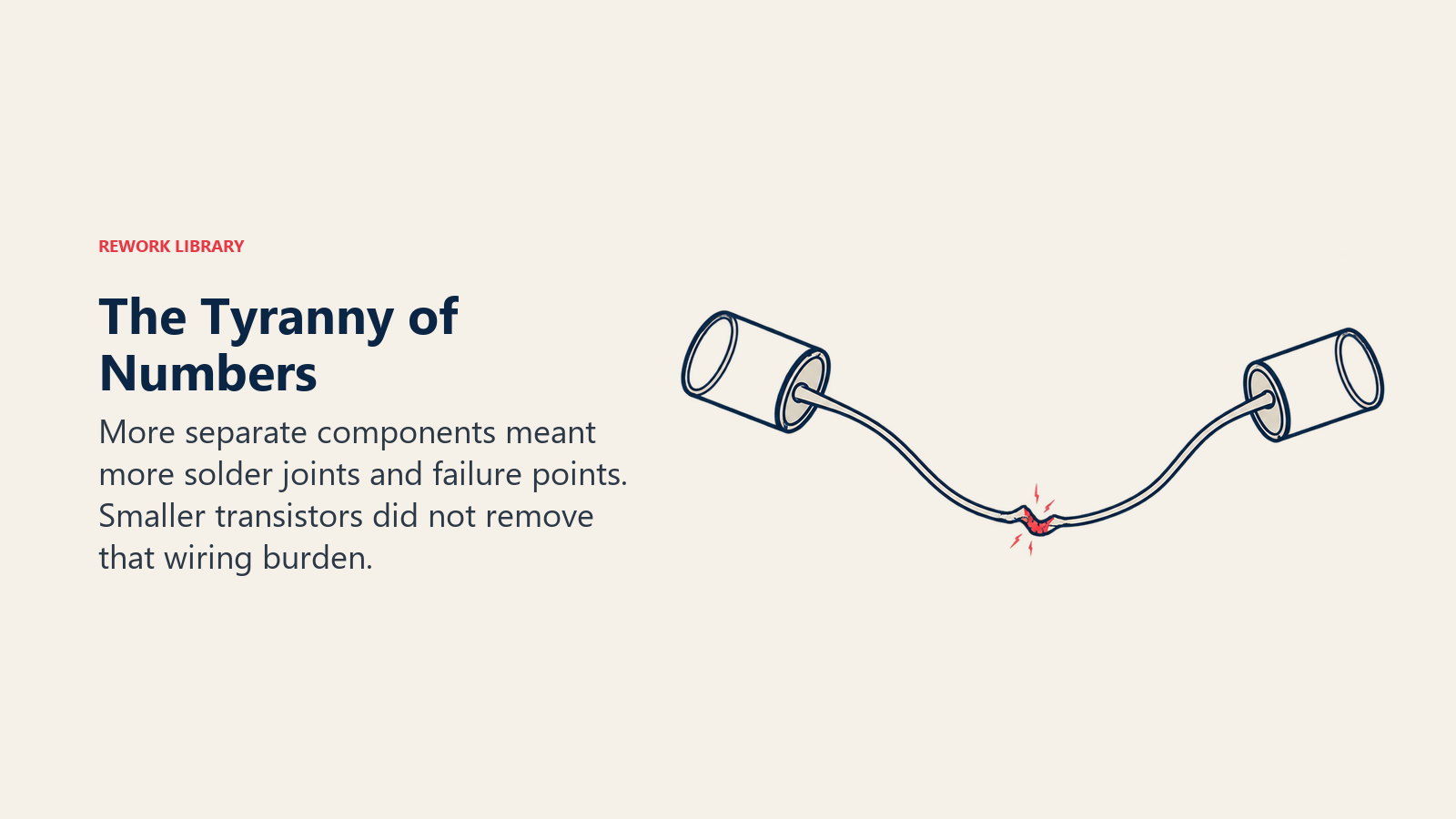
By the mid-1950s, transistors had shrunk equipment. But designers wanted systems with very many circuits. Every extra component meant more joints to solder and more places to fail.
The integrated circuit was demonstrated by Jack Kilby at Texas Instruments on 12 September 1958 and made manufacturable by Robert Noyce and Fairchild Semiconductor in 1959 and 1960. It has been shrinking and spreading ever since. Engineers didn't set out to make a small computer part. They set out to stop wiring thousands of separate components by hand, and the chip was the cheapest way to make the wiring disappear. For the wider story of the field, see The History of Computers, the computer timeline and who invented the computer.
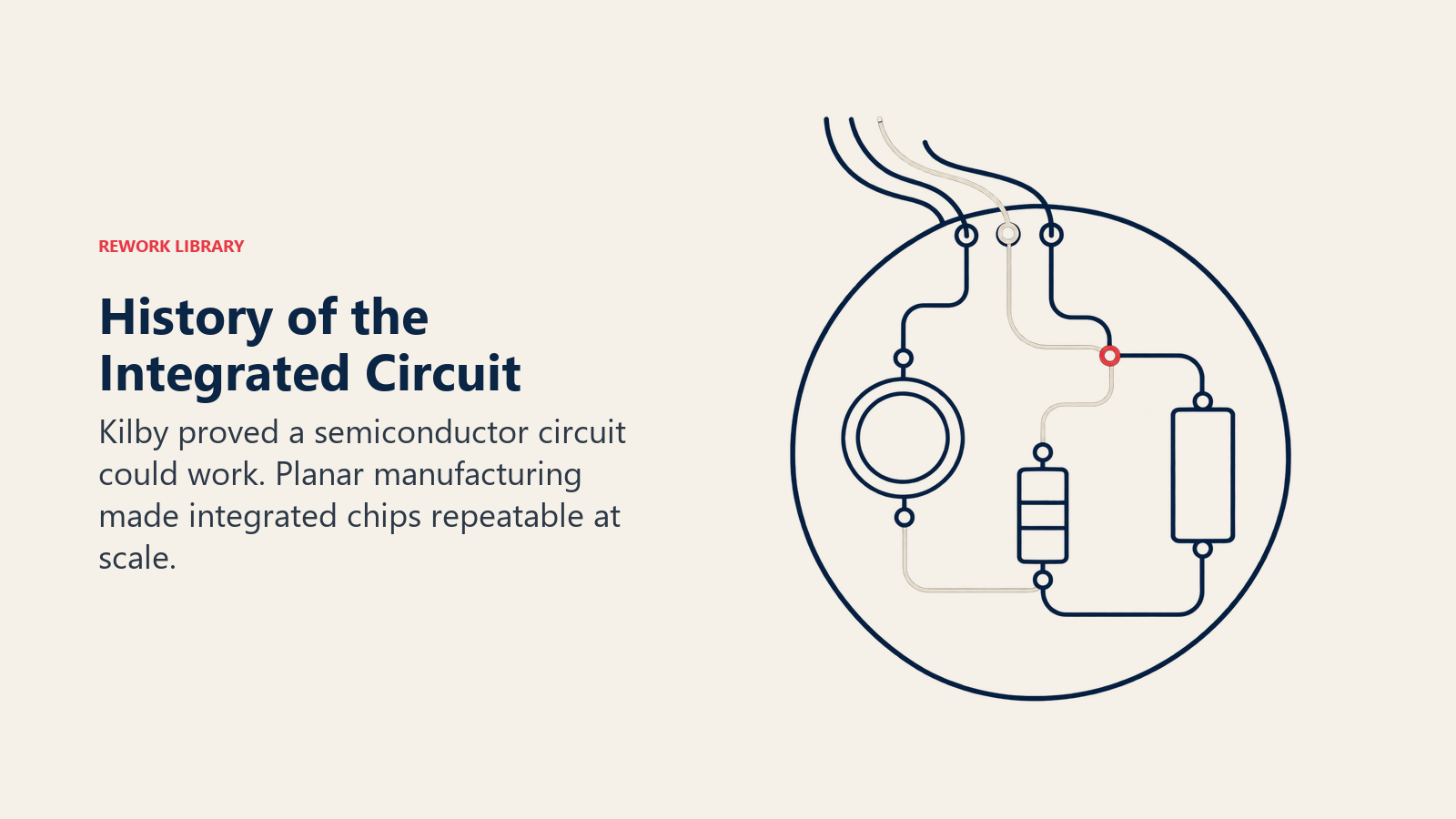
Two terms first. A discrete component is a single transistor, resistor or capacitor sold and wired as its own part. An integrated circuit puts the transistors, resistors and capacitors of a whole circuit into one piece of semiconductor, so the wiring between them is made with the parts instead of added afterward.
Timeline at a Glance
| Year | Milestone | Why It Mattered |
|---|---|---|
| 1946 | ENIAC runs on about 18,000 vacuum tubes and 500,000 soldered joints | Showed what hand-wired electronics cost at scale. |
| 16 December 1947 | Bardeen and Brattain achieve transistor action at Bell Labs | Replaced the tube with a solid-state switch. |
| 1952 | G. W. A. Dummer proposes electronics "in a solid block" | The idea, years before anyone built it. |
| 12 September 1958 | Kilby builds a working circuit from semiconductor slices | The first demonstration of the concept. |
| 6 February 1959 | Kilby's patent application is filed | Priority claim for Texas Instruments. |
| 30 July 1959 | Noyce's patent application is filed | Priority claim for Fairchild, with a manufacturable design. |
| 26 May 1960 | Fairchild produces its first working monolithic devices | The planar chip existed on silicon. |
| 1962 | The Apollo Guidance Computer is designed around ICs | A buyer that could pay for immature technology. |
| 19 April 1965 | Moore's article appears in Electronics | Turned a trend into a planning yardstick. |
| 1971 | Intel's 4004 puts a CPU on a chip | The chip became the computer. |
| 1987 | TSMC is established as a pure-play foundry | Separated chip design from chip manufacturing. |
| 9 August 2022 | The CHIPS Act becomes law | Governments began funding fabs directly. |
The Wiring Wall (1940s-1957)
Switching elements multiply and so do the joints between them
The turning point is scale. Long before anyone said "integrated circuit," computing already ran on switching elements wired together: telephone relays, then vacuum tubes. They were precursors, not the concept. Nobody was merging components into one piece of material. They were connecting more of them. Penn's account of ENIAC shows the cost: about 18,000 vacuum tubes, 500,000 soldered joints, 70,000 resistors, 10,000 capacitors and 150 kilowatts of power. For that machine's full story, see the history of ENIAC, and for the tube-based commercial machines that followed, see UNIVAC and the first commercial computers. Those machines already followed the stored-program design; what still had to change was the hardware underneath it.
The solid-state switch came next, a story told in full in the history of the transistor. On 16 December 1947, John Bardeen and Walter Brattain at Bell Labs applied two gold contacts to a slab of germanium and amplified a signal up to 100 times. They demonstrated it to lab officials on 23 December, and Bell Labs announced it publicly on 30 June 1948. The Computer History Museum quotes a Bell spokesman saying it could have "far-reaching significance" for electronics. Silicon followed: Morris Tanenbaum made the first silicon transistor at Bell Labs in 1954, but Texas Instruments built and sold the first commercial devices.
Transistors shrank the machines but not the wiring problem. According to a talk by TI's Charles Phipps, Jack Morton of Bell Labs described the next barrier in a paper called the "tyranny of numbers." Systems of thousands of circuits had many interfaces between dissimilar materials and loosely controlled processes, and Morton projected more frequent equipment failures. Military programs funded miniaturization to get around it.
One person saw the answer on paper first. In 1952, G. W. A. Dummer of England's Telecommunications Research Establishment proposed, in the Computer History Museum's quotation of him, that it might be possible to envisage electronic equipment in "a solid block with no connecting wires." That was a proposal. The same museum entry says several labs did put multiple components on a chip in the mid to late 1950s, including RCA, Bell Labs, IBM and Japan's MITI, and that none of them solved general-purpose system integration.
The era left a clear problem, and nobody yet had the manufacturing method to solve it.
For teams today: the best new product ideas start as a cost you can name. Here it was joints per circuit, not "make it smaller."
Kilby's Solid Circuit (1958-1959)
A newcomer at Texas Instruments wires a circuit out of one material
The turning point is the summer of 1958. Jack Kilby, a University of Illinois electrical engineering graduate of 1947, took a job at Texas Instruments in 1958 because, in his own Nobel biography, TI was the only company that would let him work on component miniaturization more or less full time. Phipps's talk dates his arrival to May 1958 and says that by the end of July he had defined a solution with all circuit elements formed in place. TI's Pat Haggerty had suggested to Willis Adcock that semiconductors might simplify circuit interconnection, and Adcock picked Kilby for the job.
The demonstration came on 12 September 1958. Per the Computer History Museum, Kilby built a circuit from germanium mesa transistor slices he etched to act as transistor, capacitor and resistor, then joined them with fine gold "flying wires" into an oscillator. A week later he demonstrated an amplifier. The Nobel Foundation's summary of his lecture says his notebook holds the first diagram of an integrated circuit with all components made of the same material.
TI announced the concept in March 1959 and, in March 1960, introduced the Type 502 Binary Flip-Flop at $450 each. The flying wires were the weakness. The museum says only a few dozen units shipped for evaluation, because that interconnection was not a practical production technique. Phipps recalls the 502 selling two to six units a month and the early silicon circuit being attacked for lack of data on yield, cost and performance.
Kilby filed his patent, Miniaturized Electronic Circuits, on 6 February 1959. It was granted on 23 June 1964, more than five years later. The era produced the demonstration and left a production problem: a chip you could not wire in volume.
For teams today: a working demo proves the idea, and the production method is a separate project. Plan and fund them separately.
The Planar Answer (1959-1961)
Fairchild's oxide layer turns the chip into something you can manufacture
The turning point is a layer of glass left in place. Jean Hoerni, a Fairchild physicist, recalled an idea he had recorded in December 1957: instead of stripping the oxide layer from a silicon wafer, keep it to protect the junctions underneath. Conventional wisdom said to remove it. Hoerni wrote a patent disclosure in January 1959, demonstrated a working planar transistor that March, and Fairchild sold the 2N1613 planar transistor in April 1960. The planar design also meant all the parts of a circuit could be made from one side of the wafer.
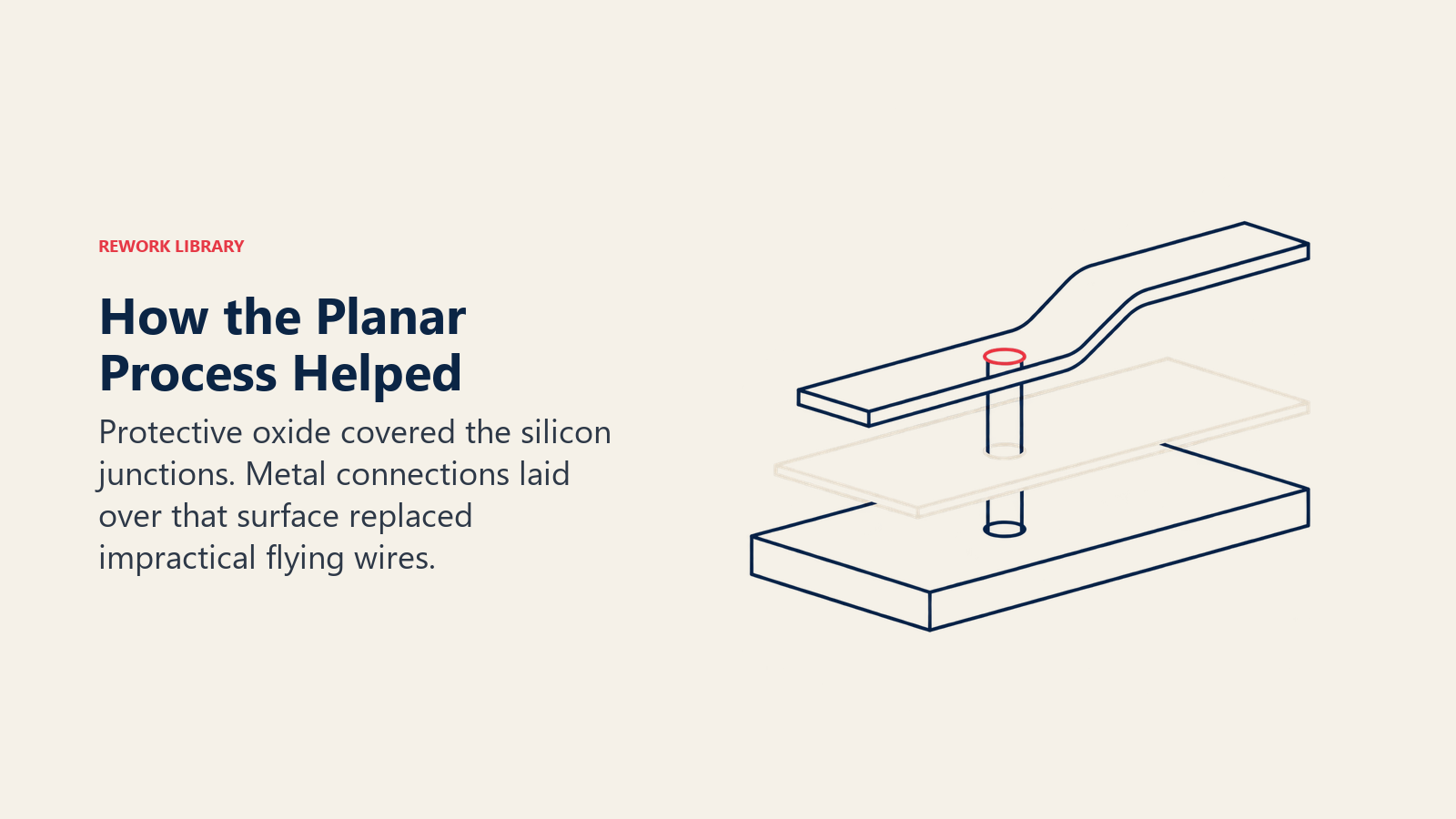
Robert Noyce took the next step. The Computer History Museum says that after patent attorney John Ralls challenged him to find other uses for the planar process, the Fairchild co-founder conceived a monolithic integrated circuit: diodes, transistors, resistors and capacitors diffused into the silicon, joined by aluminum lines deposited over the protective oxide. That removes the flying wires. Noyce filed his Semiconductor Device-and-Lead Structure patent on 30 July 1959, and it was granted on 25 April 1961.
Building it fell to Jay Last. In August 1959 Noyce asked Last to start development, and a team including Sam Fok, Isy Haas, Lionel Kattner and James Nall followed. The first working monolithic devices came on 26 May 1960, separating components with epoxy-filled channels etched from the back of the wafer. A boron-diffusion method with p-n junction isolation worked on 27 September 1960. Fairchild announced its Micrologic flip-flop in March 1961 at a New York press conference and a photograph in LIFE magazine. TI adopted the planar technique and announced its Series 51 family in October 1961.
Several things were true at once, and they are easy to blur. The table below separates them.
| Step | Kilby (Texas Instruments) | Noyce (Fairchild) |
|---|---|---|
| Idea | July 1958 solution, per TI's Phipps | After Hoerni's planar process, 1959 |
| First demonstrated | 12 September 1958, germanium, flying wires | 26 May 1960, silicon, planar |
| Patent filed | 6 February 1959 | 30 July 1959 |
| Patent granted | 23 June 1964 | 25 April 1961 |
| First product | Type 502, March 1960, $450 | Micrologic, announced March 1961 |
| Lasting contribution | All components from semiconductor material | Metal over oxide, a monolithic structure |
The era produced a manufacturable chip, and it set up a legal fight over who owned it.
For teams today: the second inventor often wins the factory. Kilby proved it could be done, and Noyce made it repeatable.
The Aerospace Orders (1961-1965)
Missiles and moon rockets pay for chips nobody else can afford
The turning point is a customer that could not say no. The first integrated circuits were slow, replaced only a handful of components and cost many times more than discrete transistors. Only aerospace and military systems valued the small size and low power enough to pay. In 1961, TI's Harvey Cragon built a demonstration "Molecular Electronic Computer" for the Air Force to show that 587 TI ICs could replace 8,500 transistors and other parts.
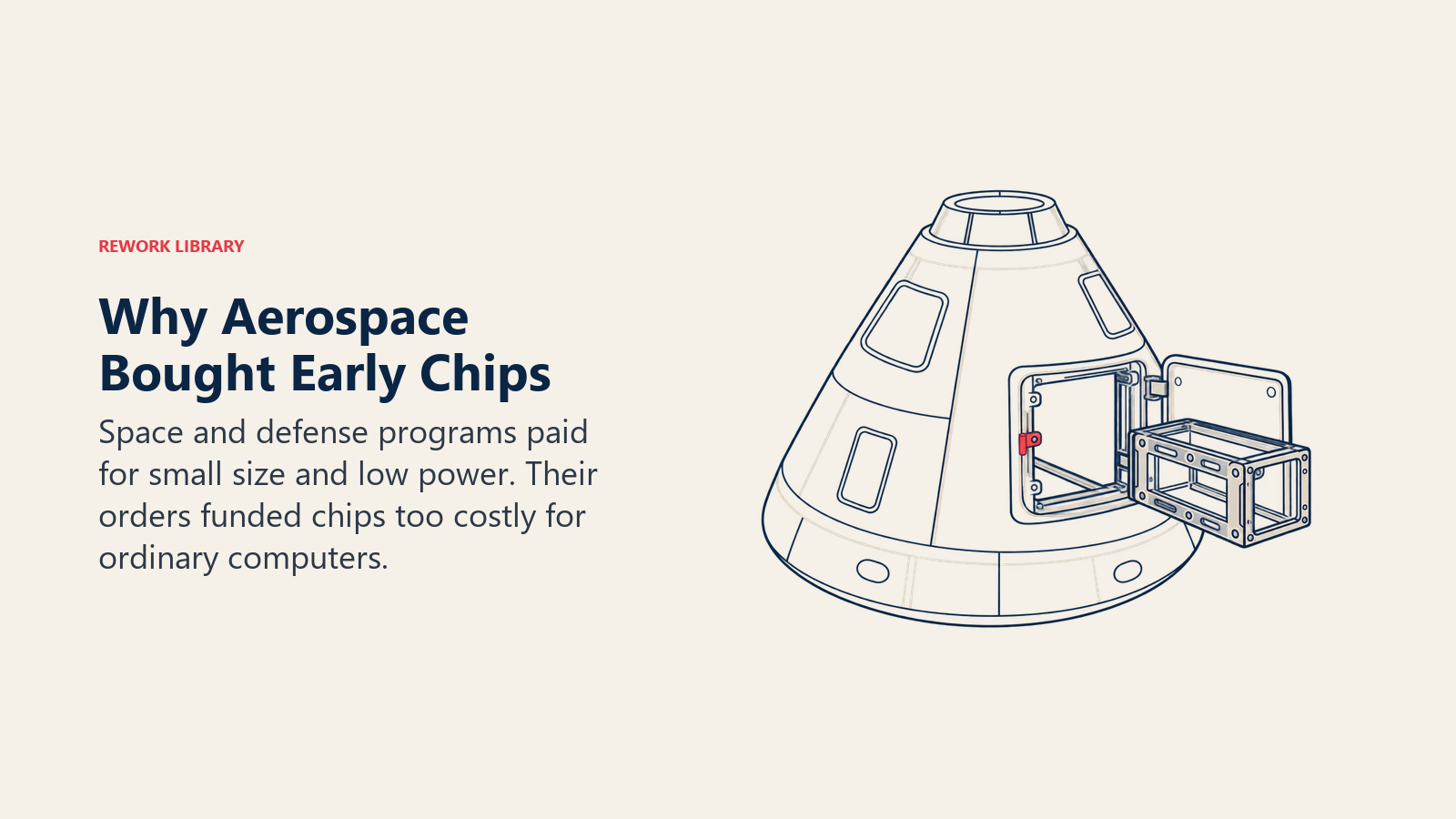
Two programs set the volume. NASA's Apollo Guidance Computer, designed by MIT in 1962 and built by Raytheon, used about 4,000 Type-G three-input NOR gate circuits per system, and the program bought 200,000 units at $20 to $30 each, making it the largest user of ICs through 1965. Then the Minuteman II missile overtook it: in 1962, TI won a contract from Autonetics, a division of North American Aviation, and by 1965 Minuteman was the largest single consumer. The museum counts 22 custom circuits in that contract, while Phipps recalls Autonetics issuing an April 1962 request for 13 circuits, nine logic and four analog, and TI winning in the fall. The IMP satellite carried the first ICs into orbit in 1963.
The money was uneven. Phipps says the Minuteman win's execution damaged TI's performance in the marketplace for several years, because the program consumed all of design engineering in 1963. He also says design wins took years to become production orders. His figures put TI's 1966 IC revenue at about $30 million in a world IC market of $158 million.
Meanwhile the ownership fight ran at once. The Computer History Museum says Fairchild and TI litigated IC patents for many years and that the courts eventually ruled in Noyce's favor, but the companies had already settled on a cross-license that included a net payment to Fairchild. The IEEE Computer Society's pioneer biography says the courts ruled for Noyce in 1969. Note what a court decides: it rules on a patent claim, not on who built the first working circuit. The same sources agree on the historical split. Kilby built the first working circuit with all components in semiconductor material, and Noyce supplied the practical interconnection scheme. Both received the National Medal of Science, and the museum calls them co-inventors.
Computers took the chip more slowly than missiles did. IBM's System/360 of 1964 used hybrid Solid Logic Technology modules, because monolithic ICs could not yet meet the cost and speed demands of large computers. The Computer History Museum dates the first IC-based mainframes to 1965 and 1966, including RCA's Spectra 70 series and the Burroughs B2500/3500. For how that fit the larger story, see generations of computers.
For teams today: a demanding first customer can fund a technology that the mass market would reject. Pick one, and expect the first contract to be a distraction as well as a lifeline.
The Moore's Law Years (1965-1970s)
A trend line becomes a target, and then a whole computer fits on a chip
The turning point is an article. Gordon Moore, Fairchild's director of R&D, wrote "Cramming More Components onto Integrated Circuits" for the 19 April 1965 issue of Electronics. He observed that the complexity for minimum component cost had increased at a rate of roughly "a factor of two per year" and projected 65,000 components per circuit by 1975. He also predicted home computers and automatic controls for automobiles. The Computer History Museum notes that he drew his line through five points covering 1959 to 1964.
The 1975 revision is the part people forget. At the IEEE International Electron Devices Meeting in 1975, Moore, by then at Intel, said the projection had come true thanks to lithography, wafer size, process technology and "circuit and device cleverness." Adding data with more microprocessor designs, which were less dense than memories, he slowed the rate to a doubling every two years. The history of Moore's Law follows that forecast through the roadmap years to the packaging age. Carver Mead is credited with naming it "Moore's Law." The museum calls it a self-fulfilling prophecy, because the industry planned its work around the line. In 1974, IBM's Robert Dennard and colleagues gave it a physical basis: shrinking a transistor's horizontal dimensions improved speed by the same factor, and the paper related the shrink to power reduction.
Memory moved first. Intel's 1103 DRAM, priced at 1 cent a bit, began in 1970 to replace magnetic cores as computer main memory. Noyce and Moore had co-founded Intel in 1968, according to the IEEE Computer Society.
Then the processor, the subject of the history of the microprocessor. The Computer History Museum says Intel's 4004 came from Ted Hoff and Stanley Mazor's design, and in 1971 Federico Faggin, assisted by Masatoshi Shima, used silicon-gate MOS technology to fit its 2,300 transistors into a low-cost 16-pin package. The museum also names earlier multi-chip and chip-set CPUs, such as Lee Boysel's 1969 AL-1 and the MP944 for the F-14A. The 4004 was one of several answers to putting a CPU on silicon. Intel's 8080 and Motorola's 6800 of 1974 made the idea widespread, and the 8086 and 8088 rode the IBM PC. For the software side of that shift, see the history of operating systems.
This era made the chip the unit of computing and set up the next problem: making chips this small needed more capital than any one company wanted to carry.
For teams today: a forecast that people plan around starts to drive the result. Moore revised his own rate when the data changed, and you should revise yours.
The Foundry Age (1980s-present)
Design splits from manufacturing, and chips become geopolitics
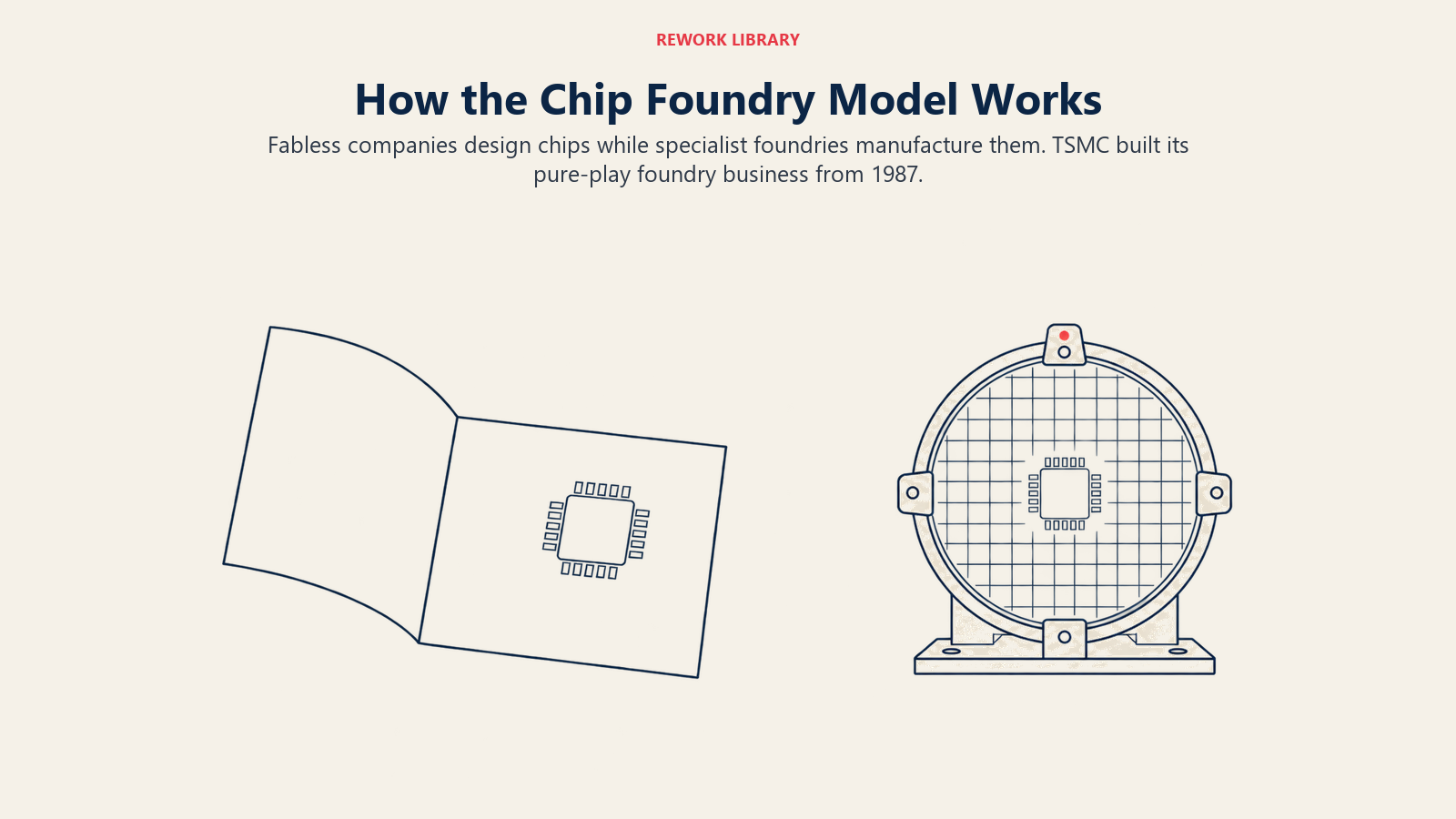
The turning point is a specialist. In 1967, the Computer History Museum notes, independent equipment makers such as Applied Materials began to take over process technology that chipmakers had built themselves, which helped create "wafer-foundry" vendors and, in the 1980s, "fabless" companies that design chips without owning plants. In 1987, Dr. Morris Chang established TSMC, which says it pioneered the pure-play foundry business model.
The tools kept getting harder to build. ASML's company history says it shipped a first prototype EUV tool in 2010, that customers began ordering a production-ready system in batches in 2016, and that at the start of 2020 EUV moved into high-volume manufacturing as the company celebrated its 100th EUV system shipment. By 2024, NVIDIA's Blackwell GPU was described as having 208 billion transistors, built on a custom TSMC process as two reticle-limit dies joined by a 10 TB/second link. Set that next to the 4004's 2,300 transistors and the ratio is roughly 90 million to one, though a 1971 CPU and a data-center accelerator are different kinds of part. Demand of that scale is part of the history of deep learning.
Governments now treat the chip as strategic. The CHIPS and Science Act was approved on 9 August 2022 as Public Law 117-167. NIST says it gave the Department of Commerce $50 billion for semiconductor research, development and manufacturing, split into $39 billion for manufacturing incentives and $11 billion for R&D.
The last era is still being written. Its open problem is concentration: a few foundries and one lithography supplier stand between most designs and a working chip.
For teams today: the layer you depend on can be the thinnest and most concentrated one. Map your own chain down to who makes the tools.
Key People
| Name | Role | Contribution | Year |
|---|---|---|---|
| G. W. A. Dummer | British radar engineer | Proposed electronics in a solid block with no connecting wires | 1952 |
| Jack Morton | Bell Labs | Described the "tyranny of numbers" | 1950s |
| John Bardeen and Walter Brattain | Bell Labs physicists | Achieved transistor action in germanium | 1947 |
| Jack Kilby | Texas Instruments engineer | Built the first working circuit from semiconductor material; shared the 2000 Nobel Prize | 1958 |
| Pat Haggerty | Texas Instruments executive | Pushed semiconductor interconnection research; announced the invention | 1958-1959 |
| Jean Hoerni | Fairchild physicist | Invented the planar process | 1959 |
| Robert Noyce | Fairchild co-founder, later Intel | Patented the monolithic chip with metal over oxide | 1959 |
| Jay Last | Fairchild co-founder | Led the first working planar IC | 1960 |
| Gordon Moore | Fairchild R&D, later Intel | Published the 1965 projection and the 1975 revision | 1965, 1975 |
| Ted Hoff, Stanley Mazor, Federico Faggin, Masatoshi Shima | Intel engineers | Designed the 4004 | 1971 |
| Morris Chang | TSMC founder | Established the pure-play foundry | 1987 |
Key Facts
- Kilby built his first circuit on 12 September 1958 and filed his patent on 6 February 1959; it was granted on 23 June 1964.
- Noyce filed his patent on 30 July 1959 and it was granted on 25 April 1961.
- Phipps recalls TI's 1966 IC revenue at about $30 million in a $158 million world IC market.
- The Apollo Guidance Computer bought 200,000 ICs at $20 to $30 each, the largest use through 1965.
- Moore's 1965 article projected 65,000 components per circuit by 1975; in 1975 he slowed the doubling to every two years.
- Kilby received the 2000 physics prize "for his part in the invention of the integrated circuit".
The Pattern Behind the History
The same five moves repeat across the chip's history. We call the sequence the Wire to Wafer Cycle. It's our synthesis of the history, not a research finding.
- A cost of connection forces the idea. Joints and interfaces, not component size, were the problem that Morton named.
- Several people reach for it at once. Dummer, RCA, Bell Labs, IBM, Kilby and Noyce all worked on integration.
- A process, not a part, decides who wins. Hoerni's oxide layer made the chip manufacturable.
- A buyer with deep pockets pays for immaturity. Apollo and Minuteman bought chips that computers could not yet afford.
- The layer underneath splits off. Equipment makers and foundries became separate businesses, and then national priorities.
What It Teaches Teams Today
- Name the cost, not the product. The chip began as an answer to "too many joints."
- Fund the demo and the factory separately. Kilby's circuit worked, but only a few dozen shipped.
- Pick a first customer who can pay. Aerospace bought what offices would not.
- Revise your forecast in public. Moore changed the rate in 1975 when new data arrived.
- Know which date you mean. Demonstration, patent filing, patent grant and first product are four different dates.
The integrated circuit shows how a stubborn cost, two competing inventors and a few customers with deep pockets turned a bundle of wires into a single piece of silicon. Next time your own system gets harder to maintain as it grows, ask where the joints are, not how to make the parts smaller.

Co-Founder, Rework.com