The History of the Microprocessor
Turn this article into takeaways for your work.


Each assistant summarizes the article only for you and suggests best practices for your work.
In the late 1960s a processor was still built from many parts. Every new product meant designing its logic again from scratch. The problem was cost and the number of parts.
The microprocessor, a complete central processing unit on a single chip, arrived in 1971 with Intel's 4004. It started as a custom job for a Japanese calculator maker called Busicom. Nobody set out to put "the computer" on a chip. A calculator order, a pile of unfinished logic designs and one engineer's insistence on a general-purpose part turned a customer's one-off into the engine of every later computer. For the wider story, see The History of Computers, the computer timeline and who invented the computer. This article builds on the history of the integrated circuit.
Two terms first. A central processing unit (CPU) is the part of a computer that fetches instructions and carries them out. A microprocessor is a CPU built on one chip, or a very small number of chips. The Computer History Museum notes the device is popularly known as a microprocessor or MPU, short for micro-processor unit.
Timeline at a Glance
| Year | Milestone | Why It Mattered |
|---|---|---|
| 30 June 1945 | Von Neumann's First Draft of a Report on the EDVAC names a central arithmetical part and a central control | Wrote down the CPU as a concept, decades before it fit on a chip. |
| March 1969 | Four-Phase Systems' AL-1 reaches working devices | An 8-bit CPU slice, one of several multi-chip precursors. |
| April 1969 | Busicom and Intel sign a provisional agreement for custom calculator chips | The commission that produced the 4004. |
| 1970 | Garrett AiResearch designs the MP944 chip set for the F-14A | Another early CPU built from several chips. |
| March 1971 | Busicom has a complete working MCS-4 chip set | The 4004 worked inside its first product. |
| November 1971 | Intel begins advertising the 4004 | The part reached the open market. |
| 1972 | Intel announces the 8-bit 8008 | Eight bits, a broader audience. |
| 1974 | Intel's 8080 and Motorola's 6800 arrive | The second generation made the idea widely accepted. |
| 1975 | MOS Technology shows the 6502 at $25 | A price shock that opened home computing. |
| 12 August 1981 | IBM unveils the PC with Intel's 8088 | Locked the x86 line into the business world. |
| 26 April 1985 | The first ARM chip is delivered to Acorn | A RISC design that would later be licensed, not manufactured. |
| November 1990 | Advanced RISC Machines is founded by Acorn, Apple and VLSI | A company built on licensing designs. |
| 18 April 2005 | Intel announces its first dual-core platform | The industry moved from faster clocks to more cores. |
| 10 November 2020 | Apple announces the M1 | A system on a chip for the Mac. |
| 18 March 2024 | NVIDIA announces Blackwell | The processor became an AI accelerator. |
The Processor in Pieces (1945-1970)
The CPU exists on paper long before it exists on a chip
The idea of the processor is older than the chips that would hold it, and it starts with a typed report. Dated 30 June 1945, John von Neumann's First Draft of a Report on the EDVAC says that a "central arithmetical part of the device will probably have to exist," which it calls CA, and names the organs that perform central control as a second specific part, CC. That split is the CPU as a concept. It was a precursor to the microprocessor, not the thing itself: for a machine built from tubes, then transistors, then small-scale chips, the CPU was a cabinet, not a part. See the stored-program computer article for how that design spread.
By the late 1960s the integrated circuit, built from transistors that had replaced vacuum tubes, had made it thinkable to shrink the cabinet. The Computer History Museum says designers worked to integrate CPU functions onto a few MOS LSI chips. In 1969 Lee Boysel created Four-Phase Systems' AL-1, an 8-bit CPU slice expandable to 32 bits, with working devices in March 1969. In 1970 Steve Geller and Ray Holt of Garrett AiResearch designed the MP944 chip set for the F-14A Central Air Data Computer, built on six metal-gate chips fabricated by AMI. These were real CPUs in silicon. They were also parts of larger systems, made for one customer's purpose.
This is where definitions matter. If "microprocessor" means any CPU on a few chips, the AL-1 and the MP944 qualify. If it means a general-purpose CPU on one chip sold on the open market, the next era belongs to Intel. The museum lists the earlier devices alongside the 4004 and treats the 4004 as one answer among several. A separate thread, Texas Instruments' calculator chip work, led to single-chip designs too, and we return to it below.
The era left a problem: each processor was designed for one job, so each product paid again for its own logic.
For teams today: a concept can be written down decades before it is cheap to build. Document the idea even if you can't ship it yet.
The Busicom Commission (1969-1971)
A calculator order becomes a general-purpose chip
The turning point is a customer order. Per Intel's own history, Busicom, a Japanese calculator company, asked Intel to design custom chips for its new 141-PF printing calculator in 1969. Intel says the request was for a twelve-chip set, while IEEE Spectrum says Busicom's engineer Masatoshi Shima proposed an eight-chip system in June 1969. The sources count the original chips differently, and both agree on the next step. IEEE Spectrum says Busicom and Intel signed a provisional agreement in April 1969, and that Ted Hoff, who ran applications research at Intel, proposed cutting the chip count and moving to a 4-bit system. Intel says its engineers proposed a design of just four chips, including one that could be programmed.
Hoff worked with Stanley Mazor on the specifications and the architecture. Then the project stalled. IEEE Spectrum says the 4004 project had ground to a halt inside Intel in early 1970 because Hoff and Mazor were not chip designers and no one else was available to do the logic design. Federico Faggin, who had developed silicon-gate MOS technology at Fairchild, accepted an offer from Intel in April 1970. Spectrum quotes his reaction to the schedule: "I had less than six months to design four chips." Faggin, assisted by Shima, who had come from Busicom, fit the 4004's 2,300 transistors into a low-cost 16-pin package. Busicom had a complete working set of MCS-4 chips in March 1971.
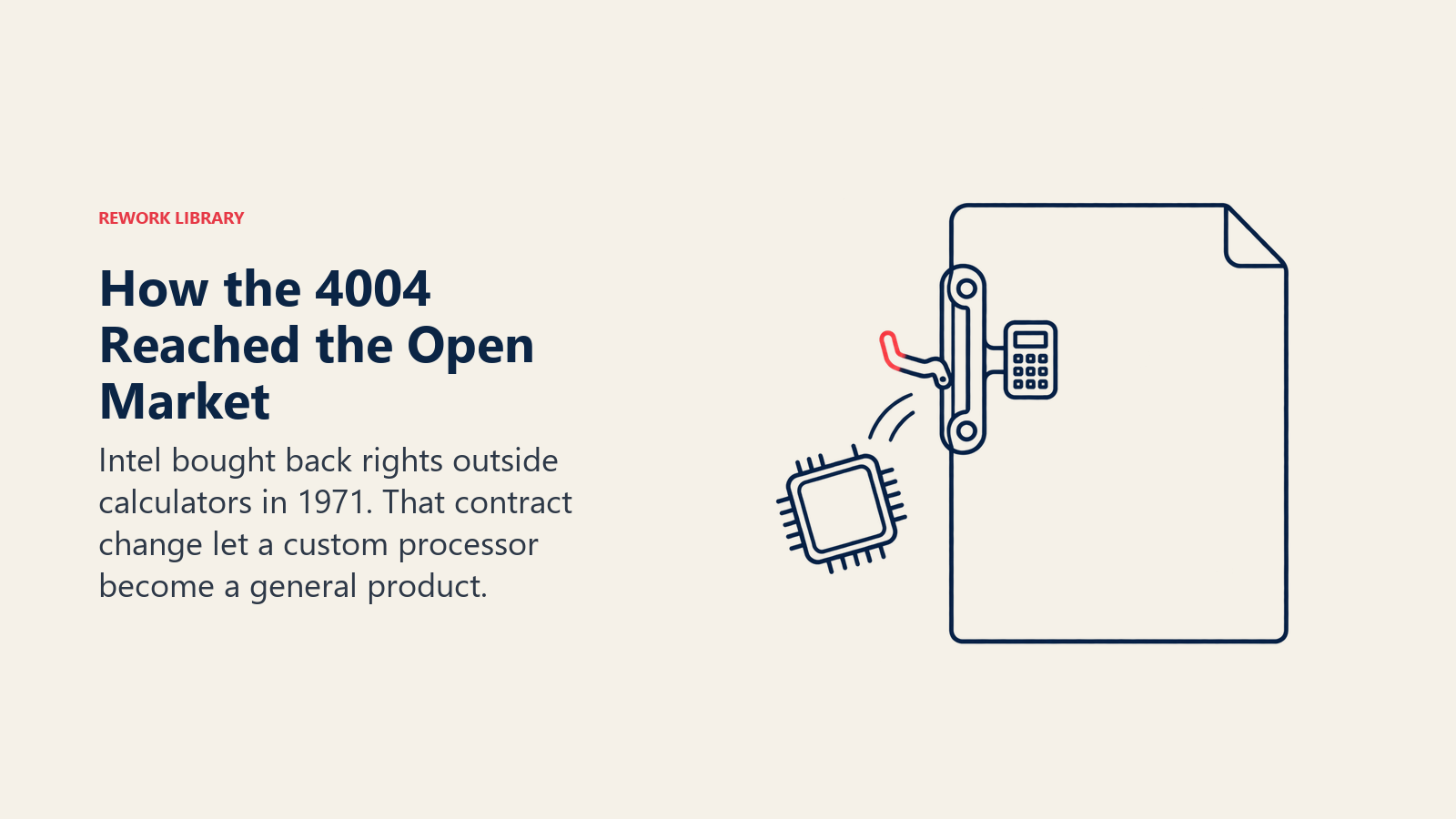
Then came the business turn. Intel's account says Busicom, which owned the exclusive rights, wanted to renegotiate the price. In May 1971 Intel CEO Robert Noyce repurchased the rights to the chip for everything but calculators, returning Busicom's $60,000 development investment. Intel began advertising the 4004 in November 1971. Busicom went bankrupt in 1974. In the Intel account, Hoff sums up the result in four words: "We democratized the computer."
Credit is shared, and the sources lean on different people. The Computer History Museum names Hoff and Mazor for the concept and Faggin, assisted by Shima, for the silicon. The museum's catalog describes a 2007 oral history panel with Faggin, Hoff, Mazor, Shima and Hal Feeney, which is the place to read the participants in their own words. The 4004 itself was a 4-bit part, a calculator-class processor. The era ended with a working chip and a legal right to sell it to anyone.
For teams today: the best product often hides inside a custom project. The ownership clause in that contract decided who got to sell the generalized result.
The Eight-Bit Scramble (1972-1980)
Everyone builds a processor, and the price collapses
By the mid-1970s hobbyist magazines were running articles on microprocessors. The turning point is the second generation. The 8-bit 8008 was announced in 1972; Faggin supervised it and Hal Feeney designed it, for CTC, later Datapoint. Intel's 8080 and Motorola's 6800, led by Tom Bennett, established widespread acceptance of the MPU concept in 1974. The Computer History Museum calls the 8080 Intel's first widely used microprocessor, with up to ten times the performance of its predecessor.
Then price became the weapon. MOS Technology's 6502, a low-cost variant of the 6800 architecture, was shown at a San Francisco conference in 1975 at $25, far below comparable Intel and Motorola parts, and some attendees thought it was a hoax. Chuck Peddle led the small team of former Motorola engineers that built it. The part went into computers and games from Apple, Atari and Commodore; the Commodore PET of 1977 was based on it. Zilog's Z80 was an improvement on the 8080 and, per the museum, the most enduring of the 8-bit designs; the Sinclair ZX Spectrum of 1982 used it. By the end of the decade, 16-bit parts had arrived from General Instrument, National, TI and Zilog.
A second family grew in parallel. The Computer History Museum says Texas Instruments' 1971 TMS1802 calculator chip, designed by Gary Boone and Michael Cochran, provided the foundation for the TMS1000, a general-purpose 4-bit microcontroller family announced in 1974 at $2 in volume. It went into toys, alarms and garage-door openers. A microcontroller puts memory and input and output on the same chip as the processor, so it needs no support parts. Boone's patent, Computing Systems CPU, was filed 31 August 1971 and issued 4 September 1973. Which chip counts as "first" depends on the definition. The 4004 was general-purpose and sold openly. The TMS1000 line was single-chip and built for fixed jobs.
The era produced cheap computing and left a new problem: a dozen incompatible chips, each with its own software.
For teams today: when a category opens, the cheapest credible entrant can reset expectations in one trade show. Price is a feature competitors can't ignore.
The Standard and the Challenger (1981-2004)
x86 wins the desk while RISC wins the argument
On 12 August 1981 at the Waldorf in New York, Don Estridge unveiled the IBM PC. It put a desktop computer where offices had once queued for the mainframe. It used Intel's 8088, ran at up to 5 MHz and could address 1 megabyte of memory. Its launch price was $1,565, against a target of $1,500. Microsoft supplied the operating system, and IBM published a technical reference for its "open architecture." That openness invited clones. The 8088's instruction set was the ancestor of what we now call x86, and the PC's success tied business software to it. The software side is in the history of operating systems. The Computer History Museum adds that Motorola's 68000 reached its widest market success in the Macintosh.
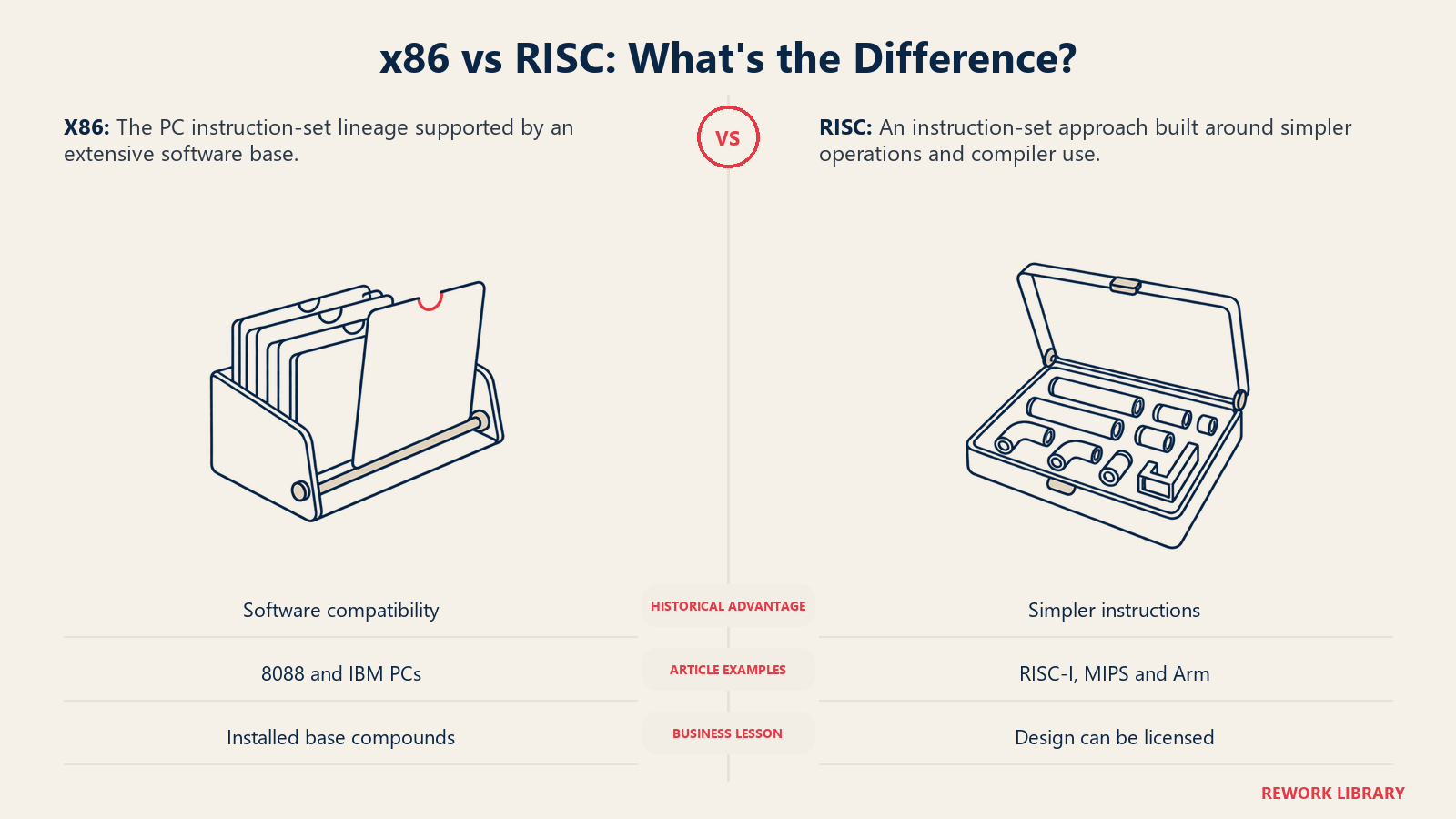
Meanwhile a rival idea was forming in research labs. The IEEE milestone page on the first RISC (reduced instruction set computing) microprocessor says IBM's 801, led by John Cocke from around 1975, was never commercialized. David Patterson's Berkeley RISC-I started in 1980 as graduate-class assignments with DARPA support, and its first chips arrived in fall 1981. John Hennessy led the Stanford MIPS project at about the same time. The pitch was a smaller, simpler instruction set that the compiler could use well. The IEEE page, which favors the Berkeley work, says RISC-I outperformed the VAX on almost every real-world benchmark after bug fixes. For how compilers fit, see the history of programming languages.
Arm shows where RISC went next. Arm's own history says Acorn, maker of the BBC Micro, began its RISC machine around late 1983 or early 1984. Sophie Wilson developed the instruction set and Steve Furber worked on the chip design. The first chip was delivered to Acorn on 26 April 1985, and the Archimedes, the first RISC-based home computer, followed in 1987. Advanced RISC Machines Ltd was founded in November 1990 as a joint venture of Acorn, Apple and VLSI Technology: Apple provided the cash, VLSI the tools, and Acorn 12 engineers. The key business move came from Robin Saxby, who introduced a licensing model in which partners paid an upfront fee and then royalties on silicon. Arm did not make chips. It sold designs.
The two eras overlapped on purpose. x86 owned the desk through compatibility, and RISC proved the cleaner design, but for most of this period the two did not collide. They met later, in the data center and in the phone.
For teams today: the best technology and the biggest installed base are different prizes. Compatibility compounds, and a licensing model can be a product.
The Many-Core Turn (2005-present)
Heat ends the clock race, and the chip becomes a system
By the early 2000s the clock-speed race hit a wall made of heat. IEEE Spectrum reports that rising transistor density intensified hot spots, and that Intel engineers projected from 1999 onward that, on trend, chips would by 2010 burn as hot as the surface of the sun. The remedy was to slow the clock and add cores. IBM's Power4 of 2001 was the first mainstream processor with more than one core on a single die. On 18 April 2005, Intel announced PCs on its first dual-core platform, built on the 3.2 GHz Pentium Extreme Edition 840. An Intel executive said PCs now had "two brains" instead of one. Spectrum notes that the Pentium D was effectively two single-core chips in one package.
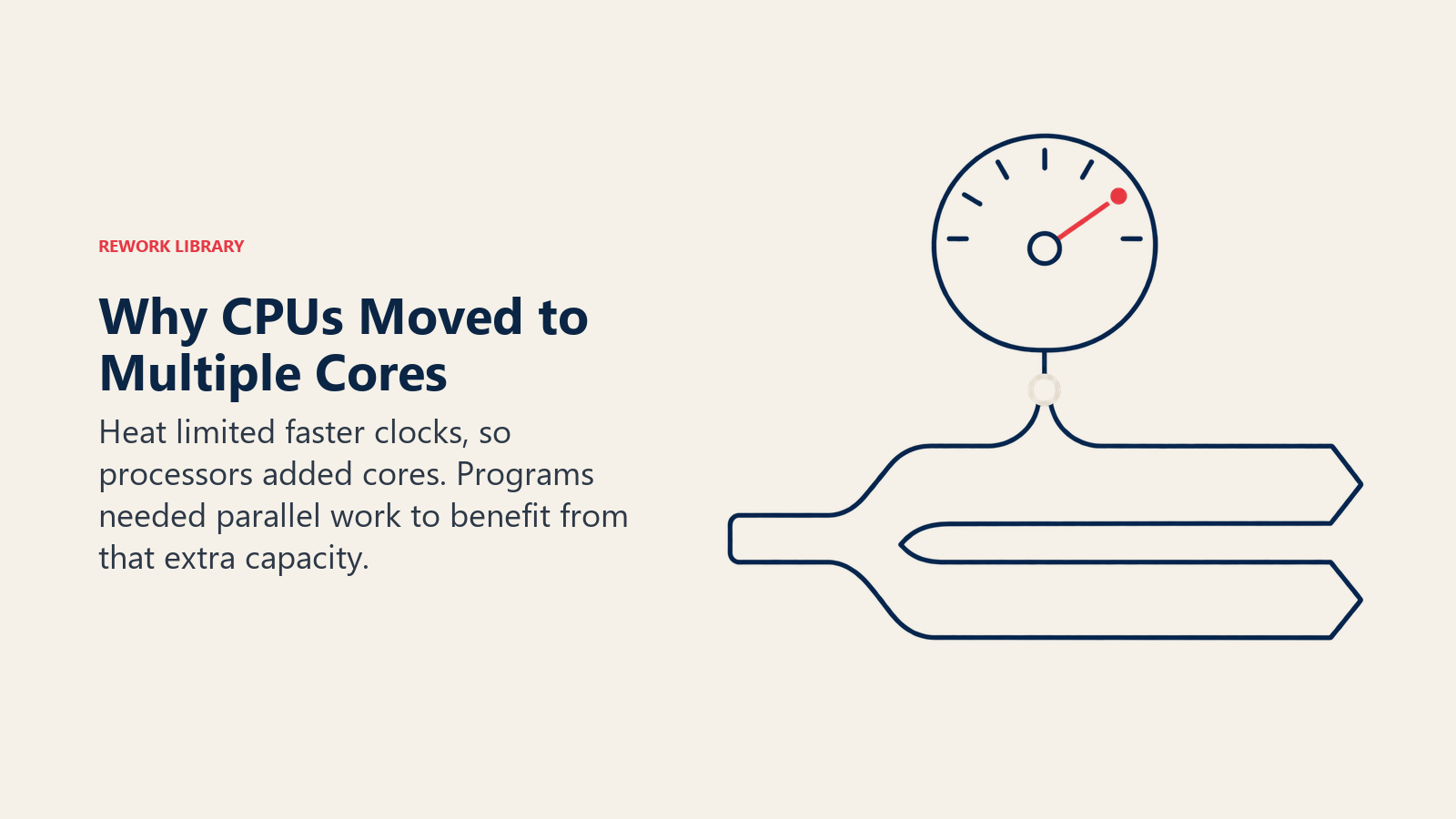
The consequence reached software. Faster clocks had made old programs faster for free. More cores did not, unless the program was written to use them. Moore's observation also changed shape: Gordon Moore's 1965 projection of doubling every 12 months was revised at the 1975 IEEE International Electron Devices Meeting to a doubling every two years. The industry kept adding transistors and found new ways to spend them.
One way was integration. On 10 November 2020 Apple announced the M1, which it called the first personal computer chip built on a 5-nanometer process, with 16 billion transistors. It is a system on a chip with an 8-core CPU of four high-performance and four high-efficiency cores, a unified memory architecture and an Apple Neural Engine. Apple was also one of the three founding partners of Arm in 1990, per Arm's own account. The machines those chips went into are traced in the history of the personal computer.
The other way was specialization. NVIDIA's Blackwell, announced 18 March 2024, has 208 billion transistors on a custom TSMC process called 4NP, as two dies at the reticle limit joined by a 10 TB/s link. Put it next to the 4004's 2,300 transistors and the ratio is roughly 90 million to one, though a calculator CPU and a data-center accelerator are different kinds of part. Chips built for AI work are covered in what is an AI chip, and the cloud buildout around them in the history of cloud computing.
The last era is still open. The general-purpose processor that began as a calculator part is now one block among many on a chip, next to graphics, neural and memory blocks.
For teams today: when one lever runs out, the industry changes the question. Clock speed gave way to cores, and cores gave way to specialization.
Key People
| Name | Role | Contribution | Year |
|---|---|---|---|
| John von Neumann | Mathematician | Wrote the First Draft that defines a central arithmetical and a central control part | 1945 |
| Lee Boysel | Four-Phase Systems | Created the AL-1, an 8-bit CPU slice | 1969 |
| Steve Geller and Ray Holt | Garrett AiResearch | Designed the MP944 chip set | 1970 |
| Ted Hoff | Intel applications research | Proposed a programmable, general-purpose design for Busicom | 1969-1971 |
| Stanley Mazor | Intel engineer | Shaped the 4-bit architecture with Hoff | 1969-1971 |
| Masatoshi Shima | Busicom engineer | Proposed the calculator system and assisted the 4004 design | 1969-1971 |
| Federico Faggin | Intel designer | Applied silicon-gate MOS to the 4004; supervised the 8008 | 1970-1972 |
| Robert Noyce | Intel CEO | Repurchased the 4004 rights from Busicom | 1971 |
| Tom Bennett | Motorola | Led the 6800 team | 1974 |
| Chuck Peddle | MOS Technology | Led the team that built the $25 6502 | 1975 |
| Gary Boone and Michael Cochran | Texas Instruments | Designed the calculator chip behind the TMS1000 | 1971-1974 |
| David Patterson and John Hennessy | Berkeley and Stanford | Led RISC-I and MIPS | 1980-1981 |
| Sophie Wilson and Steve Furber | Acorn | Designed the ARM instruction set and chip | 1985 |
| Robin Saxby | Arm executive | Introduced the licensing model | 1990s |
Key Facts
- Busicom and Intel signed a provisional agreement in April 1969; Busicom had a complete working chip set in March 1971.
- The 4004 fit 2,300 transistors into a 16-pin package.
- In May 1971 Intel returned Busicom's $60,000 investment to repurchase the rights to everything but calculators.
- The IBM PC launched on 12 August 1981 at $1,565 with Intel's 8088.
- The first ARM chip reached Acorn on 26 April 1985; Arm was founded in November 1990.
- Apple's M1 carries 16 billion transistors; NVIDIA's Blackwell has 208 billion.
The Pattern Behind the History
The same four moves repeat across the processor's history. We call the sequence the Commission to Commodity Cycle. It's our synthesis of the history, not a research finding.
- A custom job exposes a general need. Busicom wanted calculator logic, and Hoff saw a programmable part.
- Rights and price decide who profits. Intel bought back the 4004 rights, and the $25 6502 reset what a processor cost.
- A standard beats a better design. The IBM PC's open architecture fixed x86 in place while RISC won the technical argument.
- A physical limit changes the question. Heat ended the clock race, and cores, system-on-chip designs and accelerators followed.
What It Teaches Teams Today
- Look inside the custom project. The 4004 was a customer's one-off until someone asked what else it could do.
- Read the ownership clause. Busicom owned the rights and gave them back for a refund.
- Price is a product decision. The 6502 won attention at $25.
- Compatibility compounds. A large installed base kept x86 on top for decades.
- Plan for the constraint you can't beat. Heat forced the move from faster to wider.
- Know which "first" you mean. Multi-chip CPU, single-chip microcontroller and general-purpose microprocessor are different claims.
The microprocessor shows how a customer's one-off, a contract clause and a price tag can reshape an industry. Next time you scope a custom project, ask what the general version would be, and who would own it.

Co-Founder, Rework.com