Who Invented the Computer?
Turn this article into takeaways for your work.


Each assistant summarizes the article only for you and suggests best practices for your work.
Picture 1945. At the University of Pennsylvania, a team was building an electronic machine for the Army. At Bletchley Park in England, Colossus machines were breaking German ciphers in secret. In Berlin, the first working programmable computer had been destroyed in a bombing raid. Nobody there could have said who invented the computer.
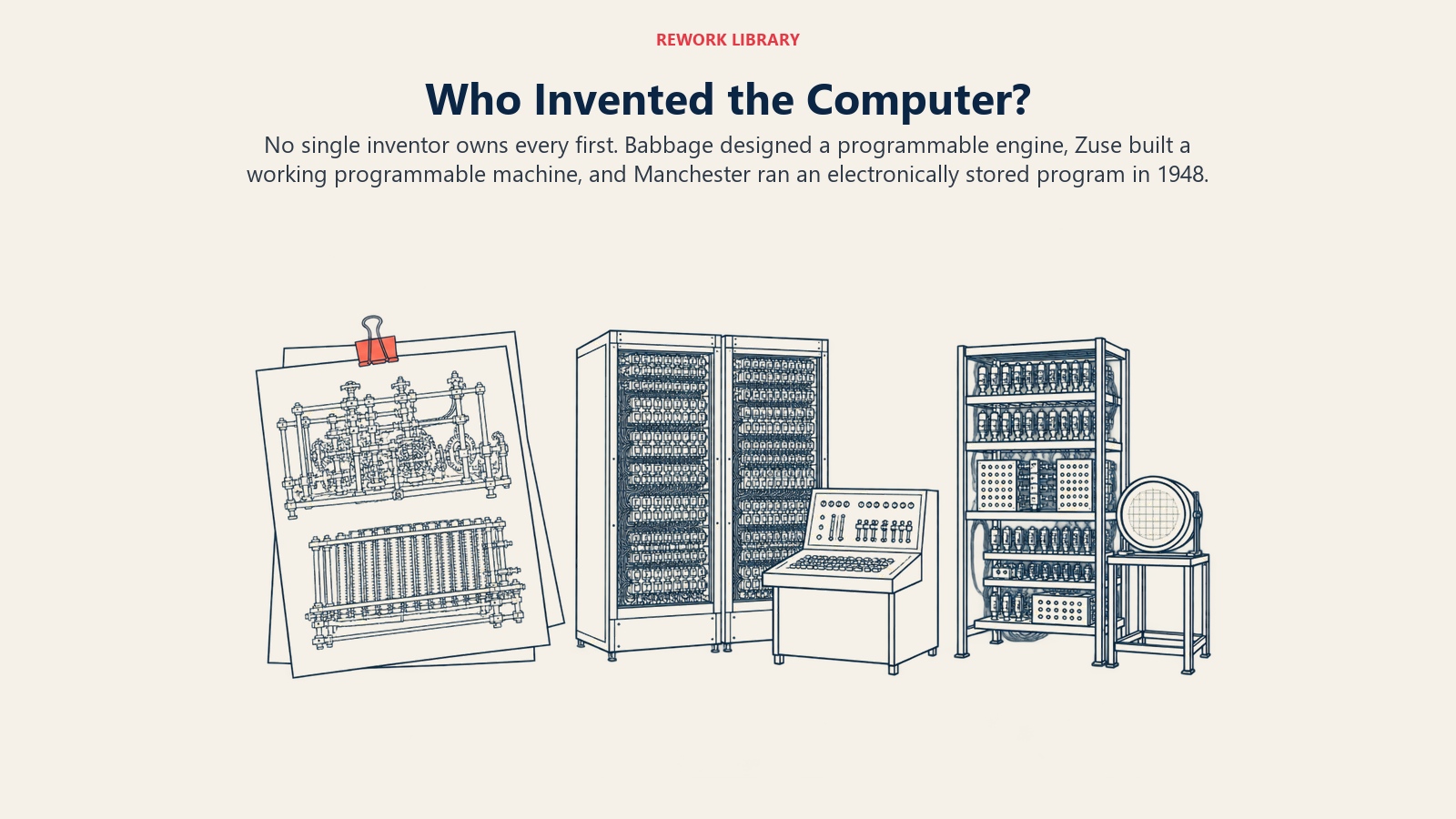
No single person invented the computer. The honest answer depends on what you mean by the word. Charles Babbage designed the first programmable machine in 1834 but never built it. Konrad Zuse's Z3 was the first working programmable one, completed in 1941. The Atanasoff-Berry Computer (1942) was an early electronic digital machine, ENIAC (announced 1946) was the famous one, and the Manchester "Baby" ran the first stored program on 21 June 1948. Many people in several countries assembled the computer, often in secret, and the credit went to whoever's paperwork and publicity survived.
Timeline at a Glance
This table covers only the origin claims. For the full dated chronology, read the computer timeline, and for the five-generation view of hardware, see the generations of computers.
| Year | Milestone | Why It Mattered |
|---|---|---|
| 2nd century BCE | The Antikythera mechanism, a geared astronomical device | Gears were already doing calculation in the ancient world. |
| 1834 | Babbage conceives the Analytical Engine | A design with a store, a mill and punched-card programming. |
| 1843 | Ada Lovelace publishes her Notes | The first published account of what such a machine could do. |
| 1935 | NACA Langley forms a pool of five women "computers" | The word still meant a person. |
| 1936-1937 | Alan Turing publishes "On Computable Numbers" | It described a single machine that could compute any computable sequence. |
| 12 May 1941 | Zuse completes the Z3 in Berlin | The first working programmable, fully automatic digital machine. |
| 1942 | Atanasoff and Berry complete the ABC at Iowa State | An electronic machine built to solve linear equations. |
| 1 June 1944 | The first Colossus Mark 2 reaches Bletchley Park | Electronic code breaking, kept secret for decades. |
| 30 June 1945 | Von Neumann's First Draft of a Report on the EDVAC is dated | The stored-program design reached paper, with a credit fight attached. |
| 14 Feb 1946 | ENIAC is announced at Penn | The public face of the electronic computer. |
| 21 June 1948 | The Manchester Baby runs its first program | The first program held in electronic memory. |
| 6 May 1949 | EDSAC runs its first program at Cambridge | The first practical stored-program machine with a regular service. |
| 1973 | Honeywell v. Sperry Rand | A federal court ruled the ENIAC patent invalid. |
The Precursors (antiquity-1830s)
Gears and clerks did the calculating first
Start at the bottom of the Aegean. Around the 2nd century BCE, someone built a bronze device with at least 30 geared wheels that sank with a ship off the Greek island of Antikythera. The ASME landmark page says scientists think it could predict lunar and solar eclipses and keep a calendar accurate. It is a precursor, not a computer: it modeled the sky and wasn't a general machine you could reprogram. But it shows that the dream of putting calculation into a machine is very old.
For most of history, though, the machine was a person. Before electronic machines existed, "computer" was a job title, as NASA's history of Langley's computers explains. Virginia Tucker arrived at Langley the day after Labor Day 1935 to join four other women in the lab's first "computer pool," and by 1946 the department had trained about 400 women. That is the meaning behind the word through the 1940s, and it matters for this story: the machines were named after the people they replaced.
The problem this period couldn't solve was scale. Calculation by hand was slow and error-prone, so a machine that did the arithmetic reliably was the obvious goal. In the 1830s one Englishman set out to design it.
For teams today: the original "computer" was a role, not a device. Every wave of automation starts by describing the job a person does, and the people who do it are the ones who know where the errors hide.
Babbage's Engines (1822-1871)
A programmable design waits a century for hardware
In June 1822, Charles Babbage announced a Difference Engine to the Royal Astronomical Society, according to the Science Museum Group. Joseph Clement built a finished portion in 1832, and work stopped the next year. The engine was a calculator for tables, with no programming in it.
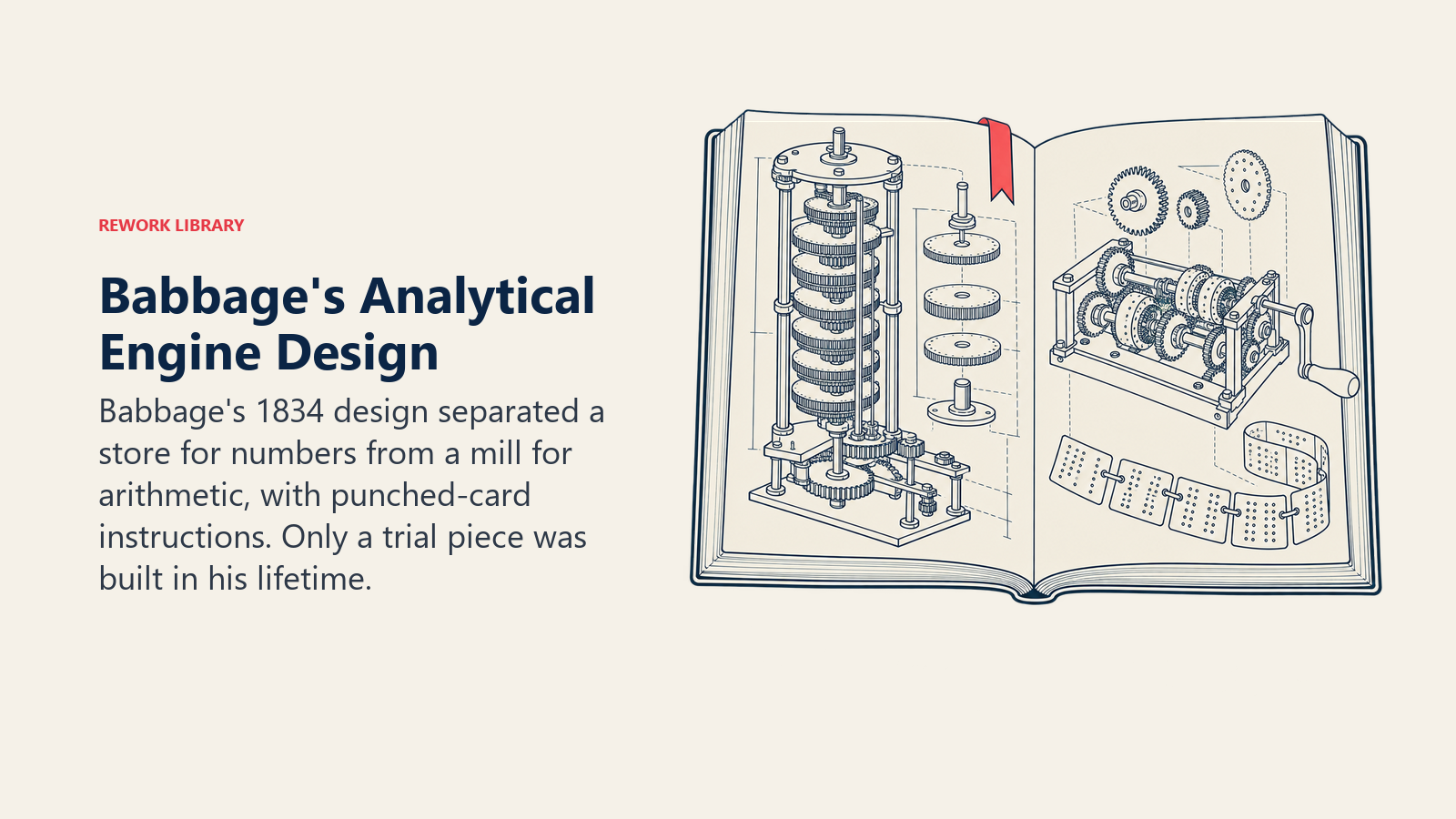
The leap came in 1834. With the Difference Engine stalled, Babbage began the Analytical Engine, which the same source describes as programmable using punched cards, with a store where numbers and intermediate results were held and a separate mill that did the arithmetic. Store, processor and card-fed instructions: a design recognizable to anyone who has seen a modern computer. The Science Museum notes only a trial piece was built before Babbage died in 1871. The Computer History Museum puts the paradox in one line: he "invented computers but failed to build them." It adds that the first complete Babbage engine, a Difference Engine No. 2, was finished in London in 2002, 153 years after the design.
Ada Lovelace gave the design its public voice. Her translation of Luigi Menabrea's account appeared in Taylor's Scientific Memoirs in September 1843, with each of her own notes signed AAL. In Note G she worked through how the engine could compute Bernoulli numbers, and the notes themselves say the engine "has no pretensions whatever to originate anything." She also wrote that the engine "weaves algebraical patterns just as the Jacquard-loom weaves flowers and leaves." That's an early grasp of what a programmable machine is for. For how that remark echoes through today's debates, see the origin of artificial intelligence.
If you define a computer as a programmable, general machine, Babbage and Lovelace win on ideas. If you require that it be built, they lose. The engine was never built in his lifetime.
For teams today: a good design with no way to ship it changes nothing. Babbage's plans mattered later because someone wrote them down well enough to be rediscovered.
Turing's Paper (1936-1937)
A mathematician defines what any computer could compute
Alan Turing wasn't trying to build anything. His 1936-1937 paper "On Computable Numbers, with an Application to the Entscheidungsproblem" asked whether a mathematical question could be settled by a mechanical procedure. The Turing Scrapbook notes that in April 1936 he learned Alonzo Church had already answered Hilbert's question, and that Section 6 of the paper opens: "It is possible to invent a single machine which can be used to compute any computable sequence."
That sentence is the theoretical idea behind the general-purpose computer. A single machine, given the right instructions, can do the work of any other. Turing's paper didn't describe hardware, and it didn't start a company. It gave builders a definition of what they were building. People who define "computer" as "universal machine" credit Turing, and that is a fair reading, as long as you add that he described the idea and others built the metal.
For his later and better-known work on machine intelligence, see the origin of artificial intelligence and the history of AI.
For teams today: a clear definition of the problem can matter more than the first prototype. Turing's definition gave a whole field a target.
The Wartime Machines (1937-1945)
Berlin, Iowa, Bletchley and Philadelphia build in parallel
Four projects in three countries, mostly unaware of one another, produced the machines that anyone arguing about "first" ends up quoting. Each solved a different problem.
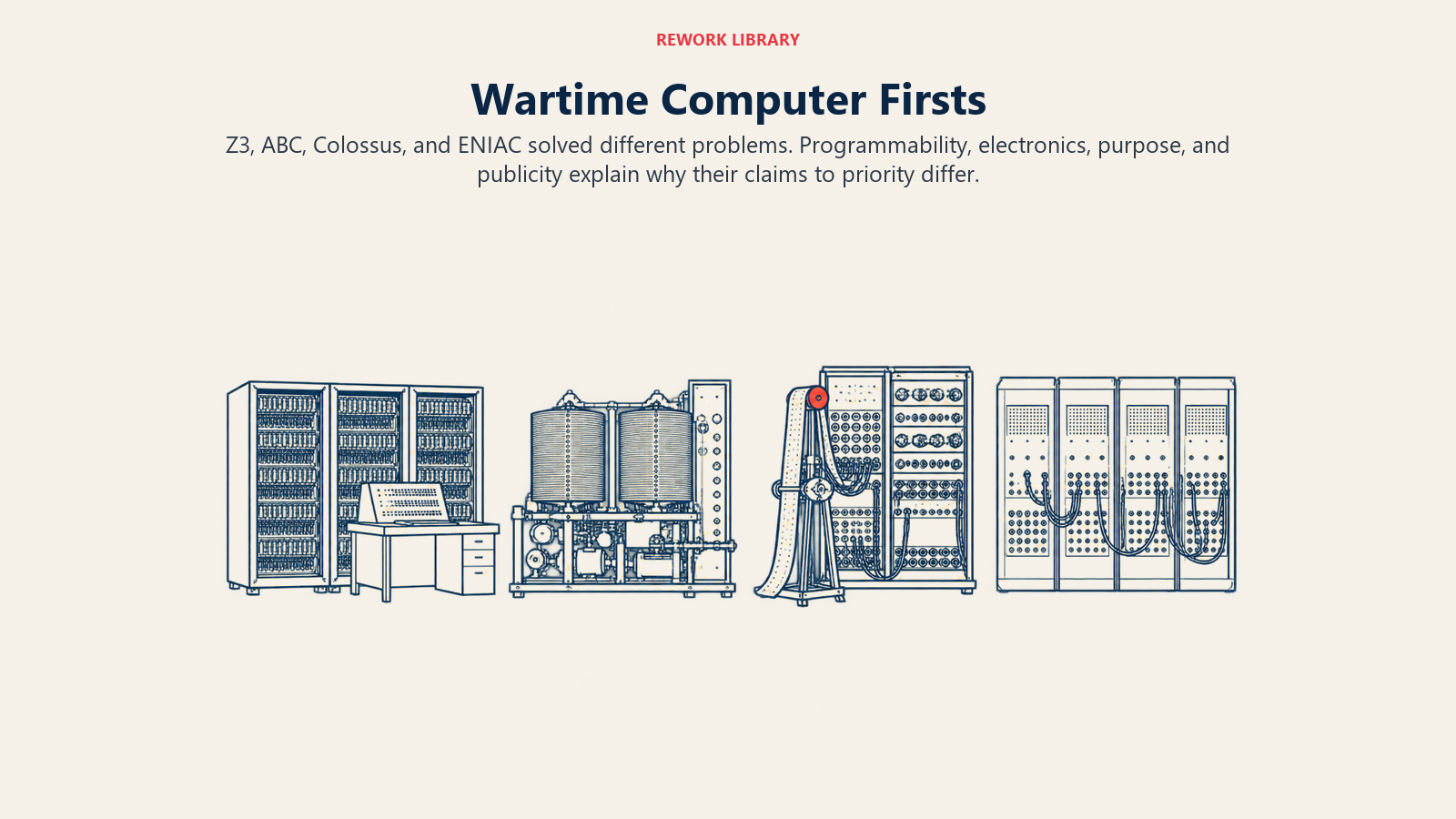
Berlin: Konrad Zuse's Z3. Zuse completed the Z3 on 12 May 1941 and presented it that day at the Deutsche Versuchsanstalt für Luftfahrt in Berlin-Adlershof. The Centre for Computing History calls it "the world's first working programmable, fully automatic digital computing machine", and says it used more than 2,000 relays. The Computer History Museum's timeline gives 2,300 relays, floating-point binary arithmetic and a 22-bit word. Relays are mechanical switches, so the Z3 was digital and programmable, but not electronic. Relay counts differ by source. The original was destroyed in the bombing of Berlin in December 1943.
Ames, Iowa: the Atanasoff-Berry Computer. John Atanasoff, a physics professor at Iowa State, and his graduate student Clifford Berry worked on the ABC from 1939 to 1942. The Computer History Museum says it was completed in 1942, used vacuum tubes, pioneered binary arithmetic and could solve simultaneous linear equations with up to 29 unknowns. By modern standards, the museum adds, it wasn't a full computer, because it couldn't store its own program. Iowa State's collection of Atanasoff records says it held 280 vacuum tubes and 31 thyratrons. It was electronic and digital, and built for one job.
Bletchley Park: Tommy Flowers' Colossus. Flowers designed Colossus at the Post Office Research Station at Dollis Hill. The National Museum of Computing says he spent eleven months designing and building it, that the Mark 1 reached Bletchley Park in late December 1943 or January 1944 and was working by early February 1944, and that it had "programmability, albeit limited in modern terms." The Crypto Museum says the Mark 2, planned with at least 2,400 valves, arrived on 1 June 1944, days before the Normandy landings. Colossus was electronic, and it was built to break the Lorenz ciphers the Nazis used, as the Computer History Museum timeline records. The same museum says the first information about it was declassified in 1975.
Philadelphia: Eckert and Mauchly's ENIAC. John Mauchly proposed an all-electronic calculating machine in 1942, and ENIAC was built between 1943 and 1945, according to the Computer History Museum. It used almost 18,000 vacuum tubes, and the museum records that it was the first large-scale computer to run at electronic speed without mechanical parts. The Army wanted ballistics tables. The University of Pennsylvania's ENIAC history page says it was originally announced on 14 February 1946, credits Mauchly as the visionary and J. Presper Eckert Jr. as the engineer, and describes programming by plugging in cables and setting switches. The Computer History Museum records that the classified machine became front-page news in The New York Times on 15 February 1946. So ENIAC has two dates: built 1943-1945, announced February 1946.
Notice how differently the four were remembered. Zuse's original was destroyed in 1943. Colossus stayed classified until 1975. The ABC was a single-purpose machine in a university basement. ENIAC had the Army, the press and, later, a patent application behind it.
For teams today: when several groups solve the same problem under pressure, the winner of the history books is often the one with the best publicity and records, not the earliest prototype.
The Stored-Program Race (1945-1949)
Instructions move into memory, and the credit fight begins
ENIAC's weakness was how long it took to set up. Each new problem meant rewiring. The Computer History Museum says Eckert and Mauchly saw the drawbacks of rewiring ENIAC for each problem, but urgent wartime work didn't let them explore putting programs in memory. John von Neumann joined as a consultant after a chance meeting with Herman Goldstine on a railway platform, and he drafted a report on ENIAC's successor.
That report is dated 30 June 1945: First Draft of a Report on the EDVAC. The Computer History Museum notes that von Neumann wrote it and that its key idea was a single large internal memory holding both instructions and data. The credit dispute followed from one detail: the report carried von Neumann's name alone. Eckert and Mauchly, whose experience with ENIAC had shown them the limits of rewiring, were not credited on the document, and the design became widely known as the "von Neumann architecture." That is the root of the dispute.
Then machines caught up with the paper.
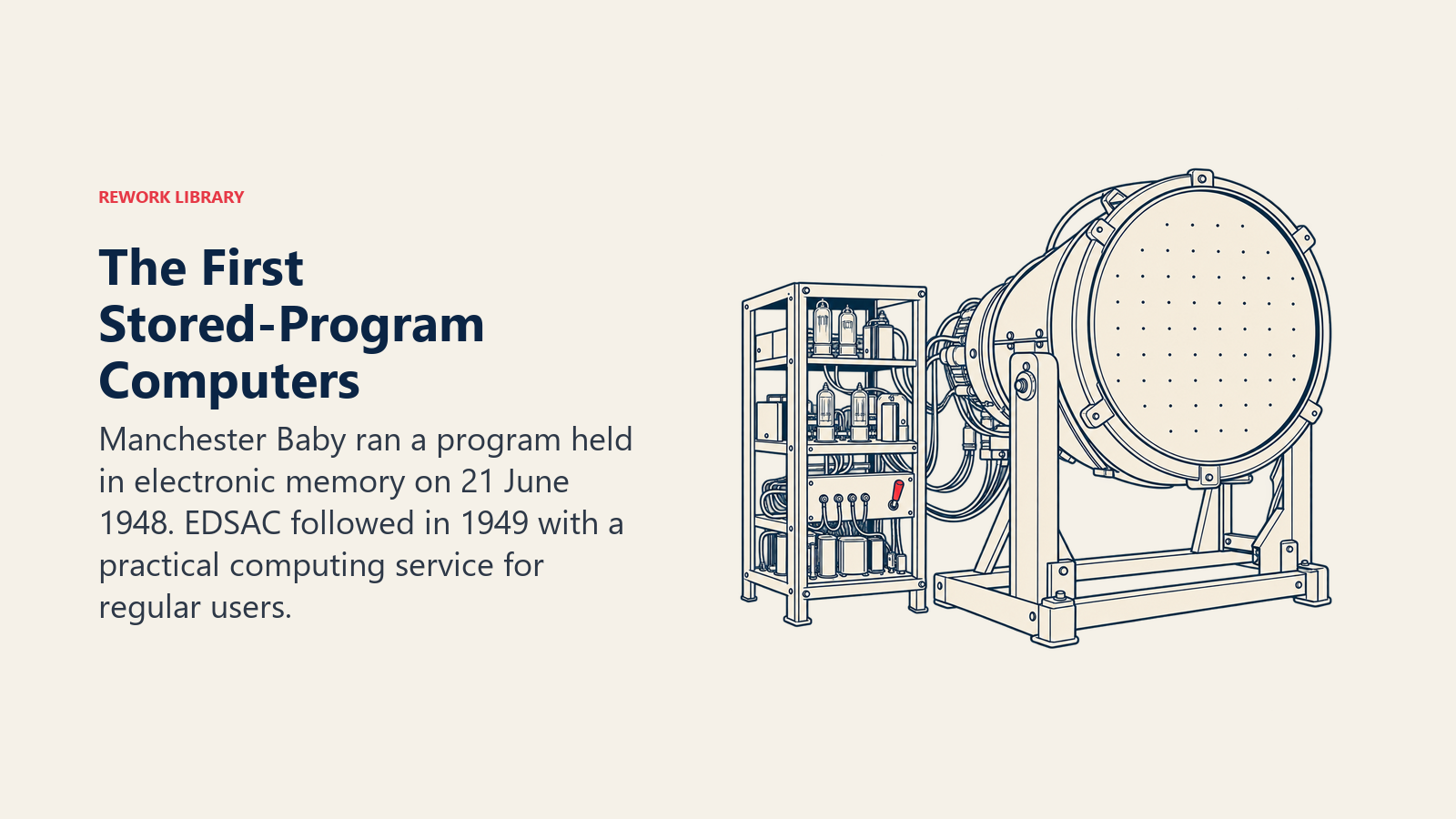
On 21 June 1948, at 11am, the Small-Scale Experimental Machine, nicknamed "the Baby," started running its first program at the University of Manchester. The University of Manchester credits Frederic Williams, Tom Kilburn and Geoff Tootill with building it, says the run took 52 minutes and 3.5 million calculations, and says it was the first computer to run a program stored electronically in its memory. The Computer History Museum says Kilburn wrote the program, and describes the run as the first on a digital, electronic, stored-program computer. Williams later recalled that a program was "laboriously inserted" and the start switch pressed. The university also admits calling it "the birth of modern computing" is a matter of opinion.
Cambridge made it practical. The National Museum of Computing says EDSAC ran its first successful program on 6 May 1949 under Maurice Wilkes, with Bill Renwick as chief engineer and David Wheeler adding features for everyday users. It had 512 words of memory at first, used mercury delay-line tanks, and ran a computing service for more than nine years. The Computer History Museum calls it the first practical stored-program computer to provide a regular computing service. That's the machine most people would recognize as a computer in the sense we use today: electronic, digital, running programs held in memory, and used by people who didn't build it.
For teams today: the idea of a shared design is only as good as its attribution. If you publish a draft with one name on it, expect the others to remember.
The Verdict and After (1947-present)
A court awards the invention to Iowa, and nobody agrees
While the machines were being built, the lawyers were already involved. Eckert and Mauchly filed their ENIAC patent application on 26 June 1947, and it was granted on 4 February 1964 as US patent 3,120,606, "Electronic numerical integrator and computer." The assignee was Sperry Rand, and the rights became the subject of the lawsuit Honeywell v. Sperry Rand.
In 1973, Judge Earl Larson ruled the patent invalid. The IEEE Computer Society's biography of Larson says he found that Eckert and Mauchly "did not themselves first invent the automatic electronic computer," but derived the subject matter from John Vincent Atanasoff. Iowa State's collection describes Honeywell, Inc. v. Sperry-Rand as the case that established the ABC as the first electronic digital computer.
Read that carefully. A court ruled on a patent, a legal question about who owned a claim. It didn't rule on the history of computing, and historians point out that the ABC wasn't programmable or general-purpose. The ruling remains the strongest single reason Atanasoff's name appears in this story at all, and it ended the ENIAC patent nine years after its 1964 grant.
Today, the credit is shared because the work was shared. Think of the cast: a Victorian engineer and a mathematician who annotated his plans, a young mathematician who defined computation, a German engineer in Berlin, a physics professor and his student in Iowa, a Post Office engineer working in secret, two Philadelphia engineers and a mathematician with a draft, and the Manchester and Cambridge teams who got programs into memory. The networks that followed, told in the history of the internet, repeated the pattern: many contributors and a few names on the paperwork. So did the systems behind artificial intelligence.
For teams today: when you launch something, assume the history will be argued later. Record who did what, when, and keep the dated evidence.
Which Definition Gives Which Winner
Use this table to settle a bar argument. Every row is a different answer to "who invented the computer?" The sources are cited in the sections above.
| Machine | Date | Programmable? | Electronic? | Stored program? | What the claim rests on |
|---|---|---|---|---|---|
| Analytical Engine (Babbage) | Designed 1834, never completed | Yes, by punched cards, as designed | No, mechanical | No, cards fed the instructions | The idea of a general machine |
| Z3 (Zuse) | 12 May 1941 | Yes | No, relays | No | First working programmable digital machine |
| ABC (Atanasoff, Berry) | 1942 | Built for one job, up to 29 unknowns | Yes, vacuum tubes | No | Early electronic digital machine, and the 1973 ruling |
| Colossus Mark 1 and 2 (Flowers) | Working early 1944, Mark 2 on 1 June 1944 | Limited | Yes, valves | No | Large-scale electronic machine in service, secret until 1975 |
| ENIAC (Eckert, Mauchly) | Built 1943-1945, announced 14 Feb 1946 | Yes, by cables and switches | Yes, almost 18,000 tubes | No, rewired for each problem | The first large-scale electronic computer the public saw |
| Manchester Baby (Williams, Kilburn, Tootill) | 21 June 1948 | Yes | Yes | Yes | First program held in electronic memory |
| EDSAC (Wilkes and team) | First program 6 May 1949 | Yes | Yes, thermionic valves | Yes | First practical stored-program machine with a regular service |
Key People
| Name | Role | Contribution | Year |
|---|---|---|---|
| Charles Babbage | English inventor | Designed the Difference Engines and the Analytical Engine | 1822-1871 |
| Ada Lovelace | Mathematician and translator | Annotated the Analytical Engine and wrote its Bernoulli number program | 1843 |
| Alan Turing | Mathematician | Described a universal machine that can compute any computable sequence | 1936-1937 |
| Konrad Zuse | German engineer | Built the Z3 | 1941 |
| John Atanasoff and Clifford Berry | Iowa State physicist and graduate student | Built the ABC | 1939-1942 |
| Tommy Flowers | Post Office engineer | Designed Colossus | 1943-1944 |
| J. Presper Eckert and John Mauchly | Engineer and physicist | Built ENIAC and filed its patent | 1943-1947 |
| John von Neumann | Mathematician | Wrote the First Draft of a Report on the EDVAC | 1945 |
| Frederic Williams, Tom Kilburn, Geoff Tootill | Manchester engineers | Built the Baby and ran its first program | 1948 |
| Maurice Wilkes | Cambridge computer scientist | Led the EDSAC project | 1949 |
| Earl Larson | US District judge | Ruled the ENIAC patent invalid | 1973 |
Key Facts
- Babbage's Difference Engine No. 2 was completed in London in 2002, 153 years after its design, per the Computer History Museum.
- Konrad Zuse completed the Z3 on 12 May 1941.
- The first Colossus Mark 2 reached Bletchley Park on 1 June 1944, and its first information was declassified in 1975.
- ENIAC used almost 18,000 vacuum tubes and was announced on 14 February 1946.
- The Manchester Baby ran its first program on 21 June 1948, taking 52 minutes.
- Eckert and Mauchly's ENIAC patent was filed on 26 June 1947 and granted on 4 February 1964.
The Pattern Behind the History
Our synthesis, not published research: credit for the computer followed five habits.
- The idea comes before the machine. Babbage and Turing described what a computer was decades before anyone built one.
- Secrecy hides priority. Zuse's machine was destroyed, and Colossus stayed classified until the 1970s.
- Definitions pick the winner. Programmable, electronic, digital and stored-program each point to a different machine.
- Publicity and paperwork decide the textbook. ENIAC had the press and a patent; Atanasoff needed a lawsuit.
- A shared design leaves a credit dispute. Von Neumann's draft spread the architecture and hid the team.
What It Teaches Teams Today
- Define "first" before you argue. Most credit disputes at work, from who built the process to who won the account, are really definition disputes.
- Write down who did what, with dates. The ENIAC patent fight came down to documents from the early 1940s.
- Put names on shared work. An unattributed draft is how the von Neumann dispute started.
- Don't confuse the loudest launch with the first. Check the quieter projects before you pick your story.
- Expect your own work to be re-read. Colossus waited three decades to be told. For how organizations adapted around these machines, see the history of management.

Co-Founder, Rework.com
On this page
- Timeline at a Glance
- The Precursors (antiquity-1830s)
- Babbage's Engines (1822-1871)
- Turing's Paper (1936-1937)
- The Wartime Machines (1937-1945)
- The Stored-Program Race (1945-1949)
- The Verdict and After (1947-present)
- Which Definition Gives Which Winner
- Key People
- Key Facts
- The Pattern Behind the History
- What It Teaches Teams Today