Charles Babbage and the Analytical Engine
Turn this article into takeaways for your work.


Each assistant summarizes the article only for you and suggests best practices for your work.
In 1821 Charles Babbage was checking tables of logarithms with the astronomer John Herschel. Navigation, astronomy and engineering ran on such printed tables. People computed them by hand, so they carried mistakes. As the Science Museum Group tells it, Babbage wished the calculations "had been executed by steam."
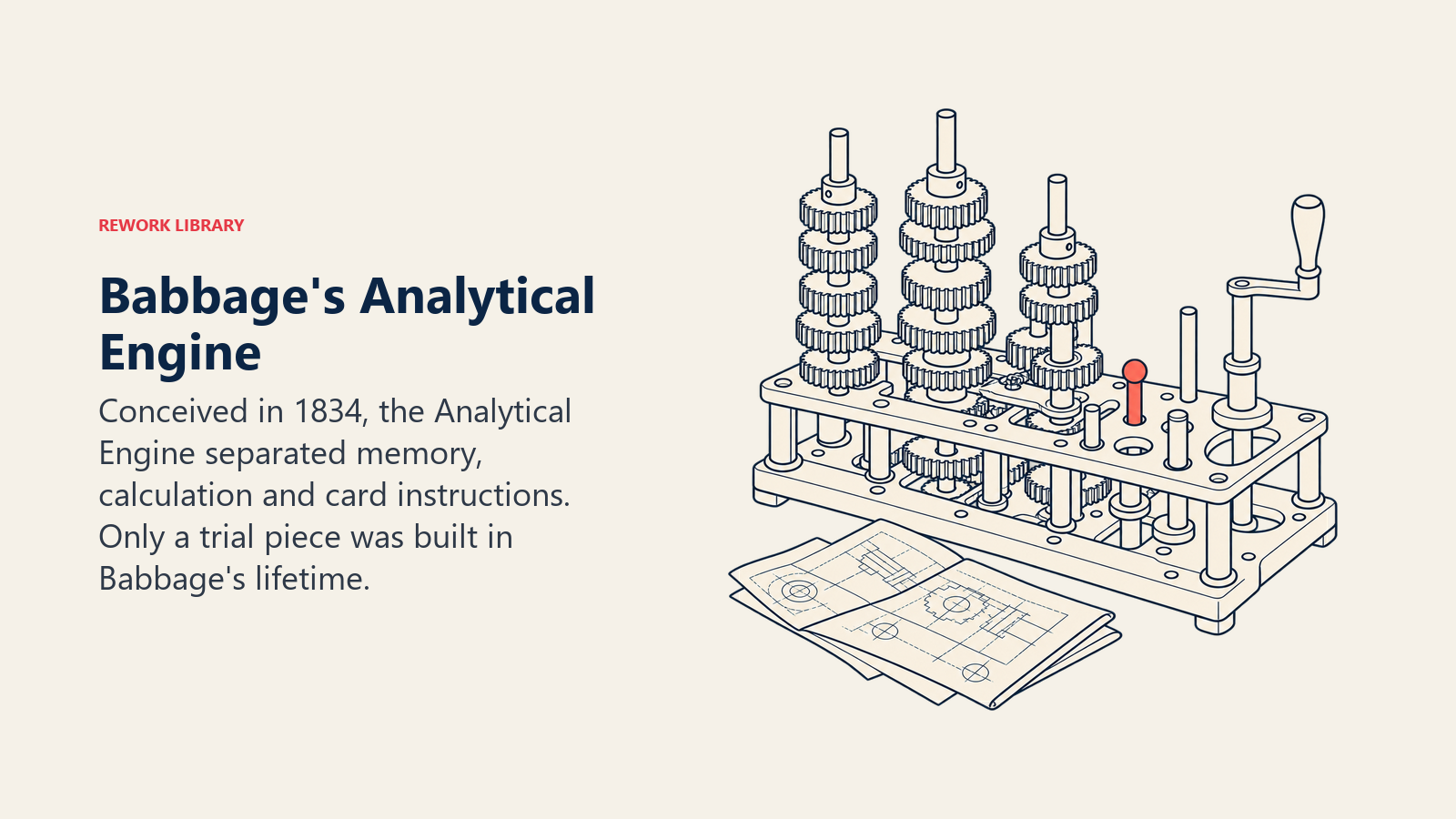
The Analytical Engine is the general-purpose, card-programmed calculating machine that the English mathematician Charles Babbage conceived in 1834. He spent the rest of his life refining it on paper. It was never finished, and no complete version exists even now. The design arrived about a century before the technology and the money to build it. That's why historians still argue over whether it counts as the first computer, as we do in who invented the computer. For the wider field, start at the history of computers.
Timeline at a Glance
| Year | Milestone | Why It Mattered |
|---|---|---|
| 1812 or 1813 | Babbage, half asleep over logarithm tables at Cambridge, imagines computing them by machinery | The origin of the whole project, by Babbage's own account. |
| 14 June 1822 | Babbage first announces the Difference Engine to the Royal Astronomical Society | The first engine was a table-maker, not yet a computer. |
| 1832 | Joseph Clement completes a working section of about 2,000 parts | Proof that the machine could work, and all that was ever built of it in Babbage's lifetime. |
| 1833 | Work stops after a pay dispute with Clement | The stalled project pushed Babbage toward a better idea. |
| 1834 | Babbage conceives the Analytical Engine | A machine with a store, a mill and punched-card control. |
| 1840 | Babbage presents the engine to Italian scientists at Turin | A rare in-person explanation to Italian mathematicians. |
| October 1842 | Menabrea's memoir appears in Geneva | The engine's principles reach print. |
| 1843 | Lovelace publishes her translation with notes about three times its length | The notes describe step-by-step procedures for the engine. |
| 1847-1849 | Babbage designs Difference Engine No. 2 | A simpler engine that could actually be built later. |
| 1871 | Babbage dies with only a trial piece of the Analytical Engine built | The design survives only on paper. |
| 1910 | Henry Babbage builds a mill, a hand-operated printing calculator | The only part of the engine his son ever made. |
| 1991 | Science Museum completes the calculating section of Difference Engine No. 2 | Babbage's drawings were shown to work. |
| 2002 | The printing mechanism is added | The first complete Babbage engine. |
| 2011 | The Plan 28 project forms to build the Analytical Engine | The unbuilt engine becomes a live project. |
The Table Problem (1812-1833)
Hand-computed tables drive Babbage to a calculating machine
Picture the rooms of the Analytical Society at Cambridge, a table of logarithms open on the desk and a young Babbage with his head resting beside it. By his own account in Passages from the Life of a Philosopher, another member called out, "what are you dreaming about?" and Babbage replied, "I am thinking that all these Tables... might be calculated by machinery." The anecdote came to him from a friend, and he dates the event to 1812 or 1813.
The idea matured a decade later. On 14 June 1822 Babbage announced his Difference Engine in a paper read to the Royal Astronomical Society, per the Science Museum Group. The engine used the method of differences, which Babbage explains in his memoir needs the machine to do addition only, and it was meant to set the results in type so no human copyist could add new errors. He gave the government a reason to pay: the frontispiece of his memoir records that the large engine was commenced in 1823 for the government. By 1831 the Treasury had spent £17,500, which the Science Museum puts at about the price of twenty-two locomotives.
In 1832 Joseph Clement, Babbage's engineer, finished a working section of about 2,000 parts. And in 1833 the project stalled. The Computer History Museum says Clement quit after a pay dispute and construction of Difference Engine No. 1 halted. That same year the seventeen-year-old Ada, later Lady Lovelace, met Babbage and saw the small working section demonstrated, according to the Science Museum.
The first engine solved one narrow problem and created a wider one. It could only tabulate. A machine that did one job well, at that price, was hard to defend to a Treasury, and Babbage was already thinking beyond it.
For teams today: Babbage's start was a defect rate, not a gadget. The strongest projects begin with a specific, countable error that people already pay to live with.
The Card Idea (1834-1842)
Jacquard's punched cards meet the calculating engine
In a workshop Babbage kept in his own house, at his own expense, drawings piled up. In 1834, with the Difference Engine stalled, Babbage conceived the Analytical Engine, which the Computer History Museum calls a general-purpose programmable machine. This is the design date. The announcement of it to a public came later, and the build never came.
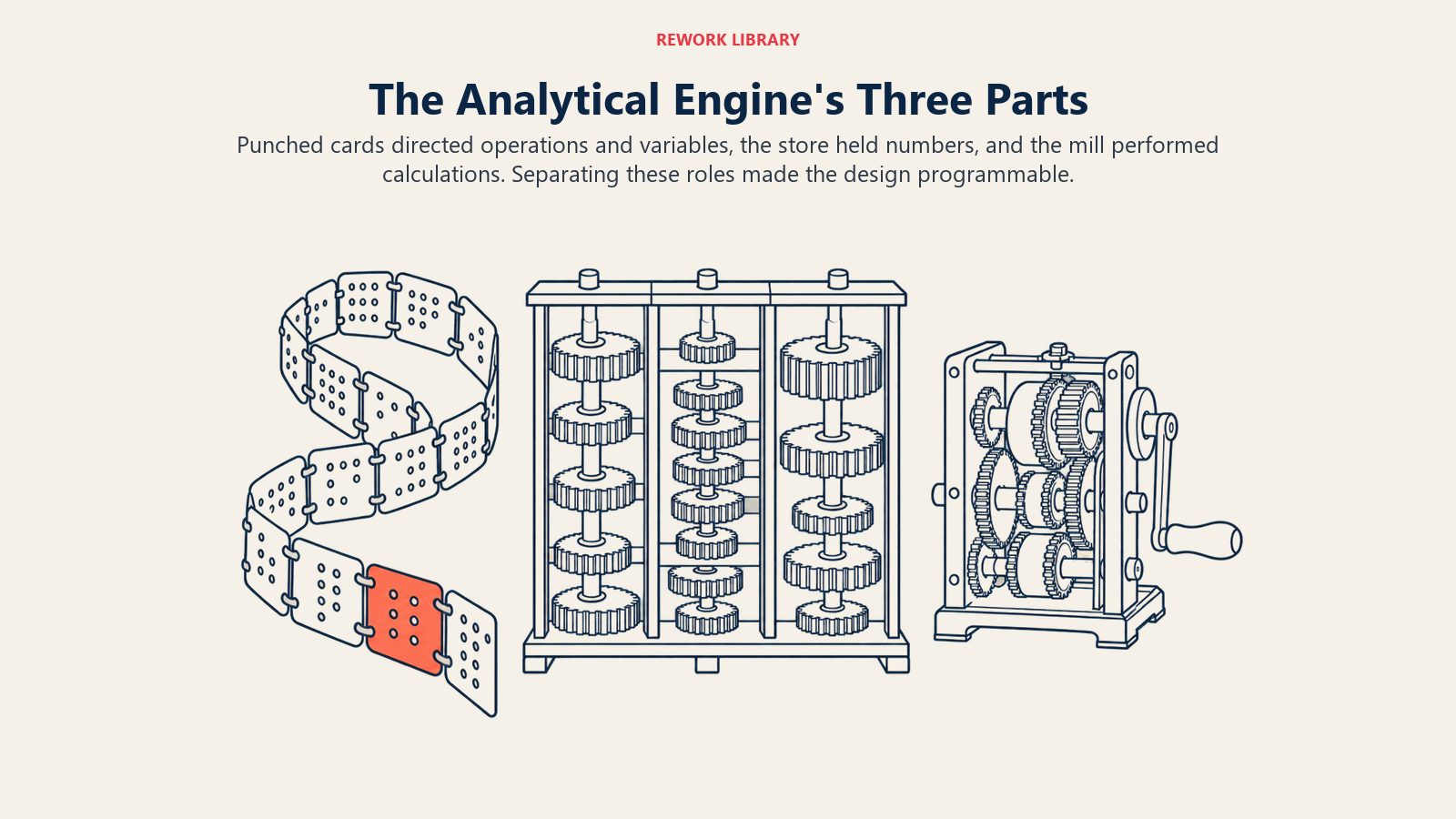
What made it different was a split Babbage described himself. In his chapter on the engine he lays out two parts: a store holding the variables and the results of earlier operations, and a mill where the quantities about to be worked on are brought. Control came from punched cards borrowed from the Jacquard loom. Two sets of cards did the directing, operation cards to say what to do and variable cards to say which numbers to do it to. Babbage wrote that the analogy of the engine with the loom "is nearly perfect". In modern words, the store is memory, the mill is the processor and the cards are the program. We trace that card lineage further in the history of programming languages.
The new engine also forced new engineering. Babbage records that it was not until upwards of twenty different mechanical modes of addition had been designed and drawn that the simplicity the engine needed was reached. And he developed a system of signs he called Mechanical Notation to describe the machinery, saying he could not have invented the engine without it.
Then the money ran out. The government's engagement on the Difference Engine, Babbage wrote, had lasted upwards of twenty years when it finally ended after an unsatisfactory interview with Sir Robert Peel, and the memoir's frontispiece gives 1842 as the year construction was abandoned. In the same passage he says that after expending more of his private fortune than the government had spent, he had received neither acknowledgment nor reward.
Before that, in 1840, Babbage took his drawings and models to Turin at the invitation of his friend Plana. Several mornings, in his own apartments, he explained the idea to Italian mathematicians and engineers, among them Plana and L. F. Menabrea, an officer of the Military Engineers. Plana had asked whether the engine would give the same control over the executive side of analysis that mathematicians already had over the legislative side. Babbage said he could hardly have put it better. Plana proposed notes on the principles, then passed the task to the younger Menabrea.
For teams today: Babbage's design separated memory, processing and instructions before anyone built such a thing. When you design a system, ask what the equivalent of the store, the mill and the cards is, and keep them separate.
The Notes (1842-1871)
Menabrea and Lovelace put the engine into print
The next scene is a printed page. Menabrea's memoir, written in French from the Turin meetings, appeared in the Bibliothèque Universelle de Genève in October 1842, and Ada Lovelace translated it. Babbage recounts that when he asked why she had not written an original paper, she said the thought had not occurred to her, so he suggested she add notes. He says the choice of illustrations was entirely hers. The full text is in the Sketch of the Analytical Engine, where her notes run to far more than the memoir.
Three passages from those notes became famous. The first compares the machine to a loom: the Analytical Engine "weaves algebraical patterns" the way a Jacquard loom weaves flowers and leaves. The second draws a line around what the engine could do: it "has no pretensions whatever to originate anything", and can do only what we know how to order. That sentence returns a century later, when Alan Turing quotes it and answers it, a story we tell in the history of the Turing Test. The third is a worked example, the computation of the Numbers of Bernoulli, which we cover in Ada Lovelace and the first computer program.
Babbage meanwhile kept drawing. Between 1847 and 1849 he designed Difference Engine No. 2, which the Computer History Museum says needed about one-third of the parts of No. 1. In his memoir he offers the government the improvements he had made for the Analytical Engine, then states he did not expect it to undertake the larger machine. He adds that it was not matured enough for anyone else to attempt without long training.
Babbage died in 1871. By then, the Science Museum notes, only a trial piece of the Analytical Engine had been built. The era solved the problem of record: the design now existed in a language other people could read. It left the problem of delivery, since no one with money or workshops was willing to take it over.
For teams today: Babbage's best asset turned out to be documentation. Write up decisions well enough that a stranger can pick them up, because the people who finish your work may not be the ones who start it.
The Long Quiet (1871-1984)
A son builds one mill, and the plans sit in storage
After 1871 the story shifts to a workshop and an archive. Babbage's youngest son, Henry Prevost Babbage (1824-1918), took up the mill. The Science Museum Group collection dates his machine to 1910 and describes it as a hand-operated printing calculator for addition, subtraction, multiplication and division, based on the plans for the mill. The museum holds it incomplete, with spare parts and casting patterns, and it weighs 260 kg. It was one component, with no store and no cards, not a working engine.
Henry's other legacy was the paper. The Babbage archive of plans, notebooks and papers came to the Science Museum through him, as the I Programmer report on its later digitisation recounts. For more than a century, then, the Analytical Engine was a pile of drawings and one brass fragment. The wider story of calculating devices in these years, from desk machines to tabulators, belongs to the history of mechanical calculators.
Notice the pattern: a design can outlive the world that could not build it. The engine's ideas did not travel through Babbage's machine. They survived in the printed notes and the archive until electronic computers made the vocabulary of stores, mills and programs ordinary.
For teams today: Archives are an asset. A project parked for lack of funds is still worth filing properly, because a later team may have the tools you lacked.
The Rebuild (1985-2002)
The Science Museum proves Babbage's drawings work
Picture the Science Museum in London, where a team worked from Babbage's own drawings for years. According to the Science Museum Group, planning and construction of Difference Engine No. 2 began there in 1985, and the museum completed the first phase in 1991 for the bicentenary of Babbage's birth. The printing mechanism followed in 2002.
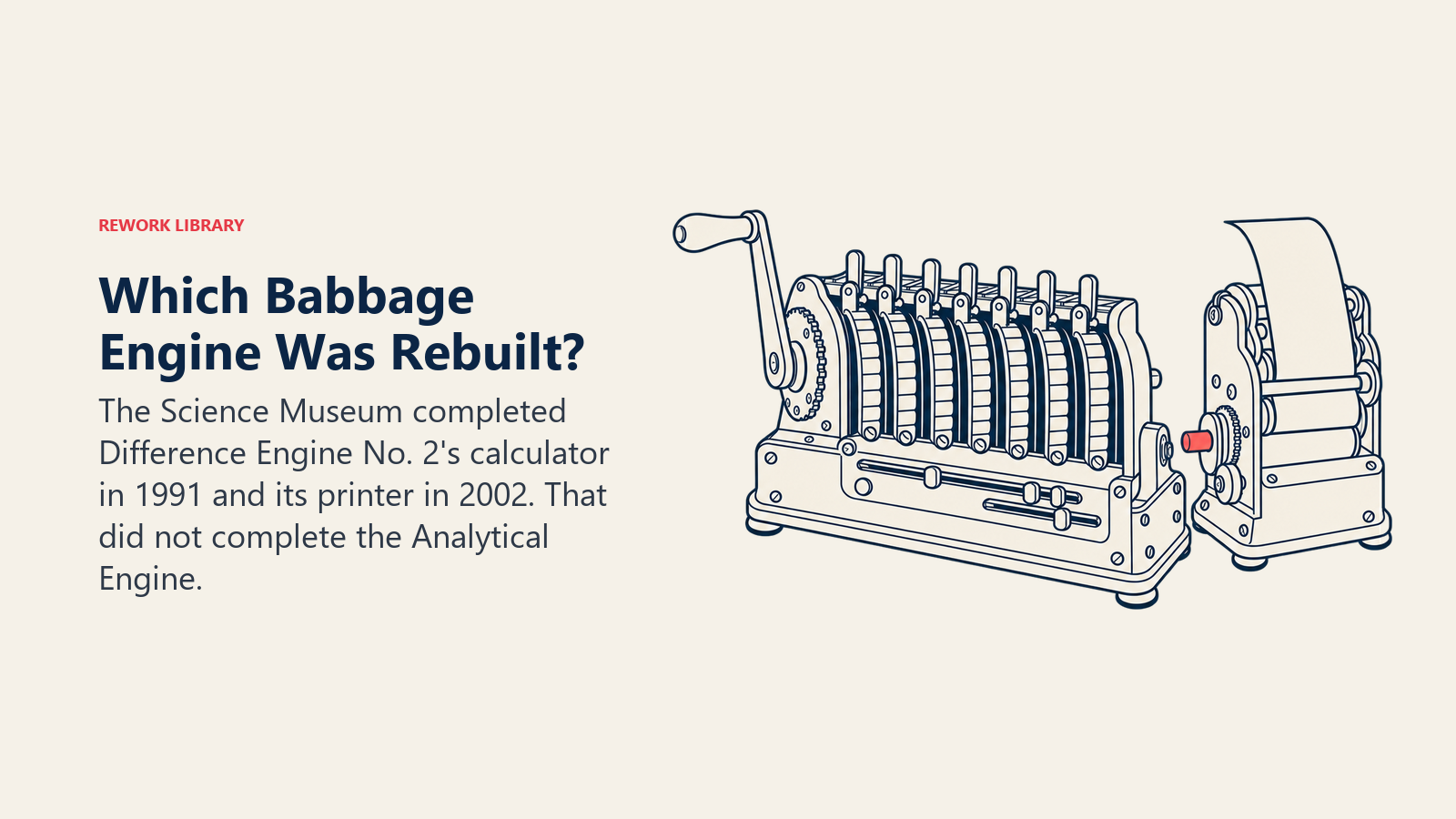
The finished machine is large. The Computer History Museum says it has 8,000 parts, weighs five tons and is 11 feet long, and that it was built to the original drawings 153 years after they were made. Sources describe the completion differently: the Science Museum counts 1991 for the calculating engine and 2002 for the full engine with printer, while the Computer History Museum gives 2002 as the completion. Both agree the design worked as drawn.
Notice what this did and did not prove. It showed that the drawings for the simpler engine were sound. It said nothing yet about the Analytical Engine, which is larger and far less finished on paper.
The new problem was obvious. Building the simpler engine had taken roughly seventeen years, and the Analytical Engine was a much bigger job.
For teams today: Build the small, well-specified version first. The Science Museum validated the method on the simpler design before anyone attempted the harder one.
The Plan 28 Years (2002-present)
Volunteers and curators try to decode the unbuilt engine
The sources date the start differently. The Science Museum Group says Doron Swade and others formed the Plan 28 project in 2011, while I Programmer says John Graham-Cumming launched it in 2010 and had enlisted Swade by the end of that year. Its aim, in I Programmer's words, is "a fully-functional implementation of Babbage's original design". The name refers to one of Babbage's numbered design drawings, which he called Plans. Graham-Cumming, who publishes the project blog, and Swade began with the paper. The same report describes the digitising of the entire archive as the first step, with Graham-Cumming and Swade getting early access.
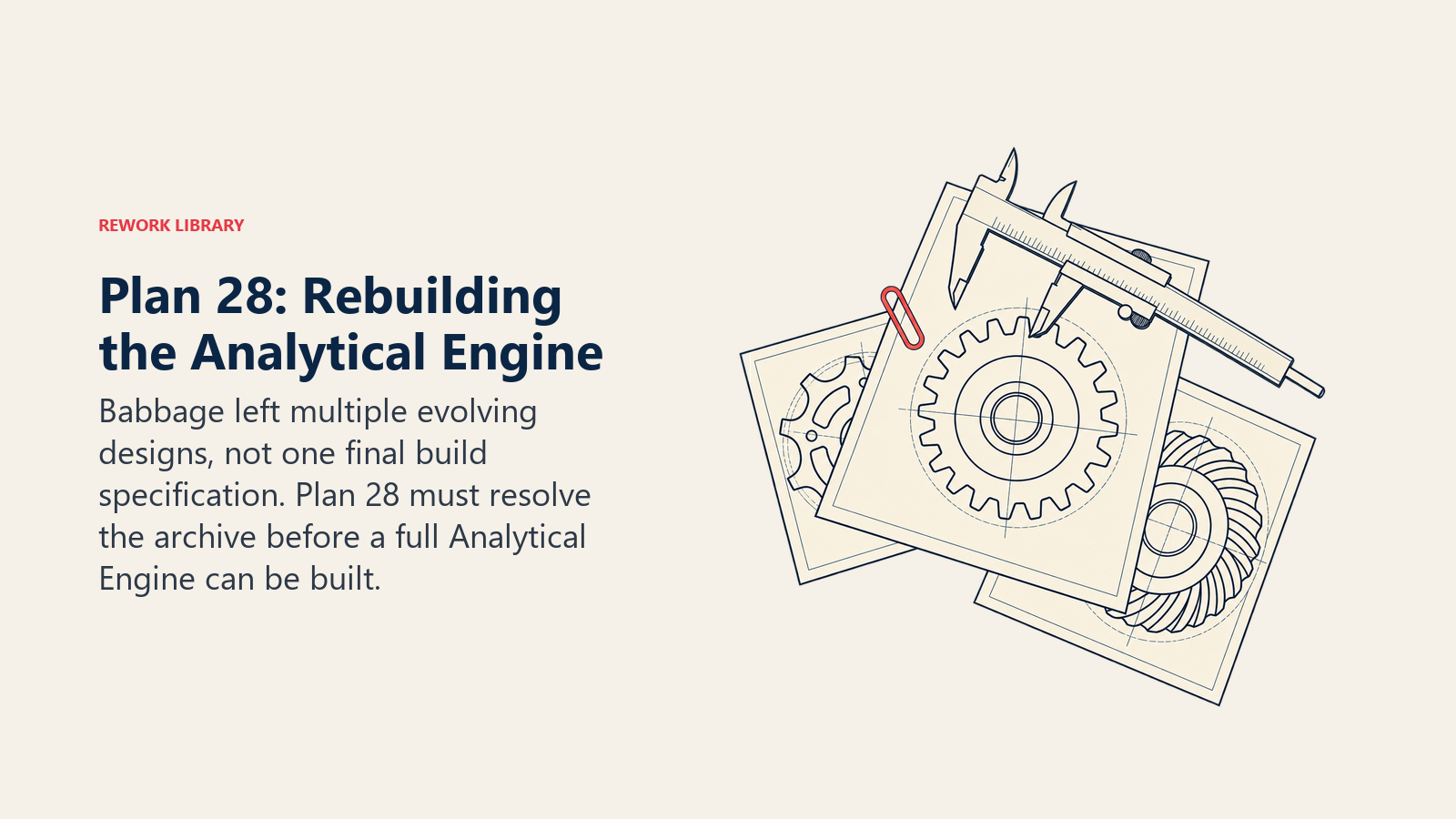
The work is part archaeology and part software. Babbage left many designs and no single final one, so the team has to work out which drawing wins. A 2019 Plan 28 report mentions a sheet-by-sheet review of the archive and the discovery of what may be Plan 28a, described there as part of the most advanced design for the engine.
No full Analytical Engine has been built. The era's result is a better question than the old one. Instead of asking whether Babbage was right, the project asks which of his designs was the final one and how many parts it would take.
For teams today: Legacy systems are a lot like Babbage's archive. Before you rebuild, find out which version of the design is the real one.
Key People
| Name | Role | Contribution | Year |
|---|---|---|---|
| Charles Babbage | English mathematician and inventor | Designed the Difference Engines and the Analytical Engine | 1822-1871 |
| John Herschel | Astronomer | Checked tables with Babbage in the episode that led to the "steam" remark | 1821 |
| Joseph Clement | Engineer and toolmaker | Built the working section of the first Difference Engine | 1832 |
| Plana | Babbage's Italian correspondent | Invited Babbage to Turin and framed the engine's purpose | 1840 |
| L. F. Menabrea | Officer of the Military Engineers, Turin | Wrote the memoir describing the engine | 1842 |
| Ada Lovelace | Translator and annotator | Added the notes that describe the engine's operation | 1843 |
| Henry Prevost Babbage | Babbage's youngest son | Built the 1910 mill and passed on the archive | 1910 |
| Doron Swade | Curator and engineer | Enlisted by Graham-Cumming for Plan 28, the push to build the engine | 2010-present |
| John Graham-Cumming | Programmer and author | Launched Plan 28, per I Programmer | 2010-2011 |
Key Facts
- The Treasury spent £17,500 on the Difference Engine by 1831, about the price of twenty-two locomotives.
- The Analytical Engine was conceived in 1834 and never completed in Babbage's lifetime.
- Babbage designed upwards of twenty different mechanical modes of addition before reaching the simplicity the engine needed.
- Lovelace's 1843 notes ran about three times the length of the memoir she translated.
- Difference Engine No. 2 has 8,000 parts, weighs five tons and is 11 feet long.
- The Science Museum began building it in 1985, finished the first phase in 1991 and added the printer in 2002.
The Pattern Behind the History
The same four moves repeat across the six eras. We call the sequence the Design-Ahead Loop. It is our synthesis of the history above, not a research finding.
- Start with a counted pain. Hand-computed tables carried errors, and Babbage set out to remove them.
- Generalize beyond the first fix. The Difference Engine only tabulated. The Analytical Engine split memory, processing and instructions.
- Outrun the funding. The government ended its support in 1842, and the engine stayed on paper.
- Leave a readable record. The Sketch, the notebooks and the archive let later people test the design.
What It Teaches Teams Today
- Specify the pain in numbers. A table error rate is easier to fund than a vague promise of better calculation.
- Separate memory, processing and instructions. Babbage's split is the shape of every computer built since.
- Document for strangers. The Sketch and the archive are why this story is still being rewritten.
- Prototype the smaller thing first. The Science Museum built the simpler engine before facing the harder one.
- Know which design is final. Plan 28's hardest question is not engineering but version control.
Babbage never saw the engine run, and still it shaped how people think about computers. His lasting lesson is to write the design down so well that it can wait for a world able to build it. For the full arc that followed, continue with the computer timeline and the five generations of computers.
