Colossus and Wartime Code-Breaking Computers
Turn this article into takeaways for your work.


Each assistant summarizes the article only for you and suggests best practices for your work.
In August 1941, a German operator on an Athens to Berlin teleprinter circuit made an error. That mistake let John Tiltman break one message. But breaking one message wasn't the same as reading a war. Nobody yet knew how the machine behind it worked.
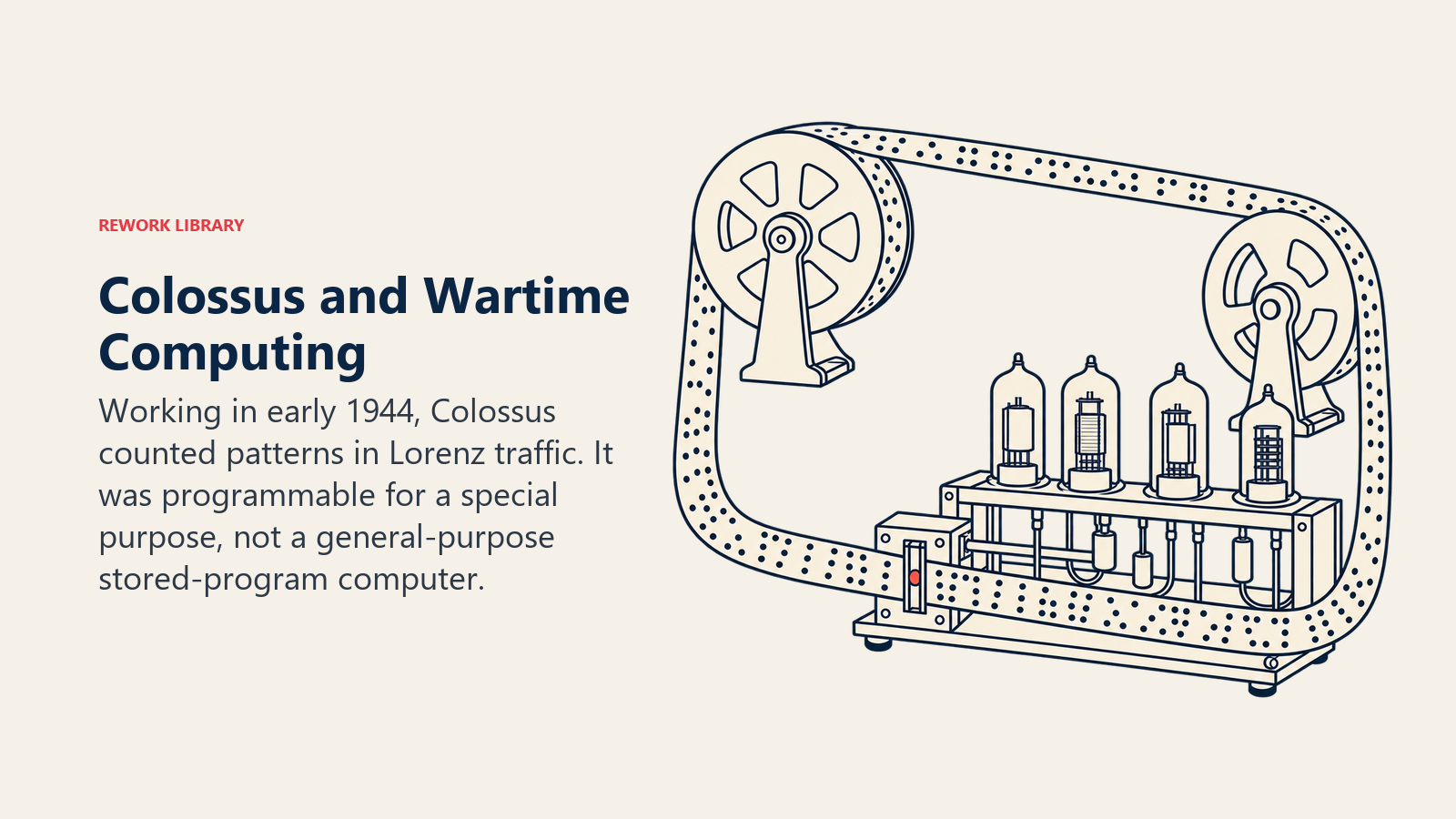
Colossus was a set of electronic machines built at the Post Office research station at Dollis Hill. They were installed at Bletchley Park from early 1944 to read German Lorenz teleprinter messages. It was the end of a chain. That chain began with Polish mathematicians attacking Enigma in the early 1930s, passed through the British Bombe in 1940 and the unreliable Heath Robinson in 1943, and then stayed secret for about 30 years. Each machine existed because a hand method had hit a wall. For the wider arc of the field, see The History of Computers and the computer timeline.
Timeline at a Glance
| Year | Milestone | Why It Mattered |
|---|---|---|
| 9th century | Al-Kindi writes the earliest known description of frequency analysis | Code breaking became a method, not a guess. |
| 1917 | Gilbert Vernam invents his teleprinter cipher | The tape-and-XOR idea behind later machine ciphers. |
| 1 September 1932 | Marian Rejewski joins the Cipher Bureau in Warsaw full-time | Permutation theory turned Enigma into a solvable problem. |
| 1938 | The Poles use a bomba | The first machine built to search Enigma settings. |
| 14 March 1940 | The first British Bombe, Victory, begins work at Bletchley Park | Enigma breaking went from craft to production line. |
| January 1943 | Heath Robinson development begins; a prototype arrives in June 1943 | The first electronic-assisted attack on Lorenz. |
| December 1943 to February 1944 | The first Colossus is delivered and working | A fully electronic machine on a single paper tape. |
| 1 June 1944 | The first Mark 2 is delivered, five days before D-Day | Faster machines in place for Normandy. |
| 1945 | Ten Colossus machines built | Industrial-scale code breaking by electronics. |
| After the war | Eight of the ten are destroyed | Secrecy erased the machines and the credit. |
| October 1975 | Government releases captioned photographs of Colossus | Ended 32 years of official silence. |
| 2007 | The rebuilt Colossus takes part in a Cipher Challenge | The machine runs again at Bletchley Park. |
The Early Cipher Years (9th century-1939)
From letter counting to Poland's Cipher Bureau
The earliest documented step is a method. Simon Singh's account of the history of cipher breaking says the 9th-century scholar al-Kindi wrote the earliest known description of frequency analysis, a technique that exploits variations in letter frequencies, in a treatise rediscovered in 1987 in an Ottoman archive in Istanbul. Nobody called it computing. But it turned code breaking into counting, and counting is what machines later took over.
The second step is a cipher built for machines. Gilbert Vernam invented his cipher in 1917, combining each teleprinter bit with a key bit by XOR, and the patent (US 1,310,719) was filed on 13 September 1918. Lorenz teleprinter ciphers later used the same family of idea, which John Tiltman recognised as a Vernam-type cipher when the first Lorenz message was intercepted in early 1940.
The third step is Poland. Marian Rejewski joined the Cipher Bureau in Warsaw full-time on 1 September 1932 alongside Jerzy Rozycki and Henryk Zygalski. His paper credits permutation theory, which he calls known for over a hundred years, for the breakthrough in 1932-33. By January 1938 the three could read about three-quarters of the messages passed to them. Then the Germans added complexity in December 1938. The Poles had used a "bomba" machine in 1938, an electro-mechanical device that found Enigma settings. The BCS notes that no original bomba survives, and that Rejewski's sketch and description come from papers he published in 1967 and 1979. In July 1939 he passed his knowledge to the British and French at Pyry, south of Warsaw.
Each step solved a piece of the problem, and left the same one: messages were arriving faster than people could count.
For teams today: the first reliable fix is usually a method, not a machine. Write the method down and make it repeatable before you automate it.
The Bombe Years (1939-1942)
Turing and Welchman turn Enigma breaking into a factory
The turning point is the move from Poland's procedure-based attack to Britain's text-based one. According to the Bombe history project, Alan Turing designed the Bombe to work from message text using "cribs", guessed stretches of plaintext, rather than from the indicator system, because he realised German changes to indicators would make indicator-based equipment obsolete. Gordon Welchman added the diagonal board, which used the reciprocal nature of the plugboard to cut out false stops, so that shorter cribs worked.
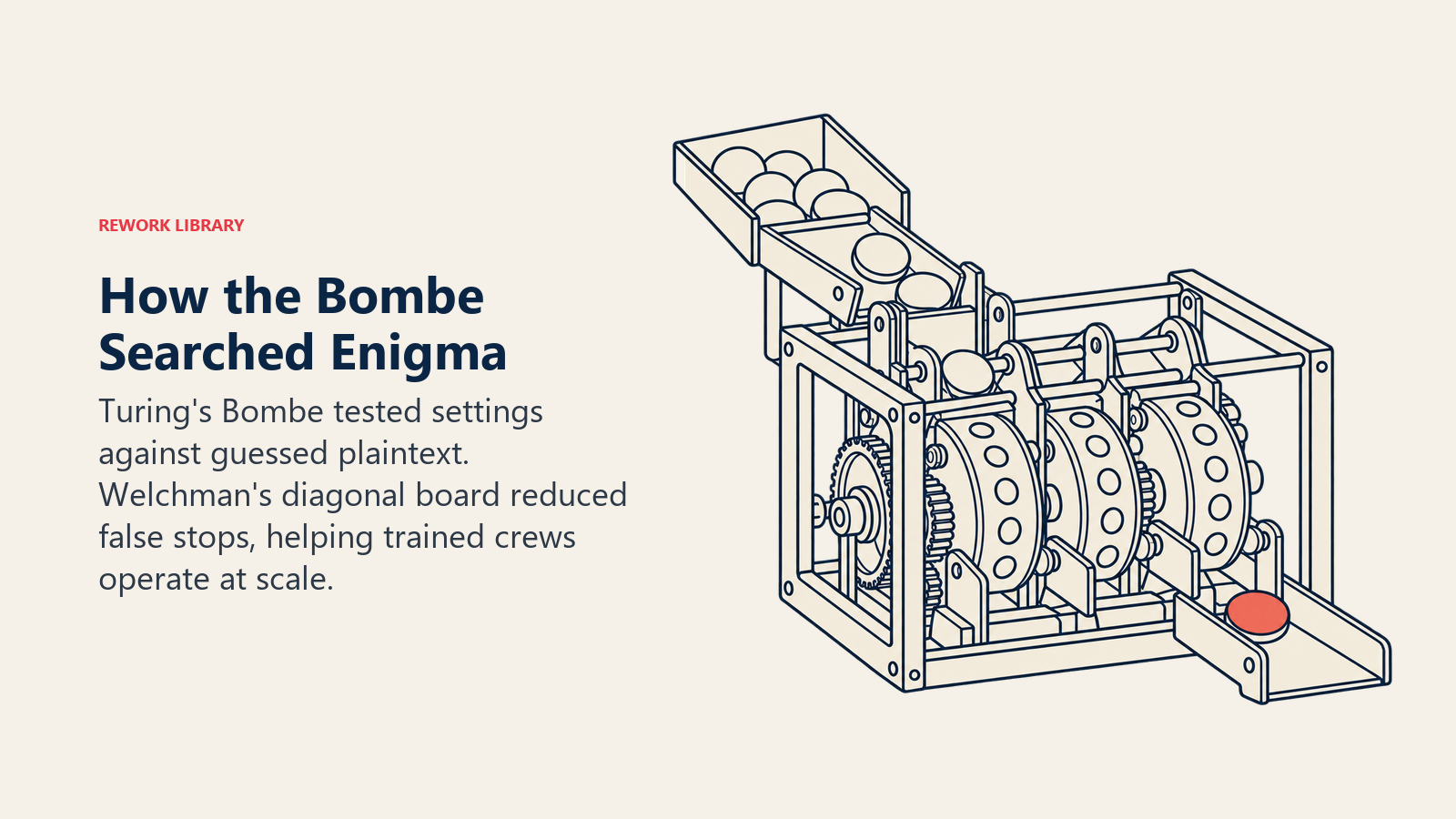
The first Bombe, Victory, began code breaking on 14 March 1940. The first Turing-Welchman machine, Agnus Dei, became operational in August 1940. By the end of the war about 211 Bombes had been built and deployed, with almost 1,676 WRNS and 263 RAF personnel working on them. After the war about 50 were kept temporarily and the rest were dismantled. The Bombe is not a computer, because it does one fixed search. But it proved that a code-breaking machine could be built in quantity and run by shift crews.
The Bombe solved Enigma at scale. It did nothing for Lorenz, a different machine that carried messages between senior German commands.
For teams today: a tool that does one job well, run by trained operators on a rota, scales faster than a clever tool that only its inventor can use.
Tunny and the Robinsons (1941-1943)
Tutte works out a machine nobody had seen
The turning point is the Lorenz break. The Lorenz SZ40 had 12 wheels, compared with three or four on the Enigma. After Tiltman's August 1941 break of a single message, Bill Tutte, then a young chemistry graduate in the research section, worked by hand on sequences of bits and deduced that the first wheel had 41 teeth. Within about two months he and his colleagues had worked out the machine's internal structure, including the intermittent movement of the second row of wheels. The British called the cipher Tunny.
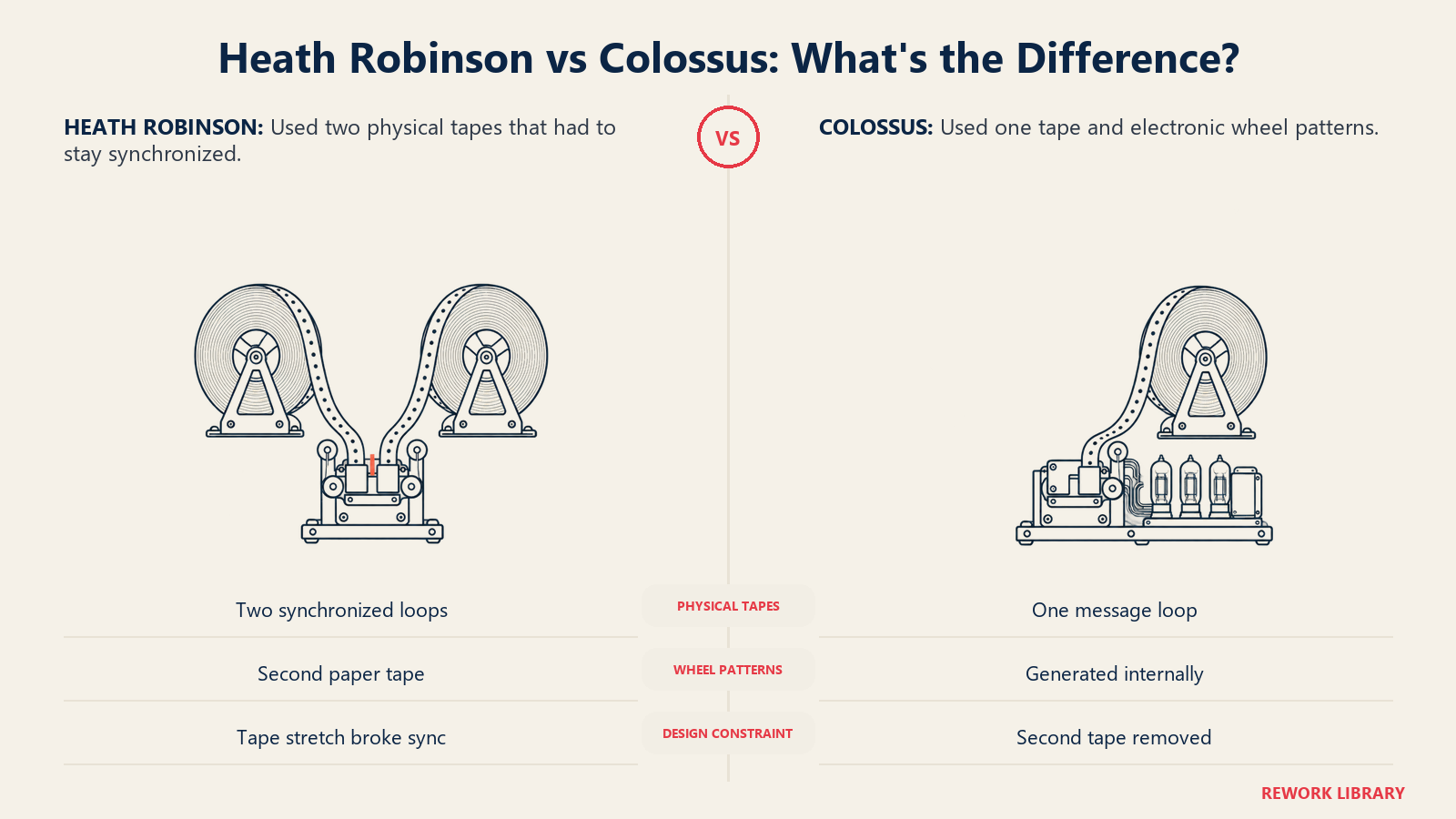
Knowing the structure still left a mountain of counting. Max Newman suggested adapting Turing's pre-war ideas to the problem, and the first machine, named Robinson after the cartoonist Heath Robinson, was unreliable. Development began in January 1943, and a prototype was delivered to Bletchley Park in June 1943. Flowers and Frank Morrell of the Post Office research stations designed it. Its two paper tapes, read at 1,000 characters per second, had to stay in step with each other. Tape stretching broke that, and several mechanical fixes were tried.
That sync problem is what Colossus removed. The same source says Colossus used a single tape reader and generated the wheel patterns internally. For the lineage of data on paper media, see Hollerith's punched cards.
For teams today: when a prototype fails because two parts drift apart, remove the dependency instead of tuning it. Heath Robinson was tuned. Colossus deleted the second tape.
The Colossus Years (1943-1945)
Flowers bets on valves and wins the argument
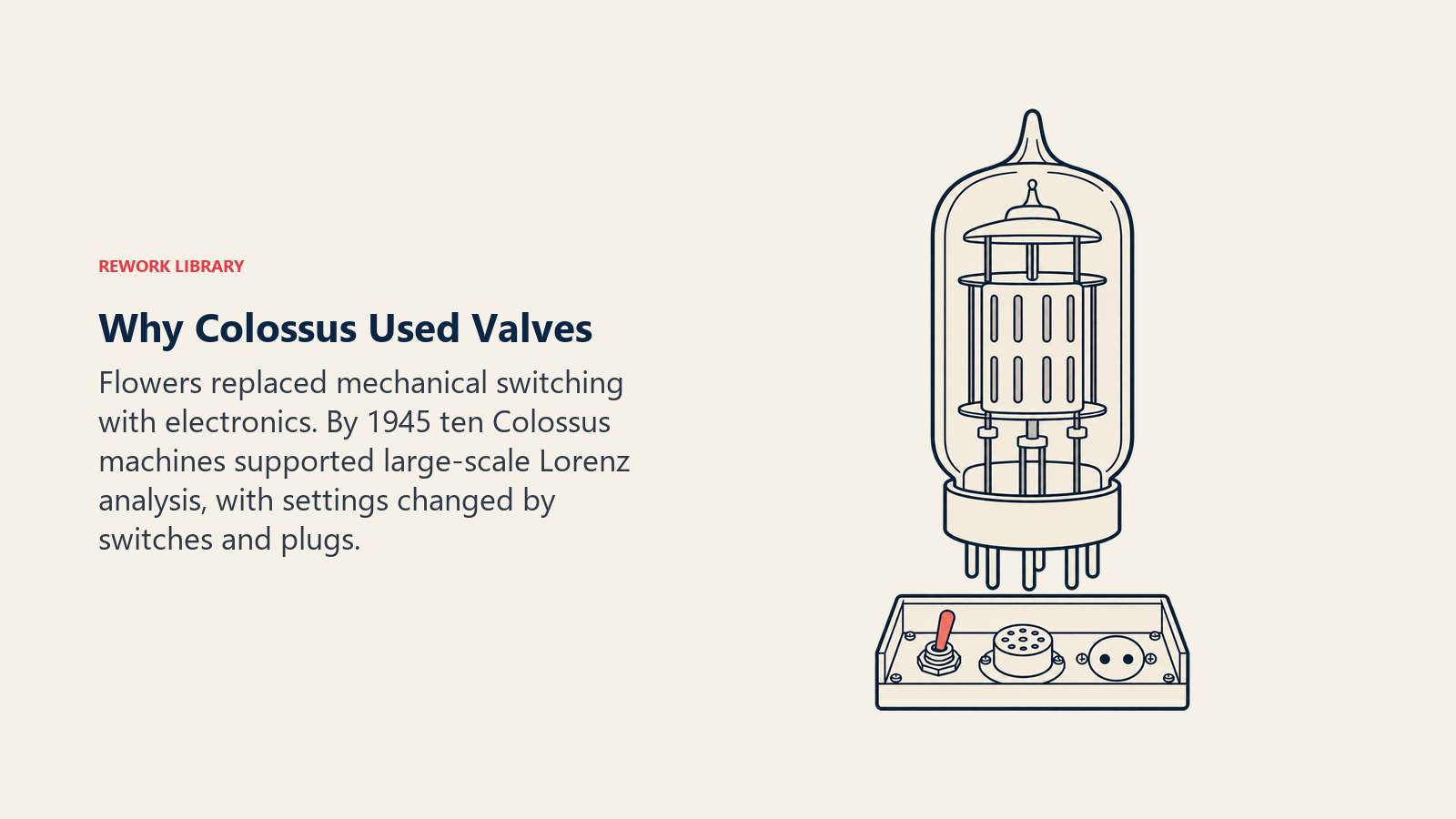
The turning point is a Post Office engineer's judgement. Tommy Flowers proposed replacing mechanical switching with electronic valves. The Computing History museum records that Bletchley Park management doubted the project, that he put his own money in to start it, and that once it worked he was given staff and priority. A letter reproduced by GCHQ describes his idea as "an entirely different machine". A Stanford course page says work began in March 1943, and The National Museum of Computing says Flowers spent eleven months designing and building it.
Dates for the first machine vary by source, so here are the variants. The National Museum of Computing says the Mark 1 was delivered in late December 1943 or January 1944 and working in early February. The Crypto Museum gives 18 January 1944 for delivery and 5 February 1944 for its first broken message. Valve counts vary as well: Randell's 1976 report gives about 1,500, the Crypto Museum over 1,700 for the Mark 1 and about 2,400 for the Mark 2, and the museum in Bletchley gives 2,500. We use "first working in early 1944" and leave the valve count open.
The Mark 2 mattered because of the calendar. The Crypto Museum says the first Mark 2 was delivered on 1 June 1944, five days before D-Day. It was five times faster, reading 5,000 characters per second. GCHQ says the intelligence helped convince Hitler that the Allied invasion would come at the Pas de Calais rather than Normandy. By the end of the war ten Colossus machines were built, 550 people worked on the operation, and 63 million characters of German communications had been decrypted. Flowers was given an MBE and a £1,000 grant, which did not cover his investment.
What Colossus was and wasn't matters here. Randell's 1976 account describes special-purpose electronic computers, and his report calls them programmable, not general-purpose. The machine was built to count, and to be reconfigured with switches and plugs for the next job.
For teams today: a credible expert sometimes needs to be right against the advice of management. Flowers's bet worked because he could show a working machine, and because he absorbed the first-stage risk himself.
The Quiet Years (1945-1975)
Eight machines destroyed, two kept, and 30 years of silence
The turning point is the order to destroy. GCHQ says that after the war eight of the ten machines were destroyed, Flowers was ordered to hand all build documentation to GCHQ, and the technology stayed in use there until the early 1960s. The Crypto Museum says the other two were kept for Cold War work and decommissioned in 1959 and 1960, while the same page also gives the mid or late 1960s, so the end date of the last machine is disputed. The Bombe fared the same way, with most dismantled.
People who had worked on Colossus continued in the field. GCHQ says experts from the project went on to build the Manchester Baby in 1948. But the public story went in a different direction: GCHQ says the machine's existence stayed out of the history books for almost six decades, and The National Museum of Computing says Colossus was left out of computing history for decades. The two accounts count differently: the photographs came in 1975, while GCHQ counts until the early 2000s. In that time, ENIAC was announced on 14 February 1946 and was long treated as the first electronic computer. The story of that machine is in the history of ENIAC.
Rejewski's story followed the same pattern. His role became public in 1973, and he died in Warsaw in 1980.
The secrecy protected the Ultra source for decades. It also cost the builders their credit and cost the field its history.
For teams today: if a result must stay secret, plan how its authors will be recorded. Silence that saves the project can erase the people.
The Rebuild Years (1975-present)
Photographs, a volunteer rebuild, and a priority debate
The turning point is a release of photographs. Brian Randell's report says that in October 1975 the British government released captioned photographs of Colossus at the Public Record Office, ending a 32-year silence. The same report credits M. H. A. Newman with formulating the requirement and T. H. Flowers with leading the team. At the 1976 Los Alamos Conference on the History of Computing, Randell revealed the Dollis Hill work for the first time, saying the machines predated ENIAC. Turing's role is debated. The report's abstract says his pre-war work on computability influenced the design. Turing's later ideas are in the history of the Turing test.
More paper followed. According to Tony Sale's rebuild page, about 5,000 documents were released by the US National Security Agency in 1995, and the 1945 Newmanry History was released in 2000. Sale began the effort in the early 1990s, and the Duke of Kent inaugurated the project in July 1994. The team worked from eight 1945 photographs, circuit diagram fragments kept by engineers, and help from Dr Arnold Lynch, who designed the optical tape reader in 1942. The Duke switched on the basic working machine on 6 June 1996. The National Museum of Computing says the project took nearly fifteen years, and in the 2007 Colossus Cipher Challenge the rebuild cracked the code in 3.5 hours, while Joachim Schueth won in 46 seconds with software on his PC. A fundraising campaign for a dedicated Colossus Gallery followed in 2012. The Bombe has its own reconstruction, unveiled by the Duke of Kent in July 2007.
The priority debate has a plain answer once the terms are set. Colossus was an electronic, programmable, special-purpose digital machine working in 1944. ENIAC was a general-purpose electronic digital computer announced in 1946. Both statements are true, and "first" depends on which words you keep. The same question runs through who invented the computer, and through the way generations of computers are counted. The ideas of a programmable machine go back to Charles Babbage and Ada Lovelace, and the older tools of arithmetic are in the history of mechanical calculators. Later software layers are covered in the history of programming languages and the history of operating systems.
For teams today: a rebuild from eight photographs is the clearest argument for documentation. Whatever you build, leave enough behind that someone could rebuild it.
Key People
| Name | Role | Contribution | Year |
|---|---|---|---|
| Al-Kindi | Scholar | Earliest known description of frequency analysis | 9th century |
| Marian Rejewski | Polish mathematician | Broke Enigma with permutation theory; designed the bomba | 1932-1938 |
| Jerzy Rozycki, Henryk Zygalski | Polish mathematicians | Worked with Rejewski on the Enigma attack | from 1932 |
| Alan Turing | Mathematician | Designed the Bombe around cribs | 1939-1940 |
| Gordon Welchman | Mathematician | Added the diagonal board | 1940 |
| John Tiltman | Bletchley codebreaker | Broke the first Lorenz message; named it Tunny | 1941 |
| Bill Tutte | Chemistry graduate | Worked out the structure of the Lorenz machine | 1941-1942 |
| Max Newman | Mathematician | Formulated the requirement for the machines | 1942-1943 |
| Tommy Flowers | Post Office engineer | Led the design of Colossus | 1943-1944 |
| Tony Sale | Computer conservationist | Led the Colossus rebuild | 1994-2007 |
| Brian Randell | Computer scientist | First public account of Colossus | 1976 |
Key Facts
- The first British Bombe, Victory, began work on 14 March 1940.
- The Lorenz SZ40 had 12 wheels, compared with three or four on the Enigma.
- Ten Colossus machines were built, and 550 people worked on the operation.
- The first Mark 2 was delivered on 1 June 1944, five days before D-Day.
- After the war eight of the ten machines were destroyed.
- Government photographs of Colossus were released in October 1975, ending 32 years of silence.
The Pattern Behind the History
The same four moves repeat from Warsaw to Bletchley Park. We call the sequence the Wall and Workaround Cycle. It's our synthesis of the history, not a research finding.
- A hand method hits a wall. The Poles lost ground in December 1938, and the Bombe's false stops forced Welchman's board.
- A machine takes the counting. The bomba, the Bombe and Colossus each mechanised a search that people had been doing on paper.
- The fix creates the next bottleneck. Heath Robinson fixed the counting and failed on tape sync, and Colossus fixed that.
- Secrecy decides the credit. The machines were destroyed or hidden, and the builders waited until the 1970s.
What It Teaches Teams Today
- Write the method first. Every machine here automated a procedure people already understood.
- Remove the weak part. Colossus won by deleting the second tape.
- Back the credible expert. Flowers needed permission and money, and he delivered.
- Plan for the record. Secrecy erased the machines, the plans and the credit.
- Document for the rebuild. Eight photographs were enough to start again, but only just.
Colossus shows how fast a field moves when a hard problem and a deadline meet, and how long it can take for the people involved to be credited. Next time your team automates a manual process, write down who built it and why, while they are still around to ask.

Co-Founder, Rework.com