The History of the Mainframe
Turn this article into takeaways for your work.


Each assistant summarizes the article only for you and suggests best practices for your work.
The problem was paperwork at scale. Governments and large firms held more records than clerks could process. For decades they rented tabulating machines to count punched cards.
The mainframe took shape between 1951 and 1964, when large organizations began buying big, centralized computers, and IBM announced the System/360 family on 7 April 1964. The machine itself was never the real product. The product was a promise that the software and data you already had would keep running on whatever IBM sold next. That promise is why mainframes are still in use after being declared dead. For the wider story of the field, see The History of Computers, the computer timeline and the generations of computers.
A mainframe is a large, centrally run computer built to process huge volumes of records for many users at once. The Computer History Museum says nobody knows for sure where the word came from. It probably first referred to the frames that held the processor circuits and main memory, and over time "main frame" became "mainframe" and came to mean "big computer."
Timeline at a Glance
| Year | Milestone | Why It Mattered |
|---|---|---|
| 1890 | Hollerith's punched cards tabulate the US census | The precursor: a government rents machines to count records. |
| 31 March 1951 | UNIVAC I is delivered to the Census Bureau | The first large computer sold to a record-keeping customer in the US. |
| April 1952 | IBM announces the 701 | IBM enters electronic computing with defense customers. |
| 1952 to 1955 | SAGE supplies 80% of IBM's computing revenue | A military air defense network funds IBM's computer business. |
| 5 October 1959 | IBM announces the 1401 | A low-cost business machine that sold beyond every forecast. |
| 1961 | IBM forms the SPREAD task force | The secret planning group behind one compatible family. |
| 7 April 1964 | System/360 is launched | One architecture across the whole product line. |
| 1970 | System/370 Model 145 debuts | Silicon memory and an upgrade path for 360 users. |
| 1975 | Amdahl ships the 470V/6 | A rival that ran IBM's software for less. |
| 1984 | Desktop computer sales pass mainframe sales, per IBM | The first sign that the center of gravity was moving. |
| March 1991 | Stewart Alsop predicts the last mainframe will be unplugged on 15 March 1996 | The mainframe's obituary, written five years early. |
| April 1993 | Lou Gerstner becomes IBM's CEO | IBM kept itself, and its mainframes, together. |
| 2000 | The eServer zSeries 900 replaces System/390 | The modern "z" line begins. |
| 8 April 2025 | IBM announces the z17 | The platform adds on-chip AI inference to the same lineage. |
The Tabulating Rooms (1890-1950)
Governments rent machines to count their records
The scene is a government office filled with trays of cards. The turning point is the 1890 US census, which IBM's history says used Hollerith's punched cards and finished months ahead of schedule and under budget. That is a precursor, not a mainframe: a tabulator added up holes in cards and could not run a program. But it set the pattern. A large institution with a record-keeping problem pays a vendor, on a lease, to process its records. The full story is in Hollerith, punched cards and the 1890 census.
The habit lasted. IBM says that as late as the mid-1950s, punched card sales made up roughly 20% of its revenue and 30% of its bottom line, and that a 1935 Social Security contract required tabulating machines to process data and print checks. The offices that bought them were the same offices that would later buy computers.
Then the war produced electronics. ENIAC showed that vacuum tubes could calculate far faster than cards, and its designers built UNIVAC to sell. Per the IEEE history wiki, Remington Rand delivered the first UNIVAC to the Census Bureau on 31 March 1951. The sequel to that story, and the claims about which machine was first, are in UNIVAC and the first commercial computers.
The era left a ready customer and no dominant supplier.
For teams today: the first buyer of a new technology is the one already paying a slower way to solve the same problem. Start there.
The Defense Orders (1950-1959)
Air defense and airlines pay IBM to build big machines
The scene is a windowless room in the North American air defense network. The turning point is a defense contract boom. IBM's history says Thomas Watson announced the 701 to shareholders in April 1952, and that ten government and defense customers had ordered by May. Watson Jr. said IBM "knew that we were in the electronics business". The 704 that followed replaced the earlier memory with high-speed magnetic core storage, and a business-oriented 702 reached the market too.
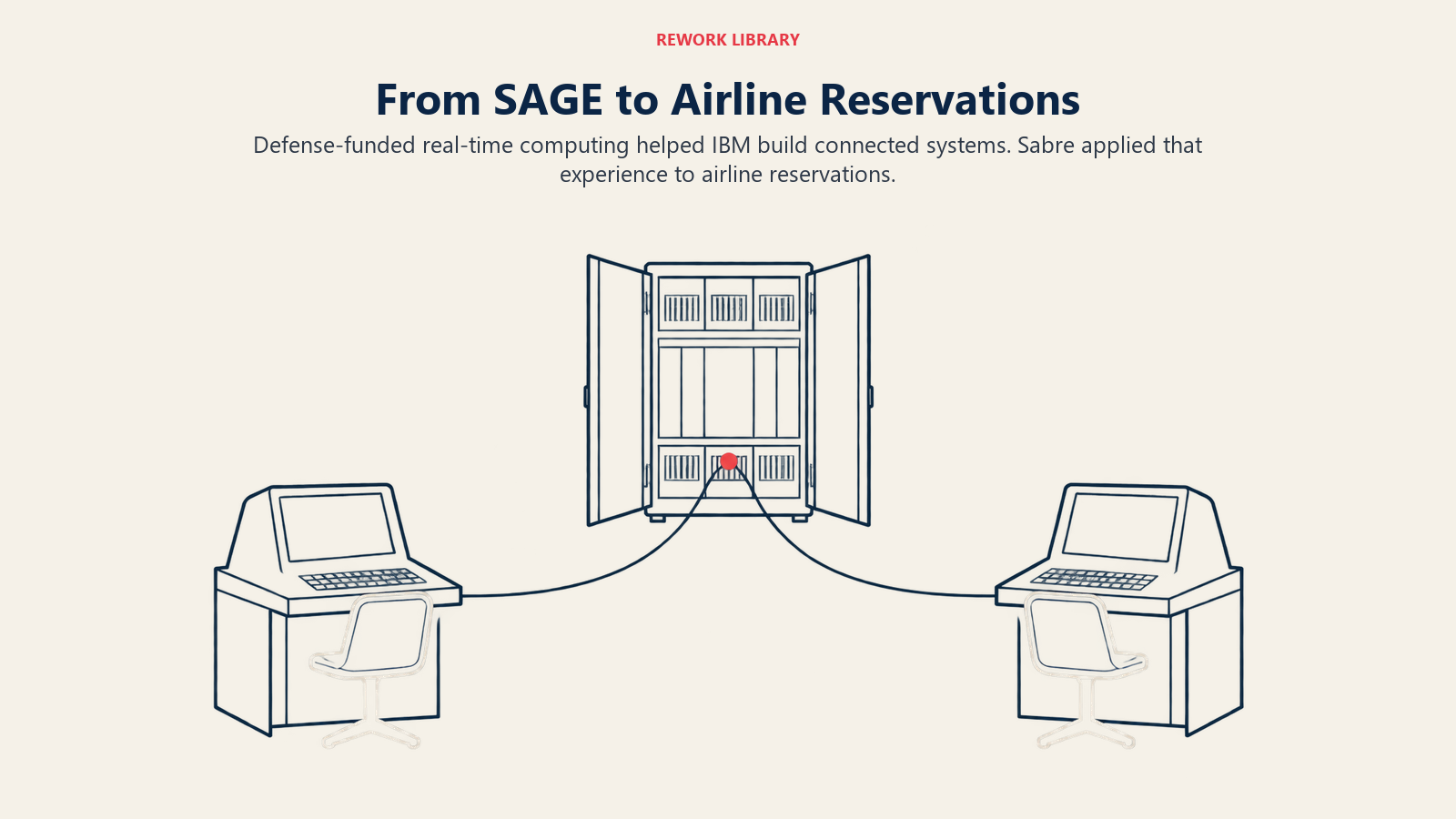
The order that mattered was SAGE. After the Soviet Union's first atomic bomb test in 1949, the US government asked MIT to build a real-time air defense system for North America. IBM's account says IBM built the AN/FSQ-7 computers, that SAGE generated 80% of IBM's computing revenue from 1952 to 1955, that each AN/FSQ-7 weighed 250 tons and filled about an acre, and that by 1958 more than 7,000 IBMers were involved. It was fully deployed in 1963 and stayed in service until January 1984. Thomas Watson Jr. is quoted there saying he worked harder to win it than for any other sale in his life.
The first civilian echo came from the airlines. According to IBM, in 1953 IBM salesman R. Blair Smith met American Airlines president C. R. Smith on a flight, and the airline could not track passenger information on handwritten cards. The result, Sabre, drew on IBM's SAGE work and connected reservation desks to a central processing center in New York over more than 10,400 miles of telephone lines. By the mid-1960s it handled 7,500 reservations an hour, and IBM says processing time fell from about 90 minutes to several seconds. A mainframe was no longer a place you sent work to. It was a place the whole business connected to.
The business case came with the 1401. IBM announced it on 5 October 1959 in a closed-circuit broadcast to prospective customers in 102 cities. Its page reports more than 5,200 orders in the first five weeks, more than 10,000 systems installed by the mid-1960s, and leases from as little as $2,500 a month against about $10,000 for comparable machines. The Computer History Museum counts more than 12,000 sold, so the total depends on the source and the date.
The era produced the customers, but also a problem. IBM was now selling several incompatible product lines, and each customer's programs were tied to one of them.
For teams today: one anchor customer with a hard, funded problem can carry a product through its immature years. Choose it deliberately.
The System/360 Bet (1959-1970)
IBM replaces five product lines with one family
The scene is a secret meeting in Greenwich, Connecticut. IBM's history says a task force named SPREAD (Systems Programming, Research, Engineering and Development) was established in 1961, and about six months of debate led to a decision to build one compatible family. The product launched on 7 April 1964. It replaced all five existing IBM computer lines, with six processor models covering a fiftyfold performance range and 54 peripheral devices. IBM calls it a "bet-the-business" move, a $5 billion gamble over four years.
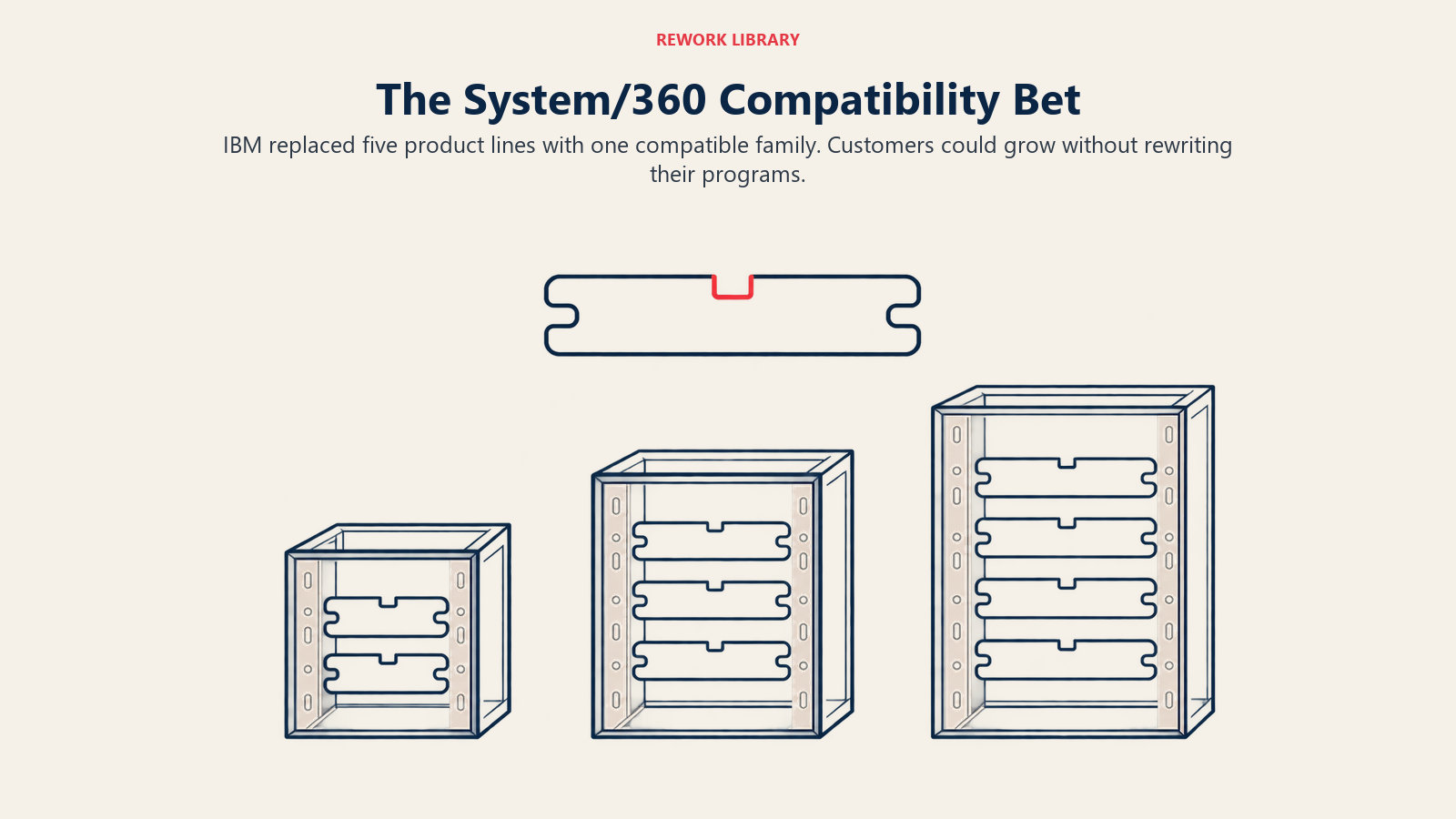
The key idea is compatibility. IBM says that for the first time, software written for one machine could run on any other machine in the line. A customer could start small and grow without rewriting programs. The family also pioneered the 8-bit byte. More than 1,000 orders came in during the first month, and orders rapidly exceeded forecasts. Gene Amdahl was chief architect, Fred Brooks led the project, and Brooks, Bob Evans and Erich Bloch shared the first National Medal of Technology for the work. The family itself has its own history, from the SPREAD report to today's IBM Z. For the chip side of the story, see the history of the integrated circuit, which explains why 360 used hybrid modules and not yet monolithic chips.
The software was the hard part. In The Mythical Man-Month, Brooks says of OS/360 that the product was late, took more memory than planned, and cost several times the estimate. At the peak over 1000 people were working on it, and he estimates about 5000 man-years from 1963 through 1966. The same book gives the rule that became his law: "Adding manpower to a late software project makes it later." For where OS/360 sits in the line of system software, see the history of operating systems.
Other makers built mainframes too, and the Computer History Museum describes the range: the Manchester Atlas pioneered virtual memory and timesharing, and Burroughs' B 5500 had an operating system written in ALGOL instead of machine language. Batch processing of punched-card jobs, the Museum adds, was typical from the 1950s until well into the 1970s. But none set a standard the way 360 did.
The era solved the upgrade problem. It created a new one: the better compatibility worked, the more customers were locked into one vendor's architecture.
For teams today: a platform bet is a promise about the future. Make it about what customers will not have to redo.
The Compatible Years (1970-1984)
Customers keep their programs and rivals copy the interface
The scene is a data center where the 360 you installed in 1966 sits next to a new box that runs the same jobs. IBM's System/370 Model 145 debuted in 1970. IBM's history says it was the first IBM computer whose main memory put its circuits on a silicon chip, with chips holding more than 1,400 circuit elements, and that virtual memory support was announced in August 1972. The company's stated aim was that 360 customers would not have to start over. Its page quotes Watson Jr.: "We don't want to make the same mistakes twice."
Compatibility invited competition. Gene Amdahl, the 360's chief architect, left to challenge IBM. The Computer History Museum's record of the Amdahl 470V/6 says it was introduced in 1975 as the company's first product, ran the same software as IBM System/370 computers, cost $3,750,000 and delivered 3.5 MIPS. Customers could now buy IBM's software environment from someone else.
Another threat came from below. The Museum says DEC's VAX line of 32-bit "super-minicomputers" rivaled much more expensive mainframes and made DEC the second-largest company in the industry. Departments began to wonder whether they needed the center at all.
Meanwhile the mainframe kept running the transaction systems that made it indispensable, such as Sabre, which American opened to travel agents in 1976 and which stored a million fares' histories a day by the late 1970s, per IBM.
The era ended with a statistic. IBM's history says that in 1984, desktop computer sales first exceeded mainframe sales. That was the turn, though not yet the fall.
For teams today: open interfaces protect customers and invite imitators. If you build a standard, price for the clone.
The Obituary Years (1984-1999)
Desktops rise, pundits write the mainframe's death notice
The scene is an IT department being told to move to client-server. The downturn is real and documented. In March 1991 InfoWorld editor Stewart Alsop predicted, in IBM's quotation of his words, that "the last mainframe will be unplugged on March 15, 1996." The Computer History Museum records that pundits repeatedly predicted mainframes would die out, and that in 2002 Alsop admitted he was wrong.
IBM's own trouble was larger than the forecasts. A Knowledge at Wharton interview says that when Lou Gerstner took over in 1993, IBM had just posted an $8 billion loss, mainframes produced over 90% of its profit and those sales were falling quickly. Conventional wisdom blamed PCs, the desktops made possible by the microprocessor. Gerstner, drawing on his years at American Express, argued mainframes were still needed and that the real problem was pricing. Breakup plans were well underway, and he rejected them, calling it "the most important decision I ever made." IBM's history confirms he became CEO and chairman in April 1993.
The machine itself changed. IBM's System/390 line arrived in 1990 and, per the company, parallel servers in 1994 cut energy costs by 40 percent and more than tripled performance. In 1998 the S/390 G5 10-way Turbo became, in IBM's words, the world's most powerful mainframe at 1,000 MIPS. IBM's page also claims that nearly two-thirds of the world's data lived on its servers, mostly S/390 mainframes, in the late 1990s. That is IBM's statement, not an independent count.
The era's lesson was survival by repricing and rebuilding. The mainframe did not win the argument, but it did not lose it either.
For teams today: "the new thing replaces the old thing" is a forecast, and forecasts are often wrong about the work that cannot move. Find that work before you migrate.
The z Era (2000-present)
The mainframe becomes a platform for cloud, security and AI
The scene is a bank's overnight batch window running beside a mobile app. The turning point is the name. In 2000 the eServer zSeries 900 replaced System/390, and the Computer History Museum notes that IBM introduced the z900 about 10 years after the published forecasts that all mainframes would vanish. The Museum adds that mainframes still run core systems in global banking and other large businesses and handle things like ATM withdrawals and airline reservations.
IBM's history page makes bigger claims about today's mainframes: that they handle 90% of credit card transactions and are used by more than 70% of Fortune 500 companies. Treat those as IBM's statements. What is documented is the product direction. In an April 2025 release, IBM said the z17, powered by the Telum II processor, could process 50 percent more AI inference operations per day than the z16, enabling more than 450 billion inferencing operations a day on-chip, and that it was designed with input from more than 100 clients. IBM's Ross Mauri said AI would be only as valuable as the infrastructure it runs on.
Alsop's 2002 retraction supplies the human explanation. IBM quotes him saying that corporate customers still value "centrally controlled, very predictable, reliable computing systems." The mainframe now sits beside the rented infrastructure told in the history of cloud computing, and next to the ERP systems that grew out of its record-keeping, as described in what is ERP.
The open problem is the oldest one: a business whose logic lives in programs written decades ago.
For teams today: the most reliable system you own may also be the one with the fewest people who understand it. Treat knowledge transfer as a cost of keeping it.
Key People
| Name | Role | Contribution | Year |
|---|---|---|---|
| Herman Hollerith | Statistician and inventor | Punched-card tabulation for the census | 1890 |
| Thomas Watson Jr. | IBM executive and later CEO | Drove IBM into electronics and the 360 | 1950s-1964 |
| R. Blair Smith | IBM salesman | Met American Airlines' president on the flight that led to Sabre | 1953 |
| C. R. Smith | American Airlines president | Funded roughly $40 million toward Sabre | 1950s |
| Gene Amdahl | IBM architect, later rival | Chief architect of System/360; founded Amdahl | 1964, 1975 |
| Fred Brooks | IBM project leader | Led System/360; wrote The Mythical Man-Month | 1964, 1975 |
| Bob Evans and Erich Bloch | Brooks's 360 collaborators | Shared the first National Medal of Technology for 360 | 1964 |
| Stewart Alsop | Technology writer | Predicted the last mainframe would be unplugged in 1996 | 1991 |
| Lou Gerstner | IBM CEO | Kept IBM and its mainframes together | 1993 |
| Ross Mauri | IBM Z general manager | Announced the z17 | 2025 |
Key Facts
- IBM launched the System/360 on 7 April 1964 and reports more than 1,000 orders in the first month.
- IBM calls the 360 a $5 billion, bet-the-business gamble over four years.
- SAGE generated 80% of IBM's computing revenue from 1952 to 1955.
- The 1401 drew more than 5,200 orders in five weeks after its 5 October 1959 announcement.
- Alsop predicted in March 1991 that the last mainframe would be unplugged on 15 March 1996, and admitted in 2002 he was wrong.
- When Gerstner arrived in 1993, mainframes produced over 90% of IBM's profit.
The Pattern Behind the History
The same five moves repeat across the mainframe's life. We call the sequence the Compatibility Ratchet. It's our synthesis of the history, not a research finding.
- A funded institution seeds the market. The Census Bureau, the Air Force and the airlines paid for the first large systems.
- A vendor bets on a family, not a machine. System/360 replaced five lines with one architecture.
- Compatibility locks customers in and invites clones. Amdahl ran IBM's software for less.
- Cheaper tiers declare the center dead. Minicomputers, desktops and client-server each tried to take the work.
- The work that cannot move stays, and the platform is rebuilt around it. The z line kept the old contract and added new capabilities.
What It Teaches Teams Today
- Sell the upgrade path. The 360's real feature was that your programs came with you.
- Separate the demo from the software. OS/360 cost more and ran later than the hardware plan.
- Expect your standard to be cloned. Plan your pricing and service for the clone, not just the original.
- Treat obituaries as forecasts. Alsop's date came and went, and the machines kept running.
- Know which date you mean. Announced, delivered, dedicated and introduced were different days in this story.
The mainframe shows how a product can outlive its fashion: by keeping a promise to the work that cannot easily move. Before you retire an old system or launch a new one, ask which of your customers' programs you are promising to keep running, and write that promise down. For the data side of that question, start with a data strategy, and for the programming languages that still run on these machines, see the history of programming languages.

Co-Founder, Rework.com