ImageNet and AlexNet: The Deep Learning Breakthrough
Turn this article into takeaways for your work.


Each assistant summarizes the article only for you and suggests best practices for your work.
Picture the field in 2010. The new ImageNet Large Scale Visual Recognition Challenge (ILSVRC) asked programs to name the object in each image. The first winners relied on hand-designed image features and conventional classifiers. Nobody was talking about neural networks. Two years later they owned the field.
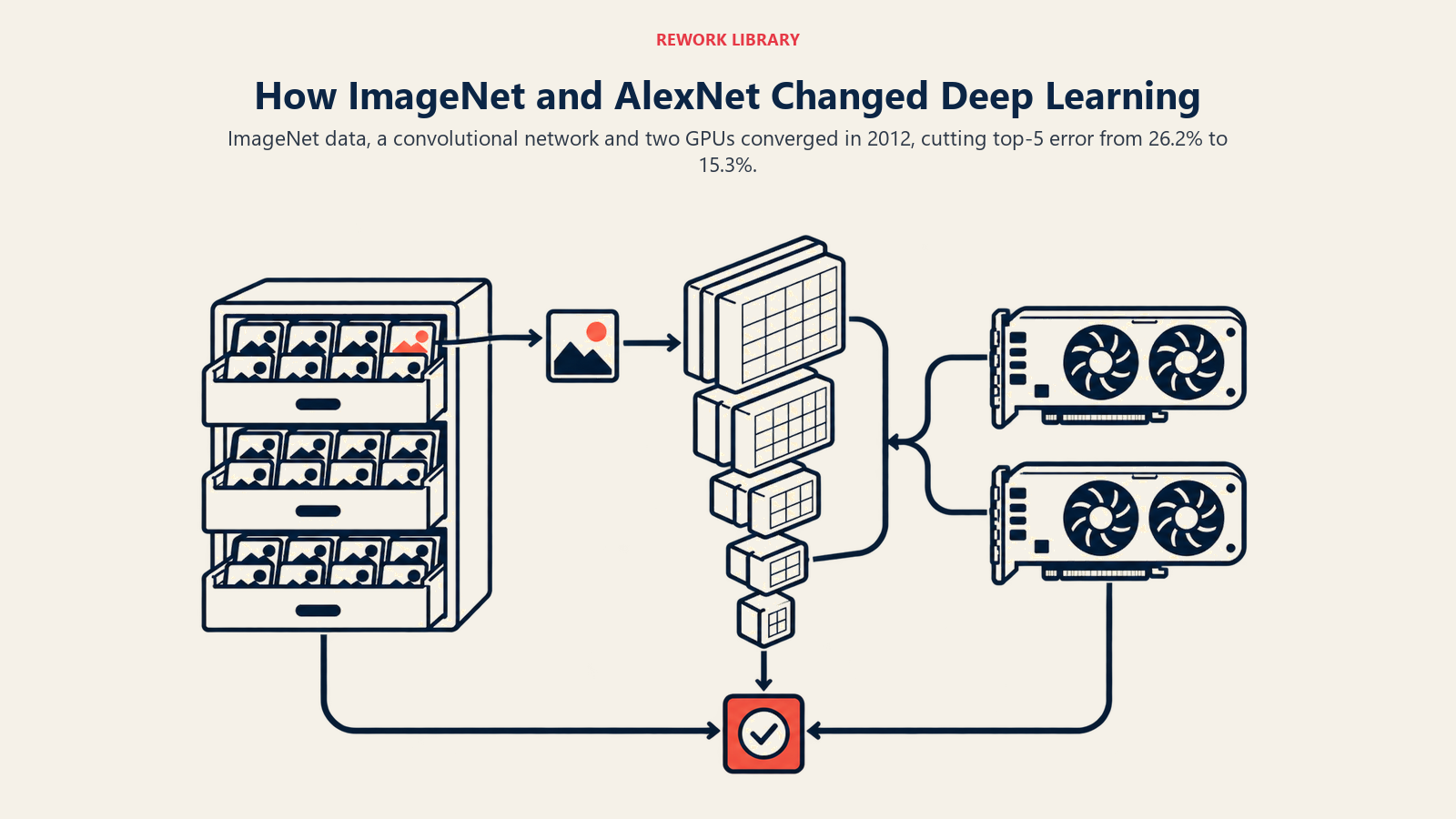
The deep learning breakthrough happened on one day in 2012. A Toronto team called SuperVision won the ImageNet image-recognition contest with a top-5 error of 15.3%, against 26.2% for the next-best entry, according to the competition's own 2012 results. The team was Alex Krizhevsky, Ilya Sutskever and Geoffrey Hinton. Their network became known as AlexNet. The throughline: the win was not one invention but the meeting of three older things. They were a huge labeled dataset (ImageNet), a convolutional network design from the 1980s, and cheap graphics processors (GPUs) that could train it in days.
The challenge asked programs to name the object in each of 1,461,406 images across 1000 classes. The first winner, a team from NEC, scored 28.2% top-5 error. For the wider arc of the field, see the history of deep learning. This article follows each of the three ingredients to the day they met, and what happened next. For the definitions, see computer vision and deep learning; for the whole story of the field, start at The History of AI.
Timeline at a Glance
| Year | Milestone | Why It Mattered |
|---|---|---|
| 1735 | Linnaeus's Systema Naturae ranks living things from kingdoms down to species | The classic model of a labeled hierarchy of categories, later echoed in ImageNet's structure. |
| Mid-1980s | George Miller begins the WordNet project at Princeton | A hierarchy of English word meanings that ImageNet would borrow. |
| 1980 | Fukushima proposes the neocognitron | A layered, shift-tolerant vision network, an ancestor of convolutional nets. |
| 1998 | LeCun and colleagues publish LeNet-5 work in Proceedings of the IEEE | A convolutional net for character recognition trained with back-propagation. |
| 2006 | NVIDIA unveils CUDA | It opened GPUs to general scientific computing. |
| 2009 | ImageNet is presented at CVPR: 3.2 million images, 5247 synsets | Labeled data at a scale vision research had not had. |
| 2010 | ILSVRC begins, with NEC winning at 28.2% top-5 error | A yearly public scoreboard for vision. |
| 2011 | Ciresan et al. report a fast GPU implementation of convolutional nets at IDSIA | Proof that GPU-trained convolutional nets set records on smaller benchmarks. |
| 2012 | SuperVision wins ILSVRC at 15.3% top-5 error | The runner-up scored 26.2%. Deep learning became the default for vision. |
| 2013 | Google acquires DNNresearch, announced March 12 | The three authors' company went to industry. |
| 2014 | GoogLeNet wins at 6.7%, VGG places second | Deeper networks kept cutting error. |
| 2015 | Microsoft's ResNet wins with 3.57% error | A 152-layer network, below the 5.1% estimated for one trained human annotator. |
| 2017 | The organizers hand the contest to Kaggle | The yearly ILSVRC cycle ended. |
| 2020 | Vision Transformer reaches 88.55% on ImageNet (published at ICLR 2021) | Attention began replacing convolution in vision. |
| 2025 | The Computer History Museum releases AlexNet's 2012 source code | The original program became a public historical record. |
The Taxonomy Idea (1735-2008)
Naturalists sort the world into named boxes
In 1735 the Swedish naturalist Carl Linnaeus published Systema Naturae, which organized nature into a hierarchy of kingdoms, classes, orders, genera and species, according to Britannica. That is a precursor, not a computer-vision idea: nobody was training machines. But it set the template that ImageNet would copy more than 270 years later, a tree of categories where every item has a place.
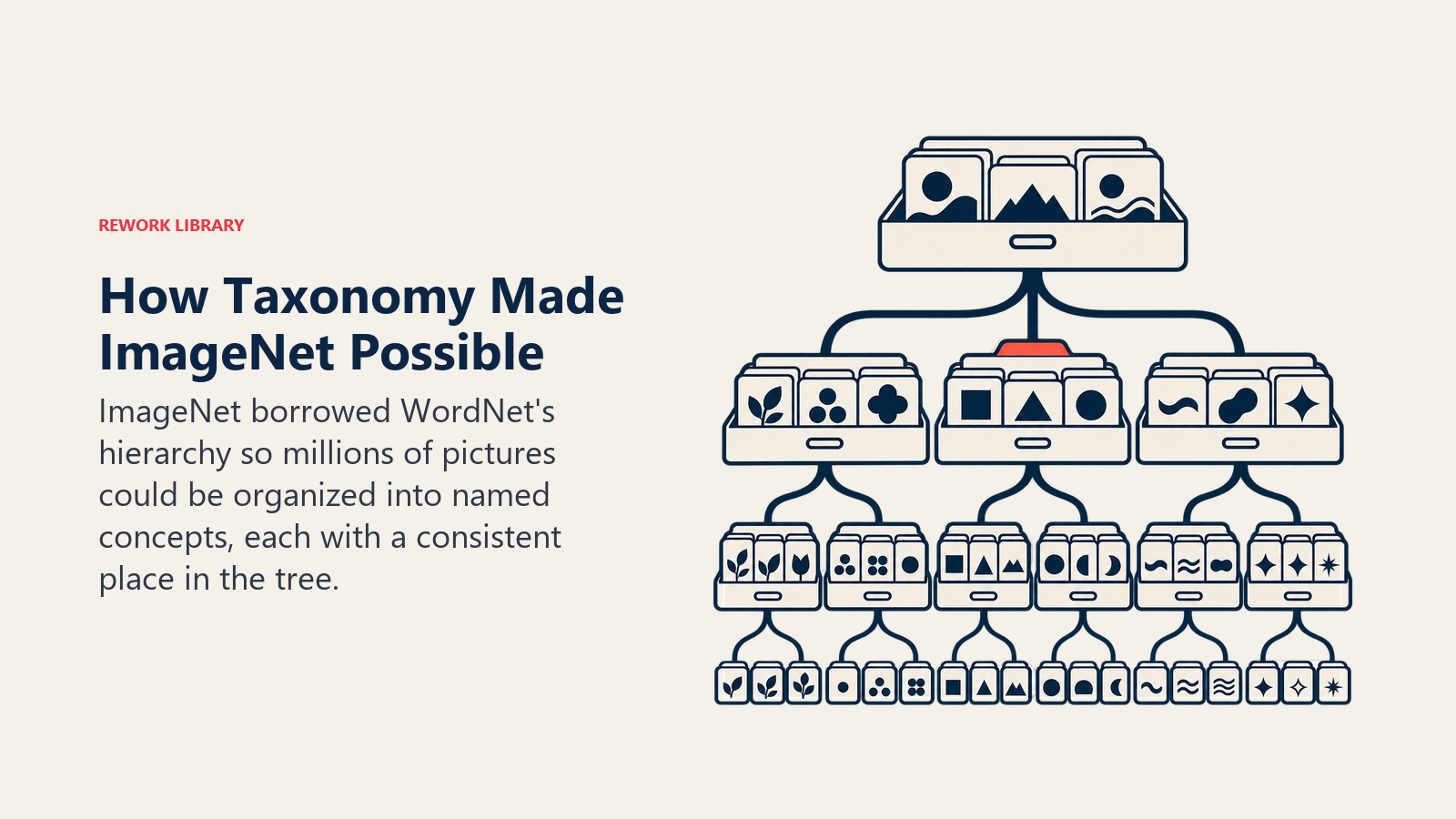
The machine-readable version came from psychology. George A. Miller, a Princeton professor, began the WordNet project in the mid-1980s, a database of English words grouped by meaning. ImageNet's authors later described their project as a large-scale ontology of images built on the backbone of the WordNet structure, where each meaningful concept, a "synset," would get its own pile of pictures.
Vision datasets before that were small. The ILSVRC paper notes that Caltech 101 had 101 object classes and commonly 15 to 30 training images per class, and that the PASCAL VOC challenge, established in 2005, set the precedent for yearly public competitions. The AlexNet paper puts the problem in one line: labeled image datasets had been on the order of tens of thousands of images. A network with millions of weights has too much freedom for a set that small.
For teams today: the model you want is often limited by a data structure you don't have yet. Before you buy compute, ask whether your own categories are defined, consistent and large enough to learn from.
The Network Lineage (1980-2006)
Convolution is invented, works on digits, and waits for a bigger problem
This era ran alongside the data story, and neither knew the other was coming. In Tokyo, Kunihiko Fukushima at the NHK Broadcasting Science Research Laboratories published the neocognitron in 1980, a network of alternating cell layers that, he wrote, ends up with a structure similar to the visual-system hierarchy proposed by Hubel and Wiesel and recognizes patterns regardless of position. It learned without a teacher. That was the shape of the future, but not yet its training method.
The training method came from Yann LeCun's group, which had started at Bell Labs. By the late 1990s LeCun and colleagues had published LeNet-5, which LeCun's own page describes as a convolutional network for handwritten and machine-printed character recognition, in a November 1998 Proceedings of the IEEE paper with Bottou, Bengio and Haffner. The same page says convolutional networks are designed to recognize patterns directly from pixels with minimal preprocessing and are trained with back-propagation. The 1989 zip-code system that preceded it is covered in the history of neural networks, and LeCun's story is in Yann LeCun's leadership.
So by 1998 the model existed. What it lacked was a problem with enough pictures to justify its size, and a machine fast enough to train it. Much of the field turned to other methods meanwhile, the stretch covered in the history of machine learning.
For teams today: an architecture that worked on a narrow task can become the general answer later. Keep a note of methods that worked in a small corner, and revisit them when your data grows.
The Graphics Turn (2006-2011)
Video-game chips become the cheapest way to train big networks
The third ingredient came from the games industry. NVIDIA's company timeline records that in 2006 it opened the parallel processing of its GPUs to science and research with the unveiling of CUDA. Sources differ on when CUDA became publicly downloadable, so this article uses the unveiling date.
Researchers noticed fast. In a 2009 ICML paper from Stanford, Rajat Raina, Anand Madhavan and Andrew Ng argued that graphics processors far surpass the computational capabilities of multicore CPUs and reported an implementation of deep belief network learning up to 70 times faster than a dual-core CPU. Their example: a four-layer network with 100 million parameters went from several weeks to about a day.
Then convolutional networks met the GPU. In a January 2011 technical report, Dan Ciresan, Ueli Meier, Jonathan Masci, Luca Gambardella and Jurgen Schmidhuber at IDSIA in Switzerland presented a fast, fully parameterizable GPU implementation of convolutional networks that achieved the best published results on the NORB, CIFAR10 and MNIST benchmarks. Those were small image sets. ImageNet-scale was next, and it needed the data to exist.
For teams today: a hardware shift can matter more than a new algorithm. When a tool gets ten times faster or cheaper, rerun your old "too slow" ideas.
The Making of ImageNet (2009-2011)
A graduate-school database becomes the world's yardstick
This era overlaps with the GPU turn, and it is the data story's main act. In 2009 a Princeton team (Jia Deng, Wei Dong, Richard Socher, Li-Jia Li, Kai Li and Li Fei-Fei) presented "ImageNet: A Large-Scale Hierarchical Image Database" at CVPR. The paper reported 12 subtrees with 5247 synsets and 3.2 million images at that point, with the aim of populating most of WordNet's roughly 80,000 noun synsets with 500 to 1000 images each. The leaders of the project now work from Stanford, where Li Fei-Fei is principal investigator. Her wider story is in Fei-Fei Li's leadership.
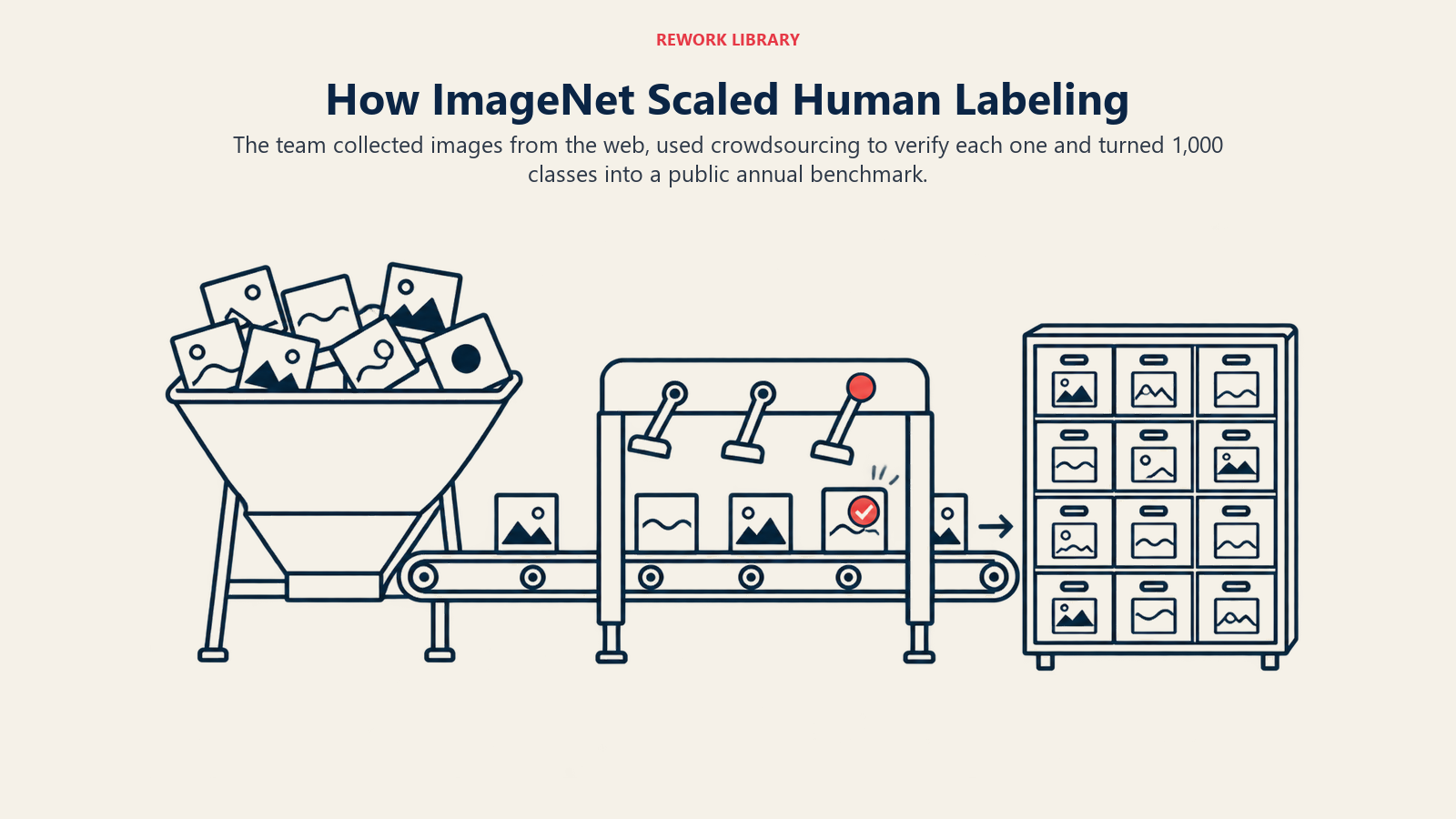
The labor was the hard part. Candidate images were collected from the web, and humans verified each one through Amazon Mechanical Turk, an online platform where users complete small paid tasks. The later ILSVRC paper states the consequence: at that scale it is no longer feasible for a small group of annotators to label the data, so the team designed crowdsourcing methods.
In 2010 the contest began. The ILSVRC paper says it has run annually since 2010 and follows PASCAL VOC in pairing a public dataset with an annual competition and workshop. Scaled up from PASCAL's 19,737 images and 20 classes, the 2010 edition used 1,461,406 images and 1000 classes. The winners of the first two rounds were conventional: NEC at 28.2% in 2010 and Xerox's XRCE at 25.8% in 2011. In 2019 the project's own site credited the 2009 paper with a retrospective most impactful paper prize.
For teams today: a shared, honest scoreboard moves a field. If your team can't say how it will measure "better," build the test set before the model.
SuperVision and After (2012-2017)
Two graphics cards, one old idea, and a gap nobody could ignore
The 2012 round is the event itself. The SuperVision team from the University of Toronto, Alex Krizhevsky, Ilya Sutskever and Geoffrey Hinton, entered a deep convolutional network. Their results page lists 15.3% top-5 error using extra ImageNet data from the Fall 2011 release, or 16.4% using only the supplied training data, against 26.2% for the runner-up from the University of Tokyo, whose entry blended classifiers built on hand-engineered features.
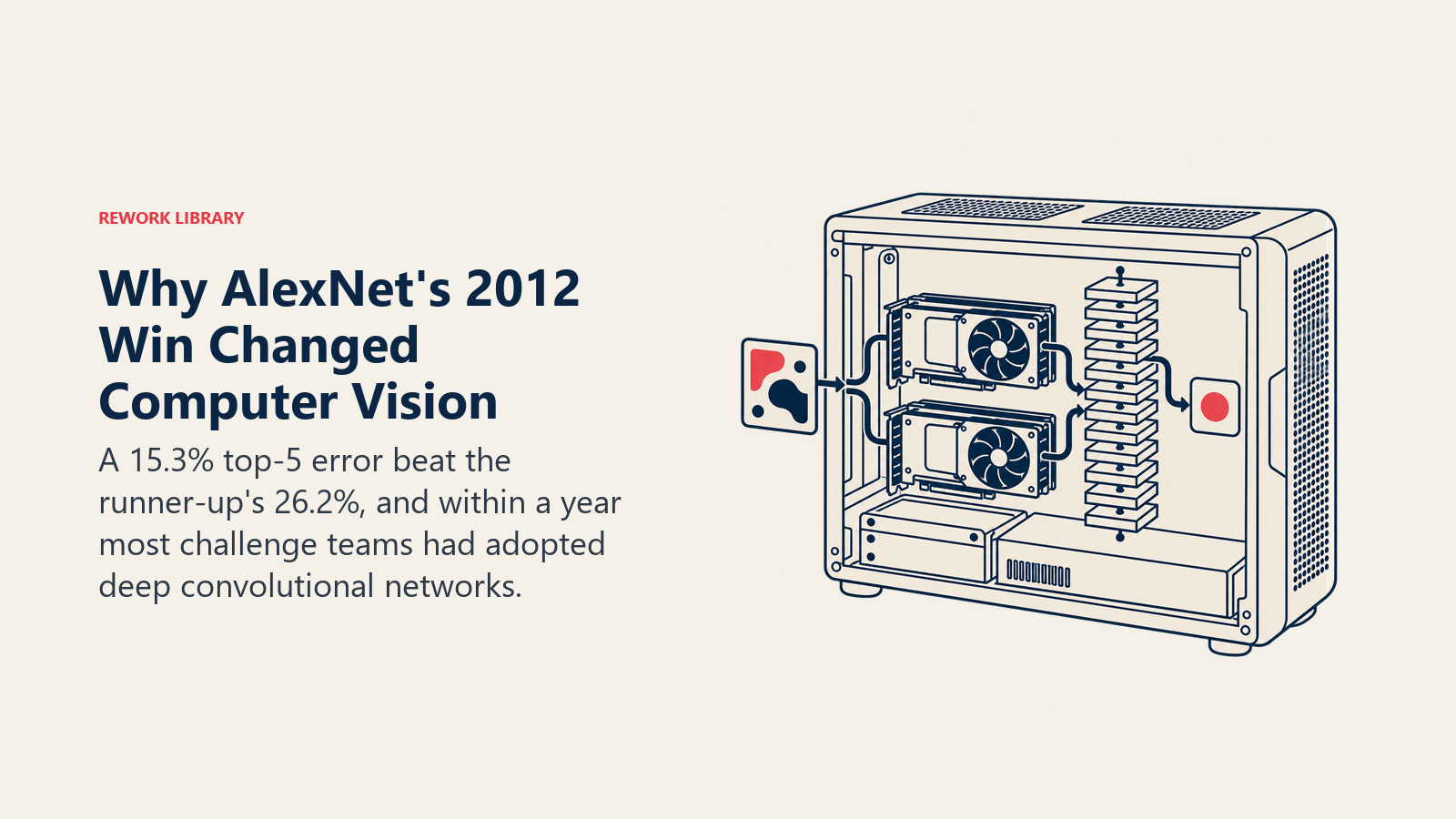
The design was a recombination, and the NeurIPS paper is explicit about the ingredients. The network had 60 million parameters and 650,000 neurons, five convolutional layers and three fully connected ones. The authors used non-saturating neurons, now called ReLU, and a very efficient GPU implementation of convolution to speed up training, plus a method called dropout to reduce overfitting. Training took between five and six days on two GTX 580 GPUs, and the authors note the 3GB memory of one card limited the network's size. They also wrote that results could improve simply by waiting for faster GPUs and bigger datasets, which is a fair summary of the next decade.
The contest paper's own verdict is blunt: 2012 was a turning point for large-scale object recognition. The response showed in participation. Twenty-four teams entered in 2013, compared to 21 in the previous three years combined, and the vast majority used deep convolutional networks. Clarifai, led by Matthew Zeiler, won 2013 at 11.7% classification error; Zeiler and Rob Fergus had published a visualization technique to understand what those networks learn.
| Year | Winning entry | Top-5 error | Notes |
|---|---|---|---|
| 2010 | NEC | 28.2% | Hand-designed features and conventional classifiers |
| 2011 | XRCE | 25.8% | Fisher vector methods |
| 2012 | SuperVision | 15.3% with extra data, 16.4% without | Deep convolutional network on two GPUs |
| 2013 | Clarifai | 11.7% | Several large networks averaged together |
| 2014 | GoogLeNet | 6.7% | 22 layers; VGG placed second |
| 2015 | ResNet (Microsoft Research) | 3.57% with an ensemble | Up to 152 layers |
In 2014 Oxford's VGG team and Google's GoogLeNet pushed depth further: the VGG paper reports its team secured first place in localisation and second in classification using networks of 16 to 19 weight layers. Then in 2015 Kaiming He, Xiangyu Zhang, Shaoqing Ren and Jian Sun at Microsoft Research introduced residual networks. Their paper reports a depth of up to 152 layers, 8 times deeper than VGG, and 3.57% error, which won ILSVRC 2015 classification.
Human comparison needs care. The ILSVRC paper reports that one trained annotator, labeling 1,500 test images, reached an estimated 5.1% error, better than GoogLeNet's 6.7% at the time. A Microsoft team then reported 4.94% top-5 error, which by their knowledge was the first result to surpass human-level performance on this task, and ResNet went lower. It is one annotator on one task, so read it as "better than a trained person labeling 1,000 classes," not "sees like a person."
Meanwhile the business moved. On March 12, 2013 the University of Toronto announced that Google had acquired the company incorporated in 2012 by Hinton, Krizhevsky and Sutskever, DNNresearch, for its research on deep neural networks. The terms were not disclosed. In 2017 the organizers ended the format: a notice on the ILSVRC 2017 page says they were passing the baton to Kaggle.
For teams today: when a new method wins by a wide margin, the gap is the signal, not the method's name. Ask what changed underneath, and who is already organized to use it. And note the pace: after 2012, winning error fell every year through 2015.
Reckoning and Reach (2018-present)
The data gets audited while the architecture moves on
The first reckoning was about the data itself. In 2019 the ImageNet team announced that of the 2,832 synsets in its person subtree, it flagged 1,593 as unsafe, offensive or sensitive, with plans to remove them and 600,040 images. The accompanying paper, by Kaiyu Yang, Klint Qinami, Li Fei-Fei, Jia Deng and Olga Russakovsky, appeared at FAT* 2020 and found that only 158 of the remaining categories were visual, the rest reflecting annotators' bias. It also notes that the 1000 ILSVRC classes contain only three people categories, so the contest itself was largely unaffected. The lesson: the people who built the scoreboard audited it themselves, in public, and said the labels inherited WordNet's stale vocabulary.
Then the architecture changed. In 2020 a Google Research team showed that a pure transformer applied to sequences of image patches could match or beat convolutional networks on image recognition when pre-trained on large data, reaching 88.55% on ImageNet. The transformer's own story is told in the history of transformer models, and the pretrain-then-adapt pattern is what we now call foundation models. ImageNet's role shifted from the proving ground to one of many evaluations.
Recognition arrived late. On October 8, 2024 the Nobel Prize in Physics went to John Hopfield and Geoffrey Hinton for foundational discoveries and inventions that enable machine learning with artificial neural networks. And in March 2025 the Computer History Museum, in partnership with Google, released the 2012 AlexNet source code as open source; Google owned it through the DNNresearch acquisition. Hinton's summary of the project, as the museum reports it, credits Sutskever with the idea and Krizhevsky with making it work. For where this technology goes next, see the history of generative AI.
For teams today: your benchmark data is a product with a maintenance burden. Audit labels, document where they came from, and plan for the day the category list looks outdated.
Key People
| Name | Role | Contribution | Year |
|---|---|---|---|
| Carl Linnaeus | Naturalist | Systema Naturae and the ranked hierarchy | 1735 |
| George A. Miller | Princeton psychologist | Began the WordNet project | Mid-1980s |
| Kunihiko Fukushima | NHK researcher | The neocognitron | 1980 |
| Yann LeCun | Researcher, formerly Bell Labs | LeNet-5 and convolutional nets trained by back-propagation | 1998 |
| Rajat Raina, Anand Madhavan, Andrew Ng | Stanford researchers | Large-scale deep learning on GPUs | 2009 |
| Dan Ciresan and Jurgen Schmidhuber | IDSIA researchers | Fast GPU convolutional nets | 2011 |
| Li Fei-Fei, Jia Deng and colleagues | Princeton, later Stanford | ImageNet and the ILSVRC contest | 2009-2010 |
| Alex Krizhevsky | Toronto graduate student | Built and trained AlexNet | 2012 |
| Ilya Sutskever | Toronto graduate student | AlexNet co-author | 2012 |
| Geoffrey Hinton | Toronto professor | AlexNet co-author, Nobel laureate | 2012, 2024 |
| Kaiming He and colleagues | Microsoft Research | ResNet | 2015 |
Key Facts
- AlexNet's ILSVRC 2012 entry scored 15.3% top-5 error against 26.2% for the runner-up.
- ImageNet's 2009 paper described 3.2 million images across 5247 synsets.
- ILSVRC's training set is about 1.2 million images in 1000 classes.
- AlexNet trained for five to six days on two GTX 580 GPUs.
- ResNet won ILSVRC 2015 with 3.57% error, against an estimated 5.1% for a trained human annotator.
- Google acquired DNNresearch, announced March 12, 2013.
The Pattern Behind the History
Across the six eras the same sequence repeats. We call it the Three-Rivers Pattern. It's our synthesis of the history above, not a research finding.
- Separate rivers flow for decades. Taxonomies from 1735, convolution from 1980, graphics chips from 2006, each built for a different purpose.
- No river is enough alone. LeNet worked without the data, ImageNet existed without the compute, GPUs sat idle without the model.
- A public scoreboard brings them together. ILSVRC gave every group the same test, so the gap in 2012 was undeniable.
- The winner's recipe spreads in months. The 2013 field filled with deep networks, and depth kept growing for years.
- Success invites an audit. The data's labels and vocabulary were reviewed in 2019, and the architecture moved on.
What It Teaches Teams Today
- Look for the combination, not the invention. Ask which of data, model and compute you actually lack.
- Invest in data structure first. ImageNet's lasting value was a clear category tree plus a large, checked label set.
- Build the benchmark early. A shared test turned a minority method into the standard in one season.
- Budget for label quality. Crowd labeling scaled ImageNet, and later audits showed what that scale cost.
- Expect your model layer to be replaced. Convolution lost some ground to attention; the dataset and evaluation set stayed useful.
The 2012 breakthrough looks sudden only if you start the story that year. Start in 1735, 1980 and 2006 and it looks like three rivers that finally met. For the longer arc around it, see the AI timeline.

Co-Founder, Rework.com