The History of the Abacus and Mechanical Calculators
Turn this article into takeaways for your work.


Each assistant summarizes the article only for you and suggests best practices for your work.
In the 1640s a tax collector added long columns of figures by hand. His son, Blaise Pascal, built a machine to do the work instead. The story starts far earlier than that.
People have counted with marked objects for at least 20,000 years, built the first geared calculating machines in the 1600s, and sold them by the thousand from the 1800s, until pocket electronics ended the line around 1972. The throughline is simple. Each generation took the one step people kept getting wrong, usually the carry from one column to the next, and turned it into a mechanism. For the full sweep of the field, see The History of Computers and the computer timeline.
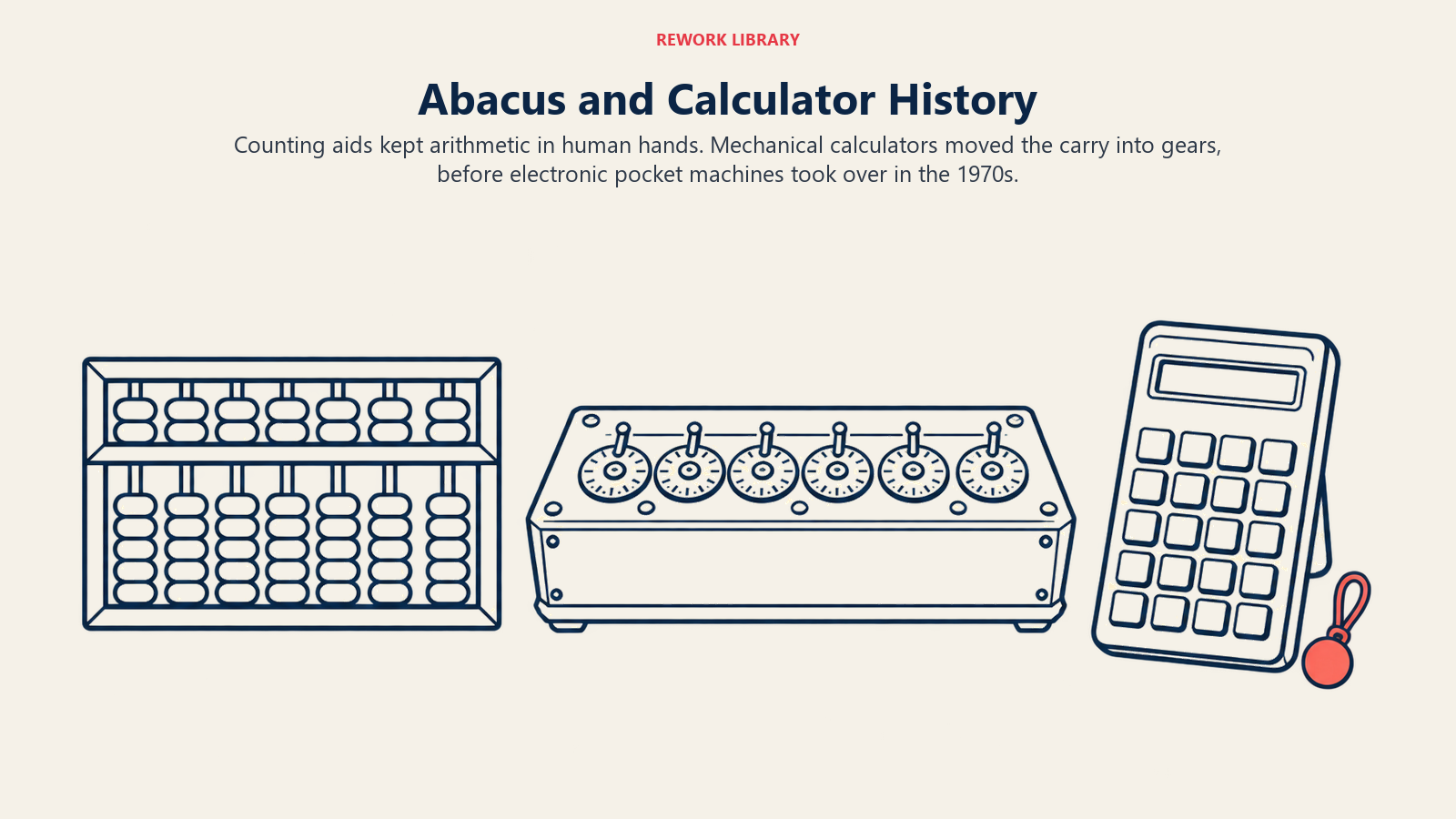
One distinction keeps the story honest. A counting aid helps a person keep track, and the person still does the arithmetic. A mechanical calculator does the arithmetic itself. The abacus is the first kind, and it stayed in use long after the second kind arrived.
| Item | Kind | Why |
|---|---|---|
| Ishango bone, counting boards, abacus | Precursor | A person moves or reads the marks and does the arithmetic. |
| Napier's bones, the slide rule | Precursor | They simplify the work, but the user still adds and carries. |
| Antikythera mechanism | Precursor | Gears compute astronomical cycles, but it is not an arithmetic machine. |
| Schickard, Pascal, Leibniz, Thomas | Mechanical calculators | The machine adds, and in some cases multiplies and divides, by itself. |
| Comptometer, Burroughs, Odhner, Curta | Mechanical calculators | Commercial descendants built for offices, banks and engineers. |
Timeline at a Glance
| Year | Milestone | Why It Mattered |
|---|---|---|
| At least 20,000 years ago | The Ishango bone, with more than 160 parallel notches, is made | Early evidence of marking quantities, though its purpose is still debated. |
| 4th century BCE | The Salamis tablet, a marble table abacus | The oldest surviving calculating device. |
| 2nd or early 1st century BCE | The Antikythera mechanism is made | A bronze gearwork device that displayed astronomical cycles. |
| 1617 | John Napier designs his rods | Multiplication and division became lookups. |
| 1623 | Schickard builds two calculators, known only from letters | The earliest known mechanical calculator, now lost. |
| 1640s | Pascal builds the Pascaline | The first adding machine produced in even modest quantity. |
| 1673 | Leibniz builds the first true four-function calculator | His stepped drum shaped calculators for generations. |
| 18 November 1820 | Thomas de Colmar receives a five-year patent | The start of the Arithmometer, which took off about 1850. |
| 1872-1873 | Baldwin's and Odhner's pinwheel designs | A cheaper, more compact mechanism that others copied. |
| 1887 | Dorr Felt is granted a patent for the Comptometer | The first commercially successful keyboard adding machine. |
| 1892 | Steiger patents the Millionaire | Multiplication in a single cycle, for high-precision users. |
| 1961 | ANITA is announced | The first commercial all-electronic desktop calculator. |
| 1972 | HP-35 introduced | A pocket machine that covered the functions of the slide rule. |
The Counting Board Years (20,000 years ago-500 CE)
Notches, marble tables and one astonishing gearbox
The turning point of this era is not a machine. It is the moment people started keeping numbers outside their heads. The Max Planck Institute's QUANTA project describes the Ishango bone, recovered by Jean de Heinzelin during the Belgian excavations at Ishango in what is now the Democratic Republic of Congo. It carries more than 160 parallel notches in distinct groups and is dated to at least 20,000 years ago. It now sits in the Royal Belgian Institute of Natural Sciences in Brussels. Some scholars read it as early mathematics, with groupings that look like prime numbers. The same source says those ideas are still unsupported by empirical data, and that researchers are testing them. Treat it as a tally, not a calculator.
Then comes the counting board. The Computer History Museum holds the Salamis tablet record: marble, from the Greek island of Salamis, dated to the 4th century BCE, called the oldest surviving calculating device, and possibly Babylonian in origin. Another history notes the slab was found in 1846 and was first thought to be a game board, and that earlier boards were made of perishable materials, so none survive. The same page describes a Roman hand abacus as the first portable counting board. The Museum calls the abacus "perhaps the oldest continuously used calculating tool" apart from fingers.
The next documented step is a machine. The Antikythera Mechanism Research Project says it was found in an old shipwreck in 1900, probably the first advanced technological astronomical instrument from ancient times, with 30 interacting gears and inscriptions the team calls a user's manual. And NYU's Institute for the Study of the Ancient World dates it to the second or early first century BCE, made somewhere in the Hellenistic world and now held in the National Archaeological Museum in Athens. It displayed chronological cycles and the motions of heavenly bodies. It is a precursor, not a calculator in the later sense: it modelled the sky rather than adding a column of prices.
For teams today: the oldest lesson is that a good tool lowers the chance of error without removing the person. When you design a process, ask which step still depends on a tired human holding a number in their head.
The Eastern Abacus (c. 1200-1946)
The bead frame outlasts the first machines
This era overlaps the next two, because the abacus never stopped being used while inventors in Europe built gears. The turning point is the bead frame itself. According to the history on the Toronto Metropolitan University site, the Chinese suanpan was first chronicled around 1200 CE, and its original layout of two beads above the bar and five below lasted until about 1850, when a one-and-five layout appeared. Japan adopted the Chinese frame around 1600 via Korea, and the one-and-four soroban still made in Japan appeared around 1930. The Computer History Museum confirms the bead counts: the suan pan has two beads above the bar and five below, and the soroban has one above and four below.
Here is the proof that the abacus was no relic. In 1946 in Tokyo, a US soldier using an electric calculator raced Kiyoshi Matsuzaki, a Japanese postal worker with a soroban. The Computer History Museum records that the abacus won four of five rounds. A trained hand on a simple frame beat a motor-driven machine on addition-heavy work.
The abacus solved the problem of speed with a very small, very cheap tool. It left a new problem untouched: it still needed a skilled operator and could not be built into a larger machine.
For teams today: a simple tool in trained hands can beat a more powerful one that nobody has practiced with. Before buying the heavier system, measure how fast your best people are on the one you already have.
The Wheel Builders (1617-1673)
Rods, dials and a stepped drum
The turning point is the logarithm. In the early 1600s astronomers and navigators faced pages of multiplication, and people looked for ways to turn it into something simpler. John Napier designed his calculating rods in 1617, a palm-sized calculator in the museum's description. The Museum's account of Schickard's machine, below, says the rods handled multiplication and division. Napier's rods are a precursor, since the user still combines the partial results by hand.
Around the same time William Oughtred made a different shortcut. The St Andrews biography says his circles of proportion were the earliest form of the slide rule, using logarithms to turn multiplication and division into addition and subtraction, built by the instrument maker Elias Allen. Oughtred's pupil William Forster persuaded him to publish, and the account appeared in 1632. Richard Delamain, another pupil, claimed the invention, and Oughtred answered with a pamphlet dated 1633. The straight slide rule is described in the same biography without a separate date.
The first machine comes next. Wilhelm Schickard, a German professor, built two calculators around 1623. The Computer History Museum says one, made for Kepler, was destroyed by fire, and the other is lost. We know the design only from his letters to Kepler, which include sketches, and the design remained lost until 1935. The machine combined Napier's bones for multiplication and division with a toothed-wheel system for addition and subtraction, and the Museum calls it the earliest known mechanical four-function calculator. The same Museum calls Leibniz's machine of 1673 the first true four-function calculator, so the word "first" depends on how much of Schickard's lost machine you count.
Pascal's machine is the one that people actually used. Per the Museum, in the 1640s he built an adding machine for his father, a tax collector, and made about 50 of them, selling about 15. It is "the first adding machine produced in even modest quantity." Its carry mechanism was complicated and unreliable and used falling weights instead of linked gears. A separate record says Pascal (1623-1662) built it to help his father and that surviving examples are in the Musée des Arts et Métiers in Paris and the Zwinger museum in Dresden. That page heads the entry 1642 but gives 1643 in the text, so "early 1640s" is the safe date.
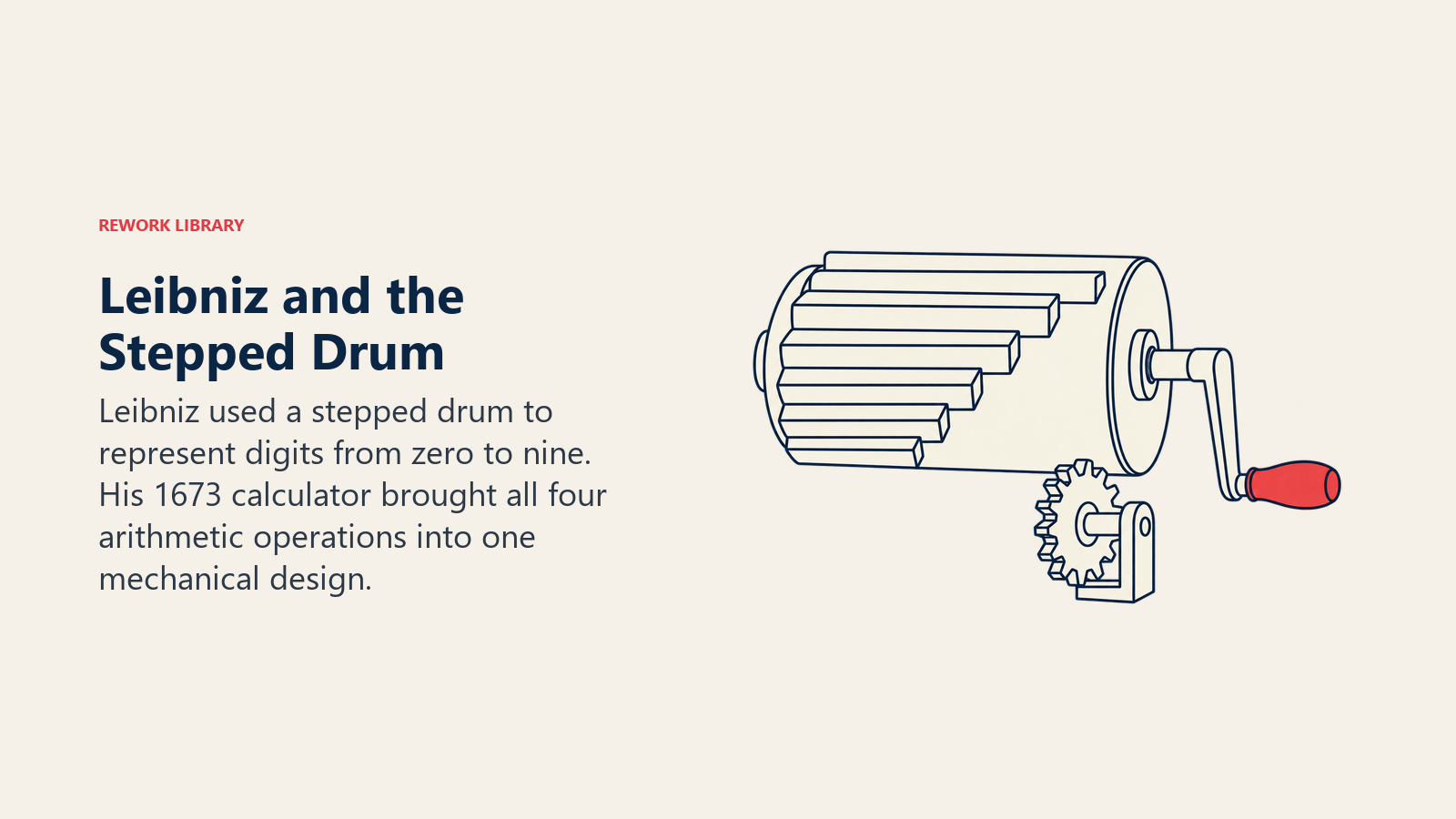
The big step belongs to Gottfried Leibniz. The Museum says he built the first true four-function calculator in 1673 and made several versions of the Stepped Reckoner over about 45 years, of which only one survives. His drum-shaped stepped gear let one gear represent any digit from 0 to 9 in a single revolution. The same page says the design became the basis for calculators for "the next 275 years," and elsewhere says "the next two centuries." Both figures appear on the page, so the exact span is loose.
This era solved the carry and the multiplication, at least on paper. It created a manufacturing problem: these were hand-built curiosities, and none of them was reliable enough to sell.
For teams today: the first version is rarely the one that scales. Pascal's carry worked on a good day, and calculators did not sell steadily until the 1800s.
The Arithmometer Age (1820-1892)
A French insurance director makes calculation a product
The turning point is a patent and then a factory. Charles Xavier Thomas de Colmar (1785-1870) directed an insurance company, first the Phénix and later the Soleil, according to the Oxford history of the machine. He took a five-year patent, number 1420, on 18 November 1820. Oxford calls that a transient prototype, and says sustained production "first began seriously in about 1850" with a new patent. The Computer History Museum dates first production to 1820. Both are right in their way: 1820 is the patent and the prototype, and about 1850 is the start of real manufacturing. The machine won a prize medal at the Great Exhibition of 1851.
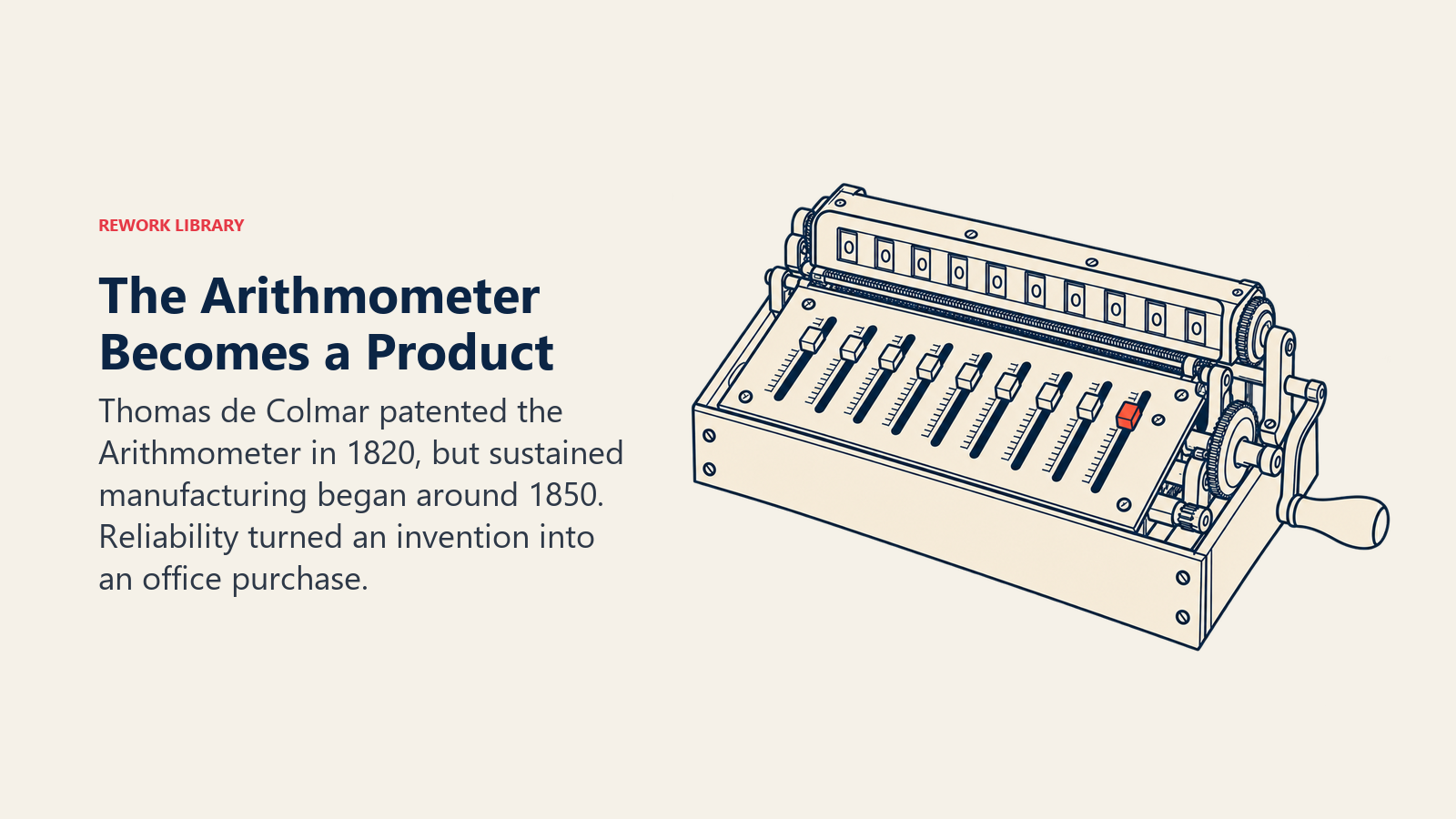
The mechanism borrowed Leibniz's stepped cylinders, per Oxford. Users set numbers with sliding levers, then pulled a silk ribbon, which later versions replaced with a crank, according to the Museum. Oxford reports about 250 machines assembled by 1854, and an 1878 report that gives about 500 sold up to 1865 and sales of no more than about 100 a year before the 1880s. The 1878 report's figures total about 1,500 machines, and the Museum puts total sales at nearly 2,000, with production continuing into the 20th century.
Competition came in the 1870s. The Museum says Frank Baldwin's 1872 pinwheel design was "the first significant advance" since the Arithmometer: each pinwheel carries zero to nine pins the operator sets with a lever. Baldwin's own production was tiny, and other manufacturers who copied the design far outsold him. In 1873 Odhner, a Swedish immigrant in Russia, produced the original Odhner pinwheel design, and the same page notes that millions of Arithmometers were sold worldwide by several manufacturers across the 20th century, including the Soviet Felix, whose production began in 1924.
Then the keyboard. Dorr Felt's Comptometer was patented in 1887 when he was 24. The Museum calls it the first commercially successful keyboard adding machine: key presses drive the mechanism, and the sum appears once all keys are pressed. Felt's prototype was built from a pasta box, meat skewers and rubber bands. More than 6,500 wooden-cased models were made between 1886 and 1903, and fewer than 90 survive.
William Seward Burroughs went another way, and his early path is a lesson in reliability. In 1880 his first calculator printed its answers, but the answers were often wrong, because cranking too fast caused errors. He redesigned the mechanism in 1890 and 1891, and reportedly threw the originals out of an upper-floor window. A more reliable version sold well in 1892.
This era turned calculation into an office purchase. It created the next problem: a market of competing designs, each good at one kind of arithmetic.
For teams today: an invention and a product are different events, and the dates prove it. The Arithmometer was patented in 1820 and became a business thirty years later. When someone says a new tool "launched," ask whether they mean the patent, the prototype or the first customer.
The Desk Machine Years (1892-1960s)
Millions of cranks, then a calculator in the palm
The turning point is specialization. In 1892 the Swiss engineer Otto Steiger patented the Millionaire, and the Museum says its mechanism held a full multiplication table, so it could multiply any two numbers in one cycle, with 16-digit results. About 4,600 were made over 40 years, and an electric drive motor became available in 1911. It was expensive and attracted insurance companies, scientists and engineers.
The main stream of desk calculators was American. Per the Computer History Museum, Marchant was founded in 1911 in Oakland, California. In 1912 Jay Monroe and Frank Baldwin formed the Monroe Calculating Machine Company to build a simple, portable four-function calculator with a keyboard. Carl Friden, Marchant's chief designer, left in 1934 to start his own firm, and Friden's calculators were the first to compute square roots directly. Baldwin's electromechanical machines, some with as many as 12,000 parts, "revolutionized scientific and technical calculations," the same page says. By the 1920s many calculators were motorized.
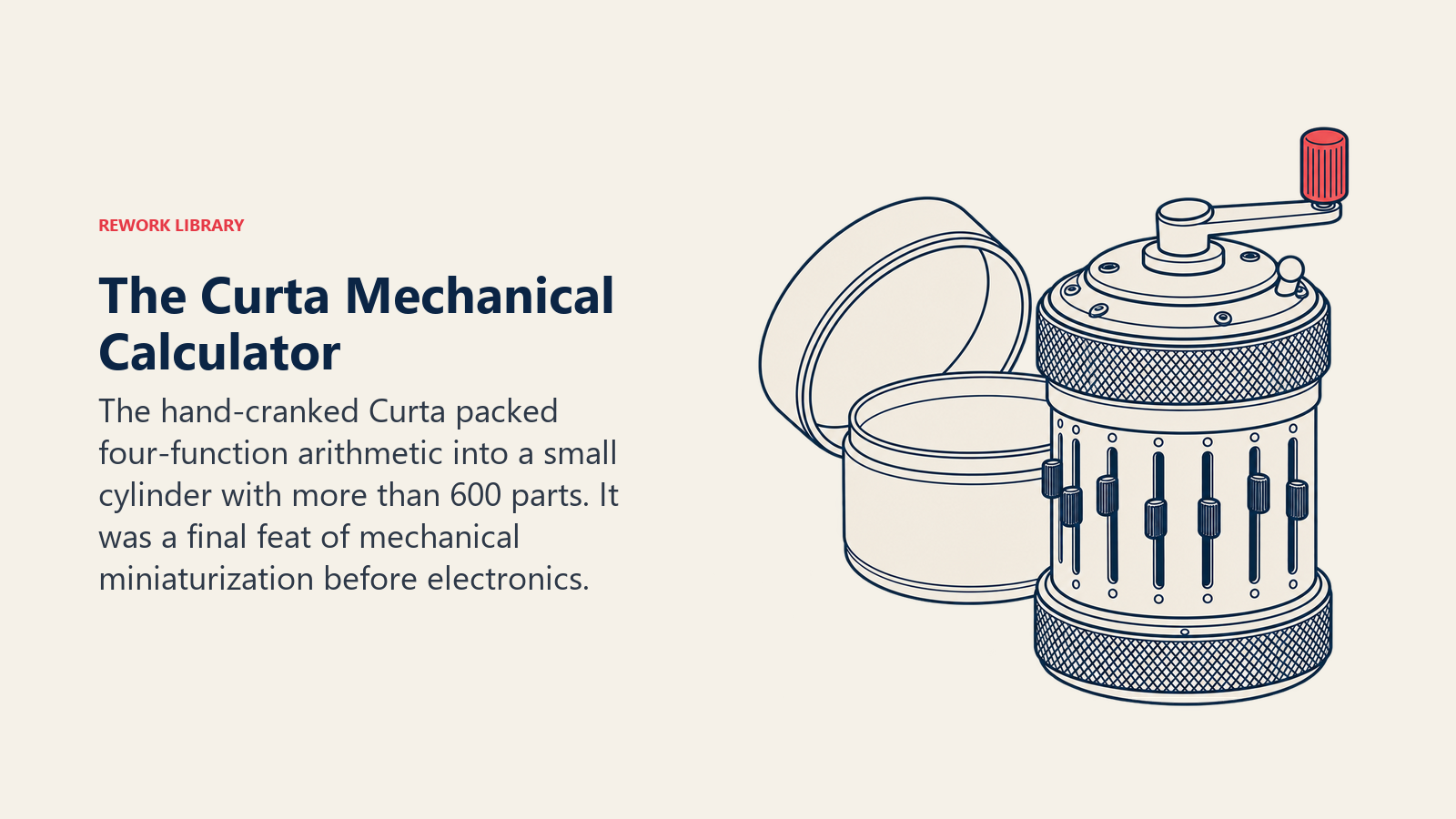
The last great mechanical design was small. Curt Herzstark worked in his family's manufacturing business until the Nazis sent him to Buchenwald in 1943, and the Museum says he refined his prewar design there. After the war the Curta became the "smallest all-mechanical, four-function calculator ever built." It is hand-cranked, uses a modified stepped drum and has more than 600 parts. Sports car rallyists kept using it after electronic calculators were available.
The problem this era left is the one the earlier ones had: precision machines, each costing a lot, made of hundreds of moving parts. Electronics would not fix any of that. It would delete it.
For teams today: when a technology is about to be replaced, the best products are often the best engineered. The Curta was a miracle of miniaturization right up to the moment electronics made miniaturization cheap.
The Electronic Takeover (1961-present)
Vacuum tubes, then chips, then the end of the cranks
The turning point is the ANITA. The Museum calls it the first commercial, all-electronic desktop calculator, announced in 1961 and designed by Norbert Kitz for the British firm Bell Punch using vacuum tubes, even though transistors were already cheaper and more efficient. The same page records that Dorr Felt's patent of 1887 had a British relative, the Sumlock Comptometer, which it also calls the first commercial electronic calculator, a claim the page does not reconcile with ANITA's. Texas Instruments built a prototype in 1967, and the Canon Pocketronic printing calculator was the first product directly based on it. By the late 1960s desktop electronic calculators were lighter and quieter than mechanical ones.
The chip came next. Intel's 4004, whose 1971 packaging the Computer History Museum credits to Ted Hoff, Stanley Mazor, Federico Faggin and Masatoshi Shima, appears there in a Busicom calculator prototype. The calculator and the microprocessor grew up together, which links this story back to the generations of computers.
Then the pocket. The HP-35, introduced in 1972, is recognized by the IEEE milestone as the first handheld calculator to perform transcendental functions such as trigonometric, logarithmic and exponential ones. It performed all the functions of the slide rule to ten-digit precision. That is the same slide rule Oughtred had started, and the pocket machine went on to absorb the slide rule's job.
The mechanical line ended here for ordinary arithmetic, and the same logic moved up the stack into programmable machines. How that happened is told in who invented the computer, and the design ideas that Babbage and Lovelace attached to it are in Charles Babbage and the Analytical Engine and Ada Lovelace and the first computer program. The jump from calculating to instructing a machine is also behind the history of programming languages.
For teams today: the replacement tool usually keeps the old interface. The first electronic calculators still had a keypad and a display of digits, because users already knew how to use that. Keep what people already know while you change what is underneath.
Key People
| Name | Role | Contribution | Year |
|---|---|---|---|
| Jean de Heinzelin | Excavator at Ishango | Recovered the Ishango bone | 1950s |
| John Napier | Scottish mathematician | Designed the calculating rods | 1617 |
| William Oughtred | English mathematician | Circles of proportion, the earliest slide rule | published 1632 |
| Wilhelm Schickard | German professor | Built two calculators known from letters to Kepler | c. 1623 |
| Blaise Pascal | French mathematician | Built the Pascaline for his father's tax work | 1640s |
| Gottfried Leibniz | German philosopher | Built the Stepped Reckoner and its drum | 1673 |
| Charles Xavier Thomas de Colmar | Insurance director | Patented and later mass-produced the Arithmometer | 1820, about 1850 |
| Frank Baldwin | American architect and inventor | Pinwheel design; co-founded Monroe | 1872, 1912 |
| Dorr Felt | American inventor | Comptometer, first successful keyboard adding machine | 1887 |
| William Seward Burroughs | American inventor | Printing adding machine, redesigned for reliability | 1880-1892 |
| Curt Herzstark | Austrian engineer | Refined the Curta design in Buchenwald | 1943 onward |
| Norbert Kitz | Engineer at Bell Punch | Designed ANITA | 1961 |
Key Facts
- The Ishango bone has more than 160 parallel notches and is dated to at least 20,000 years ago.
- The Salamis tablet is marble and dates to the 4th century BCE.
- Pascal built about 50 Pascalines and sold about 15.
- Thomas de Colmar's patent dates to 18 November 1820, but sustained production began about 1850.
- More than 6,500 wooden-cased Comptometers were built between 1886 and 1903, and fewer than 90 survive.
- In 1946 a soroban won four of five rounds against an electric calculator in Tokyo.
The Pattern Behind the History
The same four moves repeat across every era above. We call the sequence the Carry Cycle. It's our synthesis of the history, not a research finding.
- Find the step people get wrong. For Pascal and Leibniz it was the carry and the multiplication, and for Burroughs it was a crank turned too fast.
- Build it for one user. Pascal's father, Kepler, and Felt's pasta-box prototype all began with one person's problem.
- Make it reliable enough to sell. Thomas needed thirty years from patent to factory, and Burroughs had to redesign his mechanism in 1890 and 1891.
- Let the next technology inherit the job. The slide rule, the Curta and the rotary desk machine each ended when electronics took over their interface.
What It Teaches Teams Today
- Separate the tool from the skill. The abacus beat an electric machine in 1946 because the person using it was practiced.
- Respect the carry. The expensive failures in this story came from the handoff between steps. Check the handoffs in your own process first.
- Know which date you mean. Invention, patent, prototype and first sale were different years for the Arithmometer.
- Reliability sells. Burroughs's first machine printed wrong answers, and the better one sold.
- Keep the interface when the engine changes. The first electronic calculators still looked like their mechanical ancestors.
The abacus and the mechanical calculator tell the same story from opposite ends: a simple tool kept beating complicated ones until the complicated ones became reliable, and then electronics erased both. Next time you evaluate a tool, ask which step it removes from your people, and whether that step was the one that caused the mistakes.

Co-Founder, Rework.com
On this page
- Timeline at a Glance
- The Counting Board Years (20,000 years ago-500 CE)
- The Eastern Abacus (c. 1200-1946)
- The Wheel Builders (1617-1673)
- The Arithmometer Age (1820-1892)
- The Desk Machine Years (1892-1960s)
- The Electronic Takeover (1961-present)
- Key People
- Key Facts
- The Pattern Behind the History
- What It Teaches Teams Today