The History of ENIAC
Turn this article into takeaways for your work.


Each assistant summarizes the article only for you and suggests best practices for your work.
Artillery crews needed firing tables. These were page after page of settings that tell a gun how to hit a target at a given range. The Army could not produce them fast enough.
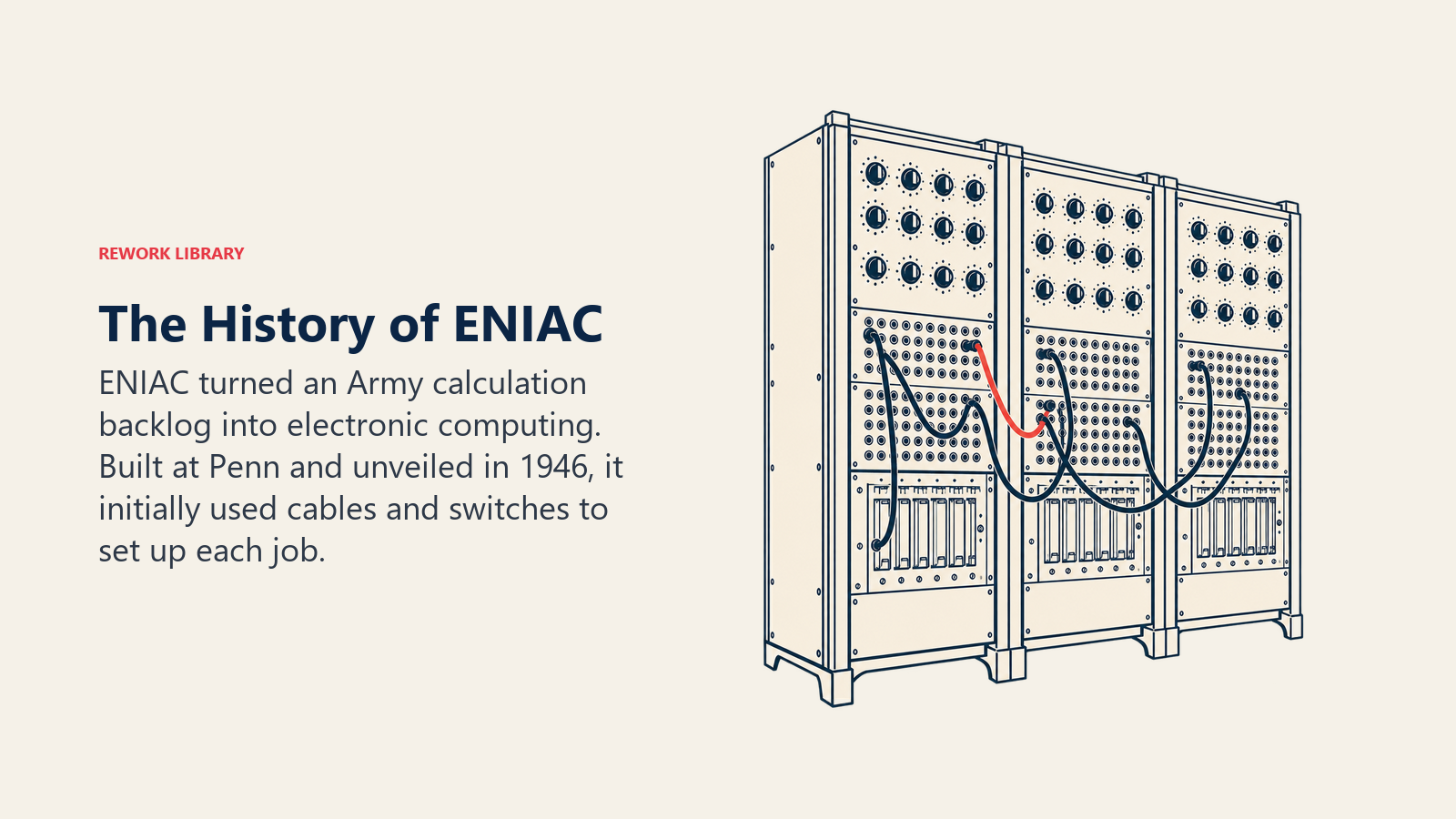
ENIAC, the Electronic Numerical Integrator and Computer, was proposed in 1942 and built in secret at the University of Pennsylvania's Moore School for the US Army. It was announced to the public in February 1946 and switched off for good in October 1955. A wartime backlog of artillery calculations turned a physicist's memo into the machine that proved large electronic computers could work. For the wider story of the field, see The History of Computers, the computer timeline and who invented the computer.
Some terms need a plain definition. A "computer" in 1943 was often a person who calculated for a living. A "differential analyzer" was a room-sized mechanical analog machine for solving equations. ENIAC replaced both with vacuum tubes that switched in microseconds.
Timeline at a Glance
| Year | Milestone | Why It Mattered |
|---|---|---|
| 1935 | Two differential analyzers are installed, one at the Army's Ballistic Research Laboratory and one at the Moore School | The analog stopgap that ENIAC later replaced. |
| June 1942 | The Army contracts the Moore School to run its differential analyzer exclusively for Ordnance | Put the Moore School and the Army's ballistics problem together. |
| August 1942 | Mauchly circulates a memo on high-speed vacuum tube calculating | The founding document of the project. |
| 5 June 1943 | The first Army agreement is dated, at $61,700 for six months of research | Funded the work that became ENIAC. |
| October 1944 | A contract supplement for EDVAC is added | Planning for a stored-program successor began before ENIAC finished. |
| 1945 | Von Neumann's First Draft of a Report on the EDVAC is issued by the Moore School | Described the stored-program design that ENIAC lacked. |
| 14-15 February 1946 | ENIAC is announced and dedicated | The public first learned a large electronic computer existed. |
| July 1946 | Ordnance formally accepts the machine | Completion on the Army's terms. |
| 1947 | ENIAC is dismantled, moved to Aberdeen and restarted | The working life of the machine began at the Army's own range. |
| Early 1948 | Converted to run coded instructions from function tables | Closed part of the gap with stored-program design. |
| 2 October 1955 | Power is removed at 11:45 PM | The end of a nine-year service life at Aberdeen. |
| 1973 | Judge Larson invalidates the ENIAC patent | A court, not the engineers, settled the legal question of priority. |
The Firing Table Problem (1935-1942)
Human computers and a mechanical analyzer hit a wall
The turning point is the installation of two differential analyzers in 1935. The Computer History Museum says the Army's Ballistic Research Laboratory (BRL) at Aberdeen received one and the Moore School received the other. The BRL's job was to calculate artillery firing tables, and its human computers could not keep up with wartime demand.
The Army's own account of the period describes the stack of tools. According to an Ordnance history reproduced online, the Ballistic Computing Section used desk calculators and the Bush Differential Analyser, and both had limits. In June 1942 the Ordnance Department contracted the Moore School to operate its analyzer exclusively for the Army. In September 1942 a computing branch was set up there as a substation of Aberdeen, with Lt. Herman Goldstine supervising the group. Both analyzers ran day and night during the war.
Meanwhile a physicist was thinking about the same bottleneck from a different direction. The IEEE Computer Society's biography says John Mauchly taught physics at Ursinus College from 1933 to 1941, conceived an electronic, vacuum-tube version of tabulating equipment while doing meteorological calculations, took a summer course at the Moore School in 1941, and was asked to stay as an instructor. Mauchly's idea built on a lineage you can trace through Hollerith's punched cards and the older mechanical calculators, though none of those machines was electronic.
This era set up the problem: hand calculation and the analog analyzers were not clearing the Army's demand for tables.
For teams today: the demand for a new tool usually appears first as a backlog that your current tools cannot clear. Measure the backlog before you decide what to build.
Project PX (1942-1945)
Mauchly proposes, Eckert engineers, the Army pays
The turning point is a memo. In August 1942 Mauchly wrote "The Use of High Speed Vacuum Tube Devices for Calculating", which the Computer History Museum catalogs as a memorandum "privately circulated in August, 1942" and holds in the Donald Knuth papers. The IEEE biography says he saw its value for ballistics range tables and for meteorology. The Museum's account adds that, to win Army funding, he and J. Presper Eckert framed the project around ballistics rather than weather.
The contract date depends on the source. The Army's history says the original agreement is dated 5 June 1943 and called for six months of work on an "electronic numerical integrator and computer" and a report, at an initial $61,700. The Computer History Museum lists 17 May 1943 as the date the Army and the University of Pennsylvania signed. The Army history says nine supplements extended the work to 1946 and raised the total to $486,804.22, and the Museum puts the cost at almost $500,000. Inside the Moore School the project went by the code name Project PX, per the same Museum page.
The roles were clear. Per the Army history, Eckert was chief engineer and Professor John Grist Brainerd was project supervisor, with Mauchly as the Moore School's principal consultant. Goldstine served as the Army's liaison. The Museum describes Eckert, then 24, as head engineer and Mauchly as the idea generator and booster. Penn credits Eckert with solving the reliability problems by running the tubes at one-quarter power, and the Museum adds that the machine lost roughly one tube every day or two.
The size of the thing is easy to state. Penn counts 18,000 vacuum tubes, about 30 tons, a room 30 by 50 feet and 150 kilowatts of power. The Army's count is slightly higher, about 19,000 tubes and 174 kilowatts, so treat both as the same machine measured two ways.
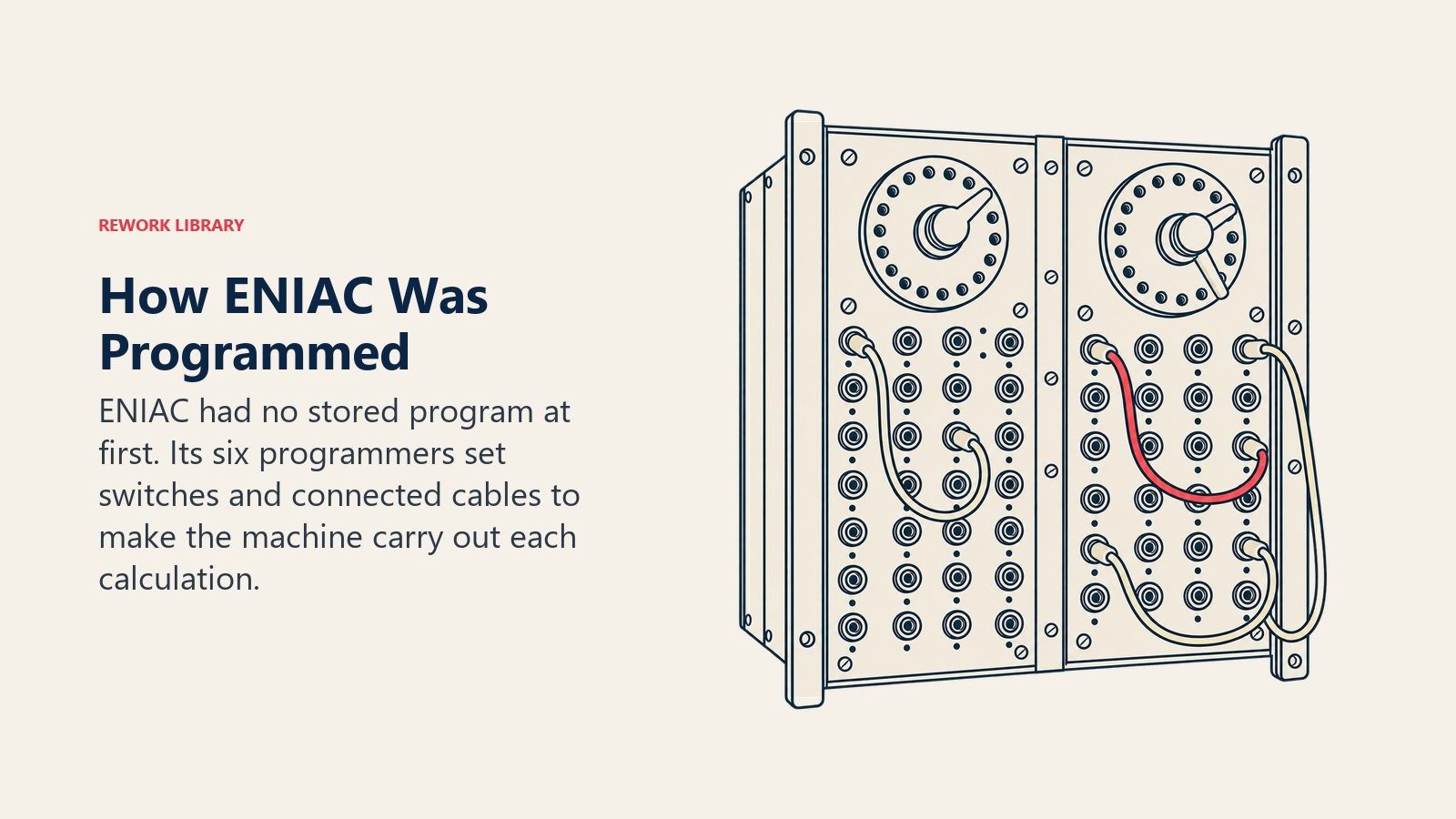
The people who made it run were women who had been wartime human computers. Penn names the six: Kathleen McNulty Mauchly Antonelli, Jean Jennings Bartik, Frances (Betty) Snyder Holberton, Marlyn Wescoff Meltzer, Frances Bilas Spence and Ruth Lichterman Teitelbaum. They worked on classified Army ballistics calculations before ENIAC. The Computer History Museum notes that Bilas and Jennings both held mathematics degrees, and that Bilas had operated the Moore School's differential analyzer. ENIAC had no stored program. Programming meant setting switches and plugging cables, which is why the programmers' job mattered so much.
This era produced a working machine and created the next problem: a computer you had to rewire for every job. In October 1944 the Moore School received a contract supplement for EDVAC, a stored-program design, while ENIAC was still being built.
For teams today: the project got funded because it was pitched against the sponsor's problem, ballistics, not the inventor's, weather. Frame your proposal in the buyer's terms.
The Unveiling (1945-1946)
A secret machine becomes front-page news
The turning point is the public demonstration. Penn says ENIAC was "originally announced on February 14, 1946", and the IEEE milestone page dates the New York Times announcement to the same day. The Army history says it was dedicated at the Moore School on 15 February 1946, and the Computer History Museum says the story reached the front page of the Times on 15 February. The two dates are announcement and dedication, a day apart.
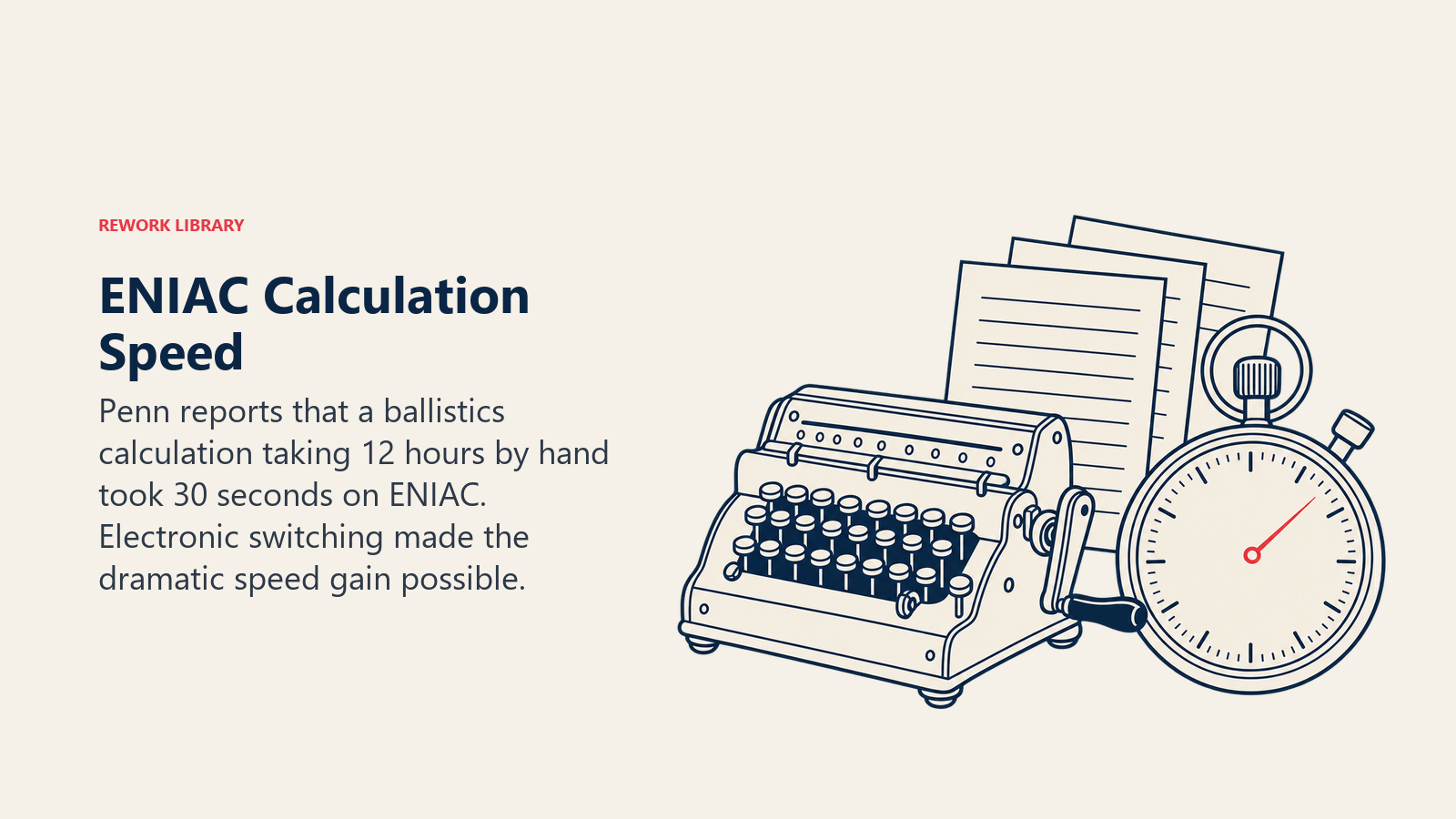
The pitch was speed. Penn says a ballistics calculation that took 12 hours by hand took 30 seconds on ENIAC. The Army report gives the electronics behind it: one addition in 200 microseconds and a ten-digit multiplication in 2.6 milliseconds.
The women were left out of the story. Penn's account says that two women created the test run that impressed the media, that they were not invited to the celebratory dinner at Houston Hall, and that the articles and pictures published featured only men. Penn's heritage page names Meltzer and Teitelbaum as the pair who carried out the demonstration, and the news story credits Bartik and Holberton with devising the trajectory calculation behind it. The six were inducted into the Women in Technology International Hall of Fame in 1997.
A different story ran in parallel. In 1945 John von Neumann's First Draft of a Report on the EDVAC was issued by the Moore School, laying out how a computer could hold its instructions in memory. That idea is the root of the stored-program computer, and ENIAC had been built before it was written down. The Army history says von Neumann also suggested switch-based code selection for ENIAC itself.
The era left a credit problem. Eckert and Mauchly left the Moore School in 1946 amid a dispute over the school's patent policy, and formed a partnership in June 1946 to market UNIVAC. EDVAC was not complete until 1951.
For teams today: the people who run the machine are often missing from the launch photo. Credit the operators in the announcement, not decades later.
The Aberdeen Years (1946-1955)
Moved to the Army's range, rewired for coded instructions
The turning point is the move. The Army accepted the machine in July 1946. The Computer History Museum says it ran until 9 November 1946, then was refurbished, given a memory upgrade and moved to Aberdeen Proving Ground, with a restart on 29 July. The Army history says units began arriving at Aberdeen in January 1947 and the machine was operational again by August 1947. One Museum page puts the move in 1946, so the accounts differ by a year. Penn says it was moved in 1947.
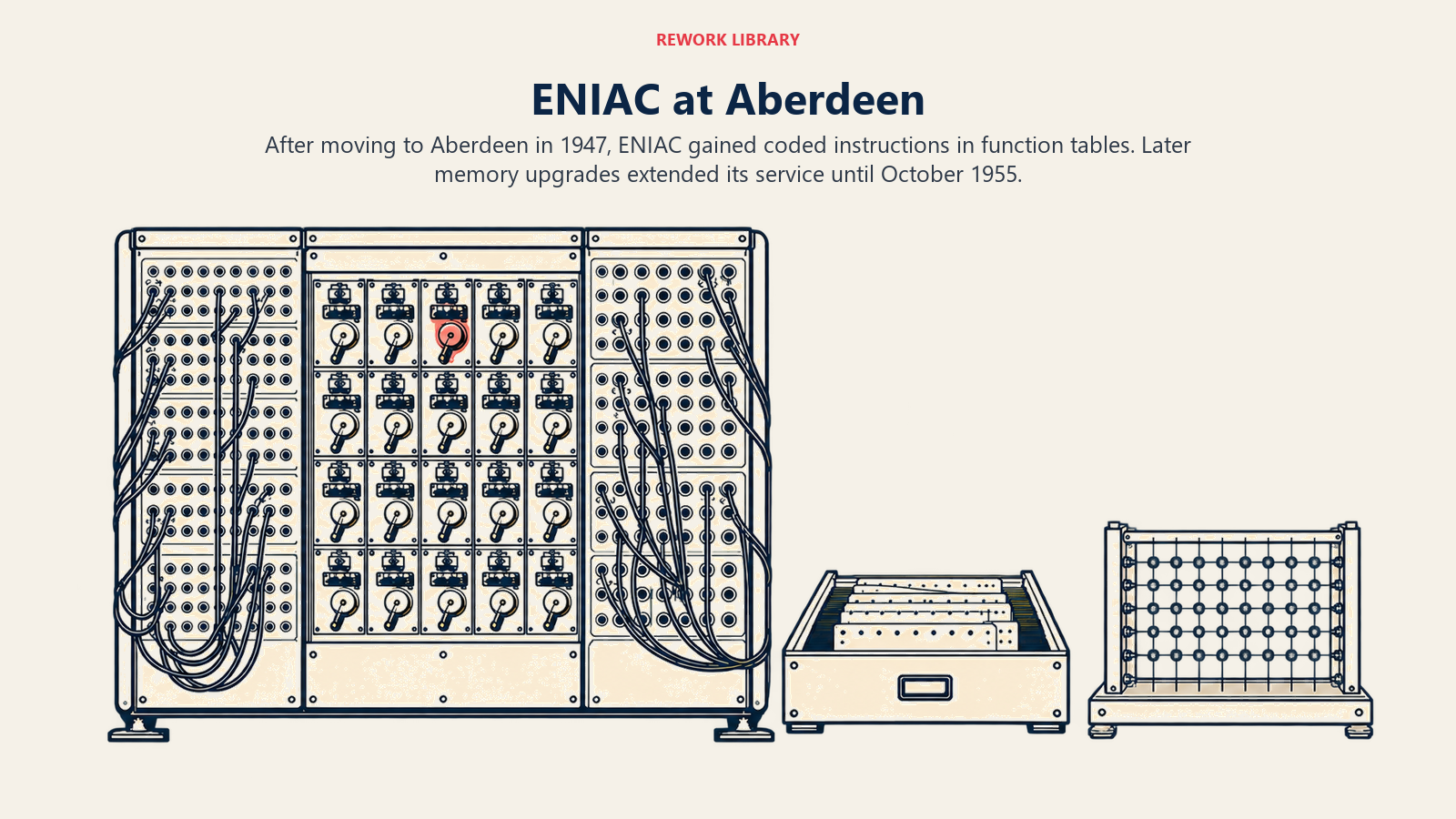
At Aberdeen, ENIAC changed how it was programmed. The Army history says that in early 1948 it was converted to a serial instruction execution machine, with function tables that stored 600 two-digit instructions each. In 1951 a faster-access function table added stored-program capacity. By July 1953 Burroughs had installed a 100-word static magnetic memory.
The workload was wide. Penn lists ballistics, weather prediction, atomic-energy calculations and cosmic-ray studies, and the IEEE milestone page places its military research use at Los Alamos and the Ballistic Research Laboratory. From 1953 the Army history says EDVAC and ORDVAC shared the load. The Army report ends the story at 11:45 PM on 2 October 1955, when power was removed because the machine was obsolete and costly to run. The Army counts 80,223 hours of operation across 1946 to 1955. The Computer History Museum's gallery text says a lightning strike ended the run; the Army record names obsolescence and cost.
The era moved ENIAC from cable-and-switch setup toward coded instructions. Its leftover problem was the cost of keeping an obsolete machine running, and later machines, described in generations of computers, took over the work.
For teams today: a system that is rebuilt every few years to chase a new requirement ends up with a different architecture than it started with. Plan the conversion, because the original design will not survive the workload.
The Legacy Years (1955-present)
A court, a museum and a chip replica
The turning point is the lawsuit. Honeywell sued Sperry Rand, which owned the Eckert-Mauchly patent rights. The Iowa State finding aid dates the complaint to 26 May 1967, the trial from 1 June 1971 to 13 March 1972, and says Honeywell argued Mauchly had taken key ideas from John Atanasoff's computer after visiting him in Ames, Iowa in June 1941. Judge Earl Larson found that Eckert and Mauchly did not themselves first invent the automatic electronic computer and invalidated the ENIAC patent. The Iowa State guide dates the final judgment to April 1973, while Scientific American says the ruling was published on 19 October 1973. Those are different dates for the same decision, so say "1973" if you cannot be exact. A court's finding of patent invalidity is a legal ruling about patent priority, not a verdict on who built the first useful machine.
Recognition came late. The IEEE milestone was dedicated on 1 September 1987, with the plaque at the Moore School. Penn says four of the original 40 panels are on display and that ENIAC was reimplemented on a chip in 1997. For how people later learned to instruct machines like it, see the history of programming languages. A contemporary machine built for a different job is told in Colossus and the code-breaking computers.
For teams today: ownership fights outlive the product. Document who contributed what while the people are still around.
Key People
| Name | Role | Contribution | Year |
|---|---|---|---|
| John Mauchly | Physicist, principal consultant | Wrote the 1942 memo that proposed the machine | 1942 |
| J. Presper Eckert | Chief engineer | Led the engineering; ran tubes below rated power | 1943-1946 |
| John Grist Brainerd | Moore School professor | Project supervisor | 1943-1946 |
| Herman Goldstine | Army lieutenant | Army liaison and supervisor of the Moore School group | 1942-1946 |
| John von Neumann | Mathematician | Author of the First Draft of a Report on the EDVAC | 1945 |
| Kay McNulty, Jean Jennings, Betty Snyder, Marlyn Wescoff, Fran Bilas, Ruth Lichterman | The six programmers | Learned and ran the machine, built the 1946 demonstration | 1945-1946 |
| Earl R. Larson | Federal judge | Invalidated the ENIAC patent | 1973 |
Key Facts
- The Army's first agreement is dated 5 June 1943 and committed $61,700; supplements raised the total to $486,804.22.
- ENIAC had about 18,000 vacuum tubes and weighed 30 tons, according to Penn.
- A calculation that took 12 hours by hand took 30 seconds on ENIAC.
- It was announced on 14 February 1946 and dedicated on 15 February.
- It logged 80,223 hours of operation before power was removed on 2 October 1955.
- Four of the original 40 panels are on display at Penn.
The Pattern Behind the History
The same four moves run through the ENIAC story. We call the sequence the Backlog to Machine Cycle. It's our synthesis of the history, not a research finding.
- A backlog pays for the invention. Firing tables the Army could not finish funded a machine nobody had built.
- The sponsor sets the framing. Mauchly's weather idea became a ballistics proposal.
- The operators do the unrecorded work. Six programmers learned the machine without a manual and were missing from the press.
- The next design is already on paper. EDVAC was in contract before ENIAC was finished.
What It Teaches Teams Today
- Start from a backlog. The Army wanted tables, not a computer.
- Pitch in the buyer's language. The same technology got funded when it was called a ballistics tool.
- Credit operators early. The programmers were excluded from the celebration.
- Expect your first system to be converted. ENIAC was rewired for coded instructions within about two years of Aberdeen.
- Know which date you mean. Contract, dedication, acceptance and restart were different dates.
ENIAC shows how a practical backlog, a persuasive memo and a team willing to learn an unmanualed machine produced something new. Next time you start a project, ask who is waiting on the output and who will actually run it.
