The History of Computers: From Calculators to AI Systems
Turn this article into takeaways for your work.


Each assistant summarizes the article only for you and suggests best practices for your work.
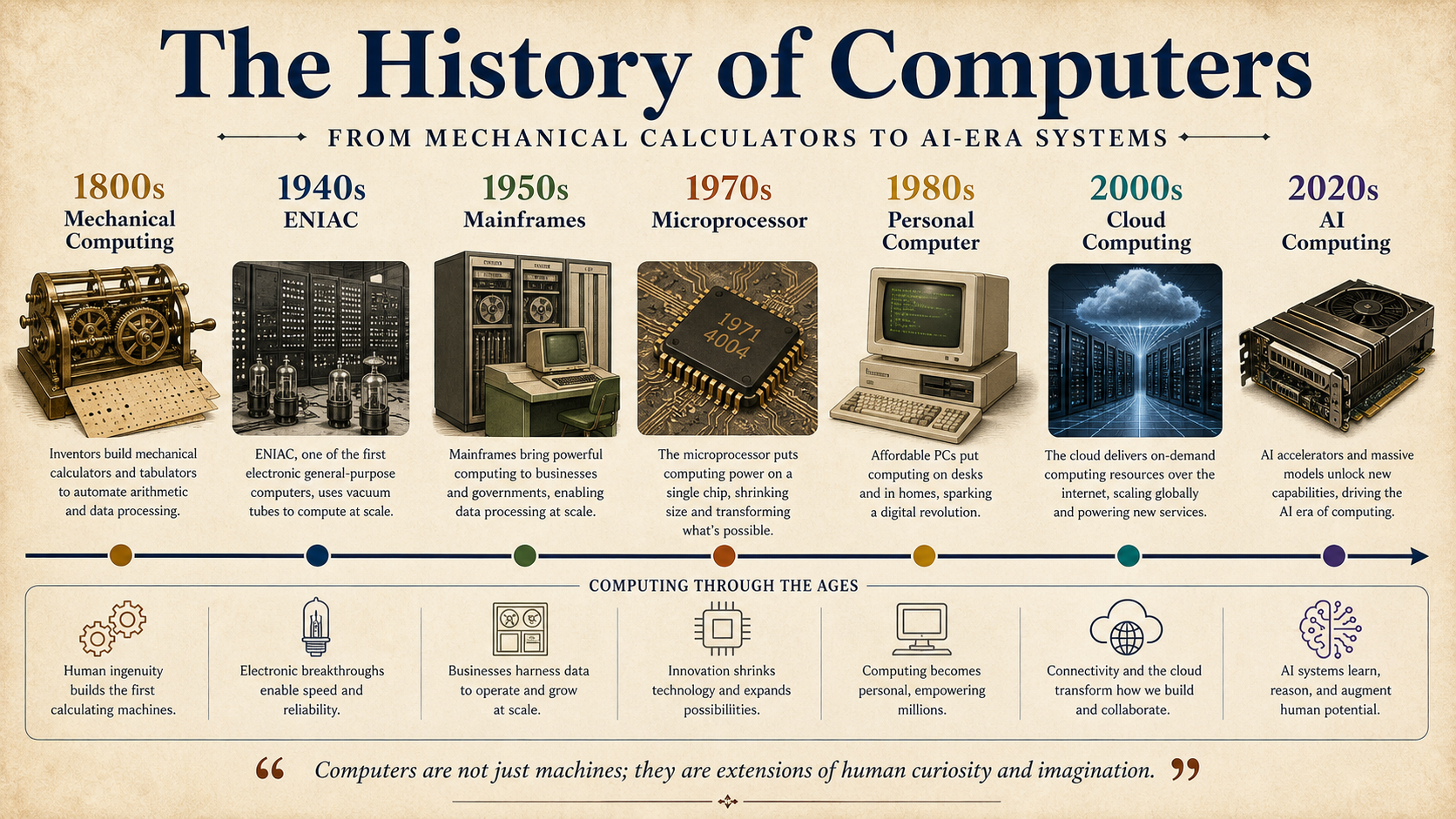
The history of computers is the story of one idea repeating: every generation made computing cheaper, then moved it closer to the person doing the work. Calculation went from clerks to a few giant institutional machines, then to desks, then to pockets, and now to models you instruct in plain language. If you run a team, the pattern matters more than any single invention, because it predicts who gets value from the next wave and who gets left waiting for a specialist.
Quick timeline of computer milestones
| Year/Era | Milestone | Why it mattered |
|---|---|---|
| 1830s-1840s | Babbage designs the Analytical Engine; Lovelace publishes her notes (1843) | The idea of a programmable machine existed a century before one could be built. |
| 1890 | Hollerith punched cards used for the US census | Data processing became an industrial job, not a clerical one. |
| 1944-1946 | Colossus runs at Bletchley Park; ENIAC is unveiled | Electronic speed replaced mechanical speed. |
| 1947-1948 | The transistor is invented; the Manchester "Baby" runs the first stored program | Hardware got reliable and software became changeable. |
| 1951 | UNIVAC I is delivered to the US Census Bureau | Computers began to look like products for organizations. |
| 1959 | Kilby and Noyce develop the integrated circuit | Many components could live on one chip. |
| 1964 | IBM announces System/360 | One compatible family let customers grow without rewriting software. |
| 1971 | Intel's 4004 puts a CPU on a chip | Computing could be embedded in almost anything. |
| 1975-1977 | Altair 8800 and Apple II | Individuals and small businesses could own a computer. |
| 1979 | VisiCalc ships for the Apple II | The first reason for a business to buy a PC. |
| 1981-1984 | IBM PC and Apple Macintosh | A standard platform, then a graphical interface. |
| 2006 | Amazon launches S3, the first AWS service | Infrastructure became something you rent by the month. |
| 2007 | Apple announces the iPhone | A computer in every pocket, with apps. |
| 2012 | AlexNet wins on GPUs | Graphics chips became the engine of modern AI. |
| 2022-2024 | ChatGPT arrives; Microsoft launches Copilot+ PCs | AI became an interface, and PCs started shipping with AI silicon. |
Key Facts: Computer History
- The 1890 US census ran on about 60 million punched cards, and an operator could process about 7,000 a day, at least ten times faster than manual methods, per the Computer History Museum.
- ENIAC used almost 18,000 vacuum tubes, and one failed roughly every day or two, according to the Computer History Museum.
- IBM spent $5 billion over four years on System/360, which IBM's own history calls a bet-the-business move.
- Intel's 4004 packed 2,300 transistors into a 16-pin package in 1971, per the Computer History Museum.
- The first IBM PC cost $1,565 when it was unveiled on August 12, 1981, according to IBM.
- Gordon Moore's 1965 paper predicted transistor counts would double every year for a decade. In 1975 he revised that to every two years, per Intel.
Counting machines and punched cards (1830s-1930s)
The first chapter of computer history is about removing calculation labor. Charles Babbage designed automatic computing engines in the 1800s and, as the Computer History Museum puts it, "invented computers but failed to build them." The museum finished a complete Difference Engine No. 2 in London in 2002, 153 years after it was designed. Ada Lovelace's 1843 notes on the Analytical Engine described how such a machine could follow instructions rather than only add numbers.
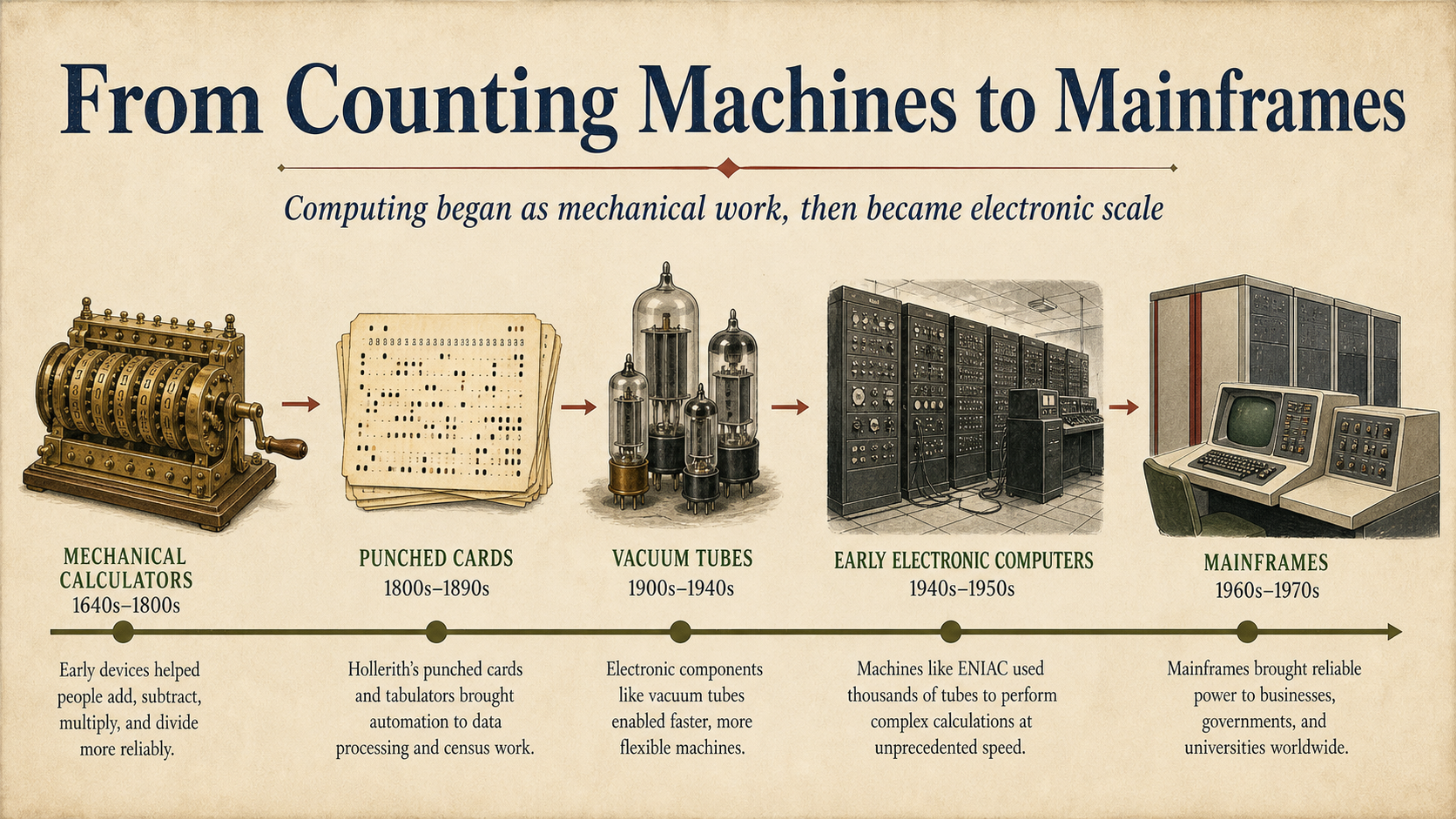
The first place this became commercial was data. The US census had a processing crisis, and the government held a contest to solve it. Herman Hollerith won by recording data on punched cards that a tabulating machine could read, and the Computer History Museum notes that the Census Bureau was still using the same basic system about seventy years later. Hollerith founded the Tabulating Machine Company in 1895, and it later merged into the company that became IBM.
The new problem was volume. Once you can process a card, you want a million cards, and the work moves from thinking to feeding the machine. Anyone who has spent a Friday keying records into a system knows the descendant of that job, and it's the same work that AI data entry automation now handles.
What this means for teams today:
- Representing work as structured data and repeatable instructions is the oldest idea in computing. It's still the first step in any automation project.
- If a process depends on people re-keying information between systems, you're running a punched-card workflow with newer furniture.
War, electronics and the first stored programs (1940s)
War money paid for electronic speed. The first Colossus became operational at Bletchley Park in 1944 to break German Lorenz ciphers, according to the Computer History Museum timeline. ENIAC followed, proposed by physicist John Mauchly in 1942, built between 1943 and 1945 with US Army funding to calculate ballistics tables, and publicized in a front-page New York Times story on February 15, 1946. The Computer History Museum records that it used almost 18,000 vacuum tubes, that one failed about every day or two, and that maintenance crews eventually learned to fix a fault in about 15 minutes.
Two changes in the late 1940s mattered as much as speed. In December 1947, John Bardeen and Walter Brattain made the first working transistor at Bell Labs, which the Computer History Museum notes grew out of research into replacements for unreliable vacuum tubes. And on June 21, 1948, the Manchester "Baby" ran the first program on a digital, electronic, stored-program computer, with Cambridge's EDSAC following in 1949 as the first practical stored-program machine to provide a regular computing service.
Stored programs are the quiet breakthrough. Once instructions live in memory like data, you can change what a machine does without rewiring it. That's why software exists as a business at all.
The problem these machines created was fragility. ENIAC was a room-sized system tended by specialists, and every new job meant rearranging how the machine was set up. Reliability and reusability became the next race.
What this means for teams today:
- Flexibility beats raw speed. A system you can reconfigure without an engineer gets used more, which is the argument behind every no-code tool.
- Budget for the people who keep the machine running, not just the machine.
Mainframes: computing as an institutional utility (1951-1970s)
In March 1951 the US Census Bureau received its first UNIVAC I, which the Computer History Museum calls the first commercial computer to attract widespread public attention. It did about 1,905 operations per second and stored data on magnetic tape. Over the next two decades the mainframe became the default tool of large organizations. The Museum's mainframe overview lists use cases that read like a corporate IT roadmap: business data storage and fast access to large datasets, scientific computing, and railway reservations. Systems like SAGE, which the Museum's timeline says connected 23 computer sites by 1958, and SABRE, the American Airlines and IBM reservation system that came online in 1964, showed computers could run live operations rather than overnight reports.
The defining product was IBM's System/360, launched on April 7, 1964. IBM describes it as one strictly compatible family under a single architecture, so software written for one machine could run on any other in the line. Customers could add capacity without rewriting programs, and the company bet $5 billion on the idea. That compatibility promise is still how enterprise software sells itself.
Mainframes also set the organizational pattern. Scarce, expensive compute got centralized. Teams submitted jobs, waited for output, and designed their processes around the queue. The new problem was distance: the people with the questions were far from the people with the machine, and a specialist priesthood sat between them.
What this means for teams today:
- Centralization is a response to scarcity, and it returns whenever coordination or security matters. A shared data strategy is the modern version of the mainframe's single source of truth.
- Enterprise suites still carry this DNA. If you're weighing a big shared platform, what ERP is and how it works is the clearest description of the trade-off between standardization and flexibility.
- Batch thinking survives in approval chains and weekly reports. Workflow automation is how teams finally retire it.
Chips, minicomputers and Moore's Law (1959-1970s)
Mainframes got big because components were large and expensive. The integrated circuit changed that. The Computer History Museum credits Jack Kilby of Texas Instruments and Robert Noyce of Fairchild Semiconductor, working separately, with developing it in 1959, and says it let computing power "increase dramatically." Digital Equipment Corporation's PDP-8, which the Museum's timeline calls the first commercially successful minicomputer, gave labs and factories a computer of their own in the mid-1960s, at a fraction of mainframe scale.
The microprocessor finished the job. In 1971 Ted Hoff and Stanley Mazor conceived Intel's 4004, and Federico Faggin, assisted by Masatoshi Shima, squeezed its 2,300 transistors into a 16-pin package, per the Computer History Museum. Its first customer application was a calculator. A computer had become a component.
Gordon Moore's observation gave the industry a planning rhythm. In 1965 he predicted transistor counts would double every year for ten years, and in 1975 he revised the pace to every two years, according to Intel. Whether or not you call it a law, executives planned around it: wait a cycle and the same budget buys more.
The problem this created was sprawl. Once a CPU is cheap enough to embed, computing leaves the data center and lands in products, tools and machines nobody in IT is tracking.
What this means for teams today:
- When a capability becomes cheap enough to embed, it spreads into places you didn't plan for. That's true of microprocessors in 1971 and of AI features in 2026.
- Manufacturers felt this first, and you can see it in robotics and automation and digital twin technology.
Personal computers and the spreadsheet (1975-1990)
Personal computing began as a hobby. In 1975 the Altair 8800 kit appeared in Popular Electronics, and its maker, MITS, helped popularize the term "personal computer," according to the Computer History Museum timeline. Apple's Apple II followed in 1977 as a ready-to-use machine for consumers and sold in the millions over nearly two decades.
What turned a hobby into a business purchase was software. VisiCalc, released in 1979, is described by the Computer History Museum as "the 'killer app' that spurred Apple II sales." Dan Bricklin built the first prototype in spring 1978, and it was followed by spreadsheets from Lotus, Microsoft, Borland and others. A finance manager could finally model a budget without waiting for a mainframe slot or a programmer.
Then came the standard. IBM unveiled its Personal Computer on August 12, 1981 at a price of $1,565, and the IBM history page notes that IBM published technical references so other companies could build software and peripherals. The machine used an Intel 8088 chip and an operating system from Microsoft that later became known as MS-DOS. That openness made the PC a de facto industry standard, and other firms reverse-engineered its boot code to make "IBM compatible" machines. In 1984 Apple launched the Macintosh, which the Museum calls the first successful mouse-driven computer with a graphical user interface.
The new problem was fragmentation. Every department built its own spreadsheet, kept its own files and trusted its own numbers. Many teams still live there, and the reasons they leave are laid out in escaping spreadsheets and CRM vs spreadsheet.
What this means for teams today:
- Tools win when the person closest to the work can use them without a specialist. That's the real reason the PC beat the mainframe terminal.
- Standards beat features. The IBM PC's open design created an ecosystem that no single vendor could match.
- Rolling out new software is a people problem first. Employee technology adoption covers what actually moves behavior.
Networked PCs and enterprise software (1990s)
By the 1990s the question was no longer "can everyone have a computer?" but "can their computers talk to each other?" Offices wired their PCs together. Email, shared drives and databases turned individual machines into a company system, and the Internet connected companies to each other. The history of the Internet tells that half of the story.
Business software changed shape to match. Instead of one program on one desk, companies adopted systems that held a single record for customers, orders and inventory. This is the period when ERP and CRM moved from enterprise ambitions to standard practice. The old tension returned in new form: centralized data was powerful, but only if everyone put the same information in the same place. It's why modern teams still have to define CRM as a single source of truth and keep it clean with CRM data hygiene.
The new problem was integration. Every system worked in isolation, and moving data between them became a full-time job, which set up the demand for cloud software and APIs in the next era.
What this means for teams today:
- A networked tool is only as good as the shared record behind it. Decide who owns each field before you roll out the platform.
- Treat data quality as an operating routine, not a cleanup project.
Cloud and mobile: computing becomes a service (2006-2015)
On March 14, 2006, AWS launched publicly with S3 as its only service, according to Amazon. That date matters because infrastructure stopped being something you bought and became something you rented by usage. A startup could run on the same class of machines as a bank without ordering a single server.
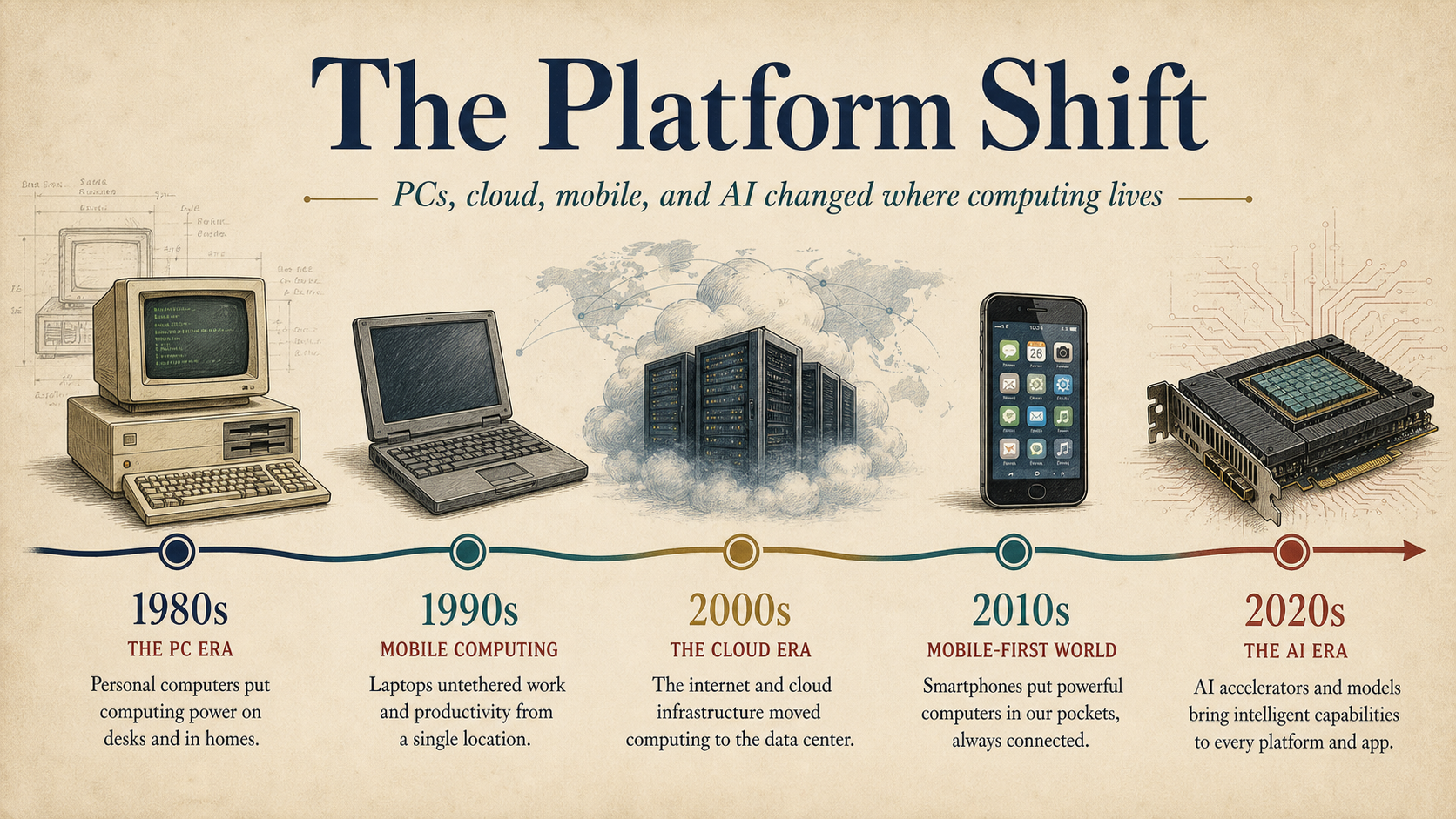
Mobile arrived next. On January 9, 2007 Apple announced the iPhone, which it described as "a revolutionary mobile phone, a widescreen iPod with touch controls, and a breakthrough Internet communications device" in one handheld, per Apple's announcement. The Museum's timeline notes it supported downloadable apps, which turned the phone into a platform. Field sales, delivery, inspection and support work, all the jobs that never sat at a desk, finally had software.
The combination changed buying habits. Teams stopped waiting for IT to provision hardware and started subscribing to SaaS tools with a credit card. That brought speed and a new headache: dozens of apps, overlapping licenses and scattered data. The economics are covered in the SaaS sprawl problem and TCO modeling for SaaS, and the architectural pattern is in the SaaS tech stack.
What this means for teams today:
- Renting capacity moves cost from capital spending to monthly operating spend. Your finance and procurement process has to move with it.
- Mobile is the interface for anyone who doesn't sit at a desk, so design workflows for the phone first for field teams.
GPUs and AI-era systems (2012-today)
The latest chapter is about a different workload. In 2012, Alex Krizhevsky and Ilya Sutskever, graduate students at the University of Toronto working with Geoffrey Hinton, trained AlexNet on Nvidia GPUs using CUDA code, per IEEE Spectrum. It ran on a machine with two Nvidia cards, and the network was trained on ImageNet, a dataset completed in 2009 by Fei-Fei Li's team. The result showed neural networks were practical once you had enough data and parallel hardware. The Computer History Museum and Google later released the original source code as open source.
Since then the demand has reshaped hardware. Cloud providers build data centers around accelerators, and ChatGPT's arrival in late 2022 put a conversational interface on top of large models. On May 20, 2024, Microsoft introduced Copilot+ PCs, which it describes in its announcement as "a new category of Windows PCs designed for AI," pairing a neural processing unit with the CPU and GPU and claiming 40+ TOPS (trillion operations per second). Intelligence is starting to move back from the data center toward the device, in the same way processing once moved from the mainframe to the desk.
That history connects directly to the history of artificial intelligence. AI didn't replace computing history. It sits on top of faster chips, cheaper memory, bigger storage and global networks, which is the argument in the history of AI. For readers who want the building blocks, start with what an AI chip is, what an AI data center is and on-device AI.
The new problem is cost and control. Running models consumes compute, energy and budget, and the question of where intelligence should live (a central platform, inside business applications, on employee devices or inside automated workflows) is a real architecture decision. How AI agents work is a good starting point for the workflow end of that choice.
What this means for teams today:
- Ask where each AI task should run: in the cloud for scale, on the device for privacy and speed, or inside an application for context.
- The skills gap repeats the PC era. The people closest to the work will get the most from AI if they're trained to use it, which is the subject of digital literacy and AI-human collaboration.
The Proximity Pattern: four moves that repeat in every era
Looking across 190 years, the same four moves show up every time a new kind of computing arrives. We call this the Proximity Pattern. It's our own synthesis of the history above, not a published study.
- Centralize. When a capability is scarce and expensive, organizations pool it. The mainframe, and today the shared AI platform, are examples.
- Shrink. Hardware gets cheaper and smaller (the transistor, the chip, the phone), so the capability can move closer to the work.
- Standardize. A shared standard creates an ecosystem: System/360 compatibility, the IBM PC's open design, cloud APIs. The standard decides who builds on top of whom.
- Abstract. A simpler interface hides the machine: the spreadsheet, the graphical interface, the touchscreen, the prompt. Adoption jumps when this happens.
Then the cycle starts again, because the new level of access brings its own sprawl and a new round of centralizing. If you're planning technology for a team, ask which move you're in. A tool still in the Centralize phase needs specialists. One that has reached Abstract can be handed to everyone, with guardrails.
Where to go next
Related histories
- The History of the Internet: the networking story that turned PCs into a global system.
- The History of AI: how today's models grew from decades of research.
- The History of Productivity: how each wave of tools changed how we measure output.
- The History of Management: how organizations adapted to the machines.
- The History of Project Management: planning methods that grew alongside computing.
Business systems and data
- What is ERP?: the enterprise descendant of the mainframe.
- Digital transformation strategy: how to plan a technology shift.
- Business intelligence: what organizations do with all that data.
- Robotic process automation: software robots for repetitive work.
AI and the next wave
- Artificial intelligence: a plain-language definition.
- What is business AI?: the foundation of the ACE framework.
- What is an AI agent?: software that acts, not just answers.
- Evolution of business AI: how companies moved from analytics to agents.
Frequently Asked Questions about The History of Computers
What was the first computer?
It depends on how you define "computer." Babbage's engines were the first designs for programmable machines, ENIAC was the first large-scale electronic computer, and the Manchester Baby ran the first program on an electronic stored-program machine in 1948. Computer history moved through several firsts rather than one invention.
Why were mainframes important to business?
Mainframes made large-scale data processing practical for banks, governments, airlines and manufacturers. IBM's System/360, announced in 1964, added compatibility across a whole product family so customers could grow without rewriting software.
How did personal computers change work?
Personal computers moved computing from specialists to everyday knowledge workers. The spreadsheet, starting with VisiCalc in 1979, was the first reason many businesses bought one, and the IBM PC's open design in 1981 created the standard everyone built on.
What is Moore's Law?
Moore's Law is Gordon Moore's observation that transistor counts on chips keep doubling. He predicted a doubling every year in 1965 and revised that to every two years in 1975. Industry planned product cycles around it for decades.
How does cloud computing fit into computer history?
Cloud computing is the move from owning machines to renting capacity. AWS launched publicly in March 2006 with S3, and combined with smartphones from 2007, it let teams subscribe to software instead of installing and maintaining it.
How does AI connect to the history of computers?
AI is the newest workload driving hardware design. Modern AI depends on GPUs, which powered the 2012 AlexNet result, plus cloud data centers and, more recently, neural processing units built into PCs.
Computer history offers a simple rule for the next decision your team makes about technology: the winners are rarely the fastest machines. They're the ones that put capability within reach of the people doing the work, on a standard others can build on. Start there when you evaluate the next tool, and you'll usually pick well.

Senior Operations & Growth Strategist
On this page
- Quick timeline of computer milestones
- Counting machines and punched cards (1830s-1930s)
- War, electronics and the first stored programs (1940s)
- Mainframes: computing as an institutional utility (1951-1970s)
- Chips, minicomputers and Moore's Law (1959-1970s)
- Personal computers and the spreadsheet (1975-1990)
- Networked PCs and enterprise software (1990s)
- Cloud and mobile: computing becomes a service (2006-2015)
- GPUs and AI-era systems (2012-today)
- The Proximity Pattern: four moves that repeat in every era
- Where to go next