Awesome Strategic Planning
Turn this article into takeaways for your work.


Each assistant summarizes the article only for you and suggests best practices for your work.
A curated list of the best resources about strategic planning for CEOs, senior executives, and directors responsible for setting company direction.
Inspired by awesome lists. Maintained by Rework.
Most strategic plans are budgets dressed up as strategy. Richard Rumelt calls it "bad strategy", a collection of goals with no diagnosis of the real challenge, no guiding policy, no coherent set of actions. The resources below will help you build a real strategy: one that makes hard choices, concentrates resources, and creates sustainable advantage.
Contents
- Articles
- Books
- Videos & Talks
- Tools & Software
- Templates & Frameworks
- Case Studies & Real-World Examples
- Communities & Newsletters
- Rework Resources
Articles
These readings approach the same strategic challenge from different angles: diagnosis, positioning, scenarios, customer jobs, fit, and market creation.
- Strategy's Strategist: An Interview with Richard Rumelt by McKinsey Quarterly - Rumelt dismantles conventional strategic planning and shows what real strategy looks like.
- What Is Strategy? by Michael Porter, Harvard Business Review - The foundational article that defines strategy as the creation of a unique and valuable position. (classic)
- The Perils of Bad Strategy by McKinsey Quarterly - Rumelt's diagnosis of the four hallmarks of bad strategy most companies fall into.
- Setting Strategy in the New Era by McKinsey - How to build strategic flexibility into an annual planning process.
- Why Strategy Execution Unravels, and What to Do About It by Harvard Business Review - Research on the five myths that cause execution to fail after a plan is set.
- Scenario Planning: A Tool for Strategic Thinking by MIT Sloan Management Review - A practical guide to building strategic scenarios under uncertainty.
- The Four Fits: Market, Product, Channel, and Model by Brian Balfour - A modern framework for validating strategic fit across growth dimensions.
- Wardley Mapping for Strategic Planning by Simon Wardley - A visual method for mapping the competitive landscape and making strategic decisions.
- Jobs to Be Done: A Framework for Strategy by Clayton Christensen, Harvard Business Review - Understanding customer needs as the foundation of sound strategy.
- Blue Ocean Strategy Explained by Blue Ocean Strategy Institute - Creating uncontested market space instead of fighting over existing demand.
Books
- Good Strategy Bad Strategy by Richard Rumelt - The clearest modern book on what real strategy is and why most companies don't have one.
- Playing to Win by Roger Martin & A.G. Lafley - A practical five-question framework for making strategy real and actionable.
- Competitive Strategy by Michael Porter - The foundational text on industry analysis, competitive positioning, and the Five Forces. (classic)
- Blue Ocean Strategy by W. Chan Kim & Renée Mauborgne - How to create new market space instead of competing in existing red oceans.
Videos & Talks
- Michael Porter on the Five Competitive Forces - Porter explains his iconic industry analysis framework at Harvard Business School.
- Roger Martin on Strategy - Martin walks through the "Playing to Win" framework and why most plans aren't strategy.
- Richard Rumelt on Good Strategy Bad Strategy - A lecture from Rumelt on the kernel of good strategy and what separates it from bad.
- Blue Ocean Strategy Explained by Chan Kim - A clear visual walkthrough of how to find and create uncontested market space.
- Wardley Mapping Tutorial by Simon Wardley - How to map your value chain to make better strategic decisions.
Tools & Software
- Cascade Strategy - Strategy execution software that connects goals, projects, and KPIs in one platform.
- Quantive - AI-powered strategy and OKR platform that links planning to execution and performance data.
- Miro - Collaborative whiteboard for running strategy workshops, mapping journeys, and building frameworks.
- Lucidchart - Diagramming tool for building strategy maps, org charts, and process flows.
- Notion - Flexible workspace for housing strategy documents, roadmaps, and team wikis.
- Aha! - Strategic roadmapping tool that connects vision and strategy to product plans.
- OnStrategy - Purpose-built strategic planning software with execution tracking and reporting.
- Strategyzer - Tools for business model and value proposition design, tightly linked to strategic planning.
Templates & Frameworks
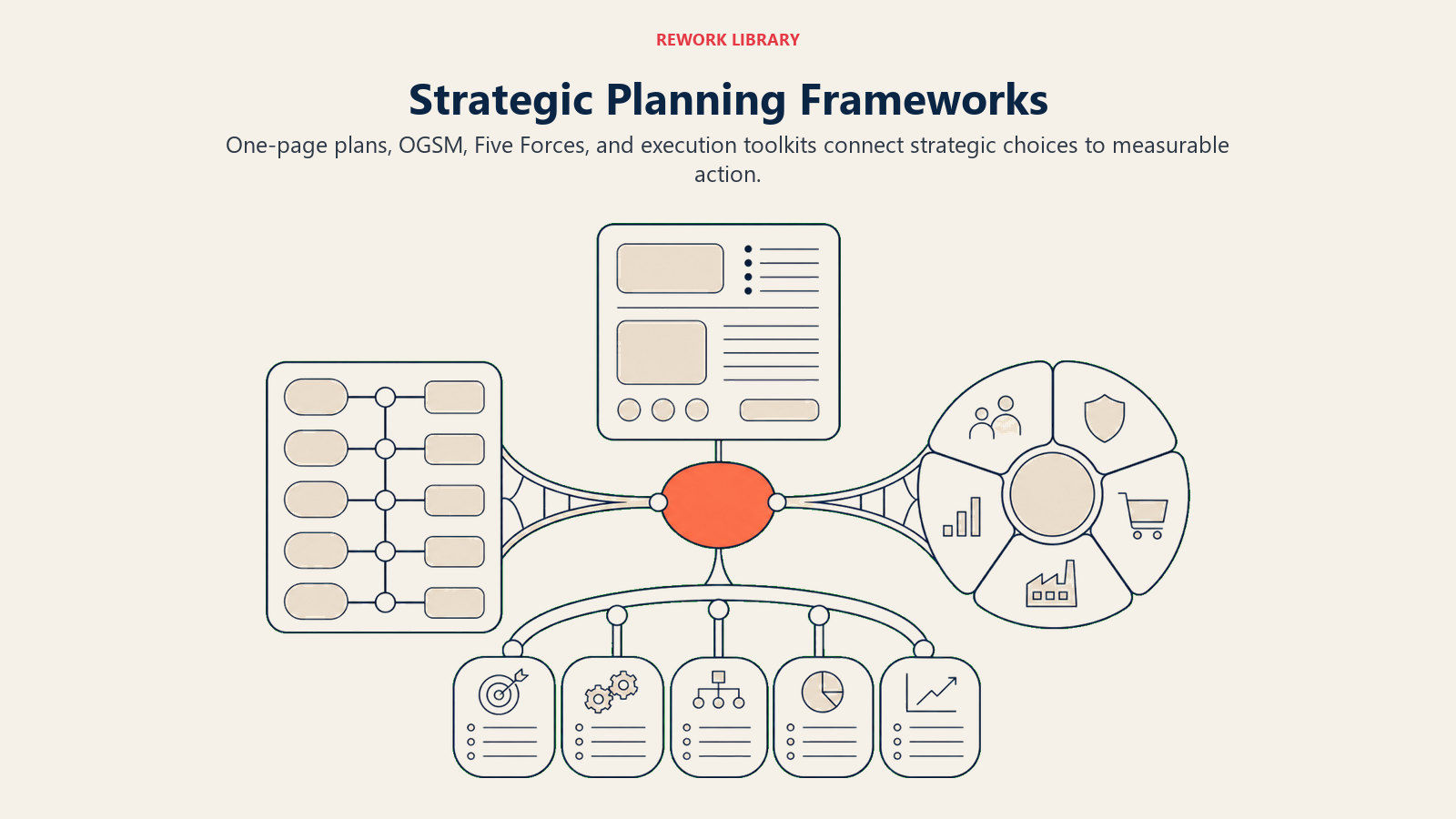
The practical toolkit moves from a concise plan and industry diagnosis to linked measures and an executable planning cycle.
- Porter's Five Forces Template by Miro - A ready-to-use collaborative canvas for running a Five Forces industry analysis.
- Strategic Planning Toolkit by McKinsey - CEO-level guidance on making strategy actionable across the organization.
- Strategic Planning Process by Rework - A step-by-step guide to running an annual strategic planning cycle, from pre-read to execution.
Case Studies & Real-World Examples
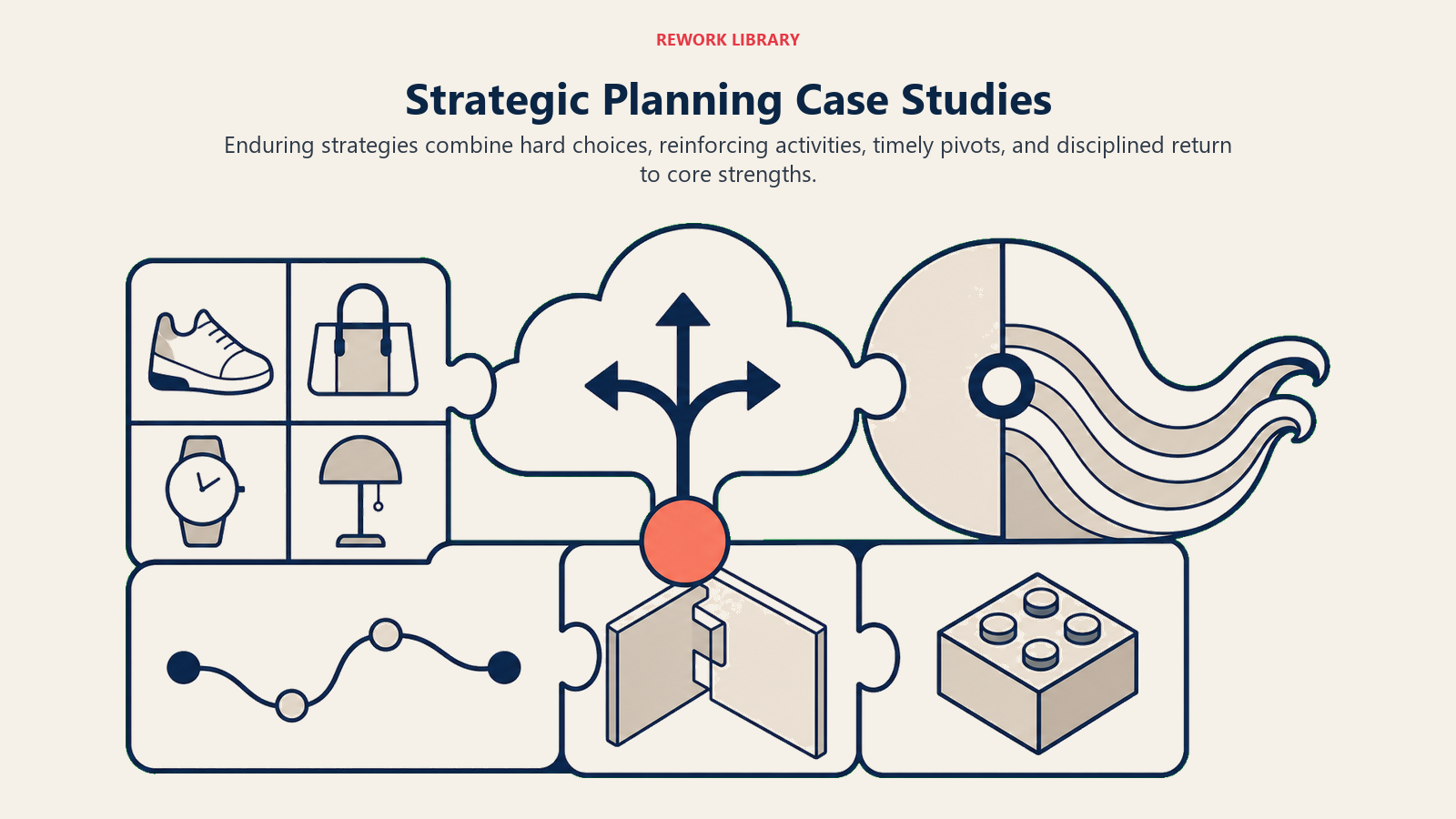
Across these companies, strategy appears as a coherent set of hard choices, reinforcing activities, timely pivots, and disciplined focus.
- Apple (Steve Jobs's return, 1997) - When Jobs returned to Apple in 1997, the company had 90 days of cash left and was selling 40 different products. Jobs's strategic plan was brutally simple: kill everything except four products arranged in a two-by-two grid (consumer/pro, desktop/portable). That ruthless strategic focus, a textbook application of Rumelt's "kernel of strategy", turned Apple from a near-bankrupt company into the world's first trillion-dollar corporation. Source
- Netflix (2011 pivot) - Netflix's decision to split DVD and streaming into two separate businesses (briefly rebranded as Qwikster) was widely mocked as a strategic failure. But the underlying strategic logic, that DVD and streaming required completely different cost structures, content strategies, and competitive responses, was correct. Netflix's willingness to make an uncomfortable strategic choice, even at the cost of short-term PR damage, enabled them to dominate global streaming. Source
- Southwest Airlines - Southwest's strategic plan has been the same for over 50 years: low cost, no frills, point-to-point routes, one aircraft type. Michael Porter used Southwest as his primary example of what strategy actually is, a unique and valuable position maintained through a coherent, mutually reinforcing set of activities. While competitors have cycled through dozens of strategy shifts, Southwest's consistency generated decades of uninterrupted profitability in one of the world's most turbulent industries. Source
- IKEA - IKEA's strategy is unchanged since Ingvar Kamprad wrote his 1976 manifesto: "A Furniture Dealer's Testament." The flat-pack model, self-service stores, and focus on working families with limited income are strategic choices that reinforce each other completely. IKEA's refusal to deviate from this strategy, declining to add delivery and assembly services for decades, is a case study in disciplined strategic focus generating $44 billion in annual revenue across 63 countries. Source
Communities & Newsletters
- Strategy+Business - PwC's publication on corporate strategy, leadership, and management thinking.
- Strategic Management Society - Academic and practitioner community advancing the field of strategic management.
- Roger Martin's Substack - Regular essays from the co-author of Playing to Win on strategy, design, and leadership.
Rework Resources
Explore more strategic planning content on the Rework blog:
- Mission vs Vision Statement - Building the strategic foundation before writing a single goal.
- Growth Strategy Frameworks - Connecting your strategic plan to the right growth model for your stage.
Contributing
Know a great strategic planning resource that should be on this list? Let us know.