Awesome Business Automation
Turn this article into takeaways for your work.


Each assistant summarizes the article only for you and suggests best practices for your work.
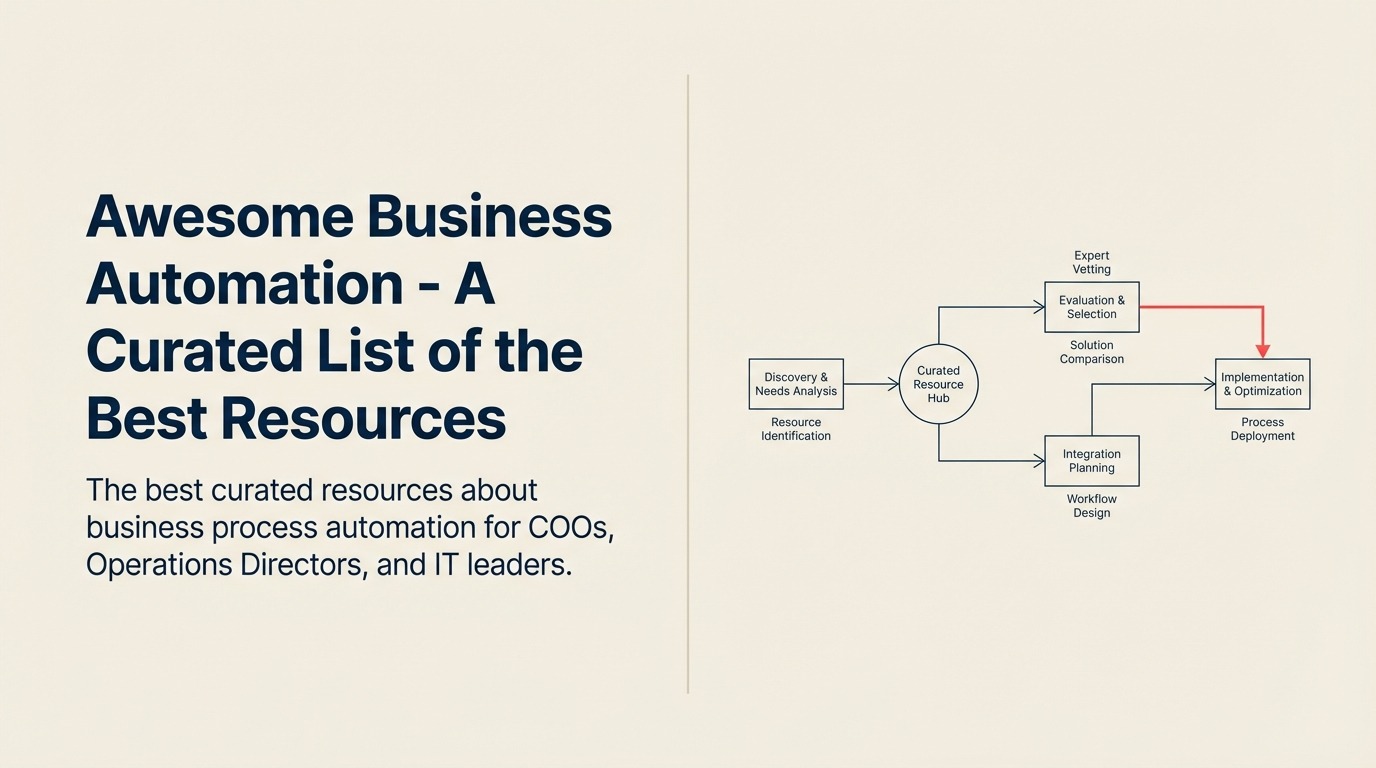
A curated list of the best resources about business process automation, RPA, workflow automation, and AI-powered automation for operations leaders and business executives.
Inspired by awesome lists. Maintained by Rework.
Contents
- Articles
- Books
- Videos & Talks
- Tools & Software
- Templates & Frameworks
- Case Studies & Real-World Examples
- Communities & Newsletters
- Rework Resources
Articles
The automation landscape shifted significantly in 2024-2025. No-code tools now handle workflows that required developers two years ago, while AI agents are starting to tackle knowledge work that neither RPA nor traditional automation could touch. These resources map the terrain.
- The Best Business Automation Software by Zapier - A regularly updated guide to automation tools organized by use case and business function.
- Workflow Automation and AI: Zapier vs. Make vs. n8n - A technical comparison of the three leading workflow automation platforms for different team types.
- n8n vs Zapier for Hyperautomation - A cost and capability comparison for teams evaluating hyperautomation platforms in 2026.
- Gartner RPA Predictions 2025: Key Automation Trends - What Gartner says is happening in RPA: AI convergence, new categories, and vendor consolidation.
- iPaaS Comparison 2025: The 5 Best Tools - A practitioner's comparison of Integration Platform as a Service tools for enterprise automation.
- Mastering Automation Tools: A Business Student's Guide - A clear primer on Make, Zapier, n8n, and where each fits in the automation stack.
- Automating Workflows with AI Agents in n8n - How AI agents extend no-code automation into decision-making and knowledge work.
- McKinsey: A Smarter Way to Automate - The McKinsey framework for identifying high-ROI automation opportunities before selecting tools.
- Gartner Identifies Business Orchestration and Automation Technologies (BOAT) - Gartner's October 2025 announcement of BOAT as the convergence of iPaaS, RPA, and workflow automation.
- 10 Best Automation Software Tools for 2025 - An opinionated ranking of business automation tools across different use cases and company sizes.
- Top 8 Zapier Alternatives for AI Automation - Honest evaluation of Zapier alternatives for teams with specific scale or cost constraints.
Books
- Automate Your Busywork by Aytekin Tank - The Jotform founder's practical guide to automating repetitive work using no-code tools available today.
- The AI-First Company by Ash Fontana - How to build an organization where AI and automation are core to the business model, not an add-on.
- The Age of Surveillance Capitalism by Shoshana Zuboff - A critical framework for understanding automation's broader economic and ethical implications.
- No Code Revolution by Kieran Gilmurray - How no-code tools are reshaping who builds software and what operations teams can accomplish without IT.
- Human Compatible by Stuart Russell - An AI pioneer's thinking on designing automated systems that remain under human oversight and control.
Videos & Talks
- Zapier Automation Tutorials - Zapier's official YouTube channel with step-by-step tutorials for automating common business workflows.
- UiPath: Introduction to RPA - A clear explainer on robotic process automation, when to use it, and what problems it actually solves.
- Make (Integromat) Tutorial for Beginners - A walkthrough of building your first multi-step automation in Make without code.
- McKinsey: The Future of Work and Automation - McKinsey researchers on which job categories are most exposed to automation and what that means for operations teams.
- n8n: Building AI-Powered Workflows - A technical walkthrough of connecting LLMs to business workflows using n8n's open-source platform.
Tools & Software
This section distinguishes between no-code automation tools (business users can operate independently) and enterprise RPA platforms (typically require IT involvement for deployment and governance).
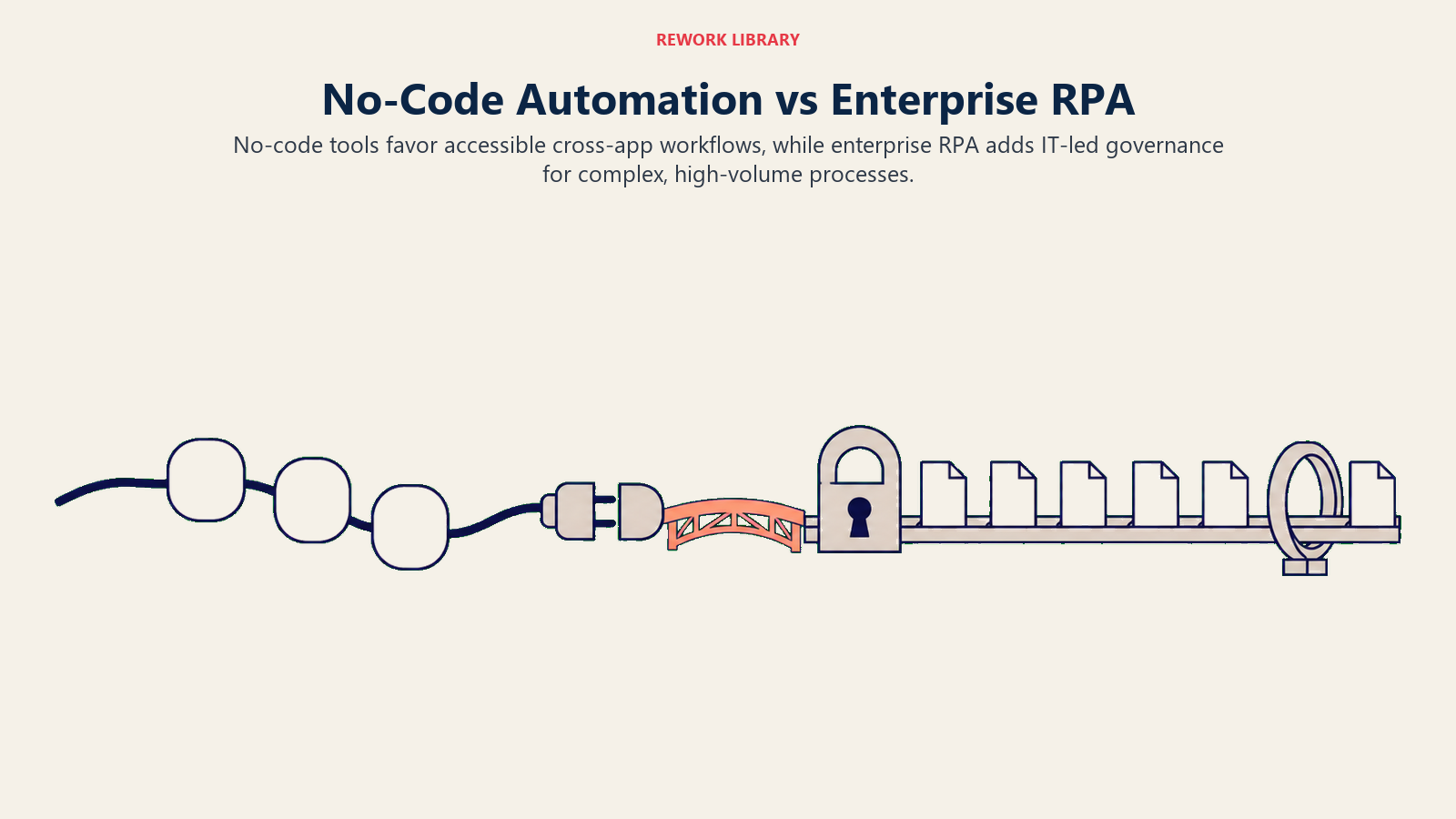
No-Code / Low-Code Automation
- Zapier - The most accessible workflow automation tool, connecting 7,000+ apps with a visual trigger-action builder.
- Make (formerly Integromat) - A more powerful visual automation platform with complex logic, data transformation, and lower per-task cost than Zapier.
- n8n - Open-source workflow automation that can be self-hosted, with strong AI agent and API integration capabilities.
- Bardeen.ai - Browser-based automation for repetitive web tasks, research, and data entry without writing code.
- Retool - Low-code platform for building internal tools and dashboards connected to databases and APIs.
Enterprise RPA and Orchestration
- UiPath - Seven-time Gartner Magic Quadrant Leader in RPA, with AI-powered robots for complex enterprise automation.
- Microsoft Power Automate - Microsoft's automation platform with deep Office 365 integration and a large library of enterprise connectors.
- Workato - Six-time Gartner iPaaS Magic Quadrant Leader for enterprise-grade integration and automation workflows.
Templates & Frameworks
Use these frameworks to test whether a process is stable, repetitive, measurable, and governable enough to automate before comparing vendors.
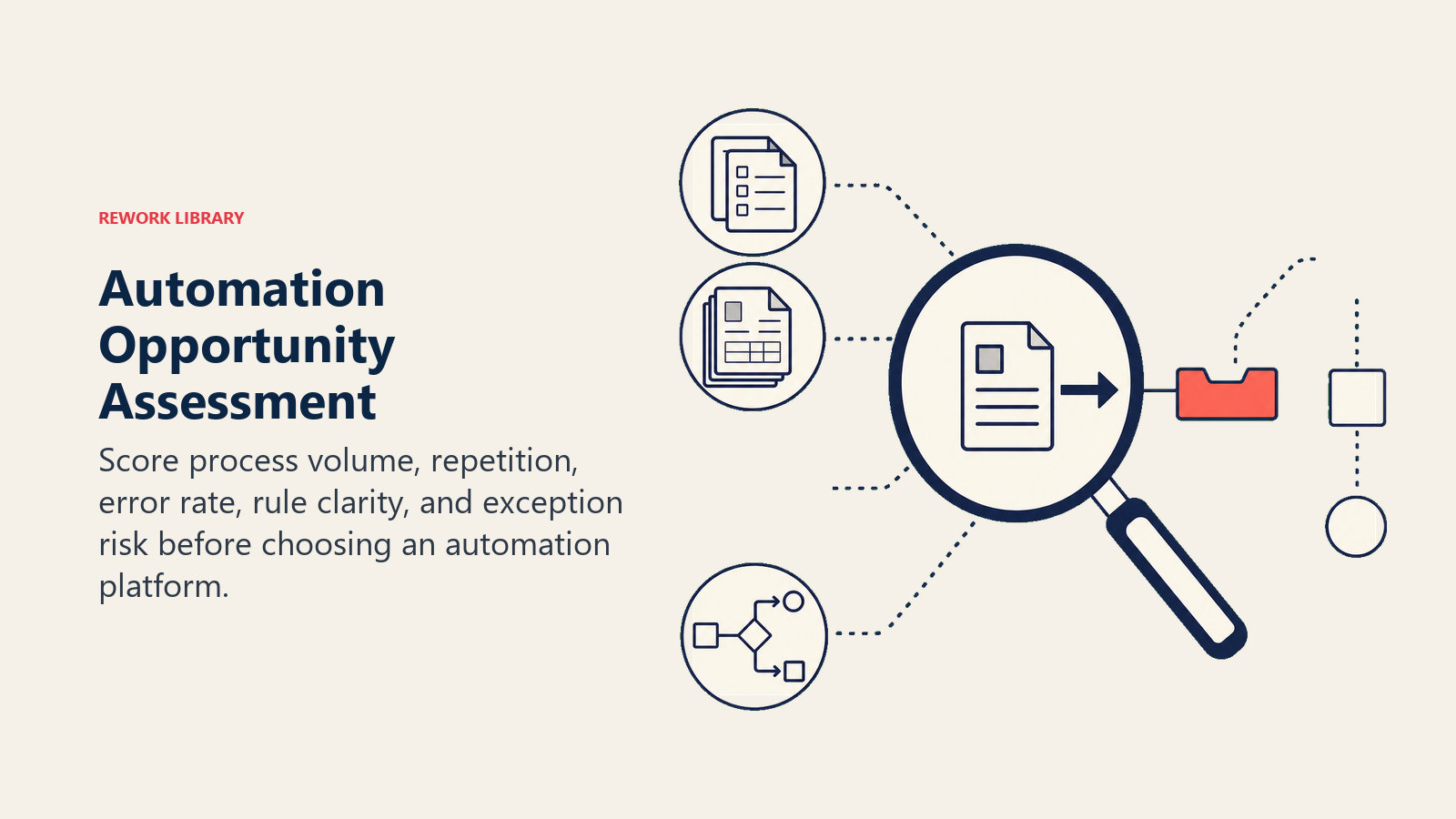
- Automation Opportunity Assessment Template by Zapier - A structured worksheet for evaluating which processes are best candidates for automation based on volume, frequency, and error rate.
- Automation Governance Checklist by Gartner - A framework for maintaining oversight, auditability, and control over automated processes as your bot fleet grows.
- AI Workflow Automation Overview via Rework - A practical guide to choosing between Zapier, Make, n8n, and Power Automate based on your team's technical capacity, budget, and the complexity of the workflows you need to build.
Case Studies & Real-World Examples
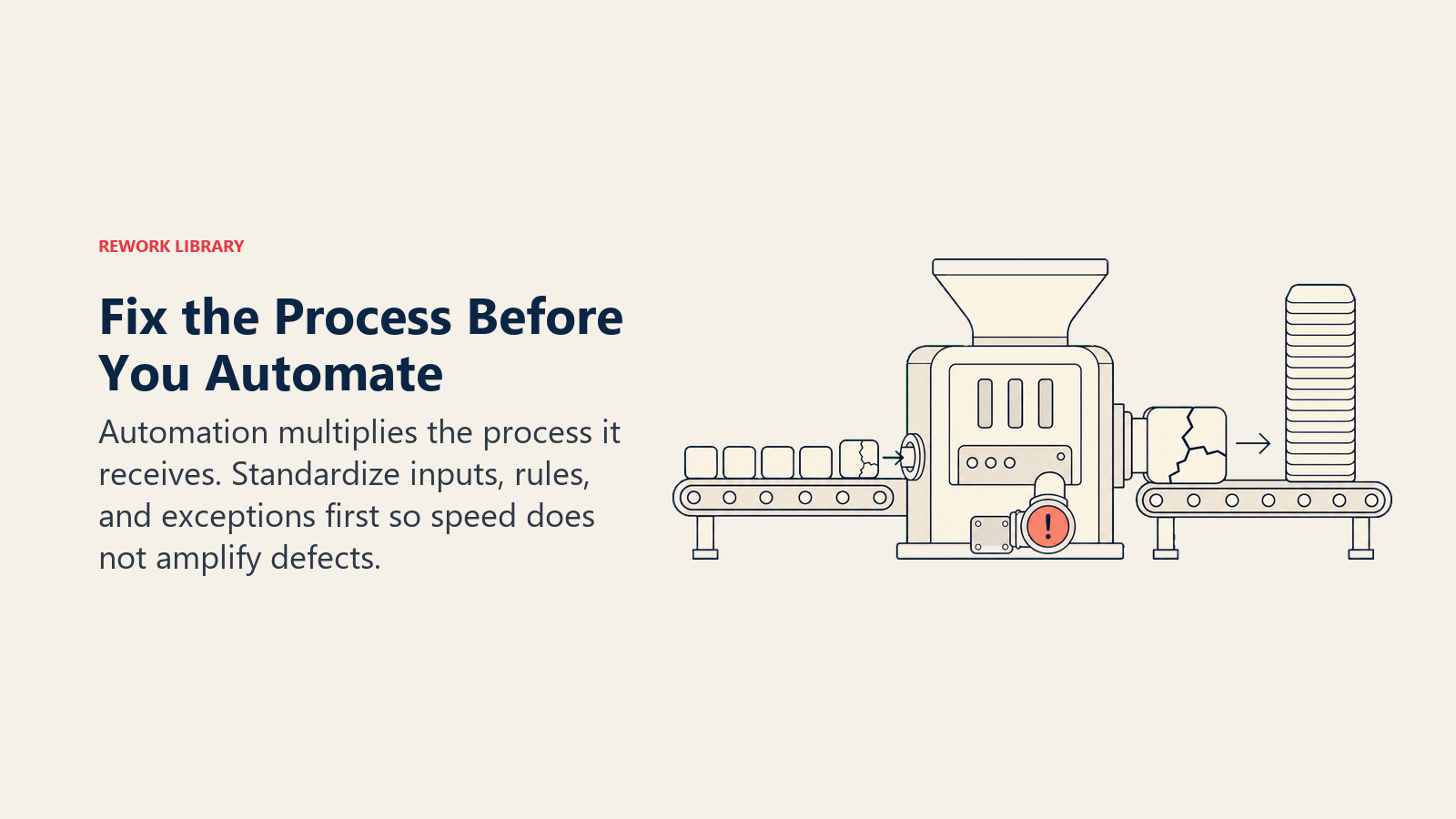
The gap between automation projects that deliver ROI and those that don't usually comes down to one question asked before tool selection: is the underlying process actually well-defined? Automating a broken process just produces broken results faster. These cases show what successful automation decisions looked like in practice.
Capital One with RPA + AI - Capital One deployed intelligent document processing to automate the review of credit applications, extracting data from unstructured documents (pay stubs, bank statements, tax returns) and pre-populating underwriting fields. The automation reduced underwriter time per application by 60% and improved consistency in data extraction. The lesson for executives: AI-enabled automation has a steeper implementation curve than rule-based RPA, but it's the only approach that works for unstructured input - and financial services is full of unstructured input. Source
A cautionary case: Co-op Group (UK) ERP failure - The Co-op Group launched an ERP automation project in the mid-2010s to consolidate its retail, funeral, legal, and food businesses onto a single system. The project ran significantly over budget and behind schedule because the automation scope was defined before the business processes were rationalized. Different divisions had different definitions of the same data fields (e.g., "customer"), and automation amplified inconsistency rather than resolving it. The program ultimately cost over £100 million more than planned. The case is a clean example of why the McKinsey "smarter way to automate" framework - fix the process first - is not optional. Source
n8n at a European fintech - A fintech startup used n8n's open-source automation platform to build a compliance reporting workflow that pulled transaction data from their core banking system, ran it through a rules engine, generated formatted reports, and emailed them to regulators on a scheduled basis - replacing a process that previously required a compliance analyst's full Friday afternoon every week. The self-hosted deployment cost under $200/month compared to a comparable iPaaS license that would have cost $3,000+. This case shows why open-source automation tools have become a serious consideration for cost-conscious companies with technical operations teams. Source
Communities & Newsletters
- Zapier Community - An active forum for Zapier users sharing workflows, troubleshooting integrations, and exploring new automation ideas.
- No Code Founders - A community of entrepreneurs and operators building products and automating businesses without writing code.
- Automation.com Community - Industry news, webinars, and peer discussions for automation professionals across RPA, BPM, and AI.
Rework Resources
- AI Workflow Automation Overview - A practical guide to choosing and implementing workflow automation tools for business operations.
- AI Tools for Business Operations - How AI-powered tools are changing day-to-day operations across finance, HR, marketing, and customer success.
Contributing
Know a great resource that belongs on this list? Let us know.
Links verified. Distinguishes no-code tools for business users from enterprise RPA for IT-led deployments.