Awesome Competitive Analysis
Turn this article into takeaways for your work.


Each assistant summarizes the article only for you and suggests best practices for your work.
A curated list of the best resources about competitive analysis and market intelligence for CEOs, CMOs, strategy directors, and product leaders.
Inspired by awesome lists. Maintained by Rework.
Most companies do competitive analysis wrong. They track competitor websites, read press releases, and build a slide deck once a year. Real competitive intelligence is continuous, primary-research-driven, and directly connected to sales and product decisions. The resources below cover the full spectrum, from foundational frameworks to the tools that make competitive intelligence a repeatable function.
Contents
- Articles
- Books
- Videos & Talks
- Tools & Software
- Templates & Frameworks
- Case Studies & Real-World Examples
- Communities & Newsletters
- Rework Resources
Articles
This reading path connects industry structure, win-loss evidence, positioning, public data, and sales-ready competitive enablement.
- Porter's Five Forces: A Framework for Industry Analysis by Michael Porter, Harvard Business Review - The original paper that gave us the Five Forces framework for analyzing industry dynamics. (classic)
- Competitive Analysis Using Public Data by McKinsey - Using SEC filings, earnings calls, and public data to build competitive models.
- Positioning Against Competitors by April Dunford - How positioning strategy drives competitive differentiation in sales conversations.
- The Porter's Five Forces Deep Dive by Mindtools - A thorough, practical explanation of applying Five Forces to real industry analysis.
- Competitive Moats: What They Are and How to Build One by Harvard Business Review - Identifying the sustainable advantages that make you hard to compete with.
- Competitive Intelligence vs. Competitive Enablement by Kompyte - Understanding the difference between gathering intel and activating it across teams.
Books
- Competitive Strategy by Michael Porter - The foundational text on competitive positioning, industry forces, and strategic differentiation. (classic)
- Obviously Awesome by April Dunford - A 10-step positioning process that makes competitive differentiation concrete and actionable.
- The Innovator's Dilemma by Clayton Christensen - The essential read on how incumbents get disrupted and how to see it coming. (classic)
- Competing Against Luck by Clayton Christensen - Jobs-to-be-Done theory applied to understanding what your competitors are really up against.
- Blue Ocean Strategy by Kim & Mauborgne - How to move beyond competing in crowded markets by creating new demand.
Videos & Talks
- Michael Porter on Competitive Strategy - Porter explains his Five Forces framework and what competitive advantage really means.
- April Dunford on Product Positioning - A practical walkthrough of the 10-step competitive positioning process from Obviously Awesome.
- How to Build a CI Function - A practitioner guide to building a competitive intelligence team and process.
- Win/Loss Analysis Deep Dive by Clozd - How to design and run a win/loss interview program that surfaces real competitive insight.
- Clayton Christensen on Disruption Theory - The inventor of disruption theory explains how incumbents can protect themselves.
Tools & Software
- Crayon - Competitive intelligence platform that monitors competitors across 100+ data sources automatically. (paid)
- Klue - Turns competitive intel into sales-ready battlecards and playbooks distributed to your teams. (paid)
- Kompyte - Automated competitive tracking with AI-generated summaries and CRM integrations. (paid)
- SEMrush - All-in-one digital marketing tool with strong competitive SEO and advertising intelligence. (freemium)
- SimilarWeb - Web traffic and engagement analytics to benchmark your digital presence against competitors. (freemium)
- G2 - Software review platform with category grids and buyer intent data useful for competitive positioning. (freemium)
- SpyFu - Reveals competitors' paid and organic keywords, ad budgets, and search strategy. (paid)
- Alpha Sense - Enterprise market intelligence platform with AI search across earnings calls, filings, and news. (paid)
Templates & Frameworks
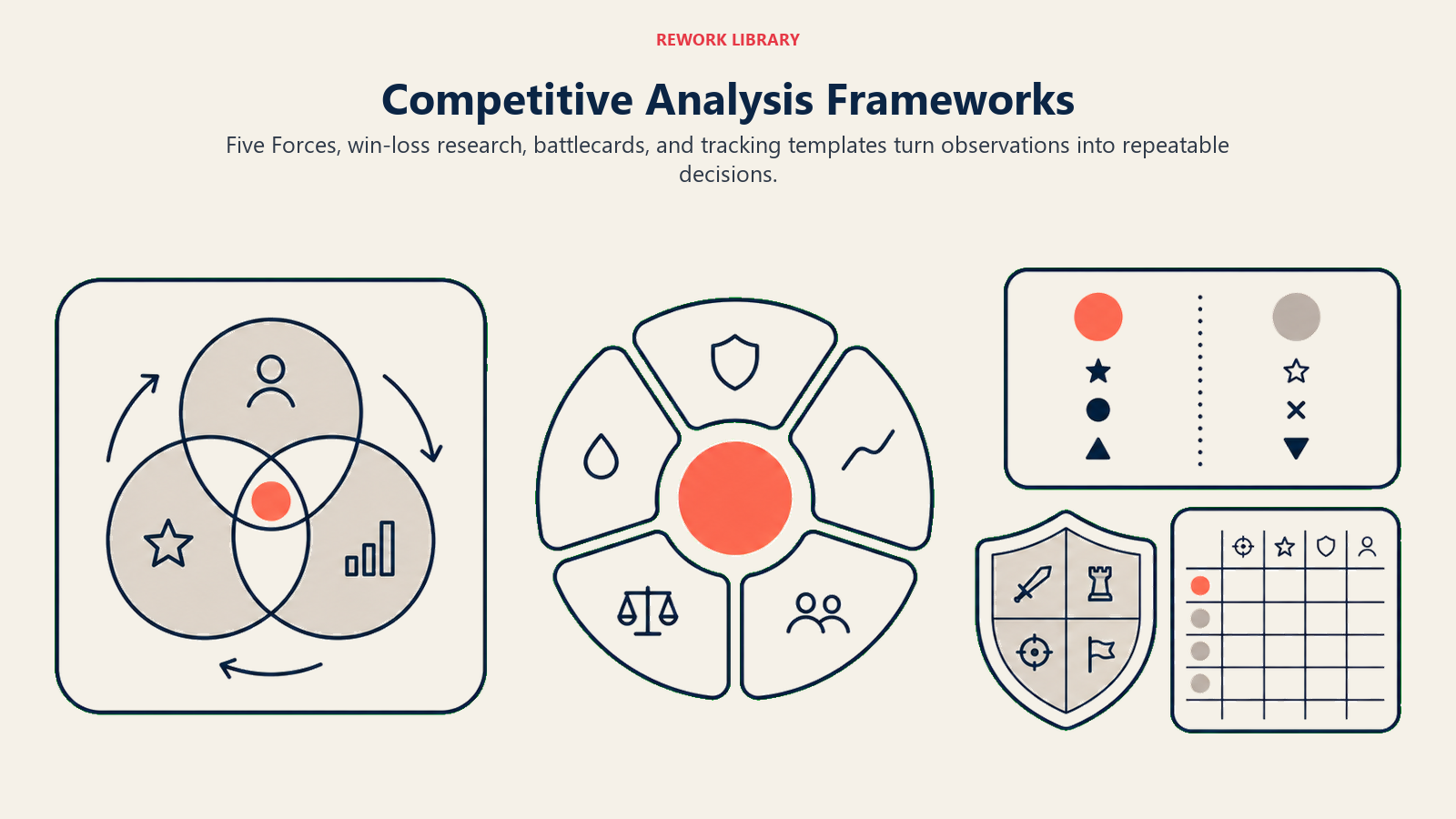
These templates turn scattered observations into a repeatable system for forces analysis, interviews, competitor tracking, and sales responses.
- Porter's Five Forces Worksheet by Miro - A visual, collaborative template for running a Five Forces analysis with your team.
- Growth Strategy Frameworks by Rework - How leading companies build and sustain competitive advantage at scale, with frameworks you can apply immediately.
Case Studies & Real-World Examples
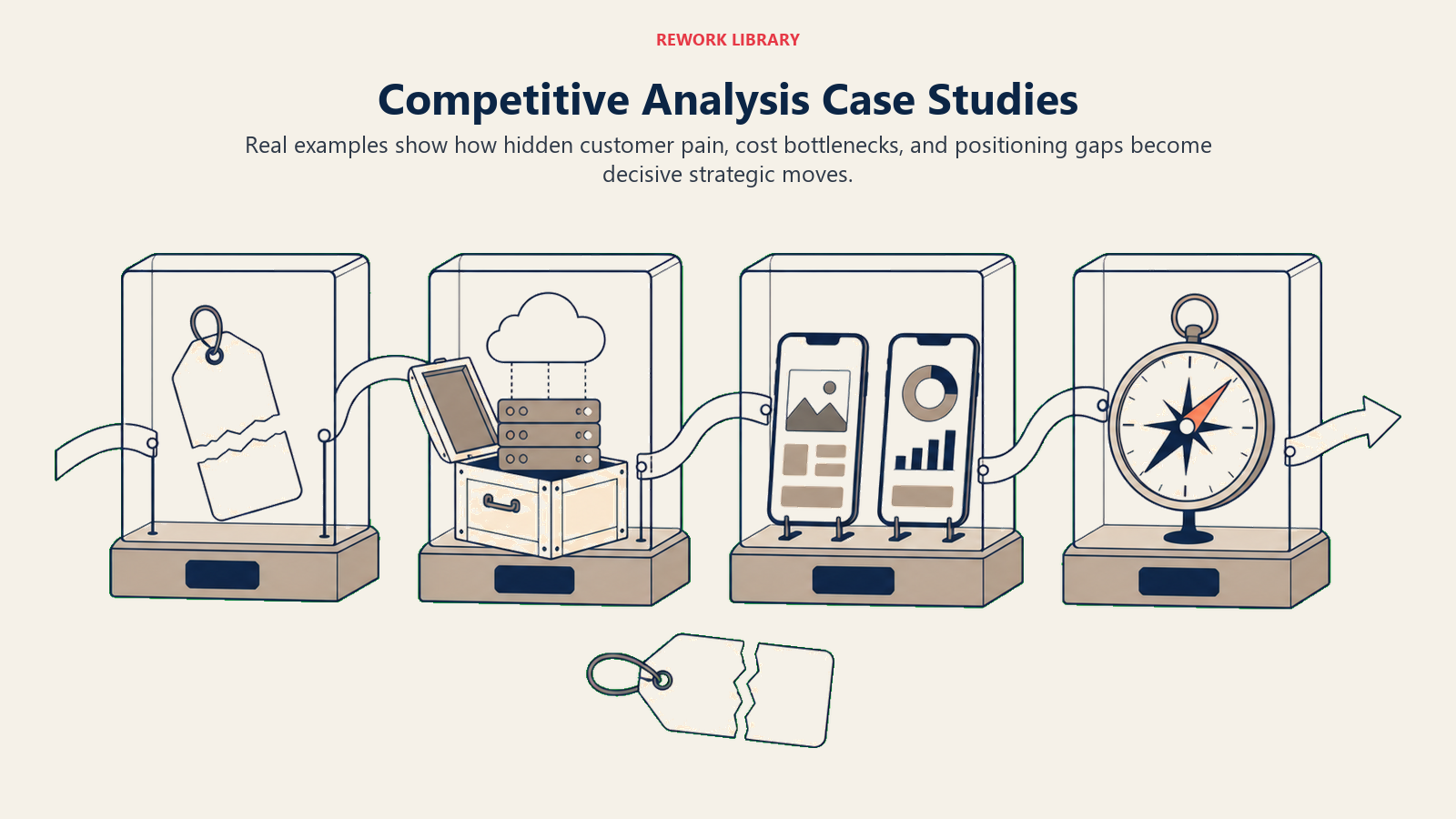
The examples below show how customer pain, cost bottlenecks, product gaps, and positioning insights become strategic moves.
- Netflix vs. Blockbuster - Blockbuster had more revenue, more locations, and more brand recognition than Netflix in 2004. But Netflix's competitive analysis identified Blockbuster's real weakness: the late fee model created deep customer resentment that Blockbuster's financials didn't show. Netflix built its entire value proposition around eliminating that pain. When Netflix made the insight actionable, Blockbuster filed for bankruptcy in 2010 while Netflix had 20 million subscribers. This is the canonical example of competitive analysis surfacing a structural vulnerability invisible to the incumbent. Source
- Dollar General - Dollar General's annual competitive analysis process tracks not just direct competitors like Dollar Tree, but the relative price of a 40-item basket of goods at Walmart, grocery stores, and dollar stores in every major market. This granular competitive pricing intelligence, updated quarterly, guides their pricing decisions in a way that protects their core customer (households earning under $40,000/year) from trading up to competitors. Dollar General's disciplined CI has supported 31 consecutive years of same-store sales growth. Source
- Notion - Notion's competitive repositioning against Microsoft Word and Google Docs was informed by deep win/loss analysis from their sales conversations. They discovered that buyers didn't actually want a better document editor, they wanted a system for organizing their team's knowledge. That insight, surfaced through structured competitive interviews, led Notion to reposition from "collaborative docs" to "connected workspace," unlocking the enterprise segment and growing to a $10 billion valuation. Source
Communities & Newsletters
- Competitive Intelligence Alliance - The Strategic and Competitive Intelligence Professionals (SCIP) network, with certification programs and events.
- Crayon's State of Competitive Intelligence Report - Annual benchmark report on CI practices, team structures, and tool adoption.
- April Dunford's Newsletter - Regular insights on positioning, competitive differentiation, and product marketing strategy.
Rework Resources
Explore more competitive strategy content on the Rework blog:
- A/B Testing Framework - Using experimentation to validate competitive positioning and conversion improvements.
Contributing
Know a great competitive analysis resource that should be on this list? Let us know.