Awesome Remote Work
Turn this article into takeaways for your work.


Each assistant summarizes the article only for you and suggests best practices for your work.
This is a curated set of business resources for remote and hybrid work: the best articles, books, videos, tools, templates, case studies, and communities for leaders running distributed teams. Each entry is hand-picked for operators, not theorists, so you can skip the noise and go straight to the references that help you build an intentional remote culture. It sits alongside our other curated business resource lists on leadership, team management, and productivity.
A curated list of the best resources about remote work and hybrid team management for business leaders, operations directors, and managers running distributed teams.
Inspired by awesome lists. Maintained by Rework.
Remote and hybrid work stopped being experimental around 2020 and became the default operating model for a large portion of the global workforce. But most organizations are still improvising. This list covers the resources that help leaders build intentional remote cultures - not just replicate office habits on video calls.
Contents
- Articles
- Books
- Videos & Talks
- Tools & Software
- Templates & Frameworks
- Case Studies & Real-World Examples
- Communities & Newsletters
- Rework Resources
Articles
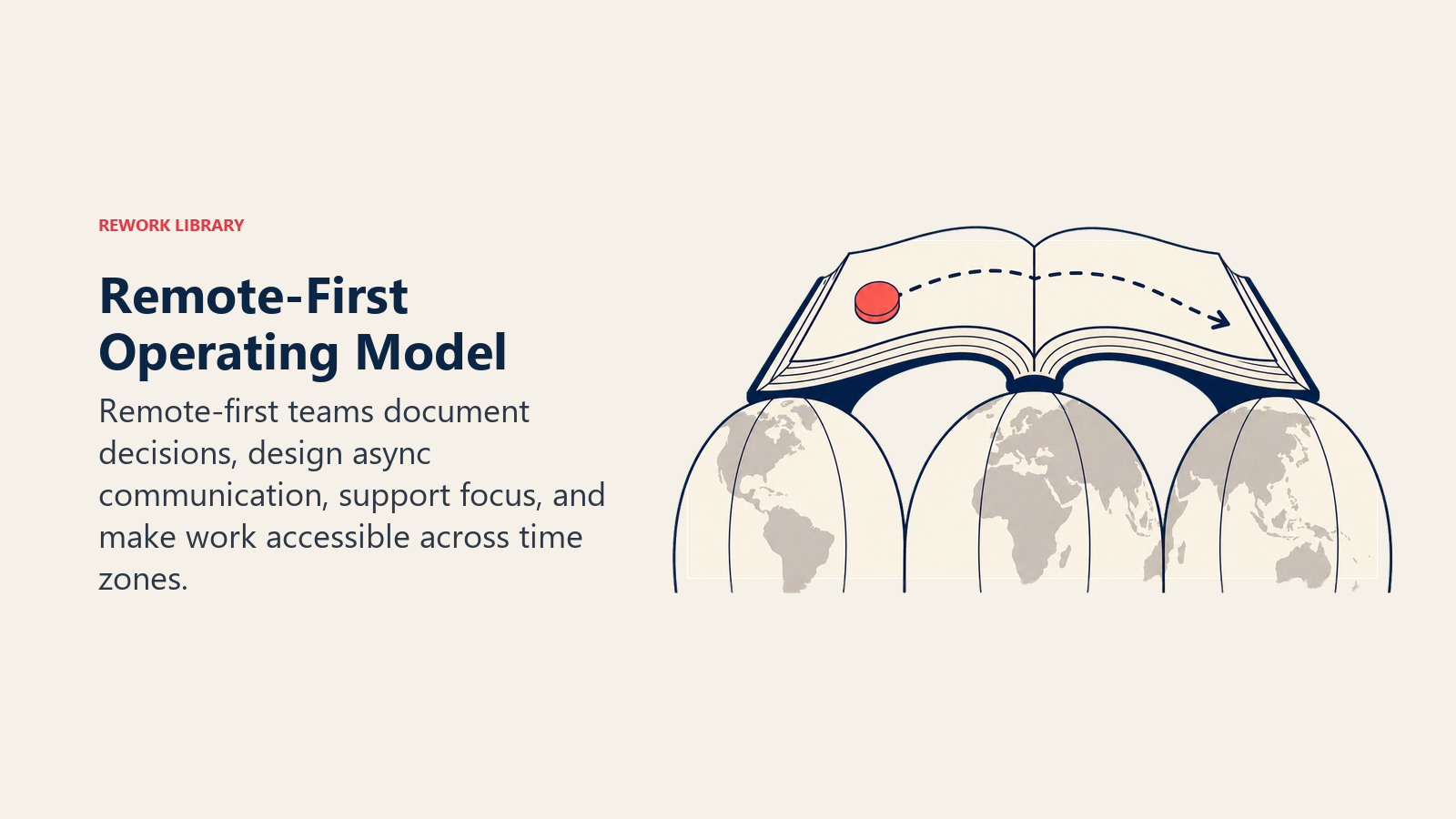
Remote-first operating models depend on documented decisions, deliberate async communication, focused work, and equal access across time zones.
- GitLab's Complete Guide to Remote Work - The most comprehensive open-source handbook for fully remote organizations, written by a company with 2,000+ remote employees.
- The Basecamp Guide to Internal Communication - Jason Fried and DHH's principles for async-first communication that reduces meeting overload.
- Buffer State of Remote Work 2025 - Annual survey of remote workers covering biggest challenges, benefits, and work setup preferences.
- Owl Labs State of Hybrid Work Report - Data-driven annual report on how hybrid teams are structured and what makes them work.
- The Harvard Business Review Guide to Hybrid Work - HBR's research collection on the management challenges and opportunities of hybrid arrangements.
- Nicholas Bloom's Research on Hybrid Work - Stanford professor Nicholas Bloom's ongoing research on what hybrid arrangements actually do to productivity.
- Writing a Remote Team Handbook: What to Include - GitLab's living handbook, publicly available, showing what a complete remote operating guide looks like.
- Async Communication: How to Get More Done With Fewer Meetings - Basecamp's Shape Up methodology for async project management without constant status updates.
Books
- Remote: Office Not Required by Jason Fried & David Heinemeier Hansson - The foundational case for remote work, from the founders of Basecamp. Still essential reading.
- Work Together Anywhere by Lisette Sutherland & K. Janene-Nelson - A comprehensive handbook covering everything from home office setup to managing remote team culture.
- The Year Without Pants by Scott Berkun - An inside account of working at Automattic, the company behind WordPress.com, and what fully distributed work actually looks like day-to-day.
- The Long-Distance Leader by Kevin Eikenberry & Wayne Turmel - Practical leadership principles for managing people you don't see in person every day.
- Leading from Anywhere by David Burkus - A research-backed guide for managers running distributed teams across time zones and cultures.
Videos & Talks
- The Future of Remote Work - Nicholas Bloom at Stanford - Bloom presents his research on what hybrid arrangements actually do to productivity, innovation, and retention.
- Async First: How GitLab Operates Without an Office - GitLab's Head of Remote explains the specific practices that make async-first culture work at scale.
- Jason Fried on Why Work Doesn't Happen at Work - The TED Talk that made async communication a mainstream conversation in business.
- Building Remote Culture That Actually Sticks at Remote Work Summit - Practical frameworks for creating belonging and connection when your team is distributed.
- How Zapier Manages a 100% Remote Team Across 40+ Countries - Zapier's COO shares the systems and rituals that make large-scale distributed work function.
Tools & Software
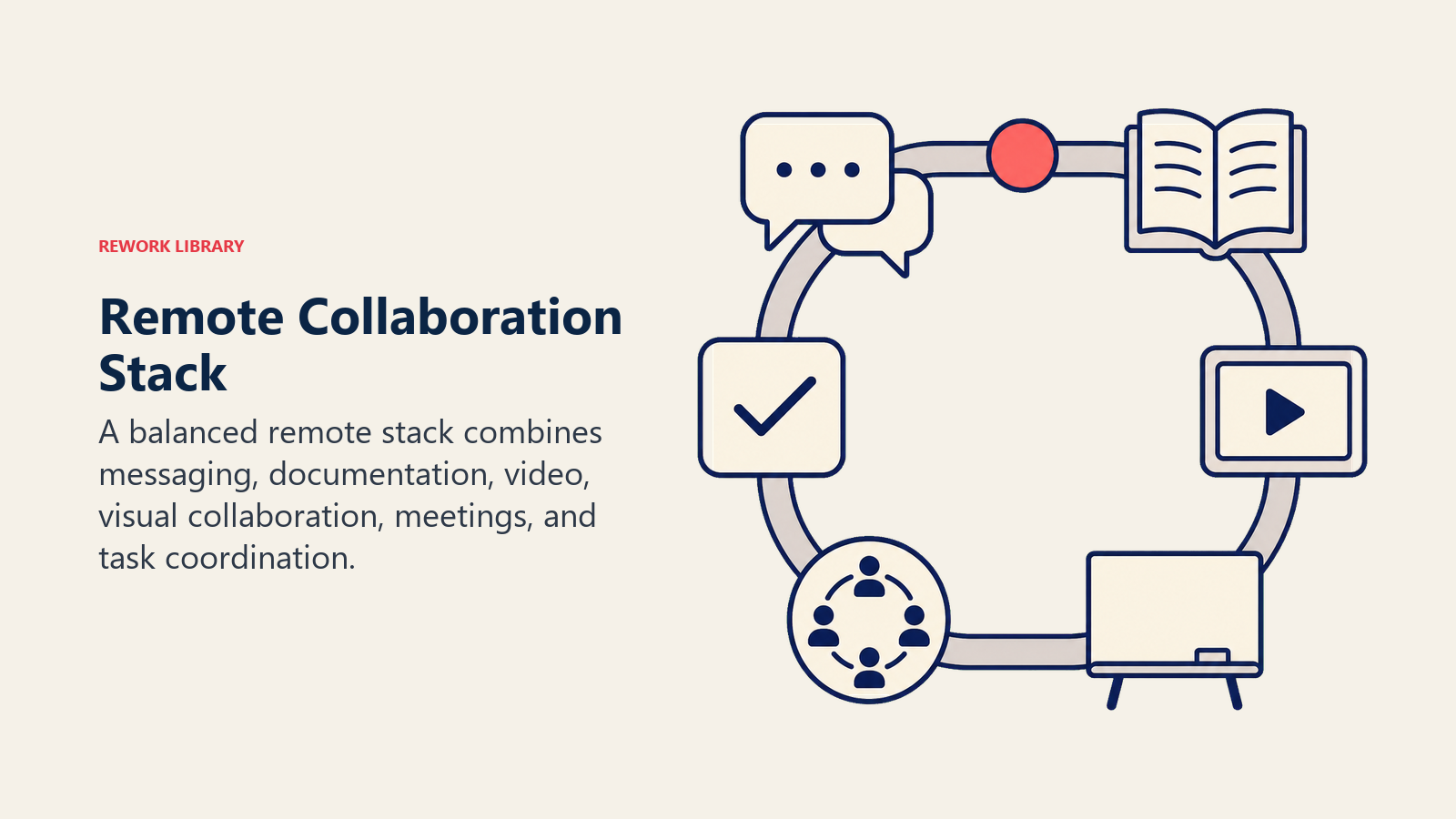
A balanced remote collaboration stack combines messaging, documentation, video, visual collaboration, meetings, and task coordination without forcing every interaction into one channel.
- Slack - The de facto async messaging platform for distributed teams, with powerful integrations and workflow automation.
- Notion - Team wiki and documentation platform for building a remote team knowledge base and onboarding hub.
- Loom - Async video messaging tool that replaces many meetings with short, watchable video updates.
- Miro - Visual collaboration whiteboard for remote brainstorming, workshops, and team retrospectives.
- Zoom - The dominant video conferencing platform for synchronous meetings and virtual all-hands sessions.
- Gather - Virtual office environment that recreates the spontaneous interaction of an office for fully remote teams.
- Range - Daily check-in and team coordination tool designed to replace synchronous standups for remote teams.
- Linear - Issue tracking and project management built for async software teams, fast and keyboard-first.
Templates & Frameworks
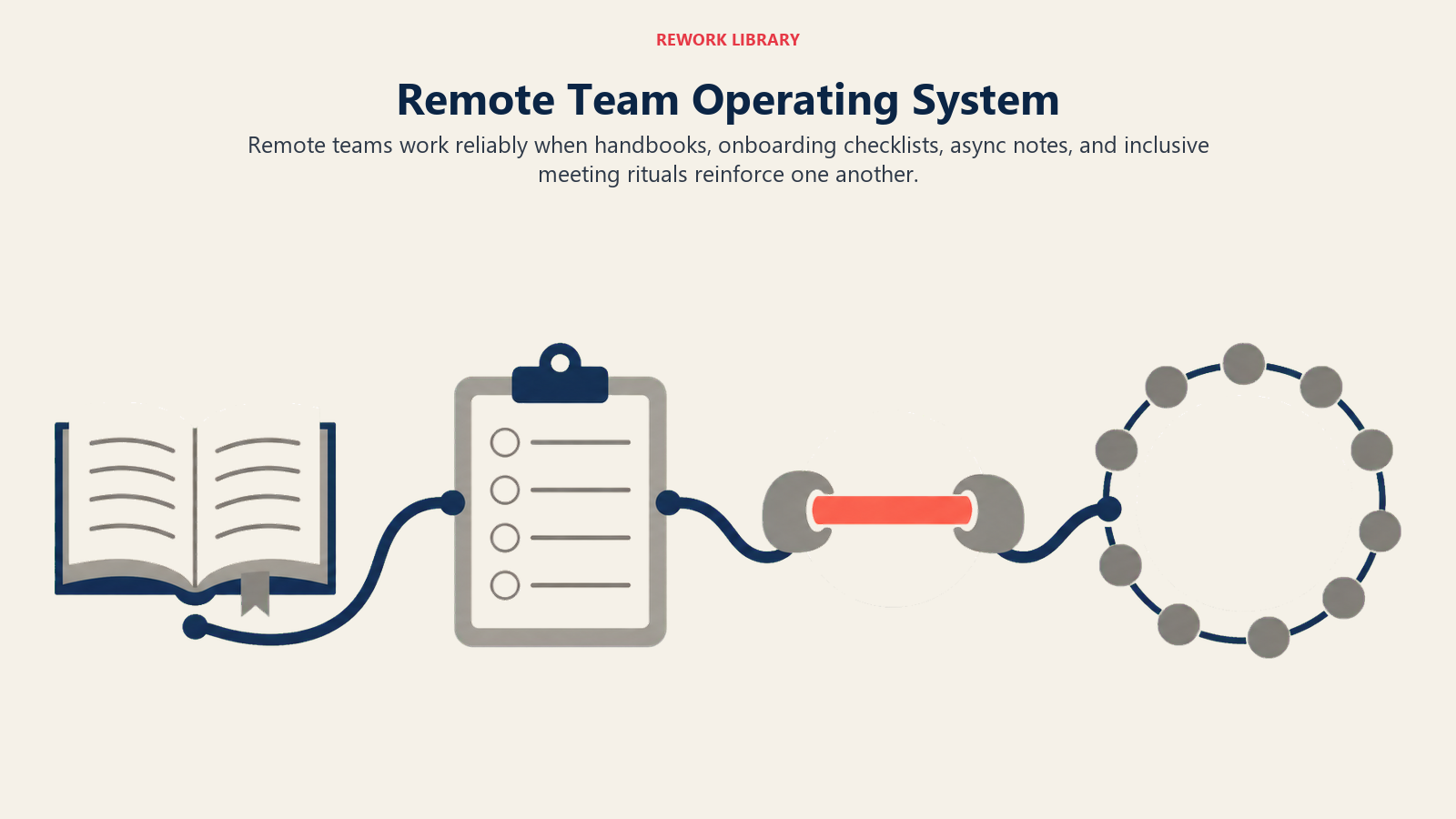
Reliable remote teams connect their handbook, onboarding process, async notes, and inclusive meeting rituals into one operating system.
- Remote Team Handbook Template by GitLab - A starting framework for building your own remote team handbook, based on GitLab's open-source model.
- Async Meeting Notes Template - Notion's structured template for capturing decisions and action items asynchronously without requiring real-time attendance.
- Virtual All-Hands Agenda Template - A structured agenda framework for running engaging all-hands meetings that don't feel like a one-way broadcast.
- Async Communication Best Practices for Remote Teams - A practical playbook for reducing meetings and improving decision-making through async communication.
Case Studies & Real-World Examples
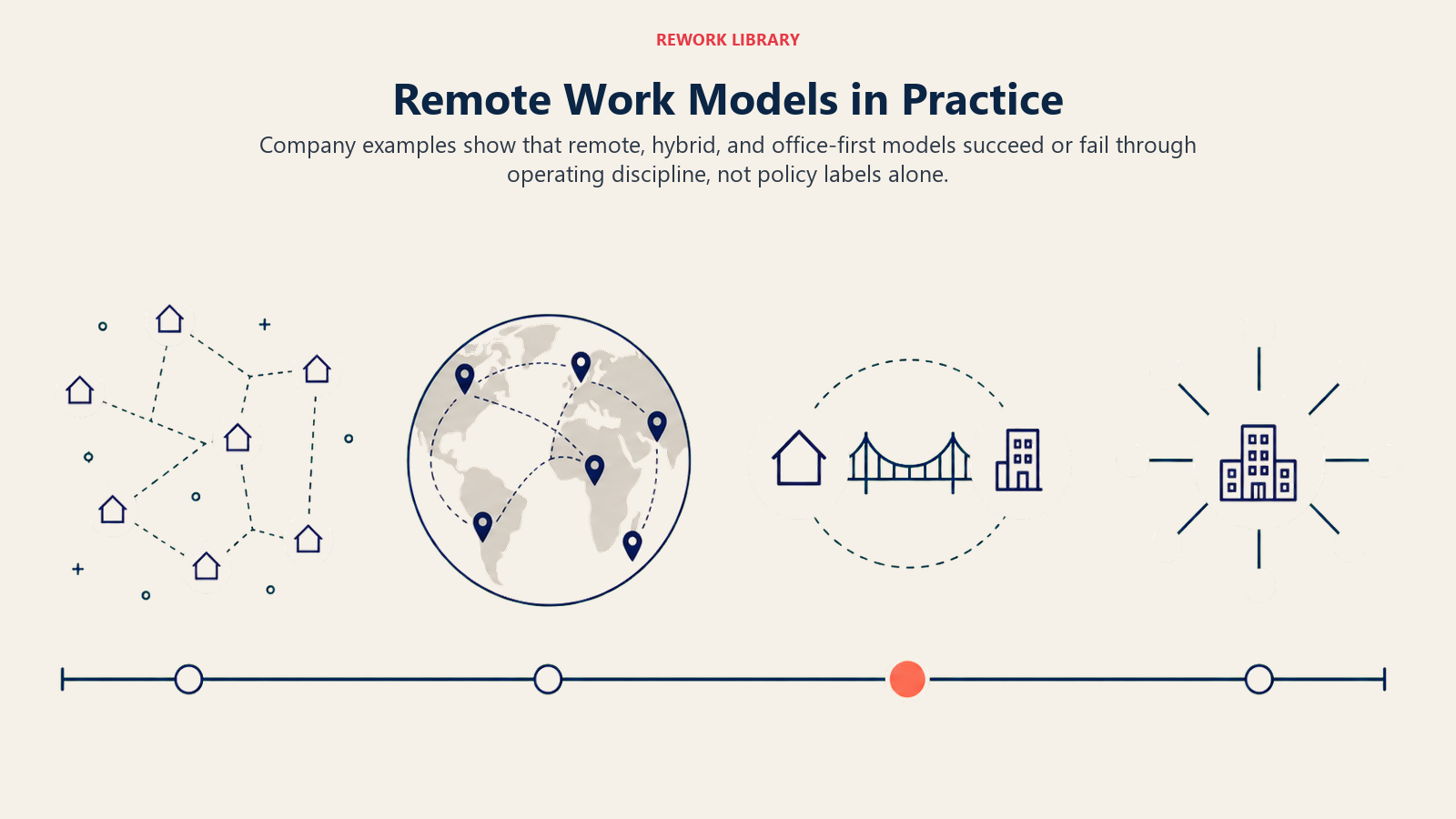
These company examples span fully remote, work-from-anywhere, hybrid, and office-first models, showing how operating discipline matters more than the policy label alone.
GitLab - Built the world's largest fully remote company with 2,000+ team members across 65 countries and zero physical offices. GitLab publishes its entire operating handbook publicly, including how it runs async standups, conducts performance reviews remotely, and onboards employees who never visit an office. The handbook has become a reference document for remote-first organizations globally. Source
Airbnb - Announced a "live and work from anywhere" policy in 2022, allowing employees to work from any country where Airbnb has an entity for up to 90 days per year with no change in compensation. The announcement resulted in a reported spike in job applications and became a highly visible case study in using remote flexibility as a talent acquisition and retention lever. Source
Automattic - The company behind WordPress.com and Tumblr has operated with no central office since its founding. With 2,000+ employees across 97 countries, Automattic uses a "Grand Meetup" once a year for the full company and small team retreats quarterly - treating in-person time as an investment in relationships rather than a daily default. Source
Communities & Newsletters
- Remote-how Academy - Training programs and a community specifically for HR leaders and managers building remote-first organizations.
- We Work Remotely - One of the largest remote job boards, with a community forum for practitioners building remote teams.
- Distribute Podcast - Conversations with leaders from fully distributed companies about what works, what fails, and what they'd do differently.
Rework Resources
- Remote Work Productivity: What Actually Works - Our evidence-based guide to maintaining productivity when your team is distributed across cities and time zones.
More Curated Business Resource Lists
- Awesome Team Management - The best resources for leading teams, distributed or in-office.
- Awesome Leadership - Hand-picked leadership books, articles, and frameworks for managers and executives.
- Awesome Productivity Tools - Curated tools and systems for getting more done with less friction.
- Awesome Employee Engagement - Resources for keeping remote and hybrid teams connected and motivated.
Remote Work Resources FAQ
What are the best business resources for remote work?
The most useful resources combine real operating playbooks with research. GitLab's all-remote handbook and Basecamp's communication guide cover practice; Nicholas Bloom's Stanford research and the Buffer State of Remote Work report cover evidence. The curated lists, books, tools, and case studies on this page bring those together for leaders building distributed teams.
Which tools do distributed teams rely on most?
Async messaging (Slack), team wikis (Notion), async video (Loom), visual collaboration (Miro), and video meetings (Zoom) form the core stack. The goal is to default to async and reserve synchronous time for the conversations that genuinely need it.
What books should a remote team leader read first?
Start with "Remote: Office Not Required" by Jason Fried and David Heinemeier Hansson for the foundational case, then "Leading from Anywhere" by David Burkus and "The Long-Distance Leader" for practical management of people you don't see in person.
Where can I find proof that remote and hybrid work performs?
Stanford professor Nicholas Bloom's large-scale studies found hybrid schedules produce equal or better productivity than full-time office while cutting attrition by roughly 35%. The case studies on this page (GitLab, Zapier, Automattic, Airbnb) show how that plays out at company scale.
Contributing
Know a great resource that belongs on this list? Let us know.
This list is maintained by the Rework team. Resources are marked where relevant for fully remote, hybrid, or distributed team contexts.
