Awesome Growth Frameworks
Turn this article into takeaways for your work.


Each assistant summarizes the article only for you and suggests best practices for your work.
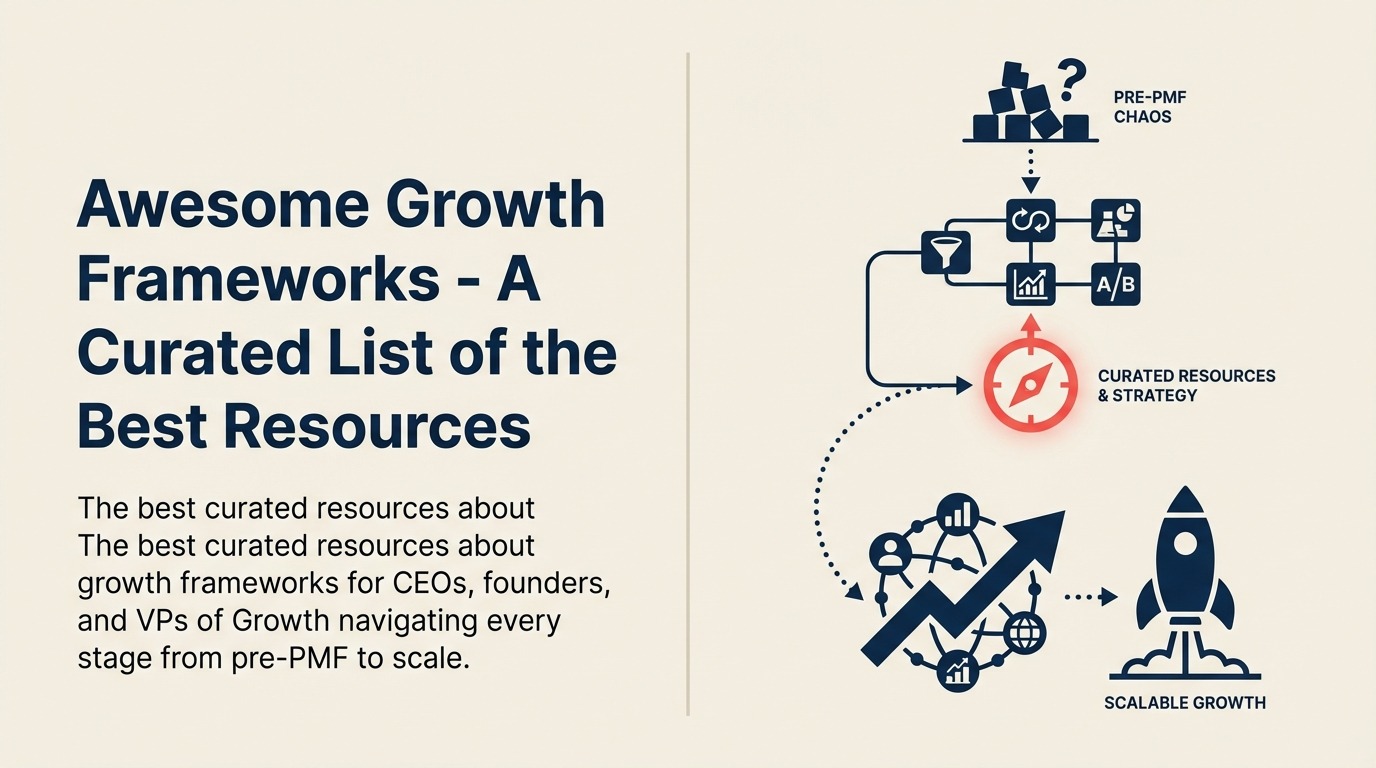
A curated list of the best resources about business growth frameworks for CEOs, founders, VPs of Growth, and product leaders.
Inspired by awesome lists. Maintained by Rework.
Growth isn't a marketing channel. It's a system. The best growth teams understand their growth model, how users acquire, activate, retain, and expand, and they run it as a tight loop rather than a leaky funnel. Whether you're pre-product-market fit, scaling a proven model, or reinventing a mature business, these resources cover the frameworks that actually move the needle.
Contents
- Articles
- Books
- Videos & Talks
- Tools & Software
- Templates & Frameworks
- Case Studies & Real-World Examples
- Communities & Newsletters
- Rework Resources
Articles
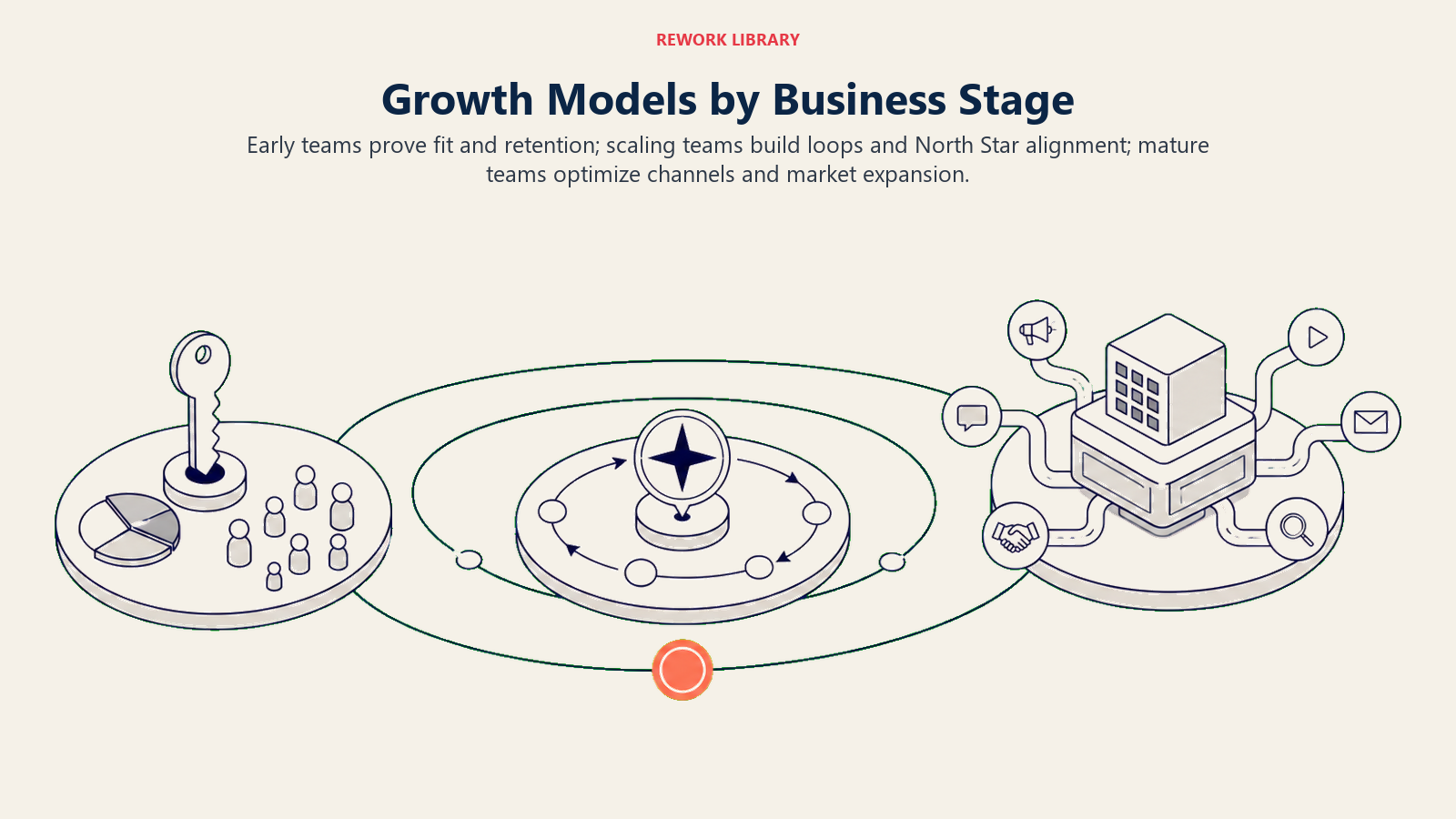
The research below follows the central growth challenge from finding product-market fit through retention, compounding loops, and enterprise scale.
Early-Stage Growth (Pre-PMF)
- The Four Fits: Market, Product, Channel, Model by Brian Balfour - Why your product, market, channel, and business model must fit together, not just product-market.
- How to Find Product-Market Fit by First Round Review - The Superhuman team's quantitative method for measuring and finding PMF.
- The Only Metric That Matters by Josh Elman - Why retention is the foundation of every growth model.
- Do Things That Don't Scale by Paul Graham - The classic YC essay on why early growth should be manual and high-touch. (classic)
Scaling Growth (Post-PMF)
- Growth Loops vs. Funnels by Reforge - Why growth loops compound over time while funnels leak, and how to build yours.
- The North Star Framework by Reforge - How to identify the single metric that captures your product's core value delivery.
- Product-Led Growth: What It Is and How It Works by ProductLed - A comprehensive explanation of PLG and when it makes sense as a go-to-market motion.
- The AARRR Metrics Framework by Dave McClure (500 Startups) - The pirate metrics model: Acquisition, Activation, Retention, Referral, Revenue. (classic)
- Brian Balfour's Essays on Growth by Brian Balfour - One of the most substantive archives of growth thinking written by a practitioner.
- Andrew Chen's Essays - Essays on network effects, growth, and the business of consumer technology.
Enterprise & Scale Growth
- Blitzscaling: Why Speed Matters by Reid Hoffman, Harvard Business Review - When and why you should prioritize speed over efficiency in growth.
Books
- Hacking Growth by Sean Ellis & Morgan Brown - The most practical guide to building a cross-functional growth team and running experiments.
- Traction by Gabriel Weinberg & Justin Mares - The 19 channels for customer acquisition tested against a bullseye framework for finding yours.
- Blitzscaling by Reid Hoffman & Chris Yeh - The case for prioritizing speed of scaling over efficiency when a market is winner-take-most.
- The Cold Start Problem by Andrew Chen - A framework for starting and scaling network-effect-driven products.
- Product-Led Growth by Wes Bush - The definitive guide to PLG: how to use your product as your primary acquisition channel.
Videos & Talks
- Growth Loops and the North Star Metric by Reforge - Reforge founders explain the growth loop model and how to apply it to your product.
- Product-Led Growth: From Theory to Practice by OpenView Ventures - A practical walkthrough of PLG implementation from the team that coined the term.
- Sean Ellis on Building a Growth Machine - The founder of GrowthHackers walks through the growth process he used at Dropbox and Eventbrite.
- Brian Balfour Reforge Growth Crash Course - 82 minutes of Reforge's core frameworks condensed into one accessible session.
- Y Combinator: How to Get Users and Grow - YC's lecture on acquisition channels and growth strategies for early-stage startups.
Tools & Software
- Amplitude - Product analytics platform for understanding user behavior and building growth models around retention.
- Mixpanel - Event-based analytics tool for tracking user journeys and optimizing activation and retention.
- Heap - Auto-capture analytics that retroactively tracks every user action without manual instrumentation.
- June - B2B SaaS analytics built specifically for tracking product-qualified leads and company-level engagement.
- GrowthBook - Open-source A/B testing and feature flagging platform for running product experiments.
- Hotjar - Heatmaps, session recordings, and surveys for understanding why users behave as they do.
- Customer.io - Behavioral messaging platform for automating activation, retention, and re-engagement campaigns.
- Segment - Customer data platform that routes user events from your product to every downstream analytics tool.
Templates & Frameworks
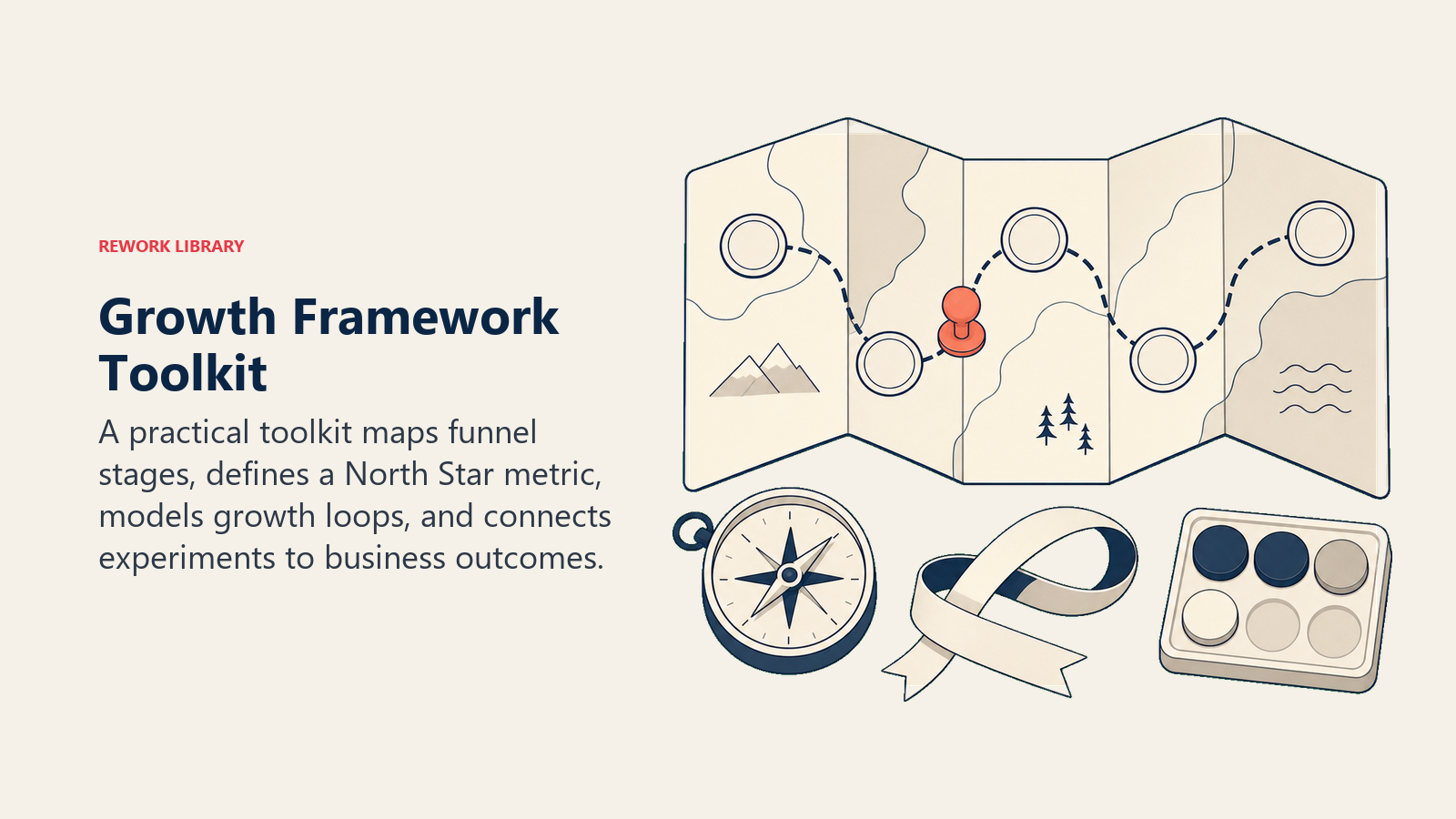
These tools turn growth theory into a working model of funnel stages, North Star inputs, experiments, and compounding loops.
- North Star Metric Worksheet by Amplitude - A guided exercise for identifying your North Star and the inputs that drive it.
- Product-Led Growth Framework by ProductLed - Templates for mapping your PLG motion, onboarding funnel, and expansion triggers.
- Growth Strategy Frameworks by Rework - A structured guide to selecting the right growth framework for your business stage and model.
Case Studies & Real-World Examples
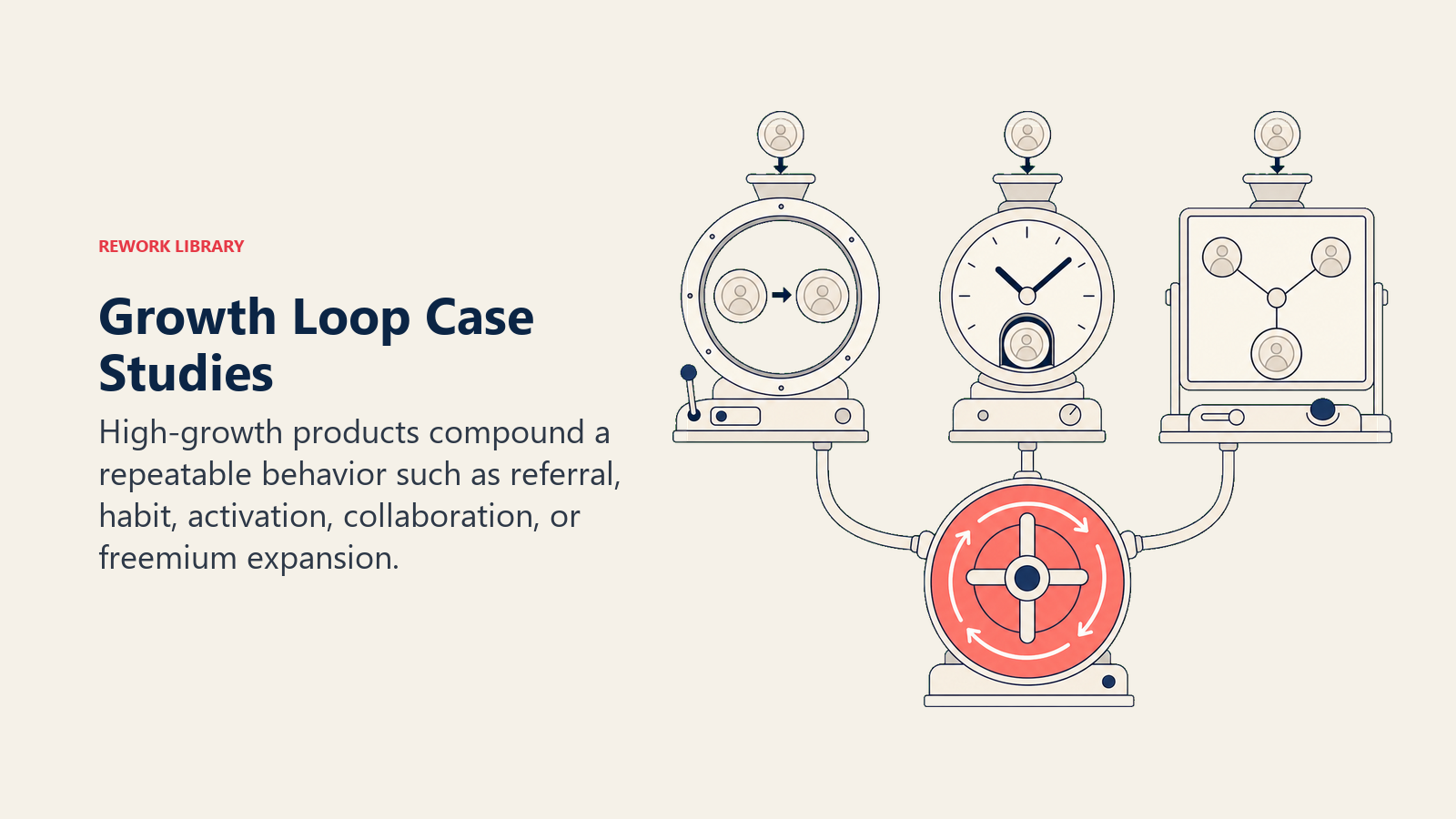
Each company below found a specific product behavior that could compound, from referrals and streaks to activation thresholds and collaboration.
- Dropbox - Dropbox's referral program is one of the most-studied growth loop examples in history. Rather than spending on paid acquisition, they offered existing users additional storage for every friend they invited. The program grew Dropbox from 100,000 to 4 million users in 15 months, a 3,900% increase, at near-zero marginal cost. Sean Ellis, who ran growth at Dropbox, later systematized the experiment-driven approach in the "growth hacking" framework that spawned an entire industry. Source
- Slack - Slack reached $1 billion in revenue faster than any enterprise software company in history, and they did it without a traditional sales team for the first three years. Their PLG framework was built on a single insight: if a team exchanges 2,000 messages, they almost never churn. Slack optimized every onboarding step around reaching that activation threshold, letting the product sell itself. The framework made "product-qualified lead" a standard concept in B2B SaaS. Source
- Airbnb - Airbnb's early growth wasn't viral or algorithmic, it was manual. Paul Graham's famous advice to "do things that don't scale" came from watching Airbnb founders fly to New York, knock on host doors, and personally photograph apartments to make listings better. That non-scalable intervention proved the hypothesis that photo quality drove bookings, which led to the scalable program of professional photography at scale. Airbnb reached 10 million nights booked before touching a growth automation framework. Source
- HubSpot - HubSpot's freemium-to-paid growth loop is one of the clearest examples of a product-led growth model in B2B. Their free CRM, with millions of users, generates a continuous stream of companies that grow into paid marketing, sales, and service hub seats. The PLG motion reduced HubSpot's customer acquisition cost by over 30% compared to their original outbound model and is the primary driver of their $2 billion+ annual revenue run rate. Source
Communities & Newsletters
- Reforge - The most rigorous growth education community, with cohort-based courses and an alumni network of senior practitioners.
- Lenny's Newsletter - Weekly deep-dives on product and growth by Lenny Rachitsky, one of the most-read voices in the space.
- GrowthHackers - Sean Ellis's community for growth practitioners, with case studies, experiments, and AMAs.
Rework Resources
Explore more growth content on the Rework blog:
- B2B SaaS Growth Model - How to build a repeatable growth model for B2B software businesses.
- ARR Forecasting - How to model and forecast annual recurring revenue across growth scenarios.
Contributing
Know a great growth framework resource that should be on this list? Let us know.